
Notes
Chapters
- A Fanatic Heart
- 27. Against the Grain
- 28. The Zemganno Brothers
- 29. Catch and Release
- 30. A Mercenary Frenzy
- 31. Le Paradou
- 32. The Sunflower and the Oleander
- 33. The Poet's Garden
- 34. Imaginary Savage
- 35. La Lutte
- 36. The Stranger
- 37. Two Roads
- 38. The Real South
- 39. Starry Night
- 40. The Isolated One
- 41. A Degenerate Child
- 42. The Garden and the Wheatfield
- 43. Illusions Fade, the Sublime Remains
- Ici Repose
The Early Years
The Dutch Years
The French Years
Chapters
Context:
BVG 70, 7/5/76: "I wish you had been there with me; it was a pleasure to see pictures again."
JLB 85, 7/3/1876 or 7/4/1876: "I rather wished that you could have been there too; it was a pleasure to see paintings again."
Context:
JLB 120, 6/12/1877: "Recently went to the Trippenhuis again to see whether those rooms, which were closed when we were there together, had been put back in order, but it will probably take another fortnight before one can go in again."
Context:
JLB 114, 5/19/1877: "The Jewish bookseller had many more beautiful things but I can't afford any more, and even though I'm hanging a few up, I'm not going to start collecting."
Context:
JLB 123, 7/27/1877: "Herewith a contribution for your collection, namely three lithographs after Bosboom and two by J. Weissenbruch, found them this morning at a Jewish bookseller's."
Context:
JLB 114, 5/19/1877: "Herewith you receive something for your portfolio, namely a lithograph after J. Maris, beneath which one might write: a poor man in the kingdom of God, and a lithograph after Mollinger. Had you seen this one before? I hadn't. From a Jewish bookseller, who gets me the Latin and Greek books I need, I had the opportunity of choosing what I wanted from a large batch, and not at all expensive, 13 for 70 cents."
Context:
BVG 95, 5/19/1877: "At a Jewish bookseller's, where I buy all the Latin and Greek books I need, I had the chance of picking prints cheaply from a large batch, 13 pictures for 70 cents."
JLB 114, 5/19/1877: "From a Jewish bookseller, who gets me the Latin and Greek books I need, I had the opportunity of choosing what I wanted from a large batch, and not at all expensive, 13 for 70 cents."
Context:
BVG 103, 7/27/1877: "[I] keep right on collecting such prints, and books too. I am making a collection of Latin and Greek themes, also that of texts that report on history, etc."
JLB 123, 7/27/1877: "Do go on collecting such prints, and books too. I'm now collecting Latin and Greek themes and all kinds of writings on history and so on."
Context:
JLB 123, 7/27/1877: "In Uncle Cor's shop I recently saw The Gospels by Bida [Alexandre Bida, 1823-1895; French artist], how beautiful it is, how wonderful it must be to be a Christian labourer like that, but it's impossible to put into words how beautiful it is, that's it again, there is much in that work that reminds one of Rembrandt."
Context:
JLB 133, 10/30/1877: "The scene reminds me of a painting by Jacquand [Claude Jacquand, 1803-1878; French artist], photographed in the cartes de visite, it's called 'The new vicar', I believe, it has the same sentiment, and also of The novice by G. Doré."

Context:
JLB 136, 12/3/1877-12/4/1877: "Recently saw at Uncle's a large drawing by Bosboom, Sacristy, also two by Miss [Maria Philippina Bilders-]van Bosse that were very beautiful, especially the one of a farmstead."
Context:
JLB 127, 8/18/1877: "Had another talk this morning with Mendes about M. Maris, and showed him that lithograph of those 3 children, and also A baptism, and he understood it very well." (Matthijs [Thijs] Maris, 1839-1917; Dutch artist.)

Context:
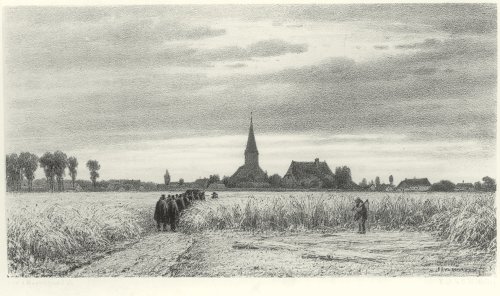
JLB 114, 5/19/1877: "1 after Jamin (which is also hanging in your room), one after M. Maris, that little boy going to school, 5 after Bosboom -- Van der Maaten, Funeral in the cornfield -- Israëls, a poor man walking on a snowy road in winter, and Van Ostade, studio."
Context:
JLB 136, 12/3/1877-12/4/1877: "[I] sent to Cor for St Nicholas a lithograph after J[acob] Maris of a girl coming from the cemetery, which one sees in the background with the gravestones and the little church. A monk sits by one of the gravestones."

Context:
JLB 114, 5/19/1877: "1 after Jamin (which is also hanging in your room), one after M. Maris, that little boy going to school, 5 after Bosboom -- Van der Maaten, Funeral in the cornfield -- Israëls, a poor man walking on a snowy road in winter, and Van Ostade, studio."

Context:
JLB 114, 5/19/1877: "Then there's Allebé, a little old woman who has collected water and coals on a winter morning with snow on the streets."

Context:
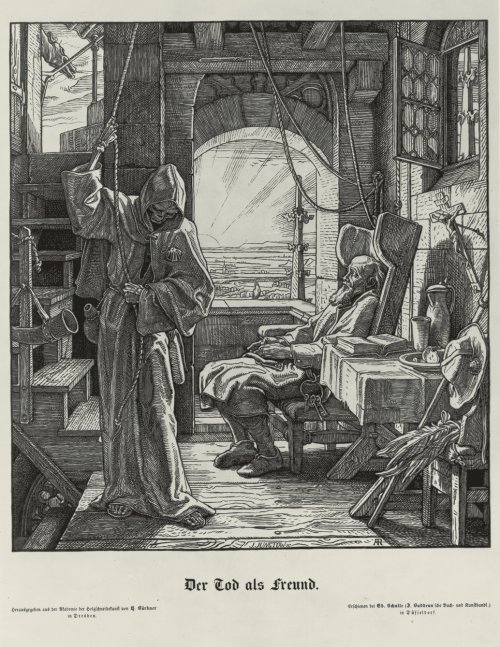
JLB 115, 5/21/1877-5/22/1877: "This morning in church I saw a little old woman, probably the foot-stove woman, who reminded me so much of that etching by Rembrandt, a woman who has been reading the Bible and has fallen asleep leaning her head on her hand."
Context:
JLB 120, 6/12/1877: "I always found that scene very moving, in London in those days one saw it in front of nearly all the print-shop windows."

Context:
JLB 142, 3/3/1878: "Did you know that Rochussen once painted the siege of Leiden?"
Context:
JLB 126, 8/5/1877: "It's especially nice if one imagines it illustrated by the etchings of Jacque."
Context:
JLB 136, 12/3/1877-12/4/1877: "While working today I had lying before me a sheet from Bargue's Cours de dessin, 1st part, No. 39, Anne of Brittany."
Context:
JLB 113, 4/30/1877: 11-23
Context:
JLB 113, 4/30/1877: "Do you have De Plancy, Légendes des artistes, with woodcuts after Rochussen?"
Context:
JLB 125, 8/3/1877: "When next you write, tell me something about the exhibition that will have opened yesterday, how much the artists would be able to find here at the dockyard that's fit to be painted."
Context:
JLB 135, 11/24/1877-11/25/1877: "That Wierda is indeed a faithful servant and, I believe, very clever, one really finds a lot of nice people in the bookselling business, C.M., Mr. [Pieter Kornelis] Braat, [Johannes Christiaan] Schröder here (Mendes gets his books from him, and I go there too sometimes), Wierda, one could also count Mr. Tersteeg among them, and that young man you met on your trip, among others, and you are one of them too, hang on to what you have, for you too are in the fight."
Context:
JLB 134, 11/19/1877: "Spent two evenings at Uncle Cor's, once to look at old books (including volumes of L'Illustration in which I found many old acquaintances, that is really an interesting magazine) …"
Context:
BVG 113, 11/19/1877: "I spent two evenings at Uncle Cor's looking over old books, including volumes of L'Illustration, in which I found many old friends (what an interesting magazine it is!)."
JLB 134, 11/19/1877: "Spent two evenings at Uncle Cor's, once to look at old books (including volumes of L'Illustration in which I found many old acquaintances, that is really an interesting magazine …"
Context:
JLB 120, 6/12/1877: "Heard the Rev. Laurillard on Sunday morning in the early sermon on 'Jesus went through the cornfields.'"
Context:
BVG 101, 6/12/1877: "Sunday morning I heard the Reverend Mr. Laurillard at early morning service; he spoke about, 'Jesus walked in the newly sown field.'"
JLB 120, 6/12/1877: "Heard the Rev. Laurillard on Sunday morning in the early sermon on 'Jesus went through the cornfields'."
Context:
JLB 120, 6/12/1877: "He made a deep impression on me …"
Context:
JLB 121, 7/9/1877: "I go to church a lot, I've heard the Rev. Laurillard three times, you would like him too, because he paints, as it were, and his work is at once lofty and noble art."
Context:
BVG 101a, 7/9/1877: "I often go to church; I have heard the Reverend Mr. Laurillard three times; you would like him too, for it is as if he paints, and his work is at the same time high and noble art."
JLB 121, 7/9/1877: "I go to church a lot, I've heard the Rev. Laurillard three times, you would like him too, because he paints, as it were, and his work is at once lofty and noble art."
Every evening came the moon and whispered in my ear,
Telling of the quiet night and what its eye
Had lit on from its watch-post in the sky.
It who knows centuries -- through ages did it roam,
Casting, high above the Flood and crest of foam,
On the floating ark a soft silver glow,
Just as it now lights my lonely window
Then, too, when the folk of Israel knelt down
To weep by the waters of Babylon
It illumined with sad twinkling down below
The unstrung harp, hanging on the willow.
Context:
JLB 121, 7/9/1877: He has the feeling of an artist in the true sense of the word, as someone like Andersen …"
Context:
JLB 131, 9/18/1877: "He treated this subject in the spirit of Michelet or [Friedrich] Rückert, or as many have also painted it, including [Paul Alexandre] Protais, Souvenirs of the homeland."
Context:
BVG 101a, 7/9/1877: " He has the feelings of an artist in the true sense of the word, for instance, like [Hans Christian] Andersen, when he said …"
JLB 121, 7/9/1877: " He has the feeling of an artist in the true sense of the word, as someone like Andersen had when he says, for example …"
Context:
BVG 94, 4/30/1877: "Knowledge of and love for the work and the life of such men as Jules Breton, Millet, Jacque, Rembrandt, Bosboom and so many others may become a source of new thoughts."
JLB 113, 4/30/1877: "Knowing and loving the work and life of such men as Jules Breton, Millet and Jacque, Rembrandt, Bosboom and so many others, can also be a source of ideas."
Context:
BVG 101, 6/12/1877: "But I repeat, brother, when I think of you, my heart goes out to you. I think it is a very fine plan -- my past comes to life again when I think of your future."
JLB 120, 6/12/1877: "But I repeat, brother, my heart spills over for you, I think the plan is very good -- my past comes completely alive again now that I'm thinking of your future."
Context:
BVG 347, 12/18/1883: "Something better than the days of the Rijswijk mill -- namely the same thing but for good and all -- two poor brother artists --bound up in one and the same feeling, for one and the same nature and art -- will it ever come to that?"
JLB 414, 12/16/1883: "Something better than the time of the Rijswijk mill -- namely the same once and for all -- two poor brothers, artists -- bound up in the same feeling for the same nature and art -- will it ever come to that?"
Context:
BVG 347, 12/18/1883: "And I see those same brothers in earlier years -- when you had just entered the art world, had just begun to read, etc., etc. -- near the Rijswijk mill, or, for example, on a winter outing to Chaam [a town near Zundert] across the snowy heath early one morning! Feeling, thinking and believing the same to such an extent -- that I ask myself, can those be the same two? The question is, what will the outcome be -- will they separate forever, or will they take the same path once and for all?"
JLB 414, 12/16/1883: "And I see those same two brothers in earlier years -- when you were just coming into the world of painting, just beginning to read &c. &c. -- by the mill in Rijswijk. Or, for example, on an outing to Chaam [a town near Zundert] in the winter, across the snow-covered heath, early in the morning! Feeling so much the same, thinking and believing so much the same -- that I ask myself -- are they the same people??? Question -- what will happen now? -- will they part company forever, or will they find the same path once and for all?" (Emphasis in original.)
Context:
BVG 94, 4/30/1877: "What a resemblance there is between the work and life of Father and that of these men; I value Father's higher still."
JLB 113, 4/30/1877: "What a similarity there is between the work and life of Pa and that of such men; that of Pa I rate even higher."
Context:
BVG 95, 5/19/1877: " When I see a painting by Ruysdael, Van Goyen, Bosboom, or so many others, I am reminded again and again of the words, "As sorrowful, yet always rejoicing" -- of wee-moed."
JLB 114, 5/19/1877: " Whenever I look at a painting by Ruisdael, Van Goyen, Bosboom and so many others, I always think of the words 'as sorrowful, yet always rejoicing'."
Context:
JLB 125, 8/3/1877: "So you were at Mauve's and had a good time there, did you draw anything while you were there?" (emphasis in original).
Context:
BVG 101a, 7/9/1877: "And also, when Israel with overflowing eyes …"
JLB 121, 7/9/1877: "Then, too, when the folk of Israel knelt down to weep …"
Context:
BVG 101a, 7/9/1877: "The moon is still shining, and the sun and the evening star, which is a good thing -- and they also often speak of the Love of God, and make one think of the words: Lo, I am with you always, even unto the end of the world."
JLB 121, 7/9/1877: "The moon still shines now, and the sun and the evening star, which is fortunate, and they often speak of God's Love and call to mind the words, lo, I am with you always, even unto the end of the world."
Context:
BVG R43, March, 1884: "… that art is something which, although produced by human hands, is not created by these hands alone, but something which wells up from a deeper source in our souls; and that with regard to adroitness and technical skill in art I see something that reminds me of what in religion may be called self-righteousness."
JLB 439, 3/18/1884: "That art is something which, although produced by human hands, is not wrought by the hands alone but wells up from a deeper source in our soul, and that I find something in dexterity and technical knowledge about art that reminds me of what, in religion, they'd call self-righteousness."
Context:
BVG 111, 10/21/1877: "In all of them there is something of the spirit of the resurrection and the life -- that lives though it seems dead, for it is not dead, but sleepeth."
JLB 332, 3/21/1883: "In all of that combined there's something of the spirit which is that of the Resurrection and the Life, which shall live though it seems dead, for it is not dead, but it sleepeth" (emphasis in original).
Context:
BVG 114, 11/25/1877: "How noble and beautiful it is -- with a peculiar, weird beauty ...."
JLB 135, 11/24/1877-11/25/1877: "… how really good and beautiful it is with its own peculiar beauty ..."
BVG 114, 11/25/1877: "How noble and beautiful it is -- with a peculiar, weird beauty, the finest expression of which we find in that story of Elijah near the brook Kishon and with the widow -- it is written in simplicity of heart and simpleness of mind by one who was sorrowful yet always rejoicing."
JLB 135, 11/24/1877-11/25/1877: "… how really good and beautiful it is with its own peculiar beauty, the most beautiful expression of which is perhaps to be found in that story of Elijah by the brook Cherith and at the widow's -- it is written with singleness of heart and poverty of spirit, by one who was sorrowful, yet always rejoicing."
Context:
JLB 288, 11/26/1882-11/27/1882: "For my part I can't understand that not everyone sees and feels it -- after all, nature or God does it for everyone who has eyes and ears and a heart to perceive."
Context:
BVG 108, 9/4/1877: "Thomas a Kempis' book is peculiar; in it are words so profound and serious that one cannot read them without emotion, almost fear -- at least if one reads with a sincere desire for light and truth -- the language has an eloquence which wins the heart because it comes from the heart."
JLB 129, 9/4/1877: "It's a curious book, that one by Thomas a Kempis, there are words so deep and serious that one cannot read them without emotion and almost fear, at least if one reads them with a sincere desire for light and truth, that language is indeed the eloquence that wins hearts because it comes from the heart."
Context:
BVG 110, 9/18/1877: "I hope I forget neither that drawing nor what it seems to say to me: I'am the light of the world: he that followeth me shall not walk in darkness, but shall have the light of life.'"
JLB 131, 9/18/1877: "I hope not to forget that drawing, nor what it seemed to be saying to me: I am the light of the world: he that followeth Me shall not walk in darkness, but shall have the light of life …"
Context:
BVG 123, 7/22/1878: "I often think of you, and am so glad that you are doing well and that you find things there which cheer you and feed your inner life. For this is what great art does, and the works of those who apply themselves heart, mind and soul -- as do many whom you know and perhaps meet personally, whose words and deeds are full of spirit and life."
JLB 145, 7/22/1878: "I think about you a lot and am so glad that things are going well for you and that you're finding things over there that stimulate you and are, as it were, good food for the true life. That too is high art, as are the works of those who work with their heart and with their mind and spirit, just as so many you know and will perhaps meet personally, whose words and works are spirit and life."
Context:
BVG 101, 6/12/1877: "This week I visited the cemetery here outside the Muiderpoort; in front of it is a little wood where it is very beautiful, especially when the sun shines through the leaves in the evening."
JLB 120, 6/12/1877: "This week I went to the cemetery here, outside the Muiderpoort, there's a small wood in front of it where it's beautiful, especially in the evening when the sun shines through the leaves …"
Context:
JLB 89, 8/26/1876: "Actually, it's not a painting but an inspiration."
Context:
BVG 116, 12/9/1877: "Look at a man like Thomas a Kempis, who wrote his little book with a simplicity and sincerity unequalled by any other writer, either before or since; or, in another sphere, look at Millet's work or Jules Dupré's "The Large Oaks" -- that is it."
JLB 137, 12/9/1877: "Just look at a man like Thomas a Kempis, constrained by the love of Christ to write that little book, sincere and simple and true as few others were, either before or since. Or in another sphere, just take a look at the work of a Millet or that of a Stieler or The large oaks by Jules Dupré. They did it …"
Context:
JLB 17, January 1874: "I saw from your letter that you have art in your blood, and that's a good thing, old chap. I'm glad you like Millet, Jacque, [Adolphe] Schreyer, Emile Charles Lambinet, Frans Hals &c., because -- as Mauve says -- 'that's it'.'"
Context:
JLB 145, 7/22/1878: " It was a remarkable presence in art and will continue to have a similar effect on many and continue to make a deep impression on those with a feeling for high art, like a portrait by [Carel] Fabritius [1622-1654; Dutch artist] or some other rather mystical paintings from the school of Rembrandt" (emphasis in original).
Context:
BVG 101, 6/12/1877: "I had to speak to the sexton about Uncle's seat in church, and I was in his house; next door there lived a cobbler, etc.; but you will find it everywhere, the world is full of it" (emphasis in original).
JLB 120, 6/12/1877: "...I had to see the sexton to ask about Uncle's place in the church and I was in his house, also living there is a shoemaker &c., but one finds it everywhere, the world is full of it, may our own heart be filled with it and become so more and more" (emphasis in original).
Context:
JLB 120, 6/12/1877: "It's a beautiful city, this, today I again saw a corner for Thijs Maris or [August] Allebé, namely houses behind the Oosterkerk, on a small inner courtyard, I had to see the sexton to ask about Uncle's place in the church and I was in his house, also living there is a shoemaker &c., but one finds it everywhere, the world is full of it, may our own heart be filled with it and become so more and more" (emphasis in original).
Context:
BVG 123, 7/22/1878: "For this is what great art does, and the works of those who apply themselves heart, mind and soul -- as do many whom you know and perhaps meet personally, whose words and deeds are full of spirit and life."
JLB 145, 7/22/1878: "That too is high art, as are the works of those who work with their heart and with their mind and spirit, just as so many you know and will perhaps meet personally, whose words and works are spirit and life."
Context:
BVG 104, 8/3/1877: "Whenever I see Uncle Vincent, I am struck anew by something indescribably charming and, I should say, something good and spiritual in him; I do not know what to call it."
JLB 125, 8/3/1877: "Every time I see Uncle Vincent I'm moved by something indescribably kind and, I might say, something good and spirited in him, I don't know what it is …"
Context:
BVG 108, 9/4/1877: "It is true you can see this daily, but there are moments when the common everyday things make an extraordinary impression and have a deep significance and a different aspect."
JLB 129, 9/4/1877: "… now that is something one can see daily, but there are moments when ordinary daily things make an extraordinary impression and seem to have a deep meaning in another setting."
Context:
JLB 120, 6/12/1877: "... I had to see the sexton to ask about Uncle's place in the church and I was in his house, also living there is a shoemaker &c., but one finds it everywhere, the world is full of it, may our own heart be filled with it and become so more and more" (emphasis in original).
Context:
JLB 120, 6/12/1877: "It's a beautiful city, this, today I again saw a corner for Thijs Maris or Allebé, namely houses behind the Oosterkerk, on a small inner courtyard, I had to see the sexton to ask about Uncle's place in the church and I was in his house, also living there is a shoemaker &c., but one finds it everywhere, the world is full of it, may our own heart be filled with it and become so more and more" (emphasis in original).
Context:
BVG 117, 1/9/1878: "Animals have it too, perhaps even more than men; but the soul, as it lives in the people painted by Israëls or Millet or [Édouard] Frère, that is what animals never have."
JLB 139, 1/9/1878-1/10/1878: "Animals have that too, perhaps more so than people, but animals don't have a soul like the one that animates the people painted by Israëls or Millet or Frère …"
Context:
BVG 117, 1/9/1878: "I feel very little sympathy for the [beautiful] figure by Gérôme. I can find no sign of spirituality in it."
JLB 139, 1/9/1878-1/10/1878: "I feel very little sympathy for that statue after Gérôme, for I see not one sign of reason in it …"
Context:
BVG 117, 1/9/1878: "I told him that I would rather see a homely woman by Israëls or Millet, or an old woman by Édouard Frère: for what's the use of a beautiful body such as Phryne's?"
JLB 139, 1/9/1878-1/10/1878: "I said I would much rather see an ugly woman by Israëls or Millet or a little old woman by E. Frère, for what does a beautiful body such as Phryné's really matter?"
Context:
JLB 139, 1/9/1878-1/10/1878: "C.M. asked me if I didn't find the Phryné by Gérôme beautiful, and I said I would much rather see an ugly woman by Israëls or Millet or a little old woman by E. Frère, for what does a beautiful body such as Phryné's really matter?"
Context:
BVG 99, 5/31/1877: "And it is also good to believe that now, just as in olden days, an angel is not far from those who are sad -- strengthened unto God -- not only to those who are nearly angels themselves, but particularly to those who want the help of a higher power to be preserved from the evil, from the badness which we know is in the world and not far away from us -- not far from those who are broken-hearted and dejected in spirit."
JLB 118, 5/31/1877: " It is also good to believe that, just as in the olden days, now, too, an angel is not far from those who feel godly sorrow -- not only from those who are almost angels themselves, but especially those who need help from a higher power to keep them from evil, from the evil that we know is in the world and not far from us, not far from those who have a broken heart and a contrite spirit."
Context:
JLB 87, 8/2/1876: "And I heard Pa say it (when I was home in April, in his sermon), but he said it in a soft voice, though it had a keener edge than the other, and he followed it with (and his countenance was like that of an angel) 'the blessed above, they say "what you are now, I used to be: what I am now, you will one day be."'"
Context:
JLB 118, 5/31/1877: "I've carefully read the story of Elijah so often, and so often has it given me strength up to now."
Context:
BVG 99, 5/31/1877: "And this story is not the only one; we read of the angel who, in Gethsemane, gave strength unto Him Whose soul was sorrowful even unto death; of the angel who awakened Peter from his sleep in prison; of the angel who appeared to Paul in the night, and said, 'Fear not.'"
JLB 118, 5/31/1877: "And that story does not stand alone, we read of the Angel who strengthened Him in Gethsemane, who was sorrowful, even unto death, of the Angel who woke Peter from his sleep in prison, of the Angel who appeared to Paul in the night and said ' Fear not.'"
Context:
JLB 118, 5/31/1877: "… we read of the Angel who strengthened Him in Gethsemane, who was sorrowful, even unto death, of the Angel who woke Peter from his sleep in prison, of the Angel who appeared to Paul in the night and said 'Fear not.'"
Context:
BVG 99, 5/31/1877: "And this story is not the only one; we read of the angel who, in Gethsemane, gave strength unto Him Whose soul was sorrowful even unto death; ...'"
JLB 118, 5/31/1877: "And that story does not stand alone, we read of the Angel who strengthened Him in Gethsemane, who was sorrowful, even unto death, …"
Context:
JLB 116, 5/28/1877: "This morning bought from a Jew 'Tobias' after Rembrandt, a small engraving, for six cents."
Context:
BVG 99, 5/31/1877: "It is also good to believe that now, just as in olden days, an angel is not far from those who are sad -- strengthened unto God -- not only to those who are nearly angels themselves, but particularly to those who want the help of a higher power to be preserved from the evil, from the badness which we know is in the world and not far away from us -- not far from those who are broken-hearted and dejected in spirit."
JLB 118, 5/31/1877: "It is also good to believe that, just as in the olden days, now, too, an angel is not far from those who feel godly sorrow -- not only from those who are almost angels themselves, but especially those who need help from a higher power to keep them from evil, from the evil that we know is in the world and not far from us, not far from those who have a broken heart and a contrite spirit."

Context:
JLB 134, 11/19/1877: "Happy the man who is instructed by Truth itself, not by signs and passing words, but as it is in itself, are good words."
Context:
JLB 126, 8/5/1877: "This is a nice excerpt from Télémaque. Mentor says, The earth is never ungrateful, she always nourishes with her fruits those who cultivate her with care and with love, she denies her goods only to those who fear giving her their hard labour." (Emphasis in original.)
Context:
BVG 115, 12/4/1877: " Twilight is falling, and the view of the yard from my window is simply wonderful, with that little avenue of poplars -- their slender forms and thin branches stand out so delicately against the grey evening sky; and then the old arsenal building on the water -- quiet as "the waters of the old pool" mentioned in the Book of Isaiah -- down by the waterside the walls of that arsenal are quite green and weather-beaten. Farther down is the little garden and the fence around it with the rosebushes, and everywhere in the yard the black figures of the workmen, and also the little dog. Just now Uncle Jan with his long grey hair is probably making his rounds. In the distance the masts of the ships in the dock can be seen, in front the Atjh, quite black, and the grey and red monitors -- and just now here and there the lamps are being lit. At this moment the bell is ringing and the whole stream of workmen is pouring toward the gate; at the same time the lamplighter is coming to light the lamp in the yard behind the house."
JLB 136, 12/3/1877-12/4/1877: " It's already growing dark, and the view of the yard from the window beside me is indescribably beautiful, with that avenue of poplars whose slender forms and thin branches stand out so delicately against the grey evening sky, and then the old building with the arsenal in the water that is as still as 'the water of the old pool' that is spoken of in the book of Isaiah, the walls of that arsenal are completely green and weathered at the bottom at water level. Then, below, the little garden and the fence around it with rosebushes, and everywhere in the yard the little black figures of the workers, and also the little dog. Just now, too, the figure of Uncle Jan with his long grey hair, probably going to make the rounds. In the distance the masts of the ships in the dock, in front the Atjeh, completely black, and the grey and red gun-turrets, and here and there the street-lamps are just being lit. There goes the bell, and the whole stream of workers is coming towards the gate, and with them the lamplighter to light the street-lamp in the square behind the house."
Context:
BVG 115, 12/4/1877: "I had a few writings, which I wanted to keep in good condition, bound; it was a pleasant feeling to get them home."
JLB 136, 12/3/1877-12/4/1877: "Have just had some writings bound that I wanted to preserve as well as possible, it was a nice feeling when I received them at home …"
Context:
JLB 136, 12/3/1877-12/4/1877: "Have just had some writings bound that I wanted to preserve as well as possible …"

Context:
BVG 114, 11/25/1877: "How noble and beautiful it is -- with a peculiar, weird beauty, the finest expression of which we find in that story of Elijah near the brook Kishon and with the widow -- it is written in simplicity of heart and simpleness of mind by one who was sorrowful yet always rejoicing."
JLB 135, 11/24/1877-11/25/1877: "… how really good and beautiful it is with its own peculiar beauty, the most beautiful expression of which is perhaps to be found in that story of Elijah by the brook Cherith and at the widow's -- it is written with singleness of heart and poverty of spirit, by one who was sorrowful, yet alway rejoicing."
Context:
BVG 108, 9/4/1877: "It is true you can see this daily, but there are moments when the common everyday things make an extraordinary impression and have a deep significance and a different aspect.;"
JLB 129, 9/4/1877: "… now that is something one can see daily, but there are moments when ordinary daily things make an extraordinary impression and seem to have a deep meaning in another setting.;"
Context:
BVG 110, 9/18/1877: "Walked back over the big piles of sand near the East Railway -- you know where I mean -- and along the Buitenkant; the moon was shining, and everything was full of Matthijs Maris and Andersen. … And that deep silence, 'e'en the withered leaf rustles not, the stars alone do speak.'"
JLB 131, 9/18/1877: "Walked back over the big sand works by the Oosterspoor which you know, and along Buitenkant, the moon was shining and everything was full of M. Maris or Andersen. … And everything was so deathly still, 'the withered leaf does not rustle, the stars alone speak."
The entire poem is as follows:
O Youth, rese-crowned, yet full of strife,
Craving half-comprehended joys,
Hearing the desperate fight of life
But as a far-off pleasant noise,
Come, e'er on thy bold path thous start,
While not a cloud thy future mars,
And still that wildly-beating heart
Under the stars.
O stormy prime, yet beautiful,
With fierce delight, ecstatic pain,
Spending and being spent: no lull,
No rest, no Counting loss of gain:
Pause, ere with early feet thou tread
The blood-stained filed of ended wars,
And bow the glories of thy head
Under the stars.
O heavy time of brows discrowned,
Of hanging hands and feeble knees,
With piteous pale ghosts haunted round,
And longings for impossible ease.
Ny, beat no more, poor wounded bird,
Against Fate's iron prison-bars,
When earth-sounds cease, God's voice is heal
Under the stars.
Soon, soon will come the supreme hour
When like a painted show life seems,
Or perfume of remembered flower,
Or dear dead faces seen in dreams.
Clasp hands beneath this silent night,
That heals all wounds and hides all scars:
God, Thou alone art Love – and Light --
Beyond the stars."
Context:
BVG 110, 9/18/1877: "Twilight is falling, ' blessed twilight,' Dickens called it and indeed he was right."
JLB 131, 9/18/1877: "Twilight is already falling, 'blessed twilight' Dickens called it, and indeed he was right."
Context:
BVG 110, 9/18/1877: "Blessed twilight, when two or three are gathered together in His name and He is in the midst of them, and blessed is the man who knows these things and follows them too."
JLB 131, 9/18/1877: "Blessed twilight when two or three are gathered together in His name and He himself is in the midst of them. And blessed is he who knows these things and also does them."

Context:
JLB 131, 9/18/1877: "Rembrandt knew that, for out of the rich treasure of his heart he brought forth, among other things, that drawing in sepia, charcoal, ink &c. (which is in the British Museum) depicting the house in Bethany."
Context:
BVG 110, 9/18/1877: "In that room twilight has fallen, the figure of our Lord, noble and impressive, stands out serious and dark against the window through which the evening twilight is shedding itself."
JLB 131, 9/18/1877: "In that room twilight dominates, the figure of the Lord, noble and impressive, stands out gravely against the window through which the evening twilight falls."
Context:
JLB 131, 9/18/1877: "I hope not to forget that drawing, nor what it seemed to be saying to me: I am the light of the world: he that followeth Me shall not walk in darkness, but shall have the light of life."
Context:
BVG 110, 9/18/1877: " Such things twilight tells to those who have ears to hear and a heart to understand and to believe in God -- blessed twilight!"
JLB 131, 9/18/1877: " The twilight says such things to those who have ears with which to hear and a heart with which to understand and to have faith in God -- blessed twilight."
Context:
BVG 114, 11/25/1877: "I look at it so often; it has a stormy or thundery expression, a look such as I think Cromwell must have had."
JLB 135, 11/24/1877-11/25/1877: "… I look at it so often, it has a stormy or thundery expression, something like the way I imagine Cromwell."

Context:
JLB 135, 11/24/1877-11/25/1877: "That portrait of De Ruyter, an old aquatint hanging here in Uncle's room, that's also really beautiful, I look at it so often, it has a stormy or thundery expression, something like the way I imagine Cromwell."
Context:
JLB 136, 12/3/1877-12/4/1877: "While working today I had lying before me a sheet from Bargue's Cours de dessin, 1st part, No. 39, Anne of Brittany."
Context:
BVG 115, 12/4/1877: "The expression on Anne of Brittany's face is noble, and reminds one of the sea and rocky coasts."
JLB 136, 12/3/1877-12/4/1877: "The expression on the face of that Anne of Brittany is noble and reminiscent of the sea and rugged coasts."
Context:
JLB 132, 10/21/1877: "That etching by Jules Goupil hung for a very long time in my room in London in the days when I was very wrapped up in Michelet and other French writers, I believe Harry Gladwell has that etching now."
Context:
JLB 145, 7/22/1878: "He is almost surprised to find himself still alive after so many disasters."
Context:
BVG 112, 10/30/1877: "Yes, boy, that etching after Jules Goupil is splendid, and with all that is linked to it, it makes a good and beautiful whole, which is a good thing to treasure in one's heart."
JLB 133, 10/30/1877: "Yes, old boy, that etching after Jules Goupil is beautiful and forms, with all that's associated with it, a fine and good whole that is a thing to keep in one's heart."
Context:
BVG 112, 10/30/1877: "Yes, boy, that etching after Jules Goupil is splendid, and with all that is linked to it, it makes a good and beautiful whole, which is a good thing to treasure in one's heart."
JLB 133, 10/30/1877: "Yes, old boy, that etching after Jules Goupil is beautiful and forms, with all that's associated with it, a fine and good whole that is a thing to keep in one's heart."
Context:
JLB 134, 11/19/1877: "Spent two evenings at Uncle Cor's, once to look at old books (including volumes of L'Illustration …"
Context:
JLB 134, 11/19/1877: "Spent two evenings at Uncle Cor's, once to look at old books (including volumes of L'Illustration among other things an old portrait of Dickens and a woodcut by De Lemud, 'The cup of coffee', a young man with rather severe and sharp features and a serious expression who looks exactly as though he were thinking about that passage from The imitation, On the monastic life, or as though he were contemplating some difficult but good work or plan, as only a soul in need can."
Context:
BVG 113, 11/19/1877: "I spent two evenings at Uncle Cor's looking over old books, including volumes of L'Illustration, among others, there was an old portrait of Dickens and a woodcut by DeLemud, "Cup of Coffee" -- a young man with rather severe, sharp features and a serious expression who looks just as if he were pondering over a fragment from l'imitation de la vie monastique or planning some difficult but good work, as only une âme en peine can do."
JLB 134, 11/19/1877: "Spent two evenings at Uncle Cor's, once to look at old books (including volumes of L'Illustration among other things an old portrait of Dickens and a woodcut by De Lemud, 'The cup of coffee', a young man with rather severe and sharp features and a serious expression who looks exactly as though he were thinking about that passage from The imitation, On the monastic life, or as though he were contemplating some difficult but good work or plan, as only a soul in need can."
Context:
JLB 134, 11/19/1877: "Spent two evenings at Uncle Cor's, once to look at old books (including volumes of L'Illustration among other things an old portrait of Dickens and a woodcut by De Lemud, 'The cup of coffee', a young man with rather severe and sharp features and a serious expression who looks exactly as though he were thinking about that passage from The imitation, On the monastic life, or as though he were contemplating some difficult but good work or plan, as only a soul in need can."
Context:
JLB 134, 11/19/1877: "Such work isn't always the worst, but what one does in sorrow, as it were, lives on."
Context:
JLB 86, 7/8/1876: "Now I have a request to make of you. Back then in The Hague I went to a catechist, Hillen, who was living in Bagijnestraat at the time. He took great pains over me and, although I didn't show it, what he said made an impression on me, and I have a mind to write a word or two to him, perhaps it would give him pleasure."
Context:
BVG 97, 5/28/1877: " Last week, I got as far as Genesis 23, where Abraham buries Sarah in the cave of Machpelah, the plot he had bought, and without really thinking about it I drew a little sketch of how I imagined the place; it is not worth much, but I enclose it herewith."
JLB 116, 5/28/1877: " Last week I got as far as Gen. XXIII, the burial of Sarah in the field that Abraham bought to bury her there in the cave of Machpelah, and I couldn't help making a little drawing of how I imagined that place to be, it's nothing very special but I'm enclosing it anyway."
Context:
JLB 116, 5/28/1877: "Last week I got as far as Gen. XXIII, the burial of Sarah in the field that Abraham bought to bury her there in the cave of Machpelah, and I couldn't help making a little drawing of how I imagined that place to be, it's nothing very special but I'm enclosing it anyway."
Context:
BVG 101, 6/12/1877: "I see clearly sometimes that what I draw, I know in those moments that I can talk with enthusiasm. I have formed a voice for this which is not too late."
JLB 120, 6/12/1877: "… sometimes I see it all so clearly in my mind's eye, and I believe that at such moments I should be able to talk about it passionately, may it later be granted me to do so."
Context:
BVG 101, 6/12/1877: " I did one this morning representing Elijah in the desert under an orange sky, with some hawthorns in the foreground."
JLB 120, 6/12/1877: " …I made this morning of Elijah in the desert with stormy skies and a couple of thorn-bushes in the foreground …"
Context:
JLB 638, 7/10/1888 or 7/10/1888: "[T]he sight of the stars always makes me dream in as simple a way as the black spots on the map, representing towns and villages, make me dream. Why, I say to myself, should the spots of light in the firmament be less accessible to us than the black spots on the map of France." (Emphasis in original.)
Context:
JLB 134, 11/19/1877: "The preparatory studies (i.e. those preceding the actual theological study and practice in preaching and speaking) more or less comes down to the history, languages and geography of Greece, Asia Minor (which can be taken to include Palestine) and Italy. So I have to study these just as diligently as a dog gnaws a bone, and similarly I should like to know the languages, history and geography of the northern countries, i.e. those around the North Sea and the English Channel."
Context:
BVG 112, 10/30/1877: "Today I was at [J.M.] Schalekamp's and at [Carel Leonhard] Brinkman's in the Hartestraat (that shop of Schalekamp's is very interesting), and I bought a few Teacher's Society maps--there are about a hundred of them at a penny apiece, including the Netherlands in every different historical period."
JLB 133, 10/30/1877: "I also cling to the church and to the bookshops, if I can think of an errand to do there I do it. Today, for instance, I was at Schalekamp's and at C.L. Brinkman's in Hartestraat (that shop of Schalekamp's is an interesting sight) and bought a couple of maps from the Teachers' Society, of which there are around 100 at a stuiver apiece, including the Netherlands in every possible historical period."
Context:
JLB 135, 11/24/1877-11/25/1877: "Good that you'll be going to see those maps by Stieler and Spruner-Menke at the library; they too are beautiful, with the same beauty, it is good to think often of Scotland." (Karl von Spruner von Merz and Theodor Menke.)
Context:
JLB 136, 12/3/1877-12/4/1877: "At the Rev. Meijjes's I also heard them talking about Stieler's atlas. His son, who's at the institute in Den Helder, has the complete atlas and wrote in his last letter, among other things, that he had copied the map of the world."
Context:
JLB 136, 12/3/1877-12/4/1877: "To do it I went to Mendes earlier than usual on several mornings, and there compared my map with those of Britannia, Caledonia and Ierne in Spruner-Menke's Atlas antiquus."
Context:
JLB 134, 11/19/1877: "(I put in the names from a map in the Atlas Antiquus of Spruner-Menke that Mendes has, because it's one to be used for history.) Come on, do your best to take a look at that atlas sometime, likewise the one by Stieler in particular. Because it is artistry. (Spruner-Menke, Atlas Antiquus.)" (Emphasis in original.)
Context:
BVG 113, 11/19/1877: "Do try your best to get a look at that atlas, and also at the one by Stieler especially, for it is the work of real artists."
JLB 134, 11/19/1877: "Come on, do your best to take a look at that atlas sometime, likewise the one by Stieler in particular. Because it is artistry." (Emphasis in original.)
Context:
JLB 134, 11/19/1877: "The preparatory studies (i.e. those preceding the actual theological study and practice in preaching and speaking) more or less comes down to the history, languages and geography of Greece, Asia Minor (which can be taken to include Palestine) and Italy. So I have to study these just as diligently as a dog gnaws a bone, and similarly I should like to know the languages, history and geography of the northern countries, i.e. those around the North Sea and the English Channel."
Context:
BVG 112, 10/30/1877: "I am busy making an excerpt from [John Lothro] Motley, including "The Conquest of Den Briel," and the siege of Haarlem, Alkmaar and Leyden; I also drew a map of it, thus making a whole of the two." JLB 133, 10/30/1877: "Am busy making an extract from Motley, including capture of Den Briel and siege of Haarlem, Alkmaar and Leiden, have drawn a map to go with it, so as to complete it."
Context:
JLB 135, 11/24/1877-11/25/1877: "Thanks for your excellent letter, thanks also for that passage from Michelet, which I've written on the back of the map of Normandy and Brittany, how really good and beautiful it is with its own peculiar beauty, the most beautiful expression of which is perhaps to be found in that story of Elijah by the brook Cherith and at the widow's -- it is written with singleness of heart and poverty of spirit, by one who was sorrowful, yet alway rejoicing."
Context:
BVG 116a, 12/30/1877: "Today I made a list of everything I can remember concerning the French Revolution, to write on the back of the little map of France."
JLB 138, 12/30/1877: "Made a list today of everything I could remember about the French Revolution, so as to write it on the back of the map of France …"
Context:
JLB 126, 8/5/1877: "Made a summary last week, for a change, of the journeys of Paul, and drew a small map to accompany it, that is good to have. Uncle Stricker recently gave me a book on the geography of Palestine (German, by [Karl Georg von] Raumer), of which he had two copies."
Context:
JLB 136, 12/3/1877-12/4/1877: " Hang them up in your room for a while, promise me you'll do it, I've copied them both quite carefully, as you know, and the one of England twice in fact, on the one that turned out best I wrote the division of the country and the names in Latin, and changed the surrounding countries to what they were in Roman times, such as Lake Flevo instead of Zuiderzee" (emphasis in original).
Context:
BVG 113, 11/19/1877: "At last I succeeded in making a map of Asia Minor, Greece and Italy, rather a large one (on which the travels of Paul are also indicated) and one of England which finally has the quality I wanted -- Mendes, for one, sees it -- namely that it has been made with feeling and love."
JLB 134, 11/19/1877: "Have finally succeeded in making a map of Asia Minor, Greece and Italy, fairly large (which now includes Paul's travels as well), and also one of England which finally has something of what I wanted it to have, at least Mendes sees it in it, namely that it was not drawn without feeling and love."
Context:
JLB 126, 8/5/1877: "Uncle Stricker recently gave me a book on the geography of Palestine (German, by Raumer), of which he had two copies."
Context:
BVG 112, 10/30/1877: "The soul of man is singularly strange, and I think it is excellent to have one -- like a map of England, made with loving devotion -- and to have in it as much as possible of the love which is holy in all things and believes in all things and hopes all things and suffers all things, and never perishes."
JLB 133, 10/30/1877: "A person's soul is a singularly strange thing, and it is good, I think, to have one like a map of England made with love and to have in it as much as possible of that love which is holy and beareth all things and believeth all things and hopeth all things and endureth all things and never faileth."
Context:
JLB 141, 2/18/1878-2/19/1878: "Had taken along the sketch of that map of the Holy Land that I'd made for Pa's birthday (with red chalk on heavy brown paper) and I gave it to him, because I thought that little room a nice place for it, and I'm glad it's hanging on the wall there."
Context:
JLB 141, 2/18/1878-2/19/1878: "Had taken along the sketch of that map of the Holy Land that I'd made for Pa's birthday (with red chalk on heavy brown paper) and I gave it to him, because I thought that little room a nice place for it, and I'm glad it's hanging on the wall there."
Context:
BVG 119, 2/18/1878: "I had brought with me a sketch of the map of the Holy Land which I made for Father's birthday, in red crayon and on strong brown paper, and I gave it to him; I thought that little room would be a nice place for it, and I am glad it hangs on the wall there now."
JLB 141, 2/18/1878-2/19/1878: "Had taken along the sketch of that map of the Holy Land that I'd made for Pa's birthday (with red chalk on heavy brown paper) and I gave it to him, because I thought that little room a nice place for it, and I'm glad it's hanging on the wall there."
Context:
BVG 121, 4/3/1878: " It is only a very small light, the one in the little Sunday-school room in Barndesteeg, but let me keep it burning."
JLB 143, 4/3/1878: " It's only a very small light, the one in the room of the Sunday school in Barndesteeg, let me keep it burning …"
Context:
BVG 119, 2/18/1878: "I want to do such things now and then, for it certainly is very doubtful that I shall ever succeed, I mean, shall ever pass all the examinations."
JLB 141, 2/18/1878-2/19/1878: "I feel the need to do something like that now and then, for it's most certainly in doubt whether I'll pass, i.e. all of the requirements …"
Context:
BVG 119, 2/18/1878: "So I must push on, for standing still or going back is out of the question: it would make things even more difficult and cause confusion -- and the end would mean the necessity of beginning all over again."
JLB 141, 2/18/1878-2/19/1878: " Onwards, then, because standing still or going downhill are things I'd rather not think about. If one did that, one would make things even more difficult and become confused, and actually end up having to start all over from the beginning."
Context:
JLB 141, 2/18/1878-2/19/1878: "…there's nothing for it but to get back to work again, for it has been clearly shown that I must do it, no matter what the cost" (emphasis in original).
Context:
BVG 119, 2/18/1878: "His sermon was mainly stories from the lives of the working people in the factories, and though he was not particularly eloquent and one could even hear that he spoke with some difficulty and effort, his words were still effective because they came from the heart -- only such are powerful enough to touch other hearts."
JLB 141, 2/18/1878-2/19/1878: "His sermon consisted mainly of stories from the lives of factory workers there, and although he wasn't especially eloquent as far as ease of expression goes, and though one even noticed how difficult it was for him and a little awkward, as it were, his words were moving nonetheless, because they came from the heart, and that alone has the power to make an impression on other hearts."
Context:
BVG 119, 2/18/1878: "His sermon was mainly stories from the lives of the working people in the factories, and though he was not particularly eloquent and one could even hear that he spoke with some difficulty and effort, his words were still effective because they came from the heart -- only such are powerful enough to touch other hearts."
JLB 141, 2/18/1878-2/19/1878: "His sermon consisted mainly of stories from the lives of factory workers there, and although he wasn't especially eloquent as far as ease of expression goes, and though one even noticed how difficult it was for him and a little awkward, as it were, his words were moving nonetheless, because they came from the heart, and that alone has the power to make an impression on other hearts."
Context:
BVG 94, 4/30/1877: "I hope and believe I will not repent my choosing to try to become a real Christian and a Christian worker."
JLB 113, 4/30/1877: "It is, I believe and trust, a choice not to be repented of, which I've made in an attempt to become a Christian and a Christian labourer."
Context:
BVG 120, 3/3/1878: "Speaking of good works, would you like to have a Flemish Imitation of Christ?"
JLB 142, 3/3/1878: "Speaking of a good work, would you care to have a Flemish Imitation of Christ?"
Context:
BVG 121, 4/3/1878: " Better to say but a few words, but filled with meaning, than to say many that are but idle sounds and as easy to utter as they are useless."
JLB 143, 4/3/1878: " If one were to say but few words, though ones with meaning, one would do better than to say many that were only empty sounds, and just as easy to utter as they were of little use."
Context:
BVG 121, 4/3/1878: "Those who merit the words: "Laboureurs, votre vie est triste, laboureurs, vous souffrez dans la vie, laboureurs, vous êtes bien-heureaux," [Labourers, your life is bleak, labourers, your life is full of suffering, labourers, you are blessed.] It is they who bear the marks of "toute une vie de lutte et de travail soutenu sans flêchir jamais." [a whole life of struggle and labour borne unflinchingly] It is right to try to become like that. "
JLB 143, 4/3/1878: "For who are they, those in whom one most clearly notices something higher? -- it is those to whom the words 'workers, your life is sad, workers, you suffer in life, workers, you are blessed' are applicable, it is those who show the signs of 'bearing a whole life of strife and work without giving way'. It is good to try and become thus."
Context:
BVG 72, 8/2/1876: "I was touched by this sentence of Paul: 'God comforts the simple people.'"
JLB 87, 8/2/1876: "…I've also been reading in Acts about Paul, how he stood on the seashore, and they fell on his neck, and kissed him, and those words of Paul moved me, 'God comforteth the simple.'"
Context:
BVG 102, 7/15/1877: "It is full of windmills and sawmills, workmen's cottages with little gardens, also old houses, everything; it is very populous, and the quarter is cut up by many small canals and waterways full of boats and all kinds of picturesque bridges, etc."
JLB 122, 7/15/1877: "There are a great many mills, saw-mills, workers' houses with little gardens, old houses too, of all kinds, and very populous, and the area is criss-crossed by all kinds of small canals and waterways full of barges, and all kinds of picturesque bridges and so on."
Context:
JLB 143, 4/3/1878: " It is good to try and become thus."

Context:
JLB 144, 5/19/1878: "If one roams the streets there, whether in the morning or evening, or walks in the direction of Montmartre, one is struck by many workshops and many rooms that recall 'a cooper' or The seamstresses or other paintings by E. Frère, and it does one good sometimes to see such things, which are simple, as one occasionally sees a good many people who for various reasons have strayed a long way from everything that is natural, thereby throwing away their true and inner lives …"
Context:
JLB 144, 5/19/1878: "If one roams the streets there, whether in the morning or evening, or walks in the direction of Montmartre, one is struck by many workshops and many rooms that recall 'a cooper' or The seamstresses or other paintings by E. Frère, and it does one good sometimes to see such things, which are simple, as one occasionally sees a good many people who for various reasons have strayed a long way from everything that is natural, thereby throwing away their true and inner lives …"
BVG 119, 2/18/1878. JLB have identified this print as The Woodcutter by George Léon Alfred Perrichon after Jean-François Millet (JLB 141, 2/18/1878-2/19/1878; n. 7).

Context:
JLB 141, 2/18/1878-2/19/1878: "Yesterday evening at C.M.'s I saw a whole year of that magazine L'Art, of which you have the issue with the woodcuts after Corot. What especially struck me were woodcuts after drawings by Millet, including The leaf-fall (shepherd guarding his flock), The flock of crows, donkeys in a marsh (misty effect), The woodcutters, Housekeeper sweeping her house, Farmyard (nocturnal effect) &c., also an etching after Corot, The dune, and after Breton, The feast of Saint John and others, by [Théophile-Narcisse] Chauvel, among others, and also one after Millet, The beans."

Context:
JLB 142, 3/3/1878: "And don't forget that he also made the etching 'The diggers', if you ever run into it you won't easily forget it."
Not mentioned in the text is the influence that Theo's association with Anton Mauve may have had on the resurgence of Vincent's interest in peasant imagery at this time. Mauve, like Millet, painted nostalgic scenes of peasant life, some of which Vincent no doubt saw when he visited Mauve's studio with Theo on his way to Amsterdam in early May 1877. In July, Vincent wrote his brother: "tell Mauve that the photograph of his drawing, the plough in the field, is hanging in my little room and constantly reminds me of him" (JLB 122, 7/15/1877). The following January, Vincent mentioned Mauve again in a similar context: "If you visit Mauve, remember to ask for that piece by Jules Breton, The labourer, and send it when you get it" (JLB 139, 1/9/1878-1/10/1878).
Context:
BVG 29, 6/29/1875: "When I entered the hall of the Hôtel Drouot, where they were exhibited, I felt like saying, "Take off your shoes, for the place where you are standing is Holy Ground."
JLB 36, 6/29/1875: "When I entered the room in Hôtel Drouot where they were exhibited, I felt something akin to: Put off thy shoes from off thy feet, for the place whereon thou standest is holy ground."
Context:
BVG 117, 1/9/1878: "Animals have it too, perhaps even more than men; but the soul, as it lives in the people painted by Israëls or Millet or Frère, that is what animals never have."
JLB 139, 1/9/1878-1/10/1878: "Animals have that too, perhaps more so than people, but animals don't have a soul like the one that animates the people painted by Israëls or Millet or Frère …"
Context:
BVG 117, 1/9/1878: "Is not life given us to become richer in spirit, even though the outward appearance may suffer?"
JLB 139, 1/9/1878-1/10/1878: "… hasn't life been given to us to become rich in our hearts, even if our appearance suffers from it?"
Context:
BVG 116, 12/9/1877: "Look at a man like Thomas a Kempis, who wrote his little book with a simplicity and sincerity unequalled by any other writer, either before or since; or, in another sphere, look at Millet's work or Jules Dupré's "The Large Oaks" -- that is it."
JLB 137, 12/9/1877: "Just look at a man like Thomas a Kempis, constrained by the love of Christ to write that little book, sincere and simple and true as few others were, either before or since. Or in another sphere, just take a look at the work of a Millet or that of a Stieler or The large oaks by Jules Dupré. They did it …"
Context:
BVG 123, 7/22/1878: "I often think of you, and am so glad that you are doing well and that you find things there which cheer you and feed your inner life. For this is what great art does, and the works of those who apply themselves heart, mind and soul -- as do many whom you know and perhaps meet personally, whose words and deeds are full of spirit and life."
JLB 145, 7/22/1878: "I think about you a lot and am so glad that things are going well for you and that you're finding things over there that stimulate you and are, as it were, good food for the true life. That too is high art, as are the works of those who work with their heart and with their mind and spirit, just as so many you know and will perhaps meet personally, whose words and works are spirit and life."
Context:
JLB 145, 7/22/1878: "That too is high art, as are the works of those who work with their heart and with their mind and spirit, just as so many you know and will perhaps meet personally, whose words and works are spirit and life."
Context:
JLB 142, 3/3/1878: "… it must be truly good, when one dies, to be conscious of having done a thing or two in truth, knowing that as a result one will continue to live in the memory of at least a few, and having left a good example to those who follow."
Context:
BVG 121, 4/3/1878: "Even in the politest circles and the best surroundings and circumstances one should retain something of the original character of a Robinson Crusoe or of primitive man, for otherwise one cannot be rooted in oneself …"
JLB 143, 4/3/1878: "Even in the most cultured circles and the best surroundings and circumstances, one should retain something of the original nature of a Robinson Crusoe or a savage, for otherwise one hath not root in himself …"
Context:
JLB 141, 2/18/1878-2/19/1878: "Was just at the Rev. Gagnebin's, but was told he was too busy to receive me (and yet he'd stipulated this hour and this day)."
Context:
BVG 120, 3/3/1878: "He told me, amongst other things, 'That at certain times in his life it did him good to forget himself completely and to throw himself into his work without reservation, that he then achieved a great deal and later felt strengthened and further along the road on which he had set out, and enlightened in spirit. For all that, no one knows even how much effort his sermons cost him.'"
JLB 142, 3/3/1878: "He said, among other things, that at certain times in his life he had benefited from forgetting himself altogether and throwing himself into work without a second thought; that he had done a lot then and had later found himself stronger and more advanced in what he intended to do and clear in his mind. That nevertheless, even now, nobody had any idea how much effort his sermons cost him."
Context:
JLB 141, 2/18/1878-2/19/1878: "Afterwards, at 1 o'clock, I had to be at a Sunday school given by an English minister, Adler, in Barndesteeg, he has a small but very respectable old church there."
Context:
JLB 142, 3/3/1878: "Do make sure somehow to get hold of and read the books by Eliot, you won't be sorry, Adam Bede, Silas Marner, Felix Holt, Romola (Savonarola's story), Scenes of clerical life. You know we gave the 3 underlined ones to Pa on his birthday last year."
Context:
JLB 143, 4/3/1878: "It's only a very small light, the one in the room of the Sunday school in Barndesteeg, let me keep it burning; in any event, if I don't do it, I don't think that Adler is the kind of man who would let it go out."
Context:
BVG 121, 4/3/1878: "It is only a very small light, the one in the little Sunday-school room in Barndesteeg, but let me keep it burning."
JLB 143, 4/3/1878: "It's only a very small light, the one in the room of the Sunday school in Barndesteeg, let me keep it burning …"
Context:
BVG 121, 4/3/1878: "Even if I should not, however, I do not think that Adler is the man to let it go out."
JLB 143, 4/3/1878: "… in any event, if I don't do it, I don't think that Adler is the kind of man who would let it go out."
Context:
JLB 142, 3/3/1878: "Was last Sunday evening at cousin Vrijdag's in Houttuinen, there are still 7 children at home, it was a pleasant little circle, most of them are still very young."
Context:
JLB 142, 3/3/1878: "Then to a Sunday school in Barndesteeg, and then walked around the outer canals, visiting three Roman Catholic churches along the way."
Vincent offers two other explanations for refusing Theo's invitation, neither one of which could have been very persuasive to Theo: (1) "If I go to The Hague, then I have to go to Baarn as well, and not just once – in any case, it's better I don't" (ibid.). Presumably, Vincent is referring to an invitation from his Uncle Jan, with whom he had already been to Baarn once in May -- a trip that he reported greatly enjoying (JLB 115, 5/21/1877-5/22/1877). (2) "I should have asked for travelling money from Uncle Stricker …" (JLB 126, 8/5/1877). Given that Theo sent him money (and that the trip was encouraged by their father), this could not have been much of a real impediment. Even Dorus saw more to Vincent's refusal than dedication to his studies. "Perhaps there is a more personal reason," he wrote, hinting at the gulf that had opened up between the brothers since Theo's return to Goupil. "Perhaps he might be a bit embarrassed to show his face around The Hague" (b2551 V/1982, "Gogh, Theodorus van" to "Gogh, Theo van", 8/16/1877). A week later, Dorus challenged again Vincent's stated reasons for refusing Theo's invitation. "Dear Theo, I am so sorry to hear that your good intentions for Vincent were not accepted by him. Going to Baarn is not the same as coming to you, but perhaps he is reluctant because he is not somewhat further along, but he should say so openly, for that I could understand." (b2552 V/1982, "Gogh, Theodorus van" to "Gogh, Theo van", 8/22/1877.)
But as Vincent's studies wore on and loneliness took hold, old fraternal longings overruled any grievances. "Have a good Sunday," he wrote in July (JLB 122, 7/15/1877). "[H]ow I'd like to visit your little room. ... I can imagine you sitting there, and I also know what you'll discuss." (ibid.) Two weeks later: "How are you, boy? Every day I think of you so very often." (JLB 123, 7/27/1877.) A month later Vincent mentioned that he "often thought of what you were doing" (JLB 128, 8/27/1877). Not long after rejecting Theo's invitation to The Hague, Vincent began to beg for a visit from him: "Old boy, I long for you so, do come soon ..." (ibid.). Vincent foresaw Theo's annual business trip for Goupil and lobbied early and often to be included in it. "Will you be making the trip in the autumn and so come to Amsterdam then as well? I sincerely hope so, write as soon as you hear anything about it. And we must arrange for you to come and stay here, there is room enough in the house and you only have to let Uncle know, we must make the most of the time and opportunity to be together." (ibid.)
In mid-September, he re-iterated the invitation as the sales trip approached: "The time is approaching when you'll go travelling for the Messrs G&Cie, and I'm already looking forward to seeing and talking to you again. What I wanted to ask you is this. Wouldn't you be able to arrange it so that we could be together for a while, quietly and calmly, I was thinking of at least one whole day." (JLB 131, 9/18/1877.)
When Theo finally did visit, he visited twice that October (b2561 V/1982, "Gogh, Theodorus van" to "Gogh, Theo van", 10/6/1877). The first time was early in his sales trip. On October 6, Dorus wrote Theo, "How did Vincent look? It must have done him good to see you." (ibid.) This visit had to take place after October 2, because on that day, Dorus wrote Theo, "Vincent is also eagerly looking forward to your arrival and would like to know about it in advance" (b2558 V/1982, "Gogh, Theodorus van" to "Gogh, Theo van", 10/2/1877). So the available window is quite narrow, October 3-5. Theo visited Amsterdam a second time, apparently, around the weekend of October 13-14, because Vincent wrote on October 21, "Coming back home, I sat up working for a long time. That was a week ago already, the days fly by." (JLB 132, 10/21/1877.) It is possible that Theo informed his father that he intended to visit Vincent early in the trip but was unable to do so until later. It seems odd that there would be no clear indication in the letters of two visits so close together. In any event, when Theo came to Amsterdam, he came not specifically to see Vincent (despite having made the far more arduous trip to Etten in the meantime), but as part of his fall sales tour for Goupil (b2557 V/1982, ''Gogh, Elisabeth van'' to ''Gogh, Theo van'', 9/23/1877; see Ch. 11, n. 820). He did not give the advance notice Vincent had asked for. "Vincent is also eagerly looking forward to your arrival and would like to know about it in advance," Dorus wrote Theo, "so that he can do some work in advance in order to have some time to be together with you" (b2558 V/1982, "Gogh, Theodorus van" to "Gogh, Theo van", 10/2/1877).
Despite this clear request, at least one of Theo's visits (if there were two) came as a complete surprise. "[I]t was a wonderful surprise when you came here that evening," Vincent wrote afterwards about the visit that took place around October 14 (JLB 132, 10/21/1877). (There is no mention of the earlier pre-October 6 visit in Vincent's surviving letters.) Nor did the brothers spend the long Sunday together that Vincent had envisioned: "Wouldn't you be able to arrange it so that we could be together for a while, quietly and calmly, I was thinking of at least one whole day" (JLB 131, 9/18/1877). In the same letter, Vincent even floated the fantasy of a multi-day visit presumably on Goupil business. After viewing the Rembrandt etchings at the Trippenhuis, he ruminated: "[Why] won't Theo and I be able to see them together sometime? Think about whether you couldn't go off on your own for a day or even longer for such things. … If you think it's a good idea, speak to Mr. Tersteeg about it, and write a few words in advance and tell me when you're coming, then I'll study ahead and be free and at your disposal when you come." (JLB 131, 9/18/1877.) In the same vein, he suggested that they could see together "the exhibition that will open one of these days" (ibid.). According to Luijten, the exhibition referred to was " Levende Meesters," which opened in Amsterdam on September 20, 1877, in the hall of the former Koninklijke Akadctnie van Beeldende Kunsten (Luijten, p. 95). Instead of this fraternal weekend idyll, Theo came late on a work night and left the next morning.
According to a letter from Dorus, Theo was in Gelderland on the weekend of October 6-7 (the first weekend of his trip), and was expected in Etten on the next weekend, October 13-14 (b2561 V/1982, "Gogh, Theodorus van" to "Gogh, Theo van", 10/6/1877). On the weekend after that, October 21, Vincent wrote Theo about the "wonderful surprise" of his recent visit (JLB 132, 10/21/1877). Thus (if letter JLB 132, 10/21/1877 is correctly dated), Theo probably visited Vincent during the evening of Sunday, October 14.
We know Theo did not visit Vincent on the weekend at the beginning of his trip (September 29-30) because Dorus wrote Theo on October 2, "Vincent is also eagerly looking forward to your arrival and would like to know about it in advance" (b2558 V/1982, "Gogh, Theodorus van" to "Gogh, Theo van", 10/2/1877). We also know that even during his short visit, Theo took time to visit other relatives -- or that this, at least, was his intention. Regarding Theo's upcoming trip to Amsterdam, Dorus wrote on October 2, "How happy Vincent will be when he sees you. Then you will be going to Aunt Mina's. Kee and Vos would really like to see you." (b2559 V/1982, "Gogh-Carbentus, Anna C. van" to "Gogh, Theo van", 10/2/1877.) "Aunt Mina" refers to Anna Carbentus's eldest sister, Willemina, who was married to Reverend Stricker. After this October encounter, the brothers did not see each other again until Christmastime, when Vincent once again entertained visions of an elaborate fraternal reunion (JLB 137, 12/9/1877). He had proposed an elaborate itinerary for his trip home for the holidays, involving two days in The Hague (December 20 and 21), staying at the Rooses (Willem and Dientje); then, on December 22, a trip to Dordrecht while Theo worked. When Theo got off work, he would take the train to Dordrecht and they would meet up there for the final leg into Breda/Etten (JLB 136, 12/3/1877-12/4/1877). Theo responded with a simpler plan: that Vincent just stop in The Hague on his way to Etten (JLB 137, 12/9/1877). It doesn't appear that either plan materialized. Theo delayed committing to any itinerary until the last minute and then quashed the plans altogether.
By now, Vincent could no longer suppress his pique. He discusses returning a print that his brother gave him for Christmas, claiming, "it belongs in your collection" (JLB 138, 12/30/1877). And although Vincent agreed to stop in The Hague on his way back to Amsterdam, he added snippily, "but don't count on it" (ibid.). When he did stop, he cut his visit short by taking an early train home (JLB 139, 1/9/1877-1/10/1878). Despite these breaches, Vincent struggled to maintain the aura of perfect brotherhood for as long as he could through the power of words and images. He used the relationship between their father and Uncle Jan to cloak an apology: "[E]ven if that holy fire smoulders now and then because of worries and daily things, sometimes it [i.e., their relationship] flares up, bright and dazzling and glorious" (JLB 132, 10/21/1877). As Christmas approached, Vincent's letters swelled with appreciations of authors (Michelet [ibid.]), poets (Breton [ibid.]), and artists (Scheffer [ibid.]) that the brothers had both loved. He asked Theo to send him a copy of the famous passage from Michelet's L'amour that Vincent had sent Theo years before -- a real talisman of their brotherhood -- and an excerpt from Jules Breton, probably the poem "Illusions," which Vincent sent to Theo in 1873 (JLB 61, 12/10/1875; see Chapter 7).
The request for the Michelet and Breton fragments seems to fit a pattern at this time of the brothers exchanging tokens of their bond. For Christmas that year, Theo gave Vincent a print. JLB say that it is not clear which print Vincent is referring to when he calls is "Trekweg at Rijswijk" (JLB 139, 1/9/1878-1/10/1878; n. 10). JLB offer three possibilities: View of The Trekvliet, View near the Geestbrug, and Molen Langs de Trekvaart (Mill by the Trekvaart). The last of the three was the same print, and perhaps the same copy of the print, that Vincent gave to Theo in 1873 (JLB 11, 7/20/1873; n. 16). And of the three images would have represented the two brothers' talismanic walk along the road to Rijswijk. As for the Scheffer, the images Vincent mentions are prints after Christus Consolator and Christus Remunerator (JLB 139, 1/9/1878-1/10/1878; n. 12). Perhaps a better example of an image recalled by Vincent to reaffirm their brotherhood is Jules Goupil's Young Citizen of the Year V, which suddenly, inexplicably bursts into Vincent's imagination at this time (JLB 132, 10/21/1877). More than any other single image, this portrait of a young revolutionary -- who Vincent thought resembled both his brother and himself -- reaffirmed their identity. The "caption" that Vincent attaches to the image of reincarnation is clearly an attempt to minimize the rift that had opened between them: "[I]t is not dead, but sleepeth" (JLB 137, 12/9/1877). "[I]t does one good," he wrote at Christmastime in 1877, "to feel that a brother of his also walks and lives on earth …" (ibid.). But even Vincent's powerful imagination could not reconcile two such different lives.
While Vincent spent his winter days in cheerless study and his nights in a heatless shed, Theo learned to play quadrille, a popular card game ("I have fallen in love with it," he confessed), and socialized with other eligible society bachelors (b0948 V/1962, ''Gogh, Theo van'' to ''Gogh, Elisabeth van'', 1/29/1878). In a rare letter from Theo, he talks about his partners at quadrille, one of whom was known to his sister Lies. "I play with Berend Brugsma, who seems to be so notorious in Tiel. He is someone who deserves it fully in my opinion that all the girls at a boarding school for ladies, as well as the assistant teachers, are in love with him." (ibid.) Where Vincent could do nothing right in his family's eyes; Theo could do no wrong. His brief rebellion had been dismissed with barely a pause in the general acclaim as he continued to earn pay raises from Tersteeg (b0960 V/1962, "Gogh, Theodorus en Anna C. van" to "Gogh, Theo van", 1/6/1878) and praises from Uncle Cent (quoted in Hulsker, Vincent and Theo, p. 70). He sent money home (b0960 V/1962, "Gogh, Theodorus en Anna C. van" to "Gogh, Theo van", 1/6/1878); he sent money to Vincent (JLB 137, 12/9/1877). "Now that you are so much richer," wrote sister Lies, "you have to go and have your portrait made" (b0962 V/1962, "Gogh, Elisabeth van" to "Gogh, Theo van", 1/13/1878). Lies was referring to a photographic portrait, of course. Theo quickly set his sister straight on his financial condition. "You wrote that I should consider to have my portrait made now that I have become so much richer, but if you knew how much is needed it surprises me that I have been able to make ends meet so far" (b0948 V/1962, "Gogh, Theo van" to "Gogh, Elisabeth van", 1/29/1878).
This suggests that Theo preferred to use the information he was given, on both sides, to fashion a remedy, rather than to curry favor. In general, he worked, as he always had, as the family peacemaker, trying to defuse the mounting tensions by presenting each side's arguments to the other in the most sympathetic terms. "What a good letter you have written to us about the worry over Vincent," his parents wrote (b0981 V/1962, "Gogh, Theodorus van" to "Gogh, Theo van", 6/7/1878). "That was really good of you, for a lot of things went through our minds and heart, and they still do. We still don't know what this crisis will lead to." (ibid.) But such diplomacy could not have been enough for Vincent, a paranoid absolutist who expected "like-mindedness and devotion and love" from his brother, not intermediating neutrality (JLB 132, 10/21/1877).
Context:
JLB 143, 4/3/1878: "There was once a man who went into a church one day and asked, can it be that my zeal has deceived me, that I have turned down the wrong path and have gone about things the wrong way, oh, if only I could rid myself of this uncertainty and have the firm conviction that I will eventually overcome and succeed. And then a voice answered him, And if you knew that for certain, what would you do? Act now as though you knew it for certain and thou shalt not be ashamed. Then the man went on his way, not faithless but believing, and returned to his work, no longer doubting or wavering."
Context:
BVG 121, 4/3/1878: "Even in the politest circles and the best surroundings and circumstances one should retain something of the original character of a Robinson Crusoe or of primitive man, for otherwise one cannot be rooted in oneself …"
JLB 143, 4/3/1878: "Even in the most cultured circles and the best surroundings and circumstances, one should retain something of the original nature of a Robinson Crusoe or a savage, for otherwise one hath not root in himself …"
Context:
BVG 121, 4/3/1878: "Even in the politest circles and the best surroundings and circumstances one should retain something of the original character of a Robinson Crusoe or of primitive man, for otherwise one cannot be rooted in oneself …"
JLB 143, 4/3/1878: "Even in the most cultured circles and the best surroundings and circumstances, one should retain something of the original nature of a Robinson Crusoe or a savage, for otherwise one hath not root in himself …"
Context:
BVG 121, 4/3/1878: "If only we try to live righteously, we shall fare well, even though we are bound to encounter genuine sadness and real disappointments and shall probably commit real mistakes and do things that are wrong, but it is certainly better to be ardent in spirit, even though one makes more mistakes, than to be narrow-minded and over-cautious."
JLB 143, 4/3/1878: "If we but try to live uprightly, then we shall be all right, even though we shall inevitably experience true sorrow and genuine disappointments, and also probably make real mistakes and do wrong things, but it's certainly true that it is better to be fervent in spirit, even if one accordingly makes more mistakes, than narrow-minded and overly cautious."
Context:
BVG 122, 5/1/1878: "At times it is good to see such simple things when one sees so many people who for different reasons have strayed from all that is natural and so have lost their real and inner life."
JLB 144, 5/19/1878: "… and it does one good sometimes to see such things, which are simple, as one occasionally sees a good many people who for various reasons have strayed a long way from everything that is natural, thereby throwing away their true and inner lives…"
Context:
BVG 122, 5/1/1878: "It is true, however, that first impressions often change, for we know only too well that all is not gold that glitters and that though there may be a bright dawn, there is also a dark midnight and a burning, oppressive heat at noon."
JLB 144, 5/19/1878: "It's true, though, that first impressions don't last, for we know all too well that all that glitters is not gold, and that when there is a friendly dawn there is a midnight too, and scorching and oppressive heat in the afternoon."
Context:
BVG 121, 4/3/1878: "But to be true to the saying, one must not backslide …"
JLB 143, 4/3/1878: "But in order to remain faithful to those words one may not retreat ..."
Context:
BVG 121, 4/3/1878: "The sooner one tries to become accomplished in a certain position in life and a certain field and adopts a relatively independent way of thinking and acting, and the more one keeps to set rules, the stronger in character one will grow, and that does not mean becoming narrow-minded."
JLB 143, 4/3/1878: "The sooner one seeks to become competent in a certain position and in a certain profession, and adopts a fairly independent way of thinking and acting, and the more one observes fixed rules, the stronger one's character becomes, and yet that doesn't mean that one has to become narrow-minded."
Context:
BVG 121, 4/3/1878: "The sooner one tries to become accomplished in a certain position in life and a certain field and adopts a relatively independent way of thinking and acting, and the more one keeps to set rules, the stronger in character one will grow, and that does not mean becoming narrow-minded."
JLB 143, 4/3/1878: "The sooner one seeks to become competent in a certain position and in a certain profession, and adopts a fairly independent way of thinking and acting, and the more one observes fixed rules, the stronger one's character becomes, and yet that doesn't mean that one has to become narrow-minded."
Context:
JLB 143, 4/3/1878: "It's only a very small light, the one in the room of the Sunday school in Barndesteeg, let me keep it burning; in any event, if I don't do it, I don't think that Adler is the kind of man who would let it go out."
Context:
JLB 143, 4/3/1878: "Happy is he who has faith in God, for he shall overcome all of life's difficulties in the end, though it be not without pain and sorrow."
Context:
BVG 121, 4/3/1878: " The need is for nothing less than the infinite and the miraculous, and a man does well to be satisfied with nothing less, and not to feel easy until he has gained it."
JLB 143, 4/3/1878: " There, in that, is the need for nothing less than the boundless and miraculous, and a man does well if he is satisfied with nothing less and doesn't feel at home until he has acquired it."
Context:
JLB 143, 4/3/1878: "As far as being an homme intérieur et spirituel is concerned, couldn't one develop that in oneself through knowledge of history in general and of certain people of all eras in particular, from biblical times to the Revolution and from The odyssey to the books of Dickens and Michelet? And couldn't one learn something from the work of the likes of Rembrandt or from Weeds by Breton, or The four times of the day by Millet, or Saying grace by Degroux, or Brion, or The conscript by Degroux (or else by Conscience), or his Apothecary, or The large oaks by Dupré, or even the mills and sand flats by Michel?"
Context:
BVG 121, 4/3/1878: "As for being an " homme intéreur et spirituel" might one not be able to develop into one through knowledge of history in general and of certain individuals from all ages in particular, from the history of the Bible to that of the Revolution and from the Odyssey to the books of Dickens and Michelet?"
JLB 143, 4/3/1878: "As far as being an homme intérieur et spirituel is concerned, couldn't one develop that in oneself through knowledge of history in general and of certain people of all eras in particular, from biblical times to the Revolution and from The odyssey to the books of Dickens and Michelet?"
Context:
BVG 121, 4/3/1878: "That is what all great men have acknowledged in their works, all those who have thought a little more deeply and searched and worked and loved a little more than the rest, who have plumbed the depths of the sea of life."
JLB 143, 4/3/1878: "That is the avowal that all great men have expressed in their works, all who have thought a little more deeply and have sought and worked a little harder and have loved more than others, who have launched out into the deep of the sea of life."
Context:
JLB 143, 4/3/1878: "We've talked quite a lot about what we feel to be our duty and how we should arrive at something good, and we rightly came to the conclusion that first of all our goal must be to find a certain position and a profession to which we can devote ourselves entirely."
Context:
BVG 121, 4/3/1878: "Happy is he who has loved much, and is sure of himself, and although he may have wavered and doubted, he has kept that divine spark alive and returned to what was in the beginning and ever shall be."
JLB 143, 4/3/1878: "… happy is he and strong in himself who has loved much and, even if he has wavered and doubted, has kept that divine fire and has returned to that which was in the beginning and shall never die."
Context:
BVG 121, 4/3/1878: "Even in the politest circles and the best surroundings and circumstances one should retain something of the original character of a Robinson Crusoe or of primitive man, for otherwise one cannot be rooted in oneself, and one must never let the fire in one's soul die, for the time will inevitably come when it will be needed."
JLB 143, 4/3/1878: "Even in the most cultured circles and the best surroundings and circumstances, one should retain something of the original nature of a Robinson Crusoe or a savage, for otherwise one hath not root in himself, and never let the fire in his soul go out but keep it going, there will always be a time when it will come in useful."
Context:
BVG 121, 4/3/1878: "If only one keeps loving faithfully what is truly worth loving and does not squander one's love on trivial and insignificant and meaningless things then one will gradually obtain more light and grow stronger."
JLB 143, 4/3/1878: "If only one continues to love faithfully that which is verily worthy of love, and does not squander his love on truly trivial and insignificant and faint-hearted things, then one will gradually become more enlightened and stronger."
Context:
BVG 121, 4/3/1878: "If only we try to live righteously, we shall fare well, even though we are bound to encounter genuine sadness and real disappointments and shall probably commit real mistakes and do things that are wrong, but it is certainly better to be ardent in spirit, even though one makes more mistakes, than to be narrow-minded and over-cautious."
JLB 143, 4/3/1878: "If we but try to live uprightly, then we shall be all right, even though we shall inevitably experience true sorrow and genuine disappointments, and also probably make real mistakes and do wrong things, but it's certainly true that it is better to be fervent in spirit, even if one accordingly makes more mistakes, than narrow-minded and overly cautious."
Context:
BVG 121, 4/3/1878: "Love is the best and the noblest thing in the human heart, especially when it is tested by life as gold is tested by fire."
JLB 143, 4/3/1878: "Love is the best and most noble thing in the human heart, especially when it has been tried and tested in life like gold in the fire …"
Context:
BVG 121, 4/3/1878: "Le rayon d'en haut does not always shine upon us and may well be hidden behind clouds, but without that light a man cannot live and is worth nothing and can do no good, and those who claim that man can live without faith in that higher light and need not trouble to acquire it, are sure to have their hopes dashed."
JLB 143, 4/3/1878: "The ray from on high doesn't always shine on us, and is sometimes behind the clouds, and without that light a person cannot live and is worth nothing and can do nothing good, and anyone who maintains that one can live without faith in that higher light and doesn't worry about attaining it will end up being disappointed."
The months of terrified paralysis also left another permanent legacy: anger. The same empty rounds of sermons and lessons that fed Vincent's guilt, also fed his resentment. Throughout the spring, he used his letters, or silence, to torture his parents -- starting in February, when he mentioned becoming a catechist and then retreated into a month-long silence (b0969 V/1962, "Gogh-Carbentus, Anna C. van" to "Gogh, Theo van", 3/2/1878). After his next letter, which put his parents "somewhat at ease" (b0970 V/1962, "Gogh-Carbentus, Anna C. van" to "Gogh, Theo van", 3/16/1878), another long silence swept right through his birthday, causing extreme consternation, as he must have known it would (b0972 V/1962, "Gogh-Carbentus, Anna C. van" to "Gogh, Theo van", 3/31/1878). A month after the previous letter, Vincent wrote begging to be allowed to keep his Sunday School job (b0974 V/1962, "Gogh, Theodorus van" to "Gogh, Theo van", 4/12/1878). Throughout these months, both parents complained repeatedly to Theo about Vincent's not writing or not writing regularly. "He writes so little for him. ... In the past, we had also been uneasy and then in the mail a good letter came after all; we just want to hope for the same now." (b0972 V/1962, "Gogh-Carbentus, Anna C. van" to "Gogh, Theo van", 3/31/1878.) This time, however, the "good" letter never came. At Easter (April 21), Vincent teased them until the very last minute with the possibility he might visit ("Will Vincent come?"), and then never appeared -- or at least there is no mention of such a visit either in his letters or in the family letters (b0975 V/1962, "Gogh, Theodorus van" to "Gogh, Theo van", 4/19/1878).
On the eve of the holiday, there is much questioning in the family letters about whether Vincent would, in fact, come (ibid.). The first mention of Vincent after Easter is in a letter of May 8: "We have heard nothing else from Amsterdam"; and then later in the same letter: "We have not heard anything from Vincent" (b0976 V/1962, ''Gogh, Theodorus en Anna C. van'' to ''Gogh, Theo van'', 5/8/1878). To us, this suggests strongly that Vincent was not home for Easter. Clearly, Vincent saw his parents' refusal to support his new calling as a betrayal: a betrayal of it as well as of him. Vincent's parents had observed that "his heart seems to be torn by forces working in opposite directions" (b0968 V/1962, "Gogh, Theodorus van" to "Gogh, Theo van", 3/2/1878).
To them, those opposing forces seemed clear enough: on the one hand, an ambition to lead a religious life, and, on the other, an unwillingness to prepare for that life by studying. Anna summed up this view in a letter to Theo in March: "He won't want anything other than a job in the church but without studying" (b0969 V/1962, "Gogh-Carbentus, Anna C. van" to "Gogh, Theo van", 3/2/1878). However, there are other ways to view the "opposing forces" that Anna noticed in her son: a desire to please his parents vs. an impatient evangelical zeal; a desire to be self-sufficient vs. a tendency to self-neglect and self-sacrifice; a recognition of the need to study vs. a natural contrariness. But the real opposing forces animating all of these various dimensions of his dilemma was this: guilt vs. anger. These opposing forces would increasingly pull him in contrary and ultimately self-extinguishing directions.
Context:
BVG 132, 8/1/1879-8/15/1879: "You were there yourself, so you know how things were planned and discussed, argued and considered, talked over with wisdom, with the best intentions, and yet how miserable the result was, how ridiculous the whole undertaking, how utterly foolish."
JLB 154, 8/11/1879-8/14/1879: "You were there yourself, and so you know how the pros and cons were weighed, considered and deliberated upon, reasoned with wisdom, how it was well meant -- and yet how pitiful the result, how daft the whole business, how grossly stupid."
Context:
BVG 132, 8/1/1879-8/15/1879: "You were there yourself, so you know how things were planned and discussed, argued and considered, talked over with wisdom, with the best intentions, and yet how miserable the result was, how ridiculous the whole undertaking, how utterly foolish."
JLB 154, 8/11/1879-8/14/1879: "You were there yourself, and so you know how the pros and cons were weighed, considered and deliberated upon, reasoned with wisdom, how it was well meant -- and yet how pitiful the result, how daft the whole business, how grossly stupid."
Context:
BVG 132, 8/1/1879-8/15/1879: "You were there yourself, so you know how things were planned and discussed, argued and considered, talked over with wisdom, with the best intentions, and yet how miserable the result was, how ridiculous the whole undertaking, how utterly foolish."
JLB 154, 8/11/1879-8/14/1879: "You were there yourself, and so you know how the pros and cons were weighed, considered and deliberated upon, reasoned with wisdom, how it was well meant -- and yet how pitiful the result, how daft the whole business, how grossly stupid."
Context:
BVG 422, 8/15/1885-8/31/1885: "Really, when I think of my own experience, when I think how my working for some years at Goupil & Co.'s ended in my being drawn very strongly toward home, when I think how there followed for me an absolutely bewildering crisis which soon left me entirely alone, and how everything and everybody I had formerly relied upon changed completely and left me high and dry."
JLB 550, 12/28/1885: "Truly -- when I think back to my own experience, when I consider that several years at G&Cie ended by my feeling very strongly drawn towards home, when I think how a crisis ensued for me, bewildering, and in which I so very soon stood entirely alone, and everything and everyone I had previously thought would endure, changed, and none of it stood fast" (emphasis in original).
Context:
BVG 161, 11/23/1881: "Alas, previously when I declared that I would not continue with my study in Amsterdam, and later in the Borinage when I refused to do what the clergymen there wanted me to do, Father said something similar. So there is indeed a lasting, deep-rooted misunderstanding between Father and myself."
JLB 189, 11/23/1881: "Sadly, when I made it clear that I wouldn't go on studying in Amsterdam and later, in the Borinage, when I refused to do what the ministers there wanted, even then Pa said something similar. So there really is a long-standing and deep-rooted misunderstanding between Pa and me ... "
Context:
BVG 326, 9/21/1883: "I believe you will approve of this feeling, even more so if you knew exactly what happened between him [Uncle CM] and me years ago, when I was very skeptical about the plan of studying, whether the promise to carry it through was sincere and well considered."
JLB 388, 9/21/1883: "I think that you'll appreciate my feelings, and would do so all the more if you knew precisely what occurred between him and me in years past. When I was very dubious about the plan to study, whether the promise to bring that about was straightforward and well-considered …" (emphasis in original).
One can hear all of these in Vincent's efforts to put the blame for the debacle in Amsterdam (which Vincent no doubt felt Theo held against him) elsewhere. "I didn't want to tell my protectors that I regard the whole University (or at least the Theology Faculty) as an unspeakable mess, a breeding-ground for Pharisees" (ibid.). Hulsker makes an unpersuasive attempt to defend this post-facto self-defense: "However surprising his story may sound, though, it tallies more with the facts than appears at first sight. His opinions about religion must have started to become more unorthodox in the Amsterdam period; the decision two years later to break off all ties with the Church did not come out of the blue. And it was indeed impossible for him to let his 'protectors' know -- especially clergymen like Uncle Stricker and his father -- that he was developing a conception of academic theology as 'a breeding place of Pharisaism!'" (Hulsker, Vincent and Theo, p. 62.)
Context:
BVG 326, 9/21/1883: "And in my opinion it always remains an excellent thing that a stop was put to it then, which I brought about on purpose and arranged so that the shame of giving it up fell on me, and on nobody else."
JLB 388, 9/21/1883: "…in my view it remains an excellent thing that it stopped when it did, which I deliberately brought about myself, contriving it such that the shame of giving up fell on me and not on anyone else."
There was a significant British missionary presence in Belgium, but that still does not explain Slade-Jones's presence in Holland. It is conceivable that Dorus wrote and invited him to add Etten to a planned itinerary for travel in the area, but that would imply some ongoing contact between the two preachers, of which there is no evidence. Suspicion of some clandestine arrangement between the two is raised by the failure of Dorus or Vincent to give an adequate explanation for Slade-Jones's sudden, well-timed appearance. (Dorus wrote Theo that Slade-Jones's presence was a "happy coincidence" but that would no doubt have been his story if he had arranged the coincidence -- just as it had been when he arranged the job for Vincent in Dordrecht the previous year [b0985 V/1962, ''Gogh, Theodorus van'' to ''Gogh, Theo van'', 7/22/1878].) We find no evidence for Bailey's assertions that Vincent and Slade-Jones had "corresponded regularly since Vincent left Isleworth"; that Slade-Jones was "still keen to encourage him in his religious vocation"; or that it was Jones who "suggested that Vincent should apply to a mission training school ... and proposed that they should go together for an interview" (Bailey, p. 112). The latter suggestion seems especially unlikely since Dorus had had several contacts with Pieterszen and it was Pieterszen who arranged the appointment at the mission training school in Brussels. Dorus's comment on Slade-Jones was appreciative: "He is a good man who made a good impression on all of us" (b0985 V/1962, ''Gogh, Theodorus van'' to ''Gogh, Theo van'', 7/22/1878).
Context:
JLB 146, 8/5/1878: "As you can imagine, Pa and I quite often take walks together around the parish or to Hoeven or Leur, and Cor and I make many excursions to the heath, either to Zundert Heath or the one near Sprundel."
Context:
BVG 123, 7/22/1878: "We sat for some time in the pine wood, and together we drew a little map of Etten and surroundings with the Bremberg, Sprundel, t' Heike and De Hoeve."
JLB 145, 7/22/1878: "We sat for a while in the pine-wood, and together we drew a map of Etten and its surroundings with the Bremberg and Haansberg and 't Slagveld and Geestestraat and Sprundel and Het Heike and Hoeven."
Context:
JLB 146, 8/5/1878: "As you can imagine, Pa and I quite often take walks together around the parish or to Hoeven or Leur."
Context:
JLB 145, 7/22/1878: "Yesterday Pa had to preach at Zundert, and I went along."
Context:
JLB 145, 7/22/1878: "Have managed to get hold of one and it's now hanging on the wall of the little room here where I'm allowed to take up residence, i.e. the classroom that looks out on the garden and against which the ivy grows."
Context:
JLB 145, 7/22/1878: "Yesterday Pa had to preach at Zundert, and I went along."
Context:
JLB 145, 7/22/1878: "Yesterday Pa had to preach at Zundert, and I went along."
Context:
JLB 145, 7/22/1878: "Was also at Jan Doomen's, who has been suffering a lot from rheumatism in his leg, and complains that he wouldn't even be able to walk to Breda any more, but it didn't bother him so much working in the field or the garden, only in the morning the pain drove him to get up very early."
Context:
JLB 145, 7/22/1878: "In the evening, when we rode back from Zundert over the heath, Pa and I walked a way, the sun set red behind the pines and the evening sky was reflected in the marshes, the heath and the yellow and white and grey sand were so resonant with tone and atmosphere."
Context:
JLB 145, 7/22/1878: "… the sun set red behind the pines and the evening sky was reflected in the marshes, the heath and the yellow and white and grey sand were so resonant with tone and atmosphere. You see, there are moments in life when everything, within us too, is peace and atmosphere, and all of life seems to be like a path across the heath …"
Ironically, Dorus himself had reservations about the rightness of this course for Vincent. Around the time of the trip to Brussels, he described to Vincent "the negative sides [of] this kind of work [i.e., evangelical]" (b0985 V/1962, "Gogh, Theodorus van" to "Gogh, Theo van", 7/22/1878). But Vincent's determination to please his father overruled any objections from his father. Just as when Dorus resisted Vincent's decisions to undertake theological studies in Amsterdam, Vincent probably thought his father's objections represented a lack of confidence in Vincent's abilities, not a broader judgment about his suitability for the calling -- which only further inflamed his desire to prove himself by succeeding. In this way, Dorus's opposition to any project was transformed into a potent incentive to undertake it. Dorus eventually came to understand this contrary dynamic and endeavored to hide both his support and his opposition to Vincent's projects.
Context:
JLB 145, 7/22/1878: "As Pa has certainly already written to you, Pa and I went to Brussels last week in the company of the Rev. Jones of Isleworth, who stayed here over Sunday. The impression we brought home from that journey was satisfactory inasmuch as we think that, with time, a place and position can be found there -- that the road is most certainly shorter and less expensive than in Holland, and that it's therefore best to fix our eyes on Belgium and to go on looking there until we find something."
Context:
BVG 123, 7/22/1878: "What is wanted is the talent to give popular and attractive lectures to people, more short and interesting than long and learned."
JLB 145, 7/22/1878: "What is required is the talent to give easy, warm-hearted and popular lectures or speeches to the people, better short and to the point than long and learned."
Context:
BVG 123, 7/22/1878: "In short, one must be a popular orator to succeed there."
JLB 145, 7/22/1878: "In a word, one must be a lay preacher to succeed over there."
Context:
JLB 148, 11/13/1878-11/15/1878 or 11/16/1878: "You've no doubt been to Saint-Gilles. I once took a walk from there to the 'old boundary mark'. Where the road to Mont Saint Jean begins there's another hill, the Alsemberg. Here, on the right, is the cemetery of Saint-Gilles, full of cedars and ivy, from which one can look out over the city."
Context:
BVG 126, 11/15/1878: "There are some places here, thank God one finds them everywhere, where one feels more at home than anywhere else, where one gets a peculiar pristine feeling like that of homesickness, in which bitter melancholy plays some part; but yet its stimulation strengthens and cheers the mind, and gives us, we do not know how or why, new strength and ardour for our work."
JLB 148, 11/13/1878-11/15/1878 or 11/16/1878: "There are also places here -- as there are everywhere, for that matter, thank God -- where one feels at home more than elsewhere, where one gets a remarkable, familiar feeling like homesickness, which has something bitterly melancholy about it but which nevertheless strengthens and awakens the spirit in us and gives us new strength and appetite for work and stimulates us, we know not how or why."
Context:
JLB 148, 11/13/1878-11/15/1878 or 11/16/1878: "On the evening of the day we spent together, which for me passed as if in a twinkling, I want to write to you after all."
Despite these glamorous opportunities, however, Theo's months in Paris had been beset by problems. The appointment of Theo to the position at the Exposition Universelle was met with significant resentment among other Goupil employees in Paris. "You say that the young people there don't understand why you have been chosen for that position," Dorus wrote an obviously distraught Theo in May (b0977 V/1962, ''Gogh, Theodorus van'' to ''Gogh, Theo van'', 5/10/1878). "Can it be jealousy?" (ibid.). Theo's stay in Paris, originally scheduled to end in September (b2437 V/1982, "Gogh, Theodorus van" to "Gogh, Theo van", 9/12/1878) was extended at least once (b5343 V/1994, "Gogh, Theodorus van" to "Gogh, Theo van", 10/20/1878). In the fall, Theo apparently sought a permanent position in Paris (Stolwijk, p. 53). For a while, at least , Uncle Cent opposed a permanent move, although the family letters suggest that he may have had a change of heart and intended to argue for a permanent Paris position for Theo until he was taken seriously ill in late October (b5342 V/1994, ''Gogh, Vincent van (1820-1888)'' to ''Gogh, Theo van'', 10/7/1878). "Uncle wanted to write to Mr. Bossod [sic], I only hope he will because unfortunately, all good plans have fallen to pieces, and Uncle has been very ill, and he still is. It's a bitter disappointment, not only for uncle, but it also has an effect on others, especially on you and on us. Uncle had the good intention to talk to you and to the gentlemen about you. I only hope that Uncle is able to write, he has such a great interest in you, and uncle would like to do whatever he can to secure your future -- but it always boils down to this: he shouldn't hurry things." (b2444 V/1982, "Gogh-Carbentus, Anna C. van" to "Gogh, Theo van", 11/5/1878.) In any event, Theo came home to a very advantageous promotion at the Hague gallery (Stolwijk, p. 53).
Context:
JLB 148, 11/13/1878-11/15/1878 or 11/16/1878: "I can attend the lessons, for free if necessary -- but this is the only privilege."
Context:
BVG 126, 11/15/1878: "I spoke with the Rev, de Jong and Master Bokma, they tell me that I cannot attend the school on the same conditions as they allow to the native Flemish pupils; I can follow the lessons free of charge if necessary -- but this is the only privilege, -- so in order to stay here longer I ought to have more financial means than I have at my disposal, for they are nil."
JLB 148, 11/13/1878-11/15/1878 or 11/16/1878: "Spoke with the Rev. De Jonge and with Master Bokma, they say there is no opportunity to be at the school under the same conditions they offer to native Flemings -- I can attend the lessons, for free if necessary -- but this is the only privilege -- in order to stay, therefore, I would need to have more financial means at my disposal than I do now, which is none."
Context:
BVG 126, 11/15/1878: "I spoke with the Rev. de Jong and Master Bokma, they tell me that I cannot attend the school on the same conditions as they allow to the native Flemish pupils; I can follow the lessons free of charge if necessary -- but this is the only privilege, -- so in order to stay here longer I ought to have more financial means than I have at my disposal, for they are nil."
JLB 148, 11/13/1878-11/15/1878 or 11/16/1878: "Spoke with the Rev. De Jonge and with Master Bokma, they say there is no opportunity to be at the school under the same conditions they offer to native Flemings -- I can attend the lessons, for free if necessary -- but this is the only privilege -- in order to stay, therefore, I would need to have more financial means at my disposal than I do now, which is none."
Context:
BVG 123, 7/22/1878: " It has been a remarkable feature in art and will continue to have a great influence on many people, and it will always have an attraction for those who have a keen sense for high art, just as, for instance, a portrait by Fabritius does, or some more or less mystical pictures of the Rembrandt school."
JLB 145, 7/22/1878: " It was a remarkable presence in art and will continue to have a similar effect on many and continue to make a deep impression on those with a feeling for high art, like a portrait by Fabritius or some other rather mystical paintings from the school of Rembrandt."
Context:
JLB 148, 11/13/1878-11/15/1878 or 11/16/1878: "Have you ever seen a painting, or rather a photo of it, by Carlo Dolci, The Garden of Olives? There's something Rembrandtesque about it, saw it recently."
Context:
BVG 126, 11/15/1878: "There are old houses covered with evergreen or vines, and pretty little inns; among the houses I noticed one was that of a mustard manufacturer, a certain Verkisten, his place was just like a picture by Thijs Maris for instance."
JLB 148, 11/13/1878-11/15/1878 or 11/16/1878: "There are old houses with ivy or Virginia creeper and charming inns, among the houses I noticed was that of a mustard-maker, one Verkissen. His place would be perfect for a painting by Thijs Maris, for example."
Context:
BVG 126, 11/15/1878: "I saw many linden trees there, still more interwoven, and more Gothic so to say, than those we saw in the Park, and at the side of the hollowed road that leads to the churchyard there were twisted and gnarled stumps and tree roots, fantastical like those Albert Dürer etched in 'Ritter, Tod and Teufel.'"
JLB 148, 11/13/1878-11/15/1878 or 11/16/1878: "I saw many lime trees, even more entwined with one another and even more Gothic, so to speak, than those we saw in the park, and at the side of the sunken road leading to the cemetery twisted bushes and the roots of trees, as gnarled as those Dürer etched in 'Knight, Death and the Devil'."
Context:
BVG 126, 11/15/1878: "I saw many linden trees there, still more interwoven, and more Gothic so to say, than those we saw in the Park, and at the side of the hollowed road that leads to the churchyard there were twisted and gnarled stumps and tree roots, fantastical like those Albert Dürer etched in 'Ritter, Tod and Teufel.'"
JLB 148, 11/13/1878-11/15/1878 or 11/16/1878: "I saw many lime trees, even more entwined with one another and even more Gothic, so to speak, than those we saw in the park, and at the side of the sunken road leading to the cemetery twisted bushes and the roots of trees, as gnarled as those Dürer etched in 'Knight, Death and the Devil'."
Context:
JLB 149, 12/26/1878: "I still think so often of that day when you were in Brussels and of our visit to the Museum."
Context:
JLB 148, 11/13/1878-11/15/1878 or 11/16/1878: "I'm very happy about the two prints you gave me, but you should have let me give you that small etching, The three mills."
Context:
JLB 148, 11/13/1878-11/15/1878 or 11/16/1878: "How much there is in art that is beautiful, if only one can remember what one has seen, one is never empty or truly lonely, and never alone."
Context:
BVG 126, 11/15/1878: "Here are workshops of all kinds that look picturesque, especially in the evening with the lights, and to us who are also labourers and workmen, each in his sphere and in the work to which he is called, they speak in their own way, if we only listen to them, for they say: Work while it is day, the night cometh when no man can work."
JLB 148, 11/13/1878-11/15/1878 or 11/16/1878: "There are workshops of all kinds there that look pleasant, especially lit up in the evening, which also speak in their own way to us who are, after all, labourers and workers, each in the sphere and in the work whereunto we have been called, if only we care to listen, for they say, work while it is day, before the night cometh, when no man can work …"
Context:
BVG 126, 11/15/1878: "Here are workshops of all kinds that look picturesque ..."
JLB 148, 11/13/1878-11/15/1878 or 11/16/1878: "There are workshops of all kinds there that look pleasant ..."
Context:
BVG 126, 11/15/1878: "Here are workshops of all kinds that look picturesque, especially in the evening with the lights, and to us who are also labourers and workmen, each in his sphere and in the work to which he is called, they speak in their own way, if we only listen to them, for they say: Work while it is day, the night cometh when no man can work."
JLB 148, 11/13/1878-11/15/1878 or 11/16/1878: "There are workshops of all kinds there that look pleasant, especially lit up in the evening, which also speak in their own way to us who are, after all, labourers and workers, each in the sphere and in the work whereunto we have been called, if only we care to listen, for they say, work while it is day, before the night cometh, when no man can work ... "
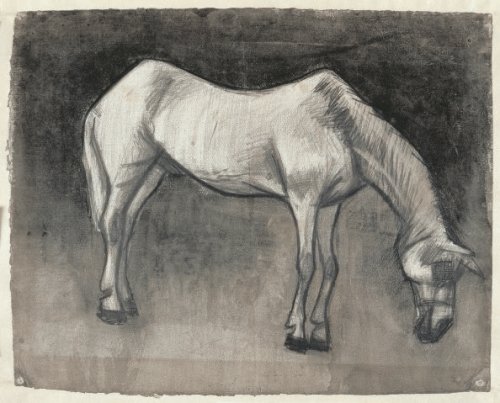
Context:
BVG 126, 11/15/1878: " The poor horse, the old faithful servant, is standing there patiently and meekly, yet bravely and unflinchingly; like the old guard who said, "la garde meurt mais elle ne se rend pas," [the guard dies, but never surrenders] it awaits its last hour."
JLB 148, 11/13/1878-11/15/1878 or 11/16/1878: " The poor horse -- the old faithful servant, stands patient and submissive, but courageous nonetheless and as resolute, as it were, as the old guard who said 'the guard dies but does not surrender' -- waits for its final hour."
Context:
JLB 148, 11/13/1878-11/15/1878 or 11/16/1878: "The Borins … do nothing but mine coal. … The coal-miner is a type peculiar to the Borinage; daylight hardly exists for him, and he scarcely enjoys the sun's rays except on Sunday. He works with great difficulty by the light of a lamp whose illumination is pale and feeble, in a narrow gallery … he thus works in the midst of a thousand constantly recurring dangers, but the Belgian foreman has a cheerful character, he's used to this way of life, and when he goes down the pit, his hat topped with a little lamp whose job is to guide him in the darkness, he entrusts himself to his God …"
Context:
JLB 148, 11/13/1878-11/15/1878 or 11/16/1878: "Paul spent three years in Arabia before he became active as a preacher and began his great missionary journeys and his actual work among the heathens. If I could spend three years or so in a similar region, working in peace and always learning and observing, then I wouldn't return from there without having something to say that is indeed worth hearing."
Context:
JLB 148, 11/13/1878-11/15/1878 or 11/16/1878: "You see, it always strikes me and it is remarkable, when we see the image of unutterable and indescribable forsakenness -- of loneliness -- of poverty and misery, the end of things or their extremity -- the thought of God comes to mind."
Context:
JLB 148, 11/13/1878-11/15/1878 or 11/16/1878: "This little house is not far from Trekweg, it's actually a simple inn right next to the big workplace where the workers come in their free time to eat their bread and drink a glass of beer."
Context:
BVG 126, 11/15/1878: "That little drawing "Au Charbonnage" is nothing specially remarkable, but the reason I made it is that one sees here so many people that work in the coal mines, and they are rather a characteristic kind of people."
JLB 148, 11/13/1878-11/15/1878 or 11/16/1878: "That little drawing, 'The Au charbonnage café' is really nothing special, but the reason I couldn't help making it is because one sees so many coalmen, and they really are a remarkable people."
Context:
BVG 126, 11/15/1878: "This little house stands not far from the road; it is a small inn attached to the big coal shed, and the workmen come there to eat their bread and drink their glass of beer during the lunch hour."
JLB 148, 11/13/1878-11/15/1878 or 11/16/1878: "This little house is not far from Trekweg, it's actually a simple inn right next to the big workplace where the workers come in their free time to eat their bread and drink a glass of beer."
Hulsker implies that Vincent went with the intention of seeing the minister to whom Dorus's letter is addressed, Pierre Péron, but this is conjecture (Hulsker, Vincent and Theo, pp. 74-75). It is equally possible that he arrived in the region and sought out the closest clergyman. If he had had a recommendation from any of his mentors in Brussels (Pieterszen, De Jonge, or Bokma), he would not have so urgently needed his father's. As collateral support for his conjecture, Hulsker suggests that Péron "was not only the secretary of the synod [the Synodal Evangelization Committee] but also of the Committee for Evangelization" (ibid.). (Hulsker may have confused the similar names of these two deeply antagonistic organizations [Lutjeharms, p. 13] [see Ch. 11, n. 379].) In fact, Péron did not become the secretary until the middle of January 1879, long after Vincent's arrival, so his position could not have figured into Vincent's "planning" (b2448 V/1982, ''Gogh, Theodorus van'' to ''Gogh, Theo van'', 12/15/1878). It should also be noted in passing that, although Vincent went several times to gives lessons and Bible readings in Mechelen and Lier while a student in Brussels, clearly neither of these congregations offered him any kind of position after he was refused admission in the school's program, despite his father's connection to Rev. Pieterszen, the pastor in Mechelen (b2437 V/1982, ''Gogh, Theodorus van'' to ''Gogh, Theo van'', 9/12/1878).
Vincent's whereabouts during this time are also unclear. He was in Dour, in the south of Belgium, in time to write his father and ask for a recommendation that his father sent on December 5. But that leaves a week between Dorus's announcement of his imminent departure for Brussels and Vincent's latest possible arrival in the Dour -- plenty of time for an encounter in Brussels. In addition, Dorus's letter of December 5 appears to support the inference of a second trip to Brussels: it refers to his trip in mid-July with Vincent as "the first visit that he and I made to Brussels" (Van Gogh, Dorus, n.p.; emphasis added). Nevertheless, Hulsker is inexplicably definitive in his judgment that, "[i]n fact, Reverend Van Gogh's journey never even took place" (Hulsker, Vincent and Theo, p. 74-75). He cites as evidence only that Vincent was in Dour "in the same days at the end of November." We find this sufficient cause for the text's caution, but not for Hulsker's certainty. Another possibility is that Vincent left and Plugge immediately notified Dorus -- by wire, perhaps -- thus aborting the planned trip. This scenario, however, depends on the perfect timing of Vincent's departure, as Vincent was clearly still in Brussels at the time of Plugge's letter (c. November 22), and Dorus was clearly poised to leave Etten immediately on November 24.
Context:
BVG 332, 10/12/1883: "No, beware of the moment when one says, I shall make myself scarce; I went through that moment myself, I hope you will not know it."
JLB 394, 10/12/1883: "No, beware of reaching that point where one says: I'll make myself scarce; I had that myself, I hope that you won't have it."
Context:
BVG 126, 11/15/1878: "As soon as I came home I began a sermon about the " barren fig tree," Luke xiii 6-9."
JLB 148, 11/13/1878-11/15/1878 or 11/16/1878: "As soon as I got home I began working on a sermon on 'the barren fig tree', Luke XIII: 6-9."
Context:
BVG 326, 9/21/1883: " That I did not lack courage, I tried to prove by going to the Borinage, where life was certainly much harder than it would have been for me if I had become a student."
JLB 388, 9/21/1883: "I tried to prove that I didn't lack courage by going to the Borinage, where life was most certainly much harder for me than it would have been had I become a student."
Context:
BVG 126, 11/15/1878: "If I could work quietly for about three years in such a district, always learning and observing, then I should not come back from there without having something to say that was really worth hearing."
JLB 148, 11/13/1878-11/15/1878 or 11/16/1878: "If I could spend three years or so in a similar region, working in peace and always learning and observing, then I wouldn't return from there without having something to say that is indeed worth hearing."
Context:
BVG 126, 11/15/1878: "If I could work quietly for about three years in such a district, always learning and observing, then I should not come back from there without having something to say that was really worth hearing."
JLB 148, 11/13/1878-11/15/1878 or 11/16/1878: "If I could spend three years or so in a similar region, working in peace and always learning and observing, then I wouldn't return from there without having something to say that is indeed worth hearing …"
Context:
BVG 126, 11/15/1878: "If God wills, and if He spares my life, I would be ready about my thirtieth year, starting out with a peculiar training and experience, being able to master my work better, and riper for it than now."
JLB 148, 11/13/1878-11/15/1878 or 11/16/1878: "If God wills it and spares my life, I'd be ready by about the age of 30 and could begin, with my special training and experience, having more mastery of my affairs and more maturity for the work than I do now."
Context:
BVG 98, 5/30/1877: " … when I think of the many watching me who will know where the fault is if I do not succeed, who will not make trivial reproaches …of disappointment, of the fear of failure, of disgrace – then I also know the longing, I wish I were far away from everything!"
JLB 117, 5/30/1877: "…when I think of the eyes of so many that are fixed upon me -- who, if I do not succeed, will know the reason why -- who will not utter any ordinary reproaches … of disappointment, of the danger of failing to a scandalous extent, then that desire is no stranger to me either -- I would really like to get away from everything!"