
Notes
Chapters
- A Fanatic Heart
- 27. Against the Grain
- 28. The Zemganno Brothers
- 29. Catch and Release
- 30. A Mercenary Frenzy
- 31. Le Paradou
- 32. The Sunflower and the Oleander
- 33. The Poet's Garden
- 34. Imaginary Savage
- 35. La Lutte
- 36. The Stranger
- 37. Two Roads
- 38. The Real South
- 39. Starry Night
- 40. The Isolated One
- 41. A Degenerate Child
- 42. The Garden and the Wheatfield
- 43. Illusions Fade, the Sublime Remains
- Ici Repose
The Early Years
The Dutch Years
The French Years
Chapters
Context:
JLB 484, 3/2/1885: "Now as to when you write that if I had something ready that I thought was good, you would try to enter it for the Salon -- I appreciate your wanting to do this."
Context:
BVG 395, 3/1/1885: "This in the first place, and further, that had I known it six weeks ago, I should have tried to send you something for this purpose."
JLB 484, 3/2/1885: "This in the first place -- and then further that if I'd known it 6 weeks earlier, I would have tried to send you something for this purpose."
Context:
BVG 395, 3/1/1885: "Now I have nothing that I should care to send in; lately I have, as you know, painted heads almost exclusively, and they are studies in the real sense of the word -- that is to say, they are meant for the studio.
JLB 484, 3/2/1885: "Now, though, I don't have anything that I would care to send in. Recently, as you know, I've painted heads almost exclusively. And they are studies in the true meaning of the word -- that is, they're meant for the studio." (Emphasis in original.)
Context:
BVG 396, 3/10/1885-3/20/1885: "I work hard, and suppose that only one out of ten or twenty studies I make is worth seeing; though those few, either more or less in number, may be of no value now, they may be later on, perhaps."
JLB 485, 3/9/1885-3/23/1885: "I work hard and -- suppose that only 1 in 10 or 20 of the studies that I make have something that makes them worth the trouble of looking at them -- those few, be it more, be it fewer in number -- although they're worth nothing now, may well be later." (Emphasis in original.)
Context:
BVG 396, 3/10/1885-3/20/1885: "I work hard, and suppose that only one out of ten or twenty studies I make is worth seeing; though those few, either more or less in number, may be of no value now, they may be later on, perhaps."
JLB 485, 3/9/1885-3/23/1885: "I work hard and -- suppose that only 1 in 10 or 20 of the studies that I make have something that makes them worth the trouble of looking at them -- those few, be it more, be it fewer in number -- although they're worth nothing now, may well be later" (emphasis in original).
No "heads of children" survive from this period, so one can assume that neither Vincent nor his uncle followed up on this painful pleasantry. As to the brothers' conversation during the studio visit, or during Theo's stay, there are only a few hints. They must have argued about whether or how long Vincent should stay in Nuenen: "I didn't want to keep talking about it or contradict you much when you were here -- but when you said that I would change some day and, no more than Mauve stayed in Bloemendaal for ever, would I stay here for ever either -- maybe -- but -- I don't see any advantage myself in moving" (ibid.). Theo may have suggested that Vincent paint the graveyard in which their father was buried ("As soon as we have a few fine days, I'll make something of the churchyard" [ibid.]), perhaps as a memento mori. And Vincent showed his brother some studies for -- or perhaps just talked about -- his plan for "that thing with the peasants around a dish of potatoes in the evening" (JLB 490, 4/6/1885). From Vincent's report, it appears that Theo expressed some reservations about Vincent's plan to paint the scene in lamplight -- a concern that resonated with Theo's general and long-standing complaint about the darkness of Vincent's images. Vincent recalls the conversation caustically: "Perhaps I'll make daylight of it, or both, or -- 'neither one' -- you'll say" (ibid.).
Context:
JLB 489, 4/4/1885: "The painting went better again today; the first two heads went wrong -- today's is a head of a young girl, almost a child's head."
According to Vincent's descriptions and a sketch in JLB 485, it appears that Vincent intended, at this time, to send one or more of the following studies: Peasant Woman Darning Stockings (F 157 JH 712), Peasant Woman, Seen against the Window (F 70 JH 715), Head of Woman (F 70a JH 716), Peasant Woman Seated before an Open Door, Peeling Potatoes (F 73 JH 717), Peasant Woman Taking her Meal (F 72 JH 718), and Woman Sewing (F 71 JH 719) (See Van Tilborgh, p. 120, n. 2.) However, these do not appear to be the paintings that Theo took with him back to Paris after his visit to the studio at the time of their father's funeral. Working from a sketch in JLB letter 489, Van Tilborgh identifies one of these as the portrait of Gordina de Groot, Head of a Woman (F 130 JH 692), that Vincent painted sometime earlier that winter; and notes that Vincent signed the image after the paint had dried, probably at the time Theo took it. The other painting that Theo took is unknown, although only one other portrait head from this period is signed, Gordina de Groot, Head (F 141 JH 783), also of Gordina. (Van Tilborgh, The Potato Eaters by Vincent van Gogh, p. 91, n. 20.)
Context:
BVG 395, 3/1/1885: "Because I think it might be useful if, when you meet a good many people on the occasion of the Salon, you have something to show -- even if it's only studies."
JLB 484, 3/2/1885: "Because I think it possible that it might be of use, when you meet a good many people on the occasion of the Salon, if you had something you could show -- albeit only studies" (emphasis in original).
Context:
JLB 490, 4/6/1885: "Anyway -- I plan to make a start this week on that thing with the peasants around a dish of potatoes in the evening, or -- perhaps I'll make daylight of it, or both, or -- 'neither one' -- you'll say."
Context:
BVG 396, 3/10/1885-3/20/1885: "I am brooding over a couple of larger, more elaborate things, and if I should happen to get a clear idea of how to reproduce the effects I have in mind, in that case I should keep the studies in question here for the time being, because then I should certainly need them -- it would be, for instance, something like this …"JLB 485, 3/9/1885-3/23/1885: "I'm thinking about a couple of larger, more worked-up things, and should I get a clear idea of how to achieve the effects I have in mind -- in that case I would still keep the studies in question here, because then I would certainly need them for it. It is, for example, something like this …"
Context:
BVG 398, 4/5/1885: "And so, Theo, I hope we shall continue on both sides what we started anew; while waiting for, or rather, toiling on more important compositions, I shall send you the studies fresh from the cottages."
JLB 490, 4/6/1885: "And so -- Theo, I hope that we can continue on both sides what we've now started again. Awaiting or, rather, while I toil away on more important compositions, I'm sending you the studies as they come straight from the cottages."
Context:
BVG 398, 4/5/1885: "Of course, people will speak of unfinished, or ugly, etc., etc., but -- my idea is to show them by all means."
JLB 490, 4/6/1885: "Of course people will say they're not finished or they're ugly &c. &c., but -- in my view -- show them anyway" (emphasis in original).
Context:
JLB 156, 8/20/1880: "I've done a scratch of miners, male and female thrutchers, going to the pit in the morning, in the snow, on a path beside a thorn-hedge: passing shadows, dimly visible in the dusk. In the background, the large mine buildings and the slag heap are becoming indistinct against the sky."
Context:
JLB 372, 8/12/1883 or 8/13/1883: "I keep thinking about undertaking the potato grubbers as a large painting, although it wouldn't be finished before next year, and only half finished this season. It seems to me that the composition could stay as it is and a start could be made on it."
Context:
JLB 356, 6/22/1883: "[I intend] to do Brabant studies again for a month, say, and to come back with a batch of them for a large drawing of a country funeral, for example."
Context:
JLB 341, 4/9/1883: "Your judgement could be of great use to me when I have the studies for something, for example, in shaping them into the final whole."
Context:
JLB 394, 10/12/1883: "If it's a question of our having to earn, I can see a chance in this way -- if there's patience at home, a realization of the necessities, if above all, when it comes to models for me, even the family cooperates. As to the question of models, they'd definitely have to do what I wanted, have to trust that I had my reasons for it. If I were to say to Ma or to Wil or Lies, pose for me, it would have to happen." (Emphasis in original.)

If one wishes to cast one's net even further in search of inspiration, there are rich waters in the books Vincent was reading before and at this time. Dickens's Christmas stories, a lifelong favorite, are replete with family-at-table scenes. George Eliot's view of peasants (with "slow bovine gaze") in books like Silas Marner, Adam Bede, and Felix Holt, tutored Vincent's view of peasants from an early age, as did Michelet's Le peuple (The People) and Ernest Legouvé's Les pères et les enfants (Fathers and Children) . More recent favorites like L'Assommoir by Zola clearly had an impact on Vincent's exaggeratedly coarse casting of his peasant portrait, although he had not yet read Germinal, Zola's brutally definitive depiction of life among the lower classes (see Sund, pp. 95-96).
Context:
JLB 211, 3/11/1882: "There was another Israëls, a small one with 5 or 6 figures, I think, a labourer's family at table."

Vincent described De Groux's style as "terrifying truthfulness"(JLB 162, January 1881). He complimented De Groux's "singularly robust, forceful drawing" (JLB 354, 6/15/1883); admired his figures as having "something noble and in which there's a more serious sentiment" (JLB 278, 11/1/1882); and often used his portrayal of peasants as a descriptive shorthand (JLB 387, 9/16/1883) ("Degroux ... painted real peasants" [JLB 493, 4/13/1885]).
He routinely grouped De Groux with Millet (see JLB letters 143, 211, 228, 245, 278, 288, and 493); Daumier (JLB 277, 278, 354, 267, and 356); Israëls (JLB 273, 278, 288, 298, 450, 502, and 547); and occasionally with Rembrandt (JLB 143); Herkomer (JLB 245 and 288); Jules Breton (JLB 278); Gustave Brion (JLB 143); Félicien Rops (JLB 273); Pail Gavarni (JLB 211); and Henri Leys (JLB 148).
Closer to the time of The Potato Eaters, Vincent compared Degroux's work to that of an artist from the younger generation, Leon Lhermitte (JLB 310 and 333). It was during Vincent's stay in Brussels, apparently, that he first saw De Groux's most famous image, Le bénédicité. In 1878, he already admired it so much that he compared it to works by Rembrandt and Millet (JLB 143, 4/3/1878). In 1882, to Van Rappard, he compared Le bénédicité to The Last Supper by Leonardo da Vinci, citing their similar compositions (Van Tilborgh, The Potato Eaters by Vincent van Gogh, p. 19). Around the same time, he wrote Theo: "It would be a great mistake to imagine that such things as, for instance, the print The grace (a family of woodcutters or peasants at table) were created at a stroke in their final form" (JLB 290, 12/3/1882). De Groux's Le bénédicité was on Vincent's mind again in December 1884: "But one must see his Saying grace, The pilgrimage, The paupers' pew and, above all, above all, the simple Brabant types" (JLB 476, 12/16/1884).


A recurring theme of Vincent's admiration for De Groux was the artist's poor reputation. In March 1882, he had a heated argument with his Uncle Cor over De Groux's "untoward ... private life" (JLB 211, 3/11/1882). The accusation against De Groux breaks down into two parts, which Vincent repeatedly and defensively conflated. On the one hand, De Groux's personal reputation had been blackened by the unspecified personal scandal referred to by Uncle Cor. Living clandestinely with Sien at the time, Vincent took his uncle's attack on the artist's personal life as a veiled attack on him. On the other hand, De Groux's art had, in Vincent's estimation, been unfairly ignored by his fellow artists. Vincent first comments on this in October 1882: "If you knew what De Groux, for example, has endured by way of criticism and malice, you would be astonished" (JLB 279, 11/1/1882). At the time of The Potato Eaters, Vincent wrote: "It's an abiding shame and loss for the Belgians that De Groux still isn't appreciated as fully as he deserves" (JLB 493, 4/13/1885). In this regard, Vincent compared De Groux to another of his favorite artist-martyrs, Mathijs Maris: "De Groux is as little appreciated as Thijs Maris, for instance. He's different, however -- but -- they have this in common, that they met with fierce opposition." (JLB 476, 12/16/1884.) He also associated De Groux with the dying art of lithography (JLB 281, 11/7/1882). In all these ways, Vincent sealed his admiration for the artist with solidarity.
Context:
JLB 142, 3/3/1878: "I freely admit that it made me sad to hear it, just as it did to hear that Brion had died (his Saying grace is hanging in my room), because the work of such men, if one understands it, moves one more deeply than one is aware of."


It is interesting that Vincent chose for the final version of The Potato Eaters (F 82 JH 764, April 1885, oil on canvas, 32.3 by 44.9 inches, 82 by 114 cm., Amsterdam, Van Gogh Museum) a canvas very close in size to that of The Frugal Meal (the former is 32¼ by 45 inches [82 by 114 cm.], the latter is 35 by 54½ inches [88.9 by 138.7 cm.]). The picture was featured at the Paris World Exhibition in 1878 where Theo certainly saw it. In 1884, Israëls's image appeared, under the title Intérieur hollandais (Dutch Interior) in a Goupil portfolio of reproductions that Vincent could have seen and Theo surely did. Also included in the portfolio, as Van der Mast and Dumas point out, was "a sketch by Israëls of a family at table, which bears a strong resemblance to Van Gogh's Potato eaters in composition" (Van der Mast and Dumas, p. 154). Encouraged by the success of The Frugal Meal, Israëls made various watercolor versions of it before turning his attention to not just one but several painted variants on the same theme, Laborer's Family at Table. According to Dekkers (in Van Tilborgh, ed., pp. 78-79), it was one of these variants that Vincent reported seeing in The Hague in 1882 at the Goupil gallery on the Plaats: " another Israëls, a small one with 5 or 6 figures, I think, a labourer's family at table" (JLB 211, 3/11/1882). (See Ch. 24, n. 24.)

Israëls painted another version of the theme (Mid-day Meal in a Peasant Cottage) the same year Vincent painted The Potato Eaters, and he continued making new variations into the next century. His last variant, in fact, was titled The Potato Eaters (1903) and may or may not have been a reciprocal tribute to his earlier disciple, whose fame had already begun to eclipse his own by then. Vincent almost certainly believed that Israëls had painted The Frugal Meal based on his visit to a laborer's cottage in Dongen, a Brabant town, like Etten, close to Breda, although Israëls's only documented visit to Dongen was in 1880. (See Dekkers, in Van Tilborgh, ed., p. 76.)

The lesson that Vincent draws from this Israëls, and a painting by Mauve in the same exhibition of a fishing smack being dragged ashore by horses, may have bled into his memory of the Frugal Meal variant, and certainly has implications for The Potato Eaters (F 82 JH 764, April 1885, oil on canvas, 32.3 by 44.9 inches, 82 x 114 cm., Amsterdam, Van Gogh Museum). Calling the Mauve "a good sermon about resignation," he summarizes the lesson of such images this way: "To know how to suffer without complaining, that's the only practical thing, that's the great skill, the lesson to learn, the solution to life's problem" (ibid.). Vincent does say, however, that he was so overwhelmed by Dialogue Silencieux and the Mauve that he "scarcely looked at" the other paintings in the exhibition (ibid.).
Context:
JLB 211, 3/11/1882: "And yet, there was another Israëls, a small one with 5 or 6 figures, I think, a labourer's family at table."
Context:
BVG 181, 3/11/1882: "I certainly do not know a single picture except this Israëls which is the equal of Millet's 'Death and the Woodcutter,' or is worthy of being shown with it."
JLB 211, 3/11/1882: "I definitely know of no other painting than this Israëls that can stand up to Millet's Death and the woodcutter, that one can see at the same time, on the other hand I know of no other painting that could stand up to this Israëls than Millet's Death and the woodcutter, no other painting that one can see at the same time as this Israëls."

In the autumn of 1884, Max Liebermann and Israëls paid a joint visit to the town of Delden near the German border where they "spent their time ... studying the motif of a peasant family saying grace before their meal," according to Dekkers. Israëls almost immediately launched into another major painting on the subject (Mid-Day Meal in a Peasant Cottage in Carelshaven near Delden [1885]), while Liebermann sat on his sketches for a year before producing Saying Grace, his variation on the theme, in 1886. (118)
Neuhuys exhibited Saying Grace in London in 1876, at a time when Vincent was making frequent trips into the city from Isleworth. Dekkers relates a very interesting story that sheds light both on the popularity of the "peasant meal" motif at the time Vincent painted The Potato Eaters (F 82 JH 764, April 1885, oil on canvas, 32.3 by 44.9 inches, 82 by 114 cm., Amsterdam, Van Gogh Museum), and on the relationship the still-powerful gérant H.G. Tersteeg enjoyed with artists: "Neuhuys's large portrayals of peasant meals may have helped to fill a gap in the market when Israëls interrupted his series of paintings on the theme around 1890. ... His painting technique and use of colour are also different from Israëls's. His less worked out canvases and brighter palette give his paintings a fresher and more competent appearance. This brightness and the beautifully rendered light must have been difficult to achieve in these interior scenes, as the simple cottages were poorly illuminated. Asked how he nevertheless managed to obtain a unity of tone, he replied: 'I don't know; it's difficult, but it works'. In fact, however, it did not always work, as we know from an exchange of letters between Neuhuys and the art dealer H.G. Tersteeg of Goupil in The Hague. Tersteeg asked Neuhuys to alter the fall of light on the right wall of an interior scene which the painter had sold him three years earlier so that it would correspond more closely to that in the watercolour version. To strengthen his case he mentioned that Jacob Maris had also thought this advisable. Neuhuys must have sent a laconic reply to the effect that Tersteeg should let 'Jaap [Jacob] himself do it', for Tersteeg's next letter to Neuhuys contains the following passage: 'I shall be pleased to avail myself of your permission to ask Jaap to do whatever he deems necessary to the right wall of the casual labourer from Kempen. I think he will be willing to do so.' The fact that this is indeed what happened illustrates yet again that these paintings were to some extent a superior type of potboiler." (Dekkers, in Van Tilborgh, ed., pp. 82-83.) Vincent commented that Neuhuys painted the dark interiors of peasant cottages with "more poetry than strikes one at first, but he makes nothing that isn't also fundamentally true" (JLB 386, 9/14/1883).
Vincent mentions two other prints that might have been sources of inspiration. Starting in January 1885, he was especially eager for Theo to send him a copy of an illustration by Paul Renouard, "a weavers' strike in Lyon" (JLB 480, 1/26/1885). "I find the drawing of the weavers the finest of them all, and there's so much body and breadth in it that it seems to me this drawing could well hold its own beside Millet, beside Daumier, beside [Jules Bastien-]Lepage" (ibid.). When Theo cannot find it, Vincent is crestfallen, calling the Renouard work "one of the very finest" (JLB 482, 2/2/1885). The nominal subject matter of this illustration does not seem particularly relevant to The Potato Eaters until Vincent, in yet another mention, describes the image: "It was an old man and some women and a child, I think, who sat doing nothing in a weaver's interior where the looms were still" (JLB 483, 2/5/1885-2/26/1885). In April 1885, just as he is finishing the second painted version of The Potato Eaters (F 78 JH 734), Vincent mentions another illustration that was on his mind at the time: "I recently saw something by Mellery in an illustrated magazine; a bargee's family in the little deckhouse on their barge -- husband, wife, children -- round a table" (JLB 493, 4/13/1885; emphasis in original). The reference is to Xavier Mellery, a Belgian proto-Symbolist.
Many of Van Rappard's major works from this period involve similar subjects and engage the same problems of light and modeling as Vincent's Potato Eaters (F 82 JH 764, April 1885, oil on canvas, 32.3 by 44.9 inches, 82 by 114 cm., Amsterdam, Van Gogh Museum). (All citations of Van Rappard's work are to De Brouwer's catalogue.) Starting in 1882, Van Rappard drew and painted many images of people gathered around tables, including women at the Institute for the Blind in Utrecht (n. 85), tile painters (n. 90 and n. 92), and silversmith workers (n. 93). In May 1883, after a visit to Utrecht, Vincent reported to Theo that Van Rappard's "painting of tile painters was in Amsterdam, but [I] saw the studies for it and sketches" (JLB 344, 5/21/1883). Later in 1883, after his summer sketching trip to Drenthe, Van Rappard painted a group of five old women sewing and drinking tea around a table (Old Women in the Home in West Terschelling, n. 106) which was exhibited the following year in Brussels. In the summer of 1884, he painted a dark, dramatically-lit group working in a circle (Interior of Blom's Sail Loft in West Terschelling, n. 117). In the winter and spring of 1885, Van Rappard, like Vincent, was hard at work on a large multi-figure composition, Workers at the Ruimzicht Brickyard (n. 140), for which he did numerous heads, figures, and compositional studies -- exactly as Vincent did for The Potato Eaters.

The other feature of Van Rappard's work that echoes unmistakably in The Potato Eaters is the preoccupation with "light effects": specifically, the introduction of strong light into a dark interior with figures. Van Rappard's various workplace images starting in 1882 (Ch. 24, notes 90-93) and later (Ch. 24, n. 106; Ch. 24, n. 117) explore the same solutions as Vincent does in his weavers and other works leading up to The Potato Eaters (see Ch. 24, n. 29 and n. 68): from deep chiaroscuro (Chapter 24, n. 93) to silhouette (Chapter 24, n. 117).
Context:
JLB 114, 5/19/1877: "O Lord, join us intimately to one another ... 'Preserve us from too much self-reproach.' Let us find grace in the eyes of those to whom we are closest and in the eyes of those who shall come after us."
When Vincent arrived early for Christmas about a month later, he was in a state of heightened vulnerability (JLB 137, 12/9/1877). After several unfavorable reviews, his studies for the ministry in Amsterdam were falling apart, and would end in ignominy only a few months later. (See Chapter 10.) If Dorus was as free with his praise and gratitude for Theo's gift in Vincent's presence as he was in his letters (as he undoubtedly was), the significance of the lamp and its light -- as symbols of family favor, and of Vincent's exclusion from it -- could not have been lost on someone as metaphorically minded as Vincent.
According to the inventory of the Nuenen parsonage that was done in May 1885, after Dorus's death, there was a "hanging lamp" in the "front room" of the parsonage, where the family ate formal dinners, and a "lamp" in the "back room," where the family ate informally (Van Crimpen, in Van Uitert, ed., p. 88). The latter may have been the one given by Theo.
Context:
JLB 490, 4/9/1885: "I've just come home from there -- and have worked on it further by lamplight -- although this time I started it in daylight."
Context:
JLB 490, 4/6/1885: "I'm going to start on the studies for the different figures."
Sensier claims that the bourgeois Millet was "himself a peasant, and used to the hard toil of the fields" (an absolute fiction), and that "he always had in his heart compassion and pity for the miserable poor of the country" (ibid., p. 126). But Sensier also goes out of his way to defend Millet against the accusation that he was either "a socialist" or "an idealist" (ibid.). He expresses indignation at the suggestion that Millet's depictions of country life argued that peasants had legitimate grievances or should seek to improve their station in life. Speaking of the painter's critics, Sensier writes: "They wronged him in imputing to him a doctrine which was repulsive to his nature, and which his conscience reproved. The critics put upon him the stigma of a vanquished partisan to the end of his life. There was no use in his repeating that he was entirely resigned to the eternal destiny of man; that his art was only a desire to formulate his sensations, to tell again what life had taught him." (ibid., p. 127.)
In Adam Bede, an early Vincent favorite (JLB 30, 3/6/1875), George Eliot wrote of villagers with "a slow bovine gaze ... as incapable of an undertone as a cow or a stag" (Eliot, pp. 20-21). And in another book that Vincent loved (JLB 152, 6/19/1879), Les pères et les enfants (Fathers and Children) by Ernest Legouvé, a popular parenting guide, peasants are described as "very like us and very different from us: they have all our feelings, but in a rudimentary, elementary state. ... I have never seen in them what we would call love. ... Their hearts are like their intellects, they have not progressed beyond primary school" (Legouvé, p. 284).
People may differ as to whether these should be considered "negative connotations." Haunted by memories and terrified of reflection, Vincent may have envied the peasants their emotional and spiritual erasure, but he certainly did not admire them on those bases. At other times, when he was less concerned with making rhetorical points in defense of his art, Vincent complained of the "straitened circumstances"(JLB 316, 2/15/1883), the "follies and vices" (JLB 324, 3/4/1883), and the proclivity for "cheat[ing]" (JLB 399, 10/26/1883) that he found among the peasants. He appears to apply to them a line from Les misérables by Victor Hugo that is sympathetic, but hardly Whitmanesque: "Poor beast, it isn't her fault that she's like that" (JLB 379, 8/23/1883-8/29/1883).
Context:
JLB 451, 7/2/1884: "If I could ever get suitable models of precisely the type I have in mind (coarse, flat faces with low foreheads and thick lips, not that sharp look, but full and Millet-like)."
Context:
JLB 291, 12/4/1882-12/9/1882: "This is a very different type, with a fringe of beard, broad shoulders, a little stocky, a little like an ox in the sense that his whole appearance has been shaped by working on the land. If you like, more the type of an Eskimo, thick lips, broad nose."
Context:
JLB 291, 12/4/1882-12/9/1882: "This is a sort of cockerel type: a shaven face, fairly sharp nose and chin, the eye small, mouth sunken."
Context:
JLB 291, 12/4/1882-12/9/1882: "This is a sort of cockerel type: a shaven face, fairly sharp nose and chin, the eye small, mouth sunken. Long legs with boots."
Context:
JLB 291, 12/4/1882-12/9/1882: "If you like, more the type of an Eskimo, thick lips, broad nose."
Context:
BVG R54, 6/15/1885-6/30/1885: "I have had the very same kind of trouble for a great number of years with a great number of people. When I protested against it once in a while and said that I didn't deserve it, things got worse and worse, and they wouldn't listen to another word about it. My parents and my whole family."
JLB 517, 7/16/1885: "I've had the same sort of unpleasantness for a whole series of years with a whole series of people. When I sometimes protested that I didn't deserve it, it just got worse and worse, and people didn't want to hear a word about it -- my parents and the whole family …"
In his account of a visit to Vincent's studio, Kerssemakers recalled that he "was amazed at how floors and walls were covered with paintings and drawings in watercolor and crayon, heads of men and women with boorish pug noses, prominent cheekbones" (Kerssemakers, "Reminiscences of Vincent van Gogh," in Stein, ed., pp. 51-52). Van Tilborgh identifies the relevant passage in the book on physiognomy where Vincent picked up these notions: Alexandre Ysabeau's Lavater et Gall. Physiognomonie et phrenologie (1862). There he read: "A flat face with 'virtually no curves in the upper half and a low brow was supposedly a sign of 'stupidity and stubborness, lacking sensitivity.' Thick lips betrayed 'a high degree of coarseness with an element of cunning' but, combined with prominent cheekbones, they were typical of the African, 'a totally unintelligent being.'" (Quoted in Van Tilborgh, The Potato Eaters by Vincent van Gogh, p. 16.)
The only stereotype about blacks that Vincent articulates is that they are incredibly hard workers: "Art is a battle -- you have to put your whole life into art. One must work like a bunch of negroes." (JLB 210, 3/11/1882.) Vincent's only contact with blacks would have been through his reading, especially Uncle Tom's Cabin, and his knowledge of the Dutch slave experience in the East Indies. Vincent did not make fine distinctions between dark-skinned peoples. From Africans to Tahitians, to him they all were "negroes" (JLB 653, 7/31/1888).
Context:
BVG B15, 8/18/1888: "You know what a peasant is, how strongly he reminds one of a wild beast, when you have found one of the true race."
JLB 665, 8/21/1888: "You fellows know what a peasant is, how much of the wild animal there is when you come across somebody pure-bred."
Context:
JLB 507, 6/9/1885: "The life and death of the peasants is and will always be the same, springing up and withering regularly like the grass and the flowers."
Context:
BVG 392, 1/20/1885: "It is also in harmony with the physiognomy of the peasants and weavers."
JLB 479, 1/23/1885: "It's also in harmony with the physiognomies of peasants and weavers."
Context:
JLB 288, 11/26/1882-11/27/1882: "This is far from all theology -- simply the fact that the poorest woodcutter, heath farmer or miner can have moments of emotion and mood that give him a sense of an eternal home that he is close to."
Context:
JLB 479, 1/23/1885: "But they look as little cheerful as the cab-horses or the sheep that are transported by steamer to England."
Context:
BVG 126, 11/15/1878: "The poor horse, the old faithful servant, is standing there patiently and meekly, yet bravely and unflinchingly; like the old guard who said, 'la garde meurt mais elle ne se rend pas,' [the guard dies, but never surrenders] it awaits its last hour."
JLB 148, 11/13/1878-11/15/1878 or 11/16/1878: "The poor horse -- the old faithful servant, stands patient and submissive, but courageous nonetheless and as resolute, as it were, as the old guard who said 'the guard dies but does not surrender' -- waits for its final hour."
Context:
BVG 324, 9/14/1883: "Inside, these cottages, dark as a cave, are very beautiful."
JLB 386, 9/14/1883: "Well, it's very beautiful inside these huts, dark as a cave."
Context:
JLB 528, 8/18/1885: "As regards my work, the thing with those potato eaters that you saw the lithograph of is a subject that I tried to paint, carried away by the singular lighting of the dingy cottage."
A survey of Vincent's surviving previous oeuvre shows many examples from every period and in every medium. From Etten: Windmills near Dordrecht (F 850 JH 15), Woman Peeling Potatoes near a Window (F 1209 JH 22), Woman Peeling Potatoes near a Window (F 1213 JH 23), Woman near a Window (twice), Man with Winnow, Sower, and Woman with Broom (F 150 JH 28), Woman Mending Stockings (F 888r JH 68), Woman Sewing (F 886JH 69), Woman Sewing (F 1221 JH 70), Woman Sewing (F 885 JH 71), Woman at the Window, Knitting (F 910a JH 90), Woman at the Window, Knitting (F 170 JH 92), and Waiting Room (F 909 JH 94). From The Hague: View of The Hague with the New Church (F 1680 JH 97), Blacksmith Shop (F 1084 JH 137), Study of a Tree (F 933r JH 142), Pollard Window (F 221 JH 165), Women Miners (F 994 JH 253), Five Men and a Child in the Snow (F none JH 323), Man in a Village Inn (F 276 JH 339), Workman with Spade, Sitting near the Window (F 964a JH 340), Woman with Shawl, Sewing (F 1033 JH 353), Blind Man Sitting in Interior (F 933v JH 371), Weed Burner, Sitting on a Wheelbarrow with his Wife (F 1035a JH 375), Three Figures near a Canal with Windmill (F 1666 JH 383), Potato Digging (Five Figures) (F 9 JH 385), and A Wind-Beaten Tree (F 10 JH 384). From Drenthe: The Sower (study) (F 11 JH 392), Two Women in the Moor (F 19 JH 409), Peasant Burning Weeds (F 20 JH 417), and Landscape in Drente (F 1104 JH 424). From Nuenen: Snowy Landscape with Stooping Woman (F 1232 JH 429), Woman with a Fork in a Winter Landscape (F 1233r JH 430), Funeral in the Snow near the Old Tower (F 1686 JH 431), Churchyard in Winter (F 1236r JH 432), Churchyard in Winter (F 1237 JH 433), Interior with a Weaver Facing Right (F 1110 JH 437), Interior with a Weaver Facing Right (F 1109 JH 439), Woman with Wheelbarrow at Night (F 1106 JH 460), Weaver Arranging Threads (F 35 JH 478), Weaver, Seen from the Front (F 30 JH 479), Weaver Arranging Threads (F 32 JH 480), Weaver Standing in Front of a Loom (F 1134 JH 481), Weaver, Arranging Threads (F 1688 JH 482), Woman Reeling Yarn (F 1137 JH 493), Woman Reeling Yarn (F 1139 JH 494), Woman Reeling Yarn (F 68 JH 495), Woman Reeling Yarn (F 1136 JH 496), Weaver Near an Open Window (F 24 JH 500), Weaver, Interior with Three Small Windows (F 37 JH 501), Weaver (F 1115 JH 502), Weaver, Seen from the Front (F 27 JH 503), The Old Tower in the Fields (F 40 JH 507), and Wood Gatherers in the Snow (F 43 JH 516).
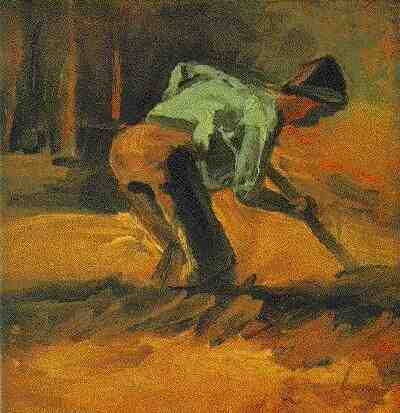

Van Tilborgh comments on all these earlier works that "the focus was not on the light effect itself" (ibid.). Given Vincent's long preoccupation (even before he became an artist [see Ch. 24, n. 71]), and Van Rappard's parallel preoccupation, we believe that this vast catalogue of images demonstrates a durable and undeniable "focus" on this lighting effect long before the portrait heads of 1884–85 and The Potato Eaters (F 82 JH 764).

Van Rappard, too, in his work from the corresponding period, returned again and again to the challenges of strong, unidirectional light, especially in portrait heads and figures (see De Brouwer's catalogue numbers: 19, 26, 46, 48, 79, 83-84, 88, 105, 120, 122 [portrait heads]; 20 [figure near window]; 49, 80-81, 89, 91, 103-104, 107, 109 [seated figures]; 92-93, 106, 117 [group scenes, interior]; 99 [weaver]). In his major work of 1885, Workers at the Ruimzicht Brickyard (n. 140), Van Rappard ventured outdoors, experimenting with the colorful chiaroscuro of bright sunlight (e.g., n. 131-133); while Vincent explored the opposite end of the value spectrum, by lamp light, in The Potato Eaters (F 82 JH 764).
From London in 1875: "That landscape -- in which a dull yellow sandy road leads over the hill to the village, ... and a grey sky, with a narrow white strip above the horizon -- is by Michel" (JLB 30, 3/6/1875).
From Ramsgate in 1876: "To the right the sea, as calm as a pond, reflecting the delicate grey sky where the sun was setting" (JLB 79, 4/28/1876).
From Isleworth in 1876: "A sandy road leads over the hills to a mountain on which one sees the holy city lit by the sun setting red behind the grey clouds of evening" (JLB 89, 8/26/1876). "It was twilight, and dark in the carriage. ... At the end of the road the church, dark against the sky. Behind the church the large, dark evening clouds, dark but with silver edges" (JLB 89, 8/26/1876). "It was beautiful in the park here, with the dark avenues of elm trees and the wet road going through them and the grey rainy sky above it all, and there was a thunderstorm in the distance. When daylight came ... it was foggy" (JLB 92, 10/3/1876). "It was so beautiful when the sun went down behind the grey clouds and when the shadows were long, ... it can be so beautiful there when the sun goes down red in the light evening mist" (JLB 93, 10/7/1876-10/8/1876). "It's lovely here now, especially in the streets in the evening, when it's a bit foggy and the street-lamps are lit" (JLB 95, 10/23/1876-10/25/1876). "It was a beautiful sight when it began to grow dark and the mist rose" (JLB 98, 11/17/1876-11/18/1876).
From Dordrecht in 1877: "it was a beautiful evening and in everything there was so much that seemed to speak, the weather was still and there was a bit of mist in the streets" (JLB 109, 3/23/1877). "It was evening when the sun went down, casting a reddish glow on the grey evening clouds, against which the masts of the ships and the row of old houses and trees stood out" (JLB 119, 6/4/1877-6/5/1877).
From Amsterdam in 1877: "It's already growing dark, and the view of the yard from the window beside me is indescribably beautiful, with that avenue of poplars whose slender forms and thin branches stand out so delicately against the grey evening sky" (JLB 136, 12/3/1877-12/4/1877).
From Isleworth in 1876: "one sees the holy city lit by the sun setting red behind the grey clouds of evening ... and mountains in the distance, against the sun. Actually, it's not a painting but an inspiration" (JLB 89, 8/26/1876). "I saw the sun setting there a couple of days ago, behind the elm trees ... one sees them [the trees] through the window in front of my reading-desk, sometimes they stand out dark against the sky" (JLB 95, 10/23/1876-10/25/1876).
From Dordrecht in 1877: "It had snowed and everything was so still, the only thing one saw was a little light here and there in one or two upstairs rooms and, in the snow, the black figure of the rattle-man" (JLB 104, 2/28/1877).
From Amsterdam in 1877: "the sun went down, casting a reddish glow on the grey evening clouds, against which the masts of the ships and the row of old houses and trees stood out" (JLB 119, 6/4/1877-6/5/1877). "That avenue of poplars whose slender forms and thin branches stand out so delicately against the grey evening sky ... In the distance the masts of the ships in the dock, in front the Atjeh, completely black" (JLB 136, 12/3/1877-12/4/1877)
From Etten in 1878: "the sun set red behind the pines ... You see, there are moments in life when everything, within us too, is peace and atmosphere" (JLB 145, 7/22/1878).
On August 28, 1874, Vincent is recorded in the guest book of the British Museum Department of Drawings and Prints as having looked at Rembrandt's drawing "Christ with Mary and Martha." (JLB 131, 9/18/1877.) Three years later he re-visualized the image emphasizing the elements of silhouette and shadow that fascinated him: "In that room twilight dominates, the figure of the Lord, noble and impressive, stands out gravely against the window through which the evening twilight falls. ... I hope not to forget that drawing, nor what it seemed to be saying to me: I am the light of the world: he that followeth Me shall not walk in darkness, but shall have the light of life." (ibid.) (See Ch. 11, n. 136.)
Context:
JLB 89, 8/26/1876: "It was twilight, and dark in the carriage. Through the window one saw the road with rows of trees on either side, and the fields. At the end of the road the church, dark against the sky. Behind the church the large, dark evening clouds, dark but with silver edges."
Context:
BVG 396, 3/10/1885-3/20/1885: "I am brooding over a couple of larger, more elaborate things, and if I should happen to get a clear idea of how to reproduce the effects I have in mind, in that case I should keep the studies in question here for the time being, because then I should certainly need them -- it would be, for instance, something like this …"
JLB 485, 3/9/1885-3/23/1885: "I'm thinking about a couple of larger, more worked-up things, and should I get a clear idea of how to achieve the effects I have in mind -- in that case I would still keep the studies in question here, because then I would certainly need them for it. It is, for example, something like this …"
Context:
JLB 357, 6/27/1883: "I wanted to have something broad and bold in silhouette and delineation in it."

Context:
JLB 445, 4/30/1884: "I've seen them weaving by lamplight in the evening, which creates very Rembrandtesque effects."
Vincent's claims of serendipity notwithstanding, he had done many studies of kneeling figures (see JLB 353, 6/15/1883), and some of the other figures in this first painted study for The Potato Eaters (Study for 'The Potato Eaters' [F 77r JH 686]), such as the probably illiterate man reading the newspaper in the dim light, suggest that Vincent arrived at the ensemble by merely pasting previous studies together. The newspaper, too, was eliminated in the next version (The Potato Eaters [F 78 JH 734]).
An alternative possibility is that Vincent moved the seated woman down in the composition far enough so as not to obscure the other sitters or create an undesirable straight line of heads; and, in doing so, created a mistake in perspective that made it look as if the woman was kneeling. Theo, who had just received the painted study (Study for 'The Potato Eaters' [F 77r JH 686]), may have commented on this oddity, mobilizing Vincent to inventive defensiveness: "As to sitting, though, don't forget that these people certainly don't sit on chairs like in one of Duval's [Pierre Louis Duval, 1811-1870; owner of restaurants in Paris] cafés, say. The finest thing I saw was that the woman was simply kneeling -- that's in the first sketch that I sent you." (JLB 502, 5/22/1885; emphasis in original.) Eugen Weber reports a "widespread practice [in late nineteenth-century France] whereby women took their meals standing up, while men sat down at the table" (Weber, p. 85).
There is no doubt, however, that green was central to Vincent's concept of The Potato Eaters (F 82 JH764). Van Tilborgh catalogues the various greens that went into the painted study for it (Study for 'The Potato Eaters' [F 77r JH 686]): "The dominant tone is green with blue as the next closest shade ... In the background, the undermost paint layer is a thin olive green, followed by an opaque dark green and then grey-green. Some of the elements were painted in a startling shade of light blue, among them the clothes of the man at the left, but this was later toned down using a shade of grey-green. After painting the contours of the head, the halo of steam around the young woman's head was added using horizontal brushstrokes in light green." (Van Tilborgh and Vellekoop, p. 134.)
Context:
BVG 405, 5/1/1885-5/15/1885: "So the two women and the interior were exactly the colour of dark soft soap."
JLB 499, 5/2/1885: "So that the two women and the interior were almost exactly the same colour as dark green soap."
Context:
JLB 494, 4/18/1885: "Enclosed a few interesting pages about colour, that is, the great verities in which Delacroix believed."

Context:
BVG 401, 4/13/1885-4/17/1885: "These rudiments, developed by modern scientists, have led to the conjecture of certain laws that form an illuminating theory of colours, a theory which Eugène Delacroix commanded scientifically and thoroughly, after grasping it instinctively."
JLB 494, 4/18/1885: "These rudiments, developed by modern scholars, have led to the notion of certain laws, which form a luminous theory of colours -- a theory that E. Delacroix mastered scientifically and thoroughly, after having instinctively known it."
Context:
BVG 404, 4/30/1885: "As for the Potato Eaters -- it is a glimpse into a very grey interior."
JLB 497, 4/30/1885: "As regards the potato eaters -- it's a glimpse into a very grey interior."
Context:
BVG R57, 8/15/1885-8/31/1885: "It is kept in such a low scale of colours that the light colours, smeared on white paper, for instance, would look like ink stains; but on the canvas they stand out like lights because of the great forces opposed to them, for instance by putting on absolutely unmixed Prussian blue."
JLB 528, 8/18/1885: "It's in such a low spectrum that the light colours, smeared on white paper, say, would look like ink blots -- they appear as lights on the canvas because of the strong forces that are opposed to them, for instance Prussian blue laid on just as it is, without mixing" (emphasis in original).
Context:
BVG 400, 4/13/1885: "I worked on it continually for three days from morning till night, and by Saturday night the paint had begun to get into a state which prevented further work until it had dried out completely."
JLB 493, 4/13/1885: "I painted 3 days continuously from early till late, and by Saturday evening the paint started to get into a state that didn't allow further work. Unless it's completely dry first."
Context:
BVG 404, 4/30/1885: "And as for the few days in which I have painted it now -- it's been a tremendous battle, but one for which I was filled with great enthusiasm. Even though at times I was afraid it would never come off. But painting, too, is 'agir-créer' [acting-creating]."
JLB 497, 4/30/1885: "And as for the few days in which I've painted it now -- it's consequently been a formidable fight, but one for which I have great enthusiasm. Although at times I feared that it wouldn't come off. But painting is also 'act and create.'"
Context:
JLB 493, 4/13/1885: "I painted 3 days continuously from early till late, and by Saturday evening the paint started to get into a state that didn't allow further work."
Context:
JLB 492, 4/9/1885: "I've just come home from there -- and have worked on it further by lamplight -- although this time I started it in daylight."
Context:
JLB 496, 4/28/1885: "Still, it's coming along, and I think there'll be something very different in it from what you can ever have seen by me. At least that clearly. I mean the life especially. I'm painting this from memory on the painting itself. But you know yourself how many times I've painted the heads!" (Emphasis in original.)
Alternatively, Vincent may have intended to create a cave-like space. If so, these liberties are consistent with that goal. What may have been inadvertent was the breakdown of perspective that resulted when he departed from reality. Perspective never came naturally to him, and without his perspective frame, he was generally lost. In that regard, however, Van Tilborgh believes Vincent's "mistakes" were intentional: "he chose to ignore the rules of perspective in order to give a good view of the chair on the left, which is seen from both the side and the back, although the man sitting in the chair is shown only from the side" (ibid.; emphasis added).
Context:
JLB 493, 4/13/1885: "I recently saw something by Mellery in an illustrated magazine; a bargee's family in the little deckhouse on their barge -- husband, wife, children -- round a table."
Context:
BVG 127, 12/26/1878: "The people here have something unique and attractive about them thanks to their simplicity and good nature, not unlike the Brabant people in Zundert and Etten."
JLB 149, 12/26/1878: "The people here have something special and appealing because of their simplicity and kind-heartedness, just like the Brabanters in Zundert and Etten."
Context:
BVG 218, 7/21/1882: "I see paintings or drawings in the poorest cottages, in the dirtiest corners."
JLB 249, 7/21/1882: "In the poorest little house, in the filthiest corner, I see paintings or drawings."
Context:
BVG 343, 12/1/1883: "I say loneliness, and not solitude, but that loneliness -- which a painter has to bear, whom everybody in such isolated areas regards as a lunatic, a murderer, a tramp, etc. etc."
JLB 408, 12/1/1883: "I say loneliness and not even in peace -- but that loneliness which a painter in an isolated region encounters when every Tom, Dick and Harry takes him to be a madman -- a murderer -- a vagabond &c. &c."
Context:
BVG 397, 4/1/1885: "Don't forget I am positively convinced that a painter of rural life can do no better than take Barbizon as an example. To dwell and to live in the very midst of what one paints, for in the country nature has a new and different aspect every day."
JLB 489, 4/4/1885: "Don't forget that I'm definitely convinced that a painter of peasant life can do no better than follow the example of Barbizon -- dwelling and living right in the midst of what one is painting, for it's new and different outside every day."
Context:
BVG 180, 3/11/1882: "Say, Theo, what a big man Millet was! I borrowed Sensier's great work from De Bock; it interests me so much that I wake up at night and light the lamp and sit up to read."
JLB 210, 3/11/1882: "Listen, Theo, what a man that Millet was! I have the big work by Sensier on loan from De Bock. It interests me so much that I wake up at night and light the lamp and go on reading."
All of Sensier's references to Millet's love of classical literature and art, including his lengthily detailed adoration of Michelangelo, should be seen in the light of the many art reviews of the time that praised Millet for the heroic classicism of his figures, often comparing them to figures out of Homer or Virgil. Sensier was always at pains to refute those critics (both detractors and advocates) who saw social commentary in Millet's images of impoverished but empowered peasants; and to support those critics, like Jules-Antoine Castagnary, who saw his figures as timelessly monumental, like figures from antiquity (or Michelangelo), or from the Bible.
There is no direct evidence to contradict this picture, apparently based on Millet's account. However, Sensier himself provides extensive circumstantial evidence to undermine it. Millet's mother (with the formidable name Aimée-Henriette-Adelaide Henry du Perron) came from a "race of rich farmers," according to Sensier, "who at one time were called gentlemen" (ibid., p. 20). She was raised in a large country house "with big buildings of granite, and [a] fine court-yard shaded by old trees" (ibid., p. 21). From an early age, Millet was tutored by the local vicar in a vast array of subjects (ibid., p. 34). This was not school, this was individual tutoring, and the subjects ranged far beyond the kind of rudimentary education provided peasant children, when it was provided at all. He "devoured hungrily the books of the home library," (ibid., pp. 35, 43) including the classics and the Bible in Latin (ibid., p. 35) and Goethe (Johann Wolfgang von Goethe, 1749-1832; German writer) in German (ibid., p. 43). He "also read with delight Shakspere [sic] " (ibid., p. 43). All this in a period when the vast majority of agricultural workers were illiterate, books were expensive, and Latin was the language of the nobility. Millet was apparently quite proud of the breadth of his learning, and Sensier was eager to dispel rumors circulated by the artist's critics that he was, in fact, an "ignorant peasant" (ibid., p. 35).
Pursuing this odd, contrary message (Millet was a peasant, but not really), Sensier's book spends far more pages on the young Millet's intellect and learning than on his farm duties. ("He drew the garden, the stables, the fields with the sea for horizon, and often the animals that went by" [ibid., p. 35].) Sensier claims that Millet's education and art were always subordinated to his farm work (ibid., p. 34), but clearly it was, if anything, the other way round. Millet's success at securing funding from the town and county councils in his home area (see Ch. 24, n. 126), his appearances in the Cherbourg papers (ibid., p. 60), and his steady access to portrait commissions from Cherbourg society (ibid., p. 66), all speak to his family's status and influence. The greater the family's status and influence, the less credible Sensier's picture of a childhood of toil in the fields -- for Millet or his parents.
Indeed, Sensier's portrait of Millet's father, Jean-Louis-Nicolas Millet, suffers from the same contradictions. "He had a contemplative mind and a musical temperament, highly developed," according to Sensier (p. 20). Jean-Louis not only sang in the parish church, he directed the choir -- a task that required recruiting singers from the countryside and giving singing lessons (his son François was one of his students) (ibid.). He could read and write music. His musical proficiency was significant enough that people "came to listen from miles around" to his choir (ibid.). Millet's mother, who managed a large household of eight children, always had at least "one or two" servants (ibid., p.18). That figure would not have included the similar complement of agricultural laborers (i.e., peasants) who undoubtedly worked the family's farm, which they owned.
The possibility that Millet or his father or his brothers occasionally helped out in the fields, especially at busy harvest times, cannot be entirely dismissed, but the evidence points more to a studious, sensitive mother's (or grandmother's) boy who would rather draw than plow, and left his country home for the city at the first available opportunity, rarely to return. Although he complained bitterly about the hostile reception he received in the big city of Paris (where he was teased as a bumpkin [ibid., p. 53-54]), Millet only returned to Normandy for brief intervals to make money (ibid., p. 61) and to find wives (he was married twice). After he left for Paris the last time, in 1845 (ibid., p. 66), he came back only once, in 1853, to settle his family's estate (ibid., p. 106). Nevertheless, Millet claims, and Sensier claims for him, an undying flame of desire "to see again my native place" (ibid., p. 67).
As for her relationship with her grandson, the painter Millet, Sensier describes it in a swoon of sentimental images of the kind so cherished by the era: "the grandmother tended [Millet] as her own child and her heart's favorite. In the vague recollections of his babyhood, Millet could always see her busy about him, rocking him, warming him in her bosom, and singing all day long songs which delighted him. ... the thought of her face, as nurse and comforter, was an ever-recurring image in the heart of her grandson. While he was still a little child, she would come to his bedside in the morning, and say, gently: 'Wake up, my little François; you don't know how long the birds have been singing the glory of God!'" (ibid., p. 20). When his grandmother died in 1851, Millet grieved accordingly: "[He] was overwhelmed with sorrow," Sensier recounts. "Millet did not speak for days, and his mute grief was pitiful to see. The tears which he was trying to repress would spring at a word, and he could only sob, 'Oh, why could I not have seen her once more!'" (ibid., p. 95). Still, he did not go home for her illness or her funeral, or for his mother's two years later. Soon thereafter, however, he did return to Normandy to participate in the settling of the family estate.
While frequent sales and commissions and financial support from friends (including Sensier) are breezily reported, the horrors of debt are catalogued in novelistic detail: "It was at twilight; Millet was in his studio, sitting on a box, his back bent like a man who is chilled. He said 'Good-day,' but did not move. It was freezing cold in the miserable room. When the money was handed him, he said: 'Thank you; it comes in time. We have not eaten for two days, but the important thing is that the children have not suffered. Until today they have had food.' He called his wife, saying, 'I am going to get wood; I am very cold.'" (ibid., p. 74.)

Interestingly, in the same book, Sensier presents two different versions of Millet's disposition. On the one hand, he quotes Millet in a self-pitying confession underscoring the seriousness of both his temperament and his art: "The gay side never shows itself to me. I don't know where it is. I have never seen it. The gayest thing I know is the calm, the silence, which is so sweet, either in the forest or in the cultivated land." (Sensier, p. 93.) On the other hand, Sensier draws a very different picture of his subject's disposition, describing him as "always gay" at gatherings of family and friends. "[He] had a really delightful gaiety. His good humor became wit; his paradoxes, his raillery, were full of biting points" (ibid., p. 114).
Context:
JLB 210, 3/11/1882: "Listen, Theo, what a man that Millet was! I have the big work by Sensier on loan from [Théophile] De Bock. It interests me so much that I wake up at night and light the lamp and go on reading."
Context:
BVG 180, 3/11/1882: "I borrowed Sensier's great work from De Bock; it interests me so much that I wake up at night and light the lamp and sit up to read."
JLB 210, 3/11/1882: "I have the big work by Sensier on loan from De Bock. It interests me so much that I wake up at night and light the lamp and go on reading."
Context:
BVG 344, 12/5/1883: "From an artistic point of view of course, Millet is Millet, Corot, Corot, fixed like the sun itself -- in my opinion at least."
JLB 409, 12/6/1883: "Anyway, from an artistic point of view, Millet is Millet, Corot Corot, fixed -- as the sun itself, in my view."
Context:
BVG 347, 12/18/1883: "Father and Tersteeg, and for instance C.M. ... they and all the influences of the past dragged me more and more out of nature."
JLB 403, 11/5/1883: "Pa and Tersteeg, and come to that C.M. and who knows who else, all the influences of the past, increasingly took me out of nature" (emphasis in original).
By the following year, having read the book, Vincent is fully in its spell: "At that time there was a sense of inexpressible melancholy in me which I find impossible to describe. I know that I then thought very, very often of a manly remark by père Millet: 'It has always seemed to me that suicide is the act of a dishonest man.'" (JLB 244, 7/6/1882.) He quotes "père Millet" again the next month (JLB 257, 8/14/1882), and refers to him by his title in JLB 258 (8/20/1882). The following year, 1883, after Vincent returned to Nuenen and began arguing with his own father, Millet fully achieved his place as the other, greater Father: "I don't differ with Pa when I consider Pa in himself, but I do differ with Pa when I compare Pa with the great père Millet, say" (JLB 414, 12/16/1883). By 1885, Vincent's respect for Millet has become almost what he would have called, in his religious period, idolatry: "I say again -- Millet is -- PÈRE Millet, that is, counsellor and guide in everything, for the younger painters" (JLB 493, 4/13/1885; emphasis in original).
Context:
BVG 161, 11/23/1881: "Do you think father Millet had more expenses than so many Italians and Spaniards who 'live in the desert where the sky is of brass and the soil of iron'?"
JLB 189, 11/23/1881: "Père Millet! Would he have had greater expenses than so many Italians and Spaniards who 'live in the desert where the sky is of brass and the earth of iron'?" (Emphasis in original.)
Context:
BVG 418, 7/1/1885: "Tell him that I long most of all to learn how to produce those very inaccuracies, those very aberrations, reworkings, transformations of reality, as may turn it into, well -- a lie if you like -- but truer than the literal truth."
JLB 515, 7/14/1885: "Tell him that my great desire is to learn to make such inaccuracies, such variations, reworkings, alterations of the reality, that it might become, very well -- lies if you will -- but -- truer than the literal truth."
Context:
JLB 493, 4/13/1885: "That's what Millet did -- and -- didn't want anything else anyway -- and in my view this means that as a human being he has shown painters a way that Israëls and Mauve, say, who live quite luxuriously, do not show" (emphasis in original).
Context:
JLB 531, 9/2/1885: "When I think about Millet or about Lhermitte -- then -- I find modern art as great -- as Michelangelo and Rembrandt -- the old infinite, the new infinite too -- the old genius, the new genius" (emphasis in original).
Context:
JLB 480, 1/26/1885: "And what Michelangelo said in an almighty beautiful metaphor, I think that Millet said without a metaphor -- and one can perhaps best learn to see through Millet, and get 'a faith'."
Context:
BVG 400, 4/13/1885: "That is what Millet did and indeed he wanted nothing else -- and to my mind this means that he set an example to painters as a human being, which Israëls and Mauve, for instance, who live rather luxurious lives, have not, and I repeat Millet is father Millet, that is, counsellor and mentor in everything to the younger painters."JLB 493, 4/13/1885: "That's what Millet did -- and -- didn't want anything else anyway -- and in my view this means that as a human being he has shown painters a way that Israëls and Mauve, say, who live quite luxuriously, do not show, and I say again -- Millet is -- PÈRE Millet, that is, counsellor and guide in everything, for the younger painters" (emphasis in original).
Context:
JLB 483, 2/5/1885-2/26/1885: "The people here instinctively wear the most beautiful blue that I've ever seen. It's coarse linen that they weave themselves, warp black, weft blue, which creates a black and blue striped pattern. When it's faded and slightly discoloured by wind and weather, it's an infinitely calm, subtle shade that specifically brings out the flesh colours."
Our reconciliation of these reports from Nuenen comforms to an eyewitness account from five years later in Vincent's life. According to Adeline Ravoux-Carrié (daughter of Arthur Gustave Ravoux, keeper of the Auberge Ravoux where Vincent stayed in Auvers in 1990): "For headwear he used a felt hat with a large brim and, in sunny weather, a straw hat like gardeners or fishermen wear" (Ravoux-Carrié, "Recollections on Vincent van Gogh's Stay in Auvers-sur-Oise," in Stein, ed., p. 211). It is interesting to note that, in his book, Sensier describes the sower in Millet's famous painting of the subject as wearing "an old felt hat" (Sensier, p. 113). In his novel about rural labor, La terre [The Earth] , Zola describes peasants wearing "round felt hats" (Zola, p. 33). In his very first self-portraits (Self-Portrait with Dark Felt Hat [F 208a JH 1089], Self-Portrait with Dark Felt Hat at the Easel [F 181 JH 1090]), Vincent portrayed himself wearing a dark felt hat.
Context:
BVG 399, 4/11/1885: "I intend to go out regularly every morning and to attack the very first thing I see people do, either in the field or at home, which in fact I am already doing now."
JLB 492, 4/9/1885: "I mean to go out regularly in the mornings and just tackle whatever I see the people doing in the fields or at home."
Context:
JLB 658, 8/9/1888: "… the cowshed a blue white, covered in cobwebs, the cows very clean and very beautiful, ... There was a tranquillity about it -- this café au lait and tobacco brown of the cows' hides."
Context:
JLB 507, 6/9/1885: "The sheep were shorn last week; I saw it -- on a table in a barn."
Context:
BVG 417, 7/10/1885-7/20/1885: "The interiors are splendid, and now I have made some friends there among the people, with whom I am always welcome."
JLB 513, 7/12/1885: "The interiors are deuced fine, and I've now made some acquaintances among the people, where I can go."
Context:
BVG 418, 7/1/1885: "Considering all the traipsing and trudging it takes to paint 'the mourning peasant' in his cottage, I dare say this work involves a longer, more tiring journey than the one so many painters of exotic subjects -- whether 'la justice au harem' or 'reception at a cardinal's' -- have to go on to produce their choicest eccentric subjects -- since Arabic or Spanish or Moorish models are readily available, against payment, in Paris."
JLB 515, 7/14/1885: "When one counts all the trudging and lugging one has to do to paint 'the peasant of Rauwveld' and his cottage, I dare swear that this is a longer and more tiring expedition than many painters of exotic subjects, be it the justice in the harem or the reception at the cardinal's, make for their choicest eccentric subjects. For in Paris one can get Arab or Spanish or Moorish models simply by ordering and paying for them."
Context:
BVG 418, 7/1/1885: "Namely, living in cottages day in and day out, being out in the fields just like the peasants -- in the heat of the sun in summer, enduring snow and frost in winter, not indoors but out in the open, and not just while taking a walk but day in, day out, like the peasants themselves."
JLB 515, 7/14/1885: "That's to say, living in those cottages day in and day out, being out in the fields just like the peasants -- enduring the heat of the sun in the summer, the snow and frost in the winter, not indoors but outside, and not for a walk, but day in and day out like the peasants themselves."
Context:
BVG 416, 7/1/1885-7/15/1885: "I must go out and work -- I didn't want to put off writing any longer; I am dog-tired every day because I have to go far, far across the heath!"
JLB 512, 7/6/1885: "I must get going -- didn't want to wait any longer; am
dog-tired every day because I'm so far away on the heath."
Context:
BVG 418, 7/1/1885: "I assure you that had my constitution not become virtually like that of a peasant, through exposure to the elements, I should not have been able to endure it, for there is simply nothing left over for my personal comfort."
JLB 515, 7/14/1885: "I assure you that if my constitution weren't becoming virtually like that of a peasant as a result of wind and weather, I wouldn't stick it out, for there's simply nothing left over for my own comfort."
Context:
BVG 417, July 1885: "The interiors are splendid, and now I have made some friends there among the people, with whom I am always welcome."
JLB 513, 7/12/1885: "The interiors are deuced fine, and I've now made some acquaintances among the people, where I can go."
Context:
JLB 509, 6/22/1885: "One may sleep on straw, eat rye bread -- well then, in the long run one is the healthier for it."
Context:
BVG 358, 3/1/1884: "What's more, let me also tell you that I never behaved towards Father, nor do I want to be aggressive towards you, my brother. I have often restrained myself -- when with strangers I would have fought quite differently and more fiercely. But this is just what ties my hands in the circumstances. There is a new field over there for me and one where I can do as I please, as a stranger among strangers -- over there, I shall have neither rights nor duties. And I shall be able to be more offhand -- bonne volonté d'être inoffensif, certitude de resister [willingness not to cause offense, confidence to stand firm], that is my goal and I am in search of it with all there is in me."
JLB 432, 3/2/1884: "Know moreover -- that I haven't been aggressive in my actions towards Pa, nor should want to become aggressive towards you, my brother. I've often restrained myself -- whereas I would have fought very differently and more fiercely with strangers. This very fact, though, also makes me powerless in the circumstances. Yonder I have a new field, and one where I can behave as I see fit, as stranger to stranger -- yonder I have neither rights nor obligations. And can then be more brusque -- willingness not to give offence, confidence to resist, that's my ideal, and I'm searching for that so far as is in me." (Emphasis in original.)
Context:
BVG 413, 6/15/1885-6/30/1885: "And I was sick of the boredom of civilization."
JLB 509, 6/22/1885: "And I was sick of the boredom of civilization" (emphasis in original).
Context:
JLB 493, 4/13/1885: "I'm thinking of moving about 1 May -- although, of course, things are all right with Ma and the sisters -- nevertheless I see and feel it's so much for the better -- for living together would become insupportable in the long run."
Context:
BVG 400, 4/13/1885: "By continually observing peasant life, at all hours of the day, I have become so involved in it that I rarely think of anything else."
JLB 493, 4/13/1885: "I've become so absorbed in peasant life by continually seeing it at all hours of the day that I really hardly ever think of anything else."
Context:
BVG 400, 4/13/1885: "It was not for nothing that I spent so many evenings musing by the fire in their homes with the miners and the peat cutters and the weavers and the peasants -- unless I was working too hard for that."
JLB 493, 4/13/1885: "And it's not for nothing that I've spent so many evenings sitting pondering by the fire with the miners and the peat-cutters and the weavers and peasants here -- unless I had no time to think -- because of the work."
Context:
BVG 408, 5/11/1885: "For instance, when a digger looks up and sniffs the wind or speaks."
JLB 506, 6/2/1885: "The sniffing of the wind when a digger looks up, say, or speaking."
Context:
BVG 418, 7/1/1885: "One is the residence of a gentleman popularly known as 'the mourning peasant' -- the other is inhabited by a worthy soul who, when I went there, was up to nothing more mysterious than digging her potato-clamp, but who must be capable of practicing witchcraft -- she goes by the name of 'the witch's head,' anyway."
JLB 515, 7/14/1885: "One of them is the residence of a gentleman who's popularly known here as 'the peasant of Rauwveld' -- the other is occupied by a worthy soul who, when I went there, was engaged in nothing more mysterious than turning over her potato patch, but must also be able to work magic, though -- at any rate she goes by the name of 'the witch's head.'"
Context:
BVG 416, 7/1/1885-7/15/1885: "I must go out and work -- I didn't want to put off writing any longer; I am dog-tired every day because I have to go far, far across the heath!"
JLB 512, 7/6/1885: "I must get going -- didn't want to wait any longer; am dog-tired every day because I'm so far away on the heath."
Context:
BVG 417, 7/10/1885-7/20/1885: "What I want is to have some more beautiful hovels far away on the heath."
JLB 513, 7/12/1885: "I want to get a few more fine cottages in the middle of the heath."
Context:
JLB 507, 6/9/1885: "I wish you'd been here on Sunday when we went on that trip. ... But for me painting is now becoming as stimulating and enticing as hunting -- it is a hunt, after all, for models, and beautiful places too." (Emphasis in original.)
Context:
JLB 507, 6/9/1885: "Tomorrow I'm going to paint a thing in another village ... I found it last Sunday on a long trip I made in the company of a peasant boy -- in order to get hold of a wren's nest."
Context:
BVG 411, 6/1/1885-6/15/1885: "I wish you had been with me last Sunday when we took that long walk. I came home quite covered with mud, for we had had to wade through a brook for half an hour."
JLB 507, 6/9/1885: "I wish you'd been here on Sunday when we went on that trip. I came back covered in mud because we had to spend a good half hour wading through a stream."
Context:
BVG 411, 6/1/1885-6/15/1885: "But the same happens to the peasant boys -- and yet they enjoy their lives."
JLB 507, 6/9/1885: "But the same happens to the peasant lads too, and -- they still have fun."
Context:
BVG R53, 6/15/1885-6/30/1885: "I let people say of me and think of me whatever they like and treat me just as they like -- that is their business; I am not obligated to listen to their everlasting drivel. My parents, my teachers, Messrs. Goupil & Co., and furthermore all kinds of friends and acquaintances have said so many unpleasant things to me for my own good and with the best intentions that in the end the burden has become a little too heavy for me ..."
JLB 516, 7/15/1885: "I let people (you and certain others are no exception) say, think of me, act towards me precisely -- as they wish -- that's their business -- I'm not obliged to listen to that eternal nagging. My parents, teachers, Messrs Goupil & Co., besides all sorts of friends and acquaintances, have said so many unpleasant things to me for my own good, with the best intentions, that in the end the burden got too heavy for me ..." (Emphasis in original.)
Context:
BVG R53, 6/15/1885-6/30/1885: "My parents, teachers, Messrs Goupil & Co., besides all sorts of friends and acquaintances, have said so many unpleasant things to me for my own good, with the best intentions, that in the end the burden got too heavy for me ..."
JLB 516, 7/15/1885: "My parents, my teachers, Messrs. Goupil & Co., and furthermore all kinds of friends and acquaintances have said so many unpleasant things to me for my own good and with the best intentions that in the end the burden has become a little too heavy for me ..."
Context:
BVG 400, 4/13/1885: "I used to have the same impression too (although in my opinion B. Lepage's woman digging potatoes is certainly no exception), but isn't this because the painters have so often failed to immerse themselves personally in peasant life."
JLB 493, 4/13/1885: "I've also had that impression sometimes (although, to my mind, the woman digging potatoes by B. Lepage is certainly an exception), but isn't it precisely because the painters are so often not deeply enough involved personally in peasant life?" (emphasis in original).
Context:
JLB 490, 4/6/1885: "I'll go on working from the model in the evenings too."
Vincent admitted his lack of success with "respectable" women ("I'm not the sort of character who has much chance of getting on a sufficiently intimate footing with girls of that sort that they're willing to pose") but went on rhapsodically about the other kind, like Gordina, describing them as "Chardinesque," which he defined as "a singular expression of simplicity and of goodness -- both through and through" (ibid., emphasis in original). (Either Vincent managed to sexualize Chardin's wholesome country girls, usually engaged in notably unsexy domestic chores, or he was confusing Jean-Siméon Chardin (1699-1779) with Jan-Baptiste Greuze (1725-1805), who painted his era's decorous equivalent of "calendar girls": overtly enticing generic portraits of voluptuous young women.)
Vincent repeatedly included his sisters among the respectable but charmless Dutch women -- an index perhaps of the trouble he is having in the parsonage with his own sisters, especially Anna (see later in this chapter). He tries, clumsily, to exempt his favorite sister, Wil, from this blanket accusation that Dutch women lack charm. "But if Wil were a Frenchwoman rather than a minister's daughter," he imagines, "she could have it" (ibid.; emphasis in original). Through all this elaborate effort at creating a typology of women, however, Vincent never stopped making sly references to "certain common servant girls" and "the charm that French women frequently have," hopelessly muddling Millet's new gospel with the abiding fantasy of sexual license (ibid.).
Zola returns to the image of the frustrated mine manager on his glum rounds a little later: "He had passed several couples, quite a slow procession of people out walking in the lovely winter night. Still more lovers going to take their pleasure behind the walls with lips pressed to lips. These were his normal encounters now: girls on their backs in every ditch, penniless louts gorging themselves with the only joy that cost nothing. And these fools grumbled at their life when they had bellyfuls of the one and only happiness of love! How gladly he would have starved like them if he could have begun his life again with a woman who would give herself to him here on the ground with all her body and all her heart. His misfortune was without any possible consolation, and he envied these poor wretches. He rode slowly home with bowed head, tortured by these long-drawn-out sounds in the depths of the black countryside, where he seemed to hear nothing but kisses." (ibid., p. 270.)
Vincent is so invested in the bourgeois fantasy that Zola parodies in this passage, that he fails to see the ferocious mockery of it. Sund offers two possible explanations for this astonishing failure of perspective: First, elsewhere in the book, Zola appears to "corroborate" Hennebeau's fantasy: "The miners are openly promiscuous and oftentimes brutal" (Sund, pp. 100-102). (See Ch. 24, n. 212.) Second, Vincent's alienation from his own class "predisposed" him to embrace Hennebeau's fevered vision. In particular, Sund cites his failures with Margot Begemann and Kee Vos, both examples of the respectable, middle-class women that he claims to reject, ostensibly at Millet's direction.
There is no doubt that Vincent was looking for consolation from failed loves as well as sexual gratification among the peasant women in Nuenen, whom he perceived as less demanding (of him). But it should be noted that he had already tried this alternate-class sexual path in The Hague, with Sien Hoornik, with results every bit as disastrous as the briefer liaisons with Margot and Kee. Whether women like Gordina provided Vincent with intimacy out of sexual "liberation," genuine affection, or because of the money Vincent freely offered is an open question. Interviewed years later by Stokvis, Gordina seemed to barely remember Vincent (Stokvis, p. 30).
Context:
JLB 515, 7/14/1885: "I assure you that if my constitution weren't becoming virtually like that of a peasant as a result of wind and weather, I wouldn't stick it out, for there's simply nothing left over for my own comfort."
Context:
JLB 509, 6/22/1885: "I'd like to write much more to you than I will in this letter, but when I get home nowadays I'm really not in the mood for writing when I've been sitting in the sun all day."
Context:
BVG 413, 6/15/1885-6/30/1885: "One may sleep on straw, eat black bread, well, one will only be the healthier for it."
JLB 509, 6/22/1885: "One may sleep on straw, eat rye bread -- well then, in the long run one is the healthier for it."
Context:
BVG 612, 10/20/1889-10/22/1889: "In my estimation I consider myself certainly below the peasants."
JLB 811, 10/21/1889: "So in my own estimation I definitely reckon myself below the peasants."
Context:
JLB 506, 6/2/1885: "... he also wished to be starving with hunger, to have an empty belly, a stomach knotted with cramps that made him dizzy in the head; perhaps that would have killed the interminable pain."
Context:
JLB 515, 7/14/1885: "But I don't desire that for myself either, any more than many peasants desire to live other than as they live."
Was Vincent "crazy" at this point in Nuenen? That is, was he suffering some sort of psychotic pathology? In addition to the testimony cited in the text and in this note (most of it, admittedly, from people who did not know Vincent intimately and who were inclined to confuse eccentricity with "madness"), the letters from this period may offer some hints of mental disintegration. First, there is an increase in the frequency of closely-spaced repetitions of ideas and phrases. Vincent's letters were always repetitive -- the product of his insistent, obsessive nature. Previously, however, his tendency was to bring the same idea back in different guises or use key phrases as refrains, separated by "verses" of new ideas or new permutations of the same idea. In the spring of 1885, the repetitions grow shorter, becoming more like autistic mumblings or dazed invocations. Here is an example from mid-May: "If I earn rather more so that I can travel more -- well then I'll also, I hope, paint the miners' heads sometime. However, I'll keep working until I'm absolutely and utterly sure of my case -- such that I'm working even faster than now and will also be able to bring home 30 or so studies in the space of a month, say. I don't know whether we'll earn money, but if it's just enough to work a tremendous amount then I'm content; doing what one wants is what matters. Yes, we must do the miners one day!" (JLB 505, 5/28/1885; emphasis added.) Also, the frequency of postscripts goes up in mid-1885. These, too, have always been features of Vincent's letters, but only intermittently. By June, hardly a letter goes by without one (e.g., JLB 507, 6/9/1885; JLB 508, 6/15/1885), further suggesting, perhaps, a loss of mental coherence and hypergraphic compensation.
Context:
JLB 506, 6/2/1885: "Although -- out of touch -- although out of the art world for a long time -- turned out -- because of my clogs &c."
Context:
JLB 506, 6/2/1885: "If 50 aren't enough, I'll draw 100 of them, and if that's still not enough, even more, until I've got what I want solidly."
Context:
BVG 404, 4/30/1885: "Millet, De Groux, so many others, have set an example of character by turning a deaf ear to such taunts as 'sale, grossier, boueux, puant' [nasty, crude, filthy, stinking], etc., etc., so it would be a disgrace should one so much as waver."
JLB 497, 4/30/1885: "Millet, Degroux, so many others, have set examples of character, of taking no notice of the reproaches of -- nasty, crude, muddy, stinking &c. &c., that it would be a disgrace if one were even to have misgivings" (emphasis in original).
Context:
JLB 490, 4/6/1885: "And I think it by no means unlikely that I'll stay here for the rest of my life, too. After all, I desire nothing other than to live deep in the country and to paint peasant life."
Context:
BVG R57, 8/15/1885-8/31/1885: "And this will remain my policy, and it is quite possible that I shall give up my studio before long and go live in a peasant's cottage, so as not to hear or see educated people -- as they call themselves -- any longer."
JLB 528, 8/18/1885: "And this will remain my system, and it may even very well be that before long I'll give up my studio and go and live in a cottage, so that I no longer hear or see anything of those who call themselves civilized people."
Context:
BVG 408, 5/11/1885: "We have not got that far, I know, but what I say is this, let's keep enthusiasm, otherwise we reach that summit of wisdom called the time of the periwigs."
JLB 506, 6/2/1885: "We're not at that point yet -- I know that, but I'm just saying -- let's retain enthusiasm, for otherwise we'll achieve that maximum of wisdom that's called the periwig age" (emphasis in original).
Context:
BVG 408, 5/11/1885: "And instinct, inspiration, impulse, and conscience are better guides than many people think."
JLB 506, 6/2/1885: "And instinct -- inspiration -- impulse -- conscience -- guide more truly than many people think."
Context:
JLB 506, 6/2/1885: "And be that as it may, for my part I agree with it, better to die of passion than to die of boredom."
Context:
BVG 408, 5/11/1885: "I don't know whether you noticed that there is a very short remark about 'enthusiasm' in Mantz's articles and how there is also something about 'le grain de folie qui est le meilleur de l'art' [the grain of madness that is the best of art]."
JLB 506, 6/2/1885: "I don't know whether you noticed that there's a tiny bit about 'enthusiasm' in Mantz's articles, how there's also something about 'the grain of madness that is the best of art'" (emphasis in original).
Context:
BVG 612, 10/20/1889-10/22/1889: "Well, I am ploughing on my canvases as they do on their fields."
JLB 811, 10/21/1889: "Anyway, I plough on my canvases as they do in their fields."
Context:
BVG 406, 5/4/1885-5/5/1885: "That little woman with the spade by Lhermitte, how characteristic it is, how full of life, as if made by a peasant who could paint; it is a masterpiece."
JLB 500, 5/4/1885-5/5/1885: "The woman with the spade by Lhermitte, how it lives and how real it is: as if done by a peasant who can paint, it's masterly" (emphasis in original).
Context:
BVG 408, 5/11/1885: "And that leaving the so-called civilized world of progress for what it is, namely a delusion, the most important thing remains, what the reformers in the matter of taste in '48 already proclaimed in a manly and vigorous way."
JLB 502, 5/22/1885: "And that, leaving aside the self-styled more civilized world of progress for what it is, namely a deception, it continues to come down to what the reformers already announced about taste in '48, for instance, in a manly and forceful way" (emphasis in original).
Context:
BVG 408, 5/11/1885: "Though not up-to-date -- though outside the art world for so long -- banished because of my clogs, etc., yet I see, for instance from that article by Mantz, that even now there are connoisseurs and art lovers -- who know something, the very thing Thoré [É-Bürger], Théophile Gautier knew."
JLB 502, 5/22/1885: "Although -- out of touch -- although out of the art world for a long time -- turned out -- because of my clogs &c. -- yet I see from that article by Mantz that there are still connoisseurs and art lovers, even now, who -- know something -- and that is what Thoré, what Théophile Gautier knew."
Sund, who knows this territory better than anyone, does not find any specific allusion to the passage in Vincent's work (Sund, pp. 96-97), even though the letter containing it accompanied a shipment of paintings, including one that Vincent described as "a head that I couldn't help painting after reading Germinal" (JLB 506, 6/2/1885). She concludes that "Van Gogh may merely have meant to ally the desolate mood of the transcribed incident or its general theme of victimization to his peasant heads, and possibly he cited the execution passage as an aside that he did not consciously connect to the head he 'had to paint after reading Germinal'" (Sund, p. 98). We read in Sund's reference to "victimization" a kernel of concurrence with our belief that Vincent's chronic martyr behavior was triggered by the calamities of 1884 and early 1885.
Context:
BVG R52, 6/1/1885: "The reason I am writing you again is just my love for Millet, for Breton and for all those who paint peasants and the common people, and I count you among them."
JLB 514, 7/13/1885: "The reason I'm writing to you again is just out of love for Millet, for Breton and for everyone who paints the peasants and the people, among whom I count you" (emphasis in original).
Context:
BVG 409, 5/15/1885: "But I shall work on till I am absolute master of my hand, so that I can work even more quickly than now, and, for instance, bring home about thirty studies within a month."
JLB 505, 5/28/1885: "However, I'll keep working until I'm absolutely and utterly sure of my case -- such that I'm working even faster than now and will also be able to bring home 30 or so studies in the space of a month, say."
Context:
BVG 400, 4/13/1885: "I quite agree -- but Millet himself felt and knew this -- and on reading Sensier I was very struck by something he said at the beginning of his career, which I don't remember word for word, only the purport of it, namely, 'that (i.e. that indifference) would be bad enough if I had need of fine shoes and the life of a gentleman, but -- puisque j'y vais en sabots -- je m'en tirerai' [as I go about in clogs, I'll manage]. And so it turned out."
JLB 493, 4/13/1885: "I agree -- but Millet himself felt and knew that -- and, on reading Sensier, what he said about the start of his career struck me so much that although I don't remember it literally, I remember the sense of it, that is, 'that (i.e. that indifference) would be bad enough for me if I needed fine shoes and the life of a gentleman -- but -- because I go around in clogs, I shall manage' . And that's how it turned out." (Emphasis in original.)
Context:
BVG 413, June 1885: "One may sleep on straw, eat black bread, well, one will only be the healthier for it."
JLB 509, 6/22/1885: "One may sleep on straw, eat rye bread -- well then, in the long run one is the healthier for it."
Context:
BVG 410, 6/1/1885: "Ah! Live like a beast, having no possessions of his own, flattening the corn with the ugliest, dirtiest female coal trammer, and being able to find contentment in it."
JLB 506, 6/2/1885: "Ah! to live like a beast, to possess nothing of one's own, to flatten the corn with the ugliest, dirtiest female coal-pit drawer, and to be able to be happy with that."
Context:
BVG 413, 6/15/1885-6/30/1885: "If I could earn something with my work, if we had some firm ground, be it ever so little, under our feet for our daily existence, and if then the desire to become an artist took for you the form of, let me say, Hennebeau in Germinal, discounting all difference in age, etc. -- what pictures you could still make then!"
JLB 509, 6/22/1885: "If I could earn something with my work, if we had some firm ground, even a little -- under our feet, to be able to go on living -- and if ever the desire to become an artisan took shape in you -- let me say to make it clear -- in the manner of, say, discounting all the differences in age &c. -- Hennebeau in Germinal -- what you would be able to paint then."
Context:
JLB 506, 6/2/1885: "And that, leaving aside the self-styled more civilized world of progress for what it is, namely a deception, it continues to come down to" (emphasis in original).
Context:
BVG 411, 6/1/1885-6/15/1885: "But it exists -- that enchanted land -- where one is not [?] free."JLB 507, 6/9/1885: "But it's there -- an enchanted land -- where one isn't free."
Context:
BVG 411, 6/1/1885-6/15/1885: "But it exists -- that enchanted land -- where one is not [?] free."
JLB 507, 6/9/1885: "But it's there -- an enchanted land -- where one isn't free."
Context:
JLB 509, 6/22/1885: "... it is something to be deep in the snow in winter, to be deep in the yellow leaves in the autumn, to be deep in the ripe wheat in the summer, to be deep in the grass in the spring. It is something to always be with the mowers and the peasant girls, in summer with the big sky above, in the winter by the black fireplace. And to feel -- this has always been so and always will be." (Emphasis in original.)
Context:
JLB 490, 4/6/1885: "Only it's certain that Ma simply cannot comprehend that painting is a faith and that it brings with it the duty to pay no heed to public opinion -- and that in it one conquers by perseverance and not by giving in" (emphasis in original).
Context:
JLB 489, 4/4/1885: "I didn't want to keep talking about it or contradict you much when you were here -- but when you said that I would change some day and, no more than Mauve stayed in Bloemendaal for ever, would I stay here for ever either -- maybe -- but -- I don't see any advantage myself in moving."
Context:
JLB 473, 12/6/1884: "When I'm better I'll probably go and live in the studio, at least in the daytime."
Based on other evidence (see Ch. 24, n. 276), it becomes clear that all of this is cover for the fight that Vincent is waging with his sister Anna over his remaining in the parsonage. Vincent has apparently invented and backdated most, if not all, of the rationale to make his expulsion by Anna look like a voluntary contribution to family harmony. For example, the widow Van Gogh was permitted to stay in the parsonage for another year, but was already making plans to return to Breda. While Dorus's estate was not large (see Ch. 24, n. 286), she certainly did not need the extra income of a boarder.
Context:
BVG 397, 4/1/1885: "I did not want to talk much about it or contradict you much when you were here, but when you said that I should change someday and that I should not always stay here, any more than Mauve had always stayed in Bloemendaal, it may be true, but I personally see no good in moving, because I have a good studio here and the scenery is very beautiful."
JLB 489, 4/4/1885: "I didn't want to keep talking about it or contradict you much when you were here -- but when you said that I would change some day and, no more than Mauve stayed in Bloemendaal for ever, would I stay here for ever either -- maybe -- but -- I don't see any advantage myself in moving, because I have a good studio here and the countryside here is very beautiful."
Context:
JLB 490, 4/6/1885: "It's likely that Ma, Wil and Cor will go to Leiden next year. Then I'll be the only one of us who's still in Brabant."
Context:
BVG 398, 4/5/1885: "I have no other wish than to live deep, deep in the heart of the country, and to paint rural life. I feel that my work lies there, so I shall keep my hand to the plough, and cut my furrow steadily."JLB 490, 4/6/1885: "I desire nothing other than to live deep in the country and to paint peasant life. I feel that I can create a place for myself here, and so I'll quietly keep my hand to my plough and cut my furrow."
Context:
BVG 398, 4/5/1885: "And it doesn't seem at all improbable that I shall stay there for the rest of my days.
JLB 490, 4/6/1885: "And I think it by no means unlikely that I'll stay here for the rest of my life, too."
Despite Vincent's transparently fictitious claim that "things are all right with Ma and the sisters" (JLB 493, 4/13/1885) in mid-April, suggestions of their arguments are sprinkled throughout the following letters ("At home they're rather different from what you suppose" [JLB 501, 5/6/1885]). Vincent is patronizing to his sister even in letters that were obviously crafted to obscure the rancor at home: "I can see that you're doing your best to reconcile us, but my dear chap, I really don't wish her any harm, and I really don't do them any harm. Only I don't want to exert any influence on them, since firstly they don't understand themselves, but secondly don't want to understand either." (JLB 506, 6/2/1885.)
Time stripped away much of Vincent's reticence on the subject of his expulsion from the parsonage. In December 1885, he referred to his sister Anna with scathing sarcasm: "I don't have the slightest desire to write to the people at home while they're with my charming sister Anna" (JLB 548, 12/17/1885). And he makes it clear that he did not voluntarily leave the parsonage, he was pushed out: "I left the house then &c. It follows automatically that, since they got their way." (ibid.; emphasis in original.) This reading of the events of April 1885 was confirmed in a letter from sister Wil to a friend, written in 1886 but only recently discovered (Van Tilborgh, "Letter from Willemien van Gogh," p. 21). "After my father's death," Wil writes, "[sister] Anna thought it would be more peaceful for Mum if [Vincent] no longer lived at home and she made sure he left us" (ibid., emphasis added). Van Tilborgh puts the best possible face on the clear implication of brusque treatment: "It was not previously known that Anna had persuaded Vincent to leave the parental home" (ibid.).
Context:
JLB 490, 4/6/1885: "As to Anna -- you mustn't think that I'll continue to take something like that amiss or hold a grudge about it -- but only, it's a shame that they think to do Ma a service with something like that -- that's a shame - and that's stupid and unwise."
BVG R54, 6/15/1885-6/30/1885: "I simply said -- for the sake of clarity -- that my views about practical matters and my way of life differed too much from theirs to enable us to come to a lasting agreement"
JLB 517, 7/16/1885: "I simply said for the sake of clarity -- that as far as practical matters and way of life were concerned, my views were too different for us to able to agree in the long run" (emphasis in original).
Context:
JLB 506, 6/2/1885: "I foresee that the characters of the 3 sisters (all three) will get worse not better with time, and to me at least they're utterly disagreeable as it is. You remember with how much warmth I wrote to you about Wil when Ma was ill. Well now, it's been such a short burst -- and it's frozen again."
Context:
JLB 506, 6/2/1885: "I foresee that the characters of the 3 sisters (all three) will get worse not better with time, and to me at least they're utterly disagreeable as it is. You remember with how much warmth I wrote to you about Wil when Ma was ill. Well now, it's been such a short burst -- and it's frozen again."
Context:
JLB 490, 4/6/1885: "I still very much regret the incident with Anna that decided me in this respect. What she said to you changed nothing of what she reproached me for, and however absurd those reproaches were and her unfounded presumptions about things that are still in the future -- she hasn't told me she takes them back. Well -- you understand how I simply shrug my shoulders at such things -- and anyway, I increasingly let people think of me just exactly what they will, and say and do too, if need be."
Context:
BVG 400, 4/13/1885: "I think I'll be moving by the first of May -- although I'm getting on well of course with Mother and our sisters, I can still see and sense it is pour le mieux [better so] this way -- since in the long run it would hardly be feasible to live together."
JLB 493, 4/13/1885: "I'm thinking of moving about 1 May -- although, of course, things are all right with Ma and the sisters -- nevertheless I see and feel it's so much for the better -- for living together would become insupportable in the long run."
Context:
BVG 408, 5/11/1885: "I think them -- I know, contrary to your opinion and contrary to theirs -- I think those at home very, very far from sincere ..."
JLB 506, 6/2/1885: "I find them at home (I know -- contrary to your opinion and contrary to their own opinion) very far, very far from sincere ..."
Context:
BVG 400, 4/13/1885: "Which I can put down neither to them personally nor to myself personally so much as to the incompatibility of the ideas of people who seek to maintain a certain social standing and a painter of peasant life who gives the matter no thought."
JLB 493, 4/13/1885: "Which I don't so much ascribe to them personally nor to me personally either, but rather to the irreconcilability of the ideas of people who keep up a position and -- a peasant painter -- who doesn't think about it."
Context:
JLB 517, 7/16/1885: "As for my family -- on the occasion of my father's death -- foreseeing that the misunderstanding with them could have gone on forever -- I simply said for the sake of clarity -- that as far as practical matters and way of life were concerned, my views were too different for us to able to agree in the long run. That I wanted to act entirely according to my own views, but only for myself. And that I relinquished my share of the inheritance -- because, having been greatly at odds with my father in the last few years, I didn't consider that I had any right to nor did I have any wish for what was his. This cut short any further unpleasantness with my family, you'll admit."
According to a will drawn up in 1851, at the time of their marriage (ibid., p. 90), Anna was appointed Dorus's sole heir "in so far as the law allows," according to the inventory report. Apparently, the law allowed her only half, because elsewhere in the report, the notary refers to the estate "now belonging for the one half to the first party [Anna] and for the other half to the children and children by marriage of the aforesaid Theodorus van Gogh" (ibid., p. 88). This was not the last word, however. Perhaps as the result of a later will, the estate was actually divided 5/8 (11,136 guilders) to Vincent's mother, and 3/8 (4,176 guilders) to all the children together, according to the final report drawn up by Reverend Stricker and sent to Theo (see Ch. 24, n. 289). Thus, after various adjustments, Vincent stood to inherit 690 guilders, or about 1,400 francs. This roughly comports with the figure of "678.23 francs" that Theo mentions in 1889 as the share of their father's estate that his sisters Wil and Lies calculated they received from Vincent as a result of his renouncing his own legacy (b0920 V/1962, ''Gogh, Theo van'' to ''Gogh, Jo van en Houten-van Gogh, Anna van'', 3/10/1889; see Ch. 24, n. 287.) (If each of Vincent's five siblings received a fifth of 1,400 francs, the two sisters would have received 560 francs together. Vincent's sisters made this offer in 1889 in order to help pay Vincent's medical expenses at an asylum after his self-mutilating attack and subsequent hospitalization [see Chapter 35]. Theo refused the offer.)
If the 1,400-franc figure is correct, it is only a fraction of the 3,600 guilders calculated as Vincent's share by Meyers, but still almost a year's worth of Theo's stipend (Meyers, p. 62). The question arises as to how much Vincent knew about his father's nest egg. In June 1882, from The Hague, Vincent wrote, "The speculating about inheritances that you mention is quite out of the question, if only because there are no inheritances for me as far as I know, and indeed there cannot be for there is nothing. I believe there is literally no money at home." (JLB 235, 6/3/1882; emphasis in original.) Thus, it seems quite likely that when Vincent grandly renounced his inheritance (see Ch. 24, n. 287), he thought he was giving up nothing. Given his constantly dire financial straits, this is, in fact, the most likely reading of his generous offer in April 1885 to take only two hundred guilders as his share of his father's estate and "right willingly let the youngsters have [the rest]" (JLB 490, 4/6/1885). Indeed, this figure of two hundred guilders may have been Vincent's best guess as to what his share would be worth.
Interestingly, Theo, who probably had a much better idea of his father's financial situation, sent Vincent one hundred francs (fifty guilders) extra in April, immediately after Vincent's announcement that he wanted only two hundred guilders from his father's estate. And on the basis of this unexpected windfall, and probably some admonitory words from Theo, Vincent fully renounced his legacy: "It was absolutely essential that I paid a few things -- and that was preoccupying me. It's not that people were pestering me, though, but because I knew that they were in need of it. And that's why I wrote that I could be obliged to reserve a small part when the affairs were to be settled. But that's not necessary, now." (JLB 493, 4/13/1885; emphasis added.)
All of this is consistent with Vincent's flight from the parsonage inventory in May (see Ch. 24, n. 293). The public accounting of his father's estate may have been the first time Vincent realized just how much his "sacrifice" had cost him. Theo may have intentionally leveraged Vincent's offer to renounce his legacy in an effort to preserve as much of the estate as possible for his mother. If he had such a plan, it was, according to Meyers, successful: "None of the Van Gogh children was greedy: in the end they left everything for their mother" (Meyers, p. 62). However, if Meyers's conclusion is based entirely on Vincent's plea to a creditor later that summer ("I have inherited -- not a penny. Firstly my father was not rich, and secondly none of the children has claimed his share." [JLB 523, 8/5/1885]), it is at least suspect.
Context:
BVG R54, 6/15/1885-6/30/1885: "I relinquished my share in the inheritance; inasmuch as during the last years I had lived in great discord with my father, I felt I did not have a right to anything that was his, and for that matter I did not covet it."
JLB 517, 7/16/1885: "I relinquished my share of the inheritance -- because, having been greatly at odds with my father in the last few years, I didn't consider that I had any right to nor did I have any wish for what was his."
Context:
BVG 398, 4/5/1885: "Only it is an established fact that Mother is unable to grasp the fact that painting is a faith"
JLB 490, 4/6/1885: "Only it's certain that Ma simply cannot comprehend that painting is a faith" (emphasis in original).
Context:
BVG 398, 4/5/1885: "Only it is an established fact that Mother is unable to grasp the fact that painting is a faith, and that it imposes the duty to disregard public opinion -- and that in painting one conquers by perseverance and not by making concessions -- and that 'I cannot give thee the faith' -- this is exactly what is the matter between her and me -- as it was to Father, and remained so. Oh dear."
JLB 490, 4/6/1885: "Only it's certain that Ma simply cannot comprehend that painting is a faith and that it brings with it the duty to pay no heed to public opinion -- and that in it one conquers by perseverance and not by giving in. And -- 'I can't give you faith' is also the case between Her Hon. and me -- just as it was and remained with Pa too."
Context:
BVG 403, 4/15/1885-4/30/1885: "I mean from life especially. I paint this from memory on the picture itself. But you know yourself how many times I have painted these heads."
JLB 496, 4/28/1885: "I mean the life especially. I'm painting this FROM MEMORY on the painting itself." (Emphasis in original.)
Context:
JLB 493, 4/13/1885: "I'm now getting use of the stone -- graining, paper and printing of 50 copies for 3 guilders. I'm thinking of making a series of subjects from peasant life, in short -- the peasants at home." (Emphasis in original.)
Context:
BVG 400, 4/13/1885: "Anyway, I intend to do a series of subjects from peasant life -- les paysans chez eux [peasants at home]."
JLB 493, 4/13/1885: "I'm thinking of making a series of subjects from peasant life, in short -- the peasants at home" (emphasis in original).
JLB 496, 4/28/1885: "Thanks again for the Lhermittes and other illustrated magazines. I was disappointed in Le Chat Noir, although the title is good. I was glad to find some biographical particulars of Jules Dupré in the No. of La Vie Moderne."
Context:
BVG 399, 4/11/1885: "Try to speak to somebody at Le Chat Noir and ask them if they want a sketch of those potato eaters, and if so, of what size, for it's all the same to me."
JLB 492, 4/9/1885: "Try to talk to someone at Le Chat Noir and ask them whether they want a scratch of those potato eaters and, if so, what size, because it makes no difference to me."
Context:
JLB 492, 4/9/1885: "Try to talk to someone at Le Chat Noir and ask them whether they want a scratch of those potato eaters and, if so, what size, because it makes no difference to me."
This is the first surviving example of Theo's long campaign to reassure his mother that Vincent's prospects were not as bleak as she might otherwise fear. The letter continues: "How I wish, also for himself, that he [Vincent] will see some fruit from his work. Many before him have had to work hard for a long time before they sold anything. But not everybody has to necessarily wait that long, and thus I hope very much that that he will get satisfaction from his work." (ibid.)
This elaborate and completely speculative optimism may be related to a broader campaign by Theo to ensure that all of his father's estate passed to his mother. (See Ch. 24, n. 286.) In order to convince his mother to accept all of the children's share of the estate, Theo would have needed to convince her that (1) Vincent would find his own feet soon enough; and (2) if he did not, Theo would continue to support him. On the other hand, this may be just another example of Theo trying to put his mother's mind at rest and calm the family waters after Dorus's death. As discussed later in this chapter, however, there is no reason to believe that Theo had any real confidence in Vincent's chances of success with his strange and unlikeable peasant imagery.
Context:
JLB 495, 4/21/1885: "Do give Mr Portier as many of them as he might want. And I enclose herewith a letter to him, which will seem to you -- I think -- rather long and consequently impractical. But I thought about it that what had to be said can't be compressed into fewer words, and precisely what matters here is to give him reasons for his own instinctive feelings."
Context:
BVG 402, 4/21/1885: "But I thought that what I had to say couldn't be expressed in more concise terms, and that the chief point is to give him arguments for his own instinctive feelings."
JLB 495, 4/21/1885: "But I thought about it that what had to be said can't be compressed into fewer words, and precisely what matters here is to give him reasons for his own instinctive feelings."
When, at the end of April, Portier fails to display the images that he purports to like, Vincent's worst fears seem fulfilled. He lashes out angrily, demanding a test of Portier's commitment: "Now, though, I have something to say about Portier -- of course his private opinion isn't at all a matter of indifference to me, and I also appreciate to the utmost that he said that he took back nothing of what he'd said. Nor does it concern me that it appeared that he hadn't hung these first studies. But -- if he also wants me to send a painting destined for him, then he can only have it on condition that he exhibits it." (JLB 497, 4/30/1885; emphasis in original.) Vincent also seems prepared for Portier to withdraw his good opinion at any time. In anticipation of Portier seeing the final painted version of The Potato Eaters (F 82 JH 764, April 1885, oil on canvas, 32.3 by 44.9 inches, 82 by 114 cm., Amsterdam, Van Gogh Museum), Vincent writes fearfully, "I understand that Mr Portier, for instance, must be confirmed in what he said, so that we can count on him as a friend for ever. I sincerely hope this will succeed" (ibid.). In fact, Vincent's doubts about Portier's staying-power were well-founded.
Context:
BVG 401, 4/13/1885-4/17/1885: "I am very glad that he found 'personality' in it."
JLB 494, 4/18/1885: "That he detected personality in it pleases me very much indeed."
Context:
JLB 494, 4/18/1885: "I'm not much bothered about it, anyway, because I want to learn to make lithographs myself so as to be independent."
Context:
JLB 495, 4/21/1885: "Do give Mr Portier as many of them as he might want. And I enclose herewith a letter to him, which will seem to you -- I think -- rather long and consequently impractical."
Context:
JLB 509, 6/22/1885: "If it were something for Wisselingh, then better he should take it. I once gave Wisselingh a couple of heads and also just sent him the lithograph. But because he didn't send so much as a word in reply, I think that all I'd get would be an insult if I sent something."
Context:
BVG 401, 4/13/1885-4/17/1885: "At least it is a subject which I have felt, and such as it is, I myself could point out, as well as other critics, its weak points and some absolute mistakes. But there is a certain life in it, perhaps more than in some pictures that are absolutely faultless."
JLB 494, 4/18/1885: "At least it's a thing that I've felt, and one such that I would be able to point to defects and certain errors in it myself, just as well as other critics. Yet there's a certain life in it, and perhaps more than in certain paintings in which there are no errors at all."
Context:
JLB 497, 4/30/1885: "I think it's best not to delay sending it for too long, which is why I'll send it. Then the second lithograph of it will probably have to be abandoned. But still -- I understand that Mr Portier, for instance, must be confirmed in what he said, so that we can count on him as a friend for ever. I sincerely hope this will succeed."
Context:
BVG 394, 2/1/1885: "I think the best way to express form is with an almost monochrome colouring, the tones of which differ principally in intensity and in value."
JLB 483, 2/5/1885-2/26/1885: "Expressing the form -- I think -- works best with an almost monochrome colour scheme, the tones of which vary chiefly in intensity and in value."
Context:
JLB 499, 5/2/1885: "Now the flesh tones -- I know that on a superficial examination, that is if you don't think it through, they look like what people call flesh colour. I did paint them that way at the beginning of the painting -- some yellow ochre, red ochre and white, for example. But that was much too light and certainly didn't do." (Emphasis in original.)
Context:
BVG 405, 5/1/1885-5/15/1885: "But that was much, much too light and was decidedly wrong."
JLB 499, 5/2/1885: "But that was much too light and certainly didn't do."
Context:
BVG 405, 5/1/1885-5/15/1885: "Immediately repainted them, inexorably, and the colour they are painted in now is like the colour of a very dusty potato, unpeeled of course."
JLB 499, 5/2/1885: "I quickly repainted them without mercy, and the colour they're painted now is something like the colour of a really dusty potato, unpeeled of course."
Context:
BVG 403, 4/15/1885-4/30/1885: "What I am trying to do most is to bring life into it."
JLB 496, 4/28/1885: "Above all, I'm doing my best to put life into it" (emphasis in original).
Context:
BVG 233, 9/19/1882: "That little almshouse and those heaps of coal were so splendid that I couldn't keep my hands off them, though I had intended to draw this week because of the expenses."
JLB 266, 9/18/1882: "The courtyard and all that coal were so beautiful that I couldn't resist them, although this week I wanted to draw because of the paint."
Context:
BVG 404, 4/30/1885: "I've got something more important for him than studies."
JLB 497, 4/30/1885: "I for my part have something more important than the studies alone."
Context:
BVG 401, 4/13/1885-4/17/1885: "And that would perhaps be one which Portier could show, or which we could send to an exhibition."JLB 494, 4/18/1885: "And could perhaps be one that Portier could show or that we could send to an exhibition."
Context:
BVG 403, 4/15/1885-4/30/1885: "I will not send the potato eaters unless I know for sure there is something in it."
JLB 496, 4/28/1885: "I won't send the potato eaters unless I know for sure that it's something" (emphasis in original).
Context:
BVG 403, 4/15/1885-4/30/1885: "But I am getting on with it, and I think there are completely different things in it than you can ever have seen in my work."
JLB 496, 4/28/1885: "Still, it's coming along, and I think there'll be something very different in it from what you can ever have seen by me."
Context:
JLB 497, 4/30/1885: "I believe that the potato eaters will come off -- the last days are always hazardous for a painting, as you know, because one can't touch it with a large brush when it isn't completely dry without a great risk of spoiling it. And the changes have to be made very coolly and calmly with a small brush. This is why I simply took it away and said to my friend that he just had to make sure that I didn't spoil it in that way, and that I'd come do those small things at his place."
Context:
JLB 497, 4/30/1885: "Yesterday I took it to an acquaintance of mine in Eindhoven, who is painting. In 3 days or so, I'll go over there and lift it with a little white of egg and finish off a few details."
Context:
BVG 404, 4/30/1885: "That's why I took it to my friend and asked him to make certain I didn't spoil it, and why I'll be going to his place to apply those finishing touches."
JLB 497, 4/30/1885: "This is why I simply took it away and said to my friend that he just had to make sure that I didn't spoil it in that way, and that I'd come do those small things at his place."
Context:
JLB 497, 4/30/1885: "And the changes have to be made very coolly and calmly with a small brush. This is why I simply took it away and said to my friend [Kerssemakers] that he just had to make sure that I didn't spoil it in that way, and that I'd come do those small things at his place."
Context:
BVG 404, 4/30/1885: "That's why I took it to my friend and asked him to make certain I didn't spoil it, and why I'll be going to his place to apply those finishing touches."
JLB 497, 4/30/1885: "This is why I simply took it away and said to my friend that he just had to make sure that I didn't spoil it in that way, and that I'd come do those small things at his place."
Context:
BVG 405, 5/1/1885-5/15/1885: "Just now I again took it to the cottage to give it some last touches from nature."
JLB 499, 5/2/1885: "I've got it in the cottage again to do more things to it from life."
Context:
JLB 499, 5/2/1885: "When I went to the cottage this evening I found the folk eating their meal by the light of the little window instead of under the lamp. Oh, it was astonishingly beautiful. The colour was also singular -- you remember those heads painted against the window -- the effect was like that, only darker still."
Context:
BVG 405, 5/1/1885-5/15/1885: "When I went to the cottage tonight, I found the people at supper in the light of the small window instead of under the lamp -- oh, it was splendid!"
JLB 499, 5/2/1885: "When I went to the cottage this evening I found the folk eating their meal by the light of the little window instead of under the lamp. Oh, it was astonishingly beautiful."
Context:
BVG 405, 5/1/1885-5/15/1885: "So the head and hands became the colour of a 10-centime piece, namely dull brass."
JLB 499, 5/2/1885: "Thus head and hands became the colour of, say, a 10-centime piece, that is, dull copper."
Context:
BVG 405, 5/1/1885-5/15/1885: "And where the light touched it, the blouse became of the most tender faded blue."
JLB 499, 5/2/1885: "And his smock the most delicate faded blue possible, where the light caught it."
Context:
BVG 405, 5/1/1885-5/15/1885: "But I think I shall get it finished, always in a comparative sense, for in reality I shall never think my own work ready or finished."JLB 499, 5/2/1885: "I believe I'll finish it though -- in a manner of speaking -- for I myself will actually never think my own work finished or ready."
Context:
JLB 497, 4/30/1885: "I do still have a few smaller studies -- you can imagine, though, that I've been kept so busy with the larger one that I've been able to do little else besides that."
Context:
JLB 497, 4/30/1885: "I've had the threads of this fabric in my hands the whole winter long, and searched for the definitive pattern -- and if it's now a fabric that has a rough and coarse look, nevertheless the threads were chosen with care."
Context:
JLB 497, 4/30/1885: "I think you'd see that as far as colour is concerned -- things have livened up."
Context:
BVG 404, 4/30/1885: "You'll certainly see that it has originality."
JLB 497, 4/30/1885: "You'll see that it has originality."
Context:
BVG 406, 5/4/1885-5/5/1885: "Ostade for instance, it too comes from the heart of the peasant's life, and is original."
JLB 500, 5/4/1885-5/5/1885: "Ostade, for instance, it's nevertheless out of the heart of peasant life and -- original."
Context:
JLB 497, 4/30/1885: "I wanted it to give the idea of a wholly different way of life from ours -- civilized people."
For months Vincent had been eschewing "general approbation or appreciation" (JLB 493, 4/13/1885). "As far as general sympathy is concerned ... anyone who really wants to accomplish something good or useful should neither count on nor wish for general approbation or appreciation, but on the contrary should expect nothing other than that only a very few hearts -- and even then only maybe -- will sympathize and join in" (ibid.; emphasis in original). Interestingly, the source Vincent cites for this insight is Ernest Renan. He doesn't specify, but he may be recalling a passage in Renan's Vie de Jésus (or the abbreviated Jésus that Renan wrote in 1864 and from which Vincent copied out passages). The redemptive Christliness of unpopularity is a theme that will continue to run in tortured counterpoint to Vincent's artistic and financial ambitions throughout his life. Now, in his frantic, pre-emptive defense of The Potato Eaters (F 82 JH 764), he made a case for the enduring popularity of peasant images ("Oh -- one mustn't doubt -- anyone who paints the peasants nowadays and has his heart in his work, he wins -- at least a part, and not the worst although it's not the largest -- of the public" [JLB 507, 6/9/1885]) and contrived a strategy for marketing the painting in conjunction with the opening of a new Goupil store in Antwerp, where Vincent imagined an especially welcoming audience for "a REAL PEASANT PAINTING" (JLB 497, 4/30/1885; emphasis in original).
Perhaps as the result of conversations with Theo when he came for their father's funeral, Vincent apparently knew of plans for the new gallery by early April and knew that Theo would be traveling there on business sometime in 1885: "If I work hard day after day, I can have another 20 or so studies for you by then, and moreover another twenty or so to take to Antwerp if you want" (JLB 489, 4/4/1885). Confusingly, Theo wrote his mother on April 22 that the "Heeren" at Goupil had chosen his colleague, Frans Braat, to "represent them at the exhibition in Antwerp" (b0900 V/1962, ''Gogh, Theo van'' to ''Gogh-Carbentus, Anna C. van'', 4/22/1885). In the event, however, Theo did go to Antwerp in July in the company of another Goupil colleague, Andries Bonger, his future brother-in-law, as discussed later in this chapter. He did not, apparently, take any of Vincent's paintings with him.
Several factors converged at this time to convince Vincent that Antwerp (and Belgium) would be receptive to The Potato Eaters, leading him to try and convince Theo. The most important one appears to have been the advice and example of Van Rappard, who had long been recommending that Vincent try to sell his work in the Belgian city (JLB 432, 3/2/1884), and who exhibited several of his own peasant works at the ninth exhibition of L'Essor in Brussels in January 1885 (see De Brouwer, p. 143). Vincent reports that at least one of Van Rappard's works was in Antwerp as of May 1885 (JLB 496, 4/28/1885). Sometime before mid-April, Vincent was impressed by an illustration of a "bargee's family" seated around a table in the cabin of their boat, by the Belgian artist Xavier Mellery (JLB 493, 4/13/1885) -- an image that probably had a significant influence on the final form of The Potato Eaters. (See Ch. 24, n. 177.)
In May, Vincent praised another Belgian artist, Constantin Meunier, who specialized in depictions of peasants and laborers (JLB 496, 4/28/1885). Vincent had first noticed Meunier's work in 1881 (JLB 166, 4/30/1881 or 5/1/1881), and drew a connection between Meunier's work and Van Rappard's as early as 1883 (JLB 344, 5/21/1883).
The name reappears suddenly just about the time Vincent sends The Potato Eaters off to Theo in May 1885 as part of the larger argument on behalf of the Belgian market for peasant images: "I think that you'll certainly see in the painting that I have my own way of looking, but that it nonetheless links up with others -- certain Belgians, for instance. Scandalous that they rejected Ernst Josephson's painting. But why don't the rejected ones band together to do something themselves? Unity is strength." (JLB 499, 5/2/1885.) The reference is to the Swedish artist Ernst Josephson (see Ch. 22, n. 465), whose peasant painting Spanish Blacksmiths had been rejected by the Salon of 1882 because of its bold style, which Vincent obviously saw as a refuse precedent for The Potato Eaters.
Apparently to give his painting more intellectual heft, Vincent identifies himself with the Belgian painters (despite having earlier rejected affiliation with any school [JLB 482, 2/2/1885]) and even employs the militant rhetoric of the labor movement that was active in Belgium at the time ("Unity is strength"). Despite having heard such rhetoric during his time in the Borinage, this is the only place in the entire corpus of letters that he deploys it, and he does so here only in furtherance of his longstanding call for an association of artists, not as a vote of sympathy for the plight of workers. In 1877, while studying for the clergy, Vincent had heard a labor-sympathetic sermon given by a preacher from Lyons, France, a center of early labor activism (JLB 141, 2/18/1878-2/19/1878). He also apparently encountered pro-labor literature at that time (see Ch. 11, n. 300), but his appreciation seems to have been limited to its sentimental appeal and religious overtones. Although his sudden identification with the Belgian peasant painters in May 1885 may have influenced his decision to go to Antwerp at the end of the year, the bond was so ephemeral and short-lived that by the time he arrived there in November his artistic goals had moved on. As far as is known, he made no effort to associate with them or seek them out during his four months in Belgium.
Context:
JLB 499, 5/2/1885: "Scandalous that they rejected Josephson's painting. But why don't the rejected ones band together to do something themselves? Unity is strength."
Context:
JLB 499, 5/2/1885: "I can make a smaller version of it or a drawing, though, if you would rather have that, for I feel the thing in such a way that I can literally dream it."
Context:
JLB 499, 5/2/1885: "But I've thought a great deal about the question. Corot, Millet, Daubigny, Israëls, Dupré, others -- also paint light paintings -- that is, one can see into all the corners and depths etc. -- however deep the spectrum may be."
Context:
JLB 499, 5/2/1885: "When you write again, please tell me what you want me to do with the painting. Obviously we must make sure Portier gets something new. But I could just as well paint it again half size, say, for him, and send this larger one to Antwerp, say."
Context:
JLB 500, 5/4/1885-5/5/1885: "If extra carriage has to be paid, it's because they perhaps don't do carriage paid all the way. But I didn't want you to incur any expenses for it, since it might perhaps disappoint you."
Context:
JLB 500, 5/4/1885-5/5/1885: "But I didn't want you to incur any expenses for it, since it might perhaps disappoint you."
Context:
JLB 500, 5/4/1885-5/5/1885: "The crate for the painting is ready, so I'm sending it flat and it's a light little crate, however it still has to dry for 1 or 2 days. I'm also sending another 10 painted studies at the same time."
Context:
JLB 501, 5/6/1885: "Yesterday I sent a number of painted studies by post, and today, Wednesday, a crate marked V1, free domicile, containing the painting" (emphasis in original).
Context:
JLB 497, 4/30/1885: "As soon as the whole thing is finished and dry, I'll just send the canvas to you in a small crate, and then put a few smaller ones in with it."
Context:
JLB 493, 4/13/1885: "Be assured, though, that your saying that your faith in me was shaken and so forth is a matter of relative indifference to me."
Context:
JLB 494, 4/18/1885: "I also think that if it had been up to Henri Pille, Le Chat Noir might not have refused it."
Context:
BVG 405, 5/1/1885-5/15/1885: "What you say about the lithograph, that the effect is wooly, I think too."
JLB 499, 5/2/1885: "What you say about the lithograph, that the effect is woolly, I think so too."
Context:
JLB 502, 5/22/1885: "What you say about the figures is true, that as figures they aren't like the heads are. I've therefore thought about starting it very differently, that is tackling it from the torsos instead of from the heads." (Emphasis in original.)
Context:
JLB 506, 6/2/1885: "Really study the subject of colour etc. for yourself. I'm trying to do it myself too, and I'd also like to read everything you find of that nature."
Context:
JLB 506, 6/2/1885: "Many thanks for your letter and for the 50 francs enclosed, which was very welcome to me this month in particular, what with the move."
The key to these contrary signals may be in Theo's concluding remarks. First, he reveals that Serret's assessment was prompted as much by a desire to be helpful as by critical acumen: "But, [Serret] added, if it will please [Vincent], tell him that he has my total sympathy." Finally, Theo pointedly interprets this hash of signals for his mother: "So we must just wait, and if [Vincent] makes beautiful work, what great people think is good and admirable, try to forgive him the peculiarities in his daily life." Clearly, Theo hopes by these promising comments about Vincent's potential to lift the burden of worry from his mother's shoulders and ameliorate the rift between her and her eldest son. "It may take a long time, but eventually [Vincent's work] will have value, only I would wish it to be soon, because then one would look at him from a different point of view than is the case now." (It appears that Theo did not intend for Vincent to read this letter, as it contains confidential commentary casting an unflattering light on Vincent's situation.)
How much of this Theo told Vincent is not clear. Even though Vincent acknowledges twice in early June that Serret has commented on The Potato Eaters (F 82 JH 764, April 1885, oil on canvas, 32.3 by 44.9 inches, 82 by 114 cm., Amsterdam, Van Gogh Museum) (JLB 506, 6/2/1885; JLB 507, 6/9/1885), he appears puzzled when he hears in late June that Theo has written their mother about him: "I heard from home that you'd written something to them about Serret, about how he said I could be assured of his sympathy &c. Is Serret a painter, a dealer or an art lover? As of today, I don't know." (JLB 508, 6/15/1885.) This lapse is even more puzzling given that Theo had written about Serret in some detail as early as December 1883 and Vincent had responded at length: "What you write about Serret interests me greatly. A man like that who eventually produces something heart-rending as blossom from a hard and difficult life is a phenomenon like the blackthorn, or better yet a gnarled old apple tree which suddenly bears blossoms that are among the tenderest and most 'pure' things under the sun. When a rough man blossoms -- it's indeed a beautiful sight." (JLB 408, 12/1/1883; emphasis in original.)
Despite this poetic inspiration, Vincent has to be reminded about Serret in Theo's next letter, which he acknowledges: "You had previously written things that I had really remembered, but the name had escaped me." (JLB 509, 6/22/1885.) If Theo had told Vincent in the earlier letters in June that Serret had a significantly positive response to The Potato Eaters, Vincent would undoubtedly have remembered the name or made more urgent inquiry about it.
The reason why Theo did not relate Serret's real comments to either Vincent or his mother earlier becomes immediately apparent when Theo responds to Vincent's belated inquiry in late June. They include both a very negative critique of the figures in The Potato Eaters ("certain faults in the structure of the figures" [JLB 515, 7/14/1885]), and an assessment of Vincent's commercial prospects far less optimistic than the one Theo reported to his mother in May (Vincent writes: "Serret may agree with you that making good things and selling are quite separate" [JLB 509, 6/22/1885]). As Theo no doubt predicted, Vincent erupts in a long, furious, ranting letter (JLB 515, 7/14/1885) attempting to force Theo to force Serret to "take back" his negative comments. (See Ch. 24, n. 423.) This, of course, is a parallel to the similar battle for a retraction that Vincent is waging against Van Rappard (see later in this chapter).
Context:
BVG 403, 4/15/1885-4/30/1885: "They are full of sentiment, calculated both in general and in detail, but especially broadly conceived and treated vigorously."JLB 496, 4/28/1885: "It is felt, in the sense of being studied on a large and on a small scale at the same time, but above all largely imagined and broadly conceived too."
Context:
BVG 403, 4/15/1885-4/30/1885: "The Lhermittes are superb. I am quite enthusiastic about them."JLB 496, 4/28/1885: "The Lhermittes are superb. I adore them."
Context:
BVG 408, 5/11/1885: "Then his pointing out Lhermitte as Millet's successor. I think it all manly language, and perfectly correct, and broadly observed."
JLB 506, 6/2/1885: "Then pointing to Lhermitte as Millet's successor -- I think all of it manly language, and outstanding in accuracy and broad view."
Context:
BVG 401, 4/13/1885-4/17/1885: "I believe the fuller of sentiment a thing one makes is, and the more true to nature, the more it is criticized and the more animosity it rouses."
JLB 494, 4/18/1885: "It seems to me that the more what one does is felt and has life, the more it's criticized and gives offence."
Next, Vincent faults the "fine characterizations" of Uhde's children by comparing them unfavorably to "those by [Timoléon Marie] Lobrichon, [Édouard] Frère or even [Ludwig] Knaus, [Benjamin] Vautier as they used to be in their heyday" (ibid.). His most pointed criticism, however, is that the Uhde is too slick, too finished -- a unmistakable defense of the crudeness of The Potato Eaters: "What I have against the Uhde painting is that there's something cold in it, like in the new brick houses and schools and Methodist churches. ... In short, there is in the end something consumptive about it, and I think a Corot, a Dupré, a Millet is so infinitely more healthily painted." (ibid.) Vincent's final judgment is an unmistakable rejection of Theo's recommended model: "I have certain reservations, can't think the Uhde painting entirely good" (ibid.).
Context:
BVG 414, 6/21/1885-6/28/1885: "My objection to Uhde's picture is that there is a certain coldness in it like in new brick houses and schools and the Methodist churches. And notwithstanding the great merits of the picture, excuse me, but it makes me long for [Alexandre-Gabriel] Decamps's or [Eugène] Isabey's less orthodox style of painting."
JLB 510, 6/28/1885: "What I have against the Uhde painting is that there's something cold in it, like in the new brick houses and schools and Methodist churches. And -- forgive me -- despite the great merits of everything in the painting, it makes me nostalgic for Decamps's or Isabey's less orthodox manner of painting."
Context:
BVG 399, 4/11/1885: "I repeat, let us paint as much as we can and be productive, and, with all our faults and qualities, be ourselves ..."
JLB 492, 4/9/1885: "And I say, let's paint a lot and be productive, and be ourselves with faults and qualities ..."
Context:
BVG 401, 4/13/1885-4/17/1885: "There are only three colours which are truly elementary in nature, and which, when they are mixed two at a time, produce three more composite colours which may be called secondary, to whit: orange, green and violet."
JLB 494, 4/18/1885: "There are only three truly elementary colours, which, by being mixed two by two, create three other composite colours, called binaries: orange, green and violet."
Blanc, who was an art critic and a popularizer, certainly no scientist (see Ch. 24, n. 382), also drew on the theories of Humbert de Superville in his Essai sur les signes inconditionnels dans l'art (Essay on Unconditional Signs in Art) (1827-1839).
Context:
BVG 401, 4/13/1885-4/17/1885: "Each of the three primitive colours is rightly called complementary with regard to the corresponding secondary colours. Thus blue is the complementary colour of orange; yellow, the complementary colour of violet; and red, the complementary colour of green. Conversely, each of the combined colours is the complementary colour of the primitive one not used in the mixture. This mutual intensification is what is called the law of simultaneous contrast."
JLB 494, 4/18/1885: "Each of the three primary colours is rightly called Complementary in relation to the binary colour that corresponds with it. Thus blue is the complementary of orange, yellow is the complementary of violet, and red the complementary of green. Vice versa, each of the composite colours is the complementary of the primary colour not used in the mixture. This reciprocal heightening is what's called the law of simultaneous contrast."
Context:
BVG 401, 4/13/1885-4/17/1885: "When the complementary colours are produced in equal strength, that is to say in the same degree of vividness and brightness, their juxtaposition will intensify them each to such a violent intensity that the human eye can hardly bear the sight of it."
JLB 494, 4/18/1885: "If the complementary colours are taken at equal value, that's to say, at the same degree of brightness and light, their juxtaposition will raise both the one and the other to an intensity so violent that human eyes will scarcely be able to bear to look at it."
Context:
BVG 371, 6/1/1884-6/15/1884: "Do you know what "un ton entier" and "un ton rompu" is? Of course you can see it in a picture, but can you also explain what you see? What is meant by rompre? Such things one ought to know theoretically also, either practically as painter, or in discussing colour as a connoisseur."
JLB 450, June 1884: "Do you know what an unbroken tone and what a broken tone is? You can certainly see it in a painting, but do you also know how to explain what you see? What they mean by broken? One should know this sort of thing, theoretically too, be it as a practitioner when painting or as an expert talking about colour." (Emphasis in original.)
Context:
BVG 371, 6/1/1884-6/15/1884: "Do you know what "un ton entire" and "un ton rompu" is? Of course you can see it in a picture, but can you also explain what you see? What is meant by rompre? Such things one ought to know theoretically also, either practically as painter, or in discussing colour as a connoisseur."
JLB 450, June 1884: "Do you know what an unbroken tone and what a broken tone is? You can certainly see it in a painting, but do you also know how to explain what you see? What they mean by broken? One should know this sort of thing, theoretically too, be it as a practitioner when painting or as an expert talking about colour." (Emphasis in original.)
Context:
BVG 401, 4/13/1885-4/17/1885: "This mutual intensification is what is called the law of simultaneous contrast."
JLB 494, 4/18/1885: "This reciprocal heightening is what's called the law of simultaneous contrast."
Over the next few years, Vincent continued to gravitate toward the notion of "correct" (i.e., scientific) color: "The laws of colour are inexpressibly splendid precisely because they are NOT coincidences" (JLB 450, June 1884; emphasis in original). "I think moreover that colour ... [has] fixed laws that one must and can study like chemistry or algebra" (JLB 465, 10/9/1884; emphasis in original). After reading Blanc's Les artistes de mon temps in May 1884, he begins to see the world in Chevreul's terms: green + red ("spring is tender green (young wheat) and pink (apple blossom)" [JLB 451, 7/2/1884]); yellow + violet ("autumn is the contrast of the yellow leaves against violet tones" [ibid.]); blue + orange ("summer is the opposition of blues against an element of orange in the golden bronze of the wheat" [ibid.]).
Laying the early foundation for his later development of expressive color, Vincent writes: "one could paint a painting in each of the contrasts of the complementary colours (red and green, blue and orange, yellow and violet ... )" (ibid.). He also adds a fourth contrasting pair not included in Chevreul's six-pointed star: black-and-white ("The winter is the snow with the little black silhouettes" [ibid.]). But Vincent's attitude toward expressive color -- as opposed to the actual or "local" color of a depicted object -- is not yet settled. In the same letter that he waxes poetic on the seasonal associations of complementary pairs, he tells Theo that painting figures "is very precise work, and one isn't at liberty to depart from the colours of the costume" (ibid.).
Context:
BVG 430, 11/1/1885-11/15/1885: "For, that the laws of colour which Delacroix was the first to use, like Newton did for gravitation, and like Stephenson did for steam -- that those laws of colours are a ray of light -- is absolutely certain."
JLB 538, 11/3/1885-11/4/1885: "For it's absolutely certain that the laws of colour, which Delacroix first ordered and put forward in full and in context to the general benefit -- as Newton did gravity and as Stephenson did steam -- that these laws of colour are a light."
Context:
JLB 495, 4/21/1885: "As regards colour ... What I want to assure Portier of in this letter is my -- faith -- precisely in Eugène Delacroix and those old people."
Context:
JLB 497, 4/30/1885: "When the weavers weave those fabrics that I believe they call cheviots, and also the singular Scottish multicoloured tartan fabrics -- then they try, as you know, to get singular broken colours and greys in the cheviots -- or to get the very brightest colours in balance against one another in the multicoloured tartans so that, rather than the fabric clashing, the overall effect of the pattern is harmonious from a distance. A grey that's woven from red, blue, yellow, off-white and black threads, a blue that -- is broken by a green and an orange, red or yellow thread -- are very different from plain colours -- that is, they vibrate more and make whole colours look harsh, whole, and lifeless." (Emphasis in original.)
Context:
BVG 404, May 1885: "When weavers weave that cloth which I think they call cheviot, or those curious multicoloured Scottish tartan fabrics, then they try, as you know, to get strange broken colours and greys into the cheviot -- and to get the most vivid colours to balance each other in the multicoloured chequered cloth -- so that instead of the fabric being a jumble, the effet produit [overall effect] of the pattern looks harmonious from a distance."
JLB 497, 4/30/1885: "When the weavers weave those fabrics that I believe they call cheviots, and also the singular Scottish multicoloured tartan fabrics -- then they try, as you know, to get singular broken colours and greys in the cheviots -- or to get the very brightest colours in balance against one another in the multicoloured tartans so that, rather than the fabric clashing, the overall effect of the pattern is harmonious from a distance" (emphasis in original).
Context:
BVG 429, 10/15/1885-10/31/1885: "It is a fact that by studying the laws of the colours, one can move from instinctive belief in the great masters to the analysis of why one admires -- what one admires -- and that indeed is necessary nowadays, when one realizes how terribly arbitrary and superficially people criticize."
JLB 537, 10/28/1885: "It's certain that by studying the laws of colours one can move from an instinctive belief in the great masters to being able to account for why one likes what one likes, and that's very necessary nowadays when one considers how terribly arbitrarily and superficially people judge."
Context:
JLB 506, 6/2/1885: "I mean that in your capacity as an art expert you have to know certain rules of colour mixing and perspective just as well as the painters themselves -- in terms of theory even better than them actually -- since you have to advise and speak about paintings in the making. Don't take it amiss, for what I say is true; that this would be of more practical use to you than you might think, and would raise you above the usual standard of dealers. Which is necessary, because the usual standard is below standard. I do know a little from my own experience what the dealers know and what they don't know." (Emphasis in original.)
Context:
JLB 497, 4/30/1885: "When the weavers weave those fabrics that I believe they call cheviots, and also the singular Scottish multicoloured tartan fabrics -- then they try, as you know, to get singular broken colours and greys in the cheviots -- or to get the very brightest colours in balance against one another in the multicoloured tartans so that, rather than the fabric clashing, the overall effect of the pattern is harmonious from a distance. A grey that's woven from red, blue, yellow, off-white and black threads, a blue that -- is broken by a green and an orange, red or yellow thread -- are very different from plain colours -- that is, they vibrate more and make whole colours look harsh, whole, and lifeless."
Context:
BVG 404, 4/30/1885: "A grey woven from red, blue, yellow, off-white and black threads -- a blue broken by a green and an orange, red or yellow thread -- are quite unlike plain colours, that is, they are more vibrant, and primary colours seem hard, cold and lifeless beside them."
JLB 497, 4/30/1885: "A grey that's woven from red, blue, yellow, off-white and black threads, a blue that -- is broken by a green and an orange, red or yellow thread -- are very different from plain colours -- that is, they vibrate more and make whole colours look harsh, whole, and lifeless."
Context:
BVG 404, 4/30/1885: "Yet the weaver, or rather the designer, of the pattern or the colour combination does not always find it easy to make an exact estimate of the number of threads and their direction -- no more than it is easy to weave brush strokes into a harmonious whole."
JLB 497, 4/30/1885: "However, it's not always exactly easy for the weaver, or rather the designer of the pattern or the colour combination, to work out his calculation of the number of threads and their direction -- nor is it easy to weave brushstrokes together into a harmonious whole."
Context:
BVG 371, 6/1/1884-6/15/1884: "I think that in art, the old-fashioned idea of innate genius, inspiration, etc., I do not say must be put aside, but thoroughly reconsidered, verified -- and greatly modified."
JLB 450, June 1884: "I don't say ignore -- but thoroughly scrutinize, verify and -- very substantially alter the old-fashioned ideas of innate genius, inspiration &c. in art."
Context:
BVG 371, 6/1/1884-6/15/1884: "I think that in art, the old-fashioned idea of innate genius, inspiration, etc., I do not say must be put aside, but thoroughly reconsidered, verified -- and greatly modified."
JLB 450, June 1884: "I don't say ignore -- but thoroughly scrutinize, verify and -- very substantially alter the old-fashioned ideas of innate genius, inspiration &c. in art."
Context:
JLB 458, 9/21/1884: "I often think that there's good in every energetic movement."
Thereafter, he finds an implied attack in art that is technically accomplished and implied validation in art that is "passionate." In 1881, he says of Van Rappard's early work: "Rappard has really painted some spirited studies, including a few from the models at the academy which are vigorously conceived. A bit more passion or emotion would do him no harm, a little more self-confidence and a little more daring. ... I find his landscape drawings in pen very witty and pleasing, in those too, though, gradually a bit more passion please!" (JLB 164, 4/2/1881.)
As soon as he starts drawing in The Hague, Vincent defends his clumsy, dissatisfying work on this basis: "They may be unsalable, and I myself acknowledge all their faults, but they contain something of nature because they were made with a certain passion" (JLB 199, 1/8/1882 or 1/9/1882). He praises work that he admires in these terms: an illustration by Alfred Philippe Roll is "done ... with greater passion" (JLB 272, 10/15/1882) than the more finished works of Knaus or Vautier (Benjamin Vautier the Elder); Daumier's works have "something pithy and 'considered' ... and yet [are] full of emotion and passion" (JLB 310, 2/8/1883). As he develops his various arguments in parallel to his art, Vincent reinforces this notion with mottoes like "white-hot iron" (ibid.) and "collier's faith" (JLB 358, 7/2/1883; emphasis in original). He enlists the authority of artists like Rembrandt (whose portraits are "more than nature, more like a revelation" [JLB 361, 7/11/1883]) and the work of his favored English illustrators (that "depict what one feels and go somewhat wide of the normal rules to express what one wants" [JLB 355, 6/16/1883]); as well as writers like Honoré de Balzac and Zola ("in which one finds a degree of passion in words that's white-hot" [JLB 310, 2/8/1883; emphasis in original]). In an especially vivid passage in 1883, Vincent even invokes his old favorite Michelet in terms that presciently describe his own greatest work: "M[ichelet] feels strongly, and what he feels he slaps on without troubling himself in the least about how he does it, and without thinking in the least about 'technique' or generally accepted forms, except in so far as he casts it into one form or another such that it's comprehensible to those who wish to comprehend" (JLB 312, 2/11/1883; emphasis in original).
After he arrives in Nuenen, Vincent continues to develop the theme of passion in art through his long debates with Van Rappard on the importance of technique: "I won't go into generalities about technique, but I do foresee that, precisely when I become stronger in what I'll call power of expression than I am at this moment, people will say, not less but in fact even more than now, that I have no technique" (JLB 439, 3/18/1884; emphasis in original). In his parallel arguments with his father and with Theo, he binds his defense of passion in art more and more closely to his defense of himself and his tempestuous life ("I know that I have strong passions, and so I should have, in my opinion -- looking at myself I see that perhaps I am 'very wild'" [JLB 413, 12/15/1883]), and finds more support for this position in his continued reading of Zola and his character Octave Mouret. "'To struggle against facts, vanquish them or be vanquished by them, all human joy and health are THERE!'" he quotes Mouret in Au bonheur des dames. "'I PREFER TO DIE OF PASSION THAN TO DIE OF BOREDOM!'" (JLB 464, 10/2/1884; emphasis in original.)
This current of thinking, which runs directly counter to his frantic efforts to master conventional technique, gathers strength throughout Vincent's struggles against an unwelcoming world (both personal and artistic). It comes to a head in the furious arguments over The Potato Eaters (F 82 JH 764, April 1885, oil on canvas, 32.3 by 44.9 in., 82 by 114 cm., Amsterdam, Van Gogh Museum) and, in the heat of that fight, it find its ultimate expression in a passage from Blanc's writing on Delacroix: "par coeur" (by heart) (Blanc, p. 77). The phrase becomes a rallying cry for the rest of Vincent's short career as a painter, and he sees himself, like Delacroix, calling it out to an inattentive world: "I read ... that when all those good people were going home late in the evening -- Delacroix, with his usual vivacity and passion -- shouted out after them in the middle of the boulevard, By heart! by heart!" (JLB 496, 4/28/1885.)
Context:
BVG 406, 5/4/1885-5/5/1885: "Though I see, for instance, in the Salon number so many pictures which, if you like, are faultlessly drawn and painted as to technique, yet many of them bore me terribly because they give me neither food for the heart nor for the mind, because they have obviously been made without a certain passion."
JLB 500, 5/4/1885-5/5/1885: "When I see in the Salon issue, for instance, so many paintings which are impeccably drawn and painted in terms of technique, if one will, many of them bore me stiff all the same, because they don't make me feel or think anything, because they've evidently been made without a certain passionateness."
Context:
BVG 402, 4/21/1885: "I mean there are (rather than persons) rules or principles or fundamental truths for drawing, as well as for colour, upon which one proves to fall back when one finds out an actual truth. In drawing, for instance -- that question of drawing the figure beginning with the circle -- that is to say taking as one's basis the elliptical planes. A thing which the ancient Greeks already knew, and which will continue to apply till the end of the world."
JLB 495, 4/21/1885: "I mean -- (rather than people) there are rules or principles or basic values for both drawing and colour -- which one -- proves to arrive at -- when one finds something true. As regards drawing -- for instance, that question of drawing figures from the circle -- that is, based on the fundamental oval planes, which the ancient Greeks already felt and which will continue to be until the end of the world."
Context:
JLB 496, 4/28/1885: "And furthermore I keep going and looking every evening, to redraw sections on the spot."
Context:
BVG 403, 4/15/1885-4/30/1885: "But in the picture I give free scope to my own head in the sense of thought or imagination, which is not so much the case in studies, where no creative process is allowed, but where one finds food for one's imagination in reality, in order to make it exact."
JLB 496, 4/28/1885: "But in the painting I let my own head, in the sense of idea or imagination, work, which isn't so much the case with studies, where no creative process may take place, but where one obtains food in reality for one's imagination so that it becomes right" (emphasis in original).
Context:
JLB 497, 4/30/1885: "He'd already seen the study from which I made the lithograph, and said that he hadn't thought that I could have raised the level of both the colour and the drawing so much higher."
In June, he sends Theo an illustration based on a work by Sir George Clausen, calling it "encouraging" -- "It's different again from Millet -- but you'll see that, although you may look at it for a long time, it doesn't become boring" (JLB 510, 6/28/1885). Clausen's peasant images were academically impeccable, highly idealized, and conventionally sentimental -- all apparently contraindicative of Vincent's claims to artistic license based on truth and passion. This suggests that Vincent's model for "perfection" in figure drawing (and peasant painting) really was not fundamentally altered by the disputes over The Potato Eaters.
Context:
BVG 404, 4/30/1885: "The threads have none the less been chosen with care and according to certain rules."
JLB 497, 4/30/1885: "The threads were chosen with care and in accordance with certain rules."
Context:
JLB 502, 5/22/1885: "What you say about the figures is true, that as figures they aren't like the heads are. I've therefore thought about starting it very differently, that is tackling it from the torsos instead of from the heads. But then it would have become something altogether different." (Emphasis in original.)
Context:
BVG 408, 5/11/1885: "However, don't forget those people do not sit on chairs like those in Café Duval, for instance."
JLB 506, 6/2/1885: "As to sitting, though, don't forget that these people certainly don't sit on chairs like in one of Duval's cafés, say."
Some months later, Vincent characterizes the criticism of his painting much more bluntly: "It's an unpleasant thing for me when they say that I have 'no technique'" (JLB 535, 10/13/1885). He does not specify who "they" are, but, as far as is known, Portier and Serret were the only outsiders who had seen the painting. Both Portier and Serret, apparently, also joined Theo's criticism of the dark palette in The Potato Eaters: "When you speak to them, just tell them that it may very well be that I draw back from the present copper and green soap-like tones, but that this drawing back will, I hope, be twofold, namely that I hope to paint some in a lighter spectrum, more flesh and blood -- but equally am searching for something that's even more green soap and coppery" (JLB 506, 6/2/1885; emphasis in original). To these objections, Vincent offers both a conciliatory response ("I feel the same way about the problems and will paint them in a lighter version") and a defiant one ("In reality, every day in the gloomy cottages I see effects against the light or in the evenings in the dusk that are so curious that so far my work still seems to me too light for the effects" [ibid., emphasis added]).
Context:
JLB 506, 6/2/1885: "I'm satisfied with what you write about the painting, the comments that they made, Portier and Serret, but that they still found good things in it. I myself have criticisms of it, and more serious ones than theirs -- that about the torsos -- so I don't wish them to approve of the whole."
Context:
BVG 418, 7/1/1885: "You wrote not long ago that Serret had spoken to you 'with conviction' about certain faults in the structure of the figures in the Potato Eaters."JLB 515, 7/14/1885: "You recently wrote to me that Serret had spoken to you 'with conviction' about certain faults in the structure of the figures of the potato eaters" (emphasis in original).
Context:
BVG 408, 5/11/1885: "If fifty are not enough, I shall draw a hundred, and if that is still not enough, even more, till I have exactly what I want, namely that everything is round and that there is, so to speak, neither beginning nor end to the figure anywhere, but that it makes one harmonious lifelike whole."
JLB 506, 6/2/1885: "If 50 aren't enough, I'll draw 100 of them, and if that's still not enough, even more, until I've got what I want solidly, that's to say that everything is round, and there is as it were neither beginning nor end anywhere on the form, but it constitutes a single, harmonious, living whole."
Context:
JLB 500, 5/4/1885-5/5/1885: "How they were the ones who did the same in England as Maris, Israëls, Mauve accomplished in Holland, that is, restored nature over convention, feeling and impression over academic stuffiness and dullness."
Vincent doesn't reveal until the end of the letter that there is another, more specific trigger for this angry outburst, and a particular person against whom it is directed: Charles Serret, the painter whose opinion of The Potato Eaters (F 82 JH 764) Theo has cited. In response to some additional criticism from Serret, related by Theo (see Ch. 24, n. 372), Vincent fills an entire letter with overwrought defenses and justifications, all introduced by the injunction "tell him," desperately hoping that he, Vincent, can convince Theo to convince Serret to change his mind -- i.e., "take it back." This, of course, is exactly the same delusional mission that prompted Vincent's doomed counterattack on Van Rappard and, like that letter, it represents an expression of all Vincent's pent-up frustration, hurt, and anger at all the critics of his painting, and of him.
Context:
BVG 418, 7/1/1885: "Not so the figures of a Millet, a Lhermitte, a Régamey [Guillaume Régamey or Félix Régamey], a Lhermitte, a Daumier. They are also well put together -- but après tout, not the way the academy teaches. I believe that no matter how academically correct a figure may be, it is superfluous, though it were by Ingres himself."
JLB 515, 7/14/1885: "Not so the figures of a Millet, a Lhermitte, a Régamey, a Lhermitte, a Daumier. They're also well constructed -- but not the way the academy teaches, after all. I think that no matter how academically correct a figure may be, it's REDUNDANT in this day and age, even if it were by Ingres himself." (Emphasis in original.)
Context:
BVG 418, 7/1/1885: "I believe that no matter how academically correct a figure may be, it is superfluous, though it were by Ingres himself (with the exception of his Source, because that surely was, is and always shall be, something new), once it lacks that essential modern aspect, the intimate character, the real action."
JLB 515, 7/14/1885: "I think that no matter how academically correct a figure may be, it's REDUNDANT in this day and age, even if it were by Ingres himself (apart from his Source of course, because that indeed was and is and will remain something new) if it lacks that essential modernism -- the intimate character, the actual DOING SOMETHING" (emphasis in original).
Context:
BVG 418, 7/1/1885: "It still isn't well put. Tell Serret that I should be in despair if my figures were good, tell him that."
JLB 515, 7/14/1885: "It still isn't expressed properly. Tell Serret that I would be desperate if my figures were good, tell him that I don't want them academically correct." (Emphasis in original.)
Context:
BVG 418, 7/1/1885: "The proportions will sometimes be almost arbitrary, the anatomy and structure often anything but correct in the eyes of the academicians."
JLB 515, 7/14/1885: "The proportions will sometimes be almost random, the anatomy and structure often completely wrong 'in the eyes of the academicians'" (emphasis in original).
Context:
BVG 418, 7/1/1885: "Tell him that I long most of all to learn how to produce those very inaccuracies, those very aberrations, reworkings, transformations of reality, as may turn it into, well -- a lie if you like -- but truer than the literal truth."
JLB 515, 7/14/1885: "Tell him that my great desire is to learn to make such inaccuracies, such variations, reworkings, alterations of the reality, that it might become, very well -- lies if you will -- but -- truer than the literal truth."
This exhaustive but insubstantial discussion is patently an effort by Vincent to maintain his place among his modern heroes like Millet, even though his figures are "inaccurate" in a way that precludes him from the pantheon of academic draftsmen. In the fever of argument, he ignores that all of the artists he names as "modern" were academically trained and academically accomplished. If they made figures that were distorted, they did so as a conscious act to achieve specific effects. They were capable of doing (and most did only) academically correct drawings. Vincent was not. That is the step that Vincent is missing -- and eventually will successfully skip.
Context:
JLB 512, 7/6/1885: "The time has passed, and I'm not complaining about it. Although it's enough for a figure to be put together conventionally, academically -- or actually, although many people want precisely that, there'll be a reaction nonetheless -- and I hope that will stir things up. The artists are calling for character, well -- the public will do the same." (Emphasis in original.)
Context:
BVG 418, 7/1/1885: "Tell him that I long most of all to learn how to produce those very inaccuracies, those very aberrations, reworkings, transformations of reality, as may turn it into, well -- a lie if you like -- but truer than the literal truth."
JLB 515, 7/14/1885: "Tell him that my great desire is to learn to make such inaccuracies, such variations, reworkings, alterations of the reality, that it might become, very well -- lies if you will -- but -- truer than the literal truth."
Context:
JLB 512, 7/6/1885: "I'm so fond of Lhermitte -- Raffaëlli -- because it's thought out through and through, sensible and honest" (emphasis in original).
Context:
JLB 515, 7/14/1885: "I think that no matter how academically correct a figure may be, it's REDUNDANT in this day and age, even if it were by Ingres himself (apart from his Source of course, because that indeed was and is and will remain something new) if it lacks that essential modernism -- the intimate character, the actual DOING SOMETHING." (Emphasis in original.)
Context:
JLB 515, 7/14/1885: "I think that no matter how academically correct a figure may be, it's REDUNDANT in this day and age, even if it were by Ingres himself (apart from his Source of course, because that indeed was and is and will remain something new) if it lacks that essential modernism -- the intimate character, the actual DOING SOMETHING."
Context:
BVG 408, 5/11/1885: "And what I try to acquire is not to draw a hand but the gesture, not a mathematically correct head, but the general expression. For instance, when a digger looks up and sniffs the wind or speaks. In short, life."
JLB 506, 6/2/1885: "And what I'm trying to get with it is to be able to draw not a hand but the gesture, not a mathematically correct head but the overall expression. The sniffing of the wind when a digger looks up, say, or speaking. Life, in short." (Emphasis in original.)
Context:
BVG 404, 4/30/1885: "But a painting of peasant life should not be perfumed."
JLB 497, 4/30/1885: "But a peasant painting mustn't become perfumed."
Context:
BVG 404, 4/30/1885: "And similarly, in my opinion, it would be wrong to give a painting of peasant life a conventional polish."
JLB 497, 4/30/1885: "And likewise, one would be wrong, to my mind, to give a peasant painting a certain conventional smoothness."
Context:
BVG 404, 4/30/1885: "And similarly, in my opinion, it would be wrong to give a painting of peasant life a conventional polish. If a peasant painting smells of bacon, smoke, potato steam, fine -- that's not unhealthy -- if a stable reeks of manure -- all right, that's what a stable is all about -- if a field has the smell of ripe corn or potatoes or of guano and manure -- that's properly healthy, especially for city dwellers."
JLB 497, 4/30/1885: "One would be wrong, to my mind, to give a peasant painting a certain conventional smoothness. If a peasant painting smells of bacon, smoke, potato steam -- fine -- that's not unhealthy -- if a stable smells of manure -- very well, that's what a stable's for -- if the field has an odour of ripe wheat or potatoes or -- of guano and manure -- that's really healthy -- particularly for city folk."
Context:
BVG 404, 4/30/1885: "And similarly, in my opinion, it would be wrong to give a painting of peasant life a conventional polish. If a peasant painting smells of bacon, smoke, potato steam, fine -- that's not unhealthy -- if a stable reeks of manure -- all right, that's what a stable is all about -- if a field has the smell of ripe corn or potatoes or of guano and manure -- that's properly healthy, especially for city dwellers."
JLB 497, 4/30/1885: "One would be wrong, to my mind, to give a peasant painting a certain conventional smoothness. If a peasant painting smells of bacon, smoke, potato steam -- fine -- that's not unhealthy -- if a stable smells of manure -- very well, that's what a stable's for -- if the field has an odour of ripe wheat or potatoes or -- of guano and manure -- that's really healthy -- particularly for city folk."
Context:
BVG 400, 4/13/1885: "You write that when city-dwellers paint peasants, their figures, splendidly done though they may be, cannot but remind one of the faubourgs [suburbs] of Paris."
JLB 493, 4/13/1885: "When city-dwellers paint peasants, their figures, splendidly painted though they may be, nonetheless can't help reminding one of the Parisian suburbs" (emphasis in original).
Context:
BVG 405, 5/1/1885-5/15/1885: "While doing this I thought how perfect that saying of Millet's about the peasants is: 'Ses paysans semblant peints avec la terre qu'ils ensemencent' [These peasants seem to be painted with the soil in which they have been planting].' A saying which I can't help being constantly reminded of when I see them at work outdoors as well as indoors."
JLB 499, 5/2/1885: "While I was doing it I thought again about what has so rightly been said of Millet's peasants -- 'His peasants seem to have been painted with the soil they sow'. A phrase I can't help thinking of whenever I see them at work, outside as well as indoors." (Emphasis in original.)
He uses it again at the end of the month in a slightly modified version: "You see, I really have wanted to make it so that people get the idea that these folk, who are eating their potatoes by the light of their little lamp, have tilled the earth themselves with these hands they are putting in the dish" (JLB 497, 4/30/1885). Only a few days later, on the eve of sending the painting to his brother, he uses it twice in the same letter: "And nothing says more clearly what I mean, nowhere do I find so many grounds for my supposition, as that phrase which so accurately makes one feel Millet's colour and technique: Son paysan semble peint avec la terre meme qu'il ensemence [His peasant seems to have been painted with the very soil he sows]" (JLB 500, 5/4/1885-5/5/1885). "[Peasants] remind one of the earth, sometimes appear to have been modelled out of it" (ibid.; emphasis in original).
It reappears again in June, in response to Portier's and Serret's criticism of the dark palette of The Potato Eaters (JLB 506, 6/2/1885), and in defense of his paintings of the old church tower recently demolished: "I wanted to say how this ruin shows that for centuries the peasants have been laid to rest there in the very fields that they grubbed up in life" (JLB 507, 6/9/1885; emphasis in original).
Context:
JLB 500, 5/4/1885-5/5/1885: "And nothing says more clearly what I mean, nowhere do I find so many grounds for my supposition, as that phrase which so accurately makes one feel Millet's colour and technique. His peasant seems to have been painted with the very soil he sows."
Context:
BVG 294, 6/15/1883-6/17/1883: "Like him, I adopted the manner of some English artists, without thinking of imitating them, but probably because I am attracted by the same kinds of things in nature; they are reproduced by relatively few, so that if one wants to make them, one must seek a way to express what one feels and venture a little outside the ordinary rules to render them exactly as one wants."
JLB 355, 6/16/1883: "Like him, I arrive at the manner of some of the English without thinking of them in order to imitate them, but probably because I'm attracted by such things in nature and they're done by relatively few, and so if one does them one must find a way to depict what one feels and go somewhat wide of the normal rules to express what one wants."
Context:
BVG 410, 6/1/1885: "Tell him [Portier] my idea is that part of the public in Paris will not always remain the dupe of convention, however attractive it may be, but, on the contrary, things which have kept the dust of the cottages or of the fields most will find there some very faithful friends, though I cannot say why or how."
JLB 506, 6/2/1885: "Tell him that my idea is that in the long run a part of the public in Paris won't be fooled by convention, however seductive, but on the contrary that that which still has in it the most dust from the cottages or from the field will, I don't know how or why myself, find a few very loyal friends."
Context:
BVG 410, 6/1/1885: "Tell him [Portier] my idea is that part of the public in Paris will not always remain the dupe of convention, however attractive it may be, but, on the contrary, things which have kept the dust of the cottages or of the fields most will find there some very faithful friends, though I cannot say why or how."
JLB 506, 6/2/1885: "Tell him that my idea is that in the long run a part of the public in Paris won't be fooled by convention, however seductive, but on the contrary that that which still has in it the most dust from the cottages or from the field will, I don't know how or why myself, find a few very loyal friends."
Context:
JLB 515, 7/14/1885: "I must have picked a good hundred flies and more off the 4 canvases that you'll be getting, not to mention dust and sand &c. -- not to mention that, when one carries them across the heath and through hedgerows for a few hours, the odd branch or two scrapes across them."
The Mantz reference is just the latest fusilade in an argument over color and Theo's sponsorship of Impressionism. Vincent clearly anticipated this particular form of objection to The Potato Eaters (F 82 JH 764, April 1885, oil on canvas, 32.3 by 44.9 in., 82 by 114 cm., Amsterdam, Van Gogh Museum). On the eve of sending the final version to Paris, he initiates an elaborate exchange on the issue of "bright" vs. dark palettes, focusing on the use of white -- perhaps in response to a comment from Theo. He formulates an exhaustive metaphor comparing lightening a palette using white to diluting wine with water: "Wine, of course, contains moisture or water particles naturally -- and there will always be water in it by the nature of the thing. But too much water in it -- and it becomes weak. It's by no means my assertion that one can or should paint without white or light, any more than I would ever assert that one should dry wine. I do definitely say, though, that one may well watch out a little in our so pure? and light? times that one doesn't put too much water in the wine, too much white in the wine of colour. So that fieriness remains, and the effects don't become too tame and weaken the whole thing." (JLB 500, 5/4/1885-5/5/1885; emphasis in original.)
His argument appears to be that the Impressionists have added too much water (white) to the "wine" of Millet (ibid.). This leads to a strange, extended (presumably two-way) conversation on the use of white paint by various schools. On his side of the argument, Vincent maintains that the best Dutch painters used white sparingly, even in their paintings of snow (ibid.). It is on this basis only -- i.e., that the best "bright" paintings are really not that bright -- that Vincent allows that he "likes" bright pictures (ibid.). A month later, however, he adds a new criticism of "bright fellows" that seems to come out of the blue: "I say again that there are examples, only too many, by the very bright fellows, where they later become chalky or oily. It's because I've observed this so often that I have certain reservations." (JLB 510, 6/28/1885.)
Context:
BVG 414, 6/21/1885-6/28/1885: "You know how much I like the bright painters too, but you see it goes too far, and Mantz expresses it very subtly when he says, 'Ceux qui rêvent toujours partout le maximum des clairs, trouveraient d'une intensité un peu noire les verts de M. Harpignies' [those who are forever and everywhere dreaming of the maximum of light tones would find Mr. [Henri Joseph] Harpignies's greens somewhat black]."
JLB 510, 6/28/1885: "You know how much I like those bright fellows too -- but -- you see -- it goes too far, and Mantz puts it very well -- he says, those who are always dreaming of the maximum of bright colours everywhere will find Mr Harpignies' greens of a rather blackish intensity" (emphasis in original).
Context:
BVG 404, 4/30/1885: "Millet, De Groux, so many others, have set an example of character by turning a deaf ear to such taunts as 'sale, grossier, boueux, puant' [nasty, crude, filthy, stinking], etc., etc., so it would be a disgrace should one so much as waver."
JLB 497, 4/30/1885: "Millet, Degroux, so many others, have set examples of character, of taking no notice of the reproaches of -- nasty, crude, muddy, stinking &c. &c., that it would be a disgrace if one were even to have misgivings" (emphasis in original).
Context:
BVG 418, 7/1/1885: "You may ask, when will the figure not be superfluous, for all its faults, and grave faults to my way of thinking? When the digger digs, when the peasant is a peasant and the peasant woman is a peasant woman, is this anything new? Yes, even the little figures by Ostade and Terborch don't work as people do today."
JLB 515, 7/14/1885: "When will the figure not be redundant then, even though there were necessarily faults and grave faults in it to my mind, you'll probably ask. When the digger digs, when the peasant is a peasant, and the peasant woman a peasant woman. Is this something new? Yes. Even the little figures by Ostade, Ter Borch don't work the way they do nowadays." (Emphasis in original.)
Context:
BVG 418, 7/1/1885: "Tell him that I long most of all to learn how to produce those very inaccuracies, those very aberrations, reworkings, transformations of reality, as may turn it into, well -- a lie if you like -- but truer than the literal truth."
JLB 515, 7/14/1885: "Tell him that my great desire is to learn to make such inaccuracies, such variations, reworkings, alterations of the reality, that it might become, very well -- lies if you will -- but -- truer than the literal truth."
Context:
BVG 406, 5/4/1885-5/5/1885: "It all depends on how much life and passion an artist is able to express in his figure; if there is real life in it, then a lady's figure by Alfred Stevens for instance or some Tissots are certainly beautiful too."
JLB 500, 5/4/1885-5/5/1885: "It all comes down to the degree of life and passion that an artist manages to put into his figure. So long as they really live, a figure of a lady by Alfred Stevens, say, or some Tissots are also really magnificent."
Context:
JLB 506, 6/2/1885: "One shouldn't work in the grip of fear, and many do, who are so anxious to understand their tones and colours that the fear itself makes them insipid. Well, the real fellows, Israëls or Maris or Mauve or Neuhuys, do that very differently, for they say 'just slap it on'. Well then -- because people have snuffed out enthusiasm, they'll 'make the dogs howl with despair' when no one has any enthusiasm left and no one dares to be robust any more. We're not at that point yet -- I know that, but I'm just saying -- let's retain enthusiasm, for otherwise we'll achieve that maximum of wisdom that's called the periwig age." (Emphasis in original.)
Context:
BVG 418, 7/1/1885: "I ask you, what kind of man, what kind of visionary, or thinker, observer, what kind of human character is there behind certain canvases extolled for their technique -- often no kind at all, as you know. But a Raffaelli is somebody, a Lhermitte is somebody, and with many pictures by almost unknown people one has the feeling that they were made with a will, with feeling, with passion, with love."
JLB 515, 7/14/1885: "I ask you, what sort of a man, what sort of a visionary/observer or thinker, what sort of a human character is there behind some of these canvases praised for their technique -- often, after all, nothing. But a Raffaëlli -- is someone, a Lhermitte is someone, and in many paintings by virtually unknown people one feels that they were made with a will, with emotion, with passion, with love." (Emphasis in original.)
Context:
BVG 418, 7/1/1885: "Zola, who otherwise, in my opinion, makes some colossal blunders when he judges pictures, says something beautiful about art in general in Mes haines: 'Dans le tableau (l'oeuvre d'art), je cherche, j'aime l'homme -- l'artiste' [In the picture (the work of art), I look for, I love the man -- the artist]."
JLB 515, 7/14/1885: "Zola who otherwise, to my mind, often makes colossal mistakes in his judgement of paintings -- says something beautiful about art in general in Mes haines: ' In the painting (the work of art) I look for, I love the man -- the artist.'"
Context:
BVG 418, 7/1/1885: "Zola, who otherwise, in my opinion, makes some colossal blunders when he judges pictures, says something beautiful about art in general in Mes haines: 'Dans le tableau (l'oeuvre d'art), je cherche, j'aime l'homme -- l'artiste' [In the picture (the work of art), I look for, I love the man -- the artist]."
JLB 515, 7/14/1885: "Zola who otherwise, to my mind, often makes colossal mistakes in his judgement of paintings -- says something beautiful about art in general in 'Mes haines'. 'In the painting (the work of art) I look for, I love the man -- the artist.'"
Context:
BVG 410, 6/1/1885: "You will find a variation among them -- profile -- a background of 'the flat plain of sugar-beet fields under the starless night, dark and thick like ink.'"
JLB 506, 6/2/1885: "You'll find a variation among them -- profile -- a background of: 'the flat expanse of fields of beet under the starless night sky, as dark and thick as ink.'"
Context:
BVG 411, 6/1/1885-6/15/1885: "The village churchyard especially has sunk in badly because at first it was a total failure -- then without hesitation I began anew, taking it from another angle and painting early in the morning instead of in the evening."
JLB 507, 6/9/1885: "The peasant cemetery has sunk in particularly badly, because it was very different on the canvas at first and I scraped the first thing off completely. It was a total failure at first -- then I gave it short shrift and started from the beginning, went and sat on another side and painted early in the morning instead of in the evening." (Emphasis in original.)
Context:
BVG 408, 5/11/1885: "Then I'm working on a large study of a cottage by night."JLB 506, 6/2/1885: "Then I'm working on a large study of a cottage in the evening."
Context:
BVG 411, 6/1/1885-6/15/1885: "But while I was working on those cottages -- perhaps you will call them imitations of Michel, though they aren't -- and looking for subjects, I found such splendid hovels that I cannot help painting some more variations of those 'peasants' nests' which remind me so much of the wren's nest."
JLB 507, 6/9/1885: "But working on the cottages -- perhaps you'll say imitations of Michel, although they aren't -- and searching for subjects, I've found such splendid cottages that I now really must go bird's nesting with a number of variations of these 'people's nests', which remind me so much of the nests of wrens -- that's to say, paint them."
Context:
BVG 417, 7/10/1885-7/20/1885: "What I want is to have some more beautiful hovels far away on the heath."
JLB 513, 7/12/1885: "I want to get a few more fine cottages in the middle of the heath."
Context:
JLB 505, 5/28/1885: "Here's a croquis of a head that I just brought back. You received the same one in the last studies I sent, the largest one among them, but painted smoothly. This time I haven't smoothed out the brushstroke, and besides the colour is very different too. I haven't yet made a head that's so much painted with the soil, and more will certainly follow now." (Emphasis in original.)
Context:
JLB 505, 5/28/1885: "I haven't yet made a head that's so much painted with the soil, and more will certainly follow now" (emphasis in original).
1 painting (The cottage [Hovel with Thatched Roof (F 83 JH 777)])
1 watercolour (ditto [unknown])
1 “ ([watercolor] Auction because of demolition [Sale of Building Scrap (F 1230 JH 770)])
12 painted studies [According to JLB (506, n. 7), these twelve studies probably included Gordina de Groot, Head (F 141 JH 783), Head of a Peasant Woman (F 86 JH 785), and Scheveningen Woman Sewing (F 163 JH 687). Head of a Woman (F 388r JH 782) may have also been part of the shipment.]
Not on Vincent's list but included in the crate at the last minute was The Old Church Tower (F 84 JH 772), which Vincent gave a French title, Cimetière des paysans (Peasant Churchyard) , no doubt hoping that would make it more saleable (JLB 507, 6/9/1885). (See Van Tilborgh and Vellekoop, pp. 157-158; see also Ch. 24, n. 466.)
Context:
BVG 410, 6/1/1885: "I hope to send you this week a small box marked V2 ..."
JLB 506, 6/2/1885: "This week I hope to send to your address a little crate marked V2 ..."
Context:
BVG 408, 5/11/1885: "In these new drawings I have been starting the figures from the torso, and it seems to me that they become fuller and broader this way."
JLB 506, 6/2/1885: "In these new drawings I'm starting the figures with the torso, and it seems to me that they're fuller and broader as a result."
Context:
BVG 408, 5/11/1885: "If fifty are not enough, I shall draw a hundred, and if that is still not enough, even more, till I have exactly what I want, namely that everything is round and that thee is, so to speak, neither beginning nor end to the figure anywhere, but that it makes one harmonious lifelike whole."
JLB 506, 6/2/1885: "If 50 aren't enough, I'll draw 100 of them, and if that's still not enough, even more, until I've got what I want solidly, that's to say that everything is round, and there is as it were neither beginning nor end anywhere on the form, but it constitutes a single, harmonious, living whole."
Context:
JLB 506, 6/2/1885: "These days I'm working on putting what Delacroix said about drawing into practice on drawing a hand and arm: don't start from the line but from the middle. One has opportunity enough to start from ovals there. And what I'm trying to get with it is to be able to draw not a hand but the gesture, not a mathematically correct head but the overall expression." (Emphasis in original.)
According to JLB 506, n. 27: "Van Gogh could have derived his knowledge of Ingres from various sources, among them Henri Delaborde, Ingres. Sa vie, ses travaux, sa doctrine, d'après les notes manuscrites et les lettres du maître ... and Cassagne's Traité d'aquarelle. ... The 'wire' (fil de fer) occurs in Silvestre's Eugène Delacroix ... He also repeated this description in his Histoire des artistes vivants français et étrangers."
Vincent also writes that, in "The last few days I've also been busy drawing little figures" (JLB 502, 5/22/1885). "I'm busy drawing, by the way, so as to send a few full-length figures in a little while" (JLB 507, 6/9/1885). "I'm very busy with the figure drawings" (JLB 508, 6/15/1885). "As I already told you, these days I'm hard at work on figure drawings" (JLB 509, 6/22/1885). "I'm working hard on figure drawings every day. I must have at least a hundred, though -- or even more, before I can stop again." (JLB 510, 6/28/1885.) "I've got some more figures" (JLB 512, 7/6/1885). It is interesting that Vincent promised to send Theo these drawings but delayed doing so, perhaps recognizing that the images did not match the rhetoric: "I would also like to show Serret the studies of the harvest," he wrote in late June (JLB 510, 6/28/1885). "So I don't know exactly when I'll be able to send the portfolio of studies from the model. But before too long, anyway." (ibid.) (724)
Context:
JLB 506, 6/2/1885: "Mantz says: modelling is the integrity of art, and what he changes in Ingres's words is that Ingres said, 'drawing is the integrity of art', and added, I would like to show the outline of a wire. Hebert had what he called 'a horror of the line.'"
Context:
JLB 506, 6/2/1885: "These days I'm working on putting what Delacroix said about drawing into practice on drawing a hand and arm: don't start from the line but from the middle."
Context:
JLB 506, 6/2/1885: "Hebert had what he called 'a horror of the line.'"
Context:
JLB 510, 6/28/1885: "And we're heading towards harvest -- and then I must make the wheat harvest and the potato lifting a campaign time. It's twice as difficult to get a model … " (Emphasis in original.)
Although Vincent was reading Germinal at this time, his interest in this particular pose goes back to his earliest drawings (e.g., Mower (after Millet) [F 1674 JH 02]). The first drawing of a woman in this position does not appear until The Hague, however (Bending Woman [F 899 JH 105]), presumably because, until Sien, he had trouble finding female models willing to assume this pose in his studio. A fat female derrière does not appear in the surviving oeuvre until Drenthe (Two Women in the Moor [F 19 JH 409] and Women Working in the Peat [F 331 JH 410]). None of this undermines Sund's theory, however. There is no disputing that Vincent gleefully revels in the graphic grotesquerie of this motif, depicting it with only slight variations in at least thirty-four drawings in the summer of 1885.
Context:
BVG 414, 6/21/1885-6/28/1885: "Every day I work hard on drawing figures. But I must have a hundred of them, even more, before I am through. I want to find something different from my old drawings and to grasp the character of the peasants -- especially those from this neighbourhood."
JLB 510, 6/28/1885: "I'm working hard on figure drawings every day. I must have at least a hundred, though -- or even more, before I can stop again. I'm trying to find something different from my old drawings, and to find the character of the peasants -- especially those from round here."
Context:
JLB 437, 3/13/1884: "And if I ask you to show them to people you may meet ... If they take no notice, very well -- I'm prepared for that, too, of course. For the time being I would very definitely not want to give a talk about my work alone."
Context:
BVG 408, 5/11/1885: "And what I try to acquire is not to draw a hand but the gesture, not a mathematically correct head, but the general expression. For instance, when a digger looks up and sniffs the wind or speaks. In short, life."
JLB 506, 6/2/1885: "And what I'm trying to get with it is to be able to draw not a hand but the gesture, not a mathematically correct head but the overall expression. The sniffing of the wind when a digger looks up, say, or speaking. Life, in short." (Emphasis in original.)
Context:
JLB 515, 7/14/1885: "You can see for yourself -- and it's a phenomenon that gives me surprisingly great pleasure -- that people are increasingly starting to stage exhibitions of 1 person or a very few who belong together. This is a phenomenon in the art trade which I dare think has more future than other enterprises."
Context:
BVG 410, 6/1/1885: "But that last expression is, I think, better in the study which I have signed, and which I made before I read it, so without thinking of Germinal, simply a peasant woman coming home from planting potatoes, all covered with dust from the field."
JLB 506, 6/2/1885: "Yet to my mind the expression of that last is better in the study that I've marked, and which I made before I read it, in other words without thinking about Germinal, simply a peasant woman who came back from planting potatoes, still covered in dust from the field" (emphasis in original).
Context:
BVG R51a, 5/24/1885: "You will agree with me that such work is not meant seriously. Fortunately you can do better than that, but why then did you see and treat everything so superficially? Why didn't you study the movements? Now they are only posing. How far from true that coquettish little hand of the woman in the background is -- and what connection is there between the coffee kettle, the table and that hand that is lying on top of the handle? What on earth is that kettle doing? -- it isn't standing, it isn't being lifted up -- so what then? And why isn't that man to the right allowed to have a knee, a belly and lungs? Or are they located in his back? And why must his arm be a yard too short? And why must he do without one half of his nose? And why must that woman on the left have some sort of little tobacco-pipe stem with a little cube at the end for a nose?"
JLB 503, 5/24/1885: "You'll agree with me that such work isn't intended seriously. You can do better than this -- fortunately; but why, then, observe and treat everything so superficially? Why not study the movements? Now they're posing. That coquettish little hand of that woman at the back, how untrue! And what connection is there between the coffeepot, the table and the hand lying on top of the handle? What's that pot doing, for that matter; it isn't standing, it isn't being held, but what then? And why may that man on the right not have a knee or a belly or lungs? Or are they in his back? And why must his arm be a metre too short? And why must he lack half of his nose? And why must the woman on the left have a sort of little pipe stem with a cube on it for a nose?" (Emphasis in original.)
Context:
BVG R51a, 5/24/1885: "I hoped that I was mistaken in my opinion of your manner of working, and I hope so still; but for this very reason I was deeply sorry to see such a complete confirmation of my opinion in what you sent me that I myself was terrified by it."
JLB 503, 5/24/1885: "I still hope that I'm mistaken in my opinion of your manner of working; but for this very reason I'm really sorry to have to see in what you've now sent me so complete a confirmation of my opinion that I myself was shocked by it."
Context:
JLB 503, 5/24/1885: "And with such a manner of working you dare to invoke the names of Millet and Breton? Come on! Art is too important, it seems to me, to be treated so cavalierly."
Context:
JLB 504, 5/25/1885: "My dear friend Rappard / I just received your letter -- to my surprise. You hereby get it back. Sincerely, Vincent." (JLB 504, 5/25/1885.)
Context:
JLB 517, 7/16/1885: "I've had the same sort of unpleasantness for a whole series of years with a whole series of people. When I sometimes protested that I didn't deserve it, it just got worse and worse, and people didn't want and with him many people I knew then, when I was with Goupil to hear a word about it -- my parents and the whole family, Tersteeg , went so far in their condemnation of everything I did that in the last few years, instead of wasting more time trying to persuade them, in my turn I, who have no time to waste, simply turned my back on them as well. And let people say, think, do anything they like without taking any notice of it at all." (Emphasis in original.)
Context:
JLB 528, 8/18/1885: "We have in common with each other that we seek our subjects in the heart of the people, and then we have in common a need -- either as an objective or as a means -- to take our studies from reality. And that -- is having a lot in common with each other. And at bottom, as to whether we're opposed in regard to either drawing technique or painting technique, I for my part am not convinced of that. You're ahead of me in many things, I don't deny it, but I still believe you went too far." (Emphasis in original.)
Context:
JLB 516, 7/15/1885: "I can't tell you that your letter of today is at all useful or necessary to me. Be assured, though, that your saying that your faith in me was shaken and so forth is a matter of relative indifference to me."
Context:
BVG R52, 6/1/1885: "You have been able to reread your letter -- if you still think it justified, if you really mean that 'when you take the necessary pains you express yourself damned correctly,' well, then the best thing is simply to leave you to your delusions."
JLB 514, 7/13/1885: "If you still believe that was justified, if you still really think that 'if you put your mind to it, you can deuced well express yourself correctly' -- well -- then it's best simply to leave you to your delusions."
This effort to display his erudition, both artistic and linguistic, is typical of Vincent's arguments with Van Rappard, in which Vincent could always talk better art than Van Rappard could make. Using this notion of "knowledge" technique (a notion he does not argue to Theo), he proceeds to criticize an artist who is a friend of Van Rappard's, Hendrik Johannes Haverman: "Take Haverman, for instance; people -- you too -- say of him that he has so much technique. ... My assertion is simply this -- that drawing a figure academically correctly -- that an even, reasoned brushstroke have little -- at least less than is generally thought -- to do with the needs -- the urgent needs -- of the present day in the field of painting. If, instead of saying H[averman] has a lot of 'technique', you were to say Haverman has a lot of 'craftsmanship', I would have agreed with you for once. You will perhaps understand what I mean when I say that when Haverman sits in front of the head of a beautiful girl/woman, he'll make it more beautiful than almost anyone, but put him in front of a peasant -- and -- he won't even make a start on it. His art -- as far as I know -- proves chiefly applicable to subjects which aren't the ones that are needed -- is above all applicable to subjects that are pretty much completely and utterly opposite to Millet or Lhermitte -- and sooner run parallel to Cabanel -- who for all his what I call -- craftsmanship -- has said little that lasted -- or contributed to progress. And -- this I beg of you -- don't confuse this with the way a Millet or Lhermitte paints." (ibid.; emphasis in original.) The forced erudition of these arguments stand in stark contrast to the adolescent emotionalism of Vincent's demands that Van Rappard "take back" his criticisms.
Context:
JLB 514, 7/13/1885: "So much for the present, though. That I don't care about the form of the figure, which you've said before -- it's beneath me to take any notice of it and -- old chap -- it's beneath you to say something so unfounded. You've known me for years now -- have you ever seen me do anything other than work from the model and resign myself to the sometimes great expense of it, even though I'm poor enough as it is? What you didn't write in your last, but did repeatedly and ad nauseam in previous letters, and was the reason for the letter to which you didn't reply, is about 'technique'. What I replied to you then and reply once more is -- the conventional meaning that people increasingly give to the word technique, and the actual meaning, knowledge. Well then. Meissonier himself says, 'the knowledge -- nobody has it.'"
Context:
JLB 514, 7/13/1885: "What you did the last time you were here -- had and has my full sympathy -- and -- my dear friend Rappard -- it's because you worked so damned well that last time, and I think to myself that you might perhaps want things here to remain as they were, that I'm writing to you. Make up your own mind -- I say frankly -- from one point of view -- in spite of all my appreciation of your painting -- I have some concerns about whether you'll be able to keep it up like this later … " (Emphasis in original.)
Context:
JLB 517, 7/16/1885: "I've had the same sort of unpleasantness for a whole series of years with a whole series of people. When I sometimes protested that I didn't deserve it, it just got worse and worse, and people didn't want to hear a word about it -- my parents and the whole family, Tersteeg and with him many people I knew then, when I was with Goupil, went so far in their condemnation of everything I did that in the last few years, instead of wasting more time trying to persuade them, in my turn I, who have no time to waste, simply turned my back on them as well. And let people say, think, do anything they like without taking any notice of it at all." (Emphasis in original.)
Context:
BVG R53, 6/15/1885-6/30/1885: "Besides, it was only an experiment and nothing more, and I used corrosives on the stone later on."
JLB 516, 7/15/1885: "Besides, this is a trial and nothing more, biting it out on the stone later."
Context:
BVG R57, 8/15/1885-8/31/1885: "This much we have in common, that we seek our subjects in the heart of the people; and we further have in common a desire -- either as a final purpose or as a means -- to obtain our studies from reality."
JLB 528, 8/18/1885: "We have in common with each other that we seek our subjects in the heart of the people, and then we have in common a need -- either as an objective or as a means -- to take our studies from reality" (emphasis in original).
Context:
JLB 514, 7/13/1885: "Make up your own mind -- I say frankly -- from one point of view -- in spite of all my appreciation of your painting -- I have some concerns about whether you'll be able to keep it up like this later -- I sometimes fear that, because of the influences to which you cannot but be exposed given your social position and standing, you may not remain as good in the long run as you are at the moment -- just as a painter in your painting -- I don't concern myself with the rest" (emphasis in original).
Context:
BVG R53, 6/15/1885-6/30/1885: "And as for your saying that I am in need of someone who will tell me some home truths, that may be true, but it may also be true that I myself am the one to tell me some home truths, and that I can do without other people, especially if they are as prosy as you are."
JLB 516, 7/15/1885: "And what you say about my needing somebody to get things into my head -- maybe -- but at the same time it could be that I myself am the person to get things into my own head -- and can well do without other people -- at least if they nag as much as you do" (emphasis in original).
Context:
JLB 519, 7/16/1885: "I talked to him about the fact that to my regret I'd had trouble with Rappard, which I could hardly explain otherwise than that he'd been prattling about my work with other people from The Hague, and that since, moreover, he hadn't seen anything in a long time, he couldn't help get his head stuffed full there."
Context:
JLB 517, 7/16/1885: "I've had the same sort of unpleasantness for a whole series of years with a whole series of people. When I sometimes protested that I didn't deserve it, it just got worse and worse, and people didn't want to hear a word about it -- my parents and the whole family, Tersteeg and with him many people I knew then, when I was with Goupil, went so far in their condemnation of everything I did that in the last few years, instead of wasting more time trying to persuade them, in my turn I, who have no time to waste, simply turned my back on them as well. And let people say, think, do anything they like without taking any notice of it at all." (Emphasis in original.)
Context:
BVG R52, June 1885: "What I want to ask you now is, What is the real reason you have broken with me?"
JLB 514, 7/13/1885: "What I want to ask now -- what's the real reason that you've broken with me -- ?"
Context:
JLB 519, 7/16/1885: "I talked to him about the fact that to my regret I'd had trouble with Rappard, which I could hardly explain otherwise than that he'd been prattling about my work with other people from The Hague, and that since, moreover, he hadn't seen anything in a long time, he couldn't help got his head stuffed full there. I showed Wenckebach figures that Rappard thought good in the past, and at the same time those that I'm doing now, and pointed out to him how I'd changed in a few things and would change even more, but that what I was looking for now was certainly not inferior."
Context:
JLB 520, 7/21/1885-7/24/1885: "Should you not write this week -- then I will no longer desire your answer. And time will just have to tell whether your comments on my work and on my person will prove to be justified or not -- in good faith or not." (Emphasis in original.)
Context:
BVG 413, 6/15/1885-6/30/1885: "And who were the persons that had suppressed and refused Millet? The art dealers, the so-called experts."
JLB 509, 6/22/1885: "And who was it who had stood in the way and rejected Millet? -- the dealers -- the so-called experts &c" (emphasis in original).
Context:
BVG R54, 6/15/1885-6/30/1885: "So this is my last word: I want you to take back, frankly and without reservation, what you wrote in your last letters -- beginning with the one I sent back to you."
JLB 517, 7/16/1885: "So there you have my final word. I want you to come right out and take back once and for all, without reservation, what was in your last letters -- beginning with the one I sent back to you."
Context:
BVG R57, 8/15/1885-8/31/1885: "The reason why -- although I did not insist on what I wanted, but gave in to what you wanted -- the reason why I started out by suggesting that you should withdraw your criticism completely was not that I wanted to bend or break your opinions despotically. Nothing was further from my intention, although you took it that way."
JLB 528, 8/18/1885: "The reason why I -- although I didn't insist on my way but let you have your way -- the reason why I started by asking you to consider -- complete retraction of your criticism, wasn't that I despotically wanted to bend or break your opinions. That wasn't my intention in the least, although that's how you took it." (Emphasis in original.)
This is a rare Rashamon moment in the record where multiple accounts of the same incident survive. Vincent wrote Kerssemakers soon after the dinner with Wenckebach: "You probably saw that I was rude to [Wenckebach] for a moment when he said that Stengelin was 'an eccentric person.' That is a Frenchman who has fitted up a studio right in the middle of the moor in Drenthe. I did not see him when I was in Drenthe, but I think his example is so good and practical that it makes me miserable that the Dutch painters who looked him up had all sorts of things to say against him." (Quoted in Hulsker, p. 24.) Vincent's account may underplay his explosive behavior ("rudeness," not "rage") but it clearly shows his extreme sensitivity to criticism, even indirect criticism.
According to Wenkenbach, Kerssemakers was unphased by Vincent's behavior: "Knowing these fits of anger, [he] did not seem to mind and said good-naturedly: 'Oh, he is all right, just don't mind, he'll turn up again'" (Wenckebach, "Letters to an Artist," in Stein, ed., p. 67). Indeed, Vincent did apparently turn up again just as Wenkenbach was leaving: "I had arrived at the station to take the train back to Utrecht, Van Gogh appeared to bid me farewell, and as the train moved out of the station, he said, waving his hand: 'I hope you'll soon come again!'" (ibid.).
Wenckebach's recollection, however, is not nearly so unambiguous in its assessment of Vincent's art: "The first things my eyes caught were the characteristic, violently painted canvases as well as the expressive drawings which covered the walls. They were most striking." (Wenckebach, "Letters to an Artist," in Stein, ed., pp. 66-67.) Wenckebach's fundamentally unflattering account breaks in the middle for an uplifting description of a walk with Vincent that, we believe, reveals more about the weight of Vincent's good reputation by 1936 than it does about Wenckebach's perceptions in 1885: "he proposed that we take a walk through the country. It was during this walk that he gave me a glimpse of his sublime soul, his sensitive artistic feeling; he noticed all the colors, the delicate atmosphere, the bright sun and mighty clouds, the crops, the shady trees; he was full of enthusiasm about all the beauty of the country, every detail of light and shade on cottage and field, and so on. I felt that I had met a mighty artist!" (ibid.)
Context:
JLB 519, 7/16/1885: "I showed Wenckebach figures that Rappard thought good in the past, and at the same time those that I'm doing now, and pointed out to him how I'd changed in a few things and would change even more, but that what I was looking for now was certainly not inferior."
Context:
BVG R54, 6/15/1885-6/30/1885: "I had a talk with Wenckebach today -- and as you had said a few words to him about it and he seemed to know something about the affair, I spoke about it -- without going into details, however; but I said this much, that I would gladly consider it a misunderstanding, but that I should never admit the justice of your reproaches about my work."
JLB 517, 7/16/1885: "I spoke to Wenckebach today -- and since you'd also had a word with him on the subject and he seemed to know something about the matter, I talked about it -- although not in detail. Only as much as that I would be happy to regard it as a misunderstanding, but that I won't allow your reproaches about my work."
Context:
BVG R54, 6/15/1885-6/30/1885: "This is not only to my interest, but also to yours, for by doing so you will erase an action which, though it may be understandable, was not quite manly."
JLB 517, 7/16/1885: "This is in my interest, but in yours too, because in so doing you'll undo behaviour which, if understandable, was nonetheless not exactly spirited of you."
Context:
BVG R54, 6/15/1885-6/30/1885: "This is not only to my interest, but also to yours, for by doing so you will erase an action which, though it may be understandable, was not quite manly."
JLB 517, 7/16/1885: "This is in my interest, but in yours too, because in so doing you'll undo behaviour which, if understandable, was nonetheless not exactly spirited of you."
Context:
JLB 514, 7/13/1885: "To get to the point -- the reason why I'm writing to you is simply that -- although it was you who insulted me in the first place, not I you -- I've known you too long for me to consider this a reason to break off all acquaintance."
Context:
BVG R56, 7/1/1885-7/15/1885: "But I repeat that I am willing to look upon the whole business as a misunderstanding, and not to alter our friendly relations, provided that you realize yourself -- that you were mistaken."
JLB 520, 7/21/1885-7/24/1885: "However, I say once more that I'm willing to regard the whole question as a misunderstanding and change nothing in the friendship. But expressly on condition that you yourself realize -- that you've made a mistake."
Context:
BVG R56, 7/1/1885-7/15/1885: "The more I think about it the more I feel that I shall personally not be at all sorry to be done with you -- unless you withdraw once and for all a correspondence that -- in my opinion -- is hardly a credit to you."
JLB 520, 7/21/1885-7/24/1885: "The more I think about it, the more I, for my part, really do not mind cutting off relations unless you take back once and for all a communication which -- in my view -- does you no credit."
In addition to the dating of the drawings on the reverse (see Van Heugten, p. 108), there is another hint in the letters of when and why Vincent tore this drawing in half. In the second half of June 1885, furious with Van Rappard over his criticism of The Potato Eaters lithograph (F 1661 JH 737), Vincent wrote claiming credit for an improvement in Van Rappard's character during the five years of their friendship. But he worried that Van Rappard was now changing back into the "dry" person that he had been when they met. Vincent wrote: "I'm even sorrier to have lost you as a friend, as you were in that exceptional period when I found you changed and improved. Since I observed this ... It's taken me less than half a page of writing to express this idea, but you can see from it that I sometimes fear that your work, too, will perhaps lose its nobler quality." (JLB 516, 7/15/1885.) It would have been very like Vincent to have torn the portrait in half as a symbolic act, discarding the "changed" half of his friend (the mouth) while keeping the "nobler" half (eyes and head).
Context:
JLB 528, 8/18/1885: "You're ahead of me in many things, I don't deny it, but I still believe you went too far."
Context:
JLB 510, 6/28/1885: "Anyway -- it really is a painting for the house of G&Cie, of their best. They also had Knaus at G&Cie, and Lobrichon too. I assure you that I don't discard all that as a matter of course -- far from it. Does it express what I mean when I put it like this: it's a good painting from Messrs Goupil & Cie? Does it express what I mean when I say: lots -- but lots of talent, as much as possible -- but genius? -- no."
This is one of the few times in the letters when Vincent names artists whose work he does not like. These include Alexandre Cabanel, Benjamin Constant, and especially Gustave Jacquet. He dismisses as a group "Italians and Spaniards" for their "highly praised but so unspeakably, hopelessly dry technique," branding them (strangely, in light of his previous comments about prints for the populace) "Image makers! [popular print makers]" (ibid.; emphasis in original). Vincent grouses that his chosen subject matter, peasants, requires more effort and hardship than the exotic subjects of the Orientalists: "I dare swear that this is a longer and more tiring expedition than many painters of exotic subjects, be it the justice in the harem or the reception at the cardinal's, make for their choicest eccentric subjects. For in Paris one can get Arab or Spanish or Moorish models simply by ordering and paying for them." (ibid.)
Context:
JLB 510, 6/28/1885: "You know how much I like those bright fellows too -- but -- you see -- it goes too far, and Mantz puts it very well -- he says, those who are always dreaming of the maximum of bright colours everywhere will find Mr Harpignies' greens of a rather blackish intensity. So you see: that they start to regard every effect against a strong and coloured light, every shadow, as heresy -- that they never seem to go for a walk very early in the morning, or in the evening at sunset, that they don't want to see anything but midday light or gaslight, and that has to be electric!" (Emphasis in original.)
Portier passes like a comet through Vincent's Potato Eaters mania. Vincent seizes on his mild compliments of some drawings in April (see Ch. 24, n. 310) as the first and only sign of outside support he has received. When he sends Theo the final version of the painting (The Potato Eaters, F 82 JH 764, April 1885, oil on canvas, 32.3 by 44.9 inches, 82 by 114 cm., Amsterdam, Van Gogh Museum) in early May, Vincent is breathless to hear Portier's reaction: "Obviously we must make sure Portier gets something new" (JLB 499, 5/2/1885); "Naturally I don't know what Portier will say [about The Potato Eaters]" (JLB 500, 5/4/1885-5/5/1885); "I'm longing to hear whether Mr. Portier has seen the potato eaters" (JLB 502, 5/22/1885); "What did Portier say about the potato eaters?" (JLB 505, 5/28/1885).
Letter after letter goes by without any reaction from Portier. Finally, almost a month later, Theo reports another mild compliment, so general that it amounts to no comment at all: that Portier "found good things in it" (JLB 506, 6/2/1885). Vincent, of course, takes this as a ringing endorsement, and comments at length: "Now as to what you write about Portier, 'he is perhaps more of an enthusiast than a salesman; and that you doubt whether he can do anything with my work, it seems to me that neither you, nor I, nor he can already decide that at the moment. But when you see him, just tell him frankly that my idea is -- if, after the sympathy which he expressed concerning my work, I do my utmost to send work and thus stick to my guns -- I'm certainly counting on his persevering in showing my work. Tell him that my idea is that in the long run a part of the public in Paris won't be fooled by convention, however seductive, but on the contrary that that which still has in it the most dust from the cottages or from the field will, I don't know how or why myself, find a few very loyal friends. That he must therefore not lose heart too soon, because you and I combined won't take it amiss of him should it not succeed for a longer or shorter time, but that he must just go on showing. And that I'll go on sending. That if he would write down his comments for me, I believe they'll be useful to me. And he mustn't be embarrassed." (ibid.)
The obvious inference is that Portier has washed his hands of Vincent's work -- at least from a commercial standpoint and perhaps from an artistic one. The Potato Eaters was not an easy painting to like. Theo's comment about Portier being "more an enthusiast" was no doubt merely a sugar-coating on this bitter pill. After this, Vincent's letters from Nuenen contain not a single additional reference to Portier's reactions to his art. If Theo had conveyed any additional comments, Vincent would surely have either debated them if they were negative, or trumpeted them if they were positive. Instead, in another sign of delusiveness, he continues to correspond as if Portier were still an active supporter: "I'd like you to give both the paintings a varnish before you show them to Portier" (JLB 507, 6/9/1885); "I'm glad that this time I can show Portier something very different again" (ibid.).
By July, even Vincent is beginning to bridle at this charade and he demands again that Theo confirm Portier's commitment: "Whether Portier is or isn't the man to do something with my work -- we need him now all the same" (JLB 515, 7/14/1885). Then, without any sign of a response, he resumes the delusion: "Should you happen to see Portier, feel free to tell him that, far from giving up, I'm planning to send him much more" (ibid.). Vincent continues making similar statements in letters JLB 527, 8/17/1885, JLB 529, 8/19/1885, and JLB 532, 9/25/1885-9/29/1885. Only in December 1885, after he arrives in Antwerp, does Vincent allow himself to admit what has been obvious for some time: "I was starting to have doubts precisely because I noticed that Portier seemingly doesn't care for it any more" (JLB 546, 12/6/1885). By the end of the year, this recognition gives way to bewilderment and a sense of betrayal: "I really can't understand why Portier, having expressed himself so clearly about my work -- has since apparently become deeply indifferent. ... Now, what I can't understand is that someone like Portier, say, like Serret -- if they can't sell -- don't at least come up with an idea to market work." (JLB 548, 12/17/1885.)
Theo begins sending Vincent comments from Serret at exactly the same moment he stops sending comments from Portier -- around the first of June. The passing of the torch occurs about a month after Vincent sends The Potato Eaters. In response to Vincent's repeated demands to hear Portier's reaction to the painting, Theo sends some very general comments from both Portier and Serret. After this, all of Vincent's commentary -- and presumably all of Theo's commentary -- is focused on Serret's criticisms. There is no further mention of Portier's. Surely neither this sudden shift of focus, nor its convenient timing, is a coincidence.
Context:
JLB 509, 6/22/1885: "I was very pleased to hear that Serret is the painter about whom you had previously written things that I had really remembered, but the name had escaped me. I'd like to write much more to you than I will in this letter, but when I get home nowadays I'm really not in the mood for writing when I've been sitting in the sun all day. As to what Serret says, I think so too -- I'll drop him a line, because I'd like to become friends with him. As I already told you, these days I'm hard at work on figure drawings -- I'll send them specifically with an eye to Serret, to show him that I'm far from indifferent to the unity of a figure and the form."
Context:
JLB 509, 6/22/1885: "Do you ever see Wallis? Might the watercolour of the auction be something for him? ... You know Wallis well, so perhaps you could bring it up sometime apropos of that watercolour, but act as the opportunity arises."
Context:
JLB 497, 4/30/1885: "As to Durand-Ruel -- although he didn't think the drawings worthwhile, show him this painting. He may think it ugly -- very well -- but let him see it anyway."
Context:
BVG 404, 4/30/1885: "Let him think it ugly, I don't mind -- but let him have a look at it all the same, let people see that we put some effort into our endeavours."
JLB 497, 4/30/1885: "He may think it ugly -- very well -- but let him see it anyway -- so that they may see that we're putting energy into our endeavours."
Context:
BVG 415, 8/15/1885-8/31/1885: "Tersteeg is a man who dares; once he is convinced, he is all right."
JLB 519, 7/16/1885: "Tersteeg is someone who dares, provided he's convinced -- he's all right."
Context:
BVG 412, 6/15/1885-6/30/1885: "But I am absolutely without money, and hardly know how to get to the end of the month."
JLB 508, 6/15/1885: "I have absolutely no money, though, and scarcely know how to get through the month."
Context:
BVG 415, 8/15/1885-8/31/1885: "But I know for sure that I will get them even better if only I have some luck with the money and can continue working on them at full speed; but that is what rather worries me, and for this month I am absolutely cleaned out."
JLB 519, 7/16/1885: "I'm rather worried about that, though, and as for this month -- I'm absolutely broke -- I haven't a guilder left" (emphasis in original).
Context:
JLB 519, 7/16/1885: "… I haven't a guilder left."
Context:
JLB 490, 4/6/1885: "Since you've had to do exceptional things for the people at home because of Pa's death ... "
Context:
JLB 513, 7/12/1885: "I can or may not do anything other than spend a relatively large sum on models."
Context:
JLB 512, 7/6/1885: "I'm sorry about what you write about the money, that you'll be short yourself."
Context:
BVG 418, 7/1/1885: "Far from cutting down on the expenses for models -- which is a fairly heavy burden on me now as it is -- I think spending a little more is called for, very much called for."
JLB 515, 7/14/1885: "Instead of reducing the expenses for models -- which are already quite a burden on me -- I think it would be desirable -- very desirable -- if I could increase them a little."
Context:
JLB 493, 4/13/1885: "… it was absolutely essential that I paid a few things -- and that was preoccupying me. It's not that people were pestering me, though, but because I knew that they were in need of it."
Context:
JLB 523, 8/5/1885: "And look -- suppose you draw a bill of exchange on me, well I cannot pay. Cash, if I have it, is 10 guilders one time, 5 guilders another time, and in order to earn that I have to pay for canvas, paint, brushes again. So if you demand payment, you would have to go to the extreme (if you demand your money) of selling my furniture and whatever else I have."
In a letter that is maniacally repetitive even by Vincent's standards, he goes on to make the same point several more times: "you should know that of course if you demand payment, you will not achieve your objective that way"; "[If you] go ahead with your bills! then you, not I are the losing party." (ibid.; emphasis in original.) Vincent shows a remarkably in-depth knowledge of the rights of debtors, suggesting that he has been in this situation before. He reminds his creditor that if he presses for a liquidation sale and the value of the goods seized does not satisfy the debt, the creditor will have no further recourse against him: "I would certainly not pay you later," he taunts, "since you would lose your rights" (ibid.). This leads Vincent to his counter proposal, discussed at the end of this chapter: that the creditor help Vincent sell his paintings: "It seems to me that you have nothing to lose by trying whether you might have success with my painting" (ibid.).
Hardly a word of that sentence is true. There is also reason to doubt Vincent's honesty when he gives as one of his reasons for being unable to pay his debts the collapse of his project with Antoon Hermans the previous fall: "Last year I had an unfortunate business with a decoration for a dining room, which I made for someone who didn't pay me. When you consider that, despite every effort, I have still not got over the deficit that this caused -- the paint I had from you and Leurs last year was for that." (ibid.) Vincent told Theo and others that Hermans had agreed to pay for the paint and supplies for that project and, indeed, did so.
Context:
JLB 513, 7/12/1885: "I wanted to send these off before you come here, because otherwise it'll be rather a long time. ... What I'll do now is -- if the month may perhaps have turned out rather better for you than expected, if you could send something more -- even if it isn't much -- then I'll send the 4 canvases. Otherwise -- see above -- I can't really get them off."
Context:
JLB 489, 4/4/1885: "There are about 3 months, let's say, between now and the time you come back here in the summer. If I work hard day after day, I can have another 20 or so studies for you by then, and moreover another twenty or so to take to Antwerp if you want."
Context:
JLB 522, 7/29/1885: "In the evening I'll drop in at Ma's for a talk."
Context:
BVG 419, 8/6/1885: "I am rather busy, as they are reaping the corn in the fields for, as you know, this lasts only a few days, and it is one of the most beautiful things. But I will take care to be in the studio between 3 and 5. In the evening I'll drop in at Mother's for a little talk. But for the rest, you must not be offended when I go on with my work."
JLB 522, 7/29/1885: "I'm rather busy, since they're harvesting the wheat in the fields and, as you know, this takes only a few days and is certainly almost the most beautiful of all. But I'll make sure to be in my studio today between 3 and 5. In the evening I'll drop in at Ma's for a talk. But for the rest, you mustn't take it amiss of me if I keep on working."
Context:
JLB 527, 8/17/1885: "It's certain that the paint-dealing gentlemen wouldn't blush to do it. ... And if these fellows want to attack me and sell me up, since they expressly threatened me with collection, and that over matters of less than 30 guilders, then I won't be able to resist them and will let them do as they please, but it will be as if it happens before your very eyes, since you've just been here." (Emphasis added.)
Context:
JLB 524, 8/6/1885: "I can sum up your answer to my question thus: 'there may be a storm coming but, even in that case, don't count on either caulking or provisions."
Context:
JLB 524, 8/6/1885: "'… be aware that I may be compelled by the force of circumstances to cut the tow-rope.'"
Context:
JLB 524, 8/6/1885: "… when I say that I fear it will be tight for you this year, you reply: 'that you observe that I'd like to see that,' 'that you see very well that you can't rely on me,' 'that you know very well that I would be returning you no thanks for your pains.'"
Context:
JLB 527, 8/17/1885: "To my mind you don't in the least belong among the rising men now."
Context:
JLB 527, 8/17/1885: "I put it bluntly, more strongly than before, because I believe so firmly that the large-scale art trade is, in many respects, too much like tulip mania" (emphasis in original).
Context:
BVG 420, 8/10/1885-8/20/1885: "I say this straight out, more emphatically than before, because I really believe that the great art-dealing business is in many respects a speculation like the bulb trade was. And the situations in it, dependent on chance and freaks of fortune."
JLB 527, 8/17/1885: "I put it bluntly, more strongly than before, because I believe so firmly that the large-scale art trade is, in many respects, too much like tulip mania" (emphasis in original).
Context:
BVG 419b, 8/7/1885: "However, with this letter I cry out to you once more that my request for reinforcement may prove to be in both our interests, and I do not make it out of selfishness, as you suppose."
JLB 524, 8/6/1885: "But -- by means of this letter I cry out to you again that my request for reinforcement may prove to be in both our interests, and I'm not doing it just out of selfishness, as you assume."
Context:
BVG 422, 8/15/1885-8/31/1885: "And then I feel obliged to state -- not by way of reproach -- not in order to frighten you -- not on purpose to make you lose courage, but meaning it as a harsh truth -- that in my opinion the sun may set on you; aye, is setting on you."
JLB 530, 8/21/1885-8/26/1885: "And so I feel compelled -- not in reproach, not to frighten you, not to dishearten you, but as a piece of harsh truth -- to tell you that my view is that the sun can set for you -- indeed -- is setting."
Context:
BVG 422, 8/15/1885-8/31/1885: "And then I feel obliged to state -- not by way of reproach -- not in order to frighten you -- not on purpose to make you lose courage, but meaning it as a harsh truth -- that in my opinion the sun may set on you; aye, is setting on you."
JLB 530, 8/21/1885-8/26/1885: "And so I feel compelled -- not in reproach, not to frighten you, not to dishearten you, but as a piece of harsh truth -- to tell you that my view is that the sun can set for you -- indeed -- is setting."
Context:
JLB 530, 8/21/1885-8/26/1885: "And so I feel compelled -- not in reproach, not to frighten you, not to dishearten you, but as a piece of harsh truth" (emphasis added).
Context:
JLB 524, 8/6/1885: "… when I say that I fear it will be tight for you this year, you reply: 'that you observe that I'd like to see that.'"
Context:
BVG 420, 8/10/1885-8/20/1885: "You take it as though I were misbehaving toward you, or were your enemy, because at present I object to quite a number of things."
JLB 527, 8/17/1885: "You take it as though I was doing you wrong or was hostile to you, now I most decidedly have rather a lot of remarks to make."
Context:
JLB 524, 8/6/1885: "I can take this answer as a warning, but only in so far as it's not accompanied by suspicion of my good faith" (emphasis in original).
Context:
BVG 419b, 8/7/1885: "The thing in our conversation that makes me utterly disconsolate was that, when I said I was afraid that you would have a hard nut to crack during the current year, you answered that 'you had observed I should like to see this happen, that you see quite clearly that you cannot count on me, and that you know all right that I shall reward you with stinking ingratitude.'"
JLB 524, 8/6/1885: "What very much distresses me in our conversation is that when I say that I fear it will be tight for you this year, you reply: 'that you observe that I'd like to see that,' 'that you see very well that you can't rely on me,' 'that you know very well that I would be returning you no thanks for your pains.'"
Context:
BVG 419b, 8/7/1885: "The thing in our conversation that makes me utterly disconsolate was that, when I said I was afraid that you would have a hard nut to crack during the current year, you answered that 'you had observed I should like to see this happen, that you see quite clearly that you cannot count on me, and that you know all right that I shall reward you with stinking ingratitude.'"
JLB 524, 8/6/1885: "What very much distresses me in our conversation is that when I say that I fear it will be tight for you this year, you reply: 'that you observe that I'd like to see that,' 'that you see very well that you can't rely on me,' 'that you know very well that I would be returning you no thanks for your pains'."
Context:
BVG 419b, 8/7/1885: "The thing in our conversation that makes me utterly disconsolate was that, when I said I was afraid that you would have a hard nut to crack during the current year, you answered that 'you had observed I should like to see this happen, that you see quite clearly that you cannot count on me, and that you know all right that I shall reward you with stinking ingratitude.'"
JLB 524, 8/6/1885: "What very much distresses me in our conversation is that when I say that I fear it will be tight for you this year, you reply: 'that you observe that I'd like to see that', 'that you see very well that you can't rely on me', 'that you know very well that I would be returning you no thanks for your pains'."
Context:
BVG 421, 8/15/1885-8/31/1885: "The expenses of painting cannot always be avoided, and not to make them is not always the best policy, for if one hesitated to take models or to buy the necessary painting materials, no serious work could result."
JLB 529, 8/19/1885: "The expenses of painting can't always be avoided, and not incurring them is sometimes not the best policy, because nothing decent could come of it if one hesitated to pay for models or essential painting materials" (emphasis in original).
Context:
BVG 421, 8/15/1885-8/31/1885: "And I repeat, let's keep that little painting business of mine in good shape, for sooner or later we may need it badly. If a storm is threatening, one must keep the boats well trimmed."
JLB 529, 8/19/1885: "And I say once more, let's keep my little painting business in order, because sooner or later we might be in sore need of it."
Context:
JLB 521, 7/27/1885: "That there must necessarily be an end to this nagging is, in the first place, because it really would come to resemble the dispute between a certain two pious ministers who debated a difference of opinion concerning the geographical location of the road to salvation with so much fervour that at a certain moment, with one and the same gesture, they cast their respective wigs in each other's faces. Those wigs should be part of it -- and -- how, with the best will in the world, shall we proceed now, for we're just at the critical point and neither you nor I is in the possession of the indispensable projectile in question?"
Context:
JLB 521, 7/27/1885: "That there must necessarily be an end to this nagging is, in the first place, because it really would come to resemble the dispute between a certain two pious ministers who debated a difference of opinion concerning the geographical location of the road to salvation with so much fervour that at a certain moment, with one and the same gesture, they cast their respective wigs in each other's faces. Those wigs should be part of it -- and -- how, with the best will in the world, shall we proceed now, for we're just at the critical point and neither you nor I is in the possession of the indispensable projectile in question?"
Context:
BVG R57, 8/15/1885-8/31/1885: "But, be that as it may, inasmuch as, if we want to and it is our earnest endeavour, we may be useful and give support to each other -- and because union is strength -- I deem it desirable for us to remain friends."
JLB 528, 8/18/1885: "But be that as it may -- what I consider desirable is that because if we want to and try to we could perhaps be of use and give support to each other -- and because unity is strength -- we must remain friends."
Context:
BVG R57, 8/15/1885-8/31/1885: "But my other work proves so clearly that I render what I see that people cannot be justified, or speaking in good faith, when they judge my work otherwise than as a whole and in a broader way, taking into account my purpose and endeavor -- namely to paint le paysan chez soi, peasants in their surroundings."
JLB 528, 8/18/1885: "But in other work I prove too clearly what I'm seeking for people to be justified or acting in good faith when they do other than judge it as a whole and more broadly -- taking into account the aim and endeavour -- namely to paint peasants in their setting -- the peasant at home" (emphasis in original).
Context:
BVG 416, 7/1/1885-7/15/1885: "The time has past -- and I don't want it back -- when it was enough for a figure to be academically, conventionally correct, or rather, though many still ask for this, a reaction is setting in -- and I hope it will make some stir."
JLB 512, 7/6/1885: "Although it's enough for a figure to be put together conventionally, academically -- or actually, although many people want precisely that, there'll be a reaction nonetheless -- and I hope that will stir things up" (emphasis in original).
Context:
BVG 418, 7/1/1885: "To show the peasant figure in action, that -- I repeat -- is what an essentially modern figure painting really does, it is the very essence of modern art, something neither the Greeks nor the Renaissance nor the old Dutch school have done."
JLB 515, 7/14/1885: "Showing the figure of the peasant in action, you see that's what a figure is -- I repeat -- essentially modern -- the heart of modern art itself -- that which neither the Greeks, nor the Renaissance, nor the old Dutch school have done."
Context:
BVG 415, 8/15/1885-8/31/1885: "You too must be of good courage, for perhaps we shall make more friends and then will become more animated, and perhaps the mutual discord will change into a peasant uprising against the kind of painters one finds on every jury nowadays, who, if they could, would even now obstruct the ideas which Millet pioneered."
JLB 519, 7/16/1885: "Keep your spirits up, too, for perhaps we'll get more friends, and then it will liven up, and the squabbling among us might perhaps become a peasant battle against the sort of painters one can still point out in all juries nowadays, who even now would try to stifle the ideas for which Millet was the pioneer if they could."
Context:
BVG 420, 8/10/1885-8/20/1885: "That I am unable to stop working at the height I have risen to now, that is a fact -- every day I need colours, etc., I must push on, and if I want to pay for what I need today, yesterday's arrears will have to wait."
JLB 527, 8/17/1885: "That I can't stop the work at the level I now am, that's true. I need paint &c. every day. I must make progress, and if I want to pay for what I need today, then an outstanding bill from yesterday will have to wait." (Emphasis in original.)
Context:
BVG 420, 8/10/1885-8/20/1885: "In my opinion, at least, now is just the moment to try to do something with my work."
JLB 527, 8/17/1885: "And now, above all, to my mind at any rate, it's the time to try to push ahead with my work."
Context:
JLB 530, 8/21/1885-8/26/1885: "… we had picked out this and that from the different batches to try in Holland."
Context:
BVG 415, 8/15/1885-8/31/1885: "One must not call it engaging in a hopeless struggle, for others have won, and we shall win too."
JLB 519, 7/16/1885: "One mustn't say it's fighting a losing battle, because others have won it, and we'll win it too."
Context:
BVG 419b, 8/7/1885: "At present I am a tiny vessel which you have in tow, and which at times will seem to you so much ballast. But this -- I mean the ballast -- you may leave behind by cutting the towrope, if you like … But I, who am the skipper of my tiny vessel, ask in this case that -- far from having the towrope cut -- that my little boat be kept trim and well provisioned, in order that I may do better service in times of need."
JLB 524, 8/6/1885: "At the moment I'm a little vessel which you have in tow and once in a while can only seem to you to be dead weight. Which, by the way -- as dead weight -- you can leave behind by cutting the rope if you want to. But in this case I, who am the skipper of my small craft, ask that far from having the tow-rope cut, my little craft should be caulked and provisioned so that it may do better service in time of need."
Context:
JLB 527, 8/17/1885: "I've heard from that colourman -- who tells me I can send the paintings. But that he wants me to send them as soon as possible because there are many strangers in The Hague at present."
Context:
JLB 529, 8/19/1885: "The man I now have in The Hague is Leurs, who doesn't live in Praktizijnshoek any more but in Molenstraat."
Yet, within a few short weeks, Vincent has done a complete volte face. He talks about his creditor, Leurs, as if he were a dealer, and treats the "exhibition" in the store window as a sign of Leurs's confidence in his art, not simply a way -- the only way -- to recover at least some of the money Vincent owes him: "He's [Leurs] asking me to send him more than one painting in order to have more than one chance, and is offering me his two windows. And since he's very hard pressed for money himself, he won't shrink from making an effort. I'm sending him a couple of cottages, the old tower and smaller ones of figures. And while he shows those, I'll make a few new ones to keep him going." (JLB 529, 8/19/1885; emphasis in original.)
In fact, it was Vincent who no doubt "asked" Leurs (as he begged Furnée [JLB 522, 7/29/1885]) to take his paintings and try to sell them in lieu of legal redress. (See Ch. 24, n. 556.) There is some logic to Vincent's argument in that color dealers often displayed the work of painters they liked and wanted to support, not just painters who owed them money, but Vincent does not appear to recognize that Leurs agrees to "show" his paintings entirely under duress, as a last resort, and without having seen them -- having only Vincent's inflated guarantees of their salability to go on (ibid.).
Of course, it is not clear how much of Vincent's account of his interaction with Leurs is accurate and how much is gloss for Theo's benefit. It is interesting that the scheme Vincent tries to sell to Furnée, and the scheme that he, apparently, successfully sells to Leurs, is almost identical with the scheme that Vincent is simultaneously trying to sell to Theo. His poetic little metaphor about the "big ship" and the "little boat" -- "That in the event of a storm, I in all events am willing but perhaps also able to be of some use and service to you, but that this will be impossible in the event that my own craft fills with water" (JLB 524, 8/6/1885; emphasis in original) -- makes essentially the same argument as his letter to Furnée: i.e., "For you should know that of course if you demand payment, you will not achieve your objective that way, and then I would certainly not pay you later" (JLB 523, 8/5/1885). If Vincent had intended to gloss his account of his interaction with Leurs, this parallel "lesson" is undoubtedly the way he would have done it.
Context:
BVG R57, 8/15/1885-8/31/1885: "I know too well what my ultimate goal is, and I am too firmly convinced of being on the right road after all, to pay much attention to what people say of me -- when I want to paint what I feel and feel what I paint."
JLB 528, 8/18/1885: "I know too well what aim I have in view, I'm too absolutely and utterly convinced that I am, after all, on the right path -- when I want to paint what I feel and feel what I paint -- to worry too much about what people say of me."