
Notes
Chapters
- A Fanatic Heart
- 27. Against the Grain
- 28. The Zemganno Brothers
- 29. Catch and Release
- 30. A Mercenary Frenzy
- 31. Le Paradou
- 32. The Sunflower and the Oleander
- 33. The Poet's Garden
- 34. Imaginary Savage
- 35. La Lutte
- 36. The Stranger
- 37. Two Roads
- 38. The Real South
- 39. Starry Night
- 40. The Isolated One
- 41. A Degenerate Child
- 42. The Garden and the Wheatfield
- 43. Illusions Fade, the Sublime Remains
- Ici Repose
The Early Years
The Dutch Years
The French Years
Chapters
Context:
BVG 601, 8/22/1889: "For many days my mind has been absolutely wandering, as in Arles, quite as much if not worse, and presumably the attacks will come back again in the future, it is abominable."
JLB 797, 8/22/1889: "For many days I've been absolutely distraught, as in Arles, just as much if not worse, and it's to be presumed that these crises will recur in the future, it is ABOMINABLE" (emphasis in original).
Context:
JLB 801, 9/10/1889: "But as I have dizzy spells so often, I can only live in a situation of the fourth or fifth rank."
Context:
BVG 625, 2/2/1890: "Well, it contributes a great deal to helping me forget the last days when I was ill; at such times I don't know where I am and my mind wanders."
JLB 850, 2/1/1890: "Well this contributes a great deal to making me forget these last few days when I was ill, then I no longer know where I am and my mind wanders."
Context:
BVG 606, 9/19/1889: "In the beginning I was so dejected that I had no desire even to see my friends again and to work, and now the desire for these two things is stirring, and then there is the fact that one's appetite and health are perfect during the intervals."
JLB 803, 9/19/1889: "At first I was so despondent that I even lost the desire to see friends again and to work -- now at the moment the need for those two things is beginning to act and, added to that, appetite and health are perfectly good between times."
Context:
JLB 797, 8/22/1889: "You can imagine that I'm very deeply distressed that the attacks have recurred when I was already beginning to hope that it wouldn't recur."
Context:
BVG 605, 9/7/1889-9/8/1889: "Especially in my case, where a more violent attack could destroy my ability to paint for good."
JLB 801, 9/10/1889: "Above all, in my case, where a more violent crisis may destroy my ability to paint forever."
Context:
JLB 797, 8/22/1889: "It appears that I pick up filthy things and eat them, although my memories of these bad moments are vague, and it appears to me that there's something shady about it, still for the same reason that they have I don't know what prejudice against painters here."
Context:
JLB 801, 9/10/1889: "I'd like to force myself to go downstairs, but in vain. And yet it's almost 2 months since I've been out in the open air."
Context:
BVG 605, 9/7/1889-9/8/1889: "In vain I tried to force myself to go downstairs. And yet it is nearly two months since I have been out in the open air."
JLB 801, 9/10/1889: "I'd like to force myself to go downstairs, but in vain. And yet it's almost 2 months since I've been out in the open air."
Context:
JLB 797, 8/22/1889: "I haven't been able to eat for 4 days, as my throat is swollen."
Context:
JLB 797, 8/22/1889: "I haven't been able to eat for 4 days, as my throat is swollen."
Context:
BVG 622a, 12/30/1889-12/31/1889: "I assure you that last year I almost hated the idea of regaining my health -- of only feeling somewhat better for a shorter or longer time -- always living in fear of relapses -- I almost hated the idea, I tell you -- so little did I feel inclined to begin again. Often I said to myself that I preferred that there be nothing further, that this be the end."
JLB 842, 1/20/1890: "I can assure you that the other year it almost vexed me to recover my health -- to be better for a longer or shorter time -- continuing always to fear relapses -- almost vexed -- I tell you -- so little desire did I have to begin again. I've very often told myself that I'd prefer that there be nothing more and that it was over."
Context:
BVG 602, 9/3/1889-9/4/1889: "You see that I am in a very bad humour, things aren't going well. Then I feel like a fool going and asking doctors permission to make pictures."
JLB 798, 9/2/1889: "You can see that I'm still in a very bad mood, it's because things aren't going well. Then I consider myself imbecilic to go and ask doctors for permission to make paintings."
Context:
JLB 798, 9/2/1889: "His ideas of suicide have disappeared; there remain only his bad dreams, which are tending to disappear, and are of lesser intensity."
Context:
BVG 601, 8/22/1889: "It would perhaps be a good thing if you wrote a few words to Dr. Peyron to tell him that working on my pictures is almost a necessity for my recovery, for these days without anything to do, and without being able to go to the room they have allotted me to do my painting in, are almost unbearable."
JLB 797, 8/22/1889: "You'll perhaps do well to write a line to Dr. Peyron to say that working on my paintings is quite necessary to me for my recovery. For these days, without anything to do and without being able to go into the room he had allocated me for doing my painting, are almost intolerable to me."
Context:
BVG 601, 8/22/1889: "For many days my mind has been absolutely wandering, as in Arles, quite as much if not worse, and presumably the attacks will come back again in the future, it is abominable."
JLB 797, 8/22/1889: "For many days I've been absolutely distraught, as in Arles, just as much if not worse, and it's to be presumed that these crises will recur in the future, it is ABOMINABLE" (emphasis in original).
Context:
BVG W15, 10/20/1889-10/22/1889: " During the attacks I experience this to such a degree that all the persons I see then, even if I recognize them, which is not always the case, seem to come toward me out of a great distance, and to be quite different from what they are in reality, so much do I seem to see them in pleasant or unpleasant resemblances to person I knew in the past and elsewhere."
JLB 812, 10/21/1889: "I've experienced this in these crises to such a point that all the people I see then seem to me, even if I recognize them -- which isn't always the case -- to come from very far away and to be entirely different from what they are in reality, so much do I then seem to see in them pleasant or unpleasant resemblances to people I've known in other times and places" (emphasis in original).
Context:
BVG 605, 9/7/1889-9/8/1889: "When I see that here the attacks tend to take an absurdly religious turn, I might almost believe that this actually necessitates a return to the north."
JLB 801, 9/10/1889: "When I see that crises here tend to take an absurd religious turn, I would almost dare believe that this even necessitates a return to the north" (emphasis in original).
Context:
BVG 607, 9/19/1889: "And I insist on repeating it. I am astonished that with the modern ideas that I have, and being so ardent an admirer of [Émile] Zola and [Edmond and Jules Huot] de Goncourt and caring for things of art as I do, that I have attacks such as a superstitious man might have and that I get perverted and frightful ideas about religion such as never came into my head in the North."
JLB 805, 9/20/1889: "And I insist on repeating it -- I'm astonished that with the modern ideas I have, I being such an ardent admirer of Zola of De Goncourt and of artistic things which I feel so much, I have crises like a superstitious person would have, and that mixed-up, atrocious religious ideas come to me such as I never had in my head in the north."
Context:
BVG 605, 9/7/1889-9/8/1889: "And I must tell you, and you can see it in La Berceuse [F 504 JH 1655; F 506 JH 1670; F 507 JH 1672; or F 508 JH 1671], however unsuccessful and feeble that attempt may be, if I had had the strength to continue, then I should have done portraits of saints and holy women from life which would have seemed to belong to another age, and they would have been drawn from the bourgeoisie of today and yet would have had something in common with the very earliest Christians."
JLB 801, 9/10/1889: "So I must tell you it, and you can see it in the Berceuse, however failed and weak that attempt may be. Had I had the strength to continue, I'd have done portraits of saints and of holy women from life, and who would have appeared to be from another century and they would be citizens of the present day, and yet would have had something in common with very primitive Christians."
Context:
BVG 605, 9/7/1889-9/8/1889: "I had a piece of bad luck this last time during my illness -- that lithograph of Delacroix's, La Piet
Context:
BVG 605, 9/7/1889-9/8/1889: "I had a piece of bad luck this last time during my illness -- that lithograph of Delacroix's, La Piet
Context:
JLB 801, 9/10/1889: "Thus this time during my illness a misfortune happened to me -- that lithograph of Delacroix, the Piet
Context:
BVG 605, 9/7/1889-9/8/1889: " I was very sad about it -- so I have been busy painting it and you will see it one day on a size 5 or 6 canvas. I have made a copy of it which I think has some feeling. Besides, having seen Daniel and Les Odalisques and the portrait of [Alfred] Bruyas and La mulâtresse in Montpellier not long ago, I am still under the impression they made on me." (See: Delacroix's Daniel in the Lion's Den; Algerian Women in their Apartments; Portrait of Alfred Bruyan; and Aline, the Mulatto Woman.)
JLB 801, 9/10/1889: " I was sad about it -- then in the meantime I occupied myself painting it, and you'll see it one day, on a no. 5 or 6 canvas I've made a copy of it which I think has feeling -- besides, having not long ago seen the Daniel and the Odalisques and the Portrait of Bruyas and the Mulatto woman at Montpellier, I'm still under the impression that it had on me."
Context:
JLB 781, 6/16/1889: "The other day a Rembrandt sketch was sold in a public sale, I would like you to have seen it, it was the figure of the Angel Gabriel standing, which is in the sky of his etching of the annunciation to the shepherds."
Context:
BVG 99, 5/31/1877: "It is good to believe that there is a God who knows what we want better than we do ourselves, and Who helps us whenever we are in need of it. And it is also good to believe that now, just as in olden days, an angel is not far from those who are sad -- strengthened unto God -- not only to those who are nearly angels themselves, but particularly to those who want the help of a higher power to be preserved from the evil, from the badness which we know is in the world and not far away from us -- not far from those who are broken-hearted and dejected in spirit."
JLB 118, 5/31/1877: "It is good to believe that there is a God who knows what we need, better than we know it ourselves, and who helps us when we need help. It is also good to believe that, just as in the olden days, now, too, an angel is not far from those who feel godly sorrow -- not only from those who are almost angels themselves, but especially those who need help from a higher power to keep them from evil, from the evil that we know is in the world and not far from us, not far from those who have a broken heart and a contrite spirit."
Context:
BVG 72, 8/2/1876: "The second time, it was Father who pronounced these words (in his sermon, in April, when I was home), although he spoke in a more calm and penetrating voice than usual, added (his face looked like that of an angel): The blissful from above say: what you are now, we once were, and what we are now, you will be one day."
JLB 87, 8/2/1876: "And I heard Pa say it (when I was home in April, in his sermon), but he said it in a soft voice, though it had a keener edge than the other, and he followed it with (and his countenance was like that of an angel) 'the blessed above, they say 'what you are now, I used to be: what I am now, you will one day be.''"
Context:
BVG 605, 9/7/1889-9/8/1889: "M. Peyron does not give me much hope for the future, and this I think right, he makes me realize properly that everything is doubtful, that one can be sure of nothing beforehand. I myself expect it to return, but it is just that work takes up my mind so thoroughly, that I think that with the physique I have, things may continue for a long time in this way."
JLB 801, 9/10/1889: "I must also say that Mr. Peyron doesn't give me much hope for the future, which I find justified, he makes me really feel that everything is doubtful, that nothing can be ensured in advance. But I myself am counting on it recurring, but only work preoccupies me so thoroughly that I think that with the body I have it will continue like this for a long time." (Emphasis in original.)
Context:
BVG 605, 9/7/1889-9/8/1889: "M. Peyron does not give me much hope for the future, and this I think right, he makes me realize properly that everything is doubtful, that one can be sure of nothing beforehand. I myself expect it to return, but it is just that work takes up my mind so thoroughly, that I think that with the physique I have, things may continue for a long time in this way."
JLB 801, 9/10/1889: "I must also say that Mr. Peyron doesn't give me much hope for the future, which I find justified, he makes me really feel that everything is doubtful, that nothing can be ensured in advance. But I myself am counting on it recurring, but only work preoccupies me so thoroughly that I think that with the body I have it will continue like this for a long time." (Emphasis in original.)
Context:
JLB 800, 9/5/1889-9/6/1889: "At the moment my mind is functioning regularly and I feel absolutely normal -- and if I think rationally at present about my condition with the hope of having in general between the crises -- if, unfortunately, it's to be feared that this will always recur from time to time -- of having periods of clarity and work between times -- if I think rationally at present about my condition then certainly I tell myself that I mustn't have the idée fixe of being ill."
Context:
JLB 801, 9/10/1889: "But as I have dizzy spells so often, I can only live in a situation of the fourth or fifth rank."
Context:
BVG 605, 9/7/1889-9/8/1889: "And I can already see myself one day in the future enjoying some small success, and missing the solitude and the anguish as I watched the reaper in the field below through the iron bars of my cell."
JLB 801, 9/10/1889: "And I can see myself already in advance, on the day when I have some success, longing for my solitude and distress here when I see the reaper in the field below through the iron bars of the isolation cell."
Context:
BVG 613, 11/2/1889: "Fortunately those abominable nightmares have stopped tormenting me."
JLB 816, 11/3/1889: "Fortunately those abominable nightmares no longer torment me."
Context:
JLB 804, 9/19/1889: "The weather outside has been splendid for a very long time, but I haven't left my room for two months, I don't know why."
Context:
JLB 801, 9/10/1889: "I'd like to force myself to go downstairs, but in vain."
Context:
JLB 798, 9/2/1889: "But first they're very expensive here, and then I'm afraid of the other patients at the moment" (emphasis in original).
Context:
BVG 604, 9/5/1889-9/6/1889: "I make sure I don't overdo things, and take care to keep myself to myself. It's selfish, if you like, not getting used to my companions in misfortune here and not going round to see them, but still, I feel none the worse for it, for my work is making headway, and that's what we need, for it is absolutely vital that I do better that before, as that was not enough."
JLB 800, 9/5/1889-9/6/1889: "I take great care of myself by carefully shutting myself away; it's selfish if you like, not to become accustomed to my companions in misfortune here instead, and to go to see them, but anyway I feel none the worse for it, for my work is progressing and we have need of that, for it's more than necessary that I do better than before, which wasn't sufficient."
Context:
BVG 605, 9/7/1889-9/8/1889: "Yes, we must finish with this place, I cannot do the two things at once, work and take no end of pains to live with these queer patients here -- it is upsetting."
JLB 801, 9/10/1889: "Yes we must be done here, I can no longer do both things at once, working and doing everything in my power to live with the odd patients here -- it's unsettling."
Context:
BVG 605, 9/7/1889-9/8/1889: "The idleness in which these poor unfortunates vegetate is a pest, but there, it is a general evil in the towns and countryside under this stronger sunshine."
JLB 801, 9/10/1889: "The idleness in which these poor unfortunates vegetate is a plague, and there you are, it's a general evil in the towns and country areas under this stronger sun, and having learned differently it's a duty to resist it, certainly for me."
Context:
BVG 605, 9/7/1889-9/8/1889: "I reproach myself with my cowardice, I ought to have defended my studio better, even if it meant coming to blows with the gendarmes & the neighbours. Others would have used a revolver in my place, and had one killed gawking idiots like that, as an artist one would certainly have been acquitted. It would have been better had I done that, but I was cowardly and drunk -- ill too, but I wasn't brave."
JLB 801, 9/10/1889: "I reproach myself for my cowardice, I ought to have defended my studio better, even if I had to fight with those gendarmes and neighbours. Others in my position would have used a revolver, and indeed, had one killed onlookers like that as an artist one would have been acquitted. I would have done better in that case then, and now I was cowardly and drunk. Ill too, but I wasn't brave."
Context:
JLB 833, 12/31/1889 or 1/1/1890: "The relatively superstitious ideas people have here about painting make me more melancholy than I could tell you sometimes, because there's always basically some truth in it that as a man a painter is too absorbed by what his eyes see and doesn't have enough mastery of the rest of his life."
Context:
BVG 605, 9/7/1889-9/8/1889: "Yes, we must finish with this place, I cannot do the two things at once, work and take no end of pains to live with these queer patients here -- it is upsetting."
JLB 801, 9/10/1889: "Yes we must be done here, I can no longer do both things at once, working and doing everything in my power to live with the odd patients here -- it's unsettling."
Context:
BVG 605, 9/7/1889-9/8/1889: "During the attacks I feel cowardly in the face of the pain and suffering -- more cowardly than is justified -- and perhaps it is this moral cowardice itself, which previously I had no desire to cure, that now makes me eat for two, work hard, and limit my relations with the other patients for fear of falling ill again -- in short, I am trying to recover, like someone who has meant to commit suicide, but then makes for the bank because he finds the water too cold."
JLB 801, 9/10/1889: "In the crises I feel cowardly in the face of anguish and suffering -- more cowardly than is justified, and it's perhaps this very moral cowardice which, while before I had no desire whatsoever to get better, now makes me eat enough for two, work hard, take care of myself in my relations with the other patients for fear of relapsing -- anyway I'm trying to get better now like someone who, having wanted to commit suicide, finding the water too cold, tries to catch hold of the bank again."
Context:
JLB 800, 9/5/1889-9/6/1889: "Not to mention the fact that perhaps they'd like nothing better than for the situation to be chronic, and one would be culpably stupid if one gave in to them on that. For my taste, they make far too many enquiries about not only what I but you earn &c."
Context:
JLB 801, 9/10/1889: "And I'll tell you now that from the first day I refused to take this food, and until my crisis I ate nothing but bread and a little soup, which I'll continue to do as long as I remain here."
Context:
JLB 797, 8/22/1889: "It appears that I pick up filthy things and eat them, although my memories of these bad moments are vague, and it appears to me that there's something shady about it, still for the same reason that they have I don't know what prejudice against painters here."
Context:
JLB 800, 9/5/1889-9/6/1889: "But am of the opinion that we shouldn't put ourselves out any more with the people of this establishment than with the owners of a hotel. We've rented a room from them for a certain amount of time, and they're well paid for what they give, and that's absolutely all."
Context:
BVG 604, 9/5/1889-9/6/1889: "I can't see any objection to my telling the administration here to go to hell, and to my returning north for a fairly long time."
JLB 800, 9/5/1889-9/6/1889: "… and once that's over then I wouldn't see any disadvantage in sending the management here to all the devils and coming back to the north for a fairly long time."
Context:
JLB 801, 9/10/1889: "But he's [Dr. Peyron] very kind and very indulgent towards me, and whilst he isn't the absolute master here, far from it, I owe him many freedoms" (emphasis added).
Context:
JLB 805, 9/20/1889: "Only we have no right, at least it would be indiscreet, to meddle in the nuns' management or even to criticize them. They have their own belief and ways of doing good to others, sometimes it works very well."
Context:
BVG 605, 9/7/1889-9/8/1889: "But what disturbs me is the constant sight of these good women, who both believe in the Virgin of Lourdes and make up that sort of thing, and realizing that one is a prisoner of an administration that is only too willing to cultivate these unhealthy religious aberrations when it should be concerned with curing them. So I say again, better to go, if not into penal servitude, at least into the army."
JLB 801, 9/10/1889: "But what disturbs me is constantly seeing those good women who believe in the Virgin of Lourdes and make up things like that, and telling oneself that one is a prisoner in an administration like that, which very willingly cultivates these unhealthy religious aberrations when it ought to be a matter of curing them. So I say, it would be even better to go, if not into penal servitude then at least into the regiment."
Context:
JLB 801, 9/10/1889: "But what disturbs me is constantly seeing those good women who believe in the Virgin of Lourdes and make up things like that, and telling oneself that one is a prisoner in an administration like that, which very willingly cultivates these unhealthy religious aberrations when it ought to be a matter of curing them."
Context:
BVG 605, 9/7/1889-9/8/1889: "But what disturbs me is the constant sight of these good women, who both believe in the Virgin of Lourdes and make up that sort of thing, and realizing that one is a prisoner of an administration that is only too willing to cultivate these unhealthy religious aberrations when it should be concerned with curing them."
JLB 801, 9/10/1889: "But what disturbs me is constantly seeing those good women who believe in the Virgin of Lourdes and make up things like that, and telling oneself that one is a prisoner in an administration like that, which very willingly cultivates these unhealthy religious aberrations when it ought to be a matter of curing them."
Context:
BVG 607, 9/19/1889: "And I insist on repeating it. I am astonished that with the modern ideas that I have, and being so ardent an admirer of Zola and de Goncourt and caring for things of art as I do, that I have attacks such as a superstitious man might have and that I get perverted and frightful ideas about religion such as never came into my head in the North."
JLB 805, 9/20/1889: "And I insist on repeating it -- I'm astonished that with the modern ideas I have, I being such an ardent admirer of Zola of De Goncourt and of artistic things which I feel so much, I have crises like a superstitious person would have, and that mixed-up, atrocious religious ideas come to me such as I never had in my head in the north."
Context:
JLB 805, 9/20/1889: "… I'm astonished that with the modern ideas I have, I being such an ardent admirer of Zola of De Goncourt and of artistic things which I feel so much, I have crises like a superstitious person would have, and that mixed-up, atrocious religious ideas come to me such as I never had in my head in the north."
Context:
JLB 801, 9/10/1889: "You'll understand that I've tried to compare the second crisis with the first, and I say only this to you: it appears to me to be some kind of influence from outside rather than a cause that comes from within myself. I may be mistaken, but whatever the case I think you'll consider it right that I'm a little horrified by all religious exaggeration."
Context:
BVG 607, 9/19/1889: "And I insist on repeating it. I am astonished that with the modern ideas that I have, and being so ardent an admirer of Zola and de Goncourt and caring for things of art as I do, that I have attacks such as a superstitious man might have and that I get perverted and frightful ideas about religion such as never came into my head in the North."
JLB 805, 9/20/1889: "And I insist on repeating it -- I'm astonished that with the modern ideas I have, I being such an ardent admirer of Zola of De Goncourt and of artistic things which I feel so much, I have crises like a superstitious person would have, and that mixed-up, atrocious religious ideas come to me such as I never had in my head in the north."
Context:
JLB 805, 9/20/1889: "And I insist on repeating it -- I'm astonished that with the modern ideas I have, I being such an ardent admirer of Zola, of De Goncourt and of artistic things which I feel so much, I have crises like a superstitious person would have, and that mixed-up, atrocious religious ideas come to me such as I never had in my head in the north."
Context:
BVG 607, 9/19/1889: "On the supposition that I am very sensitive to surroundings, the already prolonged stay in those old cloisters such as the Arles hospital and the house here would be enough to explain these attacks. Then -- even as a last resort -- it might be necessary for the moment to go into a private asylum instead."
JLB 805, 9/20/1889: "On the assumption that, very sensitive to surroundings, the already prolonged stay in these old cloisters which are the Arles hospital and the home here would be sufficient in itself to explain these crises -- then -- even as a stopgap -- it might be necessary to go into a lay asylum at present."
Context:
JLB 801, 9/10/1889: "When I see that crises here tend to take an absurd religious turn, I would almost dare believe that this even necessitates a return to the north. Don't speak too much about this to the doctor when you see him -- but I don't know if this comes from living for so many months both at the hospital in Arles and here in these old cloisters. Anyway I ought not to live in surroundings like that, the street would be better then." (Emphasis in original.)
Context:
BVG 605, 9/7/1889-9/8/1889: "The idleness in which these poor unfortunates vegetate is a pest, but there, it is a general evil in the towns and countryside under this stronger sunshine."
JLB 801, 9/10/1889: "The idleness in which these poor unfortunates vegetate is a plague, and there you are, it's a general evil in the towns and country areas under this stronger sun, and having learned differently it's a duty to resist it, certainly for me."
Context:
JLB 803, 9/19/1889: "These last few weeks I've been perfectly well as far as my health goes, and I work almost without stopping from morning till night, day after day, and I lock myself up in the studio to have no distractions."
Context:
BVG 604, 9/5/1889-9/6/1889: "So let's not quarrel with them and simply give them the slip."
JLB 800, 9/5/1889-9/6/1889: "So let's give them the slip. Without quarrelling."
Context:
BVG 605, 9/7/1889-9/8/1889: "Yes, we must finish with this place, I cannot do the two things at once, work and take no end of pains to live with these queer patients here -- it is upsetting. … In the long run I shall lose the faculty for work here, and that is where I begin to call a halt, and I shall send them then -- if you agree -- about their business."
JLB 801, 9/10/1889: "Yes we must be done here, I can no longer do both things at once, working and doing everything in my power to live with the odd patients here -- it's unsettling. … In the long run here I would lose the faculty to work, now there I begin to call a halt, and so I'll send them packing, if you agree."
Context:
BVG 605, 9/7/1889-9/8/1889: "Yesterday I asked M. Peyron point-blank, since you are going to Paris, what would you say if I suggested that you be kind enough to take me with you? His reply was evasive -- that it was too sudden, that he would have to write to you beforehand."
JLB 801, 9/10/1889: "Yesterday I asked Mr. Peyron point blank: since you're going to Paris, what would you say if I suggested that you be good enough to take me with you? He answered in an evasive way -- that it was too quick, that he must write to you beforehand."
Context:
BVG 605, 9/7/1889-9/8/1889: "Yesterday I asked M. Peyron point-blank, since you are going to Paris, what would you say if I suggested that you be kind enough to take me with you? His reply was evasive -- that it was too sudden, that he would have to write to you beforehand."
JLB 801, 9/10/1889: "Yesterday I asked Mr. Peyron point blank: since you're going to Paris, what would you say if I suggested that you be good enough to take me with you? He answered in an evasive way -- that it was too quick, that he must write to you beforehand."
Context:
JLB 801, 9/10/1889: "So père [Camille] Pissarro has been really cruelly struck by those two misfortunes at the same time. As soon as I read that I had this idea of asking you if there would be a way of going to stay with him. If you pay him the same thing as here, he'll find it worth his while, for I don't need much -- except for working. So do it directly, and if he doesn't want to I would willingly go to [Victor Alfred] Vignon's."
Context:
JLB 801, 9/10/1889: "It would be different if père Pissarro or Vignon, for example, wanted to take me into their home. Well I'm a painter myself -- that can be sorted out, and better that the money goes to feed painters than to the excellent nuns."
Context:
BVG 605, 9/7/1889-9/8/1889: "Well, I'm a painter myself -- it could be arranged, and it would be better if the money went to feed painters than to the excellent nuns."
JLB 801, 9/10/1889: "Well I'm a painter myself -- that can be sorted out, and better that the money goes to feed painters than to the excellent nuns."
Context:
BVG T17, 9/18/1889: "When Father Tangui and I had a talk, we already touched upon the question of whether there might be a means of bringing about the arrangement you speak of, but then there came the death of his mother, so that it was not the right moment."
JLB 802, 9/18/1889: "While talking about you, père Tanguy and I had already touched on the question of whether there couldn't be some way of making the arrangement of which you speak, and then his mother died, and it wasn't the moment."
Context:
BVG 605, 9/7/1889-9/8/1889: "In the long run I shall lose the faculty for work here, and that is where I begin to call a halt, and I shall send them then -- if you agree -- about their business. And then to go on paying for it, no, then one or other of the artists who is hard up will agree to keep house with me."
JLB 801, 9/10/1889: "In the long run here I would lose the faculty to work, now there I begin to call a halt, and so I'll send them packing, if you agree. And paying for it what's more, no, then one or the other of the artists fallen in misfortune will consent to set up house with me."
Context:
JLB 801, 9/10/1889: "But what you say about Gauguin interests me a lot. And I still tell myself that G. and I will perhaps work together again."
Context:
JLB 801, 9/10/1889: "But what disturbs me is constantly seeing those good women who believe in the Virgin of Lourdes and make up things like that, and telling oneself that one is a prisoner in an administration like that, which very willingly cultivates these unhealthy religious aberrations when it ought to be a matter of curing them. So I say, it would be even better to go, if not into penal servitude then at least into the regiment."
Context:
JLB 801, 9/10/1889: "Don't speak too much about this to the doctor when you see him -- but I don't know if this comes from living for so many months both at the hospital in Arles and here in these old cloisters. Anyway I ought not to live in surroundings like that, the street would be better then."
Context:
JLB 801, 9/10/1889: "Isn't that true -- and then [Edgar] Degas says that it's too expensive to drink in the bars while doing paintings, I don't say no, but would he then have me go into the cloisters or the churches, there I'm the one who's afraid. That's why I make an effort at escape through the present letter, with many handshakes to you and Jo."
Context:
BVG 604, 9/5/1889-9/6/1889: " To leave now, when I believe I may well have another attack this winter, that's to say in three months' time, would perhaps be too foolhardy."
JLB 800, 9/5/1889-9/6/1889: " Leaving now would perhaps be too unwise, when I consider a new crisis likely in the winter, i.e. in 3 months."
Context:
BVG 604, 9/5/1889-9/6/1889: "But another few months and I'll be so flabby and lethargic that a change will probably do me a lot of good."
JLB 800, 9/5/1889-9/6/1889: "But another few months and I'll be so flabby and stupefied that a change will probably do a lot of good."
Context:
JLB 800, 9/5/1889-9/6/1889: "It is a very serious thought that wherever I should live here for any length of time, I would perhaps be subject to popular prejudices -- I do not even know what these prejudices are -- that would make my life with them unbearable."
Context:
JLB 800, 9/5/1889-9/6/1889: "And all in all I prefer to have a proper illness like this than to be as I was in Paris when it was brewing" (emphasis in original).
Context:
JLB 800, 9/5/1889-9/6/1889: "Thus I'm working on two portraits of myself at the moment -- for want of another model -- because it's more than time that I did a bit of figure work. One I began the first day I got up, I was thin, pale as a devil. It's dark violet blue and the head whiteish with yellow hair, thus a colour effect ..." (Emphasis added.)

The first self-portrait that Vincent does report (Self-Portrait [F 626 JH 1770]), even though he describes it as "thin and deathly pale," is placid and reassuring by comparison: a paradigm of controlled self-expression; from the attributes of palette, brushes, and painter's smock, to the full-masted eyes and firm mouth. Indeed, we suspect that Vincent's description of "thin and deathly pale" applied, originally, to F 528 JH 1780, and was only transferred to Self-Portrait (F 626 JH 1770) after the fact: that is, after Vincent abandoned the former as being too honest, too revealing, and too distressing even to mention to his brother. As Druick and Zegers point out, the false reassurance of Self-Portrait (F 626 JH 1770) is betrayed by the staged positioning of Vincent's palette and brushes, which the reflected image shows him holding in his right hand -- i.e., his painting hand (Druick and Zegers, p. 300).
Context:
BVG 604, 9/5/1889-9/6/1889: "I am working on two self-portraits at the moment -- for want of another model. Because it is high time I did a little figure work. In the one I began the first day I got up, I was thin and deathly pale."
JLB 800, 9/5/1889-9/6/1889: "Thus I'm working on two portraits of myself at the moment -- for want of another model -- because it's more than time that I did a bit of figure work. One I began the first day I got up, I was thin, pale as a devil."
Context:
BVG 605, 9/7/1889-9/8/1889: "I very much wish that, when your child comes, I might be back -- not with you, certainly not, that is impossible, but in the neighbourhood of Paris with another painter."
JLB 801, 9/10/1889: "I'd very much like to be back myself when your child arrives -- not with you, certainly not, that isn't possible, but in the area around Paris with another painter" (emphasis in original).
Context:
JLB 793, 7/29/1889: "It's fortunate that your health is good. Mr. Peyron wrote to me recently that he found your condition very satisfactory. Let's hope that it'll go from strength to strength."
Context:
BVG 601, 8/22/1889: " I hope it is not complaining too much if I tell you these details, but I do it to show you that I am not yet in a condition to go to Paris or to Pont-Aven, unless it were to Charenton."
JLB 797, 8/22/1889: " It's not in order to complain too much, I hope, if I tell you these details, but to prove to you that I'm not yet in a fit state to go to Paris or to Pont-Aven unless it were to Charenton."
Context:
BVG 602, 9/3/1889-9/4/1889: " I have been feeling better since I wrote you, and though I do not know if it will last, I do not want to wait any longer before writing you again."
JLB 798, 9/2/1889: " Since I wrote to you I'm feeling better, and whilst I don't know if it'll last I don't want to wait any longer to write to you again."
Context:
BVG 602, 9/3/1889-9/4/1889: "You see that I am in a very bad humour, things aren't going well."
JLB 798, 9/2/1889: "You can see that I'm still in a very bad mood, it's because things aren't going well."
Context:
BVG 604, 9/5/1889-9/6/1889: " Day by day my own strength is returning, and already I feel I have almost too much of it again. For one doesn't need to be a Hercules to remain hard at work at the easel."
JLB 800, 9/5/1889-9/6/1889: " Strength is coming back to me day by day, and once again it seems to me that I already have almost too much of it. For to remain hard-working at the easel it isn't necessary to be a Hercules."
Context:
BVG 604, 9/5/1889-9/6/1889: "Still, perhaps my journey to the south will yet bear fruit, for the stronger light and the blue sky teaches you to see, especially, or even only, if you see it all for a long time."
JLB 800, 9/5/1889-9/6/1889: "Anyway later -- perhaps my journey into the south will bear fruit however, because the difference of the stronger light, the blue sky, that teaches one to see, and then above all and even only when one sees that for a long time."
Up to this point (still early September), there is no mention of feeling threatened by a coercively religious environment. Only in the next letter, after Peyron's visit is confirmed (and after Peyron rejects Vincent's last-minute request to come along [see Ch. 40, n. 79]), does Vincent launch into his anti-papist tirade against the asylum: "When I see that crises here tend to take an absurd religious turn, I would almost dare believe that this even necessitates a return to the north. ... I don't know if this comes from living for so many months both at the hospital in Arles and here in these old cloisters. Anyway I ought not to live in surroundings like that, the street would be better then." (JLB 801, 9/10/1889.) As part of the same rant, Vincent, oddly, tells Theo not to share this grievance with Peyron ("Don't speak too much about this to the doctor when you see him" [ibid.]) -- presumably because he might rebut it -- and insinuates that Peyron is not really in charge of the asylum at all (see Ch. 40, n. 62) -- a necessary adjunct to his argument that the nefarious nuns are really in charge (see Ch. 40, n. 63), as well as a pre-emptive strike against whatever negative (i.e., worrisome) medical opinion the doctor might share with Theo.
Context:
JLB 801, 9/10/1889: "Good Mr. Peyron will tell you heaps of things, about probabilities and possibilities of involuntary actions. Good, but if he's specific I'll believe none of it."
Context:
JLB 808, 10/5/1889: "It's that during the stay here there have been a few expenses which I thought Mr. Peyron had notified you about as they occurred, which he told me the other day he hadn't done, with the result that it has mounted up to around 125 francs, deducting from it the 10 you sent by postal order. It's for paint, canvas, frames and stretching frames, my trip the other day to Arles, a piece of linen clothing, and various repairs."
Context:
JLB 801, 9/10/1889: "Work is going very well, I'm finding things that I've sought in vain for years, and feeling that I always think of those words of Delacroix that you know, that he found painting when he had neither breath nor teeth left."
Context:
JLB 793, 7/29/1889: "I reproach myself for writing to you so seldom, but writing letters has been extremely difficult for me of late, I don't know why."
Context:
JLB 792, 7/16/1889: "Warm regards, from Jo as well, and thank you very much again for your kind letters and the drawings."
Context:
JLB 793, 7/29/1889: "Yesterday we all went to St-Germain. Oh, how beautiful the countryside is! Why do people go and wear themselves out in towns when they could breathe some of that good air that gives back life?"
Context:
JLB 799, 9/5/1889: "One of his sons is in London, it appears that there are schools there where one learns decoration and where the pupils are absolutely free to grasp the subject as they understand it. The first thing he was given to do was a frieze of brambles. It would be really good if the same thing was done here, leaving people to follow their own inclinations, they'll find ornaments taken from nature, and many changes for interior decoration etc. might follow from it."
Context:
JLB 802, 9/18/1889: "Jo is quite well; she is now somewhere in the middle of her pregnancy. So far all goes well; she is big, which hinders her a little, but apart from a fit of nausea now and then, there is nothing the matter with her."
It was Theo's misguided invitation that finally pried Vincent out of his terrorized solitude, as guilt overpowered shame. In his first, crayoned letter after the summer attacks, he wrote: "it's very difficult for me to write, so disturbed is my mind. So I'm taking advantage of an interval. ... I hope, if I tell you these details, but to prove to you that I'm not yet in a fit state to go to Paris or to Pont-Aven unless it were to Charenton [an asylum in the Paris area]. … I no longer see any possibility for courage or good hope, but anyway it wasn't yesterday that we found out that this profession isn't a happy one." (JLB 797, 8/22/1889; emphasis added.) Vincent would surely have preferred not to write, trying to keep his suffering a secret from Theo for as long as possible.
Context:
JLB 801, 9/10/1889: "I finish this letter by thanking you again for yours and asking you to write to me again soon, and many handshakes in thought."
Context:
JLB 807, 10/4/1889: "Now I've seen Pissarro and I've talked to him about the matter. I think that he doesn't have much to say at home, where his wife [Julie] wears the trousers. After a few days he told me that it wasn't possible at his home, but that he knows someone in Auvers, who's a doctor and does painting in his free moments."
Context:
JLB 807, 10/4/1889: "If you could find something around there, that would be a good thing, for I think that Brittany also has this cloister-like quality, and one feels that a lot even in the latest Gauguins, I find."
Context:
BVG T17, 9/18/1889: "I should say go into the country somewhere where there is some forgotten artist, but you know how much you suffer from cold, as long as you are not absolutely well, you ought not to be alone."
JLB 802, 9/18/1889: "I'd say, go to the country, to a corner where there's some forgotten artist, but you know how difficult you find it to bear the cold, and as long as you're not completely better you must also not be alone."
Context:
JLB 802, 9/18/1889: "But in coming here it's the danger of company that annoys you. I'd say, go to the country, to a corner where there's some forgotten artist, but you know how difficult you find it to bear the cold, and as long as you're not completely better you must also not be alone."
Context:
BVG T17, 9/18/1889: "I understand that idleness is a weight on your mind, especially if you have no company to your liking; but when you come here, there is the danger of finding company that will enervate you."
JLB 802, 9/18/1889: "I understand that idleness weighs heavily on you, especially when you have no company to your taste. But in coming here it's the danger of company that annoys you."
"You ask me to answer categorically -- and you're right to do so -- if I would consent to go into an asylum in Paris in the event of moving immediately for this winter. I answer yes to that ... But that being said, I'll point out to you that in my letter I gave a very serious motive as a reason for wishing to move. And I insist on repeating it … Nevertheless, to avoid doing or appearing to do anything rash, I declare to you, after having thus warned you of what I might desire at a given moment -- that is, a move -- I declare to you that I feel sufficiently calm and confident to wait a while longer to see if there'll be a new attack this winter. But if then I was to write to you: I want to get out of here, you wouldn't hesitate and it would be arranged in advance, for you would know then that I'd have a serious reason, or even several, to go into a home that wasn't run like this one by the nuns, however excellent they might be." (ibid.; emphasis in original.)
A final repetition of his right to leave Saint Paul abruptly (in the same letter) is phrased more like a warning: Well, let it be understood that if I were to write to you again expressly and briefly that I wanted to come to Paris, I would have a reason for that, which I've explained above, that in the meantime there's no great hurry, and I'm quite confident, after warning you, to wait for the winter and the crisis which may recur then. But if I have another fit of religious exaltation, then no delay, I'd like to leave immediately without giving a reason. Only we have no right, at least it would be indiscreet, to meddle in the nuns' management or even to criticize them. They have their own belief and ways of doing good to others, sometimes it works very well. But I don't warn you lightly." (ibid.; emphasis in original.)
About ten days later, after Peyron returned from Paris, Vincent repeated again that, although he agreed to stay provisionally through Christmas (JLB 808, 10/5/1889), he was reserving the right to escape to Paris in an emergency: "Nevertheless, if an attack recurs I still want to try a change of climate, and even to return to the north as a stopgap" (JLB 806, 9/28/1889). Since arrangements for Vincent's immediate admission to a private asylum in Paris could not be made in advance, in Vincent's absence, all of these strident "confirmations" are, in fact, threats to show up on Theo's doorstep, at least temporarily, with little or no notice -- as Vincent had done before.
Context:
BVG T17, 9/18/1889: "According to Rivet, and also according to what I conclude from Mr. Peyron's letters, there is a possibility, which you would rather not believe, but it is absolutely necessary that you do nothing imprudent, and that you stay under the supervision of a doctor."
JLB 802, 9/18/1889: "According to Rivet, and also from what I have understood of Mr. Peyron's letters, it's possible that you won't have a crisis, but it's absolutely essential that you do nothing imprudent and that you're under the supervision of a doctor."
Vincent's mother replied a week later in a way that indicates this was, indeed, the first she had heard of the events of summer: "It made me sad that Vincent is again having a hard time; but when you hear that he's doing better, please remember to tell me, because I am thinking with compassion of him a lot. That last letter was so happy; I really hope that he will get better again." (JLB 788, 7/8/1889-7/12/1889; see Ch. 39, n. 483.) Theo wrote nothing more until after mid-September (when Wil had to inquire: "How is the news from Vincent?" [b2931 V/1982, ''Gogh, Willemina van'' to ''Gogh, Theo en Jo van'', 9/13/1889]).
After much hesitation (JLB 801, 9/10/1889), Vincent wrote a letter to his mother for her seventieth birthday in September (JLB 803, 9/19/1889). One can see why he had trouble with this letter ("Twice I started a letter that I abandoned again because my mind wasn't on writing [JLB 803, 9/19/1889]"), given its strained combination of mandatory optimism with punitive realism about the incurability of his illness: "My health is so good between times and my stomach so much better than before that I believe it could still be years before I become completely unfit, which I initially feared would be the case immediately. I'm afraid that I'll again notice in time that tomorrow always comes when one is dealing with illness. ... when one knows that it's a malady that persists you'll be able to understand that although one is completely overcome at first, one starts to get used to the idea and then considers what one can still do anyway. And that could still turn out better than expected. At first I was so despondent that I even lost the desire to see friends again and to work -- now at the moment the need for those two things is beginning to act and, added to that, appetite and health are perfectly good between times." (JLB 803, 9/19/1889.)
In her letter to him, of course, Anna apparently recommended that Vincent make the most of the social opportunity presented by an asylum for the better classes. Vincent replies drily and poignantly: "When I think that this is no time for me to look for new friends, I think that much more of my present and former friends. Yet I understand that I must not ponder this too deeply, as it may have to be settled quite differently than I sometimes imagine." (ibid.) Wil received one letter from Vincent in the interim and sent him two (JLB 804, 9/19/1889), but heard nothing more from Theo (i.e., nothing reliable) until early October when she again had to ask for the latest news: "Is Vincent coming to Paris?" (b2401 V/1982, ''Gogh, Willemina van'' to ''Gogh-Bonger, Jo van'', 10/2/1889).
Context:
JLB 798, 9/2/1889: "What do you say about Mother going to live in Leiden? I think she's right in this sense, that I can understand that she's pining for her grandchildren. And then there'll be none of us left in Brabant."
Context:
JLB 803, 9/19/1889: "But all the same it will be a strange feeling to think that none of us is left in Brabant."
Context:
JLB 805, 9/20/1889: "I feel so strongly that the story of people is like the story of wheat, if one isn't sown in the earth to germinate there, what does it matter, one is milled in order to become bread. The difference between happiness and unhappiness, both are necessary and useful, and death or passing away ... it's so relative -- and so is life. Even in the face of an illness that's unsettling or worrying, this belief is absolutely unshaken."
Context:
BVG W15, 10/20/1889-10/22/1889: "So, as I told you, I feel a nearly irresistible urge to send something of my work to Holland, and if you should succeed in getting people to accept anything, it will be my duty to be grateful."
JLB 812, 10/21/1889: "So as I tell you, for me it's almost an absolute need to send something of my work to Holland, and if you succeed in getting some accepted it will be my task to be grateful."
Context:
JLB 812, 10/21/1889: "And one clings on to the affections of the past."
He follows up at obsessive length in an October letter to sister Wil: "Very soon I'll send Theo the painted studies I had promised, and he'll get them to you in Leiden. This is what I have: An olive grove -- Wheatfield with reaper -- Wheatfields and cypresses -- Interior -- Ploughed fields, morning effect -- Orchard in blossom -- and a portrait of me. ... Let's say that during the course of the next year I send you as many, that would make a little collection with the two that you have, and if you had enough room I would urge you to keep them together, since you'll probably see artists from time to time in Leiden, and other studies would, I dare believe, soon join mine. ... You'll receive these studies in Leiden, I don't know when. Theo will probably have one framed in Paris, so you can put them in a frame if you wish and then, when the opportunity arises, put them in a crate of paintings for The Hague. But anyway, everything's completed as regards my painting, and I assure you that it isn't the worst I've done. I'd also like you to have the red vineyard that Theo has of mine, and if ever I come to Paris again I'll copy it for you." (JLB 812, 10/21/1889; emphasis in original.)
Context:
JLB 812, 10/21/1889: "Listen now -- if I willingly commit myself to continuing to send studies to you and Mother, I'd also have a desire that's almost a need to do a few more in addition for people I think about often. Thus our cousins, the ladies Mauve and Lecomte [Anna Cornelia Lecomte-Carbentus], if you see them while in Leiden, tell them that if they like my work I would gladly do some for them, very gladly, but above all, too, I would like Margot Begemann to have a painting of mine. But getting it to her by way of you is more discreet than sending it to her directly. So you would oblige me by taking steps to see that these three people I've just mentioned have something of mine."
Context:
BVG 612, 10/20/1889-10/22/1889: "But I already understand that you will not have room for everything, and therefore you may do what you like with them, but I advise you to keep them together, at least for some time, as in that case you will be better able to judge which ones you like best in the long run."
JLB 811, 10/21/1889: "Only, I can understand in advance that you won't have room for all 6, and so do with them as you wish. But I advise you to keep them together, at least for a while, since then you'll be better able to judge which you like best in the long run."
Context:
BVG W15, c. 10/20/1889-10/22/1889: "There isn't any reason for hurry, but I certainly have a right, yes, a right to work from time to time for friends who are so far away that I shall probably never see them again" (emphasis in original).
JLB 812, 10/21/1889: "There's no hurry, but from time to time I do have the right, yes the right to work for friends who are so far away that I'll probably not see them again" (emphasis in original).
Context:
BVG 602, 9/3/1889-9/4/1889: " Work distracts me infinitely better than anything else, and if I could once really throw myself into it with all my energy possibly that would be the best remedy."
JLB 798, 9/2/1889: " Work distracts me infinitely better than anything else, and if I could once really throw myself into it with all my energy that might possibly be the best remedy."
Context:
BVG 602, 9/3/1889-9/4/1889: "Besides, it is to be hoped that if sooner or later I get a certain amount better, it will be because I have recovered through working, for it is a thing which strengthens the will and consequently leaves these mental weaknesses less hold."
JLB 798, 9/2/1889: "Besides, it's to be hoped that if I recover sooner or later, up to a certain point it'll be because I've cured myself by working, which fortifies the will and consequently allows these mental weaknesses less hold."
Context:
BVG 602, 9/3/1889-9/4/1889: "Work distracts me infinitely better than anything else, and if I could once really throw myself into it with all my energy possibly that would be the best remedy."
JLB 798, 9/2/1889: "Work distracts me infinitely better than anything else, and if I could once really throw myself into it with all my energy that might possibly be the best remedy."
Context:
JLB 798, 9/2/1889: "Yesterday I started working again a little -- a thing I see from my window -- a field of yellow stubble which is being ploughed, the opposition of the purplish ploughed earth with the strips of yellow stubble, background of hills."
Context:
BVG 604, 9/5/1889-9/6/1889: "Then I'm retouching this summers studies -- in fact, I am working morning, noon and night."
JLB 800, 9/5/1889-9/6/1889: "Then I'm retouching some studies from this summer -- anyway I'm working from morning till night."
Context:
JLB 800, 9/5/1889-9/6/1889: "Then I'm retouching some studies from this summer -- anyway I'm working from morning till night."
Context:
JLB 800, 9/5/1889-9/6/1889: "Phew -- the reaper is finished, I think it will be one that you'll place in your home -- it's an image of death as the great book of nature speaks to us about it -- but what I sought is the 'almost smiling.'"
Context:
JLB 779, 6/9/1889: "As I want to keep this study of the bedroom, if you would send it back to me when I'm sent canvas, rolled up, I'll repaint it."
Context:
JLB 779, 6/9/1889: "As I want to keep this study of the bedroom, if you would send it back to me when I'm sent canvas, rolled up, I'll repaint it. Initially I'd wanted to have it lined because I didn't think I'd be able to do it again. However, as my mind has grown calmer since, I can indeed redo it now."
Context:
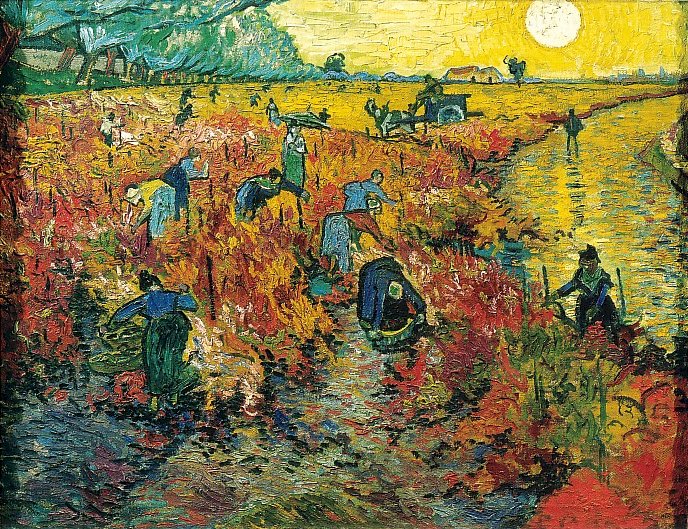
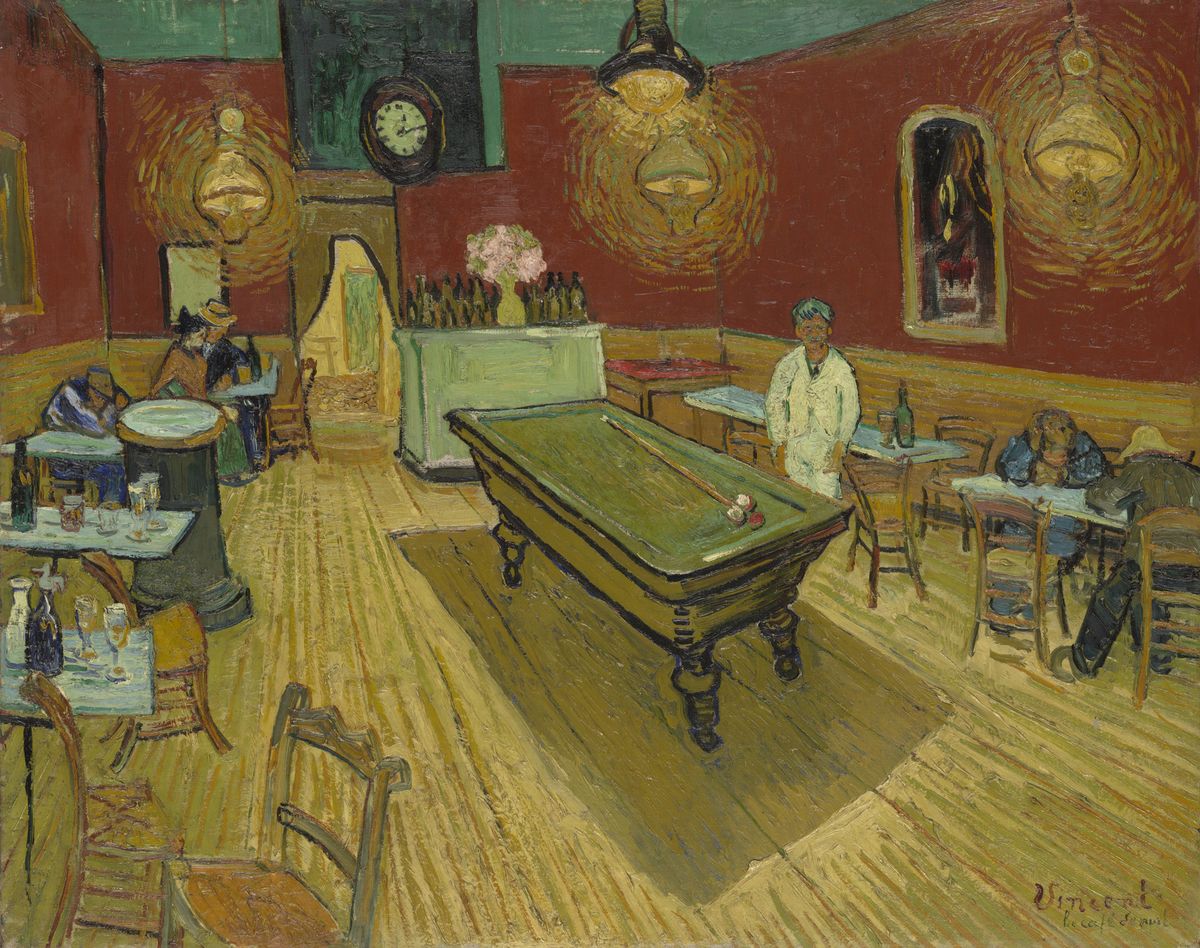
JLB 801, 9/10/1889: "When I see them again I'll do repetitions of that study of the Tarascon diligence, the Vineyard, the Harvest and above all the Red bar, that night café which is the most characteristic as regards colour." (The Tarascon Diligence [F 478a JH 1605], The Green Vineyard [F 475 JH 1595], The Red Vineyard [F 495 JH 1626], The Harvest [F 412 JH 1440], and The Night Café [F 463 JH 1575].)
Context:
BVG 605, 9/7/1889-9/8/1889: "When I see them again, I'll do some copies of those studies of the Diligence of Tarascon, the Vineyard, the Harvest, and above all of the Red Tavern, that Night Café which is the most characteristic of all as far as colour is concerned."
JLB 801, 9/10/1889: "When I see them again I'll do repetitions of that study of the Tarascon diligence, the Vineyard, the Harvest and above all the Red bar, that night café which is the most characteristic as regards colour." (The Tarascon Diligence [F 478a JH 1605], The Green Vineyard [F 475 JH 1595], The Red Vineyard [F 495 JH 1626], The Harvest [F 412 JH 1440], and The Night Café [F 463 JH 1575].)
Context:
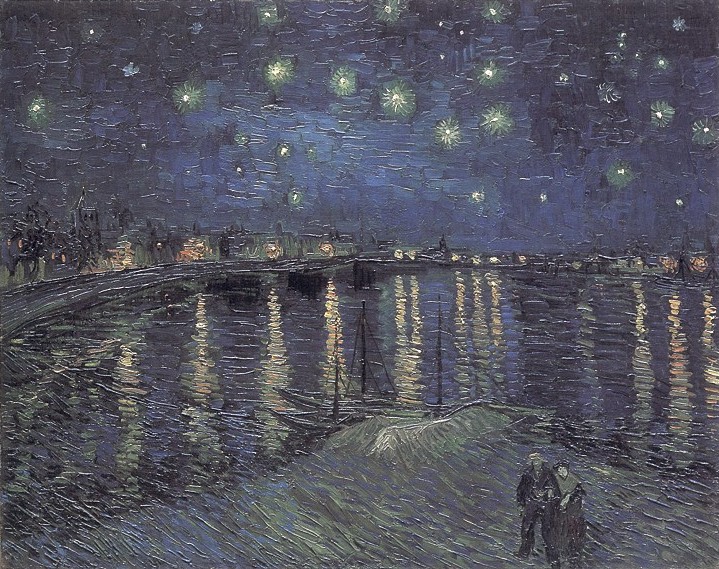
JLB 806, 9/28/1889: "This will give them a good start, and I think this will give both you and me some pleasure to ensure that our sister or sisters have a small collection of paintings. I'll do reductions of the best canvases with them in mind, in this way I also wanted them to have the red and green vineyard, the pink chestnut trees, the night effect that you exhibited." (The Green Vineyard [F 475 JH 1595], The Red Vineyard [F 495 JH 1626], Avenue of Chestnut Trees in Blossom [F 517 JH 1689], and Starry Night over the Rhône [F 474 JH 1592].)
Context:
BVG 608, 9/28/1889: "I am doing copies on a reduced scale of the best canvases for them, and I would also like them to have the red and green 'Vineyards,' the pink 'Chestnut Trees,' and the 'Night Effect' you exhibited." (The Green Vineyard [F 475 JH 1595], The Red Vineyard [F 495 JH 1626], Avenue of Chestnut Trees in Blossom [F 517 JH 1689], and Starry Night over the Rhône [F 474 JH 1592].)
JLB 806, 9/28/1889: "I'll do reductions of the best canvases with them in mind, in this way I also wanted them to have the red and green vineyard, the pink chestnut trees, the night effect that you exhibited."
Context:
JLB 800, 9/5/1889-9/6/1889: "Send me the canvas as soon as you can, because I want to do some more repetitions for the sisters too, and if I undertake new autumnal effects I'll have the wherewithal to fill my time from one end to the other for this month."
Context:
BVG 604, 9/5/1889-9/6/1889: "Send me the canvas as soon as you can, for if I still want to do other copies for the sisters, and if I am to make a start on the new autumn effects, I'll have enough to fill my time from the beginning of this month to the end."
JLB 800, 9/5/1889-9/6/1889: "Send me the canvas as soon as you can, because I want to do some more repetitions for the sisters too, and if I undertake new autumnal effects I'll have the wherewithal to fill my time from one end to the other for this month."
Context:
BVG 604, 9/5/1889-9/6/1889: "My dear brother -- I always write to you in between bouts of work, and I am working like one truly possessed, more than ever I am in the grip of a pent-up fury of work, and I'm sure it will help to cure me."
JLB 800, 9/5/1889-9/6/1889: "My dear brother -- I'm still writing to you between bouts of work -- I'm ploughing on like a man possessed, more than ever I have a pent-up fury for work, and I think that this will contribute to curing me."
Context:
JLB 800, 9/5/1889-9/6/1889: "Afterwards, what are we beginning to glimpse timidly at the moment that is original and lasting – the portrait. That's something old, one might say -- but it's also brand new. We'll talk more about this -- but let's still continue to seek out portraits, above all of artists, like the [Armand] Guillaumin and Guillaumin's portrait of a young girl, and take good care of my portrait by [John Peter] Russell, which means a lot to me. Have you framed the [Charles] Laval portrait, you haven't told me what you thought of it I think, I found it marvellous, that gaze through the pince-nez, such an honest gaze. The will that I have to do portraits these days is terribly strong, anyway Gauguin and I used to chat about that and about similar questions in such a way as to stretch our nerves to the extinction of all vital warmth." (Emphasis in original.)
Context:
BVG 602, 9/3/1889-9/4/1889: " The impossibility of getting models, however, and a lot of other things prevent me from doing it."
JLB 798, 9/2/1889: " The impossibility of having models, a heap of other things, prevent me from managing it however."
Context:
JLB 800, 9/5/1889-9/6/1889: "Yesterday I began the portrait of the chief orderly, and perhaps I'll also do his wife, for he's married and lives in a little farmhouse a stone's throw from the establishment."
Context:
JLB 800, 9/5/1889-9/6/1889: "Yesterday I began the portrait of the chief orderly, and perhaps I'll also do his wife, for he's married and lives in a little farmhouse a stone's throw from the establishment."
Thus, the portrait of Trabuc joins the Berceuse (F 506 JH 1670) as a painting in which Vincent intended to create a feeling of consolation but, in fact, created nothing of the sort -- or, at least, nothing that is accessible to modern eyes. The Trabuc that looks out from the surviving version of the image Portrait of Trabuc, an Attendant at Saint-Paul Hospital (F 629 JH 1774), which is the copy Vincent made for Theo, not the original) shows no trace of the intelligence, kindliness, or consolation that Vincent claimed for it. It does, however, support exactly Vincent's description as a "bird of prey" with "a military air" (no doubt a play on Trabuc's nickname, "The Major" [see Ch. 40, n. 165]).
It is possible, of course, that the original image, done from life, captured subtleties of personality that the copy does not. It is possible that Vincent saw those subtleties because he knew Trabuc but could not render them as well as he could describe them. Few if any of Vincent's portraits achieve psychological depth or subtlety. It is possible that Vincent's word description was intended to reassure Theo that Saint Paul was not a military or penal-style institution: that is, as a counterbalance to the image itself. Some subsequent commentators have claimed that Vincent's comparison of Trabuc to the premier Guizot and to "an old Spanish nobleman" in a Alphonse Legros etching (JLB 800, 9/5/1889-9/6/1889) was an intentional elevation of the working class -- or at a least leveling of class distinctions (see Sund, p. 184), but Trabuc did, in fact, bear a physical resemblance to Guizot, to go by contemporary prints (see Pickvance, p. 128.), and Vincent's dignified warden is no more class-disruptive than Hubert von Herkomer's heroicized workers in the Graphic or Jean-François Millet's romanticized peasants.
Context:
BVG 605, 9/7/1889-9/8/1889: "I've done the portrait of the attendant and have got a copy of it for you. It makes a fairly curious contrast with the portrait I've done of myself, in which the look is vague and veiled, whereas he has a military air and small, lively, black eyes."
JLB 801, 9/10/1889: "I've done the portrait of the orderly, and I have a repetition of it for you. It makes quite a curious contrast with the portrait I did of myself, in which the gaze is vague and veiled, while he has something military about him, and dark eyes that are small and lively."
Context:
BVG 604, 9/5/1889-9/6/1889: "If it were not a good deal softened -- completely softened -- by an intelligent look and an expression of kindliness, it would be a veritable bird of prey. It is very much a Southern type."
JLB 800, 9/5/1889-9/6/1889: "If it weren't very much tempered -- completely -- by an intelligent gaze and an expression of kindness -- he would be a real bird of prey. He really is a southern type."
Context:
BVG 604, 9/5/1889-9/6/1889: "What you told me about [Octave] Maus having been to see my canvases made me think a lot about the Belgian painters these last few days and also during my illness. As a result I was overwhelmed with memories as by an avalanche, and I tried to recall the whole of that school of modern Flemish artists until I felt as homesick as a fish out of water."
JLB 800, 9/5/1889-9/6/1889: "What you told me about Maus having been to see my canvases has made me think a lot about Belgian painters lately and during my illness. Then memories come to me like an avalanche, and I try to rebuild for myself that whole school of modern Flemish artists to the point of being as homesick as a Swiss."
Context:
BVG 604, 9/5/1889-9/6/1889: "What you told me about Maus having been to see my canvases made me think a lot about the Belgian painters these last few days and also during my illness. As a result I was overwhelmed with memories as by an avalanche, and I tried to recall the whole of that school of modern Flemish artists until I felt as homesick as a fish out of water."
JLB 800, 9/5/1889-9/6/1889: "What you told me about Maus having been to see my canvases has made me think a lot about Belgian painters lately and during my illness. Then memories come to me like an avalanche, and I try to rebuild for myself that whole school of modern Flemish artists to the point of being as homesick as a Swiss."
Context:
BVG 604, 9/5/1889-9/6/1889: "Which isn't any good, because our way lies -- forwards -- and retracing our steps is both impossible and impermissible. In other words one can think about the past without being swamped by an over-melancholic nostalgia."
JLB 800, 9/5/1889-9/6/1889: "Which isn't good, for our path is -- onward -- and retracing one's steps is forbidden and impossible. That's to say that one could think about it without getting lost in the past through an over-melancholy nostalgia."
Van Tilborgh, Van Heugten, and Conisbee, pp. 124-125: Vincent knew and loved the Millet images through the wood engravings of Jacques Adrien Lavieille after Millet's drawings, which appeared in 1852 in L'illustration and, a year later, in a separate album entitled Dessins de J.-F. Millet, graves par Adrien Lavieille. The images Vincent copied over the next few months, but mostly in September, were The Spinner (F 696 JH 1786), The Reaper (F 688 JH 1783), The Thresher (F 692 JH 1784), The Sheaf-Binder (F 693 JH 1785), The Sheep-Shearers (F 634 JH 1787), Peasant Woman Bruising Flax (Peasant Women Cutting Straw [after Millet] (F 697 JH1788), Peasant Woman with a Rake (F 698 JH 1789), Peasant Woman Binding Sheaves (F 700 JH 1781), The Reaper with Sickle (F 687 JH 1782), The Sower ([F 689 JH 1836] and [F 690 JH 1837]), The Shepherdess (F 699 JH 1838), and The Woodcutter (F 670 JH 1886).
Most of the Millet copies are within a relatively small range of size: about a foot and a half tall and a foot wide (17.25 x 12.5 in. or 44 x 32 cm). The extremes cited in the text are Peasant Woman with a Rake (15.5 x 9.5 in. or 39 x 24 cm.) on the small end and Two Peasants Digging (28.25 x 36.25 in. or 72 x 92 cm.) on the large end.

Van Tilborgh, Van Heugten, and Conisbee, p. 132: "This copy from Saint-Remy [Peasant Woman Binding Sheaves (F 693 JH 1785)] differs in details from the original engraving. The landscape in the print is difficult to decipher and in his copy the artist has devised his own background." Van Tilborgh, Van Heugten, and Conisbee also cite Vincent's The Shepherdess (F 699 JH 1838), where his bad copy of the Millet print "would not appear to have hampered the painter in creating this charming copy and he went on to give the shepherdess one clog while the original had two." Vincent reserved the right to simplify as well as to embellish. Homburg points out that in one of his copies after Millet, Morning (Morning: Peasant Couple Going to Work [F 684 JH 1880]), "[Vincent] did not pay great attention to the exact details of the background. In the case of a shepherd with his flock, for example, which is clearly visible in the wood engraving, Van Gogh omitted the group of sheep." (Homburg, p. 86.)
Context:
JLB 805, 9/20/1889: "At present I have 7 copies out of ten of Millet's Travaux des champs."
Context:
JLB 805, 9/20/1889: "I would like to have all of this, at least the etchings and the wood engravings. It's a study I need, for I want to learn. Although copying may be the old system, that absolutely doesn't bother me at all." (Emphasis in original.)
Context:
JLB 805, 9/20/1889: "In these same etchings is the Field under the snow with a harrow. Then The four times of the day, there are examples of them in the collection of wood engravings. I would like to have all of this, at least the etchings and the wood engravings." (Fields in Winter [The Harrow] by Alfred Alexandre Delauney and The Four Times of the Day by Lavieille after Millet.)
![Fields in Winter [The Harrow]](http://vangoghletters.org/vg/illustrations/1892.jpg)

BVG 607, 9/19/1889. In mid-September, not long after completing his copy after Delacroix's Pieta
Context:
JLB 805, 9/20/1889: "I would like to have all of this, at least the etchings and the wood engravings. It's a study I need, for I want to learn. Although copying may be the old system, that absolutely doesn't bother me at all. I'm going to copy Delacroix's Good Samaritan too." (Emphasis in original.)
The same three artists loomed large in Vincent's recovery a decade later, but, except for the angel, Vincent steered away from Rembrandt for months in his quest for figural subject matter. Why? He gives the answer in November 1889 in responding to news that Gauguin and Émile Bernard were doing paintings of biblical subjects: "And I'm not an admirer of Gauguin's Christ in the Garden of Olives for example, a croquis of which he sent me. ... I said that Rembrandt and Delacroix had done this admirably, that I liked that even better than the primitives, but then stop. I don't want to begin on that chapter again." (JLB 820, 11/19/1889.) In Vincent's fragile mental state, thinking about Gauguin and religious subject matter was too dangerous.
And it was impossible to think about Rembrandt without thinking about Gauguin. He reveals this in his letter to the critic Albert Aurier in February 1890: "Gauguin, that curious artist, that stranger whose bearing and gaze vaguely recall Rembrandt's Portrait of a man in the La Caze gallery" (JLB 853, 2/9/1890 or 2/10/1890). But the connection was already clearly made the previous August, just as Vincent emerged from the summer of attacks, when he wrote Theo, regarding the engraving of the angel he attributed to Rembrandt: "Thank you above all for that etching after Rembrandt. It's surprising, and yet it makes me think again of the man with the staff in the La Caze gallery. If you want to do me a very, very great pleasure, then send a copy of it to Gauguin." (JLB 797, 8/22/1889.) Vincent had previously mentioned the portrait in the Lacaze Gallery that Vincent refers to (like the angel, later de-attributed; see Ch. 40, n. 37) after his return from the trip to Montpelier with Gauguin, and had already, by his circuitous vision, seen Gauguin's image in it (JLB 726, 12/17/1888 or 12/18/1888). Vincent avoided Rembrandt's imagery -- despite its obviousness and ripeness for copying -- both for its inevitable religious overtones and its reminders of Gauguin.
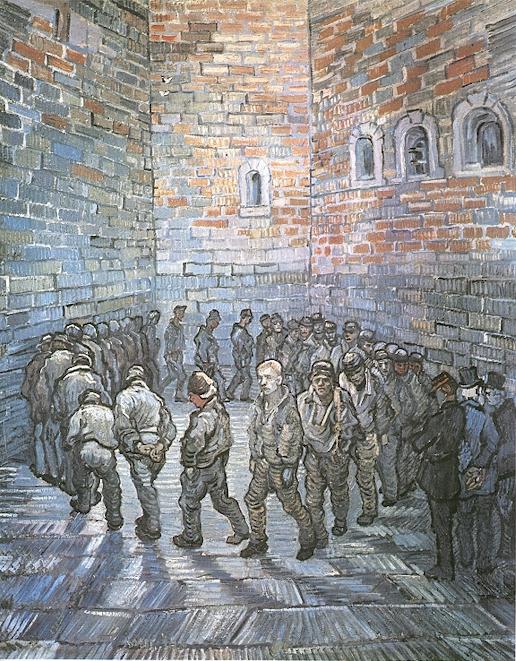
BVG 623, 1/12/1890-1/15/1890. The following January (1890), Vincent requested that Theo send him Daumier's (Honoré Daumier, 1808-1879; French artist) Drinkers. The resulting painting was The Drinkers (F 667 JH 1884). At the same time, Vincent asked for a print by Félix Régamey that he called the "Penitentiary." The following month, Vincent reported: "I've tried to copy Daumier's Drinkers and Doré's Penitentiary, it's very difficult." Either he had the name of the artist wrong or Theo sent him a substitute. The painting after Gustave Doré is Prisoners Exercising (F 669 JH 1885) (JLB 854, 2/12/1890).

Context:
JLB 839, 1/13/1890: "So what I'm pondering doing in painting is Daumier's Drinkers and Régamey's Penitentiary. You'll find them in among the wood engravings."
Context:
BVG 610, 10/8/1889: "I have copied that 'Woman with a Child Sitting by a Hearth,' by Mme. Dumont Breton, almost all in violet. I am certainly going on copying, that will give me a collection of my own, and when this is large and complete enough, I shall give the whole to a school."
JLB 810, 10/8/1889: "I've copied that woman with a child sitting beside a hearth by Mrs. Demont-Breton, almost all violet, I'm certainly going to continue copying, it will give me a collection of my own, and when it's sufficiently large and complete I'll give the whole lot to a school."
Context:
BVG 623, 1/12/1890-1/15/1890: "They will take quite a month more to dry, the three last ones, but once you get them, you will see clearly that they have been done out of a profound and sincere admiration for Millet. Then, whether they are someday criticized or despised as copies, it will nonetheless be true that they have their justification in the attempt to make Millet's work more accessible to the great general public."
JLB 839, 1/13/1890: "They'll take a good month more to dry, the last three, but once you have them you'll clearly see that they were done through a most profound and sincere admiration for Millet. Then, even if they're criticized one day or despised as copies, it will remain no less true that it's justifiable to try to make Millet's work more accessible to the ordinary general public."
Context:
JLB 815, 10/25/1889: "Perhaps I'd be more useful doing that than through my own painting."
Context:
BVG 607, 9/19/1889: "Many people do not copy, many others do -- I started on it accidentally, and I find that it teaches me things, and above all it sometimes gives me consolation."
JLB 805, 9/20/1889: "Heaps of people don't copy. Heaps of others do copy -- for me, I set myself to it by chance, and I find that it teaches and above all sometimes consoles."
Context:
BVG W14, 9/19/1889: "These last weeks I have also painted some pictures for myself -- I don't especially like to see my own pictures in my bedroom, which is why I copied one picture by Delacroix and some others by Millet."
JLB 804, 9/19/1889: "I've painted a few for myself, too, these past few weeks -- I don't much like seeing my own paintings in my bedroom, so I've copied one by Delacroix and a few by Millet."
Context:
JLB 805, 9/20/1889: "And now in the bad season I'm going to make a lot of copies, for really I must do more figure work. It's the study of the figure that teaches one to grasp the essential and to simplify. ... Then I know what to do when the weather is bad, as I have this plan to copy several things that I like."
Context:
JLB 810, 10/8/1889: "That's the terrible thing about the Impressionists, that the development of the thing gets stuck, and that for years they're left facing obstacles that the preceding generation had overcome, the difficulty of money and models."
Context:
BVG 605, 9/7/1889-9/8/1889: "I talked to her sometimes when I was doing some olive trees behind their little house, and she told me then that she didn't believe I was ill -- in fact, you would now say the same if you saw me working, my mind clear and my fingers so sure that I drew that Piet
Context:
BVG 605, 9/7/1889-9/8/1889: "I talked to her sometimes when I was doing some olive trees behind their little house, and she told me then that she didn't believe I was ill -- in fact, you would now say the same if you saw me working, my mind clear and my fingers so sure that I drew that Piet
Context:
JLB 805, 9/20/1889: "It's a study I need, for I want to learn. Although copying may be the old system, that absolutely doesn't bother me at all. ... I find that it teaches and above all sometimes consoles." (Emphasis in original.)
Context:
BVG 607, 9/19/1889: "When you say in your letter that I have always only been working, no -- I cannot agree -- I am myself very, very dissatisfied with my work, and the only thing that comforts me is that people of experience say you must paint ten years for nothing. But what I have done is only those ten years of unfortunate studies that didn't come off."
JLB 805, 9/20/1889: "When you say in your letter that I've never done anything but work, no -- that's not right -- I myself am very, very discontented with my work, and the only thing that consoles me is that experienced people say that one must paint for 10 years for nothing. But what I've done is only those 10 years of unfortunate studies that didn't come off."
Context:
JLB 801, 9/10/1889: "Ah, I'll never be able to render my impressions of certain figures I've seen here. Certainly the road to the south is the road where there's something brand new, but men of the north have difficulty in getting through. And I can see myself already in advance, on the day when I have some success."
Context:
BVG W15, 10/20/1889-10/22/1889: "But it is difficult to return to one's ordinary way of life while one is too despondent over the uncertainty of misfortune. And one goes on clinging to the affections of the past."
JLB 812, 10/21/1889: "But how difficult it is, how difficult it is to resume one's ordinary life without being absolutely too demoralized by the certainty of unhappiness. And one clings on to the affections of the past."
Context:
BVG 613, 11/2/1889: "You will see it; it seems to me that painting from these drawings of Millet's is much more translating them into another tongue than copying them."
JLB 816, 11/3/1889: "It seems to me that doing painting after these Millet drawings is much rather to translate them into another language than to copy them" (emphasis in original).
Context:
BVG 607, 9/19/1889: "And then I improvise colour on it, not, you understand, altogether myself, but searching for memories of their pictures -- but the memory, 'the vague consonance of colours which are at least right in feeling' -- that is my own interpretation."
JLB 805, 9/20/1889: "And then I improvise colour on it but, being me, not completely of course, but seeking memories of their paintings -- but the memory, the vague consonance of colours that are in the same sentiment, if not right -- that's my own interpretation" (emphasis in original).
Context:
BVG 607, 9/19/1889: "And then I improvise colour on it, not, you understand, altogether myself, but searching for memories of their pictures -- but the memory, 'the vague consonance of colours which are at least right in feeling' -- that is my own interpretation."
JLB 805, 9/20/1889: "And then I improvise colour on it but, being me, not completely of course, but seeking memories of their paintings -- but the memory, the vague consonance of colours that are in the same sentiment, if not right -- that's my own interpretation" (emphasis in original).
Context:
BVG 607, 9/19/1889: "And then I improvise colour on it, not, you understand, altogether myself, but searching for memories of their pictures -- but the memory, 'the vague consonance of colours which are at least right in feeling' -- that is my own interpretation."
JLB 805, 9/20/1889: "And then I improvise colour on it but, being me, not completely of course, but seeking memories of their paintings -- but the memory, the vague consonance of colours that are in the same sentiment, if not right -- that's my own interpretation" (emphasis in original).
Context:
BVG 607, 9/19/1889: "So be it -- but it isn't like that in music -- and if some person or other plays Beethoven, he adds his personal interpretation -- in music and more especially in singing -- the interpretation of a composer is something, and it is not a hard and fast rule that only the composer should play his own composition."
JLB 805, 9/20/1889: "Very well -- but in music it isn't so -- and if such a person plays some Beethoven he'll add his personal interpretation to it -- in music, and then above all for singing -- a composer's interpretation is something, and it isn't a hard and fast rule that only the composer plays his own compositions."
Context:
BVG 607, 9/19/1889: "And then my brush goes between my fingers as a bow would on the violin, and absolutely for my own pleasure."
JLB 805, 9/20/1889: "So then my brush goes between my fingers as if it were a bow on the violin and absolutely for my pleasure."
Context:
BVG 607, 9/19/1889: "Very good -- and I, mostly because I am ill at present, I am trying to do something to console myself, for my own pleasure. … Many people do not copy, many others do -- I started on it accidentally, and I find that it teaches me things, and above all it sometimes gives me consolation."
JLB 805, 9/20/1889: "Good -- since I'm above all ill at present, I'm trying to do something to console myself, for my own pleasure. … Heaps of others do copy -- for me, I set myself to it by chance, and I find that it teaches and above all sometimes consoles."
Context:
BVG 133, 7/1/1880: "And I do not regret that, and even now, far from home, I often feel homesick for the land of pictures."
JLB 155, 6/22/1880-6/24/1880: "And I don't repent it, and now, far from the country again, I often feel homesick for the country of paintings."
By fleshing out his strange assertion that Conscience's sentimental portrait of peasant life is really of a piece with avant-garde art, Vincent is, au fond, trying to synthesize Theo's interest in the new art with their prior shared interest (and Vincent's continuing interest) in sentimental peasant art, i.e., Millet. Note how Vincent describes a scene from the Conscience book exactly as if he were describing a work by himself or Gauguin. In the next letter, he further pursues this irrational parallel (both in art and in their lives): "Anyway, Henri Conscience isn't a perfect writer at all, but here and there, more or less everywhere, what a painter! And what kindness in what he said and wished for." (JLB 800, 9/5/1889-9/6/1889.) Le conscrit (The Recruit), which tells the story of a young man's departure for military service and his tearful return to a welcoming family, was not only among Vincent's favorite books, but also perhaps Conscience's most sentimental, Victorian, and thus anti-modernist work.
Like the Millet Travaux, Le conscrit had played a role in Vincent's climb out of an earlier crisis. In 1876, after being dismissed by Goupil and exiled to England, Vincent copied out a long passage from the book that he recalled again in 1889 (see Ch. 40, n. 215): "I have been ill. My spirit was weary, my soul disenchanted, my body sickly. I, whom God has at least endowed with moral energy and a vast instinct for affection, was falling into the depths of the bitterest discouragement, and I felt with terror a deadly poison creeping into my shrivelled heart. I have spent three months on the heath: you know, that lovely region where the soul returns to itself and enjoys sweet repose; where everything exudes peace and tranquillity; where the soul, in the presence of God's immaculate creation, shakes off the yoke of convention, forgets society and frees itself from its bonds with the vigour of returning youth; where every thought takes on the form of prayer; where the heart is emptied of everything that is not in harmony with the freshness and freedom of nature. Oh, there the weary soul finds calm; there, the exhausted man regains a youthful strength. Thus were my days of sickness spent. ... And in the evening! To sit under the wide chimney-piece, feet in the ashes, eyes fixed upon a star that sends me its light from on high through the chimney-top, as if calling out to me; or, sunk in a vague reverie, to look at the fire, watching the flames come to life, grow, gasp and crackle, pushing each other aside as if vying to lick the cooking-pot with their tongues of fire -- and to imagine that this is human life: to be born, to work, to love, to grow up, and to die. ..." (JLB 93, 10/7/1876-10/8/1876.)
Context:
JLB 798, 9/2/1889: "Speaking of that -- not very long ago in Arles I was reading a book, I can't remember which one, by Henri Conscience. It's excessively sentimental if you like, what with his peasants, but speaking of Impressionism do you know that it contains descriptions of landscape with colour notes of accuracy, feeling and primitiveness of the first order." (Emphasis in original.)
Context:
BVG 604, 9/5/1889-9/6/1889: "The inevitability of suffering and despair -- well, here I am, bucked up again for a time -- and I thank him for it."
JLB 800, 9/5/1889-9/6/1889: "This inevitability of suffering and despair -- anyway, here I am again, recovered for a period -- I'm thankful for it."
Context:
JLB 798, 9/2/1889: "You'll soon see a canvas of a hut in the mountains which I did under the influence of that book by Rod. It would be good for me to stay on a farm for a while, at least I might do some good work there."
Context:
BVG 605, 9/7/1889-9/8/1889: "Yet to see the country, one must live with the ordinary folk and in the cottages, the inns, etc."
JLB 801, 9/10/1889: "And yet to see the country one must live with the common people and in the little houses, the bars &c."
Context:
BVG 602, 9/3/1889-9/4/1889: "Wasn't he able to study nature as a hunter and as a woodsman, didn't he love it and know it from the experience of a long life, virile and complete -- and do you think that any chance Parisian who goes to the suburbs knows as much or more about it because he does a landscape in cruder tones?"
JLB 798, 9/2/1889: "Was he not able to study nature as a hunter, a savage, did he not love it and know it with experience of an entire long manly life -- and do you think that the first Parisian to come along who goes to the suburbs knows as much or more about it because he'll do a landscape with harsher tones?"
Context:
JLB 799, 9/5/1889: "There's old père Pissarro, who has all the same done some really fine things lately, and it's precisely there that one also finds these qualities of rusticity which show immediately that the man is more at his ease in a pair of clogs than in polished boots."
Context:
BVG T16, 9/5/1889: "The woman is somewhat like a young cow, but there is something so fresh in it, and then again something so countrified, that it is very pleasant to see."
JLB 799, 9/5/1889: "The woman looks a little like a young cow, but there's something so fresh and once again so countrified, that it's most agreeable to see."
Context:
BVG T16, 9/5/1889: "It is a fact that in town you meet people who are certainly interesting too, but at times you have had enough of it, and so, as long as you cannot go there, a picture of the true countryside does you good, and certainly at such moments of surfeit a [Karl] Bodmer will give you as much pleasure, or rather more than some picture done with a scientifically clever technique, but without that true and wholesome something which is to be found in a slice of brown bread."
JLB 799, 9/5/1889: "It's true that in town one meets people who are certainly interesting too, but one sometimes has enough of it, and then when one can't go away a painting of the real countryside does one good, and in those moments, certainly, a Bodmer will give as much or more pleasure as some painting that is technically clever but which doesn't have that something true and healthy like a slice of black bread."
Context:
BVG T16, 9/5/1889: "There you have old Father Pissarro, who notwithstanding everything has done very fine things recently, and in them you also find those qualities of rusticity which show immediately that man is more at ease in wooden shoes than in patent-leather boots."
JLB 799, 9/5/1889: "There's old père Pissarro, who has all the same done some really fine things lately, and it's precisely there that one also finds these qualities of rusticity which show immediately that the man is more at his ease in a pair of clogs than in polished boots."
Context:
BVG 615, 11/21/1889: "What I have done is a rather hard and coarse reality beside their abstractions, but it will have a rustic quality, and will smell of the earth."
JLB 823, 11/26/1889: "What I've done is a rather harsh and coarse realism beside their abstractions, but it will nevertheless impart the rustic note, and will smell of the soil."
Context:
BVG 600, 7/9/1889: "The fact that in Paris you take on, as it were, a second nature, which over and above the preoccupation of business and art makes you less strong than the peasants -- that fact does not prevent you from linking yourself through the bonds of a wife and child, with this simpler and truer nature, the ideal of which keeps haunting us."
JLB 789, 7/14/1889 or 7/15/1889: "The fact that one takes on a kind of second nature in Paris, that moreover preoccupations with business and art make one less strong than the peasants, doesn't prevent one, through the bonds of having wife and child, from reattaching oneself all the same to that simpler and truer nature whose ideal sometimes haunts us."
Here the theme of exclusivity emerges for the first time -- the notion that there are some things in art that only Vincent and Theo can truly see. One of those, Vincent insists in his rising fever of solidarity, is the sublimity of the human figure: "Now a Meissonier, if you look at it for a year there's still enough in it to look at the next year, never fear. Not to mention that he's a man who had his days of happiness, of perfect finds. ... one has to be blind to believe that Meissonier isn't an artist and -- one of the first rank." (ibid.) Vincent draws the circle of the cognoscenti tighter with a reference to two Bernard paintings that he and Theo had seen: "When [Paul-Albert] Besnard did those two very beautiful panels, primitive man and modern man, which we saw at Petit's, in making the modern man a reader he had the same idea." By this route, Vincent ends with a grand conceptual synthesis, a great entente, between the Romantics, like Millet, and the moderns, like Monet -- and thus between himself and his brother: "I'll always regret that in our times people believe in the incompatibility of the generation of, say, 48 and the present one. I myself believe that the two hold their own all the same." Vincent takes as his surrogate for his great reconciliation Karl Bodmer, who, not coincidentally, had credentials both as a Barbizon painter and as an explorer of primitive worlds (he had accompanied an expedition to the American West in the 1830s). Bodmer thus combined Millet's appreciation of the sublime rustic life and avant-garde insights into the sublimity of the primitive.
"Let's take good Bodmer for example. Was he not able to study nature as a hunter, a savage, did he not love it and know it with experience of an entire long manly life -- and do you think that the first Parisian to come along who goes to the suburbs knows as much or more about it because he'll do a landscape with harsher tones?" (ibid.) This is a jab not only at modern artists who, unlike Vincent and Bodmer, do not have the courage to confront directly the primitive in life, but also a pointed reminder to Theo that he can never fuller appreciate this primitive sublimity directly now that he has truly settled in Paris. No. Henceforth, he will have to rely on Vincent to do his "long" and "manly" living for him. But that will be possible, he adds, because they, like Bodmer, have a shared love of nature and shared past in nature: " from the point of view of colour I'm always an admirer of Bodmer, but I admire and I like the man who knew all the forest of Fontainebleau, from the insect to the wild boar and from the stag to the lark. From the tall oak and the lump of rock to the fern and the blade of grass" (ibid.; emphasis in original). Vincent concludes this extravagant lesson with a reminder that no one other than Theo could possibly understand and appreciate it: "Now a thing like that, not anyone who wants to can feel it or find it" (ibid.).
Context:
BVG 602, 9/3/1889-9/4/1889: " Oh, my dear brother, that heath down there in the Campine was something after all. But there, it will not come again, so let's go on."
JLB 798, 9/2/1889: " Ah my dear brother, those heaths in the Kempen were something though. But anyway, that won't come back, and onward we go."
Context:
BVG 602, 9/3/1889-9/4/1889: "Now a thing like that is not felt, nor even found by any chance comer."
JLB 798, 9/2/1889: "Now a thing like that, not anyone who wants to can feel it or find it."
Context:
BVG 347, 12/18/1883: "Something better than the days of the Rijswijk mill -- namely the same thing but for good and all -- two poor brother artists -- bound up in one and the same feeling, for one and the same nature and art -- will it ever come to that?"
JLB 414, 12/16/1883: "Something better than the time of the Rijswijk mill -- namely the same once and for all -- two poor brothers, artists -- bound up in the same feeling for the same nature and art -- will it ever come to that?"
Context:
BVG 604, 9/5/1889-9/6/1889: "At the moment my mind is working in an orderly way, and I feel completely normal -- and when I look at my present condition, in the hope of generally having, between the attacks -- if, unfortunately, it is to be expected that they will return from time to time -- of having in between times, periods of lucidity and of working -- when I look at my condition at present, then I do indeed tell myself that it won't do to become obsessed with being sick."
JLB 800, 9/5/1889-9/6/1889: "At the moment my mind is functioning regularly and I feel absolutely normal -- and if I think rationally at present about my condition with the hope of having in general between the crises -- if, unfortunately, it's to be feared that this will always recur from time to time -- of having periods of clarity and work between times -- if I think rationally at present about my condition then certainly I tell myself that I mustn't have the idée fixe of being ill" (emphasis in original).
Context:
BVG 604, 9/5/1889-9/6/1889: "I'm eating and drinking like a horse at present."
JLB 800, 9/5/1889-9/6/1889: "I'm eating and drinking like a wolf at present."
Context:
JLB 808, 10/5/1889: "I must ask you to send me the whites I asked for as soon as possible, and to add to them some canvas, 5 metres or 10, whichever suits. ... I'm using two colours here, lead white and ordinary blue, but in quite large quantities, and the canvas, that's for when I want to work on unprepared, stronger canvas."
A shipment on or about September 20 included Olive Trees with the Alpilles in the Background (F 712 JH 1740), Mountains at Saint-Rémy with Dark Cottage (F 622 JH 1766), Mountainous Landscape Behind Saint-Paul Hospital (F 611 JH 1723), Orchard in Blossom (F 511 JH 1386), Entrance to a Quarry (F 744 JH 1802), and either Olive Grove (F 585 JL 1758) or Olive Grove (F 715 JH 1759). (See JLB 805, notes 17-25.) On September 28, less than two weeks later, Vincent sent another batch, including Green Wheat Field with Cypress (F 719 JH 1725), Study of Cypresses (F 613 JH 1746), two versions of Wheat Field and Cypresses (Wheat Field with Cypresses [F 615 JH 1755] and Wheat Field with Cypresses at the Haute Galline Near Eygalières [F 717 JH 1756]), two versions of The Reaper (Wheat Field with Reaper and Sun [F 617 JH 1753] and Wheat Fields with Reaper at Sunrise [F 618 JH 1773]), Tree Trunks with Ivy [F 746 JH 1762]), Field with Poppies (F 581 JH 1751), Starry Night (F 612 JH 1731), and Evening Landscape with Rising Moon (F 735 JH 1761) (JLB 806, 9/28/1889). The last three listed paintings in this second batch were apparently left out of the first batch after the list was drawn up. (See Pickvance, pp. 296-298.)
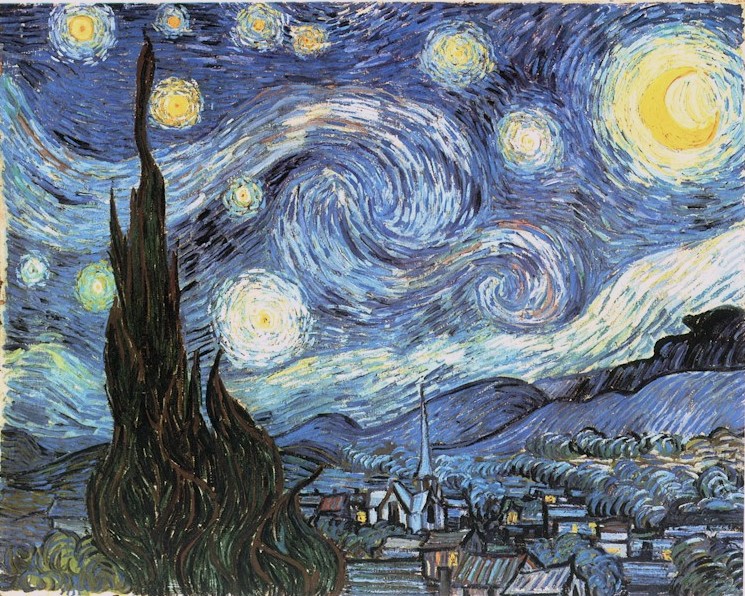
Context:
JLB 805, 9/20/1889: "I'm sending you a few canvases with the portrait, the following / Moonrise (wheatsheaves) / Study of fields / ,, of olive trees / Night study / The mountain / Field of green wheat / Olive trees / Orchard in blossom / Entrance to a quarry."
Paintings of the asylum garden that date from Vincent's first ventures out in late September and early October are Trees in the Garden of Saint-Paul Hospital (F 642 JH 1798), Trees in the Garden of Saint-Paul Hospital (F 643 JH 1799), The Garden of Saint-Paul Hospital (F 640 JH 1800), Trees in the Garden of Saint-Paul Hospital (F 731 JH 1801).
Context:
JLB 822, 11/26/1889: "I've let myself become thoroughly imbued with the air of the small mountains and the orchards."
Context:
BVG 609, 10/5/1889: "That said, I tell you that we are having some superb autumn days and that I am taking advantage of them."
JLB 808, 10/5/1889: "That said, I'll tell you that we're having some superb autumn days, and that I'm taking advantage of them."
Two Poplars on a Road Through the Hills, F 638 JH 1797, October 1889, oil on canvas, 24 x 17.9 in., 61 x 45.5 cm., The Cleveland Museum of Art, Cleveland, Ohio.
The Mulberry Tree, F 637 JH 1796, October 1889, oil on canvas, 21.3 x 25.6 in., 54 x 65 cm., Norton Simon Museum of Art, Pasadena, California. (See Ch. 40, n. 241.)
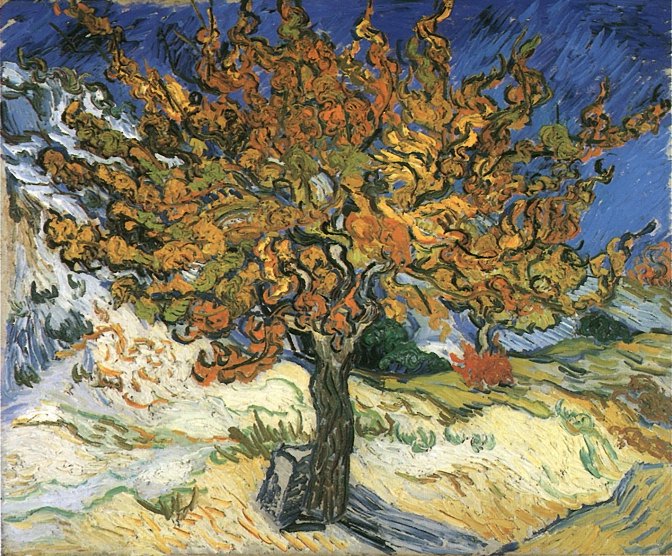
BVG 609, 10/5/1889: Vincent says this about The Mulberry Tree, F 637 JH 1796, October 1889, oil on canvas, 21.3 x 25.6 in., 54 x 65 cm., Norton Simon Museum of Art, Pasadena, California.
Context:
JLB 808, 10/5/1889: "I have a few studies, among others a mulberry tree, all yellow on stony ground standing out against the blue of the sky, in which study I think that you'll see that I've found [Adolphe] Monticelli's track."
The Mulberry Tree, F 637 JH 1796, October 1889, oil on canvas, 21.3 x 25.6 in., 54 x 65 cm., Norton Simon Museum of Art, Pasadena, California.
BVG 609, 10/5/1889: The Garden of Saint-Paul Hospital, F 640 JH 1800, October 1889, oil on canvas, 25.4 x 19.3 in., 64.5 x 49 cm., Private collection, Geneva.
Context:
JLB 808, 10/5/1889: "I have a few studies, among others a mulberry tree, all yellow on stony ground standing out against the blue of the sky, in which study I think that you'll see that I've found Monticelli's track."
Context:
JLB 808, 10/5/1889: "I have a few studies, among others a mulberry tree, all yellow on stony ground standing out against the blue of the sky, in which study I think that you'll see that I've found Monticelli's track."
Context:
JLB 806, 9/28/1889: "It's silver, sometimes more blue, sometimes greenish, bronzed, whitening on ground that is yellow, pink, purplish or orangeish to dull red ochre. But very difficult, very difficult. But that suits me and attracts me to work fully in gold or silver."
Context:
JLB 801, 9/10/1889: "I spoke with her from time to time when I was doing olive trees behind their little farmhouse, and then she told me that she didn't think that I was ill -- anyway, you would say that too at present if you saw me working, with my thoughts clear and my fingers so sure that I drew that Delacroix Piet
Context:
BVG W14, 9/19/1889: "The other day I finished the portrait of a woman upward of forty years old, an insignificant woman. The withered face is tired, pockmarked -- a sunburned, olive-colored complexion, black hair."
JLB 804, 9/19/1889: "I've just finished the portrait of a woman of forty or more, insignificant. The face faded and tired, pockmarked, an olive-tinged, suntanned complexion, black hair."
Context:
BVG W14, 9/19/1889: " Never mind, this is going to change too, for now my health is so good that I suppose the physical part of me will gain the victory."
JLB 804, 9/19/1889: " Anyway, that will change again, for my health is so good that the physique will win the day again."
When Vincent made a copy of the image in December, he wrote his mother about it: "At the moment I'm working on a painting of a path between the mountains and a small stream that works its way between the stones. The rocks are solid lilac grey or pink, with bushes here and there: box and a sort of broom, that have all sorts of colours, green, yellow, red, brown, because of the autumn. And the stream in the foreground white and foaming like soapsuds, and further up reflecting the blue of the sky." (JLB 831, 12/23/1889.) It appears that Vincent made this copy (Les Peiroulets Ravine [F 661 JH 1871]) because he was not satisfied with the first one done in October. That is probably why he did the réplique on an identical large canvas, instead of the smaller format he typically used for copies. In January, he sent Theo the first version with apologies and assurances that a second one had been finished but was still drying: " The ravine. This is the study done on a day when the mistral was blowing I had wedged my easel in place with large stones the painting [i.e., copy] of this isn´t dry, it's in a tauter drawing style, and there's more suppressed passion and it has more colour." (JLB 834, 1/3/1890; emphasis added.)
Context:
BVG 610, 10/8/1889: "I have a sterner study than the previous one of the mountains. A very wild ravine where a small stream winds its way along its bed of rocks. It is all violet. I could certainly do a whole series of these Alps, for having seen them for a long time now, I am more up to it."
JLB 810, 10/8/1889: "I have a study, rougher than the previous one of the mountains. A very wild ravine where a slender stream weaves its way along its bed of rocks. It's all violet. I could certainly do an entire series of these Alpilles, for having seen them for a long time now I've got used to it a little."
BVG 621, 1/3/1890. Vincent later reported that The Ravine (F 662 JH 1804) was done "on a day when the mistral was blowing" and that "I had wedged my easel in place with large stones" (JLB 834, 1/3/1890).
Context:
JLB 834, 1/3/1890: " The ravine. This is the study done on a day when the mistral was blowing I had wedged my easel in place with large stones the painting of this isn´t dry, it's in a tauter drawing style, and there's more suppressed passion and it has more colour." (Emphasis in original.)
Context:
BVG 610, 10/8/1889: "It is all violet. I could certainly do a whole series of these Alps, for having seen them for a long time now, I am more up to it."
JLB 810, 10/8/1889: "It's all violet. I could certainly do an entire series of these Alpilles, for having seen them for a long time now I've got used to it a little."
Context:
BVG 610, 10/8/1889: "I have a sterner study than the previous one of the mountains."
JLB 810, 10/8/1889: "I have a study, rougher than the previous one of the mountains."
Context:
JLB 810, 10/8/1889: "I could certainly do an entire series of these Alpilles, for having seen them for a long time now I've got used to it a little."
Context:
BVG 610, 10/8/1889: "I could certainly do a whole series of these Alps, for having seen them for a long time now, I am more up to it."
JLB 810, 10/8/1889: "I could certainly do an entire series of these Alpilles, for having seen them for a long time now I've got used to it a little."
Context:
JLB 834, 1/3/1890: " The ravine. This is the study done on a day when the mistral was blowing I had wedged my easel in place with large stones the painting of this isn´t dry, it's in a tauter drawing style, and there's more suppressed passion and it has more colour." (Emphasis in original.)
Entrance to a Quarry near Saint-Rémy, F 635 JH 1767, October 1889, oil on canvas, 20.5 x 25.2 in., 52 x 64 cm., Private Collection. Pickvance identifies the distinctive double opening depicted in Vincent's painting as the quarry of "Salade or Noé" (Pickvance, p. 152). This is not the same quarry that Vincent painted in July (Entrance to a Quarry [F 744 JH 1802]) (see Ch. 39, n. 529).
Context:
BVG B20, 10/8/1889: " I have been more master of myself in these last studies, because my health has steadied. … This will prove to you, I hope, that I have not got soft yet."
JLB 809, 10/8/1889: " I had more control over myself in these latest studies, because my state of health had firmed up. … That will prove, I hope, that I haven't yet gone soft."
Context:
BVG T18, 10/4/1889: "He says that for the present you are absolutely healthy, and if it weren't for the fact that it is such a short time since you had that crisis, he would already have encouraged you to leave the establishment more often."
JLB 807, 10/4/1889: "For the moment he says that you're absolutely healthy, and if it weren't such a short time since you'd had a crisis he would already have encouraged you to go outside the establishment more often."
Context:
JLB 807, 10/4/1889: "He tells me that as your trip to Arles brought on a crisis one would have to see if you can now bear a change before changing residence. If you bear these ordeals well, he sees nothing against your leaving him."
Context:
JLB 807, 10/4/1889: "I've seen Pissarro and I've talked to him about the matter. I think that he doesn't have much to say at home, where his wife wears the trousers. After a few days he told me that it wasn't possible at his home, but that he knows someone in Auvers, who's a doctor and does painting in his free moments. He tells me that he's a man who has been in touch with all the Impressionists. He thinks that you could probably stay at his home. He'll go and see him and speak to him about the matter."
Context:
BVG 609, 10/5/1889: " What you say of Auvers is nevertheless a very pleasant prospect, and either sooner or later -- without looking further -- we must fix on that."
JLB 808, 10/5/1889: " What you say of Auvers is nevertheless a very agreeable prospect to me, and sooner or later that ought to be fixed without seeking further."
Context:
BVG T18, 10/4/1889: "In the wheat field there is that unshakable something which nature has, even in her fiercest aspects."
JLB 807, 10/4/1889: "There is in the wheatfield that unshakeable side that nature has, even in its wildest aspects."
Vincent had acknowledged Isaäcson's earlier interest in June 1889, before the attacks of summer: "It gives me great pleasure that Isaäcson found things in my consignment that please him. He and De Haan appear very faithful, which is sufficiently rare these days for it to be worthy of appreciation." (JLB 782, 6/18/1889.) In October, however, Theo did not mention the reference to "Vincent" in the August paper, for reasons that are not clear -- perhaps to preserve the surprise when Vincent actually read the article. (Theo subsequently sent him copies of several Isaäcson articles [JLB 807, 10/4/1889].) Theo did, however, prepare Vincent for Isaäcson's overheated symbolist prose: "I don't like his researches into new words, but basically he talks of good things, which the majority of art critics do not" (ibid.).
A similar desire to preserve the delight of surprise can be found in Jo's letter to Vincent's sister Wil on August 23, in which she writes without revealing the secret: "Do you read the weekly 'De Portefeuille'? when it is not in your reading club, try to get hold of it; in the issue of August there is an article by Isaacson about July 14 in Paris -- which is not so remarkable, but in the two issues following there are reflections on art, in connection with the exhibition of course, which, I think, you will read with just as much pleasure as we do" (b0944 V/1962, ''Gogh-Bonger, Jo van'' to ''Gogh, Willemina van'', 8/23/1889; quoted in Hulsker, "What Theo Really Thought of Vincent," pp. 18-19). It is undoubtedly true that Isaäcson's August column constitutes either a remarkable act of aesthetic prospicience or a remarkable coincidence of national chauvinism (hinted at by De Haan's expressed admiration for Vincent's Langlois Bridge (F 397 JH 1368) [see Jampoller, in Van Uitert and Hoyle, eds., pp. 30-33], hardly the artist's most forward-looking image). It should be noted also that Isaäcson had not yet met Vincent when he wrote this appreciation of his art (JLB 811, 10/21/1889).
Context:
JLB 807, 10/4/1889: "Isaäcson, who has lately been writing in a Dutch newspaper, would like to write about your works. He's asked me if he may have certain things at his home, among others the mountains and the wheatfield."
Context:
JLB 813, 10/22/1889: "I've had several people to see your paintings. [Jozef] Israëls' son, who has been living in Paris for a while, [Jan Pieter] Veth, a Dutchman who does portraits and who writes in De Nieuwe Gids, that journal you've perhaps heard about that makes people so indignant but in which good things often appear, and then [Theo] Van Rijsselberghe, one of the Vingtistes from Brussels, the latter also saw everything there is at Tanguy's, and your works seem to interest him a great deal."
Theo described the hanging in detail to Vincent: Starry Night over the Rhône (F 474 JH 1592) "is badly placed, for one can't position oneself far enough away, as the room is very narrow, but the other one [Irises (F 608 JH 1691)] looks extremely well. They've placed it on the narrow side of the room and it strikes you from a long way off. It's a fine study, full of air and life." (JLB 799, 9/5/1889.)
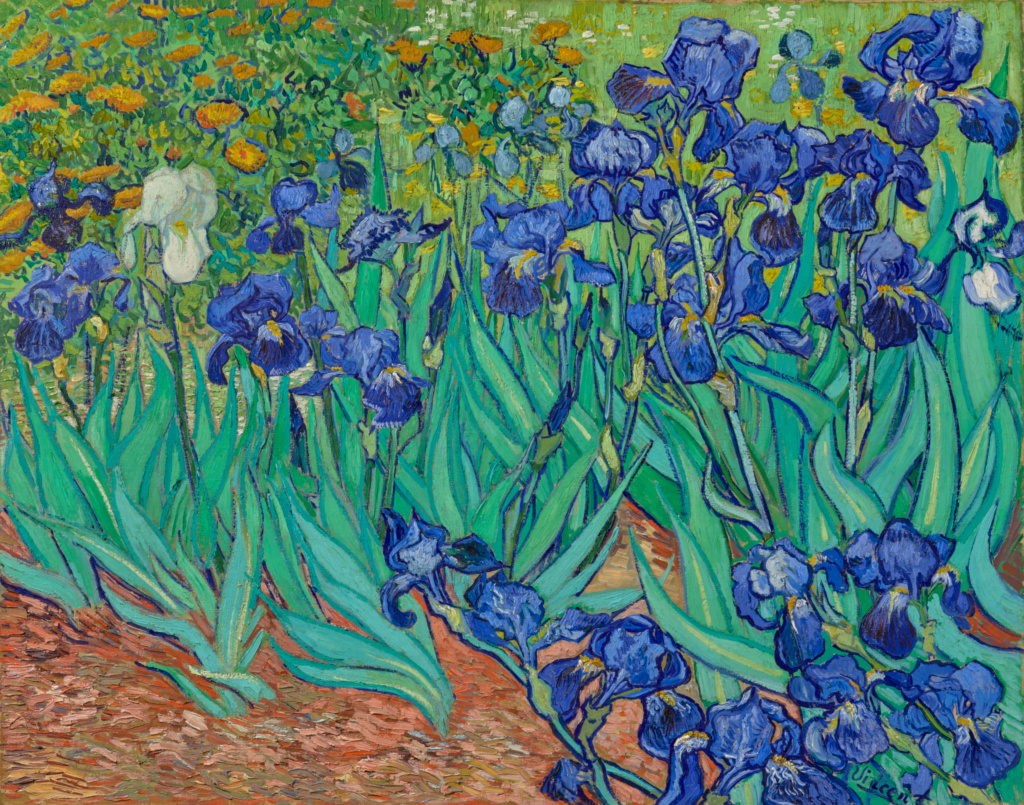
Context:
JLB 799, 9/5/1889: "There are some [Toulouse-]Lautrecs which look very well, among them a Ball at the Moulin de la Galette which is very good. One could send only two paintings each because the exhibition is being held in premises much smaller than where it was up to now. [Georges] Seurat has some seasides [Le Crotoy, Downstream and Port-en-Bessin], [Paul] Signac two landscapes [Seurat actually exhibitied three landscapes: Portrieux: The Jetty, Grey Weather, Opus 180, Portrieux, the Harbour, Opus 190, and Cassis: The Jetty, Opus 198.]."

Context:
JLB 813, 10/22/1889: "I've had several people to see your paintings. Israëls' son, who has been living in Paris for a while, Veth, a Dutchman who does portraits and who writes in De Nieuwe Gids, that journal you've perhaps heard about that makes people so indignant but in which good things often appear, and then Van Rijsselberghe, one of the Vingtistes from Brussels, the latter also saw everything there is at Tanguy's, and your works seem to interest him a great deal."
Context:
BVG 604, 9/5/1889-9/6/1889: "It is curious that Maus had the idea of inviting young Bernard and me for the next Vingtistes exhibition. I should like to exhibit with them very much, though I'm conscious of my inferiority by the side of so many tremendously talented Belgians."
JLB 800, 9/5/1889-9/6/1889: "It's curious that Maus has the idea of inviting young Bernard and me for the next Vingtistes exhibition, I would really like to exhibit there, while feeling my inferiority alongside so many Belgians who have an enormous amount of talent."
Context:
BVG 604, 9/5/1889-9/6/1889: "Actually, I care very little one way or another, it might be preferable if they did forget all about me."
JLB 800, 9/5/1889-9/6/1889: "Now, it would be absolutely the same to me, if not preferable, if they forget me."
Context:
BVG B20, 10/8/1889: "The olive trees here, old man, would be the very thing for you. I haven't had much of a chance to get them right this year, but I intend to return to the charge; they are silver against a soil of orange and violet hues, under the large white sun."
JLB 809, 10/8/1889: "The olive trees down here, my good fellow, they'd suit your book; I haven't been fortunate this year in making a success of them, but I'll go back to it, that's my intention. It's silver against orangeish or purplish earth, under the great blue sky."
BVG B20, 10/8/1889. Vincent describes one of his paintings (Entrance to a Quarry near Saint-Rémy [F 635 JH1767]) to Bernard in terms that are clearly meant to constitute a pledge of allegiance to the Japonisme pioneered the previous year by Louis Anquetin and Bernard and others: "pale lilac rocks in reddish earth, as in certain Japanese drawings. In terms of design and the division of colour into large planes, it's quite closely related to what you're doing in Pont-Aven." Vincent did not know yet that Bernard, in fact, had remained at St. Briac that summer, having been forbidden by his father to join Gauguin in Pont-Aven (JLB 822, 11/26/1889).
Context:
JLB 809, 10/8/1889: "Among these studies there's an entrance to a quarry, pale lilac rocks in reddish earth, as in certain Japanese drawings. In terms of design and the division of colour into large planes, it's quite closely related to what you're doing in Pont-Aven."
Context:
BVG B20, 10/8/1889: "Ah, if only one knew the things of those times, and if only one could paint the people of those times, who lived in the midst of them, it would be as beautiful as the work of Millet; I don't say in the matter of colour, but with regard to character, as something significant, something one has a firm faith in."
JLB 809, 10/8/1889: "Ah, if only one knew the things of those days, and if one could paint the people of those days who lived in them -- it would be as beautiful as Millet. Anyway, what we do know that's solid these days, then, is Millet; I'm not talking about colour -- but as character, as something significant, as something in which one has solid faith."
Context:
BVG 614, 11/17/1889: "If my health remains stable, then, if while I work I again start trying to sell, to exhibit, to make exchanges, perhaps I shall succeed a little in being less of a burden to you on the one hand and on the other might recover a little more zest."
JLB 820, 11/19/1889: "If my health remains stable, then if while I'm working I again start to try to sell, exhibit, make exchanges, perhaps there'll be some progress so as to be less of a burden to you on the one hand and to regain a little more zest on the other."
The primary surviving examples are The Walk: Falling Leaves (F 651 JH 1844), The Garden of Saint-Paul Hospital with Figure (F 733 JH 1845), Study of Pine Trees (F 742 JH 1846), Landscape with Trees and Figures (F 818 JH 1848) and Olive Trees against a Slope of a Hill (F 716 JH 1878).
Context:
BVG 608, 9/28/1889: "For there are lovely autumn effects to do."
JLB 806, 9/28/1889: "For there are fine autumnal effects to do."
Context:
BVG T19, 10/21/1889: "It seems to me that you are stronger when you paint true things like that, or like the stagecoach at Tarascon, or the head of a child, or the underbrush with ivy, seen from above."
JLB 813, 10/22/1889: "I consider that you're strongest when you're doing real things, like that, or like the Tarascon diligence, or the child's head, or the upright undergrowth with the ivy."
Context:
BVG T19, 10/21/1889: "It seems to me that you are stronger when you paint true things like that, or like the stagecoach at Tarascon, or the head of a child, or the underbrush with ivy, seen from above."
JLB 813, 10/22/1889: "I consider that you're strongest when you're doing real things, like that, or like the Tarascon diligence, or the child's head, or the upright undergrowth with the ivy."
Context:
BVG T19, 10/21/1889: "I understand quite well what it is which preoccupies you in your new canvases, like the village in the moonlight, but I think that the search for some style is prejudicial to the true sentiment of things."
JLB 813, 10/22/1889: "I clearly sense what preoccupies you in the new canvases like the village in the moonlight or the mountains, but I feel that the search for style takes away the real sentiment of things."
Context:
BVG T21, 12/8/1889: "This is decidedly not only one of the most modern pictures, but there is also the highest form of art in it. I am of the opinion that the researches of symbolism, for instance, need go no farther than that picture, and besides, the symbol is not premeditated forcedly."
JLB 825, 12/8/1889: "This is certainly one of the paintings that aren't only the most modern, but also in which there is the highest art. I think that the searches for symbolism, for example, need go no further than this painting, and the symbol isn't deliberate."
Context:
BVG T19, 10/21/1889: "I understand quite well what it is which preoccupies you in your new canvases, like the village in the moonlight, but I think that the search for some style is prejudicial to the true sentiment of things."
JLB 813, 10/22/1889: "I clearly sense what preoccupies you in the new canvases like the village in the moonlight or the mountains, but I feel that the search for style takes away the real sentiment of things."
Context:
JLB 813, 10/22/1889: "I clearly sense what preoccupies you in the new canvases like the village in the moonlight or the mountains, but I feel that the search for style takes away the real sentiment of things. In Gauguin's last consignment there are the same preoccupations as with you, but with him there are a lot more memories of the Japanese, the Egyptians etc."
Context:
JLB 830, 12/22/1889: "Look at Gauguin for example, I do like his talent and I'm well aware of what he wants, but I haven't managed to sell anything whatsoever of his, and yet I have all kinds of things by him."
Context:
BVG T22, 12/22/1889: "His most recent pictures are less saleable than those of last year."
JLB 830, 12/22/1889: "These latest paintings are less saleable than last year's."
Context:
BVG T20, 11/16/1889: "If one sees a great many pictures, so many that now and then one wishes not to see any for some time, those which satisfy one most under those circumstances are the wholesome, true things without all that business of schools and abstract ideas."
JLB 819, 11/16/1889: "When one sees a lot of paintings, so many that sometimes one would like not to see any for a while, what then satisfies one the most are the healthy, real things, without preoccupations about schools or abstract ideas."
Context:
BVG 614, 11/17/1889: "If I continue, I certainly agree with you that it is perhaps better to attack things with simplicity than to seek after abstractions."
JLB 820, 11/19/1889: "If I continue, certainly I'm in agreement with you that perhaps it's better to attack things with simplicity than to seek abstractions."
Context:
BVG B21, 11/20/1889: "And yet, once again I allowed myself to be led astray into reaching for stars that are too big -- another failure -- and I have had my fill of that."
JLB 822, 11/26/1889: "However, once again I'm allowing myself to do stars too big, &c., new setback, and I've enough of that."
Context:
BVG B21, 11/20/1889: "And yet, once again I allowed myself to be led astray into reaching for stars that are too big -- another failure -- and I have had my fill of that."
JLB 822, 11/26/1889: "However, once again I'm allowing myself to do stars too big, &c., new setback, and I've enough of that."
Context:
BVG 609, 10/5/1889: "When I am back, it will form at best a sort of whole, 'Impressions of Provence,' but what could he say now, when I still have to get the accent of the olives, the fig trees, the vines, the cypresses, all the other characteristic things, the same as the Alps, which must be given more character."
JLB 808, 10/5/1889: "When I'm back, at best it will form a kind of ensemble, 'Impressions of Provence.' But what does he want to say now when the olive trees, the fig trees, the vineyards, the cypresses must be more accentuated, all characteristic things, the same as the Alpilles, which must get more character."
Context:
BVG B20, 10/8/1889: "My God! it is a very bad sort of country here; everything in it is difficult to do with regard to disentangling its inner character and avoiding making it a vaguely apprehended thing instead of the true soil of Provence. Now in order to get this right, one must toil hard, I tell you, and then of course it becomes somewhat abstract; for the great thing is to give the sun and the blue sky their full force and brilliance, and the scorched -- and often melancholy -- fields their delicate aroma of thyme."
JLB 809, 10/8/1889: "Dear God, this is a pretty awful little part of the world, everything's hard to do here, to disentangle its intimate character, and so that it's not something vaguely true, but the true soil of Provence. So to achieve that, you have to toil hard. And so it naturally becomes a little abstract. Because it will be a question of giving strength and brilliance to the sun and the blue sky, and to the scorched and often so melancholy fields their delicate scent of thyme." (Emphasis in original.)
Context:
JLB 810, 10/8/1889: "You remember that fine landscape by Monticelli that we saw at [Gabriel] Delarebeyrette's, of a tree on some rocks against a sunset. There are a lot of effects like that at the moment, only I can't ever be outside at the time the sun sets, otherwise I would have tried it."
Context:
BVG 609, 10/5/1889: "When I am back, it will form at best a sort of whole, 'Impressions of Provence,' but what could he say now, when I still have to get the accent of the olives, the fig trees, the vines, the cypresses, all the other characteristic things, the same as the Alps, which must be given more character."
JLB 808, 10/5/1889: "When I'm back, at best it will form a kind of ensemble, 'Impressions of Provence.' But what does he want to say now when the olive trees, the fig trees, the vineyards, the cypresses must be more accentuated, all characteristic things, the same as the Alpilles, which must get more character."
Context:
JLB 808, 10/5/1889: "But what does he want to say now when the olive trees, the fig trees, the vineyards, the cypresses must be more accentuated, all characteristic things, the same as the Alpilles, which must get more character."
Context:
BVG B20, 10/8/1889: "Now in order to get this right, one must toil hard, I tell you, and then of course it becomes somewhat abstract; for the great thing is to give the sun and the blue sky their full force and brilliance, and the scorched -- and often melancholy -- fields their delicate aroma of thyme."
JLB 809, 10/8/1889: "So to achieve that, you have to toil hard. And so it naturally becomes a little abstract. Because it will be a question of giving strength and brilliance to the sun and the blue sky, and to the scorched and often so melancholy fields their delicate scent of thyme."
Context:
BVG B20, 10/8/1889: "My God! it is a very bad sort of country here; everything in it is difficult to do with regard to disentangling its inner character and avoiding making it a vaguely apprehended thing instead of the true soil of Provence."
JLB 809, 10/8/1889: "Dear God, this is a pretty awful little part of the world, everything's hard to do here, to disentangle its intimate character, and so that it's not something vaguely true, but the true soil of Provence" (emphasis in original).
Context:
BVG B20, 10/8/1889: "My God! it is a very bad sort of country here; everything in it is difficult to do with regard to disentangling its inner character and avoiding making it a vaguely apprehended thing instead of the true soil of Provence."
JLB 809, 10/8/1889: "Dear God, this is a pretty awful little part of the world, everything's hard to do here, to disentangle its intimate character, and so that it's not something vaguely true, but the true soil of Provence" (emphasis in original).
Context:
BVG 609, 10/5/1889: "Altogether it is difficult to leave a country before you have done something to prove that you have felt and loved it."
JLB 808, 10/5/1889: "Anyway, it's difficult to leave a land before having something to prove that one has felt and loved it."
Context:
JLB 808, 10/5/1889: "It surprises me a lot that Mr. Isaacson wants to do an article on studies of mine. I'd willingly urge him to wait a little longer, his article would lose absolutely nothing by it, and with another year of work I could hope to put more characteristic things in front of him with more willpower in the drawing, more knowledge of the Provençal south."
Context:
BVG 613, 11/2/1889: "For, yes, you must feel the whole of a country -- isn't that what distinguishes a Cézanne [Paul Cézanne, 1839-1906; French artist] from anything else? And Guillaumin whom you cite, he has so much style and such a personal manner of drawing."
JLB 816, 11/3/1889: "For yes, one must feel the wholeness of a country -- isn't that what distinguishes a Cézanne from something else. And Guillaumin, whom you mention, he has so much style and a personal way of drawing."
Context:
BVG 613, 11/2/1889: "For, yes, you must feel the whole of a country -- isn't that what distinguishes a Cézanne from anything else? And Guillaumin whom you cite, he has so much style and such a personal manner of drawing."
JLB 816, 11/3/1889: "For yes, one must feel the wholeness of a country -- isn't that what distinguishes a Cézanne from something else. And Guillaumin, whom you mention, he has so much style and a personal way of drawing."
Context:
JLB 807, 10/4/1889: "I very much like the wheatfield and the mountains, which are drawn with great expression. There is in the wheatfield that unshakeable side that nature has, even in its wildest aspects. The orchard is very beautiful too."
Context:
BVG 608, 9/28/1889: "And perhaps one day I shall do a personal impression of them like what the sunflowers were for the yellows."
JLB 806, 9/28/1889: "And one day perhaps I'll do a personal impression of it, the way the sunflowers are for yellows."
Context:
BVG T20, 11/16/1889: "If one sees a great many pictures, so many that now and then one wishes not to see any for some time, those which satisfy one most under those circumstances are the wholesome, true things without all that business of schools and abstract ideas."
JLB 819, 11/16/1889: "When one sees a lot of paintings, so many that sometimes one would like not to see any for a while, what then satisfies one the most are the healthy, real things, without preoccupations about schools or abstract ideas."
Context:
BVG T19, 10/21/1889: "I understand quite well what it is which preoccupies you in your new canvases, like the village in the moonlight, but I think that the search for some style is prejudicial to the true sentiment of things."
JLB 813, 10/22/1889: "I clearly sense what preoccupies you in the new canvases like the village in the moonlight or the mountains, but I feel that the search for style takes away the real sentiment of things."
BVG B21, 11/20/1889. Vincent wrote Bernard around November 20: "I myself suffer in that I'm utterly without models. On the other hand, there are beautiful sites here. Have just done 5 no. 30 canvases of the olive trees." (JLB 822, 11/26/1889.) Pickvance identifies these five paintings as Olive Trees with Yellow Sky and Sun (F 710 JH 1856), Olive Orchard (F 586 JH 1854), Olive Orchard (F 708 JH 1855), Olive Orchard (F 707 JH 1857 [misidentified in Pickvance as JH 1856]), and Olive Pickers (F 587 JH 1853) (Pickvance, p. 161). The text only mentions four because we believe the last of this group, Olive Grove with Picking Figures (F 587 JH 1853), was done after Vincent's trip to Arles in mid-November and rightly deserves to be treated separately, which the text does. This is the only one of the five paintings that involves models and, as the text argues, we believe the purpose of Vincent's trip to Arles was precisely to engage the models and make the sketches that he needed in order to place figures convincingly in his olive groves.
To this point, it is important to note that the grove in Olive Grove with Picking Figures (F 587 JH 1853) is exactly the same as the grove in one of the previous paintings Olive Grove: Orange Sky (F 586 JH 1854). This, in combination with the clumsy "staged" posture of the figures, suggests that Vincent did find models in Arles (including, perhaps, Madame Marie Ginoux, for the figure in the front), posed them in the positions of pickers, then took the sketches back to Saint-Rémy and (sometime between his return on November 17 and the letter to Bernard) combined them -- not very convincingly, it turned out -- with the "background" from the previous image, Olive Grove: Orange Sky (F 586 JH 1854). Pickvance agrees with this timing based on a letter from Vincent to Wil written c. November 17 (ibid.).
Context:
JLB 822, 11/26/1889: "I myself suffer in that I'm utterly without models. On the other hand, there are beautiful sites here. Have just done 5 no. 30 canvases of the olive trees."
Cypresses with Four People Working in the Field, F 1539r JH 1889, February-March 1890, oil on canvas, 12.6 x 9.3 in., 32 x 23.5 cm., Museum Folkwang, Essen, Germany. The mountains depicted in the painting lay to the east of the olive grove just outside the asylum walls.
Olive Trees with Yellow Sky and Sun, F 710 JH 1856, November 1889, oil on canvas, 29.1 x 36.6 in., 74 x 93 cm., The Minneapolis Institute of Art, Minneapolis.
Olive Grove, F 707 JH 1857, November-December 1889, oil on canvas, 28.7 x 36.4 in., 73 x 92.5 cm., Van Gogh Museum, Amsterdam.
Context:
JLB 824, 12/7/1889: "You'll see that there are no more impastos in the large studies. I prepare the thing with sorts of washes with spirits, and then proceed with touches or hatchings of colour with spaces between them. This imparts atmosphere and uses less paint."
Context:
JLB 824, 12/7/1889: "You'll see that there are no more impastos in the large studies. I prepare the thing with sorts of washes with spirits, and then proceed with touches or hatchings of colour with spaces between them. This imparts atmosphere and uses less paint."
Context:
BVG 615, 11/21/1889: "What I have done is a rather hard and coarse reality beside their abstractions, but it will have a rustic quality, and will smell of the earth."
JLB 823, 11/26/1889: "What I've done is a rather harsh and coarse realism beside their abstractions, but it will nevertheless impart the rustic note, and will smell of the soil."
Context:
BVG 615, 11/21/1889: "What I have done is a rather hard and coarse reality beside their abstractions, but it will have a rustic quality, and will smell of the earth."
JLB 823, 11/26/1889: "What I've done is a rather harsh and coarse realism beside their abstractions, but it will nevertheless impart the rustic note, and will smell of the soil."
Context:
JLB 823, 11/26/1889: "As I said to Isaacson, it's really more and more my opinion that by working assiduously from nature, without saying to oneself in advance, I want to do this or that, by working as if one were making shoes, without artistic preoccupations, one won't always do well, but on the days when one thinks about it the least one finds a subject that holds its own with the work of those who came before us."
Context:
JLB 812, 10/21/1889: "But it's annoying to paint figures without models."
Context:
BVG 610, 10/8/1889: "And so Breton, Millet and others might well make a joke of it and say in surprise, 'But look here, when shall we see these country men and women of yours?' As for myself, I feel a disgrace and a failure."
JLB 810, 10/8/1889: "And so Breton, Millet and others really are certain to mock it and be astonished and say: 'come on, when are we going to see your peasants and your peasant women?' As for me, I feel ashamed and defeated."
Context:
JLB 810, 10/8/1889: "As for me, I feel ashamed and defeated."
Context:
BVG T18, 10/4/1889: "He told me that, seeing that your trip to Arles provoked a crisis, it is necessary to ascertain before you go to live elsewhere, whether you can bear a change."
JLB 807, 10/4/1889: "He tells me that as your trip to Arles brought on a crisis one would have to see if you can now bear a change before changing residence."
Context:
BVG T18, 10/4/1889: "If you can stand these tests, he sees no objection to your leaving them."
JLB 807, 10/4/1889: "If you bear these ordeals well, he sees nothing against your leaving him."
Context:
JLB 813, 10/22/1889: "Enclosed you'll find 150 francs -- for Mr. Peyron and for your journey to Arles."
Context:
JLB 815, 10/25/1889: "Mr. Peyron repeated to me again that there's considerable improvement and that he's optimistic -- and that he sees no objection at all to my going to Arles in the coming days."
Context:
JLB 815, 10/25/1889: "Mr. Peyron repeated to me again that there's considerable improvement and that he's optimistic -- and that he sees no objection at all to my going to Arles in the coming days."
Context:
JLB 820, 11/19/1889: "Now I'll tell you that I've been to Arles and I saw Mr. Salles, who handed me the rest of the money you sent him and the rest of what I'd handed over to him, that is, 72 francs."
Context:
BVG 614, 11/17/1889: "Nevertheless, now only about 20 francs remain in hand for M. Peyron, since I laid in a stock of paints there and paid for the room where the furniture is, etc."
JLB 820, 11/19/1889: "However, only around twenty francs remain in the cash-box with Mr. Peyron at the moment, since down there I stocked myself up with colours and paid for the room where the furniture &c. is."
Context:
JLB 820, 11/19/1889: "Stayed there for 2 days, not yet knowing what to do next, it's good to show oneself there from time to time so that the same story doesn't start again with the people. At present no one there is hostile to me as far as I can tell, on the contrary, they were very friendly, and even gave me a warm welcome. And if I stayed in the area, little by little I'd have a chance to acclimatize myself, which isn't easy for strangers and would have its uses for painting there."
Context:
JLB 782, 6/18/1889: "It gives me great pleasure that Isaacson found things in my consignment that please him. He and De Haan appear very faithful, which is sufficiently rare these days for it to be worthy of appreciation. And that, as you say, there was another who found something in the yellow and black figure of a woman, that doesn't surprise me, although I think that its merit lies in the model and not in my painting."
Context:
BVG 595, 6/17/1889-6/18/1889: "And I am also glad to hear that someone else has turned up who actually saw something in the woman's figure in black and yellow. That does not surprise me, though I think that the merit is in the model and not in my painting."
JLB 782, 6/18/1889: "And that, as you say, there was another who found something in the yellow and black figure of a woman, that doesn't surprise me, although I think that its merit lies in the model and not in my painting."
Context:
BVG 609, 10/5/1889: "It was very kind of M. Peyron to speak of my affairs in those terms -- I have not dared to ask leave to go to Arles lately, which I very much want to do, thinking that he would disapprove. Not, however, that I suspected that he believed in any connection between my previous journey and the attack which closely followed it. The thing is that there are some people there whom I felt, and again feel, the need for seeing."
JLB 808, 10/5/1889: "Mr. Peyron was very kind to talk of my case in those terms -- I haven't dared ask him to go to Arles one of these days, which I'd very much like to do, believing that he would disapprove. Not, though, that I suspected that he believed there was a connection between my previous trip and the crisis that closely followed it. The thing is that there are a few people over there whom I felt and once again feel the need to see again."
Context:
JLB 782, 6/18/1889: "I despair of ever finding models. Ah, if I had some from time to time like that one, or like the woman who posed for the Berceuse, I'd do something quite different."
Olive Grove with Picking Figures, F 587 JH 1853, December 1889, oil on canvas, 28.7 x 36.2 in., 73 x 92 cm., Kröller-Müller Museum, Otterlo, The Netherlands. (See Ch. 40, n. 313.)
Vincent's report is conspicuously general and lacking in incident, except for the limited interaction with Salles. As with his last report from Arles (see Ch. 39, n. 471), it mentions no names but claims a pervasive forgiveness, even sympathy among his former neighbors -- a claim for which there is not a scintilla of specific supporting testimony (even from Vincent) and much inferential evidence to the contrary. These misleading and/or delusional protestations match exactly the repeated claims about friendly neighbors that interleaved his attacks at the Yellow House in the first months of 1889. (See Ch. 37, n. 471.)
Context:
BVG 614, 11/17/1889: "I stayed there for two days, not yet knowing what to do in the future; it is a good thing to show yourself there from time to time, so that the same story doesn't start among people again. At present no one has any antipathy to me, as far as I can see: on the contrary, they were very friendly, and even welcomed me."
JLB 820, 11/19/1889: "Stayed there for 2 days, not yet knowing what to do next, it's good to show oneself there from time to time so that the same story doesn't start again with the people. At present no one there is hostile to me as far as I can tell, on the contrary, they were very friendly, and even gave me a warm welcome."
Context:
JLB 820, 11/19/1889: "... we'll see a little if this journey might provoke another crisis. I almost dare hope not."
Context:
BVG 614, 11/17/1889: " At present no one has any antipathy to me, as far as I can see: on the contrary, they were very friendly, and even welcomed me."
JLB 820, 11/19/1889: "At present no one there is hostile to me as far as I can tell, on the contrary, they were very friendly, and even gave me a warm welcome."
Context:
BVG B21, 11/20/1889: "I still have a great deal more to say to you, and though I can tell you today that my head has grown somewhat calmer, I used to be afraid of getting excited before I got cured."
JLB 822, 11/26/1889: "I'd have plenty more things to tell you -- but although I write today that my mind is somewhat stronger, previously I was afraid of overheating it before I was cured."
Context:
JLB 820, 11/19/1889: "If I'd known in time that there were trains from here to Paris at only 25 francs I would certainly have come. It's only on going to Arles that I found this out, and it's because of the expense that I haven't done it -- at the moment it would seem to me that in springtime it would however be good to come in any event to see the people and things of the north again. For this life here is terribly numbing, and in the long run I'd lose my energy. I had hardly dared hope that I would still be as well as is the case. However, everything depends on whether this suits you or not, and I think it's wise not to rush things. Perhaps by waiting a little we won't even have need of the doctor at Auvers or the Pissarros [Camille and his wife Julie]."
Context:
BVG 614, 11/17/1889: "However, everything depends on whether this suits you or not, and I think it is wise not to hurry. Perhaps by waiting a little, we shall not even need the doctor at Auvers or the Pissarros."
JLB 820, 11/19/1889: "However, everything depends on whether this suits you or not, and I think it's wise not to rush things. Perhaps by waiting a little we won't even have need of the doctor at Auvers or the Pissarros."
JLB 823, 11/26/1889: "I don't know, though, not always being a pessimist -- I keep telling myself that I still have it in my heart to paint a bookshop one day with the shop window yellow-pink, in the evening, and the passers-by black -- it's such an essentially modern subject. Because it also appears such a figurative source of light. I say, that would be a subject that would look good between an olive grove and a wheatfield, the sowing of books, of prints. I have that very much in my heart to do, like a light in the darkness. Yes, there's a way of seeing Paris as beautiful." Note how this image of a bookshop at night, lighted from within, echoes both his vision of the Yellow House under the stars (JLB 677, 9/9/1888; see Ch. 33, n. 267) and his earlier vision of the Café au Charbonnage (F XXXI JH --) in Brussels that lighted his way to the Borinage (JLB 148, 11/13/1878-11/15/1878 or 11/16/1878; see Chapter 11).
Context:
JLB 823, 11/26/1889: "The thing is, the olive tree and the cypress have rarely been painted, and from the point of view of placing the paintings this ought to go to England, I know well enough what they're looking for over there" (emphasis in original).
Context:
BVG 615, 11/21/1889: "The thing is that these have rarely been painted, the olive and the cypress, and from the point of view of disposing of the pictures, they ought to go in England. I know well enough what they look for there."
JLB 823, 11/26/1889: "The thing is, the olive tree and the cypress have rarely been painted, and from the point of view of placing the paintings this ought to go to England, I know well enough what they're looking for over there" (emphasis in original).
Van Gogh, Vincent, Van Gogh, Theo, and Gauguin, p. 158: On November 20, Vincent wrote Maus directly, "I accept with pleasure your invitation to exhibit with Les Vingt. Here is the list of paintings that I'm sending you: #1. Sunflowers; #2. Sunflowers; #3. Ivy; #4. Flowering Orchard (Arles); #5. Wheat Field at Sunrise (Saint-Remy); #6. The Red Vineyard (Mont Majour [sic])." (The paintings he lists are Still Life: Vase with Fifteen Sunflowers [F 454 JH 1562], Still Life: Vase with Twelve Sunflowers [F 456 JH 1561], A Corner in the Garden of Saint-Paul Hospital [F 609 JH 1693], Orchard in Blossom with View of Arles [F 516 JH 1685], The Red Vineyard [F 495 JH 1626], and Enclosed Field with Rising Sun [F 737 JH 1862].) This was in response to the formal invitation that Vincent received from Maus a few days earlier: "The association [Les Vingt or "XX" as the name was often rendered] requests that you kindly let us know as soon as possible whether you wish to accept this invitation, since they are strictly limited in number, and to let us have the notes you wish to appear in the catalogue before December 15" (b1344 V/1962, ''Maus, Octave'' to ''Gogh, Vincent van'', 11/15/1889). The letter was accompanied by a catalogue of the group's previous exhibition, which, Maus wrote, "will give you the opportunity to judge the nature of the XX exhibitions, which were founded for purely artistic purposes and which have come to play a leading role in the development of the arts in Belgium" (ibid.).
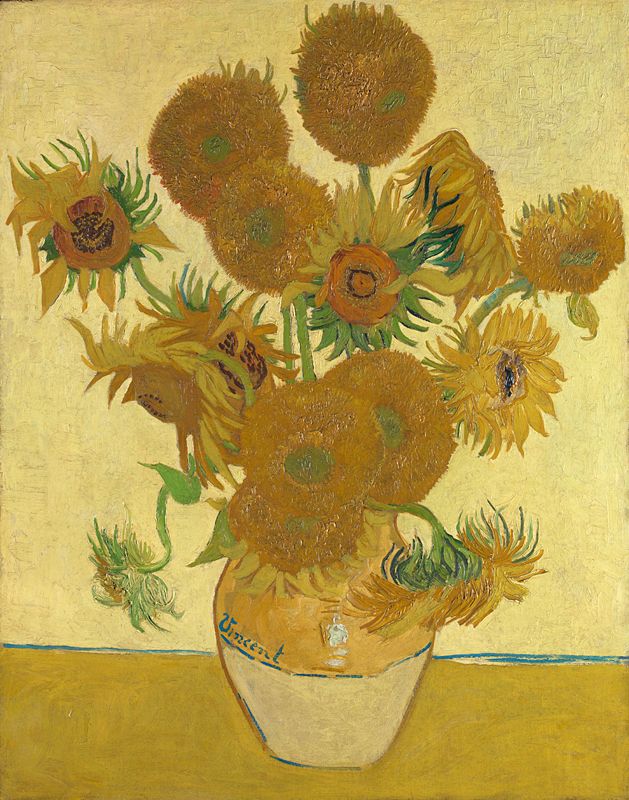
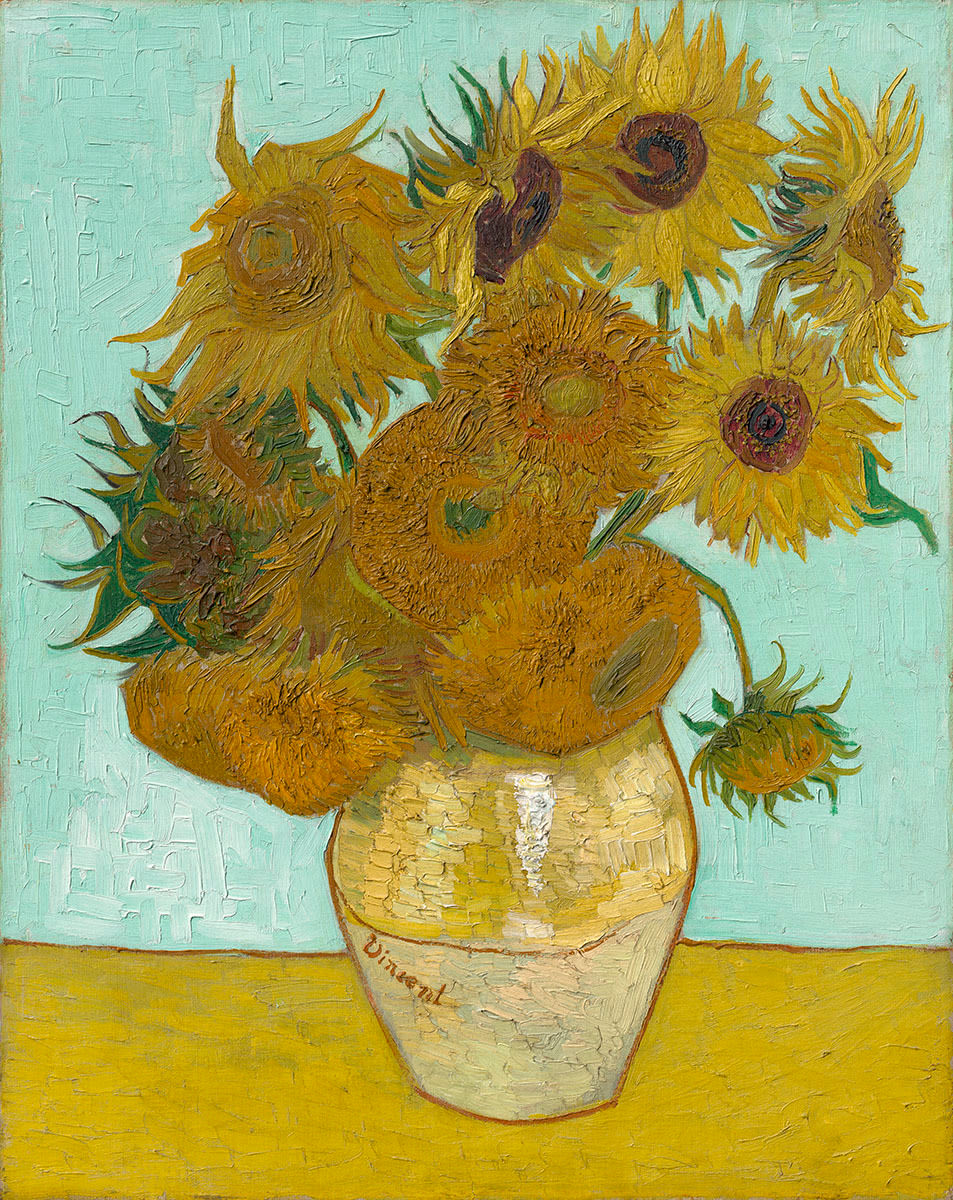
Van Gogh, Vincent, Van Gogh, Theo, and Gauguin, p. 158: For the list of paintings, see Ch. 40, n. 362. Vincent sent the same list to Theo around the same time (JLB 820, 11/19/1889). The choice of these images was no doubt influenced by considerations other than Vincent's view of their artistic merits relative to his oeuvre. The two sunflower paintings (Still Life: Vase with Fifteen Sunflowers [F 454 JH 1562] and Still Life: Vase with Twelve Sunflowers [F 456 JH 1561]) had hung in Gauguin's bedroom in the Yellow House and Vincent had already painted copies to give to his former housemate; Theo had already singled out the painting of ivy (A Corner in the Garden of Saint-Paul Hospital [F 609 JH 1693]) as a favorite (JLB 813, 10/22/1889), and informed Vincent that Orchard in Blossom (F 516 JH 1685) was hanging in Tanguy's shop window where it had won compliments (JLB 819, 11/16/1889). The Red Vineyard (F 495 JH 1626) also had resonance with Gauguin and their brief partnership. Only the last of six, the wheat field with the rising sun (Enclosed Field with Rising Sun [F 737 JH 1862]), which was still in Vincent's studio, had not previously won either Gauguin's or Theo's endorsement.
Context:
BVG 615, 11/21/1889: "Instead of grandiose exhibitions, it would have been better to address oneself to the people and work so that each one could have in his home some pictures or reproductions which would be lessons, like the work of Millet."
JLB 823, 11/26/1889: "And instead of putting on grandiose exhibitions, it would have been better to address oneself to the common people, and work so that everyone may have paintings or reproductions at home, which are lessons like the work of Millet."
Context:
BVG 615, 11/21/1889: " A picture … that will end by becoming as commonplace as a sermon, and a painter will be like a creature left over from the last century."
JLB 823, 11/26/1889: " A painting ... it will end up becoming as commonplace as a sermon, a painter like someone who's a century behind the times."
Context:
BVG 615, 11/21/1889: "And instead of grandiose exhibitions, it would have been better to address oneself to the people and work so that each one could have in his home some pictures or reproductions which would be lessons, like the work of Millet."
JLB 823, 11/26/1889: "And instead of putting on grandiose exhibitions, it would have been better to address oneself to the common people, and work so that everyone may have paintings or reproductions at home, which are lessons like the work of Millet."
Context:
BVG 623, 1/12/1890-1/15/1890: "Then, whether they are someday criticized or despised as copies, it will nonetheless be true that they have their justification in the attempt to make Millet's work more accessible to the great general public."
JLB 839, 1/13/1890: "Then, even if they're criticized one day or despised as copies, it will remain no less true that it's justifiable to try to make Millet's work more accessible to the ordinary general public."
Context:
JLB 819, 11/16/1889: "I enclose a letter which Gauguin sent me for you."
Context:
JLB 820, 11/19/1889: "Bernard also wrote to me, complaining about a heap of things while resigning himself like the good boy he is, but not happy at all; with all his talent, all his work, all his sobriety, it appears that home is often a hell for him."
Context:
JLB 819, 11/16/1889: "I've been to Bernard's this week, and he showed me what he has done lately. I think he's made a lot of progress."
Context:
JLB 819, 11/16/1889: "I've been to Bernard's this week, and he showed me what he has done lately. I think he's made a lot of progress. His drawing is less determined, but it's there all the same. There's more flexibility in his touch. With him there's a more direct influence from the primitives, thus he has done a kneeling figure surrounded by angels. The ground is in large squares, and the figures are posed as if on a chessboard, but there's one angel figure which really has nobility. He's also done a Christ in the Garden of Olives. A red-headed, violet Christ with a yellow angel."
Context:
BVG T20, 11/16/1889: "There is a more direct influence of the Primitives in him; for instance, he did a kneeling figure surrounded by angels."
JLB 819, 11/16/1889: "With him there's a more direct influence from the primitives, thus he has done a kneeling figure surrounded by angels."
Context:
BVG T20, 11/16/1889: "It is very difficult to understand, and the search for a style often lends the figures a ridiculous quality, but perhaps something good will come of it."
JLB 819, 11/16/1889: "It's very difficult to understand, and the search for style often lends something ridiculous to his figures, but perhaps something good will come of it."
Context:
BVG 614, 11/17/1889: "However, now is not the moment to ask me to admire our friend Gauguin's composition, and our friend Bernard has probably never seen an olive tree. Now he is avoiding getting the least idea of the possible, or of the reality of things, and that is not the way to synthetize -- no, I have never taken any stock in their biblical interpretations."
JLB 820, 11/19/1889: "However now isn't the moment to ask me to approve of friend G's composition -- and friend Bernard has probably never seen an olive tree. Now he therefore avoids conceiving the least idea of the possible and of the reality of things, and that isn't the way to synthesize. No, never have I got involved in their Biblical interpretations."


Context:
BVG B21, 11/20/1889: "So, my dear fellow, those biblical paintings of yours are hopeless. There are only a few who make such a mistake, and a mistake it is, but once you have turned your back on it, I dare say the results will be marvellous! Sometimes our mistakes show us the right way."
JLB 822, 11/26/1889: "So, they're a setback, my dear fellow, your biblical paintings, but ... there are few who make mistakes like that, and it's an error, but your return from it will be, I dare to say, astonishing, and it's by making mistakes that one sometimes finds the way."
Context:
BVG B21, 11/20/1889: "Let me make it perfectly clear that I was looking forward to seeing the sort of things that are in that painting of yours which Gauguin has, those Breton women walking in a meadow so beautifully composed, the colour with such naive distinction. And you are trading that in for something -- I won't prevaricate -- bogus, spurious!"
JLB 822, 11/26/1889: "But this is enough for you to understand that I would long to see things of yours again, like the painting of yours that Gauguin has, those Breton women walking in a meadow, the arrangement of which is so beautiful, the colour so naively distinguished. Ah, you're exchanging that for something -- must one say the word -- something artificial -- something affected."
Context:
BVG B21, 11/20/1889: "Let me make it perfectly clear that I was looking forward to seeing the sort of things that are in that painting of yours which Gauguin has, those Breton women walking in a meadow so beautifully composed, the colour with such naive distinction. And you are trading that in for something -- I won't prevaricate -- bogus, spurious!"
JLB 822, 11/26/1889: "But this is enough for you to understand that I would long to see things of yours again, like the painting of yours that Gauguin has, those Breton women walking in a meadow, the arrangement of which is so beautiful, the colour so naively distinguished. Ah, you're exchanging that for something -- must one say the word -- something artificial -- something affected."
Context:
BVG B21, 11/20/1889: "Le Christ portant sa croix is appalling."
JLB 822, 11/26/1889: "The Christ carrying his Cross is atrocious."
Context:
BVG B21, 11/20/1889: "And when I compare that with the nightmare of a Christ au jardin des oliviers, then, good God, I mourn, and with this letter I ask you once more, shouting at the top of my voice: please try to be yourself again!"
JLB 822, 11/26/1889: "And when I compare that with that nightmare of a Christ in the Garden of Olives, well, it makes me feel sad, and I herewith ask you again, crying out loud and giving you a piece of my mind with all the power of my lungs, to please become a little more yourself again."
Context:
BVG B21, 11/20/1889: "Le Christ portant sa croix is appalling. Are those touches of colour in it meant to be harmonious? I cannot forgive your using a cliché, yes, a cliché, for your composition."
JLB 822, 11/26/1889: "The Christ carrying his Cross is atrocious. Are the splashes of colour in it harmonious? But I won't let you off the hook for a commonplace -- commonplace, you hear -- in the composition."
Context:
JLB 822, 11/26/1889: "Look, in the adoration of the shepherds, the landscape charms me too much for me to dare to criticize, and nevertheless, it's too great an impossibility to imagine a birth like that, on the very road, the mother who starts praying instead of giving suck, the fat ecclesiastical bigwigs, kneeling as if in an epileptic fit, God knows how or why they're there."
Context:
BVG B21, 11/20/1889: "That, my friend, is what people everywhere, from France to America, have felt. And having performed a feat like that, can you really contemplate reverting to medieval tapestries?"
JLB 822, 11/26/1889: "Now, my friend -- people have felt that from France to America. After that, would you go back to renewing medieval tapestries for us?"
Context:
BVG B21, 11/20/1889: "No, I can't call that sound, for if I am at all capable of spiritual ecstasy, then I feel exalted in the face of truth, of what is possible, which means I bow down before the study -- one that had enough power in it to make a Millet tremble -- of peasants carrying a calf born in the fields back home to the farm."
JLB 822, 11/26/1889: "Because I adore the true, the possible, were I ever capable of spiritual fervour; so I bow before that study, so powerful that it makes you tremble, by père Millet -- peasants carrying to the farmhouse a calf born in the fields."
Context:
BVG B21, 11/20/1889: "No, I can't call that sound, for if I am at all capable of spiritual ecstasy, then I feel exalted in the face of truth, of what is possible, which means I bow down before the study -- one that had enough power in it to make a Millet tremble -- of peasants carrying a calf born in the fields back home to the farm."
JLB 822, 11/26/1889: "Because I adore the true, the possible, were I ever capable of spiritual fervour; so I bow before that study, so powerful that it makes you tremble, by père Millet -- peasants carrying to the farmhouse a calf born in the fields."
Context:
BVG B21, 11/20/1889: "No, I can't call that sound, for if I am at all capable of spiritual ecstasy, then I feel exalted in the face of truth, of what is possible, which means I bow down before the study -- one that had enough power in it to make a Millet tremble -- of peasants carrying a calf born in the fields back home to the farm."
JLB 822, 11/26/1889: "Because I adore the true, the possible, were I ever capable of spiritual fervour; so I bow before that study, so powerful that it makes you tremble, by père Millet -- peasants carrying to the farmhouse a calf born in the fields."
Context:
JLB 822, 11/26/1889: "An annunciation of what -- -- -- I see figures of angels, elegant, my word, a terrace with two cypresses, which I like very much; there's an enormous amount of air, of clarity in it ... but in the end, once this first impression is past, I wonder if it's a mystification, and these secondary characters no longer tell me anything."
Context:
BVG B21, 11/20/1889: " Can that really be what you mean to do? No! You can do better than that, and know that you must look for what is possible, logical and true, even if that means turning your back on those Parisian things
Context:
BVG B21, 11/20/1889: "The reason I haven't written for so long is that I've been trying to keep on top of my illness and was reluctant to enter into discussions, sensing danger in those abstractions."
JLB 822, 11/26/1889: "And if I haven't written for a long time, it's because, having to struggle against my illness and to calm my head, I hardly felt like having discussions, and found danger in these abstractions."
Context:
BVG B21, 11/20/1889: "If one carries on working quietly, beautiful subjects come of their own accord. Believe me, it is of the utmost importance to immerse oneself in reality, without any preconceived ideas, without any Parisian prejudice."
JLB 822, 11/26/1889: "And by working very calmly, beautiful subjects will come of their own accord; it's truly first and foremost a question of immersing oneself in reality again, with no plan made in advance, with no Parisian bias."
Context:
BVG B21, 11/20/1889: "And when I compare that with the nightmare of a Christ au jardin des oliviers, then, good God, I mourn, and with this letter I ask you once more, shouting at the top of my voice: please try to be yourself again!"
JLB 822, 11/26/1889: "And when I compare that with that nightmare of a Christ in the Garden of Olives, well, it makes me feel sad, and I herewith ask you again, crying out loud and giving you a piece of my mind with all the power of my lungs, to please become a little more yourself again."
Context:
JLB 823, 11/26/1889: "Of course there's no question of me doing anything from the Bible -- and I've written to Bernard, and also to Gauguin, that I believed that thinking and not dreaming was our duty, that I was therefore astonished when looking at their work by the fact that they give way to that."
Context:
BVG 615, 11/21/1889: " It is not that it leaves me cold, but it gives me a painful feeling of collapse instead of progress."
JLB 823, 11/26/1889: "So this doesn't leave me cold, but it gives me an uncomfortable feeling of a tumble rather than progress."
Context:
BVG 605, 9/10/1889: "Yet that is how one captures the true and the essential -- the most difficult part."
JLB 801, 9/10/1889: "Yet then one catches the true and the essential -- that's the most difficult thing."
The painting described is Olive Trees Against a Slope of a Hill, F 716 JH 1878, November-December 1889, oil on canvas, 13 x 15.8 in., 33 x 40 cm., Van Gogh Museum, Amsterdam. Another painting with his unusual horizon-less, birds-eye view is Valley with Plowman Seen from Above (F 727 JH 1877).
Context:
BVG T21, 12/8/1889: "This being the case, it is permissible to do a piece of nature exactly as one sees it, without being obliged to cut it down in this way or that. The sympathy an artist feels for certain lines and for certain colours will cause his soul to be reflected in them."
JLB 825, 12/8/1889: "This being the case, it's permissible to do a piece of nature simply as one sees it, without being obliged to cut it like this or like that. The fondness the artist has for certain lines and certain colours will cause his soul to be reflected in them in spite of himself."
Context:
BVG 604, 9/5/1889-9/6/1889: " I shall continue to work without let-up, and then if I have another attack around Christmas, we'll see, and when that's over, I can't see any objection to my telling the administration here to go to hell, and to my returning north for a fairly long time."
JLB 800, 9/5/1889-9/6/1889: " I'll carry on working very hard, and then if the crisis returns towards Christmas we'll see, and once that's over then I wouldn't see any disadvantage in sending the management here to all the devils and coming back to the north for a fairly long time."
Context:
BVG 604, 9/5/1889-9/6/1889: "To leave now, when I believe I may well have another attack this winter, that's to say in three months' time, would perhaps be too foolhardy."
JLB 800, 9/5/1889-9/6/1889: "Leaving now would perhaps be too unwise, when I consider a new crisis likely in the winter, i.e. in 3 months."
Context:
BVG 610, 10/8/1889: "In the evening I am bored to death. Good Lord, the prospect of winter isn't very cheery."
JLB 810, 10/8/1889: "In the evenings I'm bored to death, my God the prospect of winter isn't a cheery one."
Context:
BVG 613, 11/2/1889: "I am very well -- except for a great depression sometimes, but I am feeling well, much better than last winter, and even better than when I came here, and still better than in Paris."
JLB 816, 11/3/1889: "My health is very good -- except often a lot of melancholy however -- but I feel much much better than when I came here, and even better than in Paris."
Context:
JLB 816, 11/3/1889: "Anyway, I'll do as I can. Now that most of the leaves have fallen the landscape looks more like the north, and then I really feel that if I went back to the north I would see it more clearly than before."
Context:
JLB 816, 11/3/1889: "I'd very much like Jo to see The evening, I think that I'll send you a consignment shortly, but it's drying very badly because of the dampness of the studio. Here the houses have scarcely any cellar or foundations, and one feels the damp more than in the north."
Context:
JLB 824, 12/7/1889: "I often think of you and Jo, but with a feeling as if there was an enormous distance from here to Paris and as if it were years since I saw you."
Context:
BVG 618, 12/7/1889: "I hope you are well. For myself I have nothing to complain of, I am feeling absolutely normal, so to speak, but without an idea for the future, and really I do not know what is going to happen, and perhaps I rather avoid facing this question, feeling that I can do nothing about it."
JLB 824, 12/7/1889: "I hope that your health is good, for myself I can't complain, I feel absolutely normal, so to speak, but without ideas for the future, and truly I don't know what it's going to be, and perhaps I'm avoiding going into this question deeply, sensing that I can do nothing about it."
Context:
BVG 618, 12/7/1889: "I hope you are well. For myself I have nothing to complain of, I am feeling absolutely normal, so to speak, but without an idea for the future, and really I do not know what is going to happen, and perhaps I rather avoid facing this question, feeling that I can do nothing about it."
JLB 824, 12/7/1889: "I hope that your health is good, for myself I can't complain, I feel absolutely normal, so to speak, but without ideas for the future, and truly I don't know what it's going to be, and perhaps I'm avoiding going into this question deeply, sensing that I can do nothing about it."
Context:
BVG 614, 11/17/1889: "But what's to be done? -- we must not make any pretensions in my case, I still make too many as it is."
JLB 820, 11/19/1889: "But what can one do, one can't have pretensions in my case, I already have too many as it is."
Context:
BVG 614, 11/17/1889: "And then -- yes, there is something else in life than pictures, and this something else one neglects, and then nature seems to revenge herself and fate itself is set on thwarting us."
JLB 820, 11/19/1889: "And then -- yes there's something in life other than paintings, and this something else one neglects and nature seems to avenge itself then, and besides, fate is bent on thwarting us."
The painting is The Garden of Saint-Paul Hospital, F 660 JH 1849, November 1889, oil on canvas, 28.9 x 36.2 in., 73.5 x 92 cm., Museum Folkwang, Essen, Germany. In December, he made a copy of the painting, at the same large scale, to send to his mother and sister. The latter is The Garden of Saint-Paul Hospital (F 659 JH 1850).
Context:
JLB 822, 11/26/1889: "Under the trees, empty stone benches, dark box. The sky is reflected yellow in a puddle after the rain. A ray of sun -- the last glimmer -- exalts the dark ochre to orange -- small dark figures prowl here and there between the trunks."
Context:
BVG B21, 11/20/1889: " This sombre giant -- with its hurt pride -- contrasts, if you were to lend it human characteristics, with the pale smile of a last rose on the fading bush in front of it."
JLB 822, 11/26/1889: " This dark giant -- like a proud man brought low -- contrasts, when seen as the character of a living being, with the pale smile of the last rose on the bush, which is fading in front of him."
Context:
BVG B21, 11/20/1889: "Moreover, the motif of the great tree, struck by lightning, the wan pink-green smile of the last autumn flower, serve to reinforce this impression. … I am telling you about these canvases, and about the first one in particular, to remind you that one can express anguish without making direct reference to the actual Gethsemane, and that there is no need to portray figures from the Sermon on the Mount in order to express a comforting and gentle motif. Oh, it is only right and proper to be moved by the Bible, but present-day reality has so strong a hold over us that even when we try to imagine the past the minor events in our lives immediately wrench us out of our musings, and our own adventures throw us back irrevocably upon our personal feelings: joy, boredom, suffering, anger or a smile."
JLB 822, 11/26/1889: "And what's more, the motif of the great tree struck by lightning, the sickly green and pink smile of the last flower of autumn, confirms this idea. … I'm speaking to you of these two canvases, and especially the first, to remind you that in order to give an impression of anxiety, you can try to do it without heading straight for the historical garden of Gethsemane; in order to offer a consoling and gentle subject it isn't necessary to depict the figures from the Sermon on the Mount -- ah -- it is -- no doubt -- wise, right, to be moved by the Bible, but modern reality has such a hold over us that even when trying abstractly to reconstruct ancient times in our thoughts -- just at that very moment the petty events of our lives tear us away from these meditations and our own adventures throw us forcibly into personal sensations: joy, boredom, suffering, anger or smiling."
Context:
BVG T19, 10/21/1889: "Jo is quite well; she is getting considerably bigger, and feels life already, but this does not give her a too-unpleasant sensation."
JLB 813, 10/22/1889: "Jo is well, she's getting considerably bigger and can already feel the child quickening, but that doesn't cause her too much inconvenience."
BVG T19, 10/21/1889: Note: we have inverted Bonger's translation. (See Ch. 40, n. 423.) Vincent responded in late October just as he was painting La Veillée (Evening) (Evening: The Watch [F 647 JH 1834] "Ah, at the moment you yourself are fully in the midst of nature, since you write that Jo already feels her child quicken -- it's much more interesting even than landscape, and I'm very pleased that it has changed like this for you" (JLB 815, 10/25/1889).
Context:
BVG T19, 10/21/1889: "Jo is quite well; she is getting considerably bigger, and feels life already, but this does not give her a too-unpleasant sensation."
JLB 813, 10/22/1889: "Jo is well, she's getting considerably bigger and can already feel the child quickening, but that doesn't cause her too much inconvenience."
Context:
JLB 816, 11/3/1889: "You gave me very great pleasure by sending me those Millets, I'm working on them zealously. I was growing flabby by dint of never seeing anything artistic, and this revives me. I've finished The evening [F 647 JH 1834] and am working on The diggers [F 648 JH 1833] and the man who's putting his jacket on, no. 30 canvases, and The sower [F 689 JH 1836], smaller."
Context:
BVG 612, 10/20/1889-10/22/1889: " I certainly agree with you that it is much better for Theo now than before, and I hope everything will go well with Jo's confinement; that will set them up for quite a while."
JLB 811, 10/21/1889: " I certainly agree with you that it's a good deal better for Theo like this than before, and just hope everything goes well with Jo's confinement, then they'll be set up for quite a while."
Context:
JLB 805, 9/20/1889: "Grief mustn't build up in our souls like the water of a swamp."
Context:
BVG 611, 10/25/1889: "And yet very often terrible fits of depression come over me, and besides the more my health comes back to normal, the more my brain can reason coldly, the more foolish it seems to me, and a thing against all reason, to be doing this painting which costs us so much and brings in nothing, not even the outlay."
JLB 815, 10/25/1889: "However, melancholy very often overtakes me with great force, and besides, the more my health returns to normal the more my mind is capable of reasoning very coldly, the more to do painting that costs us so much and doesn't bring in anything, not even the cost of producing them, seems madness to me, a thing completely against reason."
Context:
JLB 820, 11/19/1889: "Now I'll tell you that I've been to Arles and I saw Mr. Salles, who handed me the rest of the money you sent him and the rest of what I'd handed over to him, that is, 72 francs. However, only around twenty francs remain in the cash-box with Mr Peyron at the moment, since down there I stocked myself up with colours and paid for the room where the furniture &c. is."
Context:
BVG W16, 12/10/1889: "What I think very unfortunate is what you write about my having said that Theo is still coughing -- damn it -- this does not please me at all -- nevertheless I think that it will improve as soon as he is a father."
JLB 827, 12/10/1889: "What I find very unfortunate is that you write that Jo says that Theo's still coughing the whole time -- blast -- that doesn't please me -- however, I still hope that when he's a father it'll get better."
Context:
JLB 829, 12/19/1889: "And if I could one day prove that I wouldn't impoverish the family, that would relieve me."
Context:
BVG 611, 10/25/1889: "I hasten to finish this letter. I have already started writing you four times without being able to finish the letter."
JLB 815, 10/25/1889: "I'm hurrying to finish this letter, I had already begun to write to you four times without being able to finish."
Context:
JLB 823, 11/26/1889: "I have to thank you very much for a consignment of colours, which was also accompanied by an excellent woollen waistcoat. How kind you are to me, and how I'd like to be able to do something good in order to prove to you that I'd like to be less ungrateful."
Context:
JLB 823, 11/26/1889: "I have to thank you very much for a consignment of colours, which was also accompanied by an excellent woollen waistcoat."
Context:
JLB 820, 11/19/1889: "It's often cold here too, however we're a little more sheltered from the mistral by the mountains. And between times I keep working."
Context:
JLB 819, 11/16/1889: "… don't you need something warm?"
Context:
JLB 823, 11/26/1889: "How kind you are to me, and how I'd like to be able to do something good in order to prove to you that I'd like to be less ungrateful."
Context:
JLB 808, 10/5/1889: "Yes, I'd like to say to Isaäcson that he would do well to wait longer, there isn't yet that in it that I hope to attain if my health continues. It's not worth mentioning anything about my work at the moment."
Context:
JLB 808, 10/5/1889: "It's not worth mentioning anything about my work at the moment."
Context:
JLB 810, 10/8/1889: "Anyway -- if they should happen to remember me -- which I'm not keen on -- there'll be enough to send something coloured to the Vingtistes. But I'm indifferent to that."
Context:
JLB 660, 8/13/1888: "Now I have a horror of success; I'm afraid of the morning after following a success by the Impressionists; even the present difficult days will later seem like 'the good times' to us."
Context:
BVG 615, 11/21/1889: " We must work as much and with as few pretensions as a peasant if we want to last."
JLB 823, 11/26/1889: " One must work as hard and with as few pretensions as a peasant if one wants to last" (emphasis in original).
Context:
BVG 615, 11/21/1889: "So slow, long work is the only way, and all ambition and keenness to make a good thing of it, false."
JLB 823, 11/26/1889: "So slow, long work is the only road, and all ambition to be set on doing well, false."
Context:
BVG W16, 12/10/1889: "Only less rain than in Holland, an unbearably harassing wind which is very cold, and dry and clear but severe spells of cold weather, although the sun has more power, and the sky is very blue."
JLB 827, 12/10/1889: "Only less rain than in Holland, very cold, unbearably irritating wind, and cold spells that are dry and bright but severe all the same, although the sun has more strength and the sky is very blue."
Context:
JLB 832, 12/23/1889: "For this past fortnight I've worked hard continuously."
Context:
JLB 824, 12/7/1889: "In spite of the cold I'm continuing to work outside up to now, and I think that it's good for me and for the work."
Context:
JLB 825, 12/8/1889: "I'm writing to Mr. Peyron to tell him that you'll probably be obliged to work in a room, and that in that case will he please let you make a fire, the cost of which he can add to my account."
Context:
JLB 820, 11/19/1889: "However, everything depends on whether this suits you or not, and I think it's wise not to rush things. Perhaps by waiting a little we won't even have need of the doctor at Auvers or the Pissarros."
Context:
JLB 823, 11/26/1889: "Then I'm going to attack the cypresses and the mountains. I think that this must be the centre of the work I've done here and there in Provence, and then we can conclude the stay here when it's convenient. Which isn't urgent, for Paris only distracts, after all. I still have it in my heart to paint a bookshop one day with the shop window yellow-pink, in the evening, and the passers-by black -- it's such an essentially modern subject. But anyway, bookshops aren't hares, and there's no hurry, and I have a good will to work here for another year, which will probably be wiser."
Context:
JLB 823, 11/26/1889: "Which isn't urgent, for Paris only distracts, after all."
Context:
BVG B21, 11/20/1889: "What I am doing is hard, harsh, but that is because I am trying to get back on my feet with work that is a bit rough, having been afraid that I would go soft with abstractions."
JLB 822, 11/26/1889: "What I'm making is harsh, dry, but it's because I'm trying to reinvigorate myself by means of rather arduous work, and would fear that abstractions would make me soft."
Context:
BVG B21, 11/20/1889: "What I am doing is hard, harsh, but that is because I am trying to get back on my feet with work that is a bit rough, having been afraid that I would go soft with abstractions."
JLB 822, 11/26/1889: "What I'm making is harsh, dry, but it's because I'm trying to reinvigorate myself by means of rather arduous work, and would fear that abstractions would make me soft."
Context:
BVG 618, 12/7/1889: "The studies, size 30 canvases, were not yet dry, and will follow later. They are giving me a lot of trouble, and sometimes I think they are very ugly, sometimes they seem good to me; perhaps you will have the same impression when you see them."
JLB 824, 12/7/1889: "The studies on no. 30 canvases weren't yet dry and will follow later. They're giving me a lot of trouble, and sometimes I find them very ugly, sometimes they look good to me -- perhaps you'll have the same impression when you see them."
Context:
JLB 829, 12/19/1889: "I'd say that these better days have already begun for myself, when I glimpse the possibility of completing, to some extent, the work in such a way that you'll have a series of Provençal studies done with feeling which will hold up, this is what I hope, with our far-off memories of youth in Holland, and thus I'm treating myself by redoing the olive trees again for our mother and sister."
Context:
BVG 615, 11/21/1889: "I am going to attack the cypresses and the mountains."
JLB 823, 11/26/1889: "Then I'm going to attack the cypresses and the mountains."
Context:
JLB 829, 12/19/1889: "I have a great desire to do more of both the cypresses and the Alpilles, and often going on long walks in all directions I've noted many subjects and know good places for when the fine days come."
Context:
BVG 617, 12/15/1889: "And because of my long stay, I feel the country here differently than I should some other place -- good ideas are beginning to germinate a little now, and we must let them develop."
JLB 829, 12/19/1889: "And through the prolonged stay, I feel the country here differently from the first place encountered -- good ideas are now germinating a little and should be allowed to develop."
Context:
JLB 826, 12/9/1889 or 12/10/1889: "I imagine I'll spend a large part of next year here, too, since even if this were no longer absolutely necessary for my health, it would turn out best for my work -- since I'm now fairly oriented here."
Context:
JLB 829, 12/19/1889: "Then, from the point of view of expenditure there would hardly be any advantage in moving I think, and moving makes the success of the work all the more doubtful."
Context:
BVG 616, 12/10/1889: "And so one may say, It would have been simpler if I had stayed quietly in North Brabant -- but it is as it is, and what can one do?"
JLB 826, 12/9/1889 or 12/10/1889: "And so people could say that it would perhaps have been simpler had I just stayed quietly in North Brabant -- but that's as it is, and what is a body to do about it?"
Context:
BVG 619, 12/20/1889: "Sometimes I imagine that if I gave up painting and had to lead a hard life, say, as a soldier in the East, it would cure me."
JLB 831, 12/23/1889: "I've sometimes imagined that if I abandoned painting and had some hard life or other, as a soldier going to the east, say, that would make me better."
Context:
BVG 617, 12/15/1889: "However, I often think that if I had done as you did, if I had stayed with Goupils', if I had confined myself to selling pictures, I should have done better."
JLB 829, 12/19/1889: "However, I often tell myself that if I'd done like you, if I'd stayed at the Goupils', if I'd restricted myself to selling paintings, I would have done better."
Context:
BVG W18, 12/20/1889: "I'm adding a word to you in great haste; it is exactly a year ago that I had that attack; I have no reason to complain too much, as things are going better with me at the moment, but it is to be feared that it will come back from time to time."
JLB 832, 12/23/1889: "In haste I'm adding a line for you, it's exactly a year since I had that attack, I certainly have no reason to complain about it too much, as things are going better at present."
Context:
JLB 832, 12/23/1889: "But from time to time, though, it's to be feared that it may return. And this leaves the mind in a latent state of sensitivity."
Context:
JLB 830, 12/22/1889: "Cor writes quite often from the Transvaal. Life down there can't be much fun. There are no plants or flowers. If the heat isn't torrid, it rains so much that everything is flooded. The days are all absolutely alike, which is why he says he detests Sundays and other time off."
Context:
JLB 826, 12/9/1889 or 12/10/1889: "Wil described the house to me in detail, and I'm very glad that your experience proves that the reasons for the change were justified."
Context:
JLB 826, 12/9/1889 or 12/10/1889: "Your thoughts will be much with Theo and Jo; I think it's a very good plan for Wil to go and lend a hand in January and hope that that will work out, and if you go to stay with Aunt Mina in the meantime will also be doing a favour there, now Aunt is ill."
Context:
JLB 826, 12/9/1889 or 12/10/1889: "Your thoughts will be much with Theo and Jo; I think it's a very good plan for Wil to go and lend a hand in January and hope that that will work out, and if you go to stay with Aunt Mina in the meantime will also be doing a favour there, now Aunt is ill."
Context:
BVG T21, 12/8/1889: "Jo gives you her kindest regards; we received quite a batch of little things for the baby from Amsterdam. You will do its portrait as soon as you are here."
JLB 825, 12/8/1889: "Jo sends her warm regards, we've received a whole consignment of little things for the baby from Amsterdam. You'll do its portrait when it's here."
Context:
JLB 827, 12/10/1889: "The description of your and Mother's new dwelling interests me a great deal, and this move is indeed a wise and well-considered arrangement. It would certainly charm me if I saw it, this quay where people come to wash green and red wool with the small barges and vessels moored, and the factory with its windows lit up in the evening. Those are effects that I would paint."
It is a sign of Vincent's delusional state that he brushes past the ferocious epistolary altercation that he has just had with Bernard, as if it never happened: "He's [Bernard] just sent me 6 photographs of paintings he's done this year, and by contrast they are bizarre biblical subjects and very open to criticism. But you can see from this that he's a curious fellow, a seeker who tries everything. It's like tapestries from the Middle Ages: stiff, brightly coloured figures." (ibid.) He summarizes his pitch with the passage used in the text: "Anyway he's a fine, really Parisian boy, very elegant."
That match-making -- and marriage -- were on his mind in these suggestive passages is clear from Vincent's letter to Theo soon afterward when he directs his brother to send Wil and their mother one of his paintings of the olive groves: "I think it'll be a good course of action to have our sister come in January. Ah, if that one could get married, that would be a good thing." (JLB 829, 12/19/1889.) Theo replies right before Christmas: "We're expecting Wil on 2 Jan., she'll stay a month with us. I share your opinion that I'd be delighted if she could see her way to marrying, and the man who had her would find a charming wife in her." (JLB 830, 12/22/1889.)
It is interesting that Vincent says nothing to Theo specifically about the proposed match with Bernard. But a month later, it is clearly still on his mind when he writes Wil: "Have you met Emile Bernard now ... I ought to write to him, but just now I'm expecting a letter from him at any moment. He must have a lot of difficulty getting by, he's a complete Parisian by birth, that one, and he's an example of vivacity for me." (JLB 841, 1/20/1890.) A few days later, Theo writes on the same subject, apparently still unaware of Vincent's proposed match: "Wil is much better and looks extremely well. I would very much like her to find a way of getting married, but to whom?" (JLB 843, 1/22/1890.)
Context:
JLB 827, 12/10/1889: "You ask who Bernard is -- he's a young painter -- he's twenty at most. Very original. He seeks to do modern figures as elegant as ancient Greeks or Egyptians. A grace in the expressive movements, a charm through daring colours."
Context:
BVG W16, 12/10/1889: "Well, he is a nice boy, very Parisian, very elegant. He should have gone into the army this year, but they granted him a respite until next year on account of his health."
JLB 827, 12/10/1889: "Anyway he's a fine, really Parisian boy, very elegant. He was to go off to be a soldier this year, but for health reasons it has been postponed to next year."
Context:
JLB 831, 12/23/1889: "Is there any more news from Cor? It's very good that you're close to Anna and will see your grandchildren around you. Give everyone at Anna's my very best wishes at the ending of the year."
Context:
BVG 616, 12/10/1889: " I suppose that your thoughts are often with Theo and Jo; I think it an excellent plan that Wil is going to lend a helping hand in January, and I hope it will come about. If you go and stay with Aunt Mina in the meantime, she will be pleased too, now that Aunt is ill."
JLB 826, 12/9/1889 or 12/10/1889: " Your thoughts will be much with Theo and Jo; I think it's a very good plan for Wil to go and lend a hand in January and hope that that will work out, and if you go to stay with Aunt Mina in the meantime will also be doing a favour there, now Aunt is ill."
Context:
JLB 827, 12/10/1889: "While writing this letter I got to my feet to go and give a few brushstrokes to a canvas in progress -- specifically, it's the one with the ravaged pines against a red, orange, yellow sky."
Context:
JLB 829, 12/19/1889: "As to figure, the portrait of a man by Puvis de Chavannes has always remained an ideal for me, an old man reading a yellow novel, with beside him a rose and watercolour brushes in a glass of water -- and the portrait of a lady that he had in the same exhibition, a woman already old but completely as [Jules] Michelet felt, that there's no such thing as an old woman."
Context:
JLB 829, 12/19/1889: "As to figure, the portrait of a man by Puvis de Chavannes has always remained an ideal for me, an old man reading a yellow novel, with beside him a rose and watercolour brushes in a glass of water -- and the portrait of a lady that he had in the same exhibition, a woman already old but completely as Michelet felt, that there's no such thing as an old woman."
Context:
BVG 617, 12/15/1889: "The 'Portrait of a Man' by Puvis de Chavannes has always remained the ideal in figure to me, an old man reading a yellow novel, and beside him a rose and some watercolour brushes in a glass of water -- and the 'Portrait of a Lady' that he had at the same exhibition, a woman already old, but exactly as Michelet felt, There is no such thing as an old woman."
JLB 829, 12/19/1889: "As to figure, the portrait of a man by Puvis de Chavannes has always remained an ideal for me, an old man reading a yellow novel, with beside him a rose and watercolour brushes in a glass of water -- and the portrait of a lady that he had in the same exhibition, a woman already old but completely as Michelet felt, that there's no such thing as an old woman."
Context:
BVG 622a, 12/30/1889-12/31/1889: "So, my dear friends, as now and then we suffer together, this makes me think of what Mrs. Ginoux said -- 'When you are friends, you are friends for a long time …'"
JLB 842, 1/20/1890: "Since, therefore, my dear friends, we sometimes suffer together, it makes me think of what Mrs. Ginoux said -- 'when people are friends they're that way for a long time.'"
Context:
BVG 622a, 12/30/1889-12/31/1889: "I do not know whether you remember -- I think it rather strange that it is nearly a year since Mrs. Ginoux was taken ill at the same time as myself; and that it remained the same until just before Christmas -- for several days in the current year I had rather a bad attack, however it passed off very quickly; I have not had any for a week."
JLB 842, 1/20/1890: "I don't know if you'll remember, I find it quite strange, that about a year ago Mrs Ginoux was ill at the same time as I was; and now it has been so again since -- just around Christmas -- for a few days I was again taken quite badly this year, however it was over very quickly; I had it less than a week."
Context:
JLB 866, 5/2/1890: "If I were still to have at my disposal the model who posed for the Berceuse and the other whose portrait you've just received after Gauguin's drawing, then certainly I'd try to execute it in a large size, this canvas, the personalities being what I would have dreamed of as characters."
Context:
JLB 866, 5/2/1890: "If I were still to have at my disposal the model who posed for the Berceuse and the other whose portrait you've just received after Gauguin's drawing, then certainly I'd try to execute it in a large size, this canvas, the personalities being what I would have dreamed of as characters."
Context:
JLB 829, 12/19/1889: "It's a canvas I'm working on from memory after the study of the same size done on the spot, because I want a far-off thing like a vague memory softened by time. … I shake your hand warmly in thought, I'm going to work some more outside, the mistral's blowing."
Context:
JLB 827, 12/10/1889: "I have 12 large canvases on the go, above all olive groves, one with an entirely pink sky, another with a green and orange sky, a third with a big yellow sun."
Context:
BVG 617, 12/15/1889: "I think that probably I shall hardly do any more things in impasto; it is the result of the quiet, secluded life that I am leading, and I am all the better for it. Fundamentally I am not so violent as all that, and at last I myself feel calmer."
JLB 829, 12/19/1889: "I think it likely that I'll do hardly any more things in impasto, it's the result of the calm life of seclusion I'm leading, and I feel I'm better for it. Fundamentally I'm not as violent as that, anyway I feel more myself in calmness." (Emphasis in original.)
Context:
BVG W17, 1/4/1890: "I designated the one with the olive trees for you and Mother. You will see, I think, that in a white frame it will take on a mild color, meaning the contrast between pink and green."
JLB 837, 1/4/1890: "Yesterday I sent some paintings to Paris -- and the one of the women picking olives I designated for you and Mother. You'll see, I think, that in a white frame it takes on quite a soft colour effect, the opposition of the pink and the green."
Context:
BVG 617, 12/15/1889: "For instance, I am working on a picture this moment, women gathering olives, which would lend itself to that, I think. These are the colours: the ground is violet, and farther off, yellow ochre; the olives with bronze trunks have grey-green foliage, the sky is entirely pink, and three small figures pink too. The whole in a very discreet colour scheme."
JLB 829, 12/19/1889: "Thus I'm working on a painting at the moment, women picking olives, which would lend itself to it, I think. These are the colours: the field is violet and further away yellow ochre, the olive trees with bronze trunks have grey-green foliage, the sky is entirely pink, and 3 small figures pink also. The whole in a very discreet range."
Context:
BVG 617, 12/15/1889: "I am again going to work a little outside: there is a mistral. Toward sunset it generally grows a little calmer, then there are superb sky effects of pale citron, and the mournful pines with their silhouettes standing out in relief against it with exquisite black lace effects."
JLB 829, 12/19/1889: "I'm going to work some more outside, the mistral's blowing. It usually dies down by the time the sun's about to set, then there are superb effects of pale citron skies, and desolate pines cast their silhouettes into relief against it with effects of exquisite black lace."
Context:
BVG W16, 12/10/1889: "I am working on the latter canvas at the moment; it is (along with the orchard in bloom, which Theo liked, he said) the most delicate thing I have painted yet."
JLB 827, 12/10/1889: "I'm working on this last canvas at the moment, it is (with the orchard in blossom, which Theo liked, from what he was saying) the gentlest thing I've painted."
Context:
JLB 829, 12/19/1889: "It's very interesting what you tell me about a publication of coloured lithographs with a text on Monticelli, honestly, that gives me very great pleasure, and I'd be very curious to see them one day. I hope that he'll reproduce in colour the bouquet you have, for that's a thing of the first order as regards colour. One day I'd very much like to do a print or two myself in this vein after my canvases. Thus I'm working on a painting at the moment, women picking olives, which would lend itself to it, I think."
Context:
BVG 619, 12/20/1889: "I hope Theo has sent you my studies, but I started still another rather big picture for you of women gathering olives."
JLB 831, 12/23/1889: "I hope Theo sent you my studies, but I'm already working on another rather large painting for you of women harvesting olives."
Context:
JLB 829, 12/19/1889: "You tell me not to give myself too many worries and that better days will come again for me" (emphasis in original).
Context:
BVG 617, 12/15/1889: “I must tell you that these better days have already begun for me, as soon as I get a glimpse of the possibility of completing my work in some way or other, so that you would have a series of really sympathetic Provençal studies, which will somehow be linked, I hope, with our distant memories of our youth in Holland, and so I am giving myself a treat by doing the 'Women Gathering Olives' again for Mother and our sister.”
JLB 829, 12/19/1889: “I'd say that these better days have already begun for myself, when I glimpse the possibility of completing, to some extent, the work in such a way that you'll have a series of Provençal studies done with feeling which will hold up, this is what I hope, with our far-off memories of youth in Holland, and thus I'm treating myself by redoing the olive trees again for our mother and sister.”
Context:
JLB 831, 12/23/1889: "Towards the end of the year I come to bid you good-day once more. You'll say that I've forgotten it many times. It's a year since I became ill, and it's difficult for me to express the extent to which I have or haven't recovered."
Who is the maid my spirit seeks
Through cold reproof and slanders blight?
Has she love's roses on her cheek
Is hers an eye of calm delight?
No, wan and sunk with midnight prayer
And the pale looks of her I love,
And if by times a light be there
That light was kindled from above.
I choose not her mine heart's elect
Amongst those that seek their maker's shrine
In gems and garlands proudly decked
As if themselves were things divine.
No, heaven but faintly warms the breast
That beats beneath a broidered veil,
And they who come in glittering dress
To mourn their frailty -- yet are frail.
Not to the form of her I love,
And love because her bloom is gone,
But ne'er was beauty's bloom so bright,
So touching as that form's decay,
That in the altar's wavering light
In holy lustre fades away.
The poem is "Who is the maid? St. Jeromes Love" by Thomas Moore According to JLB, Vincent probably knew the poem from Harriet Beecher Stowe's We and Our Neighbors (JLB 832, n. 2). In the letter to Wil, Vincent invoked James Abbot McNeill Whistler's portrait of his mother (Arrangement in Gray and Black, No. 1) to "illustrate" the sentiment of the poem.
Context:
JLB 832, 12/23/1889: "There's a painting that Whistler did of his mother which is like that. But above all in our old Dutch paintings we find it sometimes. When I think of Mother she too appears like that to me."
Context:
JLB 831, 12/23/1889: "I often have terrible self-reproach about things in the past, my illness being pretty much my own fault, and in any event it's doubtful whether I can make amends for faults in any way. But reasoning or thinking about this is sometimes so difficult, and sometimes my feelings overwhelm me more than in the past. And then I can think so much of you and of the past. You and Pa have been so much, so very much to me, possibly more even than to the others, and I don't seem to have had a happy nature."
Context:
JLB 831, 12/23/1889: "When I was first ill I couldn't accept the idea that I had to go into an asylum. And now at present I admit that I should have been treated earlier, but it's human to err in that."
Context:
JLB 831, 12/23/1889: "I started to realize that in Paris, how much more than I Theo did his best to help Pa practically, so much so that his own interests often went by the board because of it. That's why I'm so thankful now at present that Theo finally found a wife and is waiting for his baby. Anyway, Theo had more self-denial than I, and that's deep in his character."
Context:
JLB 831, 12/23/1889: "And when Pa was no longer with us and I went to him in Paris, then the poor chap attached himself so much to me that I came to understand how much he had loved Pa. And now, I say this to you and to Wil and not to him, it's a good thing I didn't stay in Paris because we should, he and I, have become all too much bound up in each other."
Context:
JLB 831, 12/23/1889: "You and Pa have been so much, so very much to me, possibly more even than to the others, and I don't seem to have had a happy nature. I started to realize that in Paris, how much more than I Theo did his best to help Pa practically, so much so that his own interests often went by the board because of it. That's why I'm so thankful now at present that Theo finally found a wife and is waiting for his baby. Anyway, Theo had more self-denial than I, and that's deep in his character."
Context:
JLB 831, 12/23/1889: "And now it's certain that the work they're making here at present is very different -- more colourful and more forthrightly drawn than what people used to do in Holland in the time of Schelfhout, say. And yet the one is so much a consequence of the other. For example, you knew the old Van de Sande Bakhuyzen and Jules Bakhuyzen. I thought of their work only recently, that with all the apparent difference there's still so little change in people's ideas. Anyway I believe that Jules Bakhuyzen, say, would understand perfectly what I paint these days, that ravine with the stream, and another painting -- of the park at the asylum -- large pine trees against an evening sky."
Context:
BVG 619, 12/20/1889: "For the present my work is going well, but of course my thoughts are always directed on the colours and on drawing, going around in a rather small circle. So I want only to live by the day -- trying to get on from one day to the other. And besides, my painter-friends also often complain that the profession makes one so powerless, or that it is the powerless who follow it."
JLB 831, 12/23/1889: "For the moment the work's going well, but of course my thoughts, always fixed on colours and drawing, continue to go round in a rather small circle. So I want to live by the day -- trying to get from one to the next. And for that matter my fellow painters also often complain that the profession makes one so powerless. Or that it's the powerless who practise it."
Context:
BVG 619, 12/20/1889: "In the beginning when I fell ill, I could not resign myself to the idea of having to go into a hospital. And at present I admit that I should have been treated even earlier, but to err is human."
JLB 831, 12/23/1889: "When I was first ill I couldn't accept the idea that I had to go into an asylum. And now at present I admit that I should have been treated earlier, but it's human to err in that."
Context:
JLB 832, 12/23/1889: "In haste I'm adding a line for you, it's exactly a year since I had that attack, I certainly have no reason to complain about it too much, as things are going better at present. But from time to time, though, it's to be feared that it may return. And this leaves the mind in a latent state of sensitivity."
Context:
JLB 832, 12/23/1889: "I hope that you'll quite like the canvas I'm doing for Mother and you at the moment. It's a repetition of a painting for Theo, Women picking olives."
Context:
BVG 620, 1/1/1890-1/2/1890: "Odd that I had been working perfectly calmly on some canvases that you will soon see, and that suddenly, without any reason, the aberration seized me again."
JLB 833, 12/31/1889 or 1/1/1890: "Odd that I'd worked perfectly calmly on canvases that you'll soon see, and that all at once, without any reason, the confusion took hold of me again."
Context:
JLB 836, 1/4/1890: "For the moment I've been caught unawares by a great discouragement. But since this attack ended in a week."
Context:
BVG W17, 1/4/1890: "Fortunately another rather violent attack of exaltation or delirium is at an end and, if I may so say, I don't feel any after-effects at all; I feel the same as I do on ordinary days."
JLB 837, 1/4/1890: "Fortunately, a quite violent attack of exaltation or delirium is again behind me and I don't feel any after-effects, so to speak, I am as I am every day."
Context:
JLB 837, 1/4/1890: "Fortunately, a quite violent attack of exaltation or delirium is again behind me and I don't feel any after-effects, so to speak, I am as I am every day."
Context:
JLB 850, 2/1/1890: "Well this contributes a great deal to making me forget these last few days when I was ill, then I no longer know where I am and my mind wanders."
Context:
BVG 622, 1/4/1890: "For the moment I am overcome with discouragement, but since this attack was over in a week, what's the use of thinking that it may in fact come back again?"
JLB 836, 1/4/1890: "For the moment I've been caught unawares by a great discouragement. But since this attack ended in a week, what's the good of telling oneself that it can in fact recur?"
Context:
JLB 838, 1/8/1890: "In his first letter he gave me to understand that it was dangerous for you to continue to paint, as the paints were a poison, but he got a little carried away, perhaps through simply relying on hearsay, being ill himself."
Context:
BVG 620, 1/1/1890-1/2/1890: "Oh, while I was ill there was a fall of damp and melting snow. I got up in the night to look at the country. Never, never had nature seemed to me so touching and so full of feeling."
JLB 833, 12/31/1889 or 1/1/1890: "Ah, while I was ill, damp, melting snow was falling, I got up in the night to look at the landscape -- never, never has nature appeared so touching and so sensitive to me."
Context:
JLB 833, 12/31/1889 or 1/1/1890: " As for me, don't worry too much."
Context:
JLB 835, 1/3/1890: "I was pleasantly surprised by your letter, for after receiving a line from Mr. Peyron I didn't dare hope that it would be possible for you to write, and I won't hide from you that it grieved me very much."
Context:
JLB 836, 1/4/1890: "So let's continue the work as much as possible as if nothing were amiss."
Context:
BVG 622, 1/4/1890: "It is perfectly true that last year the attack returned various times -- but then also it was precisely by working that my normal condition returned little by little. It will probably be the same this time. So behave as if nothing had happened for we can do absolutely nothing."
JLB 836, 1/4/1890: "It's perfectly true that last year the crisis recurred at various times -- but then, too, it was precisely by working that the normal state returned little by little. It will probably be the same on this occasion too. So act as if nothing were amiss, for we can do absolutely nothing about it."
Context:
BVG 623, 1/12/1890-1/15/1890: "It is not, believe me, that I should not like to be able to live as before, without this preoccupation with my health. Anyway, we will make the attempt once, but probably not twice in the spring, if this passes away completely."
JLB 839, 1/13/1890: "It isn't, believe me, that I wouldn't wish to be able to live like before, without this preoccupation with health. Anyway, we'll make the attempt once but probably not twice in the spring if it goes away completely." (Emphasis in original.)
Context:
JLB 839, 1/13/1890: "So what I'm pondering doing in painting is Daumier's Drinkers and Régamey's Penitentiary. You'll find them in among the wood engravings. Thus even half locked up I'll be able to occupy myself for a long time."
It is difficult to believe that he did not at least think of Gheel when he wrote this; but it is equally difficult to imagine why he would not mention the name, even if just to exclude it because of the negative associations with his father (see Ch. 40. n. 542). In an earlier letter, he had mentioned the asylum of Charenton in Paris in a sidelong comment about another artist: "I saw admirable drawings in it by [Daniel Urrabieta] Vierge which were completely like something by Victor Hugo, astonishing things. ... I think that Vierge has also gone to Charenton, but how that fellow has worked" (JLB 834, 1/3/1890, emphasis in original). Whether this was a hint or not, Vincent essentially withdraws it soon afterwards because of the expense: "the idea of going to Paris then to the country, having no other resource to combat the expenses than painting, means manufacturing paintings that come quite expensive" (JLB 839, 1/13/1890).
Context:
JLB 839, 1/13/1890: "At Montevergues there's an asylum where one of the employees here used to be a warder. He tells me that there they only pay 22 sous a day, and that then the patients are even dressed by the establishment. Then they're put to work on the lands that belong to the house, and there's also a forge, a carpenter's workshop &c. Once they'd got to know me a little I don't think I'd be forbidden to paint, then for one thing there's still the fact that it's less expensive, and second, that one can work at something."
Context:
JLB 839, 1/13/1890: "Now, you understand that in an establishment where the patients work in the fields I would find hosts of subjects for paintings and drawings, and that I wouldn't be at all unhappy there."
Context:
JLB 839, 1/13/1890: "I'll drop a line to Gauguin and De Haan to ask if they're planning to stay in Brittany and if they'd like me to send the furniture, and then if they want me to come too. I won't commit myself to anything, only say that I'm very probably not staying here."
Context:
JLB 833, 12/31/1889 or 1/1/1890: "Now what you say about my work certainly is agreeable to me, but I still think of this bloody profession in which one is caught as if in a net and in which one becomes less practical than others."
Context:
JLB 839, 1/13/1890: "Now I'm going to talk to you again about what I think we could do for the future so as to have fewer expenses."
Context:
BVG 622, 1/4/1890: "Once away from here -- let's suppose so -- we must really see if something can be done with my canvases. I should have a certain number of mine, a certain number of others, and perhaps I should try to do a bit of business."
JLB 836, 1/4/1890: "Once I'm back from here, let's suppose, we'll have to see a little if there's really nothing to be done with my canvases, I would have a certain number of mine, a certain number of other people's, and perhaps I'd try to do a little dealing."
Context:
BVG 623, 1/12/1890-1/15/1890: "At any rate, being in better health than I have been for two years, I will again do my best to find some job or other."
JLB RM18, November-December 1889: "In any case, I really want to see, one more time and with better health than two years ago, if I can't find some sort of position."
Context:
JLB RM18, November-December 1889: "Let's take the terrible realities as they are, and if I have to abandon painting I think I shall."
Context:
JLB 835, 1/3/1890: "I hope that you're already much better and that the illness won't return."
Context:
JLB 835, 1/3/1890: "It's curious that this has taken hold of you again, precisely a year after the first attack, and it proves that you must remain on your guard."
Context:
JLB 838, 1/8/1890: "In one of the rolls there was also a superb pen drawing of a fountain in a garden; next Sunday I have a meeting with Lauzet -- who will find them very fine, I'm sure."
The last is really a negative wrapped in a positive (i.e., "they're not as bad as they used to be") than straight-out praise. Theo reserves that for Vincent's drawings, a few of which arrived in Paris right around the New Year: "In one of the rolls there was also a superb pen drawing of a fountain in a garden." (ibid.) This, of course, would have been taken by Vincent less as a compliment than as a well-worn avoidance of commenting on his paintings and as an indirect endorsement of Peyron's ban on paints, which was still in effect after the attack at Christmastime.
Context:
BVG T24, 1/8/1890: "I think there is more atmosphere in these last works, more distance than in the preceding ones. Perhaps this is due to your not laying on your paint so thickly everywhere."
JLB 838, 1/8/1890: "I feel that there's more atmosphere in your latest works, more distance than in the preceding ones. Which comes perhaps from the fact that you don't use so much impasto everywhere."
Context:
BVG T24, 1/8/1890: "I agree with you that it might be a good thing for you to come here next spring, and then you can decide to go into the country after a while if life here doesn't suit you. Here there will always be the difficulty that you cannot work in the open air, but we shall see, and in any case we shall always be happy to have you with us for some time."
JLB 838, 1/8/1890: "I share your opinion that it would perhaps be good that you should come here for a while this spring, even if you go to the country afterwards if the life here doesn't suit you. Here there'll always be the matter of you being unable to work outdoors, but you will see, and in any case we'll be happy to have you with us for a while."
Context:
JLB 843, 1/22/1890: "I'm finding out about the establishments in Holland which might be suitable, but I've already been told that they're so full that it's difficult to be admitted. There's Geel in Belgium, but I don't know precisely what one must do to have oneself admitted."
Context:
JLB 838, 1/8/1890: "When I last wrote to you it was under the impression of Dr. Peyron's first letter. I'm very, very glad that it isn't as bad as that letter made me assume, and he himself wrote to me again to say that it had taken a quite different turn than he had thought at first."
Context:
JLB 838, 1/8/1890: "In his first letter he gave me to understand that it was dangerous for you to continue to paint, as the paints were a poison, but he got a little carried away, perhaps through simply relying on hearsay, being ill himself."
Context:
JLB 833, 12/31/1889 or 1/1/1890: "Above all I mustn't waste my time, I'm going to set to work again as soon as Mr Peyron will allow it, and if he doesn't allow it then I'll make a clean break with here. It's that that keeps me still relatively balanced, and again I have a whole lot of ideas for new paintings."
Context:
JLB 833, 12/31/1889 or 1/1/1890: "At the moment of writing to you I haven't yet seen Mr. Peyron, so I don't know if he's written anything to you about my paintings. He came to tell me while I was ill that he'd received news from you, and if I wanted to exhibit my paintings, yes or no. So I told him that I'd much rather not exhibit them. Which had no justification, and so I hope that they've gone off all the same. But anyway, I regret not having been able to see Mr. P. today to find out what he wrote to you."
Context:
JLB 836, 1/4/1890: "So let's continue the work as much as possible as if nothing were amiss. I'll soon have the opportunity to go outside when the weather isn't too cold, and then I'd rather like to try to finish the work undertaken here. It's perfectly true that last year the crisis recurred at various times -- but then, too, it was precisely by working that the normal state returned little by little. It will probably be the same on this occasion too. So act as if nothing were amiss, for we can do absolutely nothing about it."
Context:
JLB 838, 1/8/1890: "When I last wrote to you it was under the impression of Dr. Peyron's first letter. I'm very, very glad that it isn't as bad as that letter made me assume, and he himself wrote to me again to say that it had taken a quite different turn than he had thought at first."
Context:
JLB 836, 1/4/1890: "He talked to me with great kindness and these things scarcely surprise him, but since there's no ready remedy it's time and circumstances alone that can perhaps have influence."
Context:
BVG 622, 1/4/1890: "What he said to me was -- "Let's hope that there will be no recurrence" -- exactly the same thing as ever; he spoke very kindly to me, and as for him, these things hardly surprise him, but since there is no quick remedy, perhaps only time and circumstances can have any influence."
JLB 836, 1/4/1890: "What he said to me was 'let's hope that this doesn't happen again' -- so absolutely the same thing as always. He talked to me with great kindness and these things scarcely surprise him, but since there's no ready remedy it's time and circumstances alone that can perhaps have influence."
Context:
JLB 836, 1/4/1890: "At the moment I've just done a little portrait of one of the lads from here which he wanted to send to his mother, that's to say I've already started work again, and Mr. Peyron would probably not have allowed me to if he saw any obstacles there."
Context:
BVG T23, 1/3/1890: "It is curious that it overtook you exactly one year after your first attack, and it proves that you must be always on your guard. So, for instance, if you know that it is dangerous for you to have colours near you, why don't you clear them away for a time, and make drawings?"
JLB 835, 1/3/1890: "It's curious that this has taken hold of you again, precisely a year after the first attack, and it proves that you must remain on your guard. So if you know that it's dangerous at times to have paints near you, why not set them aside for a while by making drawings?"
Context:
JLB 836, 1/4/1890: "Why would I change means of expression."
Context:
BVG 622, 1/4/1890: "Then, so as to do nothing in a hurry, not to break off abruptly, I would like to go on as usual while I am here."
JLB 836, 1/4/1890: "Then, in order not to hurry anything or break it off suddenly, I'd wish to continue as usual as long as I'm here."
Context:
JLB 838, 1/8/1890: "Yesterday evening your new consignment arrived, and it's very remarkable. You know, one of the things I like best is the Evening after Millet. Copied like that it's no longer a copy. There's a tone in it and everything is so harmonious. It's really very successful."
Context:
BVG 620, 1/1/1890-1/2/1890: "Just now you and Jo will have many anxieties at times, and a bad time to get through, but these are the things without which life would not be life, and it makes one serious."
JLB 833, 12/31/1889 or 1/1/1890: "In the next few days you'll have many anxieties with Jo at times, and a bad time to get through. But these are things without which life wouldn't be life, and that makes one solemn."
Context:
JLB 839, 1/13/1890: "This week I'm going to start on Millet's 'Snow-covered field' and 'First steps' in the same format as the others."
Context:
BVG W19, 1/20/1890: "I often think of Holland, of our youth in the past -- for the very reason that I feel entirely in the country here."
JLB 841, 1/20/1890: "I think a lot about Holland and about our youth back then -- precisely because here I feel right in the middle of the countryside."
Context:
JLB 841, 1/20/1890: "I imagine that Theo is probably going to be very happy one of these days, only I do have something of an idea that the days of vigil before and during have their great anxieties. Which, moreover, I cannot completely refrain from sharing."
Context:
JLB 836, 1/4/1890: "I'd very much like to go to Arles one more time, not immediately, but towards the end of February for example, first to see friends, which always cheers me up, and then to test whether I'm capable of risking the journey to Paris."
Context:
JLB 836, 1/4/1890: "I'd very much like to go to Arles one more time, not immediately, but towards the end of February for example, first to see friends, which always cheers me up, and then to test whether I'm capable of risking the journey to Paris."
Context:
BVG 622, 1/4/1890: "I should very much like to go to Arles again, not immediately, but toward the end of February, for instance, first of all to see my friends again, which always refreshes me, and then to test whether I am capable of risking the journey to Paris."
JLB 836, 1/4/1890: "I'd very much like to go to Arles one more time, not immediately, but towards the end of February for example, first to see friends, which always cheers me up, and then to test whether I'm capable of risking the journey to Paris."
Context:
JLB 839, 1/13/1890: "When I go to Arles I'll have to pay 3 months' rent on the room where my furniture is. That'll be in February. This furniture, it seems to me, will be of use, if not to me then to another painter wanting to settle in the country. Wouldn't it be wiser, in the event of leaving here, to send it to Gauguin, who'll probably spend more time in Brittany, than to you, who'll have nowhere to put it. This is another thing we need to consider in time. I think that in giving up two very old, heavy chests of drawers to someone, I could exempt myself from paying the remainder of the rent and perhaps the packing costs. They cost me around thirty francs."
Context:
JLB 839, 1/13/1890: "I think that if I came to Paris I wouldn't do anything but draw Greek casts again at first, because I must always keep on studying."
Context:
BVG 622, 1/4/1890: "I should very much like to go to Arles again, not immediately, but toward the end of February, for instance, first of all to see my friends again, which always refreshes me, and then to test whether I am capable of risking the journey to Paris."
JLB 836, 1/4/1890: "I'd very much like to go to Arles one more time, not immediately, but towards the end of February for example, first to see friends, which always cheers me up, and then to test whether I'm capable of risking the journey to Paris."
Context:
JLB 853, 2/9/1890 or 2/10/1890: "A few days ago I bought a suit that cost me 35 francs, I must pay for it towards the end of March. With this I'll have sufficient for the year, for when I came here I also bought a suit for around 35 francs, and it has served me all year. But I'll need a pair of shoes and a few pairs of drawers in March as well."
Context:
JLB 842, 1/20/1890: "I don't know if you'll remember, I find it quite strange, that about a year ago Mrs. Ginoux was ill at the same time as I was; and now it has been so again since -- just around Christmas -- for a few days I was again taken quite badly this year, however it was over very quickly; I had it less than a week."
Context:
JLB 842, 1/20/1890: "I don't know if you'll remember, I find it quite strange, that about a year ago Mrs. Ginoux was ill at the same time as I was; and now it has been so again since -- just around Christmas -- for a few days I was again taken quite badly this year, however it was over very quickly; I had it less than a week."
Context:
JLB 865, 5/1/1890: "Do what seems best to you. For the time being I would leave my furniture behind in Arles. It's with friends, and I'm sure they'd send it the day I wanted it. But the carriage and packing would be almost what it's worth."
Context:
JLB 842, 1/20/1890: "Anyway, it's only to say to you, my dear friends, that I hope so ardently, and that moreover I dare hope, that Mrs. Ginoux's illness will be very fleeting and that she'll recover from it entirely enlivened. But she isn't unaware how fond we all are of her and wish to see her well."
Context:
JLB 841, 1/20/1890: "The other day I saw some people sick with influenza and I'm so curious to know if you've had it too, as I'm inclined to believe. I saw a female patient who had a rather worrying nervous complication, and a distressing change of life."
Context:
JLB 842, 1/20/1890: "Illnesses are there to make us remember again that we aren't made of wood. That's what seems the good side of all this to me."
Context:
BVG W19, 1/20/1890: "I often think of Holland, of our youth in the past -- for the very reason that I feel entirely in the country here. And yet I am aging, you know, and it seems to me that life is passing by more rapidly, and that the responsibilities are more serious, and that the question of how to make up for lost time is more critical, and that it is harder to do the day's work, and that the future is more mysterious and, dear me, a little more gloomy."
JLB 841, 1/20/1890: "I think a lot about Holland and about our youth back then -- precisely because here I feel right in the middle of the countryside. However I'm getting old, you know, and it seems to me that life passes more quickly and the responsibilities are more serious, the question of working to make up for lost time more critical, the day more difficult to do and the future more mysterious, and my word a little more gloomy too."
Context:
BVG W19, 1/20/1890: "I often think of Holland, of our youth in the past -- for the very reason that I feel entirely in the country here. And yet I am aging, you know, and it seems to me that life is passing by more rapidly, and that the responsibilities are more serious, and that the question of how to make up for lost time is more critical, and that it is harder to do the day's work, and that the future is more mysterious and, dear me, a little more gloomy."
JLB 841, 1/20/1890: "I think a lot about Holland and about our youth back then -- precisely because here I feel right in the middle of the countryside. However I'm getting old, you know, and it seems to me that life passes more quickly and the responsibilities are more serious, the question of working to make up for lost time more critical, the day more difficult to do and the future more mysterious, and my word a little more gloomy too."
Context:
BVG W19, 1/20/1890: "I often think of Holland, of our youth in the past -- for the very reason that I feel entirely in the country here. And yet I am aging, you know, and it seems to me that life is passing by more rapidly, and that the responsibilities are more serious, and that the question of how to make up for lost time is more critical, and that it is harder to do the day's work, and that the future is more mysterious and, dear me, a little more gloomy."
JLB 841, 1/20/1890: "I think a lot about Holland and about our youth back then -- precisely because here I feel right in the middle of the countryside. However I'm getting old, you know, and it seems to me that life passes more quickly and the responsibilities are more serious, the question of working to make up for lost time more critical, the day more difficult to do and the future more mysterious, and my word a little more gloomy too."
Context:
JLB 841, 1/20/1890: "One of these days I also hope to write a line to Mother, we all owe a great deal to you, to you who care for her so faithfully and will keep her for us for as long as possible."
Context:
JLB 841, 1/20/1890: "I myself often sigh deeply that I should have been better than I am."
Context:
JLB 841, 1/20/1890: "I'll shut up quickly so as not to discourage myself."
Context:
BVG W19, 1/20/1890: "Well, the fact is that one cannot retrace one's steps, and the steps one has taken greatly influence the future."
JLB 841, 1/20/1890: "Anyway, one can't retrace one's steps, and the steps one has taken have a lot of influence on the future."
Context:
JLB 845, 1/29/1890: "It's just midnight -- the doctor's sleeping for a while because he wanted to stay here tonight. Theo, Ma and Wil are sitting at the table with me -- awaiting the things that will come -- it's a strange feeling -- always that wondering -- will the baby be here tomorrow morning? I can't write much -- but I so much wanted just to talk to you for a moment. This morning Theo brought in the article in the Mercure, and after we'd read it Wil and I talked about you for a long time ... It sounds sentimental -- a message like this -- but I can't tell him now -- half of my company has gone to bed, him too because he was so tired." (Emphasis in original.)
Context:
BVG T26, 1/29/1890: "Theo brought along the article from the Mercure this morning, and after we had read it, Wil and I talked about you for a long time -- I am eager for your next letter, which Theo is anxiously awaiting too -- shall I read it?"
JLB 845, 1/29/1890: "This morning Theo brought in the article in the Mercure, and after we'd read it Wil and I talked about you for a long time -- I'm so longing for your next letter, which Theo is also looking forward to. Shall I read it?"