Notes

Notes


Chapters

Chapters

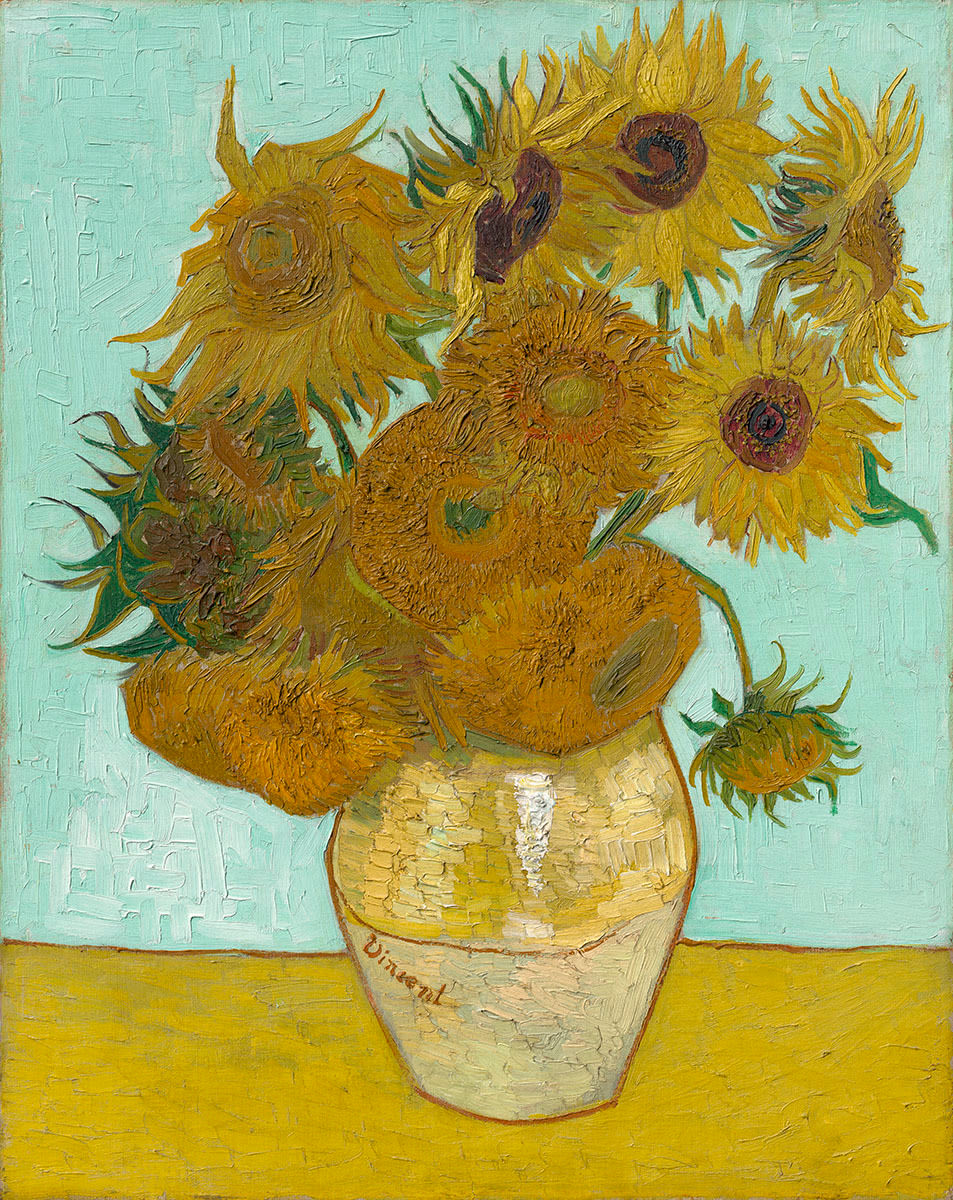
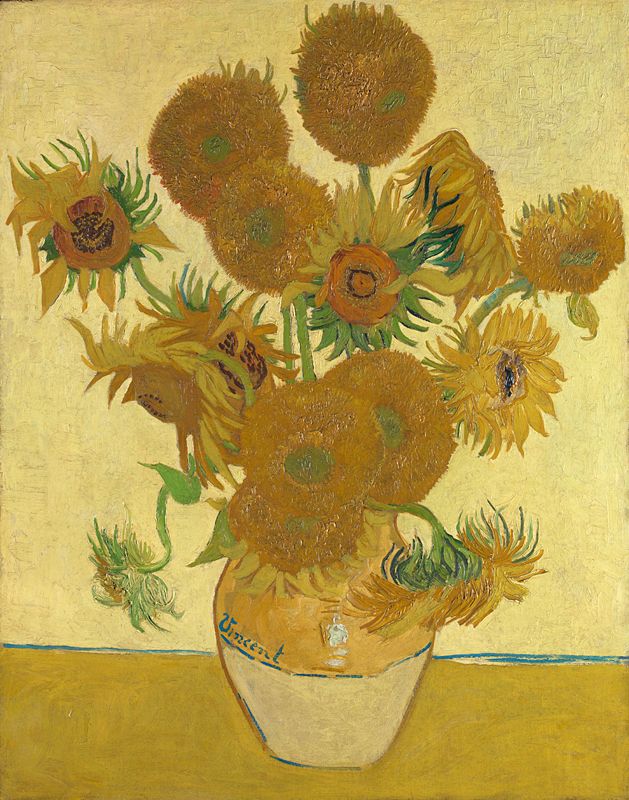
799 1. two huge bouquets BVG T22, 12/22/1889: The two sunflower paintings on display in Père Tanguy's window at Christmastime were Still Life: Vase with Twelve Sunflowers (F 456 JH 1561) and Still Life: Vase with Fifteen Sunflowers (F 454 JH 1562), both painted in Arles in 1888.

Context:
JLB 830, 12/22/1889: "The Sunflowers were on show at Tanguy's this week and made a very good effect. Your paintings cheer up Tanguy's shop, and père Tanguy likes them a lot, but he no longer sells anything but yours."
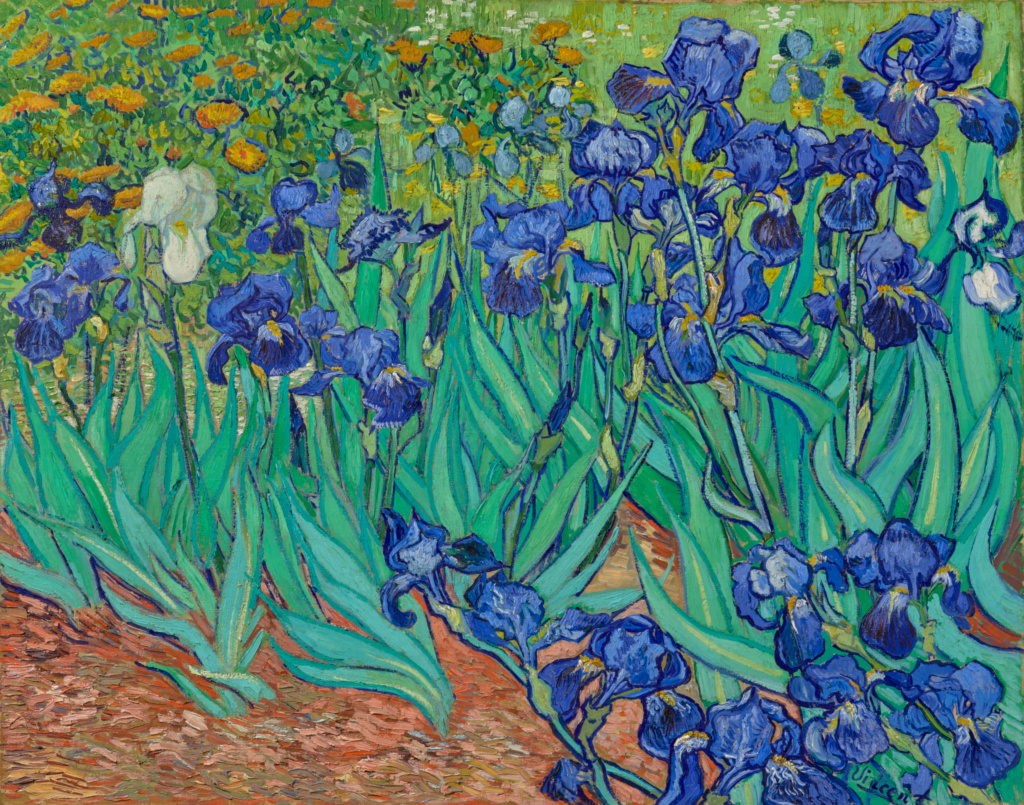
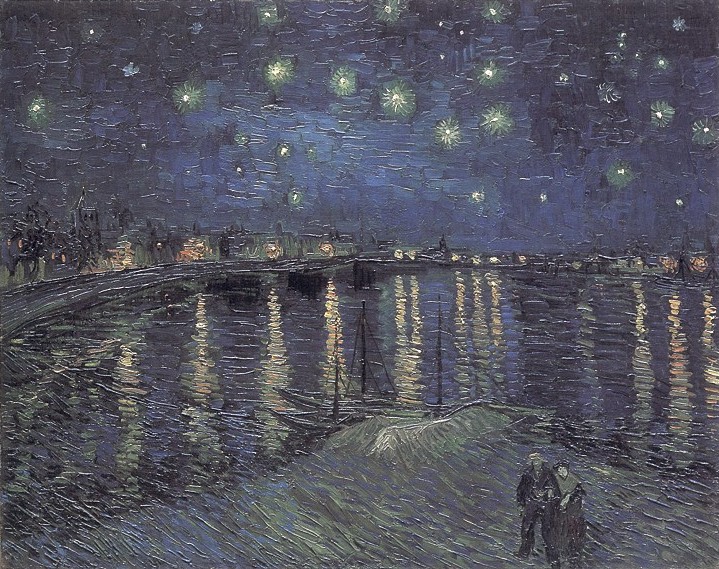
2. "It was horrible" Hartrick, p. 44. 3. "the rank glare" Hartrick, p. 44. 4. Isaäcson's article See Ch. 40, n. 270. Jansen, Luijten and Pabst note, however, that " De portefeuille reached only a relatively limited and entirely Dutch audience; [Joseph Jacob] Isaäcson's proposed review of Van Gogh's work never appeared, mainly at the insistence of Van Gogh himself" (Jansen, Luijten, and Pabst, p. 27, n. 2). 5. brief mention in La Vogue Fénéon, "The Fifth Exhibition of the Société des Artistes Indépendants," in Stein, ed., pp. 180-181: Felix Fénéon, the critic who had championed Georges Seurat and Neo-Impressionism, wrote a review of the Fifth Exhibition of the Société des Artistes Indépendants in the September 1889 issue of La Vogue, a primarily symbolist journal: "These painters smitten with optical painting would be the only ones to justify the existence of the Société des Artistes Indépendants, if this disparate confraternity did not poll M[onsieurs] [Louis] Anquetin, [Georges] Lemmen, [Henri] de Toulouse-Lautrec, and Van Gogh. ... The latter's Irises [F 608 JH 1691] violently slash into long strips their violet petals on sword-like leaves. M. Van Gogh is an amusing colorist, even in such extravagances as his Starry Night [Starry Night Over the Rhône (F 474 JH 1592)]: against the sky, a rough, cross-hatched pattern of flat brushstrokes, stars appear as strobes of white, pink, yellow that have been laid directly from the tube; orange triangles are engulfed by the river, and, near the moored boats, baroquely sinister figures scurry by." In retrospect, this seems a perceptive, even prescient comment by Fénéon, given the uproar caused only four months later by Albert Aurier's review. In context, however, it's clear that the critic had not altered his preference for Neo-Impressionism (the "painters smitten with optical painting" whose existence primarily "justified the existence" of the Society of Independents) and had only crumbs of approval ("amusing") for outsiders like Vincent. This was nothing close to Aurier's declaration of Vincent's preeminence a few months later. 6. find "pictures" Aurier, "En quête de choses d'art," p. 14. 800 7. enduring fameWe have drawn biographical details on Aurier primarily from Svetozar Rusic's "Biographie d'Albert Aurier" (1961) and Patricia Mathews's "G.-Albert Aurier's Symbolist Art Criticism and Theory" (1984). 8. " Sensationnisme"Mathews, Patricia, pp. 16-17. 9. Naturalism of BalzacMathews, Patricia, pp. 16-17: Mathews quotes a passage from Aurier's 1886 article "Sensationnisme," about which she says: "Although this passage does not describe a naturalist aesthetic, the evident belief that art and/or literature must abstract the essence from life is more closely related to that aesthetic than to Aurier's later Symbolist one." She adds: "Aurier's first novel, Vieux, begun in 1886 and finished 1889 or early 1890, but not published until March of 1891, was critiqued as a naturalist novel. Jules Huret, in his introduction to Aurier's interview related it to Balzac [Honoré de Balzac, 1799-1850; French writer]." 10. electrified himMathews, Patricia, p. 13. 11. "Bible"Mathews, Patricia, p. 12. 12. "a bizarre outlook" Mathews, Patricia, p. 13. 13. wrote for Le Chat Noir Mathews, Patricia, p. 11. 14. caught Mallarmé's eye Mathews, Patricia, pp. 11-12: Aurier's first article for Le Décadent, the most influential Decadent journal, was a poem called "À Mallarmé," published on April 24, 1886 (just a month short of his twenty-first birthday). In it, according to Mathews, "he praises that poet as a 'guide sublime' for the young generation." It was this tribute, according to Mathews and others, that probably led to a meeting between the old guard and the new guard: "[Aurier] apparently sent this or another of his poems to [Stéphane] Mallarmé at this time. Mallarmé thanked him and invited him to visit. Aurier therefore may have become acquainted with him as early as 1886." (ibid.) 15. to be convinced White and White, p. 98: "A current painting as an isolated item in trade is simply too fugitive to focus a publicity system upon. One does not buy a copy of a recognized painting; the next best thing for inspiring the warmth of confidence in the breast of the shrewd but nervous buyer is a younger sibling of the recognized painting. Independent merit of a painting in and of itself was a principle directly hostile to the institutional imperatives of the dealer-critic system, and to the social and financial needs of the artist." 801 16. Gustave Geffroy b1199 V/1962, "Geffroy, Gustave" to "Gogh, Theo van", 5/29/1888: By the end of May 1888, Émile Bernard had whetted Gustave Geffroy's appetite to see more of Vincent's work -- and even purchase one or two on behalf of a friend -- at least partly on the basis of some passages from Vincent's letters that Bernard had shown him. ("Please do thank M. Bernard for the extracts from the letters, which will be faithfully returned to him" [ibid.].) It seems doubtful that this is the end (or, at least, the only end) toward which Bernard was working. His efforts with Geffroy must have been focused (as they were with Aurier) on convincing the critic of the worth of the movement that he, Paul Gauguin, and Vincent, defined -- a movement nowhere more eloquently or ardently articulated, of course, than in Vincent's letters. 17. Albert Aurier Mathews, Patricia, p. 34. The literature generally puts the date of Bernard's and Aurier's first meeting in the summer of 1888 in Brittany (see, e.g., Rewald, p. 340), although Lövgren allows that "they had probably been acquainted earlier in Paris" (Lövgren, p. 137). Mathews's more recent and detailed inspection of Aurier's archives reveals that the two men knew each other as of January 1888 and cites an unpublished manuscript in Bernard's papers stating that "he met Aurier in 1887 at St.-Briac, when Aurier was staying with his mother and sister nearby at Saint-Enogat." Bernard's recollection of the later date (summer of 1888) was made soon after the fact (Bernard, p. 334). The second, earlier date is either a confusion (Mathews's reading of the situation) or a confabulation intended to put his association with Aurier even earlier in the critic's career, and thus enhance further his claim to partial credit for Aurier's groundbreaking recognition of Van Gogh (see Ch. 41, n. 18). But the letter from early 1888 indicates that the two men had met somewhere, sometime in 1887. 18. Bernard pressed his case Rewald, Post-Impressionism from Van Gogh to Gauguin, pp. 340-341: "When Bernard returned from Pont-Aven in the fall of that same year [1888], Aurier reported from Paris to his mother: 'I have seen Émile Bernard again, the impressionist painter from Saint-Briac. He made me visit a series of exhibitions and introduced me to [Armand] Guillaumin ...' Of course Bernard acquainted his new friend with all the recent trends in art -- Aurier soon shared Bernard's aversion for Seurat's pointillism -- spoke at length about his own and Gauguin's endeavors and also gave him a detailed account of van Gogh's life and work, showing him the sketches and letters he had received from Arles. Aurier was fascinated by them and accompanied Bernard to père Tanguy's shop as well as to Theo's apartment, to see Vincent's paintings." Rewald's telling relies heavily -- too heavily, we believe -- on Bernard's self-aggrandizing later accounts, although we have taken it as reliable in its general thrust. However, it seems unlikely that the ambitious and egotistical Bernard was promoting any of his colleagues over himself.

In an unpublished letter reported by Rewald, purportedly written by Bernard to Aurier "sometime in the second part of the year 1889" (ibid.), we see a telling clue about the way Bernard used Vincent's letters (and art) to promote his own career: "Enclosed is a short article on my friend Vincent. Should you consider it worth publishing in Le Moderniste, please do so. As far as possible I am anxious that something should be said about my good friend, since he is truly an artist and some mention should be made of him in our time; not that his work is something absolutely complete." (Bernard, quoted in Reward, p. 341; emphasis added.) Although we have serious doubts about the reliability (or at least the dating) of this letter and the "short article on my friend Vincent" that it accompanied, it still shows Bernard attempting to lure Aurier's interest by using both Vincent and Theo as bait. The passage concludes with this heavy hint to look beyond the works of any single artist (i.e., Vincent) to the broader movement and all its adherents: "It might be interesting to review in this manner a certain number of young and old impressionists in a series of articles written by them about one another" (ibid.).

After Vincent's death and subsequent celebrity, Bernard inevitably tried to claim that he had not only proposed the Aurier article, but was heavily responsible for its content -- a claim that the letter and draft article Rewald cites may have been devised to support after-the-fact. There are similar problems with Bernard's parallel claim to have pushed Aurier to review Gauguin's work. (The common thread of such claims, of course, was that Bernard saw the greatness of his fellow painters before anyone else and thus deserved to be considered the leader of the movement.) Mathews accepts Bernard's claim that, prior to Aurier's article on Vincent, "Bernard had already been after [Aurier] for some time to write on Gauguin" (Mathews, Patricia, p. 22). But the letter that Mathews cites is from July 1890, so it does not support the proposition that, as of January 1890, Bernard had been "after Aurier for some time to write on Gauguin." Mathews also cites Rewald, who quotes from a letter from Bernard to Aurier written in July 1890, around the time of Vincent's death -- long after the Mercure article (Rewald, Post-Impressionism from Van Gogh to Gauguin, p. 416, n. 18). If nothing else, this flurry of spurious credit-grabbing suggests that the scramble for a share of Vincent's celebrity had already begun by the time of his death, thanks in no small part to Aurier's January article.

19. Theo van Gogh's apartment BVG T21, 12/8/1889: In December 1889, Theo reminds Vincent of this visit: "That friend of Bernard's called Aurier also came to my place, the one who came to rue Lepic once." A letter from Aurier to his mother puts the visit to Theo on the rue Lepic sometime before November 29, 1888 (BVG, T55a, 11/29/1888; JLB did not translate this letter). In a letter that Vincent wrote to Aurier after the publication of the latter's article in the Mercure in January 1890, there is even a hint that this visit may have predated Vincent's departure from Paris -- i.e., that the artist and the critic may have actually met. "You will see that this constitutes more or less the combination of tones of those pretty Scottish checked cloths: green, blue, red, yellow, black, which once appeared so charming to you as they did to me" (JLB 853, 2/9/1890 or 2/10/1890). This may be just a vague construction intended to invoke an appreciation shared at separate times, or it may indicate an undocumented meeting between the two during Vincent's stay in the rue Lepic apartment in 1886 and 1887. Aurier arrived in Paris in 1883. Unfortunately, both men died too soon after this letter was written -- Vincent, five months later; Aurier, two years later -- to verify or deny such an early encounter.

Context:
JLB 825, 12/8/1889: "That friend of Bernard's called Aurier also came to my place, the one who came to rue Lepic once. He's very interested in what you're doing and showed me a little journal he ran in which he talked about Tanguy's shop, and in which he also mentions your paintings."

20. imagined mounting Merlhès, p. 291: Referring to the paintings that he planned to show at the Vingt in Brussels in January (1889), Gauguin wrote, "I am going to organise a serious exhibition in Brussels to rival the petit point. ... Right now, I can see the whole thing hurtling along at top speed like some locomotive and like the engineer can foresee the end of the line." He eagerly anticipated a "great struggle" and "artistic fight" ahead, but never doubted the outcome: "I say with pride: We shall see! You will be able to ask Pissarro [Camille Jacob Pissarro, 1830-1903; French artist] whether I am not gifted." (ibid.) 21. connived against him See Ch. 35, n. 219 and n. 222. 22. "a little group" Gauguin to Schuffenecker, March 1889, quoted in Malingue, ed., pp. 114-115. (Claude Émile Schuffenecker, 1851-1934; French artist.) Rewald dates this letter as having been written from Pont-Aven in March, 1889, and notes that it had been erroneously dated as having been written from Arles in December 1888 (Rewald, Post-Impressionism: From Van Gogh to Gauguin, p. 289; n. 10). 23. "Vincent sometimes" Gauguin, quoted in Merlhès, p. 306. 24. "[But] we must work" Gauguin, quoted in Malingue, ed., pp. 112-113. 25. "I am so sad" Bernard, "Letter from Émile Bernard to Alphonse Aurier," n.p. 26. religious overtones Bernard, "Letter from Émile Bernard to Alphonse Aurier," n.p.: In addition to the reference to Christ (see Ch. 41, n. 27), Bernard spins a particularly convoluted story, probably told to him by Gauguin, about Vincent's experiences ministering to the sick in the coal mines of the Borinage: "Indeed, that is what has happened: a priest at the age of 25, he was even then finding answers in Protestantism to the anti-natural theories of certain schools of thought; despised, rejected by the world, he began his life as a saint. Later he goes into the mines and … cares for a worker who has been partly burnt by the firedamp and whose forehead bears the marks of a crown of thorns." 27. "some kind of Christ" Bernard, "Letter from Émile Bernard to Alphonse Aurier," n.p.: "Caught up in the most profound mysticism, reading the Bible and delivering sermons in all the worst places and to the vilest people, my dear friend had come to believe that he was some kind of Christ, a God. It seems to me quite possible that his life of suffering and martyrdom could have wrought from this astonishing mind a being from the other side." 28. "powerful and admirable" Bernard, "Letter from Émile Bernard to Alphonse Aurier," n.p. 29. "extreme humanity" Bernard, "Letter from Émile Bernard to Alphonse Aurier," n.p. 30. trying to "murder" Bernard, "Letter from Émile Bernard to Alphonse Aurier," n.p.: This is perhaps Gauguin's deftest touch. It is his way of partaking of the symbolist cachet of crime without actually admitting to any wrongdoing. Bernard, continuing Gauguin's firsthand account, writes, "Since I had been due to leave Arles he had been so odd that I had been living on my nerves, he had even said to me, 'You are going to leave,' and as I had said 'Yes' he tore this sentence from a newspaper and put it in my hand: 'The murderer has fled.'" 802 31. "The entire population" Bernard, "Letter from Émile Bernard to Alphonse Aurier," n.p. 32. "It was then that" Bernard, "Letter from Émile Bernard to Alphonse Aurier," n.p. 33. a debate in Le Figaro Druick and Zegers, pp. 259-260: "Discussion of this issue [of the Prado Affair] now took into account current theories of criminal anthropology that proposed killers as natural born, murder as a social 'law,' and its analysis as both a fine art and a science. Contemporary publications on this subject include the translation (by one of the Symbolist movement's leading figures) of Thomas de Quincey's On Murder Considered as One of the Fine Arts (1827), which appeared in Le Figaro's literary supplement along with reviews of new studies bearing titles such as Le manuel du parfait assassin [Guide to Perfect Murder]." 34. Murder Considered See Ch. 41, n. 33. The author Thomas de Quincey was a proto-symbolist British author who influenced Charles Baudelaire, Edgar Allen Poe, Jorge Luis Borges, Nikolai Gogol, and, through a translation of On Murder that appeared in the late 1880s, the French Symbolist movement as late as Aurier's time. De Quincey is best known for his equally provocative collection of essays entitled Confessions of an English Opium Eater (1822). 35. "Prado Affair" The text's account of the Prado Affair is based on Druick and Zegers, pp. 259-260. 36. "sympathetic killers" Druick and Zegers, pp. 259-260. (See Ch. 41, n. 35.) 37. as Hugo's Jean Valjean (See Chapter 33.) On September 25, 1888, Gauguin wrote Vincent describing this self-portrait in terms that could almost have been lifted from Aurier's article more than year later: "The mask of a bandit, as badly dressed and powerful as Jean Valjean, who has an inner nobility and gentleness. His rampant blood gluts his face and the forge-fire tints enveloping his eyes … His fiery blood gluts his face and the forge-fire tints enveloping his eyes betoken the fiery lava that fires our painters' souls." (Gauguin, quoted in Cooper, ed., pp. 243-244.) In a letter to Émile Schuffenecker written in 1889, from Pont-Aven, Gauguin again invoked this image in describing a photograph of himself: "Enclosed herein, a photo of my savage's face." (Rewald, Post-Impressionism: From Van Gogh to Gauguin, p. 289; n. 10). 38. trial had flamed againSee Chapter 35. 39. in time to attend Druick and Zegers, pp. 265-266. 40. the truer artist Rewald, Post-Impressionism from Van Gogh to Gauguin, p. 341: Although he purchases in its entirety Bernard's claim to near co-authorship of Aurier's review, Rewald describes Aurier's inevitable attraction to Vincent's art: "There is no question that the prospect of studying the work of Vincent van Gogh must have appealed to any symbolist author: to reveal to the public the art of a man utterly unknown who had attempted, with colors and forms, something akin to what the symbolists tried to do with word images and sound: to express moods (just as Seurat endeavored to convey these through the direction of lines). Had not Téodor de Wyzewa stated that before he 'could like a work of art, it had to be really new, that is in keeping with the latest inventions; it had to be a little sickish.' Here was a work that was altogether new by a man who was sick, passionate, inspired, who worked in an insane asylum, wrote soul-searching letters in a strange, awkward, and yet eloquent style, a man whose life and behavior had always been outside the ordinary, not because he wanted to be different, like so many of Aurier's symbolist friends, but because he really was different." Note how Rewald's analysis stays safely in the formalist realm, never veering further than "outside the ordinary" into the issue of Aurier's baser tabloid fascination with Vincent's abhorrent, criminal, or lunatic behavior. 41. prized above all else Decaudin, p. 42: Decaudin illustrates Aurier's view of the near-hopeless plight of would-be or unrecognized artists with this passage from one of his poems in L'Oeuvre maudit about the crushing example of masters like Balzac, Shakespeare, Molière, Raphaël, Michelangelo, Homer, Phidias, and Milton:

              "All reached harbor in the midst of storms;
              All, all made Athena burst forth from their heads.
              But we, the bastard children of these giants, the new Gilberts,
              We struggle in vain against these evil spells:
              Our sublime foetuses perish in the womb:
              Our Glory will be to have suffered greatly!"

42. recently revealed The Italian criminologist Cesare Lombroso's book on the subject, L'uomo di genio (Man of Genius) had just been published in 1889. It did not appear in English until 1891, but was published in French in 1889 (L'homme du génie) and was already well known in French intellectual circles by the time Aurier sat down to write his review and rumors of Vincent's "madness" spread through the Paris art world. As Temkin notes, Lombroso's theory of the "degenerate epileptic" influenced Émile Zola's portrayal of Jacques Lantier in the author's latest installment of the Rougon-Macquart series, La bête humaine (The Human Beast) published in 1890. "In Jacques, sexual desire is mixed with an irresistible impulse to cut the woman's throat. Eventually, his mistress becomes a victim of his supposed atavism, of the pathological reawakening of the cave man. Zola did not expressly call Jacques Lantier an epileptic, but to contemporary physicians this diagnosis seemed clear. Lombroso himself is said to have praised Zola for describing in Jacques 'a criminal epileptoid vertigo.' The Paris physiologist, Dr. [Jules] Hericourt, while criticizing the notion of atavism and altogether blaming Zola for being carried away by Lombroso's theories, wrote of Jacques Lantier: "… he is an epileptic, only his epilepsy is psychical, and his attacks, instead of being convulsive, take the form of an impulse which is always the same. At first he is able to resist it, but eventually, activated by favorable circumstances, it ends by completely beclouding the sick man's reason, by taking hold of his whole being in a generalized cerebral convulsion, and by satisfying itself ... The impulses, as we know, are in the first place hereditary defects, and Mr. Zola takes care to tell us this." (Temkin, pp. 378-379.) 43. Goncourt brothers Temkin, p. 378: Edmond and Jules Huot de Goncourt. 44. "creative genius" Temkin, p. 367: Temkin summarizes extremely well Lombroso's view of the psychotic origins of creative inspiration: "Research had shown that epilepsy was a localized irritation of the cerebral cortex on a degenerative basis, yet the cortex was also the substratum of the mind and its functions. Hence, one could conclude that the creativity of genius was [according to Lombroso] 'a form of degenerative psychosis belonging to the family of epileptic affections.' Indeed, genius and epilepsy had many features in common: hereditary affliction, inclination to criminality, frequency of suicide, religiosity, vagabondage, and many more. ... Most important perhaps was the alleged analogy between the epileptic attack and the moment of inspiration which genius experienced. Lombroso analyzed creative inspiration by citing descriptions from the literature. ... Epilepsy, Lombroso thought, was not just an accident in the genius, 'but a true morbus totius substantiate,' a disease of his whole substance." This is Temkin's final, overarching judgment on Lombroso's theory: "There was a striking discrepancy between biographical carelessness and far-reaching theoretical superstructure. Obviously, these theories were not the result of induction. The idea of the epileptic nature of genius was a product of Aristotelian tradition, of neurophysiological theory, of the belief that civilization could be explained biologically, and of the conviction that much of the civilization of the time was sickly and degenerate." (Temkin, p. 368.) 803 45. "epileptoid geniuses" Temkin, pp. 367-368: According to Temkin: "Lombroso then reminded his readers of 'the numerous men of genius of the first order who have been seized by motor epilepsy, or by that kind of morbid irritability which is well known to supply its place. Among these we find such names as Napoleon [Napoléon Bonaparte, 1769-1821; French emperor], Moliere, Julius Caesar, Petrarch, Peter the Great, George Frideric Handel, Jonathan Swift, Cardinal Richelieu, the Holy Roman Emperor Charles V [, Gustave Flaubert, Fjodor Dostoevsky, and St. Paul.' The frequency of epilepsy among the very great suggested its wide diffusion among all men of genius, and it helped Lombroso to form the notion of 'the epileptoid nature of genius.'" 46. "degenerative psychosis" Temkin, p. 367. (See Ch. 41, n. 44.) 47. stigmata Temkin, pp. 366-367: "With the advancing nineteenth century the tendency to approach social problems in biological terms gained momentum. In Cesare Lombroso's (1836-1909) version of the theory of degeneracy this showed itself not only in making the born criminal a special type of man but in finding almost any kind of similarity between him and the epileptic. They shared physiognomic signs, degenerative stigmata, and, above all, psychological traits. Epilepsy united the criminal and morally insane in one natural family." 48. vied for the favor Lövgren, p. 138: Lövgren confirms the influence of Aurier's preoccupations on Bernard's and Gauguin's imagery, but spins it a different way: "Bernard and Gauguin naturally responded to Aurier's cultural pessimism and strongly individualistic artist ideal. But at the same time he provided them with symbolic themes that suited their situation. Several of his poems were allegories of the position of modern artists in society. In La montagne de doute [The Mountain of Doubt], for example, the poet is visualized as a Gethsemane figure who must be crucified for giving 'the heavenly wine' to the people." Lövgren cites several poems that contain this suggestive imagery. The following is typical:

              "We are the Accursed, the Excommunicated,
              Dragging the ball and chain of our denied masterpieces!
              We disdained the honey of Purgatories
              And vomited our blasphemous cries towards Heaven!"

Poems such as this, Lövgren writes, "provided the artists at Pont-Aven with a suggestive iconographic alphabet, and with moods which they did not hesitate to exploit."

49. he first reported Aurier, "En quête de choses d'art" p. 14. (See Ch. 41, n. 6.) "If you would like to, let us stroll through Paris in search of art. First to Tanguy's! Do you know Tanguy? Yes, no? 14 rue Clauzel; an ugly little shop and so small but good things sometimes come in small packages. Go inside and you will see treasures straight out of the Arabian nights … How clever old Tanguy is at sniffing out a masterpiece! What an eye he has for today's unknowns, the masters of tomorrow … Here [are] Vincent's pictures, fantastically spirited, intense, full of sunshine." The article also briefly mentions the work of Paul Cézanne Guillaumin, and Bernard. But Vincent comes first after the aging Provençal giant and the description of Bernard's work seems far less spirited: "Over here are views of Brittany by Émile Bernard, a happy blend of drawing, composition and color worthy of the early masters." The last appears to invoke the love of Italian "primitives" that Aurier and Bernard shared. 50. over a dozen of each Mathews, Nancy, pp. 135-136: Bernard hung twenty paintings; Gauguin, seventeen. Six other artists were also included in the show: Charles Laval, Schuffenecker, Anquetin, Louis Roy, Léon Fauche, and Daniel de Monfreid. Overall, the exhibition included more than a hundred works. For a more detailed description of the Volpini show, see Rewald, Post-Impressionism from Van Gogh to Gauguin, p. 258. 51. pomegranate-red walls Mathews, Nancy, pp. 135-136. 52. all-women band Bernier, p. 78. 53. withdrew his brother Theo reported to Vincent in June: "As you know, there's an exhibition in a café at the exhibition [i.e., the "Café des arts," commonly known as the Café Volpini after the name of its owner] where Gauguin and a few others (Schuffenecker) are exhibiting. At first I'd said that you would exhibit there too, but they acted like such rowdies there that it became really bad to be part of it. However, Schuff claims that this display will eclipse all the other painters, and if one had let him have his way I think he would have walked through Paris with the flags of all colours to show that he was the great conqueror. It was a bit like going to the World Exhibition by the back stairs. As always there were exclusions. As Lautrec ... wasn't allowed to be in it." (JLB 781, 6/16/1889.)

Theo tells a curious tale, and probably only a censored version of it. He was usually one to go along and get along and was eager for opportunities to show Vincent's work. In March of the previous year, he had written his sister Wil on this point: "At the end of the month an exhibition will be opened with three of Vincent's paintings on view. He does not attach much importance to this exhibition, but here where there are so many painters it is essential to become known and an exhibition is, after all the best thing for that." (b0915 V/1962, ''Gogh, Theo van'' to ''Gogh, Willemina van'', 3/14/1888.)

This report is uncharacteristically bitter and contemptuous ("it made one sick'), suggesting a more painful and open dispute not fully reported, and the final sigh of exasperation ("As always, there were exclusions") shows a weariness with the partisan bickering of the avant-garde world that drained his increasingly limited energy. Vincent responded with surprising equanimity to his brother's apparently unilateral decision to pull out of the Volpini show: "I think you did the right thing by not exhibiting paintings of mine at the exhibition by Gauguin and others. There's reason enough for me to abstain from doing so without offending them as long as I'm not cured myself." (JLB 782, 6/18/1889.) And, unlike his brother, he takes a more understanding view of Bernard and Gauguin's willingness to stretch the bounds of propriety in order to have their works seen: "It's still perfectly understandable, though, that for beings like them, really alive and young, who must live and try to carve out their path, it's impossible to turn all their canvases to the wall until it pleases people to admit them somewhere in the official pickle. One causes a stir by exhibiting in the cafés, which I don't say isn't in bad taste. But for myself, I have that crime on my conscience, and to the point of doing it twice, having exhibited at the Tambourin and at avenue de Clichy." (ibid.)

This benign attitude, however, has a bite, as Vincent echoes his brother's frustration with infighting among the avant-garde: "It's understandable that they couldn't keep silent. That the Impressionists' movement has had no unity is what proves that they're less skilled fighters than other artists like Eugène Delacroix and Gustave Courbet." (ibid.; emphasis in original.) A few months later, however, Vincent's attitude toward Gauguin and his insurgent show takes a turn toward outright disapproval: "The Impressionists are right a thousand times over. Yet even they must think about it for a long time and always. If it follows from that that they have the right or the duty to do themselves justice." (JLB 784, 7/2/1889.) Yet in a letter to his sister Wil around the same time, he feels the need to invent excuses for his failure to join in the Volpini show: "So my friend who was with me in Arles and a few others have thus organized an exhibition in which, in good health, I would have taken part." (JLB 785, 7/2/1889.) This, of course, was the excuse that he suggested that Theo should make to Gauguin et al. so as not to "offend them" (JLB 782, 6/18/1889). Now he seems to be using it to mask feelings of regret. In fact, Vincent must at some level have seen Gauguin's Volpini show as a tribute to, if not a direct imitation of, the show he had mounted at the Café du Chalet in Paris in 1886 (see Chapter 29). Like Vincent's show, the Volpini show was an embarrassing bust at the time (not a single painting sold) (see Thomson, in Homburg, ed., pp. 81-82), but has since been elevated to mythic significance by subsequent reputations and commentary. (See Ch. 29, n. 158.)

54. brief attention Kearns, pp. 20-21: Aurier wrote a brief, one-paragraph note in the June 27 issue of Le Moderniste. He also obliged his friend Bernard by giving the Volpini show some "free publicity in symbolist periodicals" and published articles on the Exposition authored by Bernard and Gauguin. (According to Kearns: "It was during the run of the Volpini show that Aurier met Gauguin for the first time" [ibid., p. 340-341].) Altogether, Welsh-Ovcharov summarizes, "Aurier hardly can be considered to have either championed Gauguin or satisfactorily defined the aspirations of the artists represented at the Volpini exhibition" (Welsh-Ovcharov, p. 46). 55. to Theo's BVG T21, 12/8/1889: Aurier visited Theo as late as December, a visit that Theo reported to Vincent: "That friend of Bernard's called Aurier also came to my place, the one who came to rue Lepic once. He's very interested in what you're doing and showed me a little journal he ran in which he talked about Tanguy's shop, and in which he also mentions your paintings." (JLB 825, 12/8/1889.) This was probably about the time Aurier was drafting the article for the Mercure. Theo's formulation suggests that Aurier had not visited since sometime before March or April 1889 (i.e., before Theo married and moved out of the rue Lepic apartment and before the April article in Le Moderniste Illustré [under the pseudonym "Le Flaneur"] to which Theo alludes [see Ch. 41, n. 6]). Apparently, Theo had not yet seen -- nor had his attention called to -- the April article.

Context:
JLB 825, 12/8/1889: "That friend of Bernard's called Aurier also came to my place, the one who came to rue Lepic once. He's very interested in what you're doing and showed me a little journal he ran in which he talked about Tanguy's shop, and in which he also mentions your paintings."

56. provincial trueheart Aurier, "The Isolated Ones," in Stein, ed., p. 182: "A thousand significant details undeniably assert his profound and almost childlike sincerity." 57. Everything, even the color Aurier, "The Isolated Ones," in Stein, ed., p. 181: According to Stein: "This poem has been identified as a pastiche of the 'Rêve Parisien' [Parisian Dream] from Baudelaire's Les fleurs du mal [Flowers of Evil], yet it is entirely in the spirit of Aurier's own poetry." Only about half of the poem is included in the text. Here is the full version from the review:

              "The intoxicating monotony
              Of the metal, of marble and of water. …
              And everything, even the color black,
              Seemed furbished, bright, iridescent;
              The liquid encased its glory
              In the crystallized ray. …
              And waterfalls weighty
              As crystal curtains
              Hung, dazzling,
              On great metal walls."

804 58. "exciting and powerful" Aurier, "The Isolated Ones," in Stein, ed., p. 192: "The external and material side of his painting is absolutely in keeping with his artistic temperament. In all his works, the execution is vigorous, exalted, brutal, intense." We have used two words that summarize his reaction to Vincent's art. 59. "profound and complex" Aurier, "The Isolated Ones," in Stein, ed., p. 191: "Yet, this respect and this love for the reality of things does not suffice alone to explain or to characterize the profound, complex, and quite distinctive art of Vincent van Gogh." We have slightly altered the translation. 60. "intense and fantastic colorist" Aurier, "The Isolated Ones," in Stein, ed., p. 192. 61. "vigorous, exalted" Aurier, "The Isolated Ones," in Stein, ed., p. 192. (See Ch. 41, n. 58.) 62. "master and conqueror" Aurier, "The Isolated Ones," in Stein, ed., p. 192. 63. "unbelievably dazzling" Aurier, "The Isolated Ones," in Stein, ed., p. 192. 64. "at once entirely realistic" Aurier, "The Isolated Ones," in Stein, ed., p. 181. 65. "heavy, flaming, burning" Aurier, "The Isolated Ones," in Stein, ed., p. 181. 66. "countries of resplendence" Aurier, "The Isolated Ones," in Stein, ed., p. 192. 67. "arch their backs" Aurier, "The Isolated Ones," in Stein, ed., p. 181. 68. "gnarled menacing arms" Aurier, "The Isolated Ones," in Stein, ed., p. 181. 69. "great dazzling walls" Aurier, "The Isolated Ones," in Stein, ed., p. 192. 70. "great love" Goldwater, p. 116. 71. "He is very conscious" Aurier, "The Isolated Ones," in Stein, ed., p. 191: "No doubt, like all the painters of his race [i.e., Realists], he is very conscious of material reality, of its importance and its beauty, but even more often, he considers this enchantress only as a sort of marvelous language destined to translate the Idea. He is, almost always, a Symbolist." 72. "enchantress" Aurier, "The Isolated Ones," in Stein, ed., p. 191. (See Ch. 41, n. 71.) 73. "a sort of marvelous " Aurier, "The Isolated Ones," in Stein, ed., p. 191. (See Ch. 41, n. 71.) 74. "[Van Gogh] is" Aurier, "The Isolated Ones," in Stein, ed., p. 191: "He is, almost always, a Symbolist. Not at all a Symbolist in the manner of the Italian primitives, those mystics who barely felt the necessity to materialize their dreams, but a Symbolist who feels the continual need to clothe his ideas in precise, ponderable, tangible forms, in intensely sensual and material exteriors." 805 75. "vain and beautiful chimeras" Aurier, "The Isolated Ones," in Stein, ed., p. 192. 76. "some alchemist's" Aurier, "The Isolated Ones," in Stein, ed., p. 181. 77. "exposed their nightmarish" Aurier, "The Isolated Ones," in Stein, ed., p. 181. 78. "like the idealizing dreams" Aurier, "The Isolated Ones," in Stein, ed., p. 181. 79. "indefinable aroma" Goldwater, p. 116. 80. "flesh and matter" Aurier, "The Isolated Ones," in Stein, ed., p. 191: "In almost all his canvases, beneath this morphic exterior, beneath this flesh that is very much flesh, beneath this matter that is very much matter, there lies, for the spirit that knows how to find it, a thought, an Idea, and this Idea, the essential substratum of the work, is, at the same time, its efficient and final cause." We have slightly altered the translation. 81. "brilliant and radiant" Tralbaut, p. 296. 82. "intense sensuality" Tralbaut, p. 296. 83. "almost orgiastic extravagances" Aurier, "The Isolated Ones," in Stein, ed., p. 191. 84. "He is a fanatic" Aurier, "The Isolated Ones," in Stein, ed., p. 191. 85. "What characterizes" Goldwater, p. 116. 86. "Finally, and above" Aurier, "The Isolated Ones," in Stein, ed., p. 191. 87. "invisible to healthy eyes" Aurier, "The Isolated Ones," in Stein, ed., p. 191. 88. "removed from all" Aurier, "The Isolated Ones," in Stein, ed., p. 192: "It will suffice, in order to come to the end, to characterize somewhat further this curious spirit, so removed from all banal paths." 89. "His is a brain" Aurier, "The Isolated Ones," in Stein, ed., p. 191. 90. Hinting at the rumors Aurier, "The Isolated Ones," in Stein, ed., p. 182: "Given this, we are thus able to infer legitimately from Vincent van Gogh's works themselves his temperament as a man, or rather, as an artist -- an inference that I could, if I wished, corroborate with biographical facts." Note how Aurier neatly avoids biographical details about Vincent while mysteriously invoking them. It is the perfect tease: having it both ways -- sensationalism by implication (i.e., "I could tell you things about him that would make your hair stand on end ... but I won't.") 91. "ineluctable atavistic laws" Goldwater, p. 116. 92. "disquieting and disturbing" Aurier, "The Isolated Ones," in Stein, ed., p. 181. 93. "brutally brilliant forehead" Aurier, "The Isolated Ones," in Stein, ed., p. 191: "How would one explain, for example, The Sower [F 689 JH 1836 or F 690 JH 1837], that august and disturbing sower, that rustic with his brutally brilliant forehead (bearing at times a distant resemblance to the artist himself), whose silhouette, gesture and labor have always obsessed Vincent van Gogh." 94. "universal, mad" Aurier, "The Isolated Ones," in Stein, ed., p. 182. 95. "strange, intense" Aurier, "The Isolated Ones," in Stein, ed., p. 182. 96. "this robust and true" Aurier, "The Isolated Ones," in Stein, ed., p. 192. 806 97. "insolent in confronting" Aurier, "The Isolated Ones," in Stein, ed., p. 182. 98. "naively setting out" Aurier, "The Isolated Ones," in Stein, ed., p. 192. 99. so removed Aurier, "The Isolated Ones," in Stein, ed., p. 192. 100. "a dreamer, a fanatical" Aurier, "The Isolated Ones: Vincent van Gogh," in Stein, ed., p. 191. 101. "haunted his brain" Aurier, "The Isolated Ones: Vincent van Gogh," in Stein, ed., p. 191. 102. "idée fixe" Tralbaut, p. 296. 103. "the necessary advent" Aurier, "The Isolated Ones: Vincent van Gogh," in Stein, ed., p. 191. 104. catapulted him Rewald, Post-Impressionism from Van Gogh to Gauguin, pp. 345-346: Rewald quotes Aurier's friend Rémy de Gourmont: "[The article] met with an unexpected success. It was excellent, by the way, said the truth without regard for [generally accepted] opinions and praised the painter of the sun and of sunflowers without those puerile flatteries which are the vice of enthusiasm ... Aurier's art criticisms were greatly appreciated; one felt the strength of his originality. They had real authority in the circle in which impressionist-symbolist painting is known and admired, a new and small yet strong circle ..." 105. "Vincent van Gogh" JLB 858, 3/19/1890; n. 11: JLB quote an anonymous article from L'Art Moderne, dated to January 19, 1890). 106. Palais des Beaux-Arts Lövgren, pp. 3-4. 107. others into shadow Maus, quoted in Tralbaut, pp. 298-299: "In her book, Trente années de lutte pour l'art, Madeleine Octave Maus wrote of the Vingt Exhibition in 1890: 'The pride of the group, Cézanne, went almost unnoticed, and van Gogh had the honour of attracting a scurrilously abusive press -- what a noise it made! On the other hand van Gogh made a profound impression on most of the Vingtistes.'" 108. "crazy" see Murray, p. 144: Murray quotes one newspaper reviewer (Max Sulzberger) who wrote of the Impressionist and Neo-impressionist contributions to the 1888 Vingt show (by such artists as Toulouse-Lautrec, Guillaumin, and Signac, as well as Seurat) as "a veritable challenge to good sense." 109. "fierce impasto" Lecomte, "The Exhibition of the Neo-Impressionists," in Stein, ed., p. 207: "M. Vincent van Gogh's fierce impasto and his exclusive use of gentle harmonies of color result in powerful effects: the violet background of Cypresses and the symphony of greens in an undergrowth make a vivid impression." 110. "powerful effects" Lecomte, "The Exhibition of the Neo-Impressionists," in Stein, ed., p. 207. 111. "What a great artist!" Leclercq, "Fine Arts at the Indépendants," in Stein, ed., p. 207. 112. "Instinctive …" Leclercq, "Fine Arts at the Indépendants," in Stein, ed., p. 207. 113. official Vingt dinner Rewald, Post-Impressionism from Van Gogh to Gauguin, pp. 346-347: This is the account that Maus gave in a lecture in 1918: "At the Vernissage banquet -- because in Belgium the two events go hand-in-hand -- a discussion arose about Van Gogh, several of whose febrile and schematic canvases brightened the wall. These paintings exasperated [Henri] De Groux. And so he began to criticize severely the painter of Arles, calling him an ignoramus and a charlatan. At the other end of the table, Lautrec jumped up, arms in the air, shouting that it was scandalous to slander such an artist. De Groux retorted. Tumult. Seconds were appointed. [Paul] Signac declared coldly that if Lautrec were killed, he would take up the affair himself. I had all the trouble in the world the following day persuading De Groux to make a retraction." 114. "a charlatan" Maus, "The 'La Lanterne Magique' Lecture," p. 198. 115. "Scandal! Slander!" Maus, "The 'La Lanterne Magique' Lecture," p. 198. 116. "great artist" Rewald, Post-Impressionism from Van Gogh to Gauguin, pp. 346-347: This is from Rewald's retelling of Maus's account of this famous incident (see Ch. 41, n. 113): "During this dinner [Henri] de Groux once more loudly railed against van Gogh and, according to Octave Maus' recollections, called him an ignoramus and a charlatan. At the other end of the table Lautrec suddenly bounced up, with his arms in the air, and shouted that it was an outrage to criticize so great an artist. De Groux retorted. Tumult. Seconds were appointed. Signac announced coldly that if Lautrec were killed he would assume the quarrel himself." Stein's translation of the same account differs in slight ways (see Ch. 41, n. 113). 807 117. skeptic's resignation Rewald, Post-Impressionism from Van Gogh to Gauguin, p. 347: Rewald reports how Maus defused the (probably theatrical) challenge to duel: "The other members of the XX immediately expelled de Groux from their association, and the next day Maus obtained, not without trouble, an apology from de Groux, through which the duel was averted; at the same time de Groux was permitted to resign from the group." 118. "animated discussions" Rewald, Post-Impressionism from Van Gogh to Gauguin, p. 347: This is Rewald's translation of Maus's letter to Theo: "When the occasion presents itself, please tell your brother that I was very happy about his participation in the exhibition of the XX [Les Vingt], where strong artistic sympathy for him was manifested in the heat of animated discussions." The BVG translation of Theo's letter to Vincent is different: "As soon as an opportunity presents itself please tell your brother that I was extremely glad of his participation in the Salon of the 'XX', where he has found many lively artistic sympathies in the confusion of the discussions" (BVG T29, 3/29/1890). JLB offer: "When you have an opportunity please tell your brother that I was very happy that he participated in the Salon of Les Vingt where, in the melée of discussions, he found lively artistic sympathies" (JLB 858, 3/19/1890). 119. "strong artistic sympathies" Rewald, Post-Impressionism from Van Gogh to Gauguin, p. 347. (See Ch. 41, n. 118.) 120. awoke to find According to JLB, Theo probably sent Jo's letter of January 29 together with the Aurier articles on January 30 (JLB 845, 1/29/1890; n. 2). Vincent replies to the former on January 31 (JLB 846, 1/31/1890); the latter (to Theo), on February 1 (JLB 850, 2/1/1890). 121. "If things should not" BVG T26, 1/29/1890.

Context:
BVG T26, 1/29/1890: "He has been so good to me, so good -- if things should not turn out well -- if I should have to leave him -- then you must tell him -- for there is nobody on earth he loves so much -- that he must never regret that he married me, for he has made me, oh, so happy."
JLB 845, 1/29/1890: "He's been so good to me; so good -- if things don't go well -- if I have to leave him -- you tell him -- for there's no one in the world whom he loves as much -- that he must never regret that we were married, because he's made me so happy."

122. "Jo has brought" BVG T27, 1/31/1890.

Context:
JLB 847, 1/31/1890: "She has brought into the world a fine boy who cries a lot but who seems to be in good health."

123. "I do not paint" BVG 625, 2/2/1890.

Context:
BVG 625, 2/2/1890: "No need to tell you that I hope to keep thinking that I don't paint like that, but I do gather from it how I ought to be painting."
JLB 850, 2/1/1890: "… no need to tell you that I hope to go on thinking that I don't paint like that, but rather I do see from it how I ought to paint."

124. "My back is not" BVG 625, 2/2/1890.

Context:
BVG 625, 2/2/1890: "Only it must be understood that my back is not broad enough to carry such an undertaking, and in concentrating the article on me, there's no need to tell you how immersed in flattery I feel, and in my opinion it is as exaggerated as what a certain article by Isaäcson said about you, namely that at present the artists had given up squabbling and that an important movement was silently being launched in the little shop on the Boulevard Montmartre."
JLB 850, 2/1/1890: "Only it must be understood that I don't have a strong enough back to carry out a job like that, and by concentrating the article on me, no need to tell you how I feel mired in flattery, and in my opinion it's as exaggerated as what a certain article by Isaacson said on your account about you, that at present artists declined to argue, and that a serious movement was silently being created in the little shop on boulevard Montmartre."

125. "The article is very right" BVG 625, 2/2/1890.

Context:
BVG 625, 2/2/1890: "For the article is very right as far as indicating the gap to be filled, and I think that the writer really wrote it more to guide, not only me, but the other impressionists as well, and even partly to make the breach at a good place."
JLB 850, 2/1/1890: "For the article is quite right in the sense that it indicates the gap to be filled, and I think that basically the writer writes it rather to guide not only me but also the other Impressionists, and even rather to make the breach in the right place."

126. dismissed Isaäcson'sSee Chapter 40. 127. before that, Gauguin's BVG 549, 10/10/1888: And again, a few days later: "[Gauguin's] letter is again very complimentary, as I don't deserve it, let's pass over it" (JLB 704, 10/15/1888).

Context:
JLB 701, 10/10/1888 or 10/11/1888: "Letter from Gauguin, to say that he pays me a heap of undeserved compliments ... I send you copy of my reply to his rather over-complimentary letter."

128. political campaign song BVG 625, 2/2/1890: "Gladly I'm very grateful for the article, or rather 'glad at heart', as the revue song has it" (JLB 850, 2/1/1890). JLB identify this phrase as the fourth line in the refrain of "En revenant de la revue," a political song from the campaign of the proto-fascist General Ernest Boulanger in 1886 (JLB 850, 2/1/1890; see Ch. 37, n. 406).

Context:
JLB 850, 2/1/1890: "But gladly I'm very grateful for the article, or rather 'glad at heart', as the revue song has it, since one can need it as one can truly need a medal."

129. "[Aurier] indicates a thing" BVG 625, 2/2/1890.

Context:
BVG 625, 2/2/1890: "I hope that M. [Auguste Marie] Lauzet will come, I very much wish to make his acquaintance. I have confidence in his opinion when he says it is Provence, there he touches on the difficulty, and like the other one he indicates a thing to be done rather than a thing already done."
JLB 850, 2/1/1890: "I hope that Mr. Lauzet will come, I very much want to make his acquaintance. I trust in his opinion when he says that it's Provence, there he touches on the difficulty, and like the other fellow he points out a thing to be done rather than one done."

130. "We have not" BVG 625, 2/2/1890: We have slightly altered the translation.

Context:
BVG 625, 2/2/1890: "Landscapes with cypresses! Ah, it would not be easy. Aurier feels it too when he says that even black is a color, and as for their appearance -- I am thinking about it, but don't dare go further, and I say with the cautious Isaäcson -- I do not yet feel that we have got to that."
JLB 850, 2/1/1890: "The landscapes with the cypresses! Ah, that wouldn't be easy. Aurier feels it too when he says that even black is a colour, and about their flame-like aspect. I'm thinking of it but I don't dare do it either, and say like Isaäcson, who is cautious, that I don't yet feel that we've reached that point."

131. "When my surprise"BVG 627, 2/20/1890; We have slightly altered the translation.

Context:
BVG 627, 2/20/1890: "But I must admit that afterward, when my surprise had passed off a little, I felt at times very much cheered by it; moreover, yesterday Theo wrote me that they had sold one of my pictures at Brussels for 400 francs."
JLB 855, 2/19/1890: "Now I must confess that later, when my surprise had abated somewhat, I felt very heartened by it at times; yesterday, what's more, Theo informed me that they'd sold one of my paintings in Brussels for 400 francs."

132. "that at present" BVG 625, 2/2/1890. We have slightly altered the translation.

Context:
BVG 625, 2/2/1890: "Only it ought to be understood that my back is not broad enough to be saddled with that task, and I need not tell you that, in concentrating the article on me, he has made me feel steeped in flattery. In my opinion it is all as exaggerated as a certain article by Isaäcson about you which claimed that present-day artists had given up quarrelling, and that an important movement was silently taking shape in the little shop on the Boulevard Montmartre."
JLB 850, 2/1/1890: "Only it must be understood that I don't have a strong enough back to carry out a job like that, and by concentrating the article on me, no need to tell you how I feel mired in flattery, and in my opinion it's as exaggerated as what a certain article by Isaacson said on your account about you, that at present artists declined to argue, and that a serious movement was silently being created in the little shop on boulevard Montmartre."

133. "will do us" BVG 626, 2/10/1890-2/11/1890.

Context:
BVG 626, 2/10/1890-2/11/1890: "But I think I must try to give him something good for this article, which is very much a work of art in itself; and it will do us a real service against the day when we, like everybody else, shall be obliged to try to recover what the pictures cost. Anything beyond that leaves me pretty cold, but recovering the money it costs to produce is the very condition of being able to go on."
JLB 854, 2/12/1890: "But I consider that I must try to give him something good for that article, which is in itself a very artistic thing; and it really serves us well for the day when we, like everyone, will be obliged to try and recover what the paintings cost. Everything beyond that leaves me quite cold, but recovering the money it costs to produce, that's the very condition of being able to continue."

808 134. Millet's The Sower BVG 625, 2/2/1890. (Jean-François Millet.) Speaking of his "translations" of prints into color canvases, Vincent wrote (perhaps emboldened or shamed by the attention from Aurier): "I'm stopping with the sower, which is in progress and isn't coming along as would be desirable." The painting is The Sower and it was not his last "translation." (See Pickvance, pp. 155-156.)

Context:
JLB 850, 2/1/1890: "You know that I found the Virgin so dazzling that I didn't dare look. Immediately I felt a -- 'not yet'. Now the illness makes me very sensitive, and for the moment I don't feel capable of continuing these 'translations' when it would involve such masterpieces. I'm stopping with the sower, which is in progress and isn't coming along as would be desirable."

135. pressed his brother to send BVG 626, 2/10/1890-2/11/1890.

Context:
JLB 854, 2/12/1890: "Would it not be a good idea to send Reid [Alexander Reid, 1854-1928; Scottish art dealer], and perhaps also Tersteeg, or rather C.M. [Uncle Cor], a copy of Aurier's article? The thing is that it seems to me that we ought to take advantage of it to try to place something in Scotland, either now or later."

136. "take advantage" BVG 626, 2/10/1890-2/11/1890. (See Ch. 41, n. 135.)

Context:
BVG 626, 2/10/1890-2/11/1890: "Wouldn't it be a good idea to send Reid, and perhaps Tersteeg too, or rather C. M., a copy of Aurier's article? It seems to me that we ought to take advantage of it to dispose of something in Scotland, either now or later."
JLB 854, 2/12/1890: "Would it not be a good idea to send Reid, and perhaps also Tersteeg, or rather C.M., a copy of Aurier's article? The thing is that it seems to me that we ought to take advantage of it to try to place something in Scotland, either now or later."

137. "My purpose" BVG 623a, 1/31/1890: We have slightly altered the translation.

Context:
BVG 623a, 1/31/1890: "Today I am sending you a little roll of photographs of pictures by Millet, which you may not know. However this may be, the purpose is to remind you of myself and my brother."
JLB 849, 2/1/1890: "Today I'm sending you a little roll of photographs after Millet which perhaps you may not know. In any event, it's to recall us, my brother and myself, to your good memory."

138. enclosing the article BVG 623a, 1/31/1890.

Context:
JLB 849, 2/1/1890: "You will find article on canvases of mine at the Vingtistes, I assure you that I myself owe a lot to things that Gauguin told me as regards drawing, and hold his way of loving nature in high, very high esteem."

139. promise of a painting BVG 623a, 1/31/1890: In 1888, Vincent had sent John Peter Russell a dozen drawings and received nothing in return, so this was not the fulfillment of a pre-arranged exchange. The only hint that Vincent gives of its true origin and purpose is the reference to the "collection for your native country" (JLB 849, 2/1/1890). On the connection between the offered "gift" of a painting and the projected collection, Vincent is quite explicit: "You'll remember that I've already spoken to you about it, that it was my great desire to give you one for this purpose" (ibid.; emphasis added). In other words, Vincent's proffered "gift" is conditional: by taking a painting, Russell will be committing himself to creating a national "collection" of the new art. Presumably because his and Russell's art differed so much, Vincent is vague about the scope and nature of the art for this proposed collection. One can assume that he intended to include both the Impressionists and the Neo-Impressionists (Russell had done work in both styles) with this vague (and, in fact, misleading) reference to Gauguin's work: "I ... hold his way of loving nature in high, very high esteem" (ibid.).

Context:
JLB 849, 2/1/1890: "If you ever come to Paris, take one of my canvases from my brother's place if you wish, if you still have the idea of making a collection for your native country one day. You'll remember that I've already spoken to you about it, that it was my great desire to give you one for this purpose."

140. not specifying BVG 623a, 1/31/1890. (See Ch. 41, n. 139.)

Context:
JLB 849, 2/1/1890: "If you ever come to Paris, take one of my canvases from my brother's place if you wish, if you still have the idea of making a collection for your native country one day. You'll remember that I've already spoken to you about it, that it was my great desire to give you one for this purpose."

141. revive an old plan BVG 623a, 1/31/1890. (See Ch. 41, n. 139.)

Context:
JLB 849, 2/1/1890: "If you ever come to Paris, take one of my canvases from my brother's place if you wish, if you still have the idea of making a collection for your native country one day. You'll remember that I've already spoken to you about it, that it was my great desire to give you one for this purpose."

142. Vincent urged BVG 626b, February 1890: In a letter to Theo written immediately after the one to Russell, Vincent admitted his stratagem: "I've just written a line to Russell once again to remind him about Gauguin a little" (JLB 851, 2/2/1890). He then proceeds to a very strange and wildly off-base rumination on the similarities between these two very different people, both as artists and as men: "Gauguin and Russell are people with a rustic background; wild no, but with a certain innate gentleness of the far-off fields, probably much more than you or I, that's how I find them" (ibid.). Vincent then adds what amounts almost to a disclaimer on this observation -- an admission that it is nothing more than a delusion of confraternity helpful in selling one artist to the other: "One must -- it is true -- believe in it a little from time to time in order to see it" (ibid.).

Context:
JLB 851, 2/2/1890: "I've just written a line to Russell once again to remind him about Gauguin a little, for I know that Russell is very serious and strong as a man. And if I got back together with G., then we'd have need of Russell."

143. "I assure you" BVG 623a, 1/31/1890.

Context:
BVG 623a, 1/31/1890: "You will find article about some canvases I have at the exhibition of the Vingtistes. I assure you that I owe much to the things Gauguin told me on the subject of drawing, and I have the highest respect for the way he loves nature."
JLB 849, 2/1/1890: "You will find article on canvases of mine at the Vingtistes, I assure you that I myself owe a lot to things that Gauguin told me as regards drawing, and hold his way of loving nature in high, very high esteem."

144. had recently written See JLB 840, 1/17/1890. 145. quit painting altogether Gauguin wrote Vincent: "In the 3 months I've been at Le Pouldu I've had 30 francs in my pocket; it's obviously pointless my putting energy into it, I can't carry on painting" (JLB 840, 1/17/1890). 146. talked vaguely BVG 625, 2/2/1890: This is Vincent's complaint: "Gauguin proposed, very vaguely it's true, founding a studio in his name, he, [Meijer] De Haan and I, but said that first he's pursuing his Tonkin project vigorously, and he appears to have cooled about continuing to paint, I don't know exactly why. And he's the sort of man who would scarper to Tonkin, indeed, he has a certain need for expansion and finds the artist's life -- and to an extent he's right -- a mean one. With his experiences of several journeys, what can one say to him?" (JLB 850, 2/1/1890.)

Context:
JLB 850, 2/1/1890: "Gauguin proposed, very vaguely it's true, founding a studio in his name, he, De Haan and I, but said that first he's pursuing his Tonkin project vigorously, and he appears to have cooled about continuing to paint, I don't know exactly why."

147. French colony of VietnamBVG 625, 2/2/1890: Gauguin had written Vincent in mid-January: "I'm doing everything I can at the moment to leave for Tonkin at government expense" (JLB 840, 1/17/1890). Later the same month, the plan was still alive, barely. At the end of a letter that discusses the plan for Antwerp in some detail, Gauguin closes: "All this is in any case very nebulous since I am obsessively pursuing my Tonkin project" (Gauguin, Paul Gauguin: 45 Lettres à Vincent, Théo et Jo van Gogh, p. 303). This explains Vincent's confusion when he reports Gauguin's letter to Theo. 148. Earlier in January BVG 623, 1/12/1890-1/15/1890. (See Ch. 40, n. 575.)

Context:
JLB 839, 1/13/1890: "I'll drop a line to Gauguin and De Haan to ask if they're planning to stay in Brittany and if they'd like me to send the furniture, and then if they want me to come too."

149. preposterous offer BVG 623, 1/12/1890-1/15/1890. (See Ch. 40, n. 529.)

Context:
JLB 839, 1/13/1890: "I'll drop a line to Gauguin and De Haan to ask if they're planning to stay in Brittany and if they'd like me to send the furniture, and then if they want me to come too."

150. no doubt after reading See Ch. 41, n. 232. 151. set up a studio Gauguin, in Cooper, ed., pp. 297-303: "I have spoken with De Haan (a most serious-minded man) about this and I find Antwerp fits the bill nicely because it is just as cheap to live there as in some provincial hole. Then there are museums that are not to be spurned by painters. Then again, one can work there to sell. Why shouldn't we found a studio there in my name? With a few contacts and our names a little better known through the Vingtiste exhibition, it could be done; and however little we get done, it will still be a profitable move for us. In my opinion, Impressionism will not be truly accepted in France until it has returned from abroad, where it is being rationalized and best welcomed. It is therefore abroad that we must work. You will be two Dutchmen, that is to say from the country although Antwerp is in Belgium [i.e., close to France]." Even sympathetic commentators Druick and Zegers describe Gauguin's plan for a studio in Antwerp as "a blatantly self-interested counter proposal" (Druick and Zegers, p. 231). 152. "Impressionism will not" Gauguin, quoted in Cooper, ed., pp. 297-303. (See Ch. 41, n. 151.) 153. "as established Dutch painters" BVG 626, 2/10/1890-2/11/1890.

Context:
BVG 626, 2/10/1890-2/11/1890: "And don't you think that in Antwerp -- if we carried out Gauguin's plan -- it would be necessary to maintain a certain position, to furnish a studio, in fact to do as the greater part of the established Dutch painters do."
JLB 854, 2/12/1890: "And don't you think that in Antwerp, if we put Gauguin's plan into practice, one would have to maintain a certain rank, furnish a studio, in short do as the majority of established Dutch painters do?"

154. pressed his delusional plan BVG 626, 2/10/1890-2/11/1890: As usual, Vincent goes about this campaign of persuasion both directly and indirectly. In addition to arguing against Gauguin's plan for Antwerp (see Ch. 41, n. 153) and reveling in the potential for a reunion of the Yellow House (see Ch. 41, n. 155), Vincent turns suddenly against the proposal for him to come north, his long-time dream.

Context:
JLB 854, 2/12/1890: "Lately my health is quite good, however, and I'd dare to believe that if I were to spend a while with you that would have a lot of effect upon me to counteract the influence that the company I have here necessarily exerts. But it seems to me that there's no hurry about this, and that we must consider calmly if this is the moment to spend money on the journey. Perhaps by sacrificing the journey one could be useful to Gauguin or [Auguste Marie] Lauzet. … All things considered, life here isn't very expensive, I think that in the north one would spend rather more. And that's why -- even if I came to you for a while -- the best policy might still be to continue the work here. I don't know -- and either is good to me -- but we mustn't hurry to move"

155. "It seems a pity" BVG 626, 2/10/1890-2/11/1890.

Context:
JLB 854, 2/12/1890: "To me it seems a shame that he didn't continue here a bit longer. The two of us together would have worked better than myself all alone this year. And at present we'd have a little cottage of our own to stay in and work, and could even accommodate others."

156. "Thank you very much" BVG 626a, 2/10/1890-2/11/1890.

Context:
BVG 626a, 2/10/1890-2/11/1890: " Thank you very much for your article in the Mercure de France, which surprised me a good deal. I admire it very much as a work of art in itself, it seems to me that you paint with words; in fact, I encounter my canvases anew in your article, but better than they are in reality, richer, more meaningful."
JLB 853, 2/9/1890 or 2/10/1890: " Thank you very much for your article in the Mercure de France, which greatly surprised me. I like it very much as a work of art in itself, I feel that you create colours with your words; anyway I rediscover my canvases in your article, but better than they really are -- richer, more significant."

157. "almost always" Aurier, "The Isolated Ones," in Stein, ed., p. 191. 809 158. "metallic, gem-like" BVG 626a, 2/10/1890-2/11/1890: In his description of Adolphe Monticelli, Vincent quotes conspicuously from Aurier's article: "However, I feel ill at ease when I reflect that what you say should be applied to others rather than to me. For example, to Monticelli above all. Speaking of 'he is -- as far as I know -- the only painter who perceives the coloration of things with such intensity, with such a metallic, gem-like quality' -- if you will please go and see a particular bouquet by Monticelli at my brother's place -- bouquet in white, forget-me-not blue and orange -- then you will feel what I mean." (JLB 853, 2/9/1890 or 2/10/1890.)

Context:
BVG 626a, 2/10/1890-2/11/1890: "Monticelli in particular is a case in point. Since you say that 'he is, so far as I know, the only painter who perceives the range of color of things with this intensity, with this metallic, gem-like quality,' please go to see, at my brother's, a certain bouquet by Monticelli -- a bouquet in white, forget-me-not blue & orange -- and then you will understand what I mean."
JLB 853, 2/9/1890 or 2/10/1890: "For example, to Monticelli above all. Speaking of 'he is -- as far as I know -- the only painter who perceives the coloration of things with such intensity, with such a metallic, gem-like quality' -- if you will please go and see a particular bouquet by Monticelli at my brother's place -- bouquet in white, forget-me-not blue and orange -- then you will feel what I mean."

159. "a melancholy" BVG 626a, 2/10/1890-2/11/1890.

Context:
BVG 626a, 2/10/1890-2/11/1890: "Monticelli's artistic temperament seems to me exactly the same as that of the author of the Decameron -- Boccaccio -- a melancholy, rather resigned, unhappy man, watching the fashionable wedding party and the lovers of his time pass him by, painting them and analysing them -- he, the outsider."
JLB 853, 2/9/1890 or 2/10/1890: "It seems to me that his, Monticelli's, artistic temperament is exactly that of the author of the Decameron -- Boccaccio -- a melancholy man, an unhappy, rather resigned man, seeing high society's party pass by, the lovers of his day, painting them, analyzing them, he -- the outcast."

160. "that curious artist" BVG 626a, 2/10/1890-2/11/1890: Vincent seems to be trying to appeal to Aurier's taste for the off-beat, the outcast, the bizarre, with this description of Gauguin: "Gauguin, that curious artist, that stranger whose bearing and gaze vaguely recall Rembrandt's Portrait of a man in the La Caze gallery, that friend who likes to make one feel that a good painting should be the equivalent of a good deed, not that he says so, but anyway it is difficult to spend time with him without thinking of a certain moral responsibility" (JLB 853, 2/9/1890 or 2/10/1890).

Context:
BVG 626a, 2/10/1890-2/11/1890: "Gauguin, that curious artist, that strange individual, whose demeanour and look vaguely recall Rembrandt's Portrait of a Man at the Galerie Lacaze -- that friend who likes to make one feel that a good picture should be equivalent to a good deed, not that he says so, but it is in fact difficult to be much in his company without being mindful of a certain moral responsibility."
JLB 853, 2/9/1890 or 2/10/1890: "Gauguin, that curious artist, that stranger whose bearing and gaze vaguely recall Rembrandt's Portrait of a man in the La Caze gallery, that friend who likes to make one feel that a good painting should be the equivalent of a good deed, not that he says so, but anyway it is difficult to spend time with him without thinking of a certain moral responsibility."

161. "morality" BVG 626a, 2/10/1890-2/11/1890: In a crazily off-base assessment, Vincent describes Gauguin as "that friend who likes to make one feel that a good painting should be the equivalent of a good deed, not that he says so, but anyway it is difficult to spend time with him without thinking of a certain moral responsibility" (JLB 853, 2/9/1890 or 2/10/1890). Vincent may have had in mind Jules Michelet's report of a comment by Giorgio Vasari that Giotto "was the first to put goodness into the expression of heads. ... The lustre of goodness is the soul of modern art. Its works affect our hearts precisely in the proportion that they are expressive of goodness" (Michelet, p. 292).

Throughout the letter to Aurier, Vincent quietly promotes positions he has long espoused, but takes care to avoid openly disputing the critic. In this instance, he appears to be reserving the privileged place for portraits and figure painting that he always envisioned as essential to the mandate of the Bel Ami of the Midi. This would also explain his strange defense of the Salon favorite Ernest Meissonier, whose paintings Aurier had dismissed as "little infamies": "And, in closing, I declare that I do not understand that you spoke of Meissonier's infamies. It is perhaps from that excellent fellow [Anton] Mauve that I have inherited a boundless admiration for Meissonier ... What Mauve often repeated was something like this, 'if you want to do colour you must also know how to draw a fireside or an interior like Meissonier.'" (JLB 853, 2/9/1890 or 2/10/1890.) It may be a fillip on this counter-argument when Vincent says, at the end of his letter, that he is delaying sending the cypress painting for Aurier because he wanted "to put in a small figure" (ibid.).

Context:
BVG 626a, 2/10/1890-2/11/1890: "Gauguin, that curious artist, that strange individual, whose demeanour and look vaguely recall Rembrandt's Portrait of a Man at the Galerie Lacaze -- that friend who likes to make one feel that a good picture should be equivalent to a good deed, not that he says so, but it is in fact difficult to be much in his company without being mindful of a certain moral responsibility."
JLB 853, 2/9/1890 or 2/10/1890: "Gauguin, that curious artist, that stranger whose bearing and gaze vaguely recall Rembrandt's Portrait of a man in the La Caze gallery, that friend who likes to make one feel that a good painting should be the equivalent of a good deed, not that he says so, but anyway it is difficult to spend time with him without thinking of a certain moral responsibility."

162. "worked together" BVG 626a, 2/10/1890-2/11/1890: We have slightly altered the translation.

Context:
BVG 626a, 2/10/1890-2/11/1890: "I also owe a great deal to Paul Gauguin, with whom I worked for several months in Arles, and whom, moreover, I already knew in Paris."
JLB 853, 2/9/1890 or 2/10/1890: "Next I owe a great deal to Paul Gauguin, with whom I worked for a few months in Arles, and whom, besides, I already knew in Paris."

163. "before my illness" BVG 626a, 2/10/1890-2/11/1890.

Context:
BVG 626a, 2/10/1890-2/11/1890: "A few days before we parted company, when my illness forced me to go into an asylum, I tried to paint 'his empty place.'"
JLB 853, 2/9/1890 or 2/10/1890: "A few days before we parted, when illness forced me to enter an asylum, I tried to paint 'his empty place.'"

164. "a study of the question" Rewald, Post-Impressionism from Van Gogh to Gauguin, pp. 343-344: We have used Rewald's translation.

Context:
BVG 626a, 2/10/1890-2/11/1890: "You may realize now that your article would have been fairer and -- it seems to me -- consequently more powerful, if, when dealing with the question of the nature of 'tropical painting' and the question of colour, you had -- before speaking of me -- done justice to Gauguin and Monticelli."
JLB 853, 2/9/1890 or 2/10/1890: "You may perhaps then realize that your article would have been more accurate and -- it would seem to me -- thus more powerful -- if in dealing with the question of the future 'painting of the tropics' and the question of colour, you had done justice to Gauguin and Monticelli before talking about me."

165. secondary BVG 626a, 2/10/1890-2/11/1890. Vincent reiterates this point in his cover letter to Theo ("Really I consider that one should say things like that about Gauguin, and about me nothing except very secondarily" [JLB 854, 2/12/1890]); and again, even more emphatically, to Wil later in February: "I wrote to [Aurier] that in any event it seemed to me that Monticelli and Gauguin were rather like that, that it therefore seemed to me that the share which was owing to me would be only secondary, very secondary" (JLB 856, 2/19/1890).

Context:
JLB 853, 2/9/1890 or 2/10/1890: "For the share that falls or will fall to me will remain, I assure you, very secondary."

166. reprise the role BVG 626a, 2/10/1890-2/11/1890: Another indication of this reverie of a second chance at a combination with Gauguin is the reappearance of Boccaccio in Vincent's arguments to Aurier. Boccaccio was the Italian poet and amour d'art of Petrarch -- a paradigm of artistic pairing that Vincent had used often as a model for his "combination" with Gauguin, casting himself as the Boccaccio-like "outcast" to Gauguin's maître Petrarch, in his modern "poet's garden" of the Midi. (See Chapter 33.)

Context:
JLB 853, 2/9/1890 or 2/10/1890: "It seems to me that his, Monticelli's, artistic temperament is exactly that of the author of the Decameron -- Boccaccio -- a melancholy man, an unhappy, rather resigned man, seeing high society's party pass by, the lovers of his day, painting them, analyzing them, he -- the outcast."

167. "sectarian thinking" BVG 626a, 2/10/1890-2/11/1890. (See Ch. 41, n. 169.)

Context:
BVG 626a, 2/10/1890-2/11/1890: "You see, I find it very difficult to make a distinction between impressionism and other things. I do not see any use for much of the sectarian thinking we have seen these last few years, but the absurdity of it frightens me."
JLB 853, 2/9/1890 or 2/10/1890: "You see, it seems to me so difficult to separate Impressionism from other things, I cannot see the point of so much sectarian thinking as we have seen these last few years, but I fear its absurdity."
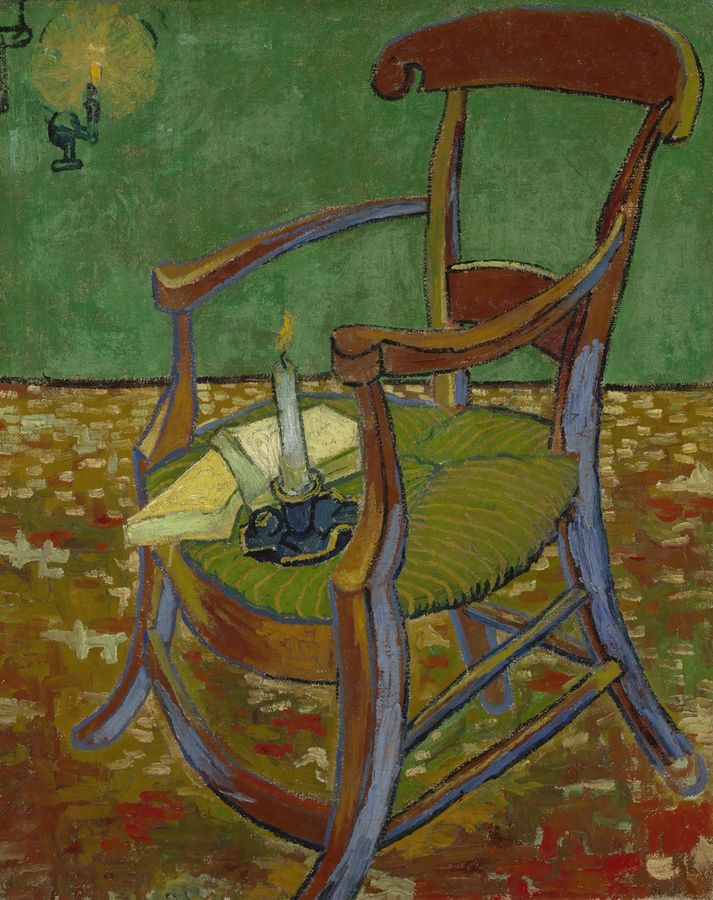
168. see for himself the fruits BVG 626a, 2/10/1890-2/11/1890: In addition to the works of Monticelli and Gauguin that Theo had for sale, Vincent mentioned one of his own paintings in particular. The painting, appropriately to Vincent's argument, is Gauguin's Chair (F 499 JH 1636).

Context:
JLB 853, 2/9/1890 or 2/10/1890: "A few days before we parted, when illness forced me to enter an asylum, I tried to paint 'his empty place'. It is a study of his armchair of dark, red-brown wood, the seat of greenish straw, and in the absent person's place a lighted candlestick and some modern novels. If you have the opportunity, as a memento of him, please go and look a little at this study again, which is entirely in broken tones of green and red."

169. gift of a new painting BVG 626a, 2/10/1890-2/11/1890: In one of the letter's stranger turns, Vincent adds a postscript with elaborate instructions on the care and framing of this "gift": "When the study I send you is dry right through, also in the impasto, which will not be the case for a year -- I should think you would do well to give it a good coat of varnish. And between times it should be washed several times with plenty of water to get out the oil completely. This study is painted in full Prussian blue, that colour about which people say so many bad things and which nevertheless Delacroix used so much. I think that once the Prussian blue tones are really dry, by varnishing you will obtain the dark, the very dark tones needed to bring out the different dark greens. I do not quite know how this study should be framed, but as I really want it to make one think of those dear Scottish fabrics, I have noticed that a very simple flat frame, bright orange lead, creates the desired effect with the blues of the background and the dark greens of the trees. Without this there would perhaps not be enough red in the canvas, and the upper part would appear a little cold." (JLB 853, 2/9/1890 or 2/10/1890; emphasis in original.)

Context:
JLB 853, 2/9/1890 or 2/10/1890: "I shall add a study of cypresses for you to the next consignment I send to my brother, if you will do me the pleasure of accepting it as a memento of your article."

170. "so characteristic" BVG 626a, 2/10/1890-2/11/1890: The quote refers to the pastiche of Baudelaire's Les Fleurs du Mal (Flowers of Evil) with which Aurier opened his article. (See Ch. 41, n. 57.)

Context:
BVG 626a, 2/10/1890-2/11/1890: "The cypress is so characteristic of the Provence landscape. You will feel it, and say, 'Even the color black.'"
JLB 853, 2/9/1890 or 2/10/1890: "The cypress is so characteristic of the landscape of Provence, and you sensed it when saying: 'even the colour black.'"

171. made a copy BVG 626, 2/10/1890-2/11/1890: This, at least, was Vincent's expressed intent.

Context:
JLB 854, 2/12/1890: "And so Gauguin has come back to Paris -- I'm going to copy my reply to Mr. Aurier to send it to him. ... I'll write to him one of these days, especially to send him the reply to Mr. Aurier's article."

172. original to Theo BVG 626, 2/10/1890-2/11/1890.

Context:
JLB 854, 2/12/1890: "Please send the enclosed letter to Mr. Aurier after you've read it."

173. "work together again" BVG 626, 2/10/1890-2/11/1890.

Context:
BVG 626, 2/10/1890-2/11/1890: "But I foresee that for him the struggle might be very hard, I think that you must tell him the pros and cons exactly as I should. I will write him soon, mainly to send him my reply to M. Aurier's article, and I should think that, if he liked, we could work together again here if his attempts to find a shelter do not succeed."
JLB 854, 2/12/1890: "But I foresee that for him the battle could be very tough. I think that you'll tell him the pros and cons of this absolutely as I would tell him, I'll write to him one of these days, especially to send him the reply to Mr. Aurier's article, and I'd think that if he wanted we could still work here together if his steps to find a position were to come to nothing."
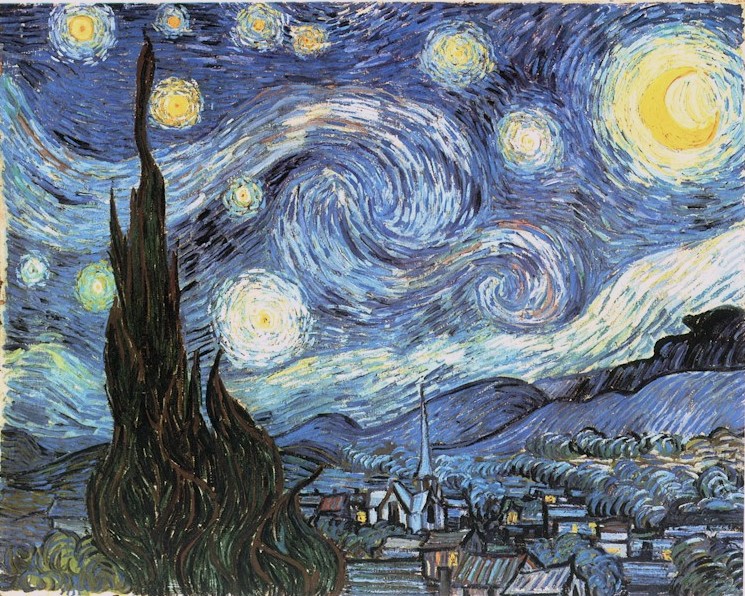
174. "[It] would encourage me" BVG 626, 2/10/1890-2/11/1890. Vincent's original is more oblique, more ambivalent, and Vincent does not connect this possible transformation directly to the prospect of Gauguin returning to the Midi: "Aurier's article would encourage me, if I dared let myself go, to risk emerging from reality more and making a kind of tonal music with colour, as some Monticellis are. But the truth is so dear to me, trying to create something true also, anyway I think, I think I still prefer to be a shoemaker than to be a musician, with colours." (JLB 854, 2/12/1890.) We would argue that Vincent is intentionally hiding the true subject of this obscure passage from his brother -- i.e., the hope that Gauguin will return and effect this transformation in Vincent's art by making it into something deeper and more "symbolic" -- with a small "s." His ambivalence arises because he knows that Theo does not favor the exaggerated works he has already done in this idiom, such as Starry Night [F 612 JH 1731], and Vincent therefore makes efforts not to raise alarm and staunchly reaffirms the devotion of both brothers to "this truth" -- i.e., Realism. The conflict between Vincent's ambition to rise to Aurier's challenge (with Gauguin's assistance) without defying his brother explains the twisted syntax of the passage.

Context:
BVG 626, 2/10/1890-2/11/1890: " Aurier's article would encourage me if I dared to let myself go, and venture even further, dropping reality and making a kind of music of tones with colour, like some Monticellis."
JLB 854, 2/12/1890: " Aurier's article would encourage me, if I dared let myself go, to risk emerging from reality more and making a kind of tonal music with colour, as some Monticellis are."

175. "drop reality" BVG 626, 2/10/1890-2/11/1890: We have slightly altered the translation. (See Ch. 41, n. 174.)

Context:
BVG 626, 2/10/1890-2/11/1890: "Aurier's article would encourage me if I dared to let myself go, and venture even further, dropping reality and making a kind of music of tones with colour, like some Monticellis."
JLB 854, 2/12/1890: "Aurier's article would encourage me, if I dared let myself go, to risk emerging from reality more and making a kind of tonal music with colour, as some Monticellis are."

176. "The good news" BVG 625, 2/2/1890.

Context:
BVG 625, 2/2/1890: "Anyway, the good news you have sent me and this article and lots of things have made me feel quite well personally today."
JLB 850, 2/1/1890: "Anyway, for me the good news you've told me and that article and a heap of things mean that I'm personally feeling completely well today."

177. "some sort of reputation" BVG 625, 2/2/1890.

Context:
BVG 625, 2/2/1890: "So if some sort or reputation comes to you and me, the thing is to try to keep some sort of calm and, if possible, clarity of mind."
JLB 850, 2/1/1890: "So if you or I were to gain some reputation or other, it's a matter of trying to retain a certain calm, and if possible presence of mind."

178. "Bravo" BVG 625, 2/2/1890.

Context:
JLB 850, 2/1/1890: "Bravo -- and how pleased Mother is going to be."

179. "I feel the desire" BVG W20, 2/20/1890.

Context:
BVG W20, 2/20/1890: "Thinking of this, but far away, I feel the desire to renew myself, and to try to apologize for the fact that my pictures are after all almost a cry of anguish, although in the rustic sunflower they may symbolize gratitude."
JLB 856, 2/19/1890: "Thinking like this, but very far off, the desire comes over me to remake myself and try to have myself forgiven for the fact that my paintings are, however, almost a cry of anguish while symbolizing gratitude in the rustic sunflower."

180. every family member Sister Lies later wrote thanking Theo for "letting me read that piece from Brussels" (b2411 V/1982, ''Gogh, Elisabeth van'' to ''Gogh, Theo en Jo'', 4/25/1890); Vincent referred to what were apparently congratulatory letters from his mother and sister Wil (JLB 850, 2/1/1890); and Uncle Cor wrote Theo about visiting Vincent's mother and her sister Wilhelmina (Mina) Stricker-Carbentus ) in early February (b3237 V/1984, ''Gogh, Cornelis Marinus van'' to ''Gogh, Theo van'', 2/4/1890). 810 181. "Jo is nursing" BVG T28, 2/9/1890.

Context:
BVG T28, 2/9/1890: "All goes well with us; Jo is nursing the baby, and has no lack of milk, and at times the little one lies with his eyes wide open and his fists pressed against his face."
JLB 852, 2/9/1890: "Things are going well at home with us, Jo is nursing the baby and has no lack of milk, and the little one sometimes lies down with his eyes wide open and his fists against his face."

182. a letter in Dutch For example: JLB 846, 1/31/1890. 183. "Your brother, Vincent" BVG 624, 1/31/1890.

Context:
JLB 846, 1/31/1890: "Your brother Vincent."

184. "he has blue eyes" BVG T28, 2/9/1890.

Context:
JLB 852, 2/9/1890: "He has blue eyes like the baby you painted, and fat cheeks."

185. "I devoutly hope" BVG T27, 1/31/1890.

Context:
BVG T27, 1/31/1890: "As we told you at the time, we are going to name him after you, and I devoutly hope that he will be able to be as persevering and as courageous as you."
JLB 847, 1/31/1890: "As we told you, we'll name him after you, and I'm making the wish that he may be as determined and as courageous as you."

186. "a new sun rising" BVG 624, 1/31/1890: We have slightly altered Bonger's translation.

Context:
BVG 624, 1/31/1890: "How happy Theo will be, and a new sun will rise inside him when he sees you recovering."
JLB 846, 1/31/1890: "How happy Theo will be, and a new sun will rise in him when he sees you recovering."

187. laid plans BVG 627, 2/20/1890. This is the first specific response to an invitation that Theo issued in January, before he knew about Vincent's attack that month: "In any event I hope that you'll come to us for a while to see our friends again and to see our little one" (JLB 843, 1/22/1890). Theo re-issues an invitation at the end of the month, but this time with some hesitation and built-in delays: "How happy I'd be if in a while, when Jo's well again, you'll be able to come and see her and see our little one!" (JLB 847, 1/31/1890). The first indication of Vincent's "acceptance" of this offer comes in his letter to Aurier about February 10, when he says, "However, before leaving here, I am planning to return to the fray to attack the cypresses" (JLB 853, 2/9/1890 or 2/10/1890). This seems to take into account Theo's request for a delay. However, by the time of his next attack less than two weeks later, Vincent has learned of the sale of a painting from the Vingt exhibition (see Ch. 41, n. 267) and seems unable to wait any longer to "unite" with his brother's family in Paris, consequences be damned: "It might also be bad for one's health to return further north. Anyway, I'll start by trying a week or so in Paris." (JLB 855, 2/19/1890.)

Context:
JLB 855, 2/19/1890: "Now I'm seriously thinking of profiting from that windfall of selling that painting to go to Paris -- to visit Theo. And thanks to the doctor here I feel I'll leave calmer and healthier than I came here. Just to see how it goes outside an asylum is perhaps only a matter of course. The work may possibly be more difficult for me, though, when I'm at liberty again."
188. "when I am free again" BVG 627, 2/20/1890.

Context:
BVG 627, 2/20/1890: "Now I am strongly inclined to take advantage of my good luck in selling this picture by going to Paris to visit Theo. And thanks to the physician here, I shall leave feeling calmer and healthier than when I came. Trying how it goes outside a hospital is perhaps only natural. Though work may perhaps be more difficult when I am free again."
JLB 855, 2/19/1890: "Now I'm seriously thinking of profiting from that windfall of selling that painting to go to Paris -- to visit Theo. And thanks to the doctor here I feel I'll leave calmer and healthier than I came here. Just to see how it goes outside an asylum is perhaps only a matter of course. The work may possibly be more difficult for me, though, when I'm at liberty again."

189. his aborted visitSee Chapter 40. 190. big charcoal drawing Gauguin, Madame Ginoux (Study for Night Café), W 318, November 1888, white and colored chalks and charcoal, 22 x 19.25 in, 56 x 49 cm., Pushkin Museum, Moscow. 191. Vincent imagined Sund, in Dorn, ed., pp. 208-209: Vincent may have painted this consummation in Landscape with Couple Walking and Crescent Moon (F 704 JH 1981), which appears to show the blue-suited, red-bearded artist walking with his full-figured, raven-haired Arlésienne. This painting is generally attributed to Vincent's last weeks in Saint-Rémy, but without any solid evidence for such a late date. It seems more likely that he painted it before his disastrous trip to Arles to see Joseph Ginoux and Marie Ginoux-Julien, proprietor and proprietress of the Café de la Gare in Arles, in late February. 192. "There have been articles" BVG 626b, 2/1/1890-2/15/1890.

Context:
BVG 626b, 2/1/1890-2/15/1890: "So for myself I am quite glad that all goes well with me, especially as my work is not progressing too badly, and because there have been articles on my pictures published simultaneously in Belgium and in Paris, where I had them exhibited, in which they speak far better of them than I myself could have wished."
JLB 851, 2/2/1890: "So for myself I'm really pleased that this is going well, all the more so because work isn't going too badly either, having had articles on my paintings both in Belgium and in Paris where I exhibited them, and people are saying much more good things about them than I myself would wish."

193. Other painters BVG 626b, 2/1/1890-2/15/1890. The "Marseille painter" that Vincent expected was Auguste Lauzet, a young French artist who was marketing a collection of lithographs of the work of Monticelli (see Ch. 40, n. 189). Theo had mentioned in January that Lauzet was going to Marseille in the first part of February and "on his way back he'll do what he can to call in on you. ... You'll see what an interesting fellow he is and how well-versed he is in modern literature." (JLB 843, 1/22/1890.) Theo even imagined that Vincent might eventually share studio with Lauzet in Paris on a permanent basis: "As regards what you write about the future, try and see if a partnership couldn't be entered into with Lauzet. You could, for example, look for a studio for the two of you, and you could come and have dinner and sleep with us" (ibid.; see Ch. 40, n. 541). Vincent looked forward to the visit ("I hope that Mr. Lauzet will come, I very much want to make his acquaintance" [JLB 850, 2/1/1890]) and even promoted Lauzet's Monticelli project in his letter to Aurier ("At present Mr. Lauzet is in the process of reproducing around thirty Monticellis" [JLB 853, 2/9/1890 or 2/10/1890]).

In fact, not long after Vincent's boast to Joseph Ginoux, the visit by Lauzet fell through -- probably another victim of rumors about the latest attack in January and then February. In April, Theo puts the best face on the reversal: "Lauzet is back, he wasn't able to stop by and see you, because his mother and sister who lived in Marseille have come to stay with him here, and he had to help them move house and didn't have the money to go out of his way" (JLB 862, 4/23/1890).

Context:
JLB 851, 2/2/1890: "I'm expecting a visit from a Marseille painter any day now, so this is another reason why I don't know precisely which day I'll be able to come and see you."

194. "Mr. Paul" BVG 626b, 2/1/1890-2/15/1890: This was apparently Marie Ginoux's flirtatious name for Gauguin; thus, Vincent's use of it constitutes a double intimacy. At first glance, this might appear to be a reference to Gauguin's invitation to Vincent to form a studio with De Haan in Antwerp (see Ch. 41, n. 151), thus a preclusion of Vincent's fantasy of Gauguin returning to Provence. But we believe Vincent is alluding only to a visit he plans to pay his brother in Paris as soon as possible because of the child, at which time he will, of course, see Gauguin as a prelude to, not a substitute for, the latter's return to Arles -- a prospect, Vincent implies, not unpleasing to Madame Ginoux. The same planning -- or, more accurately, dreaming -- probably informs his unexpected rejection, around the same time, of Theo's invitation for him to come to Paris: "I think that in the north one would spend rather more. And that's why -- even if I came to you for a while -- the best policy might still be to continue the work here." (JLB 854, 2/12/1890.)

Context:
BVG 626b, 2/1/1890-2/15/1890: "Only the other day I had a letter from Mr. Paul, and it is possible that I shall go and see him soon, for I am longing to make the acquaintance of my brother's little boy, who was born a short time ago, safe and sound fortunately."
JLB 851, 2/2/1890: "I had news of Mr. Paul again the other day, and it's possible I may soon go and see him, especially because I also have a great desire to go and make the acquaintance of my brother's little one, who has fortunately just been born safe and sound."

195. "it's possible" BVG 626b, 2/1/1890-2/15/1890. (See Ch. 41, n. 194.) We have combined elements from both translations.

Context:
BVG 626b, 2/1/1890-2/15/1890: "Only the other day I had a letter from Mr. Paul, and it is possible that I shall go and see him soon, for I am longing to make the acquaintance of my brother's little boy, who was born a short time ago, safe and sound fortunately."
JLB 851, 2/2/1890: "I had news of Mr. Paul again the other day, and it's possible I may soon go and see him, especially because I also have a great desire to go and make the acquaintance of my brother's little one, who has fortunately just been born safe and sound."

196. filled the sensuous forms The first portrait of Madame Ginoux is considered to be L'Arlésienne, F 540 JH 1892, February, 1890, oil on canvas, 23.6 x 19.7 in., 60 x 50 cm., Galleria Nazionale d'Arte Moderna, Rome. 197. same blushing palette See Ch. 40, n. 492 and n. 493. 198. began another version L'Arlésienne, F 541 JH 1893, February, 1890, oil on canvas, 25.6 x 19.3 in., 65 x 49 cm., Kröller-Müller Museum, Otterlo. 199. toward a benign smile Pickvance, pp. 175-177: According to Pickvance, one version of L'Arlésienne, (F 542 JH 1894, February, 1890, oil on canvas, 25.6 x 21.3 in., 65 x 54 cm., Museum de Arte de Sao Paulo, Sao Paulo): "shows Madame Ginoux at her most serious; in the others there is the suggestion of a smile." 200. childhood favorites Vincent had read both books as recently as early 1889, as he wrote his sister Wil: "I've re-read Beecher Stowe's Uncle Tom with extreme attention precisely because it's a woman's book, written, she says, while making soup for her children, and then also with extreme attention C. Dickens's Christmas Tales" (JLB 764, 4/28/1889-5/2/1889; emphasis in original). 811 201. Annie Slade's guestbook See Chapter 8. (Annie Slade-Jones-Dawson, wife of Thomas Slade-Jones.) 202. a third began L'Arlésienne, F 542 JH 1894, February, 1890, oil on canvas, 25.6 x 21.3 in., 65 x 54 cm., Museum de Arte de Sao Paulo, Sao Paulo. 203. Then a fourth L'Arlésienne, (Madame Ginoux), F 543 JH 1895, February, 1890, medium unknown, 31.5 x 25.2 in., 80 x 64 cm., Pushkin Museum, Moscow. 204. five versions Pickvance, p. 177: According to Pickvance: "A fifth version of L'Arlésienne, which van Gogh intended to present to Madame Ginoux, was lost when he suffered a breakdown on his last visit to Arles, in February 1890." 205. "I ought to be" JLB 856, 2/19/1890; emphasis in original.

Context:
BVG W20, 2/20/1890: "But when I had read that article I felt almost mournful, for I thought: I ought to be like that, and I feel so inferior."
JLB 856, 2/19/1890: "I found Mr. Aurier's article - leaving aside whether I deserve what he says of me -- in itself very artistic, very curious -- but it's rather like this that I ought to be than the sad reality of what I feel myself to be" (emphasis in original).

206. "Pride, like drink" BVG W20, 2/20/1890: We have altered the punctuation in the BVG translation of an original that is, by Vincent's admission, rambling and fragmented.

Context:
BVG W20, 2/20/1890: "And pride, like drink, is intoxicating, when one is praised, and has drunk the praise up. It makes one sad, or rather -- I don't know how to express it, I feel it -- but it seems to me that the best work one can do is what is done in the privacy of one's home without praise."
JLB 856, 2/19/1890: "And pride intoxicates like drink, when one is praised and has drunk one becomes sad, or anyway I don't know how to say how I feel it, but it seems to me that the best work one could do would be that carried out in the family home without self-praise."

207. "weaknesses" BVG W20, 2/20/1890. According to the JLB, "this quotation, possibly from Victor Hugo, has not been traced" (JLB 856, 2/19/1890; n. 9).

Context:
BVG W20, 2/20/1890: "Soiled in the struggle for life ... 'Who will give back to the soul what the breath of revolutions has taken away' -- this is the cry of distress uttered by the poet of another generation, who seemed to have a presentiment of our present weaknesses, diseases, wanderings."
JLB 856, 2/19/1890: "Soiled in the struggle for life ... 'who will give back to the soul that which the breath of revolutions has taken away' -- that's the cry of a poet of the other generation who seemed to have a premonition of our present weaknesses, our sicknesses, our confusions."

208. "As soon as I read" BVG 629a, 4/30/1890: We have slightly reordered the translation.

Context:
BVG 629a, 4/30/1890: " As soon as I heard that my work was having some success, and read the article in question, I feared at once that I should be punished for it; this is how things nearly always go in a painter's life: success is about the worst thing that can happen."
JLB 864, 4/29/1890: " When I heard that my work was having some success and read that article I was immediately afraid that I'd regret it -- it's almost always the case that success is the worst thing that can happen in a painter's life."

209. Degas-like lines Edgar Degas was on Vincent's mind in February 1890 for other than artistic reasons. His sister Wil, before leaving Paris, had been to visit the aging master: "Wil left, she gave us a lot of help in the household. She's a good girl. I was once with her at Degas's place; he said that she reminded him of several figures from the old Dutch paintings, and made him very much want to go and see the museums in our country. He brought out several things to show her, which pleased her greatly." (JLB 852, 2/9/1890.) Vincent replies enviously, "Then what you write about our sister also interests me a great deal. I consider that she was lucky to see Degas at his home." (JLB 854, 2/12/1890.) Rewald speculates that "it was probably on that occasion, on January 17, that Theo bought a Danseuse avant l'exercice" (Rewald, Studies in Post-Impressionism, p. 52). 210. "scruples of conscience" BVG 625, 2/2/1890: Vincent's vast project of copying works by Millet and others had been born in doubt and defensiveness (see Chapter 40). Despite defending the project vigorously and continuously ever since, he never seemed convinced by his own arguments. The depths of Vincent's self-doubt were revealed in the first months of 1890. In early January, Theo singled out one of the Millet copies (La Veillée [Evening], [F 647 JH 1834]) for special praise calling it "Copied like that it's no longer a copy" and "really very successful" (JLB 838, 1/8/1890). In the following few weeks he added, "I'm curious to see the other Millets" (JLB 843, 1/22/1890). Even with this show of support, Vincent continued to wrestle with the doubts in his own head: "What you say about the copy after Millet, The evening, pleases me. The more I think about it the more I find that there's justification for trying to reproduce things by Millet that he didn't have the time to paint in oils. So working either on his drawings or the wood engravings, it's not copying pure and simple that one would be doing." (JLB 839, 1/13/1890.)

Vincent dismissed his earlier copies (after Millet's Travaux [see Chapter 40]) as "gropings" (JLB 839, 1/13/1890) and protested various justifications for his continuing attempts in this direction: "It is rather translating into another language ... It took me a lot of time and a lot of trouble. ... They were done through a most profound and sincere admiration for Millet. ... It's justifiable to try to make Millet's work more accessible to the ordinary general public." (ibid.) Still, he imagined that one day these works would be "criticized ... or despised as copies" (ibid.). When Theo sent him a new batch of prints by Millet and others (see JLB 850, 2/1/1890), the effect was to redouble Vincent's insecurities rather than assuage them. In a pathetic reach for validation, he immediately forwarded some of the Millet images to John Peter Russell in the hopes of recruiting Russell to join him in his project of "translation": "In order to prevent people, not criticizing me, I couldn't care about that, but bothering or obstructing me under the pretext that I'm manufacturing copies -- then among the artists I need people like Russell or Gauguin to carry this task to a successful conclusion, to make something serious of it." (JLB 850, 2/1/1890.)

He swore off doing any more copies after Millet or anybody else until he had heard back from Russell: "I don't want to do it before first having heard something of your opinion, then also that of certain others on those that you'll soon receive. Without that I'd have scruples of conscience, a fear that it might be plagiarism" (ibid.). (Note that Vincent does not say, "that it might be considered plagiarism" -- suggesting just how deep his reservations still ran.) Curiously, when Vincent did send the "roll" of Millets to Russell, the accompanying letter said nothing about his translation project nor did it make any overt effort to recruit Russell to it -- indicating, perhaps, that Vincent was too ashamed of the project even to mention it (presumably just hoping that Russell would take the bait). Instead, he spends most of the letter (JLB 849, 2/1/1890) trying to coax Russell into going to the entresol to buy a work by Gauguin (see Ch. 41, n. 139 and n. 142). As far as is known, Vincent did not have the courage to mention the copying project to Gauguin at all. Yet he continued to do copies himself (e.g., Prisoners Exercising [F 669 JH 1885], after Gustave Doré; and The Drinkers [F 667 JH 1884], after Honoré Daumier; see JLB 839, 1/13/1890), in a kind of self-mortification of inadequacy.
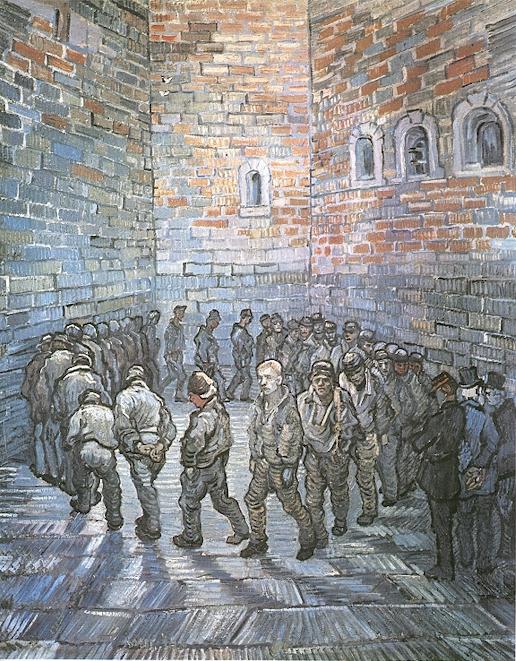
Context:
BVG 625, 2/2/1890: "I have scruples of conscience about doing the things by Millet which you sent me, for instance, and which seemed to me perfectly chosen, and I took the pile of photographs and unhesitantly sent them to Russell, so that I shall not see them again until I have made up my mind."
JLB 850, 2/1/1890: "To do the things by Millet that you sent, for example, the choice of which I consider completely right -- I have scruples of conscience, and I took the pile of photographs and I sent them unhesitatingly to Russell so that I shouldn't see them again until I'd thought long and hard about it."

211. "translations" BVG 625, 2/2/1890: This is Vincent's word, although, curiously, he puts it in quotes as if he knows it is a loose usage.

Context:
BVG 625, 2/2/1890: "My illness makes me very sensitive now, and for the moment I do not feel capable of continuing these 'translations' when it concerns such masterpieces."
JLB 850, 2/1/1890: "Now the illness makes me very sensitive, and for the moment I don't feel capable of continuing these 'translations' when it would involve such masterpieces."

212. "come off" BVG 625, 2/2/1890: The painting is The Sower, F 690 JH 1837, Late October, 1889, oil on canvas, 31.9 x 25.6 in., 81 x 65 cm., Collection Niarchos. (see Ch. 41, n. 134).

Context:
BVG 625, 2/2/1890: "I am stopping at the 'Sower [F 690 JH 1837],' which I am working on, and which is not coming off as I should wish."
JLB 850, 2/1/1890: "I'm stopping with the sower [F 690 JH 1837], which is in progress and isn't coming along as would be desirable."

213. masterpieces to the masses BVG 623, 1/12/1890-1/15/1890.

Context:
JLB 839, 1/13/1890: "Then, even if they're criticized one day or despised as copies, it will remain no less true that it's justifiable to try to make Millet's work more accessible to the ordinary general public."

214. like simple plagiarism BVG 625, 2/2/1890. (See Ch. 41, n. 210.)

Context:
JLB 850, 2/1/1890: "To do the things by Millet that you sent, for example, the choice of which I consider completely right -- I have scruples of conscience, and I took the pile of photographs and I sent them unhesitatingly to Russell so that I shouldn't see them again until I'd thought long and hard about it."

215. invented or exaggeratedIn the letter to Ginoux himself, obviously, Vincent could not exaggerate. 216. she had banned him See Ch. 40, n. 577 and n. 575. (Also see Ch. 41, n. 395.) 217. no longer even accept BVG 634a, 5/11/1890-5/12/1890: When Vincent writes his farewell letter to Mr. Ginoux in mid May 1890 (see Ch. 41, n. 395), he does not include Madame in the salutation and talks about her strictly in the third person -- an indication that she had forbidden him to write. 218. "I fear that after" b2689 V/1982, "Gogh, Anna van" to "Gogh, Theo van", /24/1874. (See Ch. 2, n. 355.) 812 219. "You will foresee" BVG 625, 2/2/1890.

Context:
BVG 625, 2/2/1890: "And you will foresee, as I do, that such praise must have its opposite, the other side of the medal."

JLB 850, 2/1/1890: "And you, like me, foresee that being praised must have its other side, its reverse of the coin."

220. "in memory of our father" BVG 625, 2/2/1890.

Context:
BVG 625, 2/2/1890: "Now as for the little boy, why don't you call him Theo in memory of our father, it would certainly give a great deal of pleasure to me."
JLB 850, 2/1/1890: "Now as for the little one, why then don't you call him Theo in memory of our father, that would certainly give me so much pleasure."

221. gloomy moods b2928 V/1982, "Gogh-Carbentus, Anna C. van" to "Gogh-Bonger, Jo van", Apr. 1890: The subject of "Baby Vincent's" comes up early in the family letters. In April 1890, Theo's mother writes Jo: "I still remember how busy mothers can be with their first born, but if everything goes well, I wish you the rewards. Does he recognize you a little -- at least with his eyes? Does he smile a little bit more?" (ibid.) The same nascent seriousness (as opposed to the much-desired quality of cheerfulness) was apparently documented in a photograph, in which the child's mirthlessness became a subject of defensive comment by Theo to his mother: "You receive herewith a picture of Jo and the boy, don't you think Jo looks good? On the picture of the boy alone he looks bigger, but the way he looks sitting with Jo is the way he often looks. He can smile." (b0929 V/1962, ''Gogh, Theo van'' to ''Gogh-Carbentus, Anna C. van'', 5/3/1890). And in another letter to a relative accompanying the same photograph: "Don't you think he looks great already? He does not always look this serious though." (b0930 V/1962, ''Gogh, Theo van'' to ''Gogh, Maria Johanna van'', 5/7/1890.) 222. "nervous disposition" BVG T32, 4/23/1890.

Context:
BVG T32, 4/23/1890: "The little one particularly gives Jo a lot of work ... He is of a nervous disposition but very gentle."
JLB 862, 4/23/1890: "The little one gives Jo ... a great deal of work ... He's nervous by nature, but very sweet."

223. "It is necessary" BVG T25, 1/22/1890: It is difficult to imagine that Theo had not read the Aurier article by the time this letter was written (January 22), even though he does not mention it. "Van Gogh" was a conspicuous name, well-known in the art world, and the article had been circulating since late December.

Context:
BVG T25, 1/22/1890: " It is necessary to get well known without obtruding oneself, and it will come of its own accord by reason of your beautiful pictures."
JLB 843, 1/22/1890: " One must make oneself known without wanting to impose oneself: this will come of its own accord through your fine works."

224. "the only cloud" BVG T27, 1/31/1890.

Context:
BVG T27, 1/31/1890: "This is the only cloud in the sky of our happiness, for, my dear brother, the bad moment for Jo is past."
JLB 847, 1/31/1890: "It's the only cloud in our happiness, for my dear brother, the bad moment for Jo is over."

225. "Jo and I suffer too" BVG T32, 4/23/1890.

Context:
BVG T32, 4/23/1890: "Your silence proves to us that you are still suffering, and I feel urgently impelled to tell you, my dear brother, that Jo and I suffer too because we know you are ill."
JLB 862, 4/23/1890: "Your silence proves to us that you're still suffering, and I need to tell you, my dear brother, that Jo and I are also suffering, knowing that you're still ill."

226. "crime" BVG 595, 6/17/1889-6/18/1889. Commenting on Gauguin's and Bernard's insurgent Volpini show in June 1889, Vincent writes, "For me it's beyond doubt that [they] have great and real merit. It's still perfectly understandable, though, that for beings like them, really alive and young, who must live and try to carve out their path, it's impossible to turn all their canvases to the wall until it pleases people to admit them somewhere in the official pickle. One causes a stir by exhibiting in the cafés, which I don't say isn't in bad taste. But for myself, I have that crime on my conscience, and to the point of doing it twice, having exhibited at the Tambourin and at avenue de Clichy. Not counting the disturbance caused to 81 virtuous cannibals of the good town of Arles and to their excellent mayor. So in any case, I am worse and more blameworthy than they are in that regard (causing a stir quite involuntarily, my word)." (JLB 782, 6/18/1889.) Vincent's use of "crime" here conflates both with his own improvisational venues in Paris and the incident in Arles with the Volpini show. By this parallel, he seems to be acknowledging that his "crimes" at Christmastime in 1888 had a publicity value and that such publicity could be deployed to draw attention to art that might otherwise be neglected ("turned to the wall"). The only difference, Vincent says, is that, unlike his comrades, he did not intentionally seek publicity with his crime in Arles. Nonetheless, he seems to accept the implication that the events in the Yellow House had already brought his art some notoriety.

Context:
BVG 595, 6/17/1889-6/18/1889: "You cause a stir by exhibiting in cafés; I do not say it is not bad taste to do it, but I myself have this crime on my conscience twice over, as I exhibited at the Tambourin and at the Avenue de Clichy, without counting the upset caused to 81 worthy anthropophagi of the good town of Arles and their excellent mayor."
JLB 782, 6/18/1889: "One causes a stir by exhibiting in the cafés, which I don't say isn't in bad taste. But for myself, I have that crime on my conscience, and to the point of doing it twice, having exhibited at the Tambourin and at avenue de Clichy."

227. "thorns and thistles" BVG 625, 2/2/1890. (See Ch. 41, n. 229.)

Context:
BVG 625, 2/2/1890: "Old Goupil managed his household pretty well even in the Parisian thorns and thistles, and I expect you will think of him many a time."
JLB 850, 2/1/1890: "Old Goupil ran his household well in the Paris undergrowth, and I think that you'll still think of him very often."

228. marriage prospects BVG T25, 1/22/1890: This plaintive question in a letter from Theo in January -- by which time Theo had undoubtedly read the Aurier article (see Ch. 41, n. 233), but Vincent had not -- suggests that the article aggravated this concern in Theo -- just as it no doubt did later when Vincent read it. Right before the attack in January, Vincent had written to his sister: "Have you met Émile Bernard now -- I'd very much like him to come and see some of my canvases one of these days" (JLB 841, 1/20/1890). The connection between Wil's marriageability and the Aurier article would have been driven home when Jo wrote about a week later: "This morning Theo brought in the article in the Mercure, and after we'd read it Wil and I talked about you for a long time" (JLB 845, 1/29/1890).

Context:
JLB 843, 1/22/1890: "Wil is much better, and she is looking extremely well. I should very much like her to get married, but to whom?"

229. "You must beware" BVG 625, 2/2/1890: This elaborate warning immediately follows Vincent's reading of the Aurier article.

Context:
BVG 625, 2/2/1890: "But from the beginning you must beware of putting your young family too much into artistic surroundings."
JLB 850, 2/1/1890: "But right from the start we must think of not putting your young family too much into the artistic environment."

230. expected visit See Ch. 41, n. 193. 231. "pretension" BVG 615, 11/21/1889.

Context:
BVG 615, 11/21/1889: "We must work as much and with as few pretensions as a peasant if we want to last."
JLB 823, 11/26/1889: "One must work as hard and with as few pretensions as a peasant if one wants to last."

232. hid his fury The consensus of the literature, not surprisingly, is that Gauguin expected that Aurier would pick him, not Vincent, as the debut avatar of Symbolism, and reacted negatively when that expectation was dashed. Gauguin had contributed articles for Aurier's magazine Le Moderniste, and certainly echoed, if not contributed to, much of Aurier's signature critical rhetoric (see Ch. 41, n. 37). Through Bernard, Aurier had been kept abreast of Gauguin's work throughout this time. According to Lövgren, Gauguin considered the review "a Judas betrayal" and "the unkindest cut of all" (pp. 146-147). According to Roskill, Gauguin felt "exploited" and that "Aurier should have dedicated an article to his work first" (pp. 204, 206). Welsh-Ovcharov ventures that Gauguin "was more than mildly surprised that it was Vincent and not himself whose art Albert Aurier chose to celebrate the very first issue (January 1890) of his new Symbolist journal" (p. 53). According to Welsh-Ovcharov, Aurier had specifically spurned a suggestion by Bernard that Gauguin be the subject of the critic's first in the series of "Les Isolées" (ibid.). (See also Rewald, Post-Impressionism from Van Gogh to Gauguin, p. 259.)

Gauguin's attitude can be gauged by his reaction after the article on Vincent appeared. He wrote the critic several letters in the following months, but when Aurier didn't respond immediately, he lashed out furiously to Bernard: "Aurier hasn't answered my two letters, just like dog shit along a wall" (Gauguin, quoted in Lövgren, p. 146; emphasis in original). Gauguin showed none of this anger or bitterness to the apologetic Vincent (see Ch. 41, n. 161). "My very dear Vincent," he opened his letter of January 28 inviting Vincent to jointly found a studio in Antwerp (Gauguin, Paul Gauguin: 45 Lettres à Vincent, Théo et Jo van Gogh, p. 297). (His inner turmoil can probably be inferred from his conspicuous failure to mention the article despite almost certainly having read it by this date.) Roskill offers one explanation for Gauguin's concealing his fury from Vincent: "When things went badly between himself and Theo, [Gauguin] used Vincent to pull his relationship with the dealer back into line" (Roskill, p. 204). In short, Gauguin, who was experiencing a "downward slide in his career [as] Van Gogh's was surging upward," could not afford to alienate his dealer (Mathews, Nancy, p. 148). After much further drama, Aurier did finally publish an article about Gauguin in the March 1891 issue of the Mercure entitled "Le Symbolisme en peinture" (“Symbolism in Painting”). The critic died prematurely the following year, at the age of twenty-seven, after contracting typhoid on a trip to the south of France. (See Rusic, p. 51.)

233. phantom love This may be the period in which Vincent painted Couple Walking and Crescent Moon, F 704 JH 1981, May, 1890, oil on canvas, 19.5 x 17.9 in., 49.5 x 45.5 cm., Museu de Arte de Sao Paulo, Sao Paulo. (See Ch. 42, n. 476.) 234. "there is no hurry" BVG 626, 2/10/1890-2/11/1890.

Context:
BVG 626, 2/10/1890-2/11/1890: "But it seems to me that there is no hurry about this, and we must consider coolly if this is the moment to spend money on the journey; perhaps we could do something for Gauguin or Lauzet by giving up the journey."
JLB 854, 2/12/1890: "But it seems to me that there's no hurry about this, and that we must consider calmly if this is the moment to spend money on the journey."

235. "My pictures" BVG W20, 2/20/1890: Note: We have reordered the passages in BVG.

Context:
BVG W20, 2/20/1890: "… although I feel that I have become a rather degenerate child. Thinking of this, but far away, I feel the desire to renew myself, and to try to apologize for the fact that my pictures are after all almost a cry of anguish, although in the rustic sunflower they may symbolize gratitude.
JLB 856, 2/19/1890: " …while feeling myself become a most degenerate child. Thinking like this, but very far off, the desire comes over me to remake myself and try to have myself forgiven for the fact that my paintings are, however, almost a cry of anguish while symbolizing gratitude in the rustic sunflower."
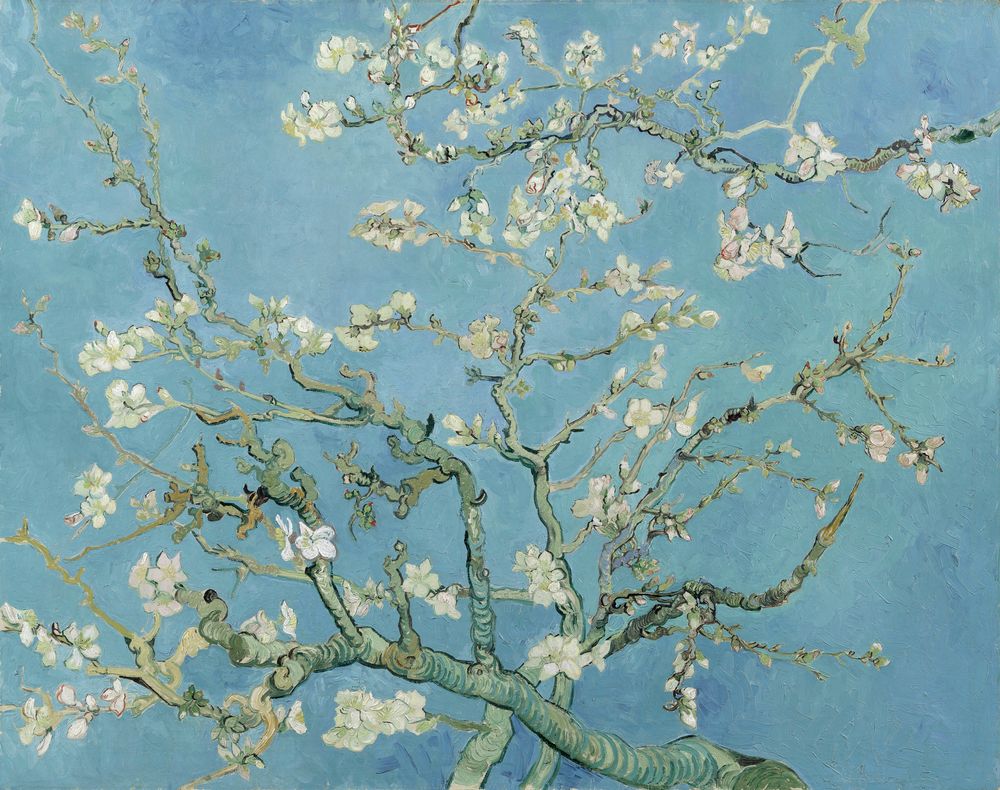
236. began a new painting The painting is Blossoming Almond Tree, F 671 JH 1891, February, 1890, oil on canvas, 28.9 x 36.2 in., 73.5 x 92 cm., Amsterdam, Van Gogh Museum, titled variously Blossoming Almond Tree, Blossoming Almond Branches, Branches of a Blossoming Almond Tree, The Almond Branches, or, simply, Almond Blossom. The text raises inferentially the question for whom the painting was done. For years, the controlling voice was the BVG translation of a February 19 letter from Vincent to Wil in which he wrote regarding the birth of Theo's son, his namesake, Vincent Willem: "Well, the result is that after all that the child is there -- and also I shall write a letter to Mother telling her so; a day or two ago I started painting a picture for her of a blue sky with branches full of blossoms standing out against it" (W20, 2/19/1890; emphasis added). (See JLB, 856, 2/1/1890: "But anyway, the result is that the child's here -- and as I wrote to his grandmother, I've started painting for him these last few days -- a large sky-blue canvas against which branches covered in blossoms stand out.") But on the same day, Vincent wrote guiltily to his mother: "I'd much rather that he'd called his boy after Pa, whom I've thought about so often these days, than after me, but anyway, as it's been done now I started right away to make a painting for him, to hang in their bedroom [i.e. Theo and Jo's]. Large branches of white almond blossom against a blue sky." (JLB 855, 2/19/1890.)

Because of this, and because Vincent later characterized the painting as a gift for the baby (see below), the passage from the letter to Wil has been translated differently from the version in BVG (Bonger may have had special knowledge on the subject): "I started immediately to make a picture for him [the baby], to hang in their bedroom, big branches of white almond blossom against a blue sky." (Pickvance, p. 178; emphasis added.) JLB support the latter interpretation (JLB, 856, 2/1/1890). The original text, with its sexually-ambiguous reflexive pronoun "lui," supports either translation: "Mais enfin le résultat c'est que l'enfant y est -- et ainsi que je l'écris à sa grandmère je me suis mis à peindre de ces jours ci pour lui -- une grande toile bleu de ciel sur lequel se détachent des branches fleuries."

One does not have to look far in Vincent’s imaginative world to find a precedent for a painting of flowers as a gift for an infant. In Rod's Sens de la Vie, which Vincent read in 1889, a new father remarks on his bébé's fascination with flowers: "One of the aspects of the baby that ravishes me the most, this is its love for flowers. She takes joy in them from the first moment that she perceives them. She takes them in her little hand, and moves them with movements of ecstasy, an intelligent air, a fine smile." (Rod, p. 131.) But the ambiguity of the painting's inspiration is not so easily resolved. It was on Vincent’s easel the day before he left on the fateful visit to Arles in February (see Pickvance, pp. 178-179), which suggests to us a connection with his maternal Ginoux longing; and when Vincent sent it off to Arles in late April, he had not added a dedication to his nephew (ibid.) -- an odd omission if it was, indeed, intended for that purpose.

When Theo immediately admired the painting, he made no reference to its suitability as (or his gratitude for) a gift for the newborn (JLB 867, 5/3/1890). By the end of May, during which time Vincent visited Theo’s apartment in Paris, however, the painting had definitively acquired the identity of a gift for the baby. "I brought along a relatively large picture for Theo's and Jo's little boy," Vincent wrote Wil from Auvers in early June, "which they hung over the piano -- white almond blossoms -- big branches against a sky-blue background" (JLB 879, 6/5/1890). (Note that the painting was hung in the living room, not in the bedroom as Vincent had imagined. Also, the false claim that he had brought it with him casts a pall of suspicion over the entire account.) We prefer to embrace the ambiguity of Vincent’s intentions for the image. It was painted in the swoon of maternal longings that preceded his trip to Arles in late February, as described in the text, and that swoon included his own mother, Madame Ginoux, the newborn nephew, Theo and Jo, and himself -- all of whose images were summoned up when Vincent imagined the perfect mother-child relationship, so much missed and yearned for.

237. "a blue sky" BVG W20, 2/20/1890.

Context:
BVG W20, 2/20/1890: "Well, the result is that after all that the child is there -- and also I shall write a letter to Mother telling her so; a day or two ago I started painting a picture for her of a blue sky with branches full of blossoms standing out against it."
JLB 856, 2/19/1890: "But anyway, the result is that the child's here -- and as I wrote to his grandmother, I've started painting for him these last few days -- a large sky-blue canvas against which branches covered in blossoms stand out."

238. his pen and his brush The text assumes that both of the letters Vincent sent on February 19, 1890 -- one to his sister Wil (JLB 856, 2/19/1890) and one to his mother (JLB 855, 2/19/1890) -- were addressed, ultimately, to his mother. They were enclosed in the same envelope and he knew that Wil shared his letters with their mother and vice versa. The two letters address some issues in common, but elaborate those common themes in different and complementary ways, further indicating that Vincent intended them as "pendants" and expected them to be read jointly. 239. "I should have greatly" BVG 627, 2/20/1890.

Context:
BVG 627, 2/20/1890: " I should have greatly preferred him to call the boy after Father, of whom I have been thinking so much these days, instead of after me."
JLB 855, 2/19/1890: " I'd much rather that he'd called his boy after Pa, whom I've thought about so often these days, than after me, but anyway, as it's been done now I started right away to make a painting for him, to hang in their bedroom."

813 240. desperate jumble of words BVG W20, 2/20/1890.

Context:
JLB 856, 2/19/1890: "… when I read the article it made me almost sad as I thought: should be like this and I feel so inferior. And pride intoxicates like drink, when one is praised and has drunk one becomes sad, or anyway I don't know how to say how I feel it."

241. childhood of wandering BVG W20, 2/20/1890. We hear Vincent evoking this source of maternal disapproval in this passage: "I say it often, are we as brand new as the old Belgian, Henri Conscience? Ah, that's why I was pleased with the success in Brussels, because of that Kempen of Antwerp that I still try to recall from time to time in the calm furrows of the fields while feeling myself become a most degenerate child." (JLB 856, 2/19/1890.) The Campine is an area of southern Brabant (northern Belgium) celebrated by Conscience for its remote heathlands, and often cited by the Van Gogh brothers as a literary surrogate for their childhood on the heaths of nearby Zundert. Anna had often reprimanded Vincent's frequent, unaccompanied trips into the heaths (see Chapter 3) and, no doubt, often attributed his anti-social nature and subsequent fate to these early "confusions." Vincent, in fact, uses that exact word in an emotionally confessional passage nearby in the same letter when he refers to "we Impressionists" as "soiled in the struggle for life," and admits to "our present weaknesses, our sicknesses, our confusions" (JLB 856, 2/19/1890).

Context:
JLB 856, 2/19/1890: "Soiled in the struggle for life ... 'Who will give back to the soul what the breath of revolutions has taken away' -- this is the cry of distress uttered by the poet of another generation, who seemed to have a presentiment of our present weaknesses, diseases, wanderings."

242. "the bounds of pride and eccentricity" BVG W20, 2/20/1890.

Context:
BVG W20, 2/20/1890: "Millet set the example by living in a hovel, and holding intercourse only with people who did not know the bounds of pride and eccentricity."
JLB 856, 2/19/1890: "Millet set the example by living in a cottage, keeping in well with people without our lapses of pride and eccentricity. So rather a little wisdom than a lot of gusto. So, just like then."

243. "soiled in the struggle" BVG W20, 2/20/1890.

Context:
BVG W20, 2/20/1890: " Soiled in the struggle for life ... 'Who will give back to the soul what the breath of revolutions has taken away' -- this is the cry of distress uttered by the poet of another generation, who seemed to have a presentiment of our present weaknesses, diseases, wanderings."
JLB 856, 2/19/1890: " Soiled in the struggle for life ... 'who will give back to the soul that which the breath of revolutions has taken away' -- that's the cry of a poet of the other generation who seemed to have a premonition of our present weaknesses, our sicknesses, our confusions."

244. "as the peasants do" BVG W20, 2/20/1890.

Context:
BVG W20, 2/20/1890: "You see that I do not reason well yet -- it would be better to know how to calculate the price of a pound of bread or a quarter of a pound of coffee, as the peasants do."
JLB 856, 2/19/1890: "You can see that I'm not yet reasoning well -- it's better to know how to calculate what a pound of bread and a quarter of coffee are worth, the way the peasants know."

245. On a walk outside BVG 627, 2/20/1890.

Context:
JLB 855, 2/19/1890: "The last few days we've had rather miserable weather here, but today it was a real spring day, and the fields of young wheat and the lilac hills in the distance so beautiful, and the almond trees are beginning to blossom everywhere."

246. the familiar scenes BVG W20, 2/20/1890: Another clue that the painting of almond branches resonated with his brief moment of family happiness in the Nuenen parsonage (at least in recollection) comes in a letter to Wil (and, necessarily, his mother) in late February 1890.

Context:
JLB 856, 2/19/1890: "But when I read the article it made me almost sad as I thought: should be like this and I feel so inferior. And pride intoxicates like drink, when one is praised and has drunk one becomes sad, or anyway I don't know how to say how I feel it, but it seems to me that the best work one could do would be that carried out in the family home without self-praise."

247. pollard birches "Pollard Birches", F 1240 JH 469, March, 1884, pencil, pen, 15.6 x 21.5 in., 39.5 x 54.5 cm., Van Gogh Museum, Amsterdam. (See Chapter 21.) 248. plunged straight in Pickvance, p. 178: According to Pickvance: "Branches and blossoms were painted first. Only then did he paint the sky in the spaces and interstices of the already established shapes, painting toward their contours or color areas, so that bare canvas can still be seen between the blossoming branches and the sky." 249. To his mother See Ch. 41, n. 238. 250. seen the Aurier article b3247 V/1984, "Gogh-Carbentus, Anna C. van" to "Gogh, Theo en Jo van", 2/1/1890: After reading the article, Vincent's mother wrote Theo: "I was so glad with the article about Vincent. How wonderful that this appreciation is spoken out in all openness." One can read Anna's seemingly unqualified delight as an indicator that Vincent's fears and guilts about the Aurier article represented artifacts of his own psychoses -- not reactions to actual negative responses from others. But Anna's ambivalence about critical praise may be just lurking offstage. Interestingly, Jo Bonger, a daughter of the Dutch bourgeoisie much like Anna Carbentus, had a skeptical attitude toward positive criticism: "That Mr. [Octave] Mirbeau is certainly enthusiastic," she cautioned Theo in 1889 after reading Mirbeau's review of a show on the entresol. "Is he a friend of [Claude] Monet's or is it pure admiration? The gentlemen of the press have such a great influence on the public, and how easily it could be abused!" (b2047 V/1982, ''Gogh, Theo van'' to ''Bonger, Jo'', 3/14/1889; quoted in Jansen and Robert, p. 214.) 251. wept when he began painting BVG W20, 2/20/1890.

Context:
JLB 856, 2/19/1890: "These days, to think that that fellow wept as he started painting, that Giotto, that Angelico painted on their knees."

252. painted on his knees BVG W20, 2/20/1890: Vincent is talking about both Giotto and Fra Angelico, thus he pluralizes the sentence with "their knees."

Context:
JLB 856, 2/19/1890: "These days, to think that that fellow wept as he started painting, that Giotto, that Angelico painted on their knees."

253. "full of grief" BVG W20, 2/20/1890.

Context:
BVG W20, 2/20/1890: "… Delacroix so full of grief and feeling ... nearly smiling."
JLB 856, 2/19/1890: "Delacroix so utterly sad and moved ... almost smiling" (emphasis in original).

254. "the quiet furrows" BVG W20, 2/20/1890. (See Ch. 41, n. 241.)

Context:
BVG W20, 2/20/1890: "'Ah, I was glad of the success at Brussels, because of that Campine of Antwerp, which I will seek to call to mind now and then when I see the quiet furrows of the fields, although I feel that I have become a rather degenerate child.'"
JLB 856, 2/19/1890: "Ah, that's why I was pleased with the success in Brussels, because of that Kempen of Antwerp that I still try to recall from time to time in the calm furrows of the fields while feeling myself become a most degenerate child."

255. "good company" Meyers, pp. 55, 57. 256. "Oh Millet! Millet!" BVG W20, 2/20/1890.

Context:
JLB 856, 2/19/1890: "Ah Millet! Millet! How that fellow painted humanity and the 'something on high', familiar and yet solemn."

257. "we impressionists" Pickvance, p. 178. (See Ch. 41, n. 207.) 814 258. "that is not in ourselves"BVG 625, 2/2/1890. JLB 850, 2/1/1890: "It requires a certain dose of inspiration, a ray from on high which doesn't belong to us, to do beautiful things."

Context:
BVG 625, 2/2/1890: "You need a certain dose of inspiration, a ray from on high, that is not in ourselves, in order to do beautiful things."
JLB 850, 2/1/1890: "It requires a certain dose of inspiration, a ray from on high which doesn't belong to us, to do beautiful things."

259. turned his eyes heavenwardIt is an issue in the literature whether Vincent painted Blossoming Almond Tree (F 671 JH 1891) "en plein air" (i.e., outside) or in the studio: that is, whether it represents a detail of a tree seen in situ or a still life of a branch. (See Pickvance, pp. 178-179.) Pickvance comes down solidly on the side of plein air: "Although frequently seen as a still life of cut almond blossoms, such as van Gogh had painted in Arles a year earlier [Blossoming Almond Branch in a Glass with a Book (F 393 JH 1362)], and on this assumption equivalent to the cut sunflowers of Paris [Four Cut Sunflowers (F 452 JH 1330)] or the cut branches of chestnut blossoms from Auvers [Blossoming Chestnut Branches (F 820 JH 2010]), this painting was surely done out of doors. Ignoring the trunk, van Gogh looked up into the tree. This seems confirmed by the gnarled lower horizontal branch that is seen from below." (ibid., p. 178.) This interpretation presents some practical problems. Could Vincent have looked up into a cloudless sky so long and intensely to capture all of the details in the painting? And what are we to make of the painting's cloudless blue sky in light of Vincent's simultaneous reports on February 19: "A day or two ago I started painting a picture ... of a blue sky with branches full of blossoms standing out against it" (JLB 856, 2/19/1890), and "The last few days we've had rather miserable weather here" (JLB 855, 2/19/1890). So, if Vincent is to be believed, the sky, at least, was a studio invention. (According to Pickvance, it was also painted last [see Ch. 41, n. 248].) The truth of the painting's creation probably lies somewhere between the two paradigms: a combination of plein-air inspiration and notation followed by studio elaboration and intensification. This even permits for the possibility that, at some point, Vincent removed the branch from the tree and brought it into his studio to study it more closely. 260. higher than any horizon The absence of any reference point to the surroundings distinguishes Vincent's painting from one of its obvious pictorial sources, John Peter Russell's Amandiers en fleur (Almond Trees in Blossom), which Russell painted in Sicily in 1887 (see Galbally, pp. 37-38, and plate xiii). Galbally makes an argument that Russell's painting was based on his viewing of Vincent's Flowering Plum Tree (F 371 JH 1296), an image copied from a Japanese print that Vincent painted at the end of his stay in Paris (see Ch. 29, n. 256). But surely this is backwards. As discussed in the text, at the time Vincent painted Blossoming Almond Tree (F 671 JH 1891), he had just resumed his correspondence with Russell after a long silence (JLB 849, 2/1/1890). Almost two years earlier, in April 1888, while painting the orchards in Arles, Vincent had expressed particular admiration for the series of paintings that Russell did in the orchards of Sicily in 1887: "As for me I remain enraptured with the scenery here, am working at a series of blooming orchards. And unvoluntarily thought often of you because you did the same in Sicily. I wished you would one day or another, when I shall send over some work to Paris, exchange a Sicilian study with me –- in case you should have one to spare." (JLB 598, 4/19/1888.) One of these "Sicilian studies" was Amandiers en fleur.

Three months later, reporting to Theo on his final correspondence with Russell before the effort at resuscitation in February 1890, Vincent still had the exchange for Russell's orchard paintings on his mind: " I told Russell that he was perfectly at liberty to take what he might want, and from the first consignment too. And that I was only waiting for a categorical answer to know whether he wanted to choose at his home or yours. That in the first case, if he wanted to see them at his home -- you'd send him some orchards too." (JLB 638, 7/9/1888 or 7/10/1888.) Thus, Blossoming Almond Tree (F 671 JH 1891) can be seen as a tribute, conscious or unconscious, to Russell, in much the same way that Vincent's Ravine (F 662 JH 1804), painted only a few months earlier (in October 1889), was a very conscious tribute to another former friend with whom Vincent wished to make amends, Émile Bernard. "I'm working on a large canvas of a ravine; it's a subject just like the study with a yellow tree that I still have from you, two bases of extremely solid rocks, between which a trickle of water flows, a third mountain that closes off the ravine. These motifs certainly have a beautiful melancholy, and it's enjoyable to work in really wild sites where you have to bury your easel in the stones so that the wind doesn't send everything flying to the ground." (JLB 809, 10/8/1889.) About a month later he tells Theo much the same, saying about his picture that "Bernard really has found perfect things in there" (JLB 816, 11/3/1889). That Vincent's Ravine owed a specific debt to Bernard's imagery, not just a general one, seems to be confirmed in December 1889 when he forcefully invokes the imagery in question to his sister Wil: "Now you think you remember having seen some rocks by him [Bernard], he's done a lot of them, and cliffs and beaches in Brittany" (JLB 827, 12/9/1889 or 12/10/1889). Galbally is no doubt correct in locating the common influence on both Vincent's and Russell's imagery, in 1887 and in 1890, of Japanese prints, as discussed by Chetham (Chetham, pp. 45-46).

261. "other hemisphere of life" BVG 516, 7/31/1888: We have slightly altered the translation. (See Chapter 30.)

Context:
BVG 516, 7/31/1888: "It would be so simple and would account so much for the terrible things in life, which now amaze and wound us so, if life had yet another hemisphere, invisible it is true, but where one lands when one dies.
JLB 652, 7/31/1888: "It would be so simple and would explain so well the horrors of life that now amaze us and distress us so if life had another, second hemisphere, invisible, it's true, but where we arrive when we breathe our last."

262. Mixing and re-mixing Pickvance, p. 178: According to Pickvance: "[Vincent] modulated the sky by using two different blues and varying the size and direction of the brushstrokes; it is not just a painted backdrop." 263. painted around Pickvance, p. 178. (See Ch. 41, n. 248.) 264. " bleu céleste" BVG W22, 6/5/1890: The original French is: "J'ai rapporté pour le petit de Theo et Jo un tableau assez grand – qu'ils ont accroché au-dessus du piano -- de fleurs d'amandiers blanches – de grandes branches sur un fond bleu céleste …"

Context:
BVG W22, 6/5/1890: "I brought along a relatively large picture for Theo's and Jo's little boy -- which they hung over the piano -- white almond blossoms -- big branches against a sky-blue background …"
JLB 879, 6/5/1890: "For Theo and Jo's little one I brought back a rather large painting -- which they've hung above the piano -- white almond blossoms -- big branches on a sky-blue background …"

265. his plea See Ch. 41, n. 169. 266. He took with him Hulsker, "Vincent's Stay in the Hospitals at Arles and St.-Rémy: Unpublished Letters from the Postman Joseph Roulin and the Reverand Salles to Theo van Gogh," p. 43: This is Dr. Théophile Peyron's contemporaneous report after Vincent's return: "He had taken with him a painting of an Arlésienne, but it has not been found." (See Ch. 41, n. 278.) 267. exciting news from Brussels BVG 627, 2/20/1890.

Context:
JLB 855, 2/19/1890: "Yesterday ... Theo informed me that they'd sold one of my paintings in Brussels for 400 francs."

268. "Compared with" BVG 627, 2/20/1890: Vincent's felt need to apologize elaborately to his mother for this milestone event is truly heartbreaking.

Context:
BVG 627, 2/20/1890: " Compared with other prices, also those in Holland, this is little, but therefore I try to be productive to be able to go on working at a reasonable cost."
JLB 855, 2/19/1890: " In comparison with other prices, including the Dutch ones, this isn't much, but that's why I try to be productive in order to be able to keep working at reasonable prices" (emphasis in original).

269. clutching the announcement We know Theo wrote a letter with the news of the sale on the eve of Vincent's trip to Arles because Vincent writes his mother immediately: "Yesterday [Tuesday, February 18] … Theo informed me that they'd sold one of my paintings in Brussels for 400 francs" (JLB 855, 2/19/1890). According to JLB: "The letter in which Theo reported this to Vincent is not known" (ibid., n. 5). The coincidence that Vincent received this letter around the same time that he took a painting to Arles, and that both disappeared (see Ch. 41, n. 278) strongly suggests to us that the two were linked in misfortune. It makes both logical and emotional sense that Vincent took the announcement to Arles for the same reason he took the paint: to make a good impression on Madame Ginoux. Vincent also may have taken with him letters from Gauguin, of which at least one (received between mid-January and mid-March [JLB 857, 3/17/1890]) does not survive. 270. "My work was" BVG 628, 3/15/1890.

Context:
BVG 628, 3/15/1890: " My work was going well, the last canvas of branches in blossom -- you will see that it was perhaps the best, the most patiently worked thing I had done, painted with calm and with a greater firmness of touch. And the next day, down like a brute."
JLB 857, 3/17/1890: " Work was going well, the last canvas of the branches in blossom, you'll see that it was perhaps the most patiently worked, best thing I had done, painted with calm and a greater sureness of touch. And the next day done for like a brute."

271. "disturbed by memories" Gauguin, Paul Gauguin: 45 Lettres à Vincent, Théo et Jo van Gogh, pp. 297-303. 272. "My illness makes me" BVG 625, 2/2/1890.

Context:
BVG 625, 2/2/1890: " My illness makes me very sensitive now, and for the moment I do not feel capable of continuing these "translations" when it concerns such masterpieces."
JLB 850, 2/1/1890: "Now the illness makes me very sensitive, and for the moment I don't feel capable of continuing these 'translations' when it would involve such masterpieces."

273. "weak head" BVG W20, 2/20/1890.

Context:
BVG W20, 2/20/1890: "Perhaps in my case it is necessary to fortify my resolution not to allow myself to have a weak head. Naturally, in consequence of continual brainwork, an artist's thoughts get somewhat exaggerated and eccentric at times."
JLB 856, 2/19/1890: "Perhaps in my case I must strengthen my resolve not to want to have a feeble mind. Naturally, through continual brain-work, the thoughts of an artist sometimes take on something of the exaggerated and eccentric."

274. "eccentric thoughts" BVG W20, 2/20/1890. (See Ch. 41, n. 273.)

Context:
BVG W20, 2/20/1890: "Perhaps in my case it is necessary to fortify my resolution not to allow myself to have a weak head. Naturally, in consequence of continual brainwork, an artist's thoughts get somewhat exaggerated and eccentric at times."
JLB 856, 2/19/1890: "Perhaps in my case I must strengthen my resolve not to want to have a feeble mind. Naturally, through continual brain-work, the thoughts of an artist sometimes take on something of the exaggerated and eccentric."

275. "I shall try" BVG W20, 2/20/1890.

Context:
JLB 856, 2/19/1890: "I'm going to try to go to Arles once more tomorrow or the day after tomorrow to see if I can bear the journey and ordinary life without the attacks recurring."

276. wandering the streets Gastaut, p. 235: According to Gastaut's research, on February 20 Vincent made a "two-day trip to Arles and goes to have a good time with the Ginoux and with Rachel, he has a terrible crisis, he wanders around the town during all night in Arles and loses a canvas he has taken with him." 277. unable to remember We assume this because Vincent apparently made no subsequent effort to locate the missing painting and other belongings (see Ch. 41, n. 278). 278. had disappeared Hulsker, "Vincent's Stay in the Hospitals at Arles and St.-Rémy: Unpublished Letters from the Postman Joseph Roulin and the Reverand Salles to Theo van Gogh," p. 43: The disappearance of the painting was reported by Dr. Peyron at the time in a letter to Theo: "He had taken with him a painting of an Arlésienne, but it has not been found." It's not clear how he knew this, unless a warden accompanied him, which seems unlikely given what happened and Peyron's report of dispatching men to fetch him (see Ch. 41, n. 279). Vincent may have informed Peyron of the missing painting or perhaps his baggage was checked upon exiting the asylum gate and the painting was noted. The circumstances of the letter's disappearance (noted in Pickvance, p. 66) are more uncertain; the text adopts the most obvious interpretation of the concurrence of the two disappearances both in subject matter and in timing (see Ch. 41, n. 269). 279. Asylum personnel Hulsker, "Vincent's Stay in the Hospitals at Arles and St.-Rémy: Unpublished Letters from the Postman Joseph Roulin and the Reverand Salles to Theo van Gogh," p. 43: Dr. Peyron informed Theo: "I have had to send two men with a carriage to fetch him from Aries and it is not known where he spent the night from Saturday to Sunday. He had taken with him a painting of an Arlésienne, but it has not been found." 280. "It will only be" Hulsker, "Vincent's Stay in the Hospitals at Arles and St.-Rémy: Unpublished Letters from the Postman Joseph Roulin and the Reverand Salles to Theo van Gogh," p. 43. 281. could not read BVG 628, 3/15/1890: Even when he did write, he still could not read.

Context:
JLB 857, 3/17/1890: "Today I wanted to try and read the letters that had come for me, but I wasn't yet clear-headed enough to be able to understand them."

815 282. held back the letters BVG 630, 5/2/1890: Vincent reports this in early May. He apparently knew of letters arriving ("Letters have also come from home, which I haven't yet had the courage to read," he wrote on April 30), but he could not read them until Peyron returned (JLB 863, 4/29/1890). (See Ch. 41, n. 327.) In his report to Theo, Peyron puts this restriction in the most delicate terms: "I regret to inform you that M. Vincent has not yet regained his full clarity of mind and that for the time being he is unable to reply to your letters." (b1063 V/1962, ''Peyron, Th.'' to ''Gogh, Theo van'', 4/1/1890; quoted in Hulsker, "Vincent's Stay in the Hospitals at Arles and St.-Rémy," pp. 43-44.) According to Rewald: "Towards the middle of April, Dr. Peyron handed van Gogh a batch of letters that had arrived during his illness, letters from his mother, his sister, from Gauguin, Aurier, Russell, probably also from Pissarro, and of course from Theo" (Rewald, Post-Impressionism from Van Gogh to Gauguin, p. 348). ("Warm regards to Gauguin, who wrote me a letter for which I thank him very much ... Russell also wrote to me, and I think it's good to have written to him ... Give my regards to the Pissarros [Camille and Julie Pissarro-Vellay], later I'm going to read your letters more calmly, and hope to write again tomorrow or the day after" [JLB 857, 3/17/1890].)

Context:
JLB 865, 5/1/1890: "Today, as Mr. Peyron had come back, I read your kind letters, then the letters from home as well."

283. "stupefaction" BVG 628, 3/15/1890.

Context:
BVG 628, 3/15/1890: "I take up this letter again to try to write, it will come little by little, the thing is that my head is so bad, without pain it is true, but altogether stupefied."
JLB 857, 3/17/1890: "I'm picking up this letter again to try and write, it will come little by little, it's just that my mind has been so affected -- without pain, it's true -- but totally stupefied."

284. Vincent could expound Hulsker, "Vincent's Stay in the Hospitals at Arles and St.-Rémy: Unpublished Letters from the Postman Joseph Roulin and the Reverand Salles to Theo van Gogh," pp. 43-44: "One is at times inclined to believe that he is coming to himself; he explains the feelings he is experiencing, but a few hours later a change takes place, the patient once more becomes despondent and suspicious and replies no more to the questions put to him." 285. "the patient once more" Hulsker, "Vincent's Stay in the Hospitals at Arles and St.-Rémy: Unpublished Letters from the Postman Joseph Roulin and the Reverand Salles to Theo van Gogh," pp. 43-44. (See Ch. 41, n. 284.) 286. took several tries BVG 628, 3/15/1890.

Context:
JLB 857, 3/17/1890: "I'm picking up this letter again to try and write, it will come little by little, it's just that my mind has been so affected -- without pain, it's true -- but totally stupefied."

287. "Don't worry" BVG 628, 3/15/1890.

Context:
BVG 628, 3/15/1890: " Don't worry about me, even if this should last a bit longer, and write the same thing to those at home and give them kindest regards from me."
JLB 857, 3/17/1890: " Don't worry about me, even if it should last a little longer, and write the same thing to those at home and give them my warm regards."

288. "My poor boy" BVG 628, 3/15/1890.

Context:
JLB 857, 3/17/1890: "So, my poor brother, take things as they are, don't grieve on my account, it will encourage me and support me more than you think to know that you're running your household well."

289. "peaceful days" BVG 628, 3/15/1890.

Context:
BVG 628, 3/15/1890: "Then after a time of affliction perhaps peaceful days will come again for me too."
JLB 857, 3/17/1890: "Then, after a time of trial, perhaps days of serenity will return for me too."

290. "write again" BVG 628, 3/15/1890.

Context:
BVG 628, 3/15/1890: "Remember me to the Pissarros, very shortly I am going to read the letters more calmly, and I hope to write again tomorrow or the next day."
JLB 857, 3/17/1890: "Give my regards to the Pissarros, later I'm going to read your letters more calmly, and hope to write again tomorrow or the day after."

291. pencil from his studio Perry, pp. 163-164: Perry reports (without sourcing) that, in the asylum, "sometimes [Vincent] could be quieted by placing a pencil in his hand." 292. sheet after sheet The drawings done during this period are Enclosed Field with a Sower in the Rain (F 1550 JH 1897), Enclosed Field with a Sower in the Rain (F 1551r JH 1898), Field with a Sower (F 1592v JH 1899), Sun Disk above a Path between Shrubs (F 1553 JH 1900), Field with Two Sowers and Trees (F 1618 JH 1901), A Sower and a Man with a Spade (F 1645r JH 1902), Two Sowers (F 1645v JH 1903), Sketches of a Cottage and Figures (F 1649v JH 1904), Sketches of a Cottage and Figures (F1600v JH 1905), Snow-Covered Cottages with Cypresses and Figures (F 1593r JH 1906), Snow-Covered Cottages, a Couple with a Child, and Other Walkers (F 1591r JH 1907), Cottages with Three Figures (F 1591v JH 1908), People Walking in Front of Snow-Covered Cottage (F 1585r JH 1909), People Walking in Front of Snow-Covered Cottage (F 1592r JH 1910), Sketch of Diggers and Other Figures (F 1620r JH 1911), Landscape with Cottage and Two Figures (F 1597v JH 1912), Snow-Covered Cottages with Figures (F 1648r JH 1913), Cottages and Trees (F 1648v JH 1914), Farmers Digging and Cottages (F 1594r JH 1915), Diggers and Road with Cottages (F 1595r JH 1916), Sketch of a Tree against Clouds with Colour Annotations (F 1583 JH 1917), Sketch of Clouds with Colour Annotations (F 1584 JH 1918), Cottages: Reminiscence of the North (F 673 JH 1919), Thatched Cottages in the Sunshine: Reminiscence of the North (F 674 JH 1920), Peasant Women Digging F 1586v JH 1924 -- Chair (F 1512r 1966), and Several Figures on a Road with Trees (F 1647v JH 1968), Carriage and Two Figures on a Road (F 1587r JH 1969). 293. peasants digging This is by far the most common motif of these drawings. Diggers -- one of the first poses that Vincent "mastered" in The Hague -- appear (mostly bent over but sometimes carrying their shovels on their shoulders) in A Sower and a Man with a Spade (F 1645r JH 1902), Sketches of a Cottage and Figures (F 1649v JH 1904), Sketches of a Cottage and Figures (F1600v JH 1905), Snow-Covered Cottages with Cypresses and Figures (F 1593r JH 1906), Cottages with Three Figures (F 1591v JH 1908), Sketch of Diggers and Other Figures (F 1620r JH 1911), Landscape with Cottage and Two Figures (F 1597v JH 1912), Snow-Covered Cottages with Figures (F 1648r JH 1913), Farmers Digging and Cottages (F 1594r JH 1915), Diggers and Road with Cottages (F 1595r JH 1916), Peasant Women Digging (F 1586v JH 1924), Sheet with Numerous Figure Sketches (F 1649r JH 1926), Sheet with Sketches of Diggers and Other Figures (F 1602v JH 1927), Sheet with Sketches of Diggers and Other Figures (F 1600r JH 1928), Sheet with Sketches of Working People (F 1599r JH 1929), Sheet with Sketches of a Digger and Other Figures (F 1620v JH1934) Sheet with Sketches of Working People (F 1605r JH 1935), Sheet with a Digger and a Dog (F 1606v JH1941), Sketch of a Peasant Working (F 1551v JH 1947), Peasant Digging (F 1587v JH 1948), Three Peasants with Spades on a Road in the Rain (F 1597r JH 1949), Sheet with Figures at a Table, a Sower, Clogs, etc. (F 1651r JH 1955), Sheet with Figures and Hands (F 1651v JH 1956), Several Figures on a Road with Trees (F 1647v JH 1968). In one of these (Sheet with Sketches of Working People [F 1599r JH 1929]) there is a curious, perhaps meaningful, juxtaposition showing a digger with a drawing-within-a-drawing at the end of his shovel handle -- as if Vincent were trying to depict the worker lifting a "heavy" shovel-full of painting rather than dirt. The painting depicted at the end of the shovel handle shows another peasant hauling a load in a wheelbarrow. The effect, if not the intent, is to create a visual equivalent to Vincent's oft-claimed parallel between his artistic drudgery and the labors of the peasant workers. 294. trembling hand Hulsker, Vincent and Theo: A Dual Biography, p. 406: This is Hulsker's description of the images Vincent executed during his long spell of seizures from late February to late April: "The clearness and mastery that characterize the paintings made just before the illness -- paintings such as the amazingly beautiful and tender canvas with the blossoming almond-branches or the portraits of Mrs. Ginoux -- have disappeared during the breakdown. The 'memories of Brabant' seem to have been painted with a trembling hand; the women are strangely deformed and the cottages with their sagging roofs look like roughly kneaded clay-figures. Two Diggers after Millet (Peasants Lifting Potatoes [F 694 JH 1922]), a small canvas that unquestionably belongs to the same little group of paintings done during this period of illness, shows the same deformations as the two women in the snow and lacks the sureness and the poetic force of the other copies after Millet that Vincent had made only a few weeks earlier. ... Most of the drawings he made at this point could also be called 'memories of Brabant.' They show the same cottages with thatched roofs as in the paintings, covered with snow. What especially lends a mentally 'disturbed' appearance to these drawings are the human figures, shown here in pairs or groups, walking, digging, etc. Most of them are lanky and pitiful figures; when in some of the drawings a sower is depicted in a landscape with deep long furrows (clearly a repetition of the walled-in field behind the asylum), the figure can be described in the terms which Vincent seems to have used to describe his portrait to Gauguin: it is certainly a sower, but a sower gone mad." 295. sowers Enclosed Field with a Sower in the Rain (F 1550 JH1897), Enclosed Field with a Sower in the Rain (F 1551r JH 1898), Field with a Sower (F 1592v JH 1899), Field with Two Sowers and Trees (F 1618 JH 1901), A Sower and a Man with a Spade (F 1645r JH 1902), Diggers and Road with Cottages (F 1595r JH 1916), Sheet with Numerous Figure Sketches (F 1649r JH 1926), Sheet with Two Sowers and Hands (F 1603r JH 1936), Sheet with Hands and Several Figures (F 1603v JH 1937), Sheet with Figures at a Table, a Sower, Clogs, etc. (F 1651r JH 1955). 296. wanderers Sun Disk above a Path between Shrubs (F 1553 JH 1900), Snow-Covered Cottages with Figures (F 1648r JH 1913), Diggers and Road with Cottages (F 1595r JH 1916), Two Men on a Road with Pine Trees (F 1586r JH 1945), Two Men Walking in a Landscape with Trees (F 1647r JH 1950), Several Figures on a Road with Trees (F 1647v JH 1968), and Carriage and Two Figures on a Road (F 1587r JH 1969). 297. empty shoes Sheet with Figures at a Table, a Sower, Clogs, etc. (F 1651r JH 1955), and Interior of a Farm with Figures at the Fireside (F 1608r JH 1962). 298. parents with babies Drawing of Cup, Plate and Spoons (F 1604r JH 1930), Sheet with Sketches of a Digger and Other Figures (F 1620v JH 1934), Sheet with Hands and Several Figures (F 1603v JH 1937), Couple Walking Arm in Arm with a Child in the Rain (F 1589r JH 1951), Sheet with Peasants Eating and other Figures (F 1595v JH 1957), Interior of a Farm with Figures at the Fireside (F 1608r JH 1962). Also, with children: Snow-Covered Cottages, a Couple with a Child, and other Walkers (F 1591r JH 1907), People Walking in front of Snow-Covered Cottage (F 1592r JH 1910), Couple Walking Arm in Arm with a Child in the Rain (F 1589r JH 1951), Sheet with Figures and Hands (F 1651v JH 1956), Sketch of the Painting The Potato Eaters (F 1594v JH 1958), and Child and Woman Pouring Coffee (F 1589v JH 1960). 299. peasants eating around a table Sketches of People Sitting on Chairs (F 1601v JH 1952), Sheet with People Sitting on Chairs (F 1601r JH 1953), Sheet with Two Groups of Peasants at a Meal (F 1588 JH 1954), Sheet with Peasants Eating and Other Figures (F 1595v JH 1957), Sketch of the Painting The Potato Eaters (F 1594v JH 1958), Three Peasants at a Meal (F 1596v JH 1959), Child and Woman Pouring Coffee (F 1589v JH 1960), and Interior of a Farm with Two Figures (F 1585v JH 1961). 300. empty chairs Mantelpiece with Chair (F 1511 JH 1963), Chair near the Stove (F 1510 JH 1964), Chair and Sketch of a Hand (F 1549r JH 1965), and Chair (F 1512r JH 1966). 301. "Everything that reminds" b0929 V/1962, "Gogh, Theo van" to "Gogh-Carbentus, Anna C. van", 5/3/1890. 302. With or without Peyron's permission Rewald, Post-Impressionism from Van Gogh to Gauguin, p. 347: Rewald argues that Peyron, out of desperation, reversed course on the issue of Vincent's painting: "At his wits' end, Dr. Peyron apparently decided to let the patient have it his own way and even allowed him to paint." Given Vincent's repeated efforts to poison himself (or so Dr. Peyron and staff thought), it is highly doubtful that Peyron would have risked this radical reversal. We have proposed instead, based on the doctor's own report (see Ch. 41, n. 284), that Vincent had periods of lucidity during the two months of attacks, and that some of these may have lasted long enough for him to be allowed supervised access to his studio. 303. paint a handful of images BVG 629a, 4/30/1890. In addition, several other surviving paintings may belong to this period of illness: Cottages: Reminiscence of the North (F 673 JH 1919), Thatched Cottages in the Sunshine: Reminiscence of the North (F 674 JH 1920), Peasants Lifting Potatoes (F 694 JH 1922), and, perhaps, Two Diggers among Trees (F 701 JH 1847).

Context:
JLB 864, 4/29/1890: "While my illness was at its worst, I still painted, among other things a reminiscence of Brabant, cottages with mossy roofs and beech hedges on an autumn evening with a stormy sky, the sun setting red in reddish clouds [Cottages and Cypresses: Reminiscence of the North (F 675 JH 1921)]. And a turnip field with women lifting turnips in the snow [Two Peasant Women Digging in Field with Snow (F 695 JH 1923)]."

304. moss-covered hovels Cottages: Reminiscence of the North (F 673 JH 1919), Thatched Cottages in the Sunshine: Reminiscence of the North (F 674 JH 1920). 305. quiet villages Cottages and Cypresses: Reminiscence of the North, F 675 JH 1921, March-April, 1890, canvas on panel, 11.4 x 14.4 in., 29 x 36.5 cm., Van Gogh Museum, Amsterdam. 306. picturesque sunsets Cottages and Cypresses: Reminiscence of the North, F 675 JH 1921, March-April, 1890, canvas on panel, 11.4 x 14.4 in., 29 x 36.5 cm., Van Gogh Museum, Amsterdam. 307. "soap-green" Meier-Graefe, p. 45. 308. "Reminiscences of the North" JLB 863, 4/29/1890.

Context:
BVG 629, 4/30/1890: "While I was ill I nevertheless did some little canvases from memory which you will see later, memories of the North, and now I have just finished a corner of a sunny meadow, which I think is fairly vigorous."
JLB 863, 4/29/1890: "While I was ill I nevertheless still did a few small canvases from memory which you'll see later, reminiscences of the north, and now I've just finished a sunlit corner of a meadow which I think is fairly vigorous."

309. "Peasants at Dinner" BVG 629, 4/30/1890.

Context:
BVG 629, 4/30/1890: "Please send me what you can find of figure among my old drawings. I am thinking of doing the picture of the 'Peasants at Dinner' [F 82, JH 764] [The Potato Eaters], with the lamplight effect again."
JLB 863, 4/29/1890: "Please send me what you can find of figures among my old drawings, I'm thinking of redoing the painting of the peasants eating supper [F 82, JH 764], lamplight effect" (emphasis in original).

310. "I can make something" BVG 629, 4/30/1890.

Context:
BVG 629, 4/30/1890: "I think that if you still have them, I can make something better of them now from memory."
JLB 863, 4/29/1890: "I think that if you still have them I could now make something better of them from memory."

816 311. "all the kindness" BVG 629, 4/30/1890.

Context:
BVG 629, 4/30/1890: "At the same time I beg you to accept the various pictures I am sending you with my thanks for all the kindness you have shown me, for without you I should be very unhappy."
JLB 863, 4/29/1890: "At the same time, please accept the various paintings I'm sending you with my thanks for all the kindnesses you've shown me, for without you I would be most unhappy."

312. "I feel a bit better" BVG 629, 4/30/1890: We have slightly altered Bonger's translation.

Context:
BVG 629, 4/30/1890: "Until now I have not been able to write you, but being a bit better just now, I did not wish to delay wishing you a happy year, since it's your birthday … "
JLB 863, 4/29/1890: "I haven't been able to write to you until now, but as I'm feeling a little better these days I didn't want to delay wishing a happy year to you, your wife and your child, since it's your birthday."

313. "What am I to say" BVG 629, 4/30/1890.

Context:
JLB 863, 4/29/1890: "What can I tell you of these two last months, things aren't going well at all, I'm more sad and bored than I could tell you, and I no longer know what point I'm at."

314. "Really I have no luck" BVG 629, 4/30/1890.

Context:
BVG 629, 4/30/1890: "Now the trees in blossom are almost over, really I have no luck."
JLB 863, 4/29/1890: "Now the trees in blossom are almost finished, really I have no luck."

315. falling behind BVG 629, 4/30/1890. In the same letter, he includes a long list of paints and supplies he wants Theo to send, explaining guiltily: "You would do me a service by sending me at least half of it at once, at once, for I've lost too much time" (JLB 863, 4/29/1890). This line of argument relates to his continuing condemnation of the idleness of his fellow inmates: "I would move anyway, preferring to be in an asylum where the patients worked to this awful idleness here, which really seems to me quite simply a crime" (JLB 866, 5/2/1890).

Context:
JLB 863, 4/29/1890: "The rest of the canvases are meagre, I'm very much behind, not having been able to work for two months."

316. the blooming season BVG 629a, 4/30/1890.

Context:
JLB 864, 4/29/1890: "I've been unable to work just at the best time in the spring, and so things aren't going too well. But what is a body to do about it?"

317. asylum in Avignon or Paris BVG 629, 4/30/1890: Vincent had taken up and put down these options several times in the previous year. (For Charenton, see Ch. 40, n. 76 and n. 527; for Montevergues, see Ch. 38, n. 9 and n. 61.)

Context:
JLB 863, 4/29/1890: "I don't believe one can be more shut up and imprisoned in the places where they don't pretend to leave you free, such as at Charenton or Montevergues."

318. come and goneSee Chapter 41. 319. "I do not think" BVG 629, 4/30/1890.

Context:
BVG 629, 4/30/189: " I do not think I could be more shut up and more of a prisoner in the homes where they do not pretend to leave you free, such as at Charenton or Montevergues."
JLB 863, 4/29/1890: " I don't believe one can be more shut up and imprisoned in the places where they don't pretend to leave you free, such as at Charenton or Montevergues."

320. "What one has to" BVG 629a, 4/30/1890.

Context:
BVG 629a, 4/30/1890: "Every change is not a change for the better, but I am longing to get away from here; what one has to endure here is hardly bearable."
JLB 864, 4/29/1890: "Not every change is for the better, but I'm really longing to get away from here; it's hard to bear what one endures here."

321. chastised Theo BVG 632, 5/3/1890.

Context:
JLB 866, 5/2/1890: "You remember that 6 months ago I told you after a crisis that if it happened again I would ask you to let me move? We're at that point ..."

322. a preposterous theory BVG 630, 5/2/1890: Vincent's theory is, necessarily, vague and not even proffered with any particular enthusiasm.

Context:
JLB 865, 5/1/1890: "I'm almost sure that I'll soon get better in the north, at least for quite a long time, while still apprehensive of a relapse in a few years' time -- but not immediately. That's what I imagine after having observed the other patients here, some of whom are considerably older than I am or, among the young ones, were more or less idlers -- students. Anyway, what do we know about it?"

323. "observation" BVG 630, 5/2/1890: We have slightly altered the translation. (See Ch. 41, n. 322.)

Context:
BVG 630, 5/2/1890: "That is what I imagine after having observed the other patients here, some of whom are considerably older than I, or else in their young days were more or less idlers -- students."
JLB 865, 5/1/1890: "That's what I imagine after having observed the other patients here, some of whom are considerably older than I am or, among the young ones, were more or less idlers -- students."

324. doctor recommended by Pissarro See Ch. 40, n. 265. 325. died once already BVG 614, 11/17/1889. In November 1889, Vincent had confidently predicted "we won't even have need of the doctor at Auvers or the Pissarros" (JLB 820, 11/19/1889). (See Ch. 40, n. 357.) The plan to live with Pissarro had died even earlier, starting in September 1889, not long after it was born (JLB 802, 9/18/1889; see Ch. 40, n. 86) and finally killed off (by Madame Pissarro, apparently) in early October that year (JLB 807, 10/4/1889; see Ch. 40, n. 122).

Context:
JLB 820, 11/19/1889: "Perhaps by waiting a little we won't even have need of the doctor at Auvers or the Pissarros."

326. "He gives the impression" BVG T31, 3/29/1890.

Context:
BVG T31, 3/29/1890: " He gives the impression of being a man of understanding. Physically he is a little like you. As soon as you come here we are going to see him; he comes to Paris several times a week for consultations. When I told him how your crisis came about, he said to me that he didn't believe it had anything to do with madness, and that if it was what he thought he could guarantee your recovery, but that it was necessary for him to see you and to speak with you in order to be able to make a more definite statement."
JLB 860, 3/29/1890: " He looks like a man who understands things well. He resembles you a little. When you come here we'll go and see him, he comes to give consultations in Paris several times a week. He said to me when I told him how your crises occurred that he didn't believe that this had anything to do with madness and that if it was what he thought, he replied that he would cure you, but he needed to see you and talk to you to be able to give his opinion with greater certainty."

327. until the beginning of May BVG 630, 5/2/1890. Vincent may not have read any of the letters that arrived in March or April until the beginning of May, or he may have read a tranche of letters once during this period. In mid-March, he wrote: "Today I wanted to try and read the letters that had come for me, but I wasn't yet clear-headed enough to be able to understand them" (JLB 857, 3/17/1890). The next reference he makes to the letters piling up comes at the end of April: "Letters have also come from home, which I haven't yet had the courage to read, so melancholy do I feel," but he could not read them even if he had wanted to, until Peyron returned and gave them to him (JLB 863, 4/29/1890; see Ch. 41, n. 282).

Context:
JLB 865, 5/1/1890: "Today I wanted to try and read the letters that had come for me, but I wasn't yet clear-headed enough to be able to understand them."

328. "I am almost certain" BVG 630, 5/2/1890.

Context:
BVG 630, 5/2/1890: " I am almost certain that in the North I shall get well quickly, at least for a fairly long time, even while still apprehensive of a relapse in some years' time but not at once."
JLB 865, 5/1/1890: " I'm almost sure that I'll soon get better in the north, at least for quite a long time, while still apprehensive of a relapse in a few years' time -- but not immediately."

329. "I dare to think" BVG 630, 5/2/1890.

Context:
BVG 630, 5/2/1890: "So relying on that, I dare think that I shall find my balance in the North, once delivered from surroundings and circumstances which I do not understand or wish to understand."
JLB 865, 5/1/1890: "So based on that I dare believe that in the north I would rediscover my confidence once freed from surroundings and circumstances which I neither understand nor wish to understand."

330. "a fortnight at most" BVG 631, 5/4/1890.

Context:
BVG 631, 5/4/1890: "Right, so now I'm saying that it seems to me that a fortnight at most (although I'd be happier with a week) should be enough to prepare the move."
JLB 868, 5/4/1890: "Right, so I'm going to tell you that it seems to me that a fortnight at the most (a week, though, would please me more) should be enough to take the necessary steps to move."

817 331. "tests"

Context:
BVG T18, 10/4/1889: "If you can stand these tests, he sees no objection to your leaving them."
JLB 807, 10/4/1889: If you bear these ordeals well, he sees nothing against your leaving him.

332. "under the supervision" BVG T17, 9/18/1889.

Context:
BVG T17, 9/18/1889: "According to Rivet, and also according to what I conclude from Mr. Peyron's letters, there is a possibility, which you would rather not believe, but it is absolutely necessary that you do nothing imprudent, and that you stay under the supervision of a doctor."
JLB 802, 9/18/1889: "According to Rivet, and also from what I have understood of Mr. Peyron's letters, it's possible that you won't have a crisis, but it's absolutely essential that you do nothing imprudent and that you're under the supervision of a doctor."

333. find a painter willing b1328 V/1962, "Mourier-Petersen, Christian Vilhelm" to "Gogh, Theo van", 2/25/1890. On February 25, Vincent's former neighbor in Arles, Christian Mourier-Petersen (see Ch. 30, n. 192) wrote Theo a short note that concludes cryptically: "Please give my regards to your brother. I shall be living in Copenhagen this winter." (ibid.) We take this to be an indication that Theo had suggested to Mourier-Petersen that he return for the winter to the Arles area where he could share a studio with Vincent. Whether Theo intended that the two would live together or merely share a studio (while Vincent continued to spend the nights at the asylum) is unknown. Theo had already proposed a similar studio-home split solution with the artist Auguste Lauzet in Paris (JLB 843, 1/22/1890, see Ch. 41, n. 193). 334. always with conditions See Ch. 40, n. 540 and n. 541. The most recent built-in delay came as recently as late April in a letter that otherwise overflows with fraternal sympathy and visions of Vincent's ultimate reunion with Theo's new family. ("It would do you good if you could see him and play with him" [JLB 862, 4/23/1890].) "At Whitsun we intend to go and spend the two feast days at Pissarro's, who has invited us" (ibid.). This appears to be a subtle hint to Vincent that he should not plan on using the holiday to make a trip to Paris. (In 1890, Whitsuntide fell around May 15.) 335. five months without an attack In May 1889, Vincent had written echoing Theo's caution: "I dare to believe that once one knows what it is, once one is aware of one's state and of possibly being subject to crises, that then one can do something about it oneself so as not to be caught so much unawares by the anguish or the terror. Now, this has been diminishing for 5 months, I have good hope of getting over it, or at least of not having crises of such force." (JLB 776, 5/23/1889.) 336. "Now that the crisis" b0927 V/1962, ''Gogh, Theo van'' to ''Gogh, Willemina van'', 3/14/1890, quoted in JLB 857, 3/17/1890; n. 1. 337. "completely himself" b0928 V/1962, "Gogh, Theo van" to "Gogh-Carbentus, Anna C. van en Gogh, Willemina van", 4/15/1890: "The doctor [Peyron] wrote last time that he is only seldom completely himself anymore. Usually he sits with his head in his hands, and if somebody talks to him it is as if it hurts him and he indicates to leave him alone." 338. "irresponsible" b0928 V/1962, "Gogh, Theo van" to "Gogh-Carbentus, Anna C. van en Gogh, Willemina van", 4/15/1890: "What a sad situation, and Dr. Peyron says that although he hopes the crisis will end soon it will still have an effect on him. If only we could do something for him, but to bring him here would be irresponsible if we are not certain that there is no risk that the crisis will return while he is traveling or walks around here. It is such a pity that just now his work is becoming very successful." 339. "sad situation" b0928 V/1962, "Gogh, Theo van" to "Gogh-Carbentus, Anna C. van en Gogh, Willemina van", 4/15/1890. (See Ch. 41, n. 338.) 340. occasional letters During his brother's attacks in March and April, Theo let long periods lapse between his letters. Nor did he respond with any speed or urgency to the few letters Vincent did manage to write during this period. Nor did he respond (as far as we know) to Peyron. Vincent sent Theo two letters in roughly three months (JLB 854, 2/12/1890 and JLB 857, 3/17/1890). During the same period, Theo sent three letters (JLB 858, 3/19/1890, JLB 860, 3/29/1890 [the birthday greeting], and JLB 862, 4/23/1890). Moreover, Theo's letters were short. Vincent had an excuse for his lapses. Theo did not, as far as Vincent knew; and Vincent surely took his brother's laggard correspondence as a sign of gradual emotional detachment. In Theo's defense, he did have other worries at the time. Jo had fallen ill (see Jansen and Robert, p. 36), the art business was suffering under a broad economic slump (see Lövgren, p. 146), and his own health had become increasingly precarious (he died from the effects of tertiary syphilis less than a year later). Theo's troubled, preoccupied mind is revealed in a letter that he received from his old employer, H.G. Tersteeg in The Hague. Theo had apparently written his gérant colleague in some distress about his new role as businessman and family man. Tersteeg responded sympathetically: "The father in the house, as I must have written to you earlier, becomes more and more secure in his boots and acquires an endurance that he would have thought impossible as a youngster. I am pleased, for you as well as myself, that you poured out your heart with me. I know from experience how it relieves you when you can put your objections and grievances into words and also, reading your letter, I relived my own difficult history. I had that also, but I got through earlier, and I had it in Holland." (b1368 V/1962, ''Tersteeg, H.G.'' to ''Gogh, Theo van'', 4/7/1890.) 341. hollow encouragements Theo's letters during the two months of Vincent's prolonged attacks in March and April are catalogues of inattentive, even insensitive, blandishment and denial. "We were really pleased to receive your last letter, but we're sorry from the bottom of our hearts that you can't give us better news. You'll need an enormous amount of patience to overcome the trouble your condition must cause you. However, there's a tendency to improvement, which we must begin by being extremely glad about. The cold weather always has an influence on you, and so it's possible that milder weather will cure you entirely, let's hope so, and don't tire yourself out too much. ... I hope, my dear brother, that you can soon give us more satisfactory news of your health. ... Jo sends you her warm regards, and joins with me in sending best wishes for your speedy recovery." (JLB 858, 3/19/1890.) "How pleased I would be to be able to go and see you tomorrow to shake your hand on your birthday. Will it be a celebration for you, or are you still in a state where you find yourself unhappy? What do you do during the day, and have you something to do to distract yourself? Can you read, and do you have what you need? ... Be of good heart, and remain hopeful that things will get better soon." (JLB 860, 3/2/1890.) "Last week I had been married for a year already. How swiftly time passes. We have every reason to be satisfied with that year." (JLB 862, 4/23/1890.) "Of course I'd like you to feel better still, and above all that your sadnesses might be dispelled" (JLB 867, 5/3/1890). In one of these letters, Theo does apologize for not having visited Vincent in the asylum (JLB 860, 3/2/1890). But surely this is more gesture than generosity. After all, Theo has not even written in almost a month. Would he have visited during that time even if Vincent had been around the corner? Also, his excuse for not having visited is muddled: is it because the journey is too long or because he lacked an invitation? And in any event, why should Theo wait for an invitation from his sick brother, especially knowing how reluctant Vincent was to impose any additional hardship on his brother? 342. "Cling to the hope" BVG T31, 3/29/1890. (See Ch. 41, n. 341.)

Context:
BVG T31, 3/29/1890: "Be of good heart and cling to the hope that things will soon take a turn for the better."
JLB 860, 3/29/1890: "Be of good heart, and remain hopeful that things will get better soon."

343. Champs-Elysées Rewald, Post-Impressionism from Van Gogh to Gauguin, pp. 348-350. 344. "Your pictures" BVG T29, 3/29/1890.

Context:
BVG T29, 3/29/1890: "I was there with Jo; your pictures are very well placed and make a good effect."
JLB 858, 3/19/1890: "I was there with Jo. Your paintings are well placed and look very well."

345. " le clou" BVG T29, 3/29/1890.

Context:
BVG T29, 3/29/1890: "Gauguin said that your pictures were the chief attraction of the exhibition -- the 'clou,' he said."
JLB 858, 3/19/1890: "Gauguin said that your paintings are the key to the exhibition."

346. new offerings of Seurat BVG T29, 3/29/1890.

Context:
JLB 858, 3/19/1890: "Seurat exhibited a most curious painting there, searching to express things through the direction of the line. Certainly he expresses movement, but it has a most curious appearance and not very generous as regards ideas."

347. "discussed your pictures" BVG T31, 3/29/1890.

Context:
BVG T31, 3/29/1890: "There were also art lovers who discussed your pictures with me without my drawing their attention to them."
JLB 860, 3/29/1890: "There are also art lovers who spoke to me about it before I'd pointed them out to them."

348. Artists returned BVG T31, 3/29/1890.

Context:
JLB 860, 3/29/1890: "Pissarro who went there every day tells me that you have a real success among the artists."

349. offers of exchanges BVG 630, 5/2/1890. In June, another old "friend" came forward with praise and a request for an exchange: "Yesterday I was first at the Salon with [Eugène] Boch, who then came to lunch, after which we saw your paintings. He likes them very much, and it seems to me that he understands them. As you had said that you would willingly do an exchange with him." (JLB 890, 6/23/1890.)

Context:
JLB 865, 5/1/1890: "So Gauguin and Guillaumin, the two of them, want to do an exchange for the landscape of the Alpilles."

350. Painters stopped Theo BVG T32, 4/23/1890. Vincent had known of the French painter Erneste Ange Duez since at least 1882 when he wrote admiringly of him to Anthon van Rappard (JLB 267, 9/19/1882).

Context:
JLB 862, 4/23/1890: "Your paintings at the exhibition are very successful. The other day Duez stopped me in the street and said, give my compliments to your brother and tell him that his paintings are quite remarkable. ... Many other artists have spoken to me about them."

351. "Tell him that his pictures" BVG T32, 4/23/1890. (See Ch. 41, n. 350.)

Context:
BVG T32, 4/23/1890: "The other day Diaz stopped me in the street and said, Give your brother my compliments and tell him that his pictures are highly remarkable."
JLB 862, 4/23/1890: "Duez stopped me in the street and said, give my compliments to your brother and tell him that his paintings are quite remarkable."

352. "rapture" BVG T32, 4/23/1890: The artist was the elderly Charles Serret (Charles Emmanuel Serret, 1824-1900; French artist) who had played such an important, if ambiguous, role in Vincent's early painting career in Nuenen. (See Ch. 24, n. 372, n. 373, n. 420, n. 424, n. 421, n. 534.)

Context:
BVG T32, 4/23/1890: "Serret came to our house to see the other pictures, and he was enraptured."
JLB 862, 4/23/1890: "Serret came to the house to see the other canvases and was delighted."

818 353. "He said that if he had" BVG T32, 4/23/1890.

Context:
BVG T32, 4/23/1890: " He said that if he had no style of his own in which he could still express some things, he would change his course and go seek what you are seeking."
JLB 862, 4/23/1890: " He says that if he didn't have a genre in which he still had things to say he would change and search along the path where you're searching."

354. "the best of all" BVG T32, 4/23/1890.

Context:
BVG T32, 4/23/1890: "Monet said that your pictures were the best of all in the exhibition."
JLB 862, 4/23/1890: "Monet said that your paintings were the best in the exhibition."

355. "fierce impasto" Lecomte, p. 207: "M. Vincent van Gogh's fierce impasto and his exclusive use of gentle harmonies of color result in powerful effects: the violet background of Cypresses and the symphony of greens in an undergrowth make a vivid impression." 356. "vivid impression" Lecomte, p. 207. 357. "extraordinary power of expression" Leclercq, p. 207. 358. "His is an impassioned" Leclercq, p. 207: "His is an impassioned temperament, through which nature appears as it does in dreams -- or rather, in nightmares. It is well-balanced, because line and color become one in a harmonious strangeness. He glimpses objects in nature, but they only become a reflection of himself; for example, this quasi-mythological cypress with its glints of metal, like a fabulous dragon. Those sunflowers in a pot are magnificent. At the Salon of the Independants there are ten paintings by Van Gogh that bear witness to a rare genius." 359. "fabulous" Leclercq, p. 207. (See Ch. 41, n. 358.) 360. "magnificent" Leclercq, p. 207. (See Ch. 41, n. 358.) 361. "ten paintings that" Leclercq, p. 207. 362. languished unread BVG 630, 5/2/1890. (See Ch. 41, n. 282.)

Context:
JLB 865, 5/1/1890: "Today, as Mr. Peyron had come back, I read your kind letters, then the letters from home as well, and that did me an enormous amount of good in giving me back a little energy, or rather the desire to climb back up again from the dejected state I'm in."

363. "I send you"Gauguin, Paul Gauguin: 45 Lettres à Vincent, Théo et Jo van Gogh, pp. 305, 307. 364. "Of the many artists"Gauguin, Paul Gauguin: 45 Lettres à Vincent, Théo et Jo van Gogh, pp. 305, 307. 365. "the only exhibitor"Gauguin, Paul Gauguin: 45 Lettres à Vincent, Théo et Jo van Gogh, pp. 305, 307. 366. "There is something"
Gauguin, Paul Gauguin: 45 Lettres à Vincent, Théo et Jo van Gogh, pp. 305, 307.
367. asked for an exchange
Gauguin, Paul Gauguin: 45 Lettres à Vincent, Théo et Jo van Gogh, pp. 305, 307.
368. check from Anna Boch JLB 855, 2/1/1890; n. 5. (Anna Boch, sister of Eugène Boch.) 369. a crime, almost BVG 632, 5/3/1890: Vincent certainly thought of his continued confinement in these terms.

Context:
JLB 866, 5/2/1890: "I would move anyway, preferring to be in an asylum where the patients worked to this awful idleness here, which really seems to me quite simply a crime."

370. "It is such a pity" b0928 V/1962, "Gogh, Theo van" to "Gogh-Carbentus, Anna C. van en Gogh, Willemina van", 4/15/1890. (See Ch. 41, n. 338.) 371. economic downturn Lövgren, pp. 146-147: Despite the broad slump in the economy, including the art market (see Ch. 41, n. 340), Theo reports to Vincent: "If you need anything, say so. Business is going well and I have everything I need." (JLB 867, 5/3/1890.) This apparent contradiction may be attributable to Theo's general upbeat strategy with regard to Vincent, who was always distressed over the financial pressure his expenditures put on Theo -- a distress only made worse by the new strains on Theo's budget of a wife and child. 819 372. "I should like for you"BVG T33, 5/3/1890.

Context:
BVG T33, 5/3/1890: "Please understand that I should like you to feel better, and your fits of sadness to disappear."
JLB 867, 5/3/1890: "Of course I'd like you to feel better still, and above all that your sadnesses might be dispelled."

373. Vincent bear responsibility BVG T33, 5/3/1890.

Context:
JLB 867, 5/3/1890: "I'm very happy that you feel the strength to undertake a change, and I absolutely agree that you should come as soon as possible, but you say that I myself must fix the time when you're to come. I daren't take a decision, and only you, with Dr. Peyron's advice, can take this responsibility upon yourself. Your journey to Arles was absolutely disastrous for you, will the travelling not do you harm this time? If I were you I'd act entirely in accordance with Mr. Peyron's view." (Emphasis in original.)

374. Vincent tried to characterize BVG 630, 5/2/1890: Vincent's effort to shift the responsibility to his brother is uncharacteristically blatant. Theo's response is swift and decisive: "the most important thing in your second letter, that is your plans to come here. I'm very happy that you feel the strength to undertake a change, and I absolutely agree that you should come as soon as possible, but you say that I myself must fix the time when you're to come. I daren't take a decision, and only you, with Dr. Peyron's advice, can take this responsibility upon yourself. Your journey to Arles was absolutely disastrous for you, will the travelling not do you harm this time? If I were you I'd act entirely in accordance with Mr. Peyron's view. ... I hope that you'll be able to write to me that you're getting better and better, and that your plans can soon be realized." (JLB 867, 5/3/1890; emphasis added to show Theo's insistence that the ultimate decision-making authority was Vincent's.) Note that on the very same day Theo wrote this, Vincent was writing him pushing the decision-making responsibility onto Theo with equal firmness: "And from that moment on we can really count on a period of relative health. So don't delay in taking the necessary steps so that this doesn't drag on." (JLB 866, 5/2/1890.) The reciprocal recusals crossed in the mail.

Context:
JLB 865, 5/1/1890: "Now, rather, you propose coming back to the north, and I accept."

375. "too many illusions" BVG T33, 5/3/1890. In this elaborate argument, Theo seems to be trying to talk Vincent out of leaving Saint-Rémy: "You say that the people down there understand nothing of painting, but here it's absolutely the same, and you mustn't think that you'll find it otherwise anywhere, except as an exception. We have frequented one category of people, who have made it their principal occupation, but apart from them it's Hebrew to the people, and simple things are even less understood than there where one can puzzle over the subject etc. I hope that you'll be able to write to me that you're getting better and better, and that your plans can soon be realized. However, don't have too many illusions about life in the north, after all every part of the world has its pros and cons." (JLB 867, 5/3/1890; emphasis in original.)

Context:
BVG T33, 5/3/1890: "Please don't have too many illusions about life in the North; after all, every country has its advantages and disadvantages."
JLB 867, 5/3/1890: "However, don't have too many illusions about life in the north, after all every part of the world has its pros and cons."

376. "act in conformity" BVG T33, 5/3/1890. (See Ch. 41, n. 373.) This had been Theo's refrain from the beginning of the latest cycle of Vincent's campaign to escape the asylum: "Try to find out from Dr. Peyron if he sees no danger in your coming to Paris when you've recovered from this crisis" (JLB 858, 3/19/1890).

Context:
BVG T33, 5/3/1890: "If I were in your place I should only act in conformity with Dr. Peyron's views … "
JLB 867, 5/3/1890: "If I were you I'd act entirely in accordance with Mr. Peyron's view …"

377. opposed the release b0929 V/1962, "Gogh, Theo van" to "Gogh-Carbentus, Anna C. van", 5/3/1890: Theo wrote his mother in early May: "Dr. Peyron prefers that he stays longer." Peyron had just returned to the asylum after a brief absence and found Vincent determined to leave: "I talked with Mr. Peyron about the situation, and told him that it was almost impossible for me to bear my fate here, that not knowing anything very clear regarding the line to take, it seemed preferable to me to return to the north" (JLB 865, 5/1/1890). Peyron immediately wrote Theo (the letter has not survived) and he seems to have kept his counsel while waiting to hear from Paris (ibid.). Vincent has only good things to say about him during this interim period ("I leave him regretting that I have to leave him" [ibid.]; "I don't think Mr. Peyron will oppose a very prompt departure" [JLB 866, 5/2/1890]) and even suggests to Theo -- no doubt wishfully -- that Peyron will probably not oppose a "prompt departure," apparently unaware that Peyron had already informed Theo to the contrary (ibid.).

Within days, however, Theo wrote both Vincent and Peyron. "I wrote them both," he reported in the letter to his mother, "to Vincent that he had to talk with Dr. Peyron before doing anything and to the doctor that I would like to comply with Vincent's desire but would not want to do anything rash" (b0929 V/1962, "Gogh, Theo van" to "Gogh-Carbentus, Anna C. van", 5/3/1890). Vincent took his letter (JLB 867, 5/3/1890) as discouraging: "You're giving yourself worries here that weigh on me so heavily that it might directly discourage me. I've just said the same thing to Mr. Peyron." (JLB 868, 5/4/1890.)

Theo's resistance requires Vincent to make a more forceful argument to Peyron in order to enlist him against his recalcitrant brother: "I pointed out to him that crises like the one I've just had have always been followed by three or four months of complete calm. I wish to take advantage of this period to move -- I want to move in any event, my desire to leave here is now absolute." (ibid.) But Peyron's continued negativity can be inferred from Vincent's subsequent virulent attack on the asylum, only days after saying he regretted having to leave: "I don't feel competent to judge the way they treat patients here, I don't feel any desire to enter into the details -- but please remember that I warned you around 6 months ago that if I was seized by a crisis of the same nature I'd wish to change asylums" (ibid.).

Vincent writes nothing more about the dispute with Peyron until after Theo has sent the money for the journey, at which point Peyron is still, apparently, demanding Theo's explicit acquiescence -- a final requirement that Vincent accepts through gritted teeth: "I'll leave as soon as you've written to Mr. Peyron, I feel calm enough, and I don't think that a mental upset could easily happen to me in the state I'm in." (JLB 872, 5/13/1890.) Only a week later, after he has left Saint-Rémy, does Vincent report that at some point in these discussions, he and the directeur had a fight: "I wrote this to Dr. Peyron today; we had words over it, but we separated on good terms." Perry (p. 157), based on a letter from the often-unreliable Bernard, maintains that, "Against the doctor's advice [Vincent] wheedled a request for release from Theo. Dr. Peyron told him that if he left he would sink himself in his work and destroy himself." It would hardly be surprising that Peyron had qualms about releasing Vincent only a month after writing about the length, ferocity, and unpredictability of his attacks and the increasing difficulty of knowing when, or even if, he had recovered from an attack (b1063 V/1962, ''Peyron, Th.'' to ''Gogh, Theo van'', 4/1/1890; quoted in Hulsker, "Vincent's Stay in the Hospitals at Arles and St.-Rémy," pp. 43-44).

378. without Theo's agreement BVG 634, 5/13/1890. Earlier, Vincent had complained about Peyron's unwillingness to make the decision without Theo's agreement: "Mr. Peyron says vague things, to free himself from responsibility he says, but that way we'd never, never get to the end of it, the thing would drag on and on, and in the end we'd get angry with each other." (JLB 868, 5/4/1890.)

Context:
JLB 872, 5/13/1890: "After a last discussion with Mr. Peyron I obtained permission to pack my trunk, which I've sent by goods train. ... I'll leave as soon as you've written to Mr. Peyron."

379. furious objections Once the brothers landed on this issue as a point of contention, Vincent quickly warmed to the battle, escalating the rhetoric dramatically: "Well, I'll be very simple and as practical as possible in my reply. First, I categorically reject what you say that I should be accompanied throughout the journey. Once on the train I no longer run any risk, I'm not one of those who are dangerous -- even supposing I have a crisis, aren't there other passengers in the carriage, and besides, don't they know what to do in all the stations in such a case? You're giving yourself worries here that weigh on me so heavily that it might directly discourage me." (JLB 868, 5/4/1890.) The last sentence suggests that Vincent suspected his brother was intentionally trying to discourage him from leaving. Vincent's argument, of course, was a delusion of denial. As Theo probably knew, the terrible events in the Yellow House in December 1888 had occurred across the square from a police station (see Chapter 36). But there is denial and delusion on both sides. The question implied by Vincent's indignation is a reasonable one: If Theo thinks an attack can be triggered this easily (so easily that Vincent requires a constant companion among strangers), why is he cooperating in Vincent's decision to leave the asylum at all?

Finally, Vincent seizes the authority that his brother was so eager to thrust on him: "I wish to take advantage of this period to move -- I want to move in any event, my desire to leave here is now absolute. ... Consider ... that it's pointless [to provide an escort] and that I do have the right to change asylums if I please, it isn't my absolute freedom that I'm demanding. I've tried to be patient up to this point, I haven't done any harm to anyone, is it fair to have me accompanied like a dangerous animal? No thank you, I protest. If a crisis occurs, they know what to do in every station, and then I'd let them do it. ... As for me, my patience is at an end, at an end, my dear brother, I can't go on, I must move, even if as a stopgap." (ibid.)

Once Vincent took a stand, Theo backed down somewhat meekly -- another suggestion of his own ambivalence and denial: "It would give me great pleasure if you could make the journey, without danger. ... Since you find it such an annoyance to travel with someone from the asylum, for heaven's sake, you must risk it, although I'm not like you and wouldn't do it, to avoid, should the crisis seize hold of you again, all the miseries that would emerge should you, at an unknown station, have to deal with people you don't know and who would treat you who knows how." (JLB 869, 5/10/1890.)

380. provide an escort BVG 630, 5/2/1890. Theo responded immediately with barely-disguised alarm: "You absolutely must be accompanied during the entire journey by someone you trust. The fatigue of the journey and the sensation of rediscovering places you have known may have an influence on your illness." (JLB 867, 5/3/1890.) Vincent engaged the argument immediately and head-on: "Why then, I ask you, do you fear accidents so much -- it isn't that that ought to frighten you, my word, since I've been here I've seen people fall over or lose their mind every day. ... More soon, I hope -- and come on, spare me this forced travelling companion." (JLB 868, 5/4/1890; for more, see Ch. 41, n. 379.)

Context:
JLB 865, 5/1/1890: "I would have someone from here accompany me part of the way, as far as Tarascon or Lyon."

381. absolute disaster BVG T33, 5/3/1890. (See Ch. 41, n. 373.)

Context:
JLB 867, 5/3/1890: "Your journey to Arles was absolutely disastrous for you, will the travelling not do you harm this time?"

382. "complete calm" BVG 631, 5/4/1890. (See Ch. 41, n. 383.)

Context:
BVG 631, 5/4/1890: "I have just said the same thing to M. Peyron, and I pointed out to him that attacks like the one I have just had have invariably been followed by three or four months of complete calm."
JLB 868, 5/4/1890: "I've just said the same thing to Mr. Peyron, and I pointed out to him that crises like the one I've just had have always been followed by three or four months of complete calm."

383. "three or four months" BVG 631, 5/4/1890.

Context:
BVG 631, 5/4/1890: "I have just said the same thing to M. Peyron, and I pointed out to him that attacks like the one I have just had have invariably been followed by three or four months of complete calm."
JLB 868, 5/4/1890: "I've just said the same thing to Mr. Peyron, and I pointed out to him that crises like the one I've just had have always been followed by three or four months of complete calm."

384. battle over his departure BVG 631, 5/4/1890: To avoid an open break with his brother, Vincent puts the blame on Peyron.

Context:
JLB 868, 5/4/1890: "Mr. Peyron says vague things, to free himself from responsibility he says, but that way we'd never, never get to the end of it, the thing would drag on and on, and in the end we'd get angry with each other. As for me, my patience is at an end, at an end, my dear brother, I can't go on, I must move, even if as a stopgap."
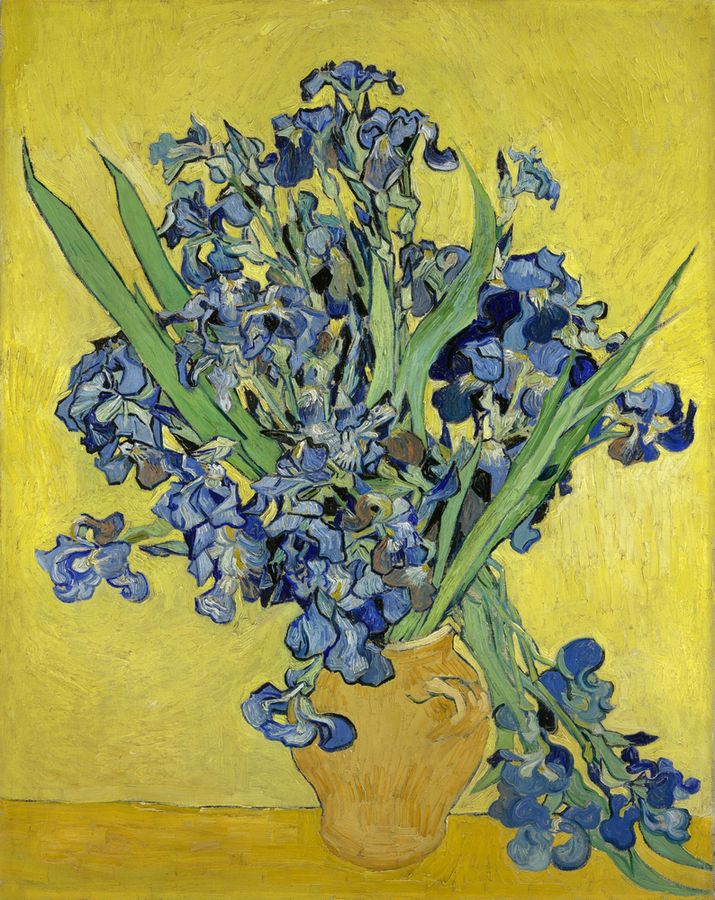
385. Never had the reservoir Hulsker, Vincent and Theo: A Dual Biography, p. 414: Hulsker inventories Vincent's incredible outpouring of work between the end of April and his departure from Saint-Rémy on May 16. He lists these twelve works: " Field of Grass with Dandelions and Tree Trunks (F 676 JH 1970); Field of Grass with Flowers and Butterflies (F 672 JH 1975); The Raising of Lazarus (F 677 JH 1972); The Good Samaritan (F 633 JH 1974); Vase with Pink Roses (F 681 JH 1976); Vase with Violet Irises against a Yellow Background (F 678 JH 1977); Vase with Violet Irises against a Pink Background (F 680 JH 1978); Vase with Pink Roses (F 682 JH 1979); Field with Green Wheat (F 807 JH 1980); Couple Walking in a Mountainous Landscape (F 704 JH 1981); Road with Cypress and Star (F 683 JH 1982); Old Man with his Head in his Hands (F 702 JH 1967) -- provided this picture was also done in May 1890." 386. "I have more ideas" BVG 630, 5/2/1890.

Context:
BVG 630, 5/2/1890: "As soon as I got out into the park, I got back all my lucidity for work; I have more ideas in my head than I could ever carry out, but without it clouding my mind. The brush strokes come like clockwork."
JLB 865, 5/1/1890: "Once I got out a little into the park I recovered all my clarity for work, I have more ideas in my head than I could ever put into action, but without it dazzling me. The brushstrokes go like a machine."

387. "greenery nooks" BVG 632, 5/3/1890: Note: we have inverted the translation. The painting that Vincent refers to here is Field of Grass with Flowers and Butterflies, F 672 JH 1975, May, 1890, oil on canvas, 25.4 x 31.9 in., 64.5 x 81cm., National Gallery, London. The other one is Field of Grass with Dandelions and Tree Trunks (F 676 JH 1970), which was begun first, at the end of April, as he reported to his mother and sister (JLB 864, 4/29/1890), and finished a day or two later (JLB 863, 4/29/1890). Vincent reported both works completed in early May (JLB 868, 5/4/1890). Around the same time, Vincent painted some close-up views of wild poppies and roses (Wild Roses [F 597 JH 2011], Roses and Beetle [F 749 JH 2012], Poppies and Butterflies [F 748 JH 2013]). Two of these (Roses and Beetle [F 749 JH 2012] and Poppies and Butterflies [F 748 JH 2013]) include insect complements of beetle and butterfly (respectively) -- protestations of the painter's Japanese serenity.

Context:
BVG 632, 5/3/1890: "I have done another one of a nook of greenery, which I think has some freshness."
JLB 866, 5/2/1890: "I've done another one of a nook of greenery which seems to me to have some freshness."

388. an imminent departure BVG 633, 5/11/1890-5/12/1890. Curiously -- but not surprisingly -- Vincent reports only a few days later that Peyron has given him permission to pack: "After a last discussion with Mr. Peyron I obtained permission to pack my trunk, which I've sent by goods train." (JLB 872, 5/13/1890.) Peyron may have turned a blind eye to the anticipatory shuttering of the studio.

Context:
JLB 870, 5/11/1890: "I'm planning to leave as soon as possible this week, and I'm starting to pack my trunk today."

389. "like a man in a frenzy" BVG W20, 2/20/1890: Vincent reported this to Wil in June, about two weeks after leaving Saint-Rémy.

Context:
BVG W20, 2/20/1890: "But during the last weeks at St. Rémy I worked like a man in a frenzy, especially on bunches of flowers, roses and violet irises."
JLB 879, 6/5/1890: "But in the last few days at St-Rémy I worked like a man in a frenzy, especially on bouquets of flowers. Roses and violet Irises."

390. won many accolades BVG T20, 11/16/1889.

Context:
JLB 819, 11/16/1889: "However bad the Independents' exhibition was, The Irises [Irises (F 608 JH 1691)] were seen by a lot of people who talk to me about them."

391. from his brother Theo BVG T16, 9/5/1889.

Context:
JLB 799, 9/5/1889: "Now I must also tell you that the Independents' exhibition is open and that in it there are your two paintings, 'The irises' and the Starry night. The latter is badly placed, for one can't position oneself far enough away, as the room is very narrow, but the other one looks extremely well. They've placed it on the narrow side of the room and it strikes you from a long way off. It's a fine study, full of air and life."

392. argument for success BVG 632, 5/3/1890: In addition to the praise directed at his paintings of sunflowers and irises, Vincent had this additional commercial reason for returning to the subject of garden flowers at this time. The painting praised in the April 30, 1890, issue of Le Figaro was Ernest Quost's Easter Flowers. (See JLB 866, 5/2/1890; n. 10.) Quost was one of the predecessors in color to whom Vincent paid deferential tribute in his response to the Aurier article, singling out the very two flowers to which Vincent turned his attention in May 1890, roses and irises: "[Are my sunflowers] any different from so many paintings of flowers that are more skillfully painted and which people do not yet sufficiently appreciate, père Quost's Hollyhocks, Yellow Irises?" (JLB 853, 2/9/1890 or 2/10/1890.) Vincent had already made the same argument to Theo: "Why not say, WITH MORE REASON, what he says about my sunflowers about Quost's magnificent and so-complete Hollyhocks and about his yellow irises, about Jeannin's splendid peonies?" (JLB 850, 2/1/1890; emphasis in original.)

Context:
JLB 866, 5/2/1890: "I think from a note in Le Figaro that père Quost must have a darned good painting in the Salon."

393. "packing seems to me" BVG 633, 5/11/1890-5/12/1890.

Context:
BVG 633, 5/11/1890-5/12/1890: "The day of my departure depends on when I'm packed and have finished my canvases; I am working on the latter with such enthusiasm that packing seems to me more difficult than painting."
JLB 870, 5/11/1890: "The day I leave depends on my having packed my trunk and finished my canvases, I'm working on the latter with so much enthusiasm that packing my trunk seems more difficult to me than doing the paintings."

820 394. "pure Prussian blue" BVG 633, 5/11/1890-5/12/1890.

Context:
BVG 633, 5/11/1890-5/12/1890: "On the other hand, the other violet bunch (ranging from carmine to pure Prussian blue) stands out against a startling citron background, with other yellow tones in the vase and the stand on which it rests, so it is an effect of tremendously disparate complementaries, which strengthen each other by their juxtaposition."
JLB 870, 5/11/1890: "On the contrary, the other violet bouquet (ranging up to pure carmine and Prussian blue) standing out against a striking lemon yellow background with other yellow tones in the vase and the base on which it rests is an effect of terribly disparate complementaries that reinforce each other by their opposition."

395. penned a farewell letter Perhaps for reasons related to the debacle in Arles in February, Vincent addressed his farewell to Joseph Ginoux only, conspicuously excluding the jilting Madame. The letter is a strange (but not untypical for Vincent) splicing of business and heartbreak. He gives careful instructions for the disposition of his furniture: "Please send by goods train my two beds and the bed linen that are still at your place. I think it will be wise to empty the palliasses, for straw will cost as much in transportation charges as it would to buy some new." (Emphasis in original.) He asks Ginoux to send his mirror, too, but not before "stick[ing] strips of paper onto it to prevent it breaking." (JLB 871, 5/12/1890.) Since the beds were no more than frames, this left the bulk of the furniture as, essentially, a gift to the Ginoux: "The two chests of drawers, chairs, table, you can keep them for your trouble." Even after having paid for months of unnecessary storage (Peyron had offered to let Vincent store the furniture at the asylum), Vincent generously adds: "If there are any additional expenses you must let me know" (JLB 787, 7/6/1889). The guilt that this generosity bespeaks is awkwardly addended to the same letter: "I very much regret having fallen ill on the day I came to Arles to take my leave of you all -- after that I was ill for 2 months and unable to work" (ibid.).

There is no evidence for Vincent's claim that he came to Arles in February "to take my leave of you all" (ibid.). Indeed, at the time, he protested again and again a very different reason for visiting the Ginoux -- namely, Madame Ginoux's illness (JLB 850, 2/1/1890; see Ch. 40, n. 577). At least according to his correspondence, he had no specific plans for an imminent departure and he continued to speak of the café proprietress in rapturous terms (JLB 866, 5/2/1890; see Ch. 40, n. 488). In his farewell letter in May, however, Vincent downgrades her illness considerably from the desperate straights he had earlier portrayed, referring to it only as "her indisposition" (JLB 841, 1/20/1890; note the use of the third person). This, combined with his failure to include her in the salutation, suggests the deep estrangement that followed the unknown events in Arles in February that led to his worst attacks and his letter probably represents an effort to reframe those events as a "good-bye" rather than a banishment (see Ch. 41, n. 276). Vincent closes his farewell with the greeting-card motto that he had assigned to his alluring matron: "I'll still think of you all often, for it's true, as Mrs. Ginoux says, that when people are friends they are so for a long time" (ibid.). Interestingly, perhaps tellingly, the Ginoux never returned any of Vincent's furniture.

396. held back enough BVG 634, 5/13/1890.

Context:
JLB 872, 5/13/1890: "The 30 kilos of luggage one is allowed to take will allow me to take a few frames, easel and some stretching frames &c."

397. canvases not dry in time BVG 633, 5/11/1890-5/12/1890. The attendant performed dutifully, apparently. In late June 1890, a package of paintings from Saint-Rémy arrived in Auvers (presumably forwarded by Theo): "Now the canvases from [Saint-Rémy] have arrived, the Irises have dried well and I dare believe that you'll find something in them; thus there are also some roses, a wheatfield, a little canvas with mountains and finally a cypress with a star." (JLB 891, 6/24/1890; see Pickvance, p. 210.)

Context:
JLB 870, 5/11/1890: "These canvases will take a good month to dry, but the man who works here will take care of sending them after my departure."

398. sent some of them BVG 630, 5/2/1890: All of the prints mentioned by Vincent are by Rembrandt.

Context:
JLB 865, 5/1/1890: "I thank you very much for the etchings -- you've chosen some of the very ones that I've already liked for a long time, the David, the Lazarus, the Samaritan, and the large etching of the wounded man, and you've added the blind man and the other very small etching, the last one so mysterious that I'm afraid of it and dare not wish to know what it is. I didn't know it, the little goldsmith."

399. The Good Samaritan BVG 632, 5/3/1890. Vincent had first expressed an intention to paint a color version of the Delacroix Samaritan (The Good Samaritan [F 633 JH 1974]) in September 1889 as part of his grand plan to make a whole collection of his favorite prints starting with Millet's Travaux (see Chapter 40): "I would like to have all of this, at least the etchings and the wood engravings. It's a study I need ... I'm going to copy Delacroix's Good Samaritan too." (JLB 805, 9/20/1889.) At the time, he had just completed his copy of the Delacroix Pietà (F 630 JH 1775) an image that had haunted and consoled him throughout the attacks of the previous summer (see Chapter 40). He did not get around to painting the Delacroix Samaritan at that time, but mentioned his intention to do so again in February 1890, after the attack in January. "In the next few days I hope to begin on Delacroix's Good Samaritan and Millet's Woodcutter" (JLB 854, 2/12/1890). Not until May, after emerging from the long series of attacks starting in late February did Vincent finally realize this long-standing ambition in The Good Samaritan (F 633 JH 1974). 400. The Raising of Lazarus BVG 632, 5/3/1890. "The etchings you sent me are really beautiful. Opposite this I've scribbled a croquis after a painting I've done of three figures which are in the background of the Lazarus etching. The dead man and his two sisters." (JLB 866, 5/2/1890.) The etching is Rembrandt's The Raising of Lazarus, which Theo sent in response to Vincent's request for some more images to "colorize" (see Ch. 41, n. 398). But in his version of the image (The Raising of Lazarus [F 667 JH 1972]), Vincent took considerable liberty with his source. Rembrandt's image shows a tableau of Christ in the foreground, his side to the viewer, with his hand in the air as Lazarus's sister lifts the death shroud from her brother's face only to discover signs of life. The scene is dramatically lighted -- literally, as in a theater, from below -- and Christ is by far the dominant figure.

Vincent's version crops the image radically, eliminating Christ altogether and focusing tightly on Lazarus and the two women kneeling over his opened grave. He also edits out another prominent figure standing behind one of the women at the graveside and replaces it with an element that both underscores the theme of rebirth and connects deeply with his own art: a giant yellow sun. In a further act of self-portraiture, he gives the re-awakened Lazarus his own red-orange beard and hair (Rembrandt's figure has no discernible facial hair and is, of course, colorless). Here is Vincent's description of his colorizing of the Rembrandt image: "The cave and the corpse are violet, yellow, white. The woman who is taking the handkerchief from the resurrected man's face has a green dress and orange hair, the other has black hair and a striped garment. Green and pink. Behind a countryside, blue hills, a yellow rising sun" (ibid.).

Druick and Zegers and Sund follow Hulsker identifying the "models" for the Lazarus's two sisters as Madame Roulin and Madame Ginoux (Druick and Zegers, p. 323; Sund, p. 198; Hulsker, Vincent and Theo: A Dual Biography, p. 412). In fact, Vincent seems to have taken few liberties with the forms or faces of Rembrandt's two mourning women; and casting the stout, reserved Madame Roulin as the wildly gesticulating (and slender) blonde sister is a stretch of the imagination even by Vincent's flexible standards, which is not to say that this unusual, aggressive cropping did not have its origins somewhere deep in the recesses of Vincent's metaphorical mind, but the omission of the Christ figure was inevitable, given his complaints about the provocative influence of religious imagery on his illness, and the exclusion of the standing figure was necessitated by his focusing closely on Lazarus and the two kneeling sisters. The insertion of the sun was an obvious solution: it both filled the void left by eliminating the figure and accounted for Rembrandt's dramatic lighting.

Context:
BVG 632, 5/3/1890: "On the back of this page I have scribbled a sketch after a painting I have done of three figures which are in the background of the etching of "Lazarus": the dead man and his two sisters."
JLB 866, 5/2/1890: "Opposite this I've scribbled a croquis after a painting I've done of three figures which are in the background of the Lazarus etching."

401. nothing terrified him more BVG 634, 5/13/1890.

Context:
JLB 872, 5/13/1890: "Spending days doing nothing, here or elsewhere, that's what would make me miserable in my current state of mind."

402. negotiated with Theo On May 4, Vincent had imposed a deadline of May 15 "at the latest" for his departure (JLB 868, 5/4/1890). As that date approached, the brothers resolved some issues. In the dispute over an escort for the train ride to Paris (see Ch. 41, n. 380), they split the difference: an asylum attendant would accompany Vincent as far as Tarascon (not far at all), where he would change trains (JLB 865, 5/1/1890). Theo promptly sent warm words of welcome ("I'd so much like to have you with us for at least a while" [JLB 867, 5/3/1890]) and the money for the journey (JLB 869, 5/10/1890) and Vincent responded on May 11 with reciprocal heart-warming words: "Yes, it seems to me, too, that there's been a very long period between the day when we said our goodbyes at the railway station and these present days" (JLB 870, 5/11/1890).

In the same letter, he dictated detailed arrangements for his arrival in Paris and agreed to send a wire from en route with a last-minute update: "If your work prevented you from coming to get me at the station, or if it was at a difficult time or if the weather was too bad, don't worry, I'd certainly find my way ... It's likely that I'll arrive in Paris around 5 o'clock in the morning. But anyway, the telegram will tell you precisely." (ibid.) Vincent sent most of his luggage by goods train on May 13 (JLB 872, 5/13/1890), but kept back the legal limit for "carry-on" baggage on the train: "The 30 kilos of luggage one is allowed to take will allow me to take a few frames, easel and some stretching frames &c." (JLB 872, 5/13/1890). He may have kept back the painting equipment partly because of the difficulty of packing it securely for the goods train, or because he wanted to continue painting until the last minute (see Ch. 41, n. 396).

Even with all these warm words and preparations, however, securing final permission to leave dragged on. Vincent addended this last argument to the letter reporting the departure of his luggage on May 13: "If you haven't yet replied to Mr. Peyron's letter, please send him a telegram, in such a way that I may make the journey on Friday or Saturday [May 16 or 17] at the latest to spend Sunday with you ... Probably the answer to Mr. Peyron will already have left, which I hope. I was a little vexed that there were a few days' delay, because that seems to me to be of no use for anything." (JLB 872, 5/13/1890.) Theo must have sent the requested approval already or soon after, as Vincent left Saint-Rémy on May 16, arriving in Paris the next day (see Chapter 42).

403. one final "translation" The painting is Old Man in Sorrow (On the Threshold of Eternity) (F 702 JH 1967, April-May, 1890, oil on canvas, 31.9 x 25.6 in., 81 x 65 cm., Otterlo, Kröller-Müller Museum, Otterlo) variously titled At Eternity's Gate, On the Threshold of Eternity, and Old Man in Sorrow. We have chosen the first of these because At Eternity's Gate is the legend that Vincent wrote, in English, on the 1882 lithograph which was the model for the painting. Because neither Theo nor Vincent mentions the painting (or the print) in any of their surviving letters from Saint-Rémy, it is not certain when Vincent painted it. Of the many "translations" he did after prints, this is the only one based on one of Vincent's own previous images. Hulsker dates the painting to September-October 1889 (Hulsker, The New Complete Van Gogh, p. 412). His only argument for this dating is that the painting shares a similar "color scheme" with some of Vincent's copies after Millet's Traveau des champs etchings ("with the dominance of the contrasting light blue and bright yellow") from the same period (ibid.).

We see various problems with this earlier dating, as well as strong arguments for a dating to late April or May 1890, which is where Homburg places it (Homburg, pp. 88-89). First, the painting is significantly bigger (32 x 25.5 in. [81 x 65 cm]) than Vincent's paintings after Millet (typically, 17 x 13 in. [43 x 33 cm.]). Second, Vincent expressed an ambition to paint a copy after Delacroix's The Good Samaritan in September 1889 but did not get around to doing so until late April, early May 1890. We find it impossible to imagine that Vincent put one of his own works in line for "translation" ahead of the beloved Delacroix image. Third, the sentiment of Eternity (F 702 JH 1967) is one of hopelessness and despair -- at the opposite pole from Millet's toiling peasants (and later, in Millet's Quatre Heures, happy country life). The purpose of the Millet copies, as Vincent himself says, was "consolation" (JLB 805, 9/20/1889), and no image could be less consoling than this reminder of the failure of his studio on the Schenkweg and his imaginary marriage to Sien Hoornik (see Chapter 18). 

It is true, as Hulsker argues that Vincent did a series of copies of his Arles paintings for his mother and sister in the September-October 1889 time frame, but these were paintings after paintings, not drawings; confined to the just-passed Arles period; and always in a smaller scale than the originals (Hulsker, The New Complete Van Gogh, p. 412). These paintings (Wheat Field with Cypresses [F 473 JH 1790], Olive Orchard [F 711 JH1791], Reaper at Sunrise [F 619 JH 1792], and The Bedroom [F 483 JH 1793]) were designed more as mementos than as fully-realized works, and Vincent carefully selected them for their likely appeal to his family based on Theo's approval.

Even Hulsker recognizes that Eternity (F 702 JH 1967) was "not intended for his mother and sister" due to its depressing theme and inevitable dark reflection on Vincent's own situation (ibid.). Indeed, this may have been why Vincent never revealed its existence to Theo. Such an image could only have worried his brother -- the opposite of what his letters were generally intended to do. By May 1890, however, Vincent had emerged from two months of the terrible attacks determined to leave Saint-Rémy; he had completed the twice-delayed Delacroix (as well as a copy after Rembrandt's The Raising of Lazarus, and Theo had blessed such projects with a strong vote of approval for Vincent's copies after Millet ("perhaps the finest thing you've done" [JLB 867, 5/3/1890]). But something even more important had changed the landscape of Vincent's imagination in a way that licensed an image like At Eternity's Gate. After repeatedly painting reveries of his Brabant past in the interstices of his attacks, he had emerged in late April with a grand new ambition to "translate" his own earlier work into the new language of color: "Please send me what you can find of figures among my old drawings," he wrote Theo on April 29. "I'm thinking of redoing the painting of the peasants eating supper, lamplight effect. … Then if you like I'll redo the old tower at Nuenen and the cottage. I think that if you still have them I could now make something better of them from memory." (JLB 863, 4/29/1890; emphasis in original.)

He wrote a similar request for old drawings to his mother and sister in Leyden: "Do you still happen to have any of my old studies and drawings? Even if they're no good in themselves, they can refresh my memory and provide information for new work, but I don't, for instance, need the ones you have hanging up. They're much more likely to be scratches of peasant figures." (JLB 864, 4/29/1890.) It's possible that either his brother or his mother and sister sent him the lithograph of At Eternity's Gate (although the latter is doubtful since his mother had left the box containing his earlier drawings in Breda when she moved [see ibid., n. 6]). It is more likely (as Hulsker agrees) that Vincent had "kept a copy for himself" (Hulsker, The New Complete Van Gogh, p. 412). Thus, the only earlier figure "drawing" that Vincent had on hand to launch his vast new artistic renovation of the past was the little lithograph from The Hague. And no image from his past better expressed his mood as he prepared for the future, leaving behind the wreckage of his dream for a studio in the Midi.

As for Hulsker's argument about the primary color scheme: the same obsessions filled Vincent's letters in early May 1890 when he undertook the copies after Delacroix and Rembrandt: "But the Lazarus! Early this morning I looked at it and I remembered not only what Charles Blanc [Charles Blanc, 1813-1882; French writer] says of it, but indeed even that he doesn't say everything about it." (JLB 865, 5/1/1890.) Vincent considered doing a Rembrandt copy "in the scale of color from light yellow to violet," and his Samaritan is a textbook of simultaneous color contrast, with orange and blue taking center stage, just as they do in Eternity (not the yellow and blue of the Millet copies from the previous year) (ibid.). Finally, studies of fireplaces and chairs are among Vincent's last surviving drawings in Saint-Rémy (Mantelpiece with Chair [F 1511 JH 1963], Chair near the Stove [F 1510 JH 1964], Chair and Sketch of a Hand [F 1549r JH 1965], Chair [F 1512r JH 1966]) and some of the details from those drawings (black mantel, three-slatted chair-back) appear in the painting but not in the earlier lithograph. (See Homburg, p. 99.)

404. image of rescue See Ch. 41, n. 399. 405. or of rebirth See Ch. 41, n. 400. 406. "At Eternity's Gate" Vincent made the lithograph he titled At Eternity's Gate (Old Man with his Head in his Hands [F 1662 JH 268]) in November 1882, in his studio off the Schenkweg in The Hague (see Chapter 18). The lithograph was based directly on a large drawing (Worn Out [F 997 JH 267]), one of the many Vincent made in 1882-83 showing the almshouse "orphan man," Adrianus Jacobus Zuyderland, in various poses. (See Chapter 18.) This pose, in particular, already haunted Vincent by 1882. He had drawn it originally in 1881, in Etten (Peasant Sitting by the Fireplace [F 863 JH 034], Peasant Sitting by the Fireplace [F 150 JH 035]), at the very dawn of his artistic career (see Ch. 16, n. 545) and had revisited it at least several more times before trying it again with Zuyderland (e.g., Peasant Sitting by the Fireplace [F 864 JH 051]; see Ch. 18, n. 337). His original inspiration may have been a Bargue académie (see Ch. 16, n. 593) or, as Homburg claims, an illustration for Dickens's Hard Times by English artist Arthur Boyd Houghton, or both (Homburg, p. 98).

For the earlier images, Vincent had used the title Worn Out, which he wrote on Peasant Sitting by the Fireplace (F 863 JH 034) (see Ch. 18, n. 338). This name stayed with the image through many iterations. He wrote Van Rappard in November 1882 as the drawing of Zuyderland was being transferred to the lithographic stone: "You remember that drawing Worn out? In the last few days I've done it again no fewer than three times with two models, and will labour on it some more. For the present I have one that will be the subject of a fifth stone, which thus depicts an old working man who sits and ponders with his elbows on his knees and his head (a bald crown this time) in his hands." (JLB 287, 11/24/1882.) Later in the same letter, he referred to it as "the new Worn out" (ibid.). Only at the very end of the process did he add the new English name "At Eternity's Gate" to the stone -- underscoring the theme of mortality's burden and religion's ultimate reward for thankless toil. By May 1890, of course, the image's meaning to Vincent had changed.

407. "I think of it" BVG 630, 5/2/1890.

Context:
JLB 865, 5/1/1890: " I consider this as a shipwreck, this journey …"

408. pitiful self-portrait b0928 V/1962, "Gogh, Theo van" to "Gogh-Carbentus, Anna C. van en Gogh, Willemina van", 4/15/1890: In mid-April, Theo conveyed to his sister and mother this vivid image of Vincent's condition from a report sent by Dr. Peyron: "The doctor wrote last time that he is only seldom completely himself anymore. Usually he sits with his head in his hands." He wrote an even more pitiful version of the same indelible image to his sister-in-law about a week later: "The Dr. wrote to us just recently that [Vincent] has been sitting with his head in his hands for weeks & when anyone speaks to him he gestures that he wants to be left alone. How terrible, would you not agree?" (b4305 V/1984, ''Gogh, Theo van'' to ''Bonger, Hermina'', 4/25/1890; quoted in Jansen and Robert, p. 37.)

One of the principal justifications for dating At Eternity's Gate to the very end of Vincent's stay in Saint-Rémy is biographical: i.e., that the painting perfectly reflects the mood of dejection and futility that Vincent felt as his departure from the asylum (and from the Midi) approached -- a departure that marked yet another failure in a lifetime of such failures. Not until May 1890, convinced that he had finally escaped the months of attacks and entered a period of "clarity", did Vincent allow his brother glimpses of the depths of remorse, self-reproach, and despair that lay just beneath the surface even as he made new plans for Auvers: "This is what one could always observe, that you and I made an effort here in the same direction as some others who weren't understood either, and were bitterly saddened by circumstances. ... I consider this as a shipwreck, this journey." (JLB 865, 5/1/1890). "The surroundings here are starting to weigh on me more than I could express -- my word, I've waited patiently for over a year -- I need air, I feel damaged by boredom and grief" (JLB 868, 5/4/1890).

In the same letter, Vincent bewails the burdens and frustrations of asylum life and how they have prematurely aged him -- bringing both his posture and his self-image more into alignment with the old man of At Eternity's Gate: "it's beginning to weigh too heavily upon me here. ... it's already something to resign oneself to living under guard, even in the event of it being sympathetic, and to sacrifice one's freedom, to stand outside society and to have only one's work, without distraction. That has carved out wrinkles that won't be rubbed off in a hurry." (ibid., emphasis in original.) It is true that the image of the old man bowed in frustration and futility had a very different meaning for Vincent when he created it in 1882. "I was trying to say this ... it seems to me that one of the strongest pieces of evidence for the existence of 'something on high' ... is the unutterably moving quality that there can be in the expression of an old man ... something precious, something noble, that can't be meant for the worms" (JLB 288, 11/26/1882-11/27/1882; see Ch. 18, n. 370).

To reinforce this image of redemptive suffering, Vincent invoked two of his secular gospelists, Jozef Israëls and Stowe: "Perhaps the most wonderful passage in Uncle Tom's Cabin is the one where the poor slave, sitting by his fire for the last time and knowing that he must die, remembers the words: Let cares like a wild deluge come, And storms of sorrow fall, May I but safely reach my home, My god, my Heaven, my All" (ibid.). By May 1890, however, Vincent could no longer find consolation in this quasi-religious reassurance of ultimate redemption. His renunciation of this comfort can be seen in his painting after Rembrandt's The Raising of Lazarus (see Ch. 41, n. 400), in which the prominent figure of Christ has been completely eliminated; the body of Lazarus looks still quite dead; and his sister's ambiguous gesture could well be grief and disappointment rather than surprise and joy. With the spark of "something on high" extinguished from it, At Eternity's Gate had become an image of hopelessness, not consolation.

409. "I confess to you" BVG 633, 5/11/1890-5/12/1890.

Context:
BVG 633, 5/11/1890-5/12/1890: "As for my work, my dear brother, I feel more confidence than when I left, and it would be ungrateful on my part to curse the Midi, and I confess to you that I leave it with great grief."
JLB 870, 5/11/1890: "My dear brother, I feel I have more confidence in my work than when I left, and it would be ungrateful of me to speak ill of the south, and I confess that it's with great sorrow that I turn my back on it."

410. "Oh, if I could" BVG 630, 5/2/1890: Vincent wrote this passage in early May. He returned to the same plangent sentiment and tone two weeks later, on the eve of his departure: "This morning, as I'd been to have my trunk stamped, I saw the countryside again -- very fresh after the rain and covered in flowers -- how many more things I would have done" (JLB 872, 5/13/1890).

Context:
BVG 630, 5/2/1890: " Oh, if I could have worked without this accursed disease -- what things I might have done, isolated from others, following what the country said to me."
JLB 865, 5/1/1890: "Ah, if I'd been able to work without this bloody illness! How many things I could have done, isolated from the others, according to what the land would tell me."