
Notes
Chapters
- A Fanatic Heart
- 27. Against the Grain
- 28. The Zemganno Brothers
- 29. Catch and Release
- 30. A Mercenary Frenzy
- 31. Le Paradou
- 32. The Sunflower and the Oleander
- 33. The Poet's Garden
- 34. Imaginary Savage
- 35. La Lutte
- 36. The Stranger
- 37. Two Roads
- 38. The Real South
- 39. Starry Night
- 40. The Isolated One
- 41. A Degenerate Child
- 42. The Garden and the Wheatfield
- 43. Illusions Fade, the Sublime Remains
- Ici Repose
The Early Years
The Dutch Years
The French Years
Chapters
Context:
BVG 169, 1/5/1882-1/8/1882: "Before things came to their present pass, I used to have many regrets and be very sad and reproach myself because things between Father and Mother and me were going so badly."
JLB 199, 1/8 or 1/9/1882: "Before things got as bad as they are now, I felt a great deal of remorse and sorrow, and tormented myself because things were going so badly between Pa and Ma and me."
Context:
JLB 193, 12/23/1881: "I sometimes wish that the three months between now and going back to M. were already over, but such as they'll be, they'll bring some good."
BVG 166, 12/29/1881: Vincent gives a very different version of his exchange with Mauve upon his sudden arrival in The Hague. We do not credit either the tone or the substance of the exchange Vincent reports. Although proper and hospitable to the Van Gogh family, Mauve was not a flexible person, especially in regard to his time and privacy. We believe that he fully subscribed to the three-month hiatus on Vincent's apprenticeship in The Hague that had been imposed when Vincent left in December (see Ch. 16, n. 3). Indeed, in April 1882, Mauve will himself impose a two-month ban on Vincent's contact with him (JLB 219, 4/21/1882). The similarity of the two bans is notable. It is unthinkable that Mauve was not aware of the high level of frustration and exasperation in the family over Vincent's repeated misadventures and he surely knew, when Vincent showed up unannounced at his door, that he was being drawn into yet another of them.
Context:
JLB 194, 12/29/1881: "I went back to Mauve and said: 'Listen, Mauve, I cannot stay in Etten any longer and I must go and live somewhere else, preferably here.' Well, Mauve said, 'then stay.'"
Context:
JLB 196, 1/3/1882: "Mauve lent me some money, 100 guilders, to rent it, furnish it and get the window and light fixed up."
Context:
JLB 196 1/3/1882: "Mauve lent me some money, 100 guilders, to rent it, furnish it and get the window and light fixed up."
Context:
JLB 196 1/3/1882: "Mauve lent me some money, 100 guilders, to rent it, furnish it and get the window and light fixed up."
Context:
JLB 199, 1/8/1882 or 1/9/1882: "I got a great bargain on some splendid woodcuts from The Graphic, some of them prints not of the clichés but of the blocks themselves. Just what I've been wanting for years. The drawings by Herkomer, Frank Holl, Walker, and others. I bought them from Blok, the Jewish bookseller, and chose the best from an enormous pile of Graphics and London News for five guilders. Some of them are superb, including the Houseless and Homeless by Fildes (poor people waiting outside a night shelter [Houseless and Hungry]) and two large Herkomers and many small ones, and the Irish Emigrants by Frank Holl and the 'Old gate' by Walker. And especially a girls' school by Frank Holl and also that large Herkomer, the invalids."
![Houseless and Hungry]](http://vangoghletters.org/vg/illustrations/1905.jpg)
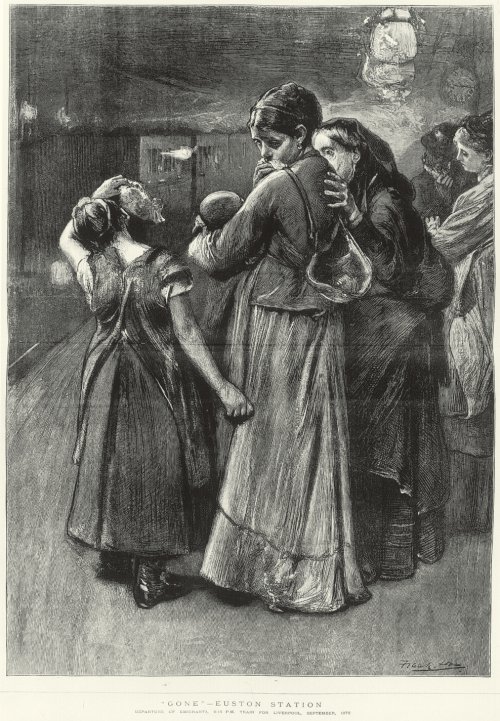
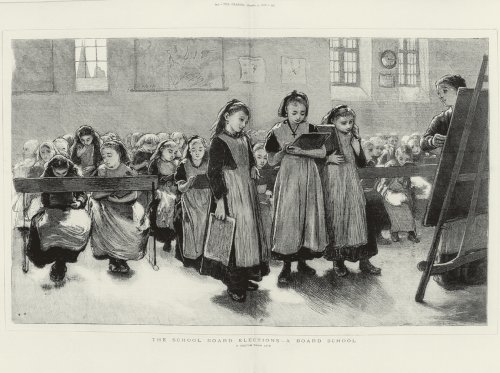
Context:
JLB 199, 1/8 or 1/9/1882: "And I've also acquired another ornament for my studio ..."
Context:
JLB 199, 1/8 or 1/9/1882: "And I even have flowers, and a couple of boxes of bulbs."
Context:
JLB 198, 1/5/1882 or 1/6/1882: "I still have all kinds of expenses ahead of me, and I truly haven't had a penny in my pocket for a day or two."
Context:
JLB 199, 1/8 or 1/9/1882: "For appearances' sake I straightened things out by writing again to Pa to say that I'd rented a studio, that I also wished him a happy New Year, that I hoped that in that new year we should no longer fight in that way or in any other manner."
Context:
JLB 197, 1/5/1882: "As far as the relations between Pa and me are concerned, they can't be put to rights so quickly."
Context:
JLB 199, 1/8 or 1/9/1882: "For appearances' sake I straightened things out by writing again to Pa to say that I'd rented a studio, that I also wished him a happy New Year, that I hoped that in that new year we should no longer fight in that way or in any other manner."
Context:
JLB 196, 1/3/1882: "Now as to me, it will perhaps not be disagreeable for you to learn that I'm installed in a studio of my own."
Context:
JLB 194, 12/29/1881: "I must remain completely independent of Pa. How? I don't know yet, but M. is willing to help me if necessary, and you too."
Context:
JLB 198, 1/5/1882 or 1/6/1882: "Today I went to Goupil out of desperation, because in keeping with what you wrote I wanted to ask Tersteeg to lend me some money for God's sake. But Tersteeg had just left town for a couple of days."
BVG 205, 6/3/1882. As Theo undoubtedly knew by this time, Vincent had "made a public scene" with Uncle Cent during his brief stay in The Hague in December (JLB 235, 6/3/1882). (See Ch. 16, n. 588.) Tersteeg was even more likely than the Cent to shame Vincent (and thus embarrass the family) in a confrontation precipitated by a "demand" for money.
Context:
JLB 235, 6/3/1882: "… I hope that, just like last year, if I meet His Hon. we shall not make a public scene."
Context:
BVG 169, 1/5/1882-1/8/1882: "... what the devil made you so childish and so shameless as to embitter Father and Father's life and render it almost impossible by setting about things in the way you did?"
JLB 199, 1/8 or 1/9/1882: "... what the devil made you so childish and so shameless as to contrive in this way to make Pa and Ma's life miserable and nearly impossible?"
Context:
BVG 169, 1/5/1882-1/8/1882: "Coûte que coûte [at all costs], you are in duty bound to ensure that matters are put right and I guarantee that one day you will be extremely sorry for having been so callous in this matter."
JLB 197, 1/5/1882: "It's your duty to set things straight at all costs, and I assure you that some day you'll mightily regret having handled this matter so harshly" (emphasis in original).
Context:
BVG 169, 1/5/1882-1/8/1882: " I offer no apology for that and while Father and Mother continue in this mood I shall take nothing back."
JLB 199, 1/8 or 1/9/1882: " I'm not asking for an apology, and as long as Pa and Ma take this attitude I won't take any of it back."
Context:
BVG 169, 1/5/1882-1/8/1882: "Anyway, the murderer has left the house now, and so, in short, I take not the slightest notice of any of it and even consider it ridiculous."
JLB 199, 1/8 or 1/9/1882: "Besides, now the murderer has left home and so, in a word, I take no notice of it, and I even think it ridiculous."
Context:
JLB 199, 1/8/1882 or 1/9/1882: "Now I thank you very much indeed for what you sent. I don't need to tell you that I really have a great many worries besides. Naturally my expenses are more than in Etten and I can't set to work with half as much energy as I should like and should be able to if I had more at my disposal."
Context:
JLB 199, 1/8 or 1/9/1882: "So you'll be doing me a great favour by entering into a definite agreement, and I hope you'll write to me about it soon."
Context:
BVG 169, 1/5/1882-1/8/1882: "For you realize, Theo, I must know with as much certainty as possible what to expect, and I must be able to calculate and be able to tell in advance whether I can do this or that or must give it up."
JLB 199, 1/8 or 1/9/1882: "Because you understand, Theo, I must know as definitely as possible where I stand, and I have to work it out in advance, and know that I can or cannot do this or that."
Context:
BVG 182, 3/14/1882-3/18/1882: "So much is demanded nowadays that painting seems like a campaign, a military campaign, a battle or a war."
JLB 212, 3/24/1882: "So much is demanded that nowadays painting is almost an offensive, a military campaign, a battle or war."
Context:
BVG 166, 12/29/1881: "But I will fight my battle, and sell my life dearly, and try to win and get the best of it."
JLB 194, 12/29/1881: "But I'll fight my fight and sell my life dearly and try to win and pull through."
Context:
BVG 152, "… I think that "serrer de près vaut mieux que lâcher" (persistence is better than surrender)."
JLB 175, 10/12/1881-10/15/1881: "… I think that delving deeply into something is better than letting it go."
Context:
BVG 167, January 1882: "And now that I am in a studio of my own, this will not make an unfavorable impression on the persons who until now suspected me of amateurism, of idleness, of sponging on others."
JLB 196, 1/3/1882: "And now that I'm in my own studio, it will most probably make a not unfavourable impression on some people who until now have thought that I'm merely dabbling, idling or loafing about."
Context:
BVG 170, 1/12/1882-1/16/1882: "Meanwhile I intend to go on making those little pen drawings, but in a style different from that of last summer's large one. Somewhat more fiercely and savagely."
JLB 200, 1/14/1882: "I'm planning to go on making small pen drawings whenever possible, but different from the large ones I made this summer. A bit sharper and a bit angrier."
Context:
BVG 190, 4/15/1882-4/27/1882: "I canot stop drawing because I really have a draftsman's fist, and I ask you, have I ever doubted or hesitated or wavered since the day I began to draw?"
JLB 220, 4/23/1882: "It's precisely because I have a draughtsman's fist that I can't keep myself from drawing and, I ask you, have I ever doubted or hesitated or wavered since the day I began to draw?"
Context:
BVG 164, 12/21/1881: "And well, what I found was that in all sorts of practical and friendly ways he helped and encouraged me."
JLB 193, 12/23/1881: "And well, what I experienced with him was that he instructed and encouraged me in all manner of kind and practical ways."
Context:
BVG 173, 1/26/1882: "I think he gives each picture and drawing some small part of his life."
JLB 203, 1/26/1882: "I believe he puts a little bit of his life into each painting and each drawing."
Fles, p. 74: According to Fles, Mauve found in Andersen "a reflection of his own love of Nature." (Also see Ch. 16, n. 50.)
Context:
JLB 199, 1/8 or 1/9/1882: "Mauve has promised to recommend me for an associate membership of Pulchri, because there I'd be able to draw from a model two evenings a week and would have more contact with artists."
Context:
JLB 199, 1/8/1882 or 1/9/1882: "Later on I'll become a regular member as soon as possible."
Context:
JLB 194, 12/29/1881: "Just address your letters to the address A. Mauve. Uilebomen 198, since I go there almost every day."
De Leeuw, Sillevis, and Dumas, p. 97.
Context:
JLB 194, 12/29/1881: "Mauve himself is very busy with a large painting of a pink against the dunes being hauled by horses."
Context:
JLB 193, 12/23/1881: "Theo, what a great thing tone and colour are!"
Context:
JLB 211, 3/11/1882: "There's a Mauve, the large painting of the pink being dragged onto the dunes, it's a masterpiece."
Context:
JLB 245, 7/6/1882-7/7/1882: "It was a Scheveningen woman knitting that I did at Mauve's studio and in fact the best watercolour I had, largely because Mauve had added some touches and repeatedly came across to draw my attention to one point or another while I was working."
Context:
BVG 191, 4/15/1882-4/30/1882: "I perceived that Mauve thought me a greenhorn."
JLB 221, 4/26/1882: "I noticed that until then Mauve had considered me 'a bloody bore.'"
BVG 214, 7/7/1882. (See Ch. 16, n. 87.)
Context:
JLB 245, 7/6/1882-7/7/1882: "Mauve had added some touches and repeatedly came across to draw my attention to one point or another while I was working."
Context:
JLB 201, 1/21/1882: "With regard to the size of the drawings or the subjects, I'll gladly listen to what Mr. T. or Mauve has to say about it."
Context:
JLB 214, 4/2/1882: "If a painter took you by the arm and said: Look, Theo, this is how you should draw that field, this is how the lines of the furrows run, for this reason or that they run like this and not otherwise, and must be brought into perspective like this. And that pollard willow being this big, the other one further on is by contrast that small, and that difference in size can be measured this way or that and -- look! if you fling that down on paper then the broad outlines are immediately correct, and you have firm ground beneath your feet on which to continue." (Emphasis added.)
However, the small size of this work (Mauve encouraged him to work on a smaller scale) and the relative facility it demonstrates in the use of watercolor suggest that it may be the sketch mentioned in JLB 245, 7/6/1882 and 7/7/1882 and that Vincent is considerably understating when he says that Mauve "added some touches," which would explain the lack of clear indication of "two hands at work." Scheveningen Woman Sewing (F 869 JH 83, December, 1881, watercolor, 18.9 x 13.8 in., 48 x 35 cm., P and N. de Boer Foundation: Amsterdam) is another watercolor that looks even further beyond Vincent's capability at the time. Many months later, after his falling out with Mauve, Vincent appears to inadvertently admit that his mentor had a greater hand in these works than he originally indicated. Regarding some watercolors that Vincent executed at that time without Mauve's assistance, he writes: "Supposing I had remained on good terms with Mauve, I believe that if I had done a watercolour like the small bench ... he would have given me tips that would have made it saleable and changed its final appearance. With many people's watercolours or paintings it's even the case that some painter or other does some work on them, sometimes transforming them completely." (JLB 265, 9/17/1882 or 9/18/1882; emphasis added.)
Context:
JLB 245, 7/6/1882-7/7/1882: "… in fact the best watercolour I had, largely because Mauve had added some touches and repeatedly came across to draw my attention to one point or another while I was working."
Context:
JLB 249, 7/21/1882: "It isn't the language of painters one ought to listen to but the language of nature. I can now understand, better than six months ago or more, why Mauve said: don't talk to me about [Jules] Dupré, talk to me instead about the side of that ditch, or something like that."
Context:
JLB 193, 12/23/1881: "But if he tells me, this or that isn't good, then it's because he's saying at the same time 'but try it this way or that way.'"
Context:
JLB 193, 12/23/1881: "However, I've definitely promised M. that I'll do my utmost to find a good studio, and now I must also use better paint and better paper."
Context:
BVG 172, 1/22/1882: "Yesterday I had a lesson from Mauve on drawing hands and faces so as to keep the colour transparent."
JLB 202, 1/22/1882: "Yesterday I had a lesson from Mauve on drawing hands and faces, on keeping the paint layer thin."
BVG 172, 1/22/1882. (See Ch. 16, n. 97.)
Context:
JLB 202, 1/22/1882: "Yesterday I had a lesson from Mauve on drawing hands and faces, on keeping the paint layer thin."
Context:
JLB 193, 12/23/1881: "And well, what I experienced with him was that he instructed and encouraged me in all manner of kind and practical ways."
Context:
BVG 170, 1/12/1882-1/16/1882: "Puisque l'exécution d'une aquarelle à quelque chose de diabolique."
JLB 200, 1/14/1882: "Because there's something diabolical about the execution of a watercolour."
Context:
JLB 200, 1/14/1882: "Mauve has now shown me a new way to make something, namely watercolours."
Context:
BVG 170, 1/12/1882-1/16/1882: "I have been working all the time now in watercolour, and I am getting to like it more and more. How I wish you were here, I have so many things to ask and tell you. Do you think you will come in the spring? Will you know some time in advance? What I have done now is far from good, but it is different and has more power and freshness, and is without body colour."
JLB 201, 1/21/1882: "I've been working all this time with watercolour only, and it's giving me more pleasure every day. How much I'd like you to be here, I'd have so much to tell and to ask you. Will you come again in the spring? Won't you know a little in advance? Now, what I've made still isn't good and is far from being so, but it's again something different and it's somewhat stronger and livelier in colour, and without body-colour."
Context:
BVG 191, 4/15/1882-4/30/1882: "And then all this changed -- Mauve's sympathy, which was like water to a parched plant to me, ran dry."
JLB 221, 4/26/1882: "But all of that changed -- Mauve's sympathy, which was to me as water to a half-withered plant, dried up."
Context:
BVG 190, 4/15/1882-4/27/1882: "Because -- and you know this -- I love Mauve, and it is so hard that all the happiness he pictured to me will come to naught."
JLB 220, 4/23/1882: "Because -- and you know this -- I do love Mauve, and it's so awful that nothing much will come of all that happiness he held out to me."
Context:
BVG 169, 1/5/1882-1/8/1882: " I love his work -- and I count myself fortunate to be learning from him, but I can no more withdraw into some system or school than Mauve can himself, and apart from Mauve and Mauve's work, I also love others who are quite different and work quite differently."
JLB 199, 1/8 or 1/9/1882: "... I like his work very much -- and I consider myself fortunate to learn something from him, but I can't shut myself up in a system or school any more than Mauve himself can, and in addition to Mauve and Mauve's work, I also like others who are very different and work very differently."
Context:
JLB 211, 3/11/1882: "I wanted to see the tableaux vivants, especially because one of them was done after an etching I gave Mauve as a present, Nicolaas Maes."
Context:
JLB 200, 1/14/1882: "You mustn't think that I'm always in a gruff, cold-hearted mood which Mauve would perhaps call a yellow soap mood or saltwater mood. ... [but] surely that's no worse than taking things too sentimentally."
Context:
JLB 203, 1/26/1882: "This is what Mauve says to console me when my drawings turn out heavy, thick, muddy, black, dead: If you were already working thinly now, it would only be being stylish and later your work would probably become thick. Now, though, you're struggling and it becomes heavy, but later it will become quick and thin. If indeed it turns out like that, I have nothing against it."
Context:
JLB 203, 1/26/1882: "Now I must learn not to do some things which I more or less taught myself, and to look at things in a completely different way."
Context:
BVG 170, 1/12/1882-1/16/1882: " Mauve says that I shall spoil at least ten drawings before I know how to handle the brush well. But behind it is a better future, so I work with as much composure as I can, and am not disheartened even by my mistakes."
JLB 200, 1/14/1882: " Mauve himself says that I'll ruin at least 10 drawings or so before I know how to handle the brush a little. But it will lead to a brighter future, so I work on with as much cold-bloodedness as I can muster, and don't let myself be deterred by my mistakes."
Context:
JLB 196, 1/3/1882: "I won't associate very much with the painters. I find Mauve more capable and more solid every day. And what more do I want?"
Context:
JLB 202, 1/22/1882: "And then it sometimes happens that one can't help being terribly depressed at times, even if only briefly, just when one is in good spirits, as I actually have been these days and still am even. And that's how it was this morning, it was one of those unfortunate hours when one is powerless and weak with nervous exhaustion. I believe it was actually caused by my having arranged with Mauve to do things with the model and outdoors, and then I suddenly thought ... perhaps I can't do it because I won't have a penny in two days' time and then M. will think that I haven't done it through cowardice."
Context:
BVG 167, 1/1/1882-1/2/1882: "However, Theo, I shall have to dress a little better now."
JLB 196, 1/3/1882: "Theo, I'll have to start dressing a bit better now, though."
Context:
JLB 196, 1/3/1882: "Now I know more or less the direction I must take, and can stand up for it openly ... "
Context:
BVG 172, 1/22/1882: "Now the light is beginning to dawn, and in spite of everything, the sun is rising."
JLB 202, 1/22/1882: "Now it's beginning to dawn on me, and in spite of everything, the sun is rising."
Context:
JLB 203, 1/26/1882: "So I simply toil on with my old crone."
Context:
JLB 203, 1/26/1882: "… the model came of her own accord to have a look, even though I only half expected her …"
Context:
JLB 203, 1/26/1882: "... when this morning the model came of her own accord to have a look, even though I only half expected her, together with Mauve I arranged her in a pose and tried to draw a little, but I can't yet … "
Context:
JLB 203, 1/26/1882: "It's not exactly easy for me to get along with Mauve all the time, any more than is the reverse, because I think we're a match for each other as regards nervous energy, and it's a downright effort for him to give me directions, and no less for me to understand them and to attempt to put them into practice."
Context:
JLB 203, 1/26/1882: "It's not exactly easy for me to get along with Mauve all the time, any more than is the reverse, because I think we're a match for each other as regards nervous energy, and it's a downright effort for him to give me directions, and no less for me to understand them and to attempt to put them into practice. But I think we're beginning to understand each other quite well, and it's already beginning to be a deeper feeling than mere superficial sympathy."
BVG 173, 1/26/1882. (See Ch. 16, n. 123.)
Context:
BVG 173, 1/26/1882: "It is not always easy for me to get on with Mauve or vice versa, because I think we are equally nervous; and it costs him a real effort to show me things, and no less for me to understand them and try to put them into practice."
JLB 203, 1/26/1882: "It's not exactly easy for me to get along with Mauve all the time, any more than is the reverse, because I think we're a match for each other as regards nervous energy, and it's a downright effort for him to give me directions, and no less for me to understand them and to attempt to put them into practice."
Mauve visited Vincent twice in the second half of January, the first time on or soon after January 22. This encounter, too, involved a model. "I believe it was actually caused by my having arranged with Mauve to do things with the model and outdoors, and then I suddenly thought ... perhaps I can't do it because I won't have a penny in two days' time and then M. will think that I haven't done it through cowardice" (JLB 202, 1/22/1882). This may have been the first encounter that Vincent speaks of later that made him "so anxious and agitated about it that I became extremely upset and fell ill" (JLB 219, 4/21/1882). The second visit, on January 26, would then be the visit that Vincent describes this way: "Mauve then came to see me and reassured me that everything would be all right and put courage into me" (ibid.). However, it is clear from Vincent's letter at the time that he and his teacher quarreled on January 26 (JLB 203, 1/26/1882). Dating the beginning of the dispute-disillusionment with Mauve to the earlier encounter (circa January 22) would bring it more into line with Vincent's dating of the change in Mauve's attitude toward him to "a fortnight after my arrival here" (JLB 219, 4/21/1882).
Context:
JLB 219, 4/21/1882: At the end of January -- about a fortnight after my arrival here, I think -- Mauve's attitude towards me suddenly changed very much -- as unfriendly as he had been friendly. I attributed it to dissatisfaction with my work, and was so anxious and agitated about it that I became extremely upset and fell ill, as I wrote to you at the time. Mauve then came to see me and reassured me that everything would be all right and put courage into me.
Context:
BVG 173, 1/26/1882: "… I have not been well, and have been in bed for almost three days with fever and nervousness …"
JLB 203, 1/26/1882: "I fell ill and spent three days or so lying in bed with fever and anxiety."
Context:
BVG 189, 4/15/1882-4/27/1882: "Once he spoke to me about drawing from casts in a way such as the worst teacher at the academy would not have spoken ..."
JLB 219, 4/21/1882: "Once he spoke to me about drawing from plaster casts in a tone that even the worst teacher at the academy wouldn't have used ..."
Context:
JLB 203, 1/26/1882: "It's not exactly easy for me to get along with Mauve all the time, any more than is the reverse, because I think we're a match for each other as regards nervous energy, and it's a downright effort for him to give me directions, and no less for me to understand them and to attempt to put them into practice."
Context:
BVG 189, 4/15/1882-4/27/1882: "Mauve's talk also became narrow-minded, if I may call it so, as it used to be broad-minded."
JLB 219, 4/21/1882: "The way Mauve talked also became just as narrow-minded, if I may put it like that, as previously broad-minded."
Context:
BVG 189, 4/15/1882-4/27/1882: "Near the end of January, I think a fortnight after my arrival here, Mauve's attitude toward me changed suddenly -- became as unfriendly as it had been friendly before."
JLB 219, 4/21/1882: "At the end of January -- about a fortnight after my arrival here, I think -- Mauve's attitude towards me suddenly changed very much -- as unfriendly as he had been friendly."
Context:
BVG 189, 4/15/1882-4/27/1882: "Well, then he was very kind to me again -- but though I still visited Mauve once in a while, Mauve was moody and rather unkind."
JLB 219, 4/21/1882: "At any rate, he was again very friendly to me -- but although I still went to see Mauve, Mauve remained uneasy and rather unfriendly."
Context:
JLB 219, 4/21/1882: "I attributed it to dissatisfaction with my work, and was so anxious and agitated about it that I became extremely upset and fell ill, as I wrote to you at the time."
Context:
BVG 184, 4/1/1882-4/15/1882: "As to the money for Tersteeg, when I first arrived here, he and Mauve were so kind and said I need not worry; but in less than a month they suddenly changed and spoke quite differently, thinking perhaps that I should give up."
JLB 214, 4/2/1882: "Regarding the money owed to Tersteeg, when I first came here, he and Mauve were so friendly and said I didn't have to worry at all -- but in less than a month they'd turned around and were talking completely differently. Perhaps thinking that I'd collapse."
Context:
BVG 173, 1/26/1882: "It's exasperating, for it's no small difficulty."
JLB 203, 1/26/1882: "It's enough to drive one to distraction, for it's no small difficulty."
Context:
BVG 173, 1/26/1882: "Now I have some hope myself, and I will work hard on them, but it is often hopeless enough, for when I try to work them up, they become too heavy."
JLB 203, 1/26/1882: "Well, I also have hope and I'll work myself to the bone, but one is sometimes driven to desperation when one wants to work something up a bit more and it turns out thick."
Context:
JLB 224, 5/7/1882: "The reason why I have put aside paintings and watercolors for a time is that Mauve's desertion gave me a great shock."
Context:
BVG 174, 2/13/1882: "Well, I am getting more used to my model, and for that very reason I must continue with her."
JLB 204, 2/13/1882: "I'm also beginning to feel more at home with my model, and that's precisely the reason why I must continue with her now."
Context:
BVG 175, 2/13/1882: "Lately Mauve has done very little for me, and once he himself said, I am not always in a mood to show you things …"
JLB 209, 3/6/1882-3/9/1882: " I've had very little help from Mauve recently, and he once said: I don't always feel like showing you."
Context:
BVG 175, 2/13/1882: "Lately Mauve has done very little for me, and once he himself said, I am not always in a mood to show you things; sometimes I am too tired, and then you will damn well have to wait for the right moment. "
JLB 209, 3/6-3/9/1882: "I've had very little help from Mauve recently, and he once said: I don't always feel like showing you. Sometimes I'm so tired, and then, for God's sake, you'll just have to wait for a more opportune moment."
Because he was trying to conceal from Theo his estrangement from Mauve, Vincent does not describe this confrontation and stinging rebuke until several months later, in April. Its exact relationship to the other major events of his falling-out with Mauve is not clear, as the details come out only belatedly and intermittently, and Vincent was hardly ever clear on sequencing. However, Vincent's later account would appear to put this episode close to mid-February. He first dates Mauve's change of attitude toward him "at the end of January – about a fortnight after my arrival here" (JLB 219, 4/21/1882). This would probably be the January 22 or January 26 encounter. (See Ch. 16, n. 125.) Then he places this confrontation "one evening shortly afterwards" (ibid.). It is clear that Mauve's banishment was effective by February 13, although Vincent, of course, does not reveal any of these dramatic events at the time, but attributes Mauve's sequestration entirely to his work and consequent "illness" (JLB 209, 3/6/1882-3/9/1882).
Context:
BVG 189, 4/15/1882-4/27/1882: "Among other things, Mauve began to imitate my speech and my manners, saying, 'Your face looks like this,' 'You speak like this' -- all in a spiteful way."
JLB 219, 4/23/1882: "Mauve began to do things like imitate my speech and my mannerisms, saying 'that's the face you pull,' 'this is how you talk,' in a hateful way ..."
Context:
BVG 191, 4/15/1882-4/30/1882: "All the anxiety and worry cannot but make me nervous and flurried in speech and manner."
JLB 221, 4/26/1882: "All that fear and sorrow cannot but make one agitated and nervous in speech and manner ... "
Context:
BVG 189, 4/15/1882-4/27/1882: "But he is very clever at those things, and I must say it was like a good caricature of me, but drawn with hatred."
JLB 219, 4/21/1882: "... but he's very good at it, and I must admit it was a striking yet hatefully drawn caricature of me."
Context:
JLB 221, 4/26/1882: "My dear fellow, if you had spent damp nights in the streets of London or cold nights in the Borinage as I have done, hungry, roofless, feverish, perhaps you'd also have the occasional ugly tic, and something in your voice, to show for it."
Context:
JLB 219, 4/21/1882: "… at home I got so angry about it that I threw the poor plaster mouldings into the coal-scuttle, broken."
Context:
JLB 219, 4/21/1882: "Once he spoke to me about drawing from plaster casts in a tone that even the worst teacher at the academy wouldn't have used, and I held my peace, but at home I got so angry about it that I threw the poor plaster mouldings into the coal-scuttle, broken."
Context:
JLB 219, 4/21/1882: "… I'll draw from plaster casts when you lot become whole and white again and there are no longer any hands and feet of living people to draw."
Context:
JLB 219, 4/21/1882: "I then said to Mauve, old chap, don't speak to me of plaster casts any more, because I can't stand it."
This explanation for the breakup with Mauve has been taken up by various writers. While it may have been a compounding factor, we think Vincent's paranoid defensiveness was the key factor. Someone less sensitive would have simply withdrawn at the first signs of his teacher's impatience or aggravation and waited for the storm of depression (if that's what it was) to pass. Vincent could not do that. Other commentators, starting with Bonger, attribute Mauve's hostility to Vincent to his affair with Sien. (See, for example: "The truth had finally been admitted. It was his relation with his model that had estranged Tersteeg and Mauve from him." [Hulsker, Vincent and Theo, p. 121.]) We think they are conflating the early estrangement (as early as January) with the later discovery of the relationship with Sien, which, no doubt, further alienated Mauve and others. As discussed in the next chapter, we believe that Sien did not become a regular feature of Vincent's life until February (by Vincent's telling, they met in late January [JLB 228, 5/16/1882]), although the model in Vincent's studio when Mauve visited in January may have been her mother. But even if Sien was present in the studio this early in January, it was too early for imputations of a relationship to produce a complete break only two weeks later.
Context:
JLB 219, 4/21/1882: "… he wrote to me 'I don't want to have anything to do with you for two months.' Since I broke the plaster casts."
Context:
BVG 193, 5/14/1882: "But since I threw the plaster casts into the coalbin, he wrote me, 'I won't have anything to do with you for two months.'"
JLB 228, 5/16/1882: "...but since he wrote to me, 'I don't want to have anything to do with you for two months.' Since I broke the plaster casts." (emphasis added).
Context:
JLB 196, 1/3/1882: "And now that I'm in my own studio, it will most probably make a not unfavorable impression on some people who until now have thought that I'm merely dabbling, idling or loafing about."
Context:
BVG 326, 9/21/1883: "The more so as it would have been better if, from the moment I went to The Hague, we had let bygones be bygones, and all had been forgiven and forgotten, and we had decided to be on good terms with each other, as I told His Honour at the time."
JLB 388, 9/21/1883: "... all the more so since it would have been better if, from the moment when I went to The Hague, all that was in the past had been forgiven and forgotten and we'd resolved to maintain cordial relations, which I discussed with His Hon."
Context:
BVG 326, 9/21/1883: "The more so as it would have been better if, from the moment I went to The Hague, we had let bygones be bygones, and all had been forgiven and forgotten, and we had decided to be on good terms with each other, as I told His Honour at the time."
JLB 388, 9/21/1883: "... all the more so since it would have been better if, from the moment when I went to The Hague, all that was in the past had been forgiven and forgotten and we'd resolved to maintain cordial relations, which I discussed with His Hon."
Context:
JLB 197, 1/5/1882: "When your letter took so long to arrive (for because it went first to Mauve I got it even later), I had to go to Mr. Tersteeg and he gave me 25 guilders to last until I received your letter."
Context:
JLB 209, 3/6/1882-3/9/1882: "I also asked W. what he thought of my pen drawings. Those are your best, he said."
Context:
BVG 193, 5/14/1882: "Dear me, why should I be afraid, what do I care about Tersteeg's "unsaleable" or "without charm" ?"
JLB 228, 5/16/1882: "Oh Lord, why should I be afraid? What do I care about H.G.T.'s 'disagreeable' and 'unsaleable?' "
Context:
JLB 218, 4/18 or 4/19/1882: "And I think that, far from holding it against me for devoting myself specifically to drawing things, one can see it as definite proof that I'm taking the most practical path" (emphasis in original).
Context:
JLB 220, 4/23/1882: "... there are no models in The Hague."
Context:
JLB 205, 2/18/1882: "But he [Tersteeg] wants them small and only in watercolour and I can't do that yet."
Context:
JLB 204, 2/13/1882: "I'm really very glad that I've gone on with the figure so far. If I'd been making only landscapes, perhaps I'd already be making something that would fetch a price, but later on I'd end up getting stuck anyway."
Context:
JLB 204, 2/13/1882: "When I went to see him Tersteeg I had a couple of drawings, and he said that they were better than the last ones and told me that I should again make a couple of small ones."
Context:
BVG 188, 4/15/1882-4/27/1882: "Though this be 'only black and white' and unsaleable??? and without charm??? I still hope there may be some character in it."
JLB 218, 4/18 or 4/19/1882: "Even though this is ' only white and black' and unsaleable??? and disagreeable??? I still hope that there may be something strong in it." (Emphasis in original.)
Context:
BVG 220, 7/26/1882: "Tersteeg called my activities a waste of time, but you will soon see that I have gained time."
JLB 251, 7/26/1882: "Tersteeg said that what I was doing was a waste of time …"
Context:
BVG 180, 3/11/1882: "That is a kind of narcotic which you take in order not to feel the pain not being able to make watercolours causes you."
JLB 210, 3/11/1882: "… that'sa kind of opium daze you administer to yourself so as not to feel the pain you suffer at not being able to make watercolours."
Context:
BVG 180, 3/11/1882: "Well, that's a very fine idea, but it is thoughtless, superficial and not to the point; the main reason for my not being able to make watercolours is that I must draw even more seriously, paying greater attention to proportions and perspective."
JLB 210, 3/11/1882: "Now then, that's very cleverly put, but that expression is actually ill-considered, superficial and doesn't hold water (the main reason I can't make watercolours straightaway is that I must draw more seriously and pay attention to proportion and perspective)."
Context:
BVG 180, 3/11/1882: "He condemns my drawings, which have a great deal of good in them, and I did not expect this of him."
JLB 210, 3/11/1882: "He condemns drawings of mine which contain much that is good, and I hadn't expected that of His Hon."
Context:
JLB 205, 2/18/1882: "Drawing is the most important thing, no matter what they say, and far and away the most difficult as well."
Context:
BVG 180, 3/11/1882: "The main reason for my not being able to make watercolors is that I must draw even more seriously, paying greater attention to proportions and perspective."
JLB 210, 3/11/1882: "The main reason I can't make watercolours straightaway is that I must draw more seriously and pay attention to proportion and perspective."
Context:
JLB 210, 3/11/1882: " I won't run after the art lovers or dealers, let those who are interested come to me. In due time we shall reap if we faint not."
Context:
BVG 180, 3/11/1882: "Believe me, in art matters the saying, "Honesty is the best policy," is true; rather more trouble on a serious study than a kind of chic to flatter the public."
JLB 210, 3/11/1882: "Believe me that in artistic matters the words hold true: Honesty is the best policy. Better to put a bit more effort into serious study than being stylish to win over the public."
Context:
BVG 180, 3/11/1882: "Sometimes in moments of worry I have longed for some of that chic, but thinking it over I say, No, let me be true to myself, and express severe, rough but true things in a rough manner."
JLB 210, 3/11/1882: "Occasionally, in times of worry, I've longed to be stylish, but on second thoughts I say no -- just let me be myself -- and express severe, rough, yet true things with rough workmanship."
Context:
JLB 201, 1/21/1882: "With regard to the size of the drawings or the subjects, I'll gladly listen to what Mr. Theo. or Mauve has to say about it. I've been working on several large ones recently, because no matter what, I must get over that dry manner in which my studies of this summer were done."
Context:
JLB 213, 3/24/1882: " Since when, I'd like to know, is one allowed to force or try to force an artist to change either his working method or his ideas?"
Context:
BVG 180, 3/11/1882: "He must see now, once and for all, that I take things seriously and will not let myself be forced to produce work that does not show my own character."
JLB 210, 3/11/1882: "Now he must see, once and for all, that I'm setting to work seriously and won't let myself be forced into sending work into the world that doesn't bear the stamp of my own character."
Context:
JLB 219, 4/21/1882: "And I wrote a short but not impolite letter to H.G.T."
Because he was afraid that Theo had received negative reports on his work from Tersteeg, Vincent was no doubt desperate to undermine and counterbalance them. (See Ch. 16, n. 184.) Vincent reports that this exchange took place in his first meeting with Tersteeg that month (before February 13), not the second one (February 18-25) where it is situated by this note, but on the latter trip, he reports in a similar vein that Tersteeg bought a watercolor from him for ten guilders (JLB 205, 2/18/1882). What Vincent fails to mention about either encounter is that money was the scarcely-hidden subtext. The "purchase" of the watercolor was a cover for an advance when Theo's money failed to appear and the tepid compliments came at a time when Theo had failed to send his monthly installment of 100 francs on time and Vincent suspected that Tersteeg was to blame. The logical, but unsupported, conclusion is that the busy gérant did or said whatever was necessary to get Vincent out of his office as promptly as possible.
Context:
JLB 209, 3/6/1882-3/9/1882: "I think it possible that you may have heard something from Tersteeg that puzzled you again."
Vincent apparently waited a week or two before confronting Tersteeg directly. (See Ch. 16, n. 187.)
Context:
BVG 182, 3/14/1882-3/18/1882: "So that in six months or a year he will either leave me utterly cold, or, or I will perhaps have found a way of getting on better with His Hon. Meanwhile -- he is still His Hon to me. Those are not the terms in which one thinks of somebody for whom one feels warm sympathy. 'His Hon.'"
JLB 212, 3/16-3/20/1882: "So that in half a year or a year he'll either leave me completely cold or -- or perhaps -- I'll find a way to get along better with His Hon. Meanwhile -- he's His Hon. to me."
Context:
BVG 179, 3/5/1882-3/9/1882: "Then why is it that when I asked Tersteeg some days ago for 10 guilders, he gave them to me, but accompanied by so many reproaches -- I might almost say insults -- that I could hardly control myself, though I did."
JLB 208, 3/6-3/9/1882: "But why, then, when I asked Tersteeg for 10 guilders the other day, did he give it to me with so many reproaches, and I'd almost say insults, that I almost couldn't restrain myself, though I did restrain myself."
Context:
BVG 184, 4/1/1882-4/15/1882: "As to the money for Tersteeg, when I first arrived here, he and Mauve were so kind and said I need not worry; but in less than a month they suddenly changed and spoke quite differently, thinking perhaps that I should give up."
JLB 214, 4/2/1882: "Regarding the money owed to Tersteeg, when I first came here, he and Mauve were so friendly and said I didn't have to worry at all -- but in less than a month they'd turned around and were talking completely differently. Perhaps thinking that I'd collapse."
Context:
JLB 208, 3/6/1882-3/9/1882: "You have to earn your bread."
Context:
JLB 541, 11/14/1885: "As for 'doing something on the side' -- right from the outset Tersteeg, for instance, nagged me about it. And that was nagging, whatever else one may think of Tersteeg." (Emphasis in original.)
Context:
BVG 183, 3/24/1882: "I think they would not begrudge me the little money I get from you which keeps me afloat in these hard times, nor unnerve me by reproaches for taking it from you."
JLB 213, 3/24/1882: "I don't think they'd begrudge me that little bit of money I get from you, which allows me to keep my head above water at this difficult time, or make me faint-hearted by reproaching me because of what I get from you."
Context:
BVG 179, 3/5/1882-3/9/1882: "One objection which has great weight with me is that you started too late."
JLB 208, 3/6-3/9/1882: "... for me it counts heavily against you that you started too late."
Context:
JLB 208, 3/6/1882-3/9/1882: "I'm absolutely certain that you're no artist."
Context:
BVG 336, 10/28/1883: "Just at the very moment when one has not yet lost one's outer clumsiness, when one is still green, a 'ni fait ni a faire' [neither done nor to be done] is enough to cause discouragement for half a year, after which one at last sees that one ought not to have let oneself be led astray."
JLB 400, 10/28/1883: "At the very moment when one hasn't yet shed one's superficial awkwardness, isn't yet polished, a 'good for nothing' is enough to cause despondency for six months, until one eventually sees after all that one shouldn't have let oneself be disoriented."
Context:
JLB 220, 4/23/1882: "Things didn't go well for you earlier either, and it was a failure, and now it's the same all over again."
Context:
JLB 250, 7/23/1882: "He told me that himself ... 'Oh, it will be the same with that painting of yours as with all the other things you've started -- it won't come to anything.'"
Context:
BVG 187, 4/15/1882: "Such things really don't hurt less but infinitely more than what I said to him -- such things sometimes pierce the heart and deeply grieve the soul."
JLB 217, 4/14/1882: "You see, truly, things like that certainly offend not less, but infinitely more, than what I said to His Hon., things like that sometimes cut right through one and sting one to the quick" (emphasis in original).
Context:
JLB 217, 4/14/1882: "Let him buy my work or not according to whether I progress or whether or not he wants it, either for himself or for another art lover. But it's not exactly fair to let a personal antipathy influence the judgement of a work or, conversely, to let oneself be led by the personal appeal of this artist or that to overlook the faults in his work."
Context:
BVG 180, 3/11/1882: " For years he has considered me a kind of incompetent dreamer; he still does; and even says of my drawing, 'That is a kind of narcotic which you take in order not to feel the pain not being able to make watercolours causes you.'"
JLB 210, 3/11/1882: " For years he's thought me a kind of blockhead and dreamer, he still views me as such, and even says about my drawings: that's a kind of opium daze you administer to yourself so as not to feel the pain you suffer at not being able to make watercolours."
Context:
BVG 219, 7/23/1882: "When judging me and my behaviour, Tersteeg always starts with the fixed idea that I can do nothing and am good for nothing."
JLB 250, 7/23/1882: "In judging me and my behaviour, Tersteeg always starts from the premise that I'm incapable of anything and am good for nothing. "
Context:
BVG 219, 7/23/1882: "No, since I do indeed have the artistic sense in the very marrow of my bones, I think it's much better to go quietly camping in the meadows or the dunes, or to work in the studio from the model, without paying the slightest attention to him."
JLB 250, 7/23/1882: "No, it seems to me more self-restrained, precisely because it (the artistic) is in fact in my very marrow, to go on bivouacking with my things in meadows or dunes very calmly, or to work in the studio with a model without taking the slightest notice of him."
Context:
BVG 183, 3/24/1882: "I wish Tersteeg or others who pretend to be friendly or to want to help me would ask for things that I can make, instead of asking for impossible things which discourage instead of encourage me."
JLB 213, 3/24/1882: "I wish that Tersteeg and others who claim to be fond of me or willing to help me would ask me for things I can make instead of demanding impossibilities that discourage rather than encourage me" (emphasis in original).
Context:
JLB 288, 11/26/1882-11/27/1882: "One would like to speak like the men of 93, we must do this and that, first those, then those, then the last will die, it's a duty so it goes without saying, and nothing more need be added."
Vincent responded furiously to the compliment, almost detecting in it the feared conspiracy between his brother and his nemesis: "You wrote something to me which you perhaps thought would make me happy, but it didn't make me happy. You said that that small watercolour is the best thing of mine you've seen -- well, that isn't true, because those studies of mine you have are much better, and the pen drawings of last summer are also better, because that little drawing means nothing; anyhow, I only sent it to you to show that my working with watercolour at some point wasn't an impossibility." (JLB 206, 2/25/1882.) Vincent always suspected some back-channel communications between the two gérants. In May, he was apparently forced to give Theo more details about the encounter with the Strickers the previous year after Tersteeg reported to Theo that he had seen the burns where Vincent had held his hand over the lamp flame (JLB 228, 5/16/1882). A letter from Dorus to Theo in June confirms that Vincent's suspicions were justified. On a visit to The Hague to see Vincent in hospital, Dorus met with Tersteeg who gave him a detailed summary of the problems with Vincent. Dorus repeated the summary in his letter then added: "Tersteeg knew these particulars from you or through your writing" (b2240 V/1982, ''Gogh, Theodorus van'' to ''Gogh, Theo van'', 6/14/1882).
Context:
BVG 179, 3/5/1882-3/9/1882: "Dear Theo, you may say, 'You must remain on good terms with Tersteeg, he is almost like an elder brother to us.'"
JLB 208, 3/6/1882-3/9/1882: "My dear Theo, you say 'be sure and stay good friends with T., for he's almost like an elder brother to us.'"
Context:
JLB 237, 6/8/1882: "In short, with all his superficially refined politeness, with his superficially civilized manners, his smart clothes and so on and so on, on consideration and also looking back on it, I find something malicious in His Hon.'s character" (emphasis in original).
Context:
JLB 221, 4/26/1882: "Did he ever help me with this or that -- no. Except for lending me the Bargues, after I had literally begged him for them no less than 4 times. When I sent him my first drawings he sent me a box of paints -- but no money at all. I'm willing to believe that those first drawings weren't worth anything, but look, someone like Tersteeg could have thought, I've known him for such a long time and I want to help him out, and he could have understood that I was so badly in need of it and do indeed have to eat."
Context:
JLB 210, 3/11/1882: "By no means do I take it back, though."
Context:
JLB 210, 3/11/1882: "By no means do I take it back, though."
Context:
JLB 212, 3/16/1882-3/20/1882: "I don't think very highly of art dealers in general -- it's true."
Context:
JLB 211, 3/11/1882: "Theo, remain something better than HGT. ... The thing is, Theo, my brother, not to let your hands be tied by anyone, especially not with a gilt chain."
Context:
BVG 182, 3/14/1882-3/18/1882: "And that you won't consider it being tempted by Satan."
JLB 212, 3/16/1882-3/20/1882: "And that you won't consider it a temptation of the devil."
Context:
JLB 211, 3/11/1882: "Be that as it may, artist is healthier -- pecuniary difficulties are the greatest worry, I repeat, you, and you as a landscape painter, would surmount them sooner than I, though I, too, shall pull through some day."
Context:
JLB 211, 3/11/1882: "Be that as it may, artist is healthier -- pecuniary difficulties are the greatest worry, I repeat, you, and you as a landscape painter, would surmount them sooner than I, though I, too, shall pull through some day."
Context:
JLB 211, 3/11/1882: "Be that as it may, artist is healthier -- pecuniary difficulties are the greatest worry, I repeat, you, and you as a landscape painter, would surmount them sooner than I, though I, too, shall pull through some day."
Context:
BVG 182, 3/14/1882-3/18/1882: "And when I wrote, 'remain something better than H. G. T.,' and when I intimated that I do not hold art dealers in general in high esteem -- it's true, I could well have kept those things to myself, but now that my silence is broken and I have spoken -- well then, that is how I will speak."
JLB 212, 3/16/1882-3/20/1882: "And if I wrote 'remain something better than HGT' and if I gave you to understand that I don't think very highly of art dealers in general -- it's true that those are things I could have kept to myself -- but now that I've broken the silence and spoken -- well, then, this is how I speak."
Context:
BVG 183, 3/24/1882: "I wish you would become a painter; you can if you want to, and you wouldn't lose by it -- you would only become something better than if you remained an art dealer, even if you were the best of all art dealers."
JLB 213, 3/24/1882: "I repeat, I wish you'd become a painter, you could do it if you wanted to, and you'd lose nothing by it, only become something better, it seems to me, than if you remain an art dealer, even if you were the very best of art dealers."
Context:
JLB 208, 3/6/1882-3/9/1882: "However, for half a year I won't go to Tersteeg anymore or talk to him or show him my work."
Context:
JLB 210, 3/11/1882: "Well, Tersteeg is Tersteeg and I am I."
Context:
BVG 219, 7/23/1882: "He [Tersteeg] should clearly understand once and for all that lately I have developed a strong aversion to him, and prefer to be done with him for good and all. I quietly continue working, and I shall gladly let him tell all the absurdities about me he may get into his noodle, as such sayings only annoy and upset me. As long as he does not hinder my work, I shall absolutely forget him."
JLB 250, 7/23/1882: "I'm quite content for him [Tersteeg] finally to understand now, clearly and plainly, that I've taken a thorough dislike to him in recent months, and would rather not have anything to do with him. I carry on working quietly, and he can say, to his heart's content, all the absurd things about me that pop into his head. As long as he doesn't impede me in my work, I'll forget all about him."
Context:
BVG 219, 7/23/1882: "... he [Tersteeg] should clearly understand once and for all that lately I have developed a strong aversion to him, and prefer to be done with him for good and all."
JLB 250, 7/23/1882: "I'm quite content for him finally to understand now, clearly and plainly, that I've taken a thorough dislike to him in recent months, and would rather not have anything to do with him."
Context:
JLB 210, 3/11/1882: "He [Tersteeg] spoke English when he was here because of the model. I said to him, In due time you will have your watercolors, but not now -- they are not due yet, take your time. And that is all I have to say. Enough of it."
Context:
BVG 180, 3/11/1882: "But let me tell you that I am not opposed or hostile to him, but I must make him understand that he judges me too superficially, and -- and I believe that he will change his opinion; I fervently hope so, for it grieves and worries me when there is an unfriendly feeling between us."
JLB 210, 3/11/1882: "Nonetheless, rest assured, I'm not opposed to, i.e. hostile towards him, but I must make him understand that he judges me too superficially and -- and -- I believe that he'll change his mind -- I sincerely hope so, because being at odds with His Hon. pains me very much and makes life difficult for me."
Context:
JLB 247, 7/18/1882: "Tersteeg is an energetic man, but I hope he won't devote his energy to persecuting Sien snd me or anything. ... Enough now. ... As for my constitution -- As for my constitution -- Tersteeg isn't my doctor and doesn't understand my constitution in the slightest."
Context:
JLB 237, 6/8/1882: "I would be put in a very bad mood if someone again dished me up with the same sort of interest as H.G.T. on certain occasions. And when I think how His Hon. took that interest to the point of daring to compare me to an opium smoker, I'm still amazed that for my part I didn't show my interest by telling him to go to hell. Talking of smoking opium, the comfort and luxury, the sort of glory in which H.G.T moves and the fairly strong doses of flattery that his visitors bring for him -- those are things that perhaps befuddle His Hon. now and again more than he realizes. In short, with all his superficially refined politeness, with his superficially civilized manners, his smart clothes and so on and so on, on consideration and also looking back on it, I find something malicious in His Hon.'s character. I wish it weren't so, but I can't say otherwise. I don't doubt for a moment that His Hon. is a clever man, but another question comes first before I can respect him: is he a good man? Namely someone who doesn't deliberately and on principle cultivate hatred, rancour, bickering and sarcasm inside himself. That is the question." (Emphasis in original.)
Context:
JLB 250, 7/23/1882: "I would think myself foolish if I were to chase after him and say: Mr. Theo, Mr. Theo, I'm a true painter like other painters, despite all your arguments."
Context:
JLB 210, 3/11/1882: "I had a very pleasant visit from Jules Bakhuyzen, and I may go and visit him whenever I wish."
Context:
JLB 337, 4/21/1883: "I met Van der V. once, and he made a good impression on me at the time."
Context:
JLB 307, 2/4/1883: "One painter here recently ended up in the madhouse -- Boks, a landscape painter."
Context:
JLB 210, 3/11/1882: "I had a very pleasant visit from Jules Bakhuyzen, and I may go and visit him whenever I wish."
Context:
JLB 196, 1/3/1882: "I won't associate very much with the painters. I find Mauve more capable and more solid every day. And what more do I want?"
Context:
JLB 249, 7/21/1882: "I've had very little conversation with painters lately. I felt none the worse for that."
Context:
JLB 280, 11/5/1882: "Equally, I was struck by the fact that when one talks to painters, in most cases, by far, the conversation is not interesting" (emphasis in original).
Context:
JLB 276, 10/29/1882: "When one reads in the book on Gavarni, about his drawings, that 'he knocked off up to six a day,' and thinks of the enormous productivity of most of the men who make those footling illustrations ... Having something of that fire in oneself and continuing to stoke it is better in my view than the pedantry of those artists who consider it beneath them to look at them."
Context:
BVG 251, 12/3/1882-12/5/1882: "I do not mean to say that there are none, but you feel what I mean, and know as well as I how many painters are inveterate liars."
JLB 291, 12/4/1882-12/9/1882: "I'm not saying that there are none, but you yourself feel what I mean, and know as well as I how a host of people who paint are enormous liars."
Context:
JLB 209, 3/6/1882-3/9/1882: "I already wrote to you in a previous letter that I'd had a visit from Weissenbruch."
Context:
JLB 125, 8/3/1877: "I was also in Weissenbruch's studio once, a couple of days before my first trip to London, and the recollection of what I saw there in the way of studies and paintings is still very clear, as is that of the man himself."
Context:
JLB 222, 5/1/1882: "Weissenbruch alone said, when I told him that I see the things as pen drawings -- then you must draw with the pen" (emphasis in original).
Context:
JLB 209, 3/6/1882-3/9/1882: "I now have permission, so long as Mauve is ill or too busy with his large painting, to go to Weissenbruch if I need to know something, and W. told me that in no way should I be worried about the change in M.'s mood."
Context:
BVG 175, 2/13/1882: "And Weissenbruch then told Mauve, He draws confoundedly well, I could work from his studies myself."
JLB 209, 3/6/1882-3/9/1882: "And Weissenbruch then said to Mauve, 'he draws damned well, I'd be able to work from his studies.'"
Context:
BVG 175, 2/13/1882: " I think it a great privilege to visit such clever people as Weissenbruch occasionally, especially when they take the trouble, as Weissenbruch did this morning, for instance, to show me a drawing they are working on but which is not yet completed, and explain how they are going to finish it."
JLB 209, 3/6/1882-3/9/1882: " I consider it a great privilege to visit such clever people as W. once in a while, especially when they take the trouble -- as W. did this morning, for instance -- to take a drawing they're working on but haven't finished yet and to explain how they set about doing it.
Context:
JLB 222, 5/1/1882: "He, namely Weiss., saw the large rather than the small Sorrow, and he said things about it that pleased me."
Context:
JLB 171, 8/26/1881: "He idolizes Millet and Corot …"
Context:
JLB 171, 8/26/1882: "He idolizes Millet and Corot, but, did those two take pains over the figures, yes or no?"
Context:
JLB 171, 8/26/1882: "[De Bock is] making a large painting of the dunes which has much that is good. But that chap should start drawing figures, in my opinion, in order to produce a whole lot of other things. I believe that he has a true painter's temperament and that we haven't heard the last of him yet. He idolizes Millet and Corot, but, did those two take pains over the figures, yes or no? Corot's figures may not be so well known as his landscapes, but that doesn't mean that he didn't make them. For that matter, in Corot every tree-trunk is drawn and modelled with attention and love as though it were a figure. And a tree-trunk by Corot is something altogether different from one by De Bock." Speaking of both De Bock and Breitner (discussed later in the chapter), Vincent wrote: "I cannot understand why they do not take more models" (BVG 239, 10/29/1882).
Context:
BVG 239, 10/29/1882: "I cannot understand why they do not take more models."
JLB 277, 10/29/1882: "I couldn't understand why they don't make more use of models."
Context:
BVG 152, 10/12/1881-10/15/1881: "If we don't draw figures, or trees as if they were figures, then we have no backbone, or rather one that's too weak."
JLB 175, 10/12/1881-10/15/188: "If we don't draw figures, or else trees as though they were figures, then we're like people who have no spine, or at least one that's too weak."
BVG 167, 1/1/1882-1/2/1882.
Context:
"De Bock does not improve on further acquaintance; he rather lacks backbone, and he gets angry when one says some things which are only the ABC."
JLB 196, 1/3/1882: "De Bock ultimately disappoints me, there's something spineless about him, and he gets angry if one says certain things to him that are actually only the ABCs."
BVG 182, 3/14/1882-3/18/1882. (See Ch. 16, n. 293.) De Bock visited Vincent's apartment in February. "De Bock came here this afternoon just as I was working from the model, and when he saw the model he started saying that he'd quite like to draw figures too; all the same, he doesn't do it" (JLB 204, 2/13/1882). Vincent returned the visit a month later and the antagonism only escalated: "Sunday I went to see De Bock again -- I don't know why, but each time I go to see him I feel the same: that chap's too weak, ... I find something worn out, something blasé, something insincere about him that oppresses me, there's something consumptive about the atmosphere in his house." (JLB 212, 3/16/1882 - 3/20/1882.)
The two met again by chance near the beach at Scheveningen, where De Bock lived. Vincent described the encounter almost a year later in a letter to Rappard: "Last year my impression of [De Bock] was really not very favourable -- he was always talking about Millet -- fine, and about the greatness, broadness, of Millet -- for example, out of doors too; I once spoke to him about this in the Scheveningse Bosjes [Scheveningen Woods]. I said then – But De Bock, if Millet were here now, would he look at those clouds and that grass and those twenty-seven tree-trunks and forget only that little chap in his bombazine suit who's sitting eating, his spade at his side? Or would that small part of the panorama where the little man sits be the point on which he fixed his attention? I don't think I love Millet less than you, I said. The fact that you admire Millet gives me great pleasure, but forgive me if I don't believe that Millet looked in the way you're forever suggesting to me. Millet is above all, and more than anyone else, the painter of mankind. To be sure he painted landscapes, and it's no doubt true that they're beautiful, but it's hard for me to understand how you can really mean what you say when you see in Millet above all the kind of thing you suggest to me." (JLB 325, 3/5/1883.)
The sources disagree as to where De Bock lived in 1882. According to Van Bruggen (Van Bruggen, ed., n.p.), he lived at 9 Kanaalweg in Scheveningen that year. According to Van der Mast and Dumas, (Van der Mast and Dumas, eds., p. 59), he was living at 128 Zuid-Binnensingel in 1882 and did not move to Kanaalweg until 1883. Both sources put his studio, where Vincent presumably visited in April, on the second floor of a "neo-gothic, tower-like" building in the garden of the villa "Germania," at 20 Van Stolkweg (now 22). A number of artists had studios in the same building, including A. G. H. Hazelhoff Roelfzema, Pieter Josselin de Jong, and Willem de Zwart.
Context:
BVG 182, 3/14/1882-3/18/1882: "Theo, on Sunday I went round to De Bock's again -- I don't know why, but every time I go and see him I get the same feeling: the fellow's too weak, he'll never make good -- unless he changes, unless -- unless -- I see something weary, something blasé, something insincere in him that oppresses me, there is something consumptive about the atmosphere in his house."
JLB 212, 3/16/1882 and 3/20/1882: "Theo, Sunday I went to see De Bock again -- I don't know why, but each time I go to see him I feel the same: that chap's too weak, he won't succeed -- unless he changes, unless -- unless -- I find something worn out, something blasé, something insincere about him that oppresses me, there's something consumptive about the atmosphere in his house."
Context:
BVG 182, 3/14/1882-3/18/1882: "Theo, on Sunday I went round to De Bock's again -- I don't know why, but every time I go and see him I get the same feeling: the fellow's too weak, he'll never make good -- unless he changes, unless -- unless -- I see something weary, something blasé, something insincere in him that oppresses me, there is something consumptive about the atmosphere in his house."
JLB 212, 3/16/1882 and 3/20/1882: "Theo, Sunday I went to see De Bock again -- I don't know why, but each time I go to see him I feel the same: that chap's too weak, he won't succeed -- unless he changes, unless -- unless -- I find something worn out, something blasé, something insincere about him that oppresses me, there's something consumptive about the atmosphere in his house."
Context:
BVG 187, 4/15/1882: "I have just received a letter from Rappard; I have been 'en froid' with him for some time, but now we are interested in each other's work again. Probably he will come to see me soon."
JLB 217, 4/14/1882: "I've just received a letter from Rappard; was at odds with him for a while, but now we're both interested in each other's work again. In all likelihood he'll come to see me soon."
Context:
JLB 195, 12/30/1881: "I received your letter from Brussels. I don't like it at all."
Context:
JLB 195, 12/30/1881: "Nothing or next to nothing in your letter holds water."
Context:
"When I have quieted down a bit later on, I shall write you again about all sorts of things in a calmer vein, but don't take it ill of me if at present I have more serious things to do than write letters."
JLB 195, 12/30/1881: "Later, when things have quietened down a bit, I'll write to you again calmly about this and that, but don't take offence if I've got more serious things to do now than write letters."
Context:
JLB 207, 3/3/1882: "Yesterday evening I went out with him to look for figure types in the street in order to study them later in the studio with a model."
Context:
JLB 232, 5/28/1882: "However, if you don't know 'Geest,' 'Slijkeinde' &c., namely the Whitechapel of The Hague with all its alleys and courtyards."
Context:
JLB 207, 3/3/1882: "By the way, Breitner spoke to me about you recently, that there was something he very much regretted, for which he thought you might still be angry at him. For he still has a drawing that belongs to you, I believe, though I didn't rightly understand the matter."
Context:
JLB 204, 2/13/1882: "At the moment I quite often go to draw with Breitner, a young painter who's acquainted with Rochussen as I am with Mauve."
Context:
JLB 204, 2/13/1882: "He draws very skilfully and very differently from me, and we often draw types together in the soup kitchen or the waiting room &c."
Context:
JLB 204, 2/13/1882: "He sometimes comes to my studio to look at woodcuts, and I go to see the ones he has as well."
Van der Mast and Dumas, eds., quoting Breitner, p. 162: "Le peintre du peuple." (See Ch. 16, n. 271.)
Context:
JLB 204, 2/13/1882: "At the moment I quite often go to draw with Breitner, a young painter who's acquainted with Rochussen as I am with Mauve."
Context:
JLB 204, 2/13/1882: "He draws very skillfully and very differently from me, and we often draw types together in the soup kitchen or the waiting room &c."
BVG 174, 2/13/1882. (See Ch. 16, n. 274.)
Context:
JLB 204, 2/13/1882: "He draws very skillfully and very differently from me, and we often draw types together in the soup kitchen or the waiting room &c."
Context:
JLB 211, 3/11/1882: "At first he said nothing -- until we came to a little drawing that I'd sketched once with Breitner, parading around at midnight -- namely Paddemoes (that Jewish quarter near the Nieuwe Kerk), seen from Turfmarkt."
Context:
JLB 207, 3/3/1882: "Yesterday evening I went out with him to look for figure types in the street in order to study them later in the studio with a model."
Bakery, F 914 JH 112, early March, 1882, pen, pencil, 8 x 13.1 in., 20.5 x 33.5 cm., The Hague, Gemeentemuseum. Hulsker asserts "with a high degree of certainty" that this drawing, as well as Digger in Torn-Up Street (F None JH 131), were among the twelve drawings Vincent gave to his Uncle Cor in fulfillment of his first commission (Hulsker, The New Complete Van Gogh, p. 38). This could be taken as evidence that they were made in response to that commission, but we believe it is more likely that Vincent already had them in his portfolio when Cor visited his studio in early March (as he had Old Street [The Paddemoes] [F 918 JH 111] or a drawing like it). Neither of these strikes us as the kind of drawing Uncle Cor would have knowingly commissioned. In this regard, they differ from some other drawings that Vincent did at the time (Gasworks [F 924 JH 118], Van Stolkpark [F 922a JH 119], Bridge and Houses on the Corner of Herengracht-Prinsessegracht, The Hague [F 1679 JH 121], Staatsspoor Station [F 919, JH 123]) that take up subjects unusually journalistic for Vincent's oeuvre and clearly were done for his uncle whose mandate was, at least according to the example he picked out, to render recognizable scenes from The Hague. Similarly, we find it implausible that Cor knowingly commissioned multiple drawings of Vincent's apartment building and environs in the Schenkweg, an undesirable and hardly characteristic new area on the outskirts of the city; and we find it astonishing that the literature does not even raise this question, especially in light of Vincent's longtime habit of drawing his dwellings. A more likely explanation, given the speed with which Vincent fulfilled his uncle's order for twelve drawings, is that these were drawings that Vincent had on hand. This would explain reports of Cor's later apparent disappointment in the commission. It would have been very much like Vincent to try to force his uncle to take works that he knew he would not like -- and then express anger and hurt when he did not like them.
Torn-Up Street with Diggers, F 930a JH 131, April, 1882, pen, pencil, 16.9 x 24.8 in., 43 x 63 cm., Berlin, Kupferstichkabinett. Unlike Hulsker, we do not believe this drawing or the rough related sketch (Diggers in Torn-Up Street, F None JH 132) included in JLB 220, 4/23/1882, date from the second half of April (Hulsker, The New Complete Van Gogh, p. 44). From the complete dissociation of the figures and the egregious lapses of proportion, this drawing would seem to date from earlier in Vincent's oeuvre. The woman in a shawl in the background of Torn-Up Street with Diggers (F930a JH131) appears in drawings that are dated as early as late February (JLB 207, 3/3/1882). We think that Vincent probably included a page from his sketchbook that he had drawn some time earlier than the date of the letter. Vincent himself provides the motivation for doing so: "I'm sending it to show you that my sketchbook proves that I try to capture things first-hand" (JLB 220, 4/23/1882). Hulsker suggests that Vincent made this remark in response to criticism from Tersteeg (Hulsker, The New Complete Van Gogh, p. 44). Just as Vincent often recast his own past to further his immediate needs (e.g., emotional justification, arguments with Theo, defense against attacks), he no doubt recruited his sketchbook in a similar way, leading to mistaken notions about when works were actually done.
Context:
JLB 207, 3/3/1882: "He's working on a large thing, a market scene which must accommodate a lot of figures."
Torn-Up Street with Diggers, F 930a JH 131, April, 1882, pen, pencil, 16.9 x 24.8 in., 43 x 63 cm., Berlin, Kupferstichkabinett. (See Ch. 16, n. 280.) The oddest figure of all in this scene is a man sitting in the middle of the street with his elbows on his knees and his head buried in his crossed arms -- exactly the pose of the naked Sien (Sorrow, F 929a JH 130; see Chapter 17).
Context:
JLB 214, 4/2/1882: "Breitner's in hospital, I visit him quite often to bring him books or drawing materials."
Context:
BVG 185, 4/1/1882-4/15/1882: "I see it in other painters, Breitner, for instance, they are afraid to take models regularly …"
JLB 215, 4/6/1882: " I see this in other painters: Breitner, for example. They're afraid to take a model regularly …"
Context:
JLB 277, 10/29/1882: "I haven't seen anything at all of the latter [Breitner] since I visited him in hospital when he was ill."
Contact:
JLB 361, 7/11/1883: "Breitner, whom I didn't in the least expect because he had apparently broken off contact completely some time ago, turned up yesterday."
Contact:
BVG 299, 7/11/1883: "Breitner, who was totally unexpected because he seemed to have broken contact completely at one time, turned up yesterday."
JLB 361, 7/11/1883: "Breitner, whom I didn't in the least expect because he had apparently broken off contact completely some time ago, turned up yesterday."
Context:
BVG 221, 8/1/1882: "… then study it at a distance, and put on a very mysterious, gloomy face in the endeavour to find out what in heaven's name it may look like, and finally make something of it, always from memory it sometimes disgusts me, and makes me think it all very tedious and dull. "
JLB 252, 7/31/1882: "… then holding it at a distance and putting on a very profound, sombre expression to find out to what in God's name it might bear some resemblance, and finally, still off the top of their head, making what they can of it, it makes me feel feeble and faint, and I find it truly tedious and heavy going.".
Context:
BVG 221, 8/1/1882: "I am sure I shall make up for that if only I work hard, so that my hand does not falter in drawing and in the perspective: but when I see young painters compose and draw from memory -- and then haphazardly smear on whatever they like, also from memory ..."
JLB 252, 7/31/1882: "I know for sure that I'll catch up if I keep hacking away at it, so that my hand doesn't hesitate in drawing and perspective. But when I see young painters composing and drawing off the top of their head -- then daubing on all sorts at random, also off the top of their head ..." (emphasis in original.)
Context:
JLB 277, 10/29/1882: "I couldn't understand why they don't make more use of models. ... gentlemen like Bock and Breitner, say."
Context:
JLB 361, 7/11/1883: "It's a square, Gothic head -- something bold or daring, and yet gentle in his look. Very broad build, in fact the exact opposite of Breitner and De Bock. There's something manly and strong in him [Van der Velden]."
Context:
JLB 206, 2/25/1882: "I've written to C.M. to tell him that I'd taken a studio here, and he wrote back saying that he expected to be coming to The Hague soon and would come and visit me."
Context:
JLB 211, 3/11/1882: "Well, it seems to me that that's not a bad way to end a visit I had rather dreaded."
Context:
BVG 178, 3/3/1882: "For the rest I'm going to run after people less and less, dealers or painters, it doesn't matter who they are."
JLB 207, 3/3/1882: "For the rest I'll run after people less and less as time goes on, whoever they may be, neither art dealers nor painters ..."
Context:
JLB 211, 3/11/1882: "... earn my bread, what do you mean by that? -- to earn one's bread or to deserve one's bread -- not to deserve one's bread, that is to say, to be unworthy of one's bread, that's what's a crime, every honest man being worthy of his crust -- but as for not earning it at all, while at the same time deserving it, oh, that! is a misfortune and A great misfortune. So, if you're saying to me here and now: you're unworthy of your bread, I understand that you're insulting me, but if you're making the moderately fair comment to me that I don't always earn it because sometimes I'm short of it, so be it, but what's the use of making that comment to me? It's scarcely useful to me if it ends there."
Context:
BVG 221, 8/1/1882: "So that immediately, sometimes in less than five minutes, one is in fierce altercation, and in such a position that neither party can go forward or back."
JLB 252, 7/31/1882: "Thus immediately, sometimes within 5 minutes, there's a conflict between you. And the situation is such that neither side can move forwards or backwards."
Context:
BVG 221, 8/1/1882: "So that immediately, sometimes in less than five minutes, one is in fierce altercation, and in such a position that neither party can go forward or back."
JLB 252, 7/31/1882: "Thus immediately, sometimes within 5 minutes, there's a conflict between you. And the situation is such that neither side can move forwards or backwards."
Context:
JLB 211, 3/11/1882: "C.M. then kept quiet about earning one's bread."
Context:
BVG 312, 8/17/1883: "In short, when I give an opinion about persons, circumstances, a society in which I do not move, you may understand that I do not always speak justly, but let my imagination roam without regard to reality, and that I see things in a very fantastic way, just as things may appear strange when seen against the light."
JLB 375, 8/18/1883: "In short, if I pass judgement on people, circumstances, circles in which I do not move, it's understandable that I don't hit the mark but fantasize beyond nature and see things very fantastically, just as everything becomes strange when seen against the light."
Context:
JLB 375, 8/18/1883: "Not all beginnings have a continuation, and in nervous tension they often seem more than they are."
Context:
BVG 312, 8/17/1883: "It's the same with other things that I will not repeat now, though I always remember afterward even what I said in my excitement, and to a certain extent there is always a grain of truth in it; but not all principles are absolute, and in nervous excitement they often seem more important than they are."
JLB 375, 8/18/1883: "It's the same with other things, which I don't want to drag up now, although I later remember what I say, even in nervousness, and a grain of it may be right, yet not all beginnings have a continuation, and in nervous tension they often seem more than they are."
Context:
BVG 180, 3/11/1882: "Though I have moments of passion aggravated by my temperament, yet I am calm, as he who has been acquainted with me so long knows quite well."
JLB 210, 3/11/1882: "Although I have moments of passion, and my disposition tends to make them worse, nonetheless I'm composed, as His Hon., who's known me long enough, very well knows."
Context:
JLB 190, 11/23/1881: "I'm actually a headstrong person after all!"
Context:
BVG 182, 3/14/1882-3/18/1882: "And how about those who are serious at heart, although they often have something disagreeable about them?"
JLB 212, 3/16/1882-3/20/1882: "And how is it with those who are at bottom serious, even though they often have something unpleasant about them?"
Context:
JLB 244, 7/6/1882: "I'm often terribly and cantankerously melancholic, irritable -- yearning for sympathy as if with a kind of hunger and thirst -- I become indifferent, sharp, and sometimes even pour oil on the flames if I don't get sympathy."
Vincent may have been especially sensitive and defensive on this point because, by this time he was probably living with, or at least supporting, a prostitute, Sien Hoornik, and perhaps her family as well. Whether Uncle Cor was aware of this, or was just expressing a generally disapproving opinion of unconventional behavior, is hard to know. It seems early for rumors of Vincent's mistress to have reached this level of currency, even though Vincent suspects that his uncle has spoken to Tersteeg before his arrival. According to Vincent, he did not meet Sien until late January (JLB 260, 9/3/1882). Whether or not Cor was fully aware of her role (hardly unusual for the period, especially for artists and their models), Vincent's defensiveness about the accusation, given his past, was predictable, which suggests that Uncle Cor was being either intentionally provocative or stupefyingly oblivious.
Context:
JLB 211, 3/11/1882: "The storm threatened again because I happened to mention the name Degroux in connection with expression. C.M. suddenly asked, But surely you know there was something untoward about Degroux's private life?"
Context:
JLB 211, 3/11/1882: "… a little drawing that I'd sketched once with Breitner, parading around at midnight -- namely Paddemoes (that Jewish quarter near the Nieuwe Kerk), seen from Turfmarkt."
Context:
JLB 211, 3/11/1882: "Could you make more of those townscapes for me?"
Context:
JLB 210, 3/11/1882: "Theo, it's almost miraculous!!!" (Emphasis in original.)
Context:
BVG 181, 3/11/1882: "C. M.'s order is like a ray of hope to me."
JLB 211, 3/11/1882: "C.M.'s order is a bright spot!"
Context:
JLB 211, 3/11/1882: "I'll try to do those drawings carefully and put some spirit into them."
BVG 181, 3/11/1882. The drawings that are generally accepted as belonging to this first commission are Old Street (The Paddemoes) (F 918 JH 111) through Van Stolkpark (F 922a JH 119), Bridge and Houses on the Corner of Herengracht-Prinsessegracht, The Hague (F 1679 JH121), and Nursery on Schenkweg (F 923 JH 125). Arguments have been made for The Houses on Schenkweg where Van Gogh Lived (F 915 JH 122), Staatsspoor Station (F 919 JH 123), and Country Road (F 1089 JH 124) as well. (See Pollock, pp. 335-336, and Hulsker, The New Complete Van Gogh, p. 38.) As discussed elsewhere in these notes, we believe that even if these identifications are correct, some of the listed drawings were created prior to the commission. Also, we feel obliged to point out that some of these drawings were not at all in the spirit of the original drawing on the basis of which Uncle Cor placed the order, suggesting that they are either misplaced on this list, or that Vincent included them out of spite or some fractured logic.
Context:
JLB 211, 3/11/1882: "Make 12 of those for me. Certainly, I said, but that means we're doing a bit of business, so let's talk straightaway about the price."
Context:
BVG 181, 3/11/1882: "'Could you make some more of these views of the city?' asked C. M."
JLB 211, 3/11/1882: "Could you make more of those townscapes for me? said C.M."
Context:
JLB 211, 3/11/1882: "My price for a drawing of that size, whether with pencil or pen, I've fixed for myself at a rijksdaalder …"
Context:
JLB 211, 3/11/1882: "I got out my portfolio with smaller studies and sketches. At first he said nothing -- until we came to a little drawing."
Context:
JLB 213, 3/24/1882: "The small drawings for [Uncle Cor]. They're finished and have been sent to him, but I'd hoped that His Hon. would have sent the money immediately, and now that he hasn't sent it immediately I'm afraid it's slipped his mind, and when will he send it now??? ... But I did think that C.M. would pay me immediately. They were certainly no worse than the example that prompted His Hon. to order them, and they gave me enough trouble, more than 30 guilders' worth at the very least."
Context:
JLB 214, 4/2/1882: "C.M. paid me, and a new order, but difficult enough, 6 detailed, specific, townscapes" (emphasis in original).
The works that are generally argued to be included in this second commission include Nursery on Schenkweg (F 923 JH 125), Nursery on Schenkweg (F 930 JH 138), Sien's Mother's House (F 941 JH 146), Sien's Mother's House, Closer View (F 942 JH 147), Carpenter's Yard and Laundry (F 939 JH 150), and Fish-Drying Barn, Seen From a Height (F 938 JH 152). (See also Pollock, pp. 335-336.) Here again, it is hard to believe that Vincent included in a commission from his Uncle for "special detailed views of the town," two drawings of his own, low-rent neighborhood (both titled Nursery on Schenkweg [F 923 JH 125] and [F 930 JH 138]); a drawing of the slum-like view out his back window (Carpenter's Yard and Laundry [F 939 JH 150]); and two related views of the undistinguished poor-district house of his prostitute-model's mother's house (Sien's Mother's House [F 941 JH 146] and Sien's Mother's House, Closer View [F 942 JH 147]) -- even assuming his uncle did not recognize any of the subjects. Unless, of course, he intended their inclusion as a covert show of contempt -- or if he already had them and just needed to fill out the order. (These are the kinds of subjects Vincent typically did on his own.)
Context:
JLB 228, 5/16/1882: "Mauve said to me: that uncle of yours only did that because he'd paid you a visit, but you should realize that it doesn't mean anything and that immediately afterwards it will all be over, and then you won't have anyone left. You must understand, Theo, that I can't bear that; if something like that is said to me, my hand goes limp as if paralyzed." (Emphasis in original.)
Context:
JLB 228, 5/16/1882: " What do you advise: should I carry on with the order for C.M. or not? I didn't know what to do." (Emphasis in original.)
Context:
JLB 228, 5/16/1882: "... it isn't fair to ask me to see it as a favour or something like that."
Context:
JLB 229, 5/18/1882: "If you tell me there's no difficulty, as I thought there was, I really hope, of course, to get to work on C.M.'s order, and have done the studies for it."
Context:
JLB 235, 6/3/1882: "Naturally, although I hadn't expected him to give me 10 guilders less for this batch than for the previous one, I agree with the 20 guilders, all the more so because I left it to His Hon. to fix the price."
Context:
BVG 205, 6/3/1882: "I have had news from C. M. in the form of a postal order for 20 guilders but without one written word."
JLB 235, 6/3/1882: "I have heard from C.M. in the form of a postal order for 20 guilders but without a single word to go with it."
Context:
JLB 236, 6/6/1882: "... did I imagine that such drawings had the least commercial value?"
Context:
JLB 236, 6/6/1882: "I've had a reply to my drawings, but received even less for them than I expected, although my expectation was no more than 30 guilders for 7 items. I received 20 guilders with a sort of reprimand to boot: 'did I imagine that such drawings had the least commercial value?'"
The rest of the "argument" with Cor takes place only in Vincent's head, as recorded in his letter to Van Rappard. In the next letter to Van Rappard, at the end of June, after hearing Van Rappard's positive comments about the drawings for Cor (Vincent must have sent him sketches), Vincent pulls back from his harsh characterization of his uncle's opinion. "Later, however, I heard from someone else that they weren't so bad and that he [Uncle Cor] hadn't meant to be so critical" (JLB 240, 6/24/1882). This suggests that Vincent's earlier comments to Van Rappard were a means of hedging his friend's reaction to his drawings: by exaggerating Cor's negative reaction, Vincent was eliciting conciliatory comments from Van Rappard -- a tactic he would use often with both Van Rappard and Theo. In this case, the strategy worked. Once those compliments were forthcoming, however, Vincent felt free to "revise" his uncle's opinion to a more favorable position, thus reconfirming his continued good relations with the prominent Amsterdam dealer, at least in Van Rappard's eyes. This kind of complex strategy of managing his relationships was typical for Vincent. What is not clear is just how conscious it was.
Context:
BVG R9, 6/4/1882-6/5/1882: " I do not pretend to be acquainted with the commercial value of things – that since he as a merchant told me there was no commercial value in them, I did not want to contradict him, or deny it – that I personally attach more importance to the artistic value, and prefer to interest myself in nature instead of calculating prices and fixing commercial value, and preferred to interest myself in nature instead of calculating prices and fixing commercial values – that if, after all, I spoke to him about the price, and could not give my things gratis for nothing, this is because, like all other human beings, I have my human needs, wanting food and a roof over my head."
JLB 236, 6/6/1882: " I didn't pretend to be well-informed as to the commercial value of things, that now that he, as a dealer, told me that they were of no commercial value, I had no desire to contradict or question that, that for my part I attached more importance to the artistic than to the commercial value, and would rather immerse myself in nature than calculate prices. And that when I talked to him about the price and didn't give him the things for nothing, that was because I, like everyone else, had my basic needs for food, accommodation, &c., and saw it as a duty to ensure that I took care of these relatively minor matters. "
Context:
BVG R9, 6/4/1882-6/5/1882: "But I am practically sure that what will happen is that this behaviour of mine will he considered ungrateful, rude and impertinent."
JLB 236, 6/6/1882: "I have little doubt, though, that my course of action will be viewed as ungrateful, rude and impertinent."
Context:
JLB 236, 6/6/1882: "... your uncle in Amsterdam, who had your best interests at heart and was so kind to you and helped you so much, that it's your own fault' &c. &c. &c."
Context:
BVG R9, 6/4/1882-6/5/1882: "But I told him that I did not want to impose my work upon him against his wishes, and that I was willing to send him new drawings, but that I was equally willing to reconcile myself to losing his custom."
JLB 236, 6/6/1882: "But that I didn't want to force my work on His Hon. against his will, and was prepared to send him new drawings if he wanted, but was also prepared to accept the loss of his custom."
Context:
BVG 180, 3/11/1882: "It may be this is done by a hand that does not quite obey my will, but still the boy's type is there."
JLB 210, 3/11/1882: "It might have been done with a hand that doesn't exactly obey my will yet, but even so it contains the type of that orphan boy."
Surviving examples from this period are Standing Woman, Half-Length (F 804 JH 103), Sien with Child on her Lap (F 1071 JH 104), Torn-Up Street with Diggers (F 930a JH 131), Diggers in Torn-Up Street (F None JH 132), Sien Pregnant, Walking with Older Woman (F 988a JH 148), Meadows Near Rijswijk (F 927 JH 161), and Three Woodcutters Walking (F 948 JH 171).
Context:
JLB 324, 3/4/1883: "This morning I began a watercolour of a boy and a girl at a similar soup distribution with another female figure in the corner. That watercolour became too unclear, partly due to the paper, which wasn't right for it."
Context:
JLB 203, 1/26/1882: "Well, I also have hope and I'll work myself to the bone, but one is sometimes driven to desperation when one wants to work something up a bit more and it turns out thick. It's enough to drive one to distraction, for it's no small difficulty."
Van Heugten, pp. 106-108: In Entrance to the Pawn Bank, The Hague (F None JH 126, March, 1882, pencil, pen, 9.4 x 13.4 in., 24 x 34 cm., Amsterdam, Van Gogh Museum), Van Heugten points out, the shadows of the two men in the foreground "should be parallel, not divergent."
Van Heugten, pp. 106-108: Referring to Entrance to the Pawn Bank, The Hague (F None JH 126, March, 1882, pencil, pen, 9.4 x 13.4 in., 24 x 34 cm., Amsterdam, Van Gogh Museum), Van Heugten writes, "the sizes of the figures are completely wrong. The two men in the foreground, for example, reduce all the others to dwarfs." The other obvious example that needs no expert explication is Torn-Up Street with Diggers (F 930a JH 131, April, 1882, pen, pencil, 16.9 x 24.8 in., 43 x 63 cm., Berlin, Kupferstichkabinett), in which the figures appear to be applied with hardly a thought to their spatial relationships.
Context:
JLB 205, 2/18/1882: "This week, in addition to the one Mr. Tersteeg bought, I've made around 3 studies that are still not right in execution, though the drawing is better, thank goodness."
Context:
BVG 308, 8/2/1883: "Last year I repeatedly tried to paint figure studies, but the way they turned out made me desperate."
JLB 370, 8/3/1883: "Last year I repeatedly tried to paint figure studies. Well, I was driven to desperation by the way they turned out. "
Context:
JLB 222, 5/1/1882: "And provided I myself am capable of doing something, I'll make twice as much progress, and perhaps it will prove easier than expected."
Context:
BVG 195, 5/1/1882: "But before any success there must first come the hand-to-hand struggle with the things in nature."
JLB 222, 5/1/1882: "But first, before any success, hand-to-hand combat with the things in nature."
Context:
JLB 322, 3/2/1883: "For I believe that with watercolour much depends on great dexterity and working quickly."
Context:
JLB 270, 10/1/1882: "Things like this are difficult, though, and won't come off in one go."
Context:
JLB 270, 10/1/1882: "Success is sometimes the outcome of a whole string of failures."
Context:
JLB 222, 5/1/1882: "That 1 in 20 is no longer an accident, though, I can count on that. There will probably be 1 every week about which I feel 'that will remain.'"
Context:
BVG R37, 6/14/1883-6/15/1883: "If I have the good fortune to find a model who is quiet and collected, then I draw it repeatedly, and then at last a study turns up which is different from an ordinary study -- I mean more characteristic, more deeply felt."
JLB 437, 3/13/1884: "If I hit it off with a model so that it's calm and quiet and I'm already familiar with it, if I draw that model repeatedly, then among the studies one will eventually come through that's something different from an ordinary study, more true to type, that's to say: more felt."
Context:
BVG 195, 5/1/1882: "There will be one every week, of which I feel, it will last."
JLB 222, 5/1/1882: "There will probably be 1 every week about which I feel 'that will remain.'"
Context:
JLB 437, 3/13/1884: "If I hit it off with a model so that it's calm and quiet and I'm already familiar with it, if I draw that model repeatedly, then among the studies one will eventually come through that's something different from an ordinary study, more true to type, that's to say: more felt."
Context:
JLB 264, 9/17/1882: "I have at least 10 different events surrounding the arrival of that pink."
Context:
JLB 226, 5/12/1882 or 5/13/188: "And one must be so engrossed in it that something quickly takes shape on the sheet of paper or the canvas, where at first there was nothing, so that later one hardly knows how one tossed it off."
Context:
JLB 346, 5/25/1889: "... one loses things one has found because of this wiping off unless one works very carefully."
Context:
BVG 232, 9/18/1882: "In short, I reckon the studies to be the seed, and the more one sows, the more one may hope to reap."
JLB 265, 9/17/1882 or 9/18/1882: "In short, I think of the studies as seed, and the more one sows the more one may hope to reap."
Context:
JLB 204, 2/13/1882: "Although the figure is more difficult and a more complicated matter, I believe it's more solid in the long run."
Context:
JLB 232, 5/28/1882: "If I didn't have to earn a living, that's to say by drawing those townscapes, I would do only figures in times like these …"
Context:
JLB 210, 3/11/1882: "And no matter how clumsy my hand, that hand will still have to end up doing what my head wants."
Context:
JLB 171, 8/26/1881: "In Corot every tree-trunk is drawn and modelled with attention and love as though it were a figure."
Context:
JLB 175, 10/12/1881-10/15/1881: "If one draws a pollard willow as though it were a living being, which it actually is, then the surroundings follow more or less naturally, if only one has focused all one's attention on that one tree and hasn't rested until there was some life in it."
Context:
JLB 210, 3/11/1882: "Listen, Theo, what a man that Millet was! I have the big work by Sensier on loan from De Bock. It interests me so much that I wake up at night and light the lamp and go on reading. Because during the day I have to work."
Context:
JLB 210, 3/11/1882: "... what a man that Millet was!"
Context:
JLB 210, 3/11/1882: " Art is a battle -- you have to put your whole life into art. One must work like a bunch of negroes. I'd rather say nothing than express myself weakly." (Emphasis in original.)
Context:
BVG 170, 1/12/1882-1/16/1882: "You see, I am seeking for tone, a head or little hand which has light and life in it, and which stands out against the drowsy dusk of the background, and then boldly against it all that part of the chimney and stove -- iron and stone -- and a wooden floor."
JLB 200, 1/14/1882: "You see I'm looking for tone, a head or a hand that glows, with life in it, and that stands out against a drowsy background, twilit, and standing out boldly against that, that fragment of fireplace and stove, iron and brick, and a wooden floor."
Context:
JLB 218, 4/19/1882 or 4/19/1882: "Perhaps more effort went into this little drawing than into many a watercolour."
Context:
BVG 195, 5/1/1882: "Though the 'Roots' is only a pencil drawing, I have brushed it in with lead pencil and scraped it of again, as I would if I were painting."
JLB 222, 5/1/1882: "Although Roots is only a 'pencil' drawing, it has been brushed in and scraped off, the same as one paints."
BVG 195, 5/1/1882. (See Ch. 16, n. 368.)
Context:
JLB 222, 5/1/1882: "Although Roots is only a 'pencil' drawing, it has been brushed in and scraped off, the same as one paints."
Context:
JLB 180, 11/7/1881: "Once the indispensable outlines have been found, we dust off the charcoal with a handkerchief or a wing and search more intimately for the contours."
Context:
BVG 195, 5/1/1882: "One can do great things with charcoal soaked in oil, I have seen Weissenbruch do it; the oil fixes the charcoal and at the same time the black becomes warmer and deeper."
JLB 222, 5/1/1882: "One can do wonderful things with charcoal that has been soaked in oil, I've seen this from Weissenbruch. The oil is then the fixative, and the black becomes warmer and deeper."
Context:
BVG 173, 1/26/1882: "When my drawings become heavy, thick, muddy, black and dull, Mauve comforts me by saying, "If your work were transparent now, it would only possess a certain chic, and it would probably become heavy later on."
JLB 203, 1/26/1882: "This is what Mauve says to console me when my drawings turn out heavy, thick, muddy, black, dead: If you were already working thinly now, it would only be being stylish and later your work would probably become thick. Now, though, you're struggling and it becomes heavy, but later it will become quick and thin. If indeed it turns out like that, I have nothing against it." (Emphasis in original.)
For example: The Houses on Schenkweg where Van Gogh Lived (F 1679 JH122) and Country Road (F 1089 JH124). Van Heugten explains the darkness of Country Road by suggesting that Vincent "probably intended to depict dusk falling" (Van Heugten, p. 118). He describes the highlights of opaque white watercolor in the sky as "the last rays of dying sunlight being reflected off the clouds" (ibid.). This is possible, of course, but there are shadows that suggest the sun is still relatively high and off to the left of the picture, not straight ahead, as the highlights indicate. In other drawings around this time (Nursery on Schenkweg [F 930 JH138] and Carpenter's Yard and Laundry [F 939 JH 150]), Vincent darkens the image by raising the horizon almost to the top of the picture. Vincent implicitly recognized this problem when he wrote Van Rappard about Carpenter's Yard and Laundry: "I've added a new black by working on it in pen, and now 'the sun shines' because the lights stand out more strongly" (JLB 232, 5/28/1882).
For example: Ditch Along the Schenkweg (F 921 JH 116), Van Stolkpark (F 922a JH 119), and Bridge and Houses on the Corner of Herengracht-Prinsessegracht, The Hague (F 1679 JH 121). In other drawings (The Houses on Schenkweg where Van Gogh Lived [F 915 JH 122], Staatsspoor Station [F 915 JH 123], and Nursery on Schenkweg [F 930 JH 138]), the water is reduced to a water-filled ditch or small canal, just enough to make room for one of Vincent's favorite pictorial tropes, reflections. To accommodate them, however, Vincent had to darken the surrounding water.
For example: Old Street (The Paddemoes) (F 918 JH 111) (which Vincent maintains was painted at midnight [JLB 211, 3/11/1882], although this may be his implausible effort to excuse the darkness of the image), Factory (F 925 JH 117), Gasworks (F 924 JH 118), Bridge and Houses on the Corner of Herengracht-Prinsessegracht, The Hague (F 1679 JH 121) (there is no natural reason for the building in the background to be in deep shadow), The Houses on Schenkweg where Van Gogh Lived (F 915 JH 122), Entrance to the Pawn Bank, The Hague (F None JH 126), and Nursery on Schenkweg (F 930 JH 138).
Context:
BVG 179, 3/5/1882-3/9/1882: "The substance of what Mauve has said up to now is, 'Vincent, when you draw, you are a painter.'"
JLB 208, 3/6/1882-3/9/1882: "The summary of what Mauve has said to me so far is: Vincent, when you draw you're a painter" (emphasis in original).
Context:
BVG 181, 3/11/1882: "I did not stay for the farce because I do not like them and I cannot stand the close air of a crowded hall, but I wanted to see the tableaux, especially as there was one after an etching which I had given to Mauve, "The Stable at Bethlehem" by Nicolaes Maes (the other was Rembrandt's "Isaac Blessing Jacob," with a splendid Rebecca looking on to see if her trick will succeed)."
JLB 211, 3/11/1882: "I skipped the farce, because I can't stand caricatures or the fug of an assembly hall, but I wanted to see the tableaux vivants, especially because one of them was done after an etching I gave Mauve as a present, Nicolaas Maes, the stable at Bethlehem. (The other was Rembrandt, Isaac blessing Jacob, with a superb Rebecca who watches to see if her ruse will succeed.)"
Context:
JLB 197, 1/5/1882: "Mauve has promised to recommend me for an associate membership of Pulchri, because there I'd be able to draw from a model two evenings a week and would have more contact with artists."
Context:
JLB 204, 2/13/1882: "Last week I went to an art viewing at Pulchri which had sketches by Bosboom and [Gerke] Henkes."
Context:
JLB 207, 3/3/1882: "For the rest I'll run after people less and less as time goes on, whoever they may be, neither art dealers nor painter …"
Context:
BVG 212, 7/6/1882: " I do not like to be in company, and often find it painful and difficult to mingle with people, to speak to them."
JLB 244, 7/6/1882: " I don't enjoy company, and dealing with people, talking to them, is often painful and difficult for me." This is taken from a letter six months later, but expresses a closely related sentiment.
Context:
JLB 213, 3/24/1882: "Blommers has asked me to give a talk one evening at Pulchri about my collection of woodcuts after Herkomer, Frank Holl, Du Maurier &c."
Context:
JLB 263, 9/12/1882-9/17/1882: "… more than once that people began to rail viciously against what they called 'the illustrative …'"
Context:
BVG R12, 9/12/1882-9/14/1882: "I don't know what your experience has been with artists here -- more than once I have found that fellows started to abuse most maliciously what they call 'the illustrative.'"
JLB 263, 9/12/1882-9/17/1882: "I don't know what your experience of getting on with artists here has been like -- I've found more than once that people began to rail viciously against what they called 'the illustrative.'"
Context:
BVG R8, 5/28/1882: "It is a pity that the artists here know so little of their English colleagues. Mauve, for instance, was quite thrilled when he saw Millais' landscape "Chill October," but for all that they don't believe in English art, and they look upon it in too superficial a manner, I think."
JLB 232, 5/28/1882: "It's a pity that the artists here know so little about the English. Mauve, for example, was enthusiastic when he saw that landscape by Millais, Chill October, but they don't believe in English art, and judge it too superficially in my view."
Context:
BVG R8, 5/28/1882: "Speaking for myself, I hate skepticism just as much as sentimentality; I do not want to suggest that the artists here are skeptics or cynics, but sometimes they seem to be, and take on a certain air of it, whereas confronted with nature they are as serious and devout as can be."
JLB 232, 5/28/1882: "Personally, I detest scepticism as much as sentimentality. I don't mean to insinuate that artists here are sceptics or cynical, but they often give that impression and have that air."
Context:
JLB 222, 5/1/1882: "Here everyone criticizes the technique [of my drawings], but I also hear the same platitudes from everyone about English drawings, for example" (emphasis in original).
Context:
JLB 217, 4/14/1882: "Went recently to see Blommers in his studio. The viewing of woodcuts didn't take place after all, but I actually benefited by it in that I finally got round to sorting them out and putting them in order."
Context:
JLB 267, 9/19/1882: "Like me, you've no doubt heard talk -- on the subject of 'the illustrative' -- against Doré above all, and of course against [Edmond] Morin."
Context:
BVG R13, 9/18/1882-9/19/1882: "I say that, if somebody like Millet had criticized Dorés drawing -- I doubt if he would ever have done it, but suppose he had -- well, then he would have had a right to do so; but when those who with their ten fingers cannot do a tenth of what Doré can do with a single finger revile his work, then it is nothing but humbug, and it would be more appropriate if they held their tongues and learned to draw better themselves."
JLB 267, 9/19/1882: "I'm only saying that if someone like Millet made comments about Doré's drawing -- I doubt if he would, but suppose he did -- well, he would have the right to do so. But when those who with their two hands can't do a tenth of what Doré can do with one finger rail against his work, that's nothing but arrogance, and they'd be well advised to be silent and to learn to draw better themselves."
Context:
JLB 263, 9/12/1882-9/17/1882: "I've found more than once that people began to rail viciously against what they called 'the illustrative' in a manner that to me very clearly proved they had no understanding of the matter at all …"
Context:
BVG R13, 9/18/1882-9/19/1882: "Doré can model a torso and put together the joints better, infinitely better, than many who revile him with pedantic self-conceit -- witness that one sheet which to him was no more than a rough sketch of sea bathers."
JLB 267, 9/19/1882: "Doré can model a torso and construct the joints better, infinitely better, than many a person who scoffs at him like a conceited know-all -- witness, for example, that print of sea bathing, which for him is no more than a scratch."
Context:
BVG 193, 5/14/1882: "When in a year -- or I don't know how long -- I shall be able to draw that Geest or any other street as I see it, with those figures of old women, workmen, girls, then Tersteeg, etc., will be very kind. But then they will hear me thunder, 'Go to hell'; and I shall say, You deserted me when I was in trouble, friend, I don't know you, go away, you're standing in my light."
JLB 228, 5/16/1882: "If in a year's time, or I don't know how much longer or shorter, I can draw that Geest district or another street as I see it with the figures of old women, workers, girls, then H.G.T &c. will be very pleasant, but then they'll get my 'go to hell' and I'll say, you left me in the lurch when I was in trouble, friend, I don't know you, go away, you're standing in my light."
Context:
JLB 221, 4/26/1882: "I heard that he laughed at my becoming a painter."
Context:
BVG 221, 8/1/1882: "And one is almost inclined to say: confound it, the painters are almost like a family, namely, a fatal combination of persons with contrary interests, each of whom is opposed to the rest, and two or more are of the same opinion only when it is a question of combining together to obstruct another member."
JLB 252, 7/31/1882: "The painters are a family too. That's to say, an ill-fated association of people with conflicting interests, each one at odds with the rest, two or more of whom share the same feelings only when they join forces to obstruct another member."
Context:
BVG 193, 5/14/1882: "There used to be better feeling among painters; now they try to devour each other, and are big personages who have villas and scheme to get ahead."
JLB 228, 5/16/1882: "Years ago there was a different tone among painters -- now they devour each other and are fine gentlemen living in villas and intriguing."
Context:
BVG 252, 12/11/1882: "Here in The Hague there are clever, great men, I readily admit it; but in many respects what a miserable state of affairs -- what intrigues, what quarrels, what jealousy."
JLB 293, 12/11/1882: "Here in The Hague -- there are clever, great men, I readily acknowledge that, but in many respects what a wretched state of affairs it is. What intriguing, quarrelling, envy." "
Context:
JLB 234, 6/1/1882-6/2/1882: "I'm aware that sometimes very ugly things were repeatedly said about me in the family in various ways, although I don't know the exact source."
Context:
BVG 190, 4/15/1882-4/27/1882: "For I am afraid that the better my drawings become, the more difficulty and opposition I shall meet."
JLB 220, 4/23/1882: "For I fear that the better I draw the more trouble and opposition I'll encounter."
Context:
BVG 190, 4/15/1882-4/27/1882: " Am I ill-mannered in another sense, that is, insolent and indelicate? I cannot believe, Theo, that I could be such a monster of insolence and impoliteness as to deserve to be cut off from society, or as Tersteeg says, "should not be allowed to stay in The Hague."
JLB 220, 4/23/1882: " Am I then someone without manners in another sense, namely rude or tactless? I refuse to believe, Theo, that I'm such a monster of rudeness or incivility as to deserve to be cut off from society or, in the words of Tersteeg at any rate, 'be unable to remain in The Hague.'" (Emphasis in original.)
Context:
JLB 219, 4/21/1882: "In reply to this, a note from Mauve saying he'd have nothing to do with me for two months."
Context:
JLB 218, 4/19/1882 or 4/19/1882: "… sometimes he's ill, at other times he needs to rest or is too busy."
Context:
JLB 219, 4/21/1882: "When the two months were more or less up, I wrote to him to congratulate him on his large painting that was finished, and spoke to him once very briefly in the street."
Context:
JLB 219, 4/21/1882: "When the two months were more or less up, I wrote to him to congratulate him on his large painting that was finished, and spoke to him once very briefly in the street."
Vincent characterizes this letter as conciliatory, not "bitter." But he is being either disingenuous or delusional. (See Ch. 16, n. 410.)
Context:
BVG 189, 4/15/1882-4/27/1882: "And since then things have happened with Tersteeg which made me write Mauve: 'Let us shake hands and not feel animosity or bitterness toward each other, but it is too difficult for you to guide me and it is too difficult for me to be guided by you if you require "strict obedience" to all you say -- I cannot give that. So that's the end of the guiding and being guided.'"
JLB 219, 4/21/1882: "And things have happened since with H.G.T which have prompted me to say to M., let's shake hands and not bear a grudge or any bitterness towards one another, but it's too difficult for you to guide me and too difficult for me to be guided by you if you demand 'strict obedience' in everything you say and I'm unable to comply. So there's an end to guiding and being guided. "
Context:
BVG 190, 4/15/1882-4/27/1882: "Let us shake hands, and then each go his own way, rather than have a quarrel between you and me, 'I repeat, since I wrote this and received no sign in reply, my grief chokes me.'"
JLB 220, 4/23/1882: "'... let's shake hands and go our separate ways rather than quarrel', I say, since I wrote such a thing and received no sign of life in return, it's as though something has been choking me."
Context:
BVG 192, 5/3/1882-5/12/1882: "I am filled with zest and ambition for my job and my work, and the reason why I have put aside paintings and watercolours for a time is that Mauve's desertion gave me a great shock, and if he sincerely retracted I should start again with renewed courage."
JLB 224, 5/7/1882: "I'm full of enthusiasm and ambition for my profession and work, if I left off painting and making watercolours for a while, it's because I was so shaken by Mauve's forsaking me, and if he really were to reconsider, I'd begin again with courage."
Context:
BVG 192, 5/3/1882-5/12/1882: "At the moment I cannot look at a brush, it makes me nervous."
JLB 224, 5/7/1882: "As it is, I can't even look at a brush, it makes me nervous."
If Mauve's comments were unprovoked, there would have been no call for Vincent to apologize. It appears that, although Vincent has edited all the self-incriminating evidence out of his account, this fragment of his own thought process, including his feelings of guilt at having provoked the fight, inadvertently found its way into the letter. We have inferred from the fragments of conversation Vincent does provide that the provocation must be disguised in this line: "I asked him to come and see my work and talk things over afterwards" (ibid.). Given Vincent's recent efforts to "talk things over" and Mauve's repeated refusal to do so, this was a provocative request, whether or not Vincent actually phrased it in these polite terms (ibid.). Under these fraught circumstances, Mauve's refusal, even of a polite request, would no doubt have opened the floodgates of Vincent's anger and hurt. Nor do we credit Vincent's claim that he kept calm and contained during this exchange, a claim implied in this colorful reference to Native Americans: "I took it coolly enough in a spirit of bravado like the Indians who say 'it doesn't hurt at all' when they're tortured" (JLB 228, 5/16/1882). We should underscore that the order of the exchange in the text is conjectural, except for the line, "You have a vicious character," which Vincent says was the last thing said before he "turned away and went home alone" (JLB 224, 5/7/1882).
Context:
JLB 224, 5/7/1882: "I asked him to come and see my work and talk things over afterwards."
Context:
BVG 192, 5/3/1882-5/12/1882: "I invited him to come and see my work, and then to talk things over."
JLB 224, 5/7/1882: "I asked him to come and see my work and talk things over afterwards."
Context:
BVG 192, 5/3/1882-5/12/1882: "Mauve flatly refused: "I will certainly not be coming to see you, that's all over."
JLB 224, 5/7/1882: "Mauve refused outright, 'I certainly won't come to see you, it's over and done with.'"
Context:
JLB 228, 5/16/1882: "Mauve said to me: that uncle of yours only did that because he'd paid you a visit, but you should realize that it doesn't mean anything and that immediately afterwards it will all be over, and then you won't have anyone left."
Context:
BVG 193, 5/14/1882: "Mauve said to me, That uncle of yours [CM] has only given this order because he was at your studio once; but you must understand that it doesn't mean anything and will be the first and last, and then nobody will take an interest in you."
JLB 5/16/1882: "Mauve said to me: that uncle of yours only did that because he'd paid you a visit, but you should realize that it doesn't mean anything and that immediately afterwards it will all be over, and then you won't have anyone left."
Context:
BVG 192, 5/3/1882-5/12/1882: "Mauve takes offense at my having said, 'I'm an artist ' – which I won't take back ..."
JLB 224, 5/7/1882: "Mauve blames me for saying, I'm an artist -- which I won't take back ..."
Context:
JLB 224, 5/7/1882: "Mauve blames me for saying, I'm an artist -- which I won't take back."
Context:
BVG 192, 5/3/1882-5/12/1882: "In the end he said, 'You have a vicious character.'"
JLB 224, 5/7/1882: "In the end he said, 'you have a vicious character.' "
Context:
JLB 228, 5/16/1882: "I took seriously what Mauve said, 'it's all over,' not when he said it to me (for then I took it coolly enough in a spirit of bravado like the Indians who say 'it doesn't hurt at all' when they're tortured)."
Context:
JLB 211, 3/11/1882: "[Uncle Cor] appeared to have spoken to Tersteeg before he came to see me, at any rate began talking about things like 'earning your bread.'"
Context:
JLB 234, 6/1/1882-6/2/1882: "But what often happens in our family? There's some piece of gossip; people inflate it, take it to an extreme, arrive at a judgement or decision about someone, sometimes entirely without having informed the person in question or speaking to him, relying solely on impressions, hearsay, snippets of information (the devil take them, especially the last). Our dear Uncle Cent has a way of gathering 'snippets of information' that I find far from loyal." (Emphasis in original.)
Context:
JLB 247, 7/18/1882: "I believe he's capable of causing all sorts of misery with his untimely meddling at home and by sowing unrest in Princenhage (and Princenhage has nothing, absolutely nothing to do with it), and upsetting everyone. Can't this be stopped??? " (Emphasis in original.)
Context:
BVG 189, 4/15/1882-4/27/1882: "Near the end of January, I think a fortnight after my arrival here, Mauve's attitude toward me changed suddenly -- became as unfriendly as it had been friendly before."
JLB 219, 4/21/1882: "At the end of January -- about a fortnight after my arrival here, I think -- Mauve's attitude towards me suddenly changed very much -- as unfriendly as he had been friendly."
Context:
JLB 221, 4/21/1882: "Because Tersteeg whispered something venomous in Mauve's ear: Watch out -- he can't be trusted with money ..."
Context:
BVG 191, 4/15/1882-4/30/1882: "Because Tersteeg poisoned Mauve's ear by saying, 'Be careful, you can't trust him with money. Let him go, don't help him any longer; as a dealer I see no good coming of it' -- or at least something like this."
JLB 221, 4/26/1882: "Because Tersteeg whispered something venomous in Mauve's ear: Watch out -- he can't be trusted with money -- drop him -- don't help him any more -- as an art dealer I don't see any point in it -- or at any rate something in this vein."
Context:
BVG 189, 4/15/1882-4/27/1882: "I thought, My dear friend, it seems as if they have poisoned your ear with slander; but I was in the dark as to the side from which the poisonous wind had blown."
JLB 219, 4/21/1882: "I thought, my dear friend, it's just as if someone has poured poison in your ear -- slander, in fact -- but I was in the dark as to where the venomous wind was coming from."
Context:
JLB 220, 4/23/1882: "It's no wonder that it depressed me, because Tersteeg already told me 'that I wouldn't be able to remain in The Hague' " (emphasis in original).
Context:
JLB 221, 4/26/1882: "When I said: Tersteeg, you must tone down your talk a bit; he said nothing. I was just imagining it, he said."
Context:
JLB 221, 4/26/1882: "If he stands by them, I'll consider him an enemy who can't stand the sight of me, rather than a friend."
Context:
BVG 189, 4/15/1882-4/27/1882: "I learned it from Tersteeg himself when he told me he would see to it that you stopped sending me money, "Mauve and I will see to it that there is an end to this."
JLB 219, 4/21/1882: "I gleaned it from H.G.T. himself, when he told me that he would see to it that the money you sent me was cut: 'Mauve and I will make sure that a stop is put to it.'"
Context:
JLB 194, 12/29/1881: "Pa told me that if I needed money he would lend it to me if necessary, but now that's impossible, I must remain completely independent of Pa."
Context:
BVG 163, 12/18/1881: "But I hate to have to account to Father for every cent I spend, the more so because it is told to everybody, not without enlargements and exaggerations."
JLB 192, 12/18/1881: "But I damned well hate having to give Pa an account of every penny, the more so because everything is blabbed to everyone else, not without embellishments and exaggerations."
Context:
JLB 192, 12/18/1881: "And I'm writing to you to tell you this. I haven't any money to stay, I haven't any money to go back. I'll wait a day or so in any case and do whatever you want. Do you think it's better that I stay here a while? ... If you want me to go back immediately, that's also fine with me. ... So now I'll wait here a couple of days, awaiting your answer. But if your answer doesn't come within 3 or 4 days, I'll ask Pa for the money to go back immediately. ... So write to me in any case by return of post, and if you want me to stay, send me some money if possible."
Context:
JLB 196, 1/3/1882: "Mauve lent me some money, 100 guilders, to rent it, furnish it."
Context:
JLB 196, 1/3/1882: "Mauve lent me some money, 100 guilders, to rent it, furnish it and get the window and light fixed up."
BVG 169, 1/5/1882-1/8/1882. Vincent is referring specifically to a bundle of prints that he bought when he first arrived. We think there is a possibility that he also bought plaster casts to give his apartment more of the look of an artist's studio. (See Ch. 16, n. 147.)
Context:
BVG 169, 1/5/1882-1/8/1882: "And what's more, I have obtained yet another ornament for my studio."
JLB 199, 1/8/1882 or 1/9/188: "And I've also acquired another ornament for my studio ..."
Context:
JLB 194, 12/29/1881: "I'm here now, and the fact is there's no turning back."
Context:
BVG 168, 1/5/1882-1/6/1882: " Theo, what's the matter with you? ... But up to now I have not received anything, not even a letter from you ... If for some reason or other you cannot send the 100 fr. at once, send me at least part of it by return mail."
JLB 198, 1/5/1882 or 1/6/1882: "Tell me, Theo, how do I stand with you? But I haven't received anything yet, not even a letter from you. … If for one reason or another you can't send the 100 francs all at once, send me part of it by return of post."
Context:
JLB 204, 2/13/1882: "I look forward every day to a letter from you, because I hope you'll send me something one of these days."
Context:
JLB 193, 12/23/1881: "I find it absolutely terrible not to be free at all."
Context:
JLB 192, 12/18/1881: "So write to me in any case by return of post, and if you want me to stay, send me some money if possible."
Context:
JLB 199, 1/8/1882 or 1/9/1882: "Now I thank you very much indeed for what you sent."
Context:
JLB 194, 12/29/1881: "I also have to try and dress better."
Context:
JLB 196, 1/3/1882: "Now I know more or less the direction I must take, and can stand up for it openly, so I won't avoid contact with people -- also not follow them too much."
When he reassures Theo yet again two weeks later, however, an edge of uncertainty has crept into even the looser formulation: "Perhaps the time will soon come when my work will put some money in my pocket" (JLB 204, 2/13/1882). In the same letter, he implicitly recognizes that the images he is making are not what the market wants. "If you can find out about it, you must tell me what kind of drawings one might be able to sell to the illustrated magazines," he asks Theo. "It seems to me they could use pen drawings of types of the people, and I'd like so much to start working on them, in order to make something suitable for reproduction" (ibid.).
A week later, he introduces, for the first time, a specific time frame, although he places the goal of salability further away than his original assurances would have indicated: "I dare to say that I'll make something saleable within the year" (JLB 205, 2/18/1882). By the next month (March), the goal has receded a little further, although Vincent cannot bring himself to withdraw the possibility of quicker success: "I have to draw for about a year more, or at least several months yet, until my hand is steady and sure, and my eye, and then I see no reason at all why I shouldn't become very productive commercially" (JLB 213, 3/24/1882). By May, the time frame has fallen away entirely and Vincent's assurances of ultimate success have become more hedged and general: "When I've done my best to succeed (naturally such a thing is now the case more than ever), and precisely by being able to count on your help and cooperation for a while longer, I'll succeed to the extent that I'll earn what's necessary by selling my work" (JLB 225, 5/10/1882).
Context:
JLB 201, 1/21/1882: "But what I win by it is that I feel I'm progressing, and I'll master the art of watercolour, and it needn't even take very long before my work is saleable."
Context:
JLB 194, 12/29/1881: "Of course I'll work and do my utmost to earn a little."
Context:
BVG 220, 7/26/1882: "For I figured it out exactly, and I shall be absolutely penniless after the first few days of August."
JLB 251, 7/26/1882: "… because I've worked it out exactly, exactly, and after the first few days of August I'll certainly be absolutely broke" (emphasis in original).
Context:
JLB 202, 1/22/1882: "I've got terrible worries. Then, too, I have relatively few drawing materials, or otherwise inadequate ones. Well, I have my box and easel and brushes, enough in fact for the time being, but this week, for instance, my drawing board warped, becoming as curved as a barrel, because it was too thin, and my easel was also damaged during shipment here, which is bothersome enough."
Context:
JLB 202, 1/22/1882: "This morning I felt so miserable that I took to my bed, I had a headache and was feverish from nervous exhaustion …"
Context:
BVG 172, 1/22/1882: "If only I continue working hard, it will not be long before I earn something with my work; but meanwhile I am greatly harassed by scarcity of funds."
JLB 202, 1/22/1882: "If I only go on working hard, it won't be long before I'll be earning something with my work, but until then I've got terrible worries."
Context:
JLB 202, 1/22/1882: "If I only go on working hard, it won't be long before I'll be earning something with my work, but until then I've got terrible worries."
BVG 172, 1/22/1882. (See Ch. 16, n. 456.)
Context:
BVG 172, 1/22/1882: "… I had a headache and was feverish from worry because I dread this week so much, and do not know how to get through it."
JLB 202, 1/22/1882: "… I had a headache and was feverish from nervous exhaustion, because I dread this week so much and don't know how I'll manage."
Context:
JLB 201, 1/21/1882: "So answer me soon and, if you will, do either one or the other: send me something to keep me going or write about it to Mr. Tersteeg."
Context:
BVG 173, 1/26/1882: "I think the success or failing of a drawing also depends greatly on the mood and condition of the painter."
JLB 203, 1/26/1882: " The success or failure of a drawing also has a lot to do with one's mood and condition, I believe."
Context:
JLB 202, 1/22/1882: "I believe it was actually caused by my having arranged with Mauve to do things with the model and outdoors, and then I suddenly thought ... perhaps I can't do it because I won't have a penny in two days' time and then M. will think that I haven't done it through cowardice."
Context:
JLB 201, 1/21/1882: "I'd also become very discouraged if I couldn't go on working just as hard or even harder."
Context:
JLB 202, 1/22/1882: "This morning I felt so miserable that I took to my bed, I had a headache and was feverish from nervous exhaustion, because I dread this week so much and don't know how I'll manage. And then I got up again and went to bed again and now it's subsided, but I wanted to tell you that I didn't exaggerate in yesterday's letter. ... but until then I've got terrible worries."
Context:
JLB 202, 1/22/1882: "And then it sometimes happens that one can't help being terribly depressed at times, even if only briefly, just when one is in good spirits, as I actually have been these days and still am even. And that's how it was this morning, it was one of those unfortunate hours when one is powerless and weak with nervous exhaustion."
Context:
BVG 176, 2/18/1882: "I work as much as I can, but don't forget that I shall break down if I have too many cares and anxieties."
JLB 205, 2/18/1882: "I work as hard as I can, but don't forget that I'll go under if I have too much worry and strain."
Context:
JLB 201, 1/21/1882: "It's awful that you have to pay for it all, but we aren't as alone as we were last winter, for example."
Context:
BVG 171, 1/21/1882: " All the worry and troubling over my drawings is hard enough, and if I had too many other cares and could not pay the models, I should lose my head."
JLB 201, 1/21/1882: " I have trouble enough struggling and wrestling with my drawings, and if this were compounded by dreadful worries and I couldn't keep the models, then I wouldn't know what to do."
Context:
JLB 192, 12/18/1881: "And needed a pair of shoes, and besides, I didn't always pay attention to every penny ..."
Context:
JLB 201, 1/21/1882: "And now that I'm here, all kinds of little expenses crop up every day, and they don't make life any easier."
Context:
JLB 299, 1/5/1883 or 1/6/1883: "Because I had to pay for some things at New Year I've now actually run out of money already, at least I have very little left."
Context:
BVG 286, 5/21/1883: "And I see again in Rappard how practical it is to use good stuff, to work often with the model, etc."
JLB 344, 5/21/1883: "And in Rappard I see again how one benefits from using good stuff, taking lots of models, &c."
Context:
JLB 214, 4/2/1882: "Accept my thanks for a wonderful box of Ingres paper and for the studies."
Context:
JLB 212, 3/16/1882-3/20/1882: "Now that I've given Tersteeg his money back I'm afraid that when the landlord comes round at the end of March I won't have much for him. That's why I'd like you to send whatever you can towards the end of March, if you could."
Context:
JLB 302, 1/18/1883: "But it's so odd that they're already my property and yet I still haven't seen them. They're stored with another large batch of books in a saleroom, but the Jew will get them out this week."
Context:
BVG R30, 3/5/1883: "Last year I bought at least six special penholders and all kinds of nibs – and the whole lot was rubbish."
JLB 325, 3/5/1883: "Last year I bought at least 6 expensive, special penholders and various pens -- it was all rubbish."
Context:
JLB 202, 1/22/1882: "Well, I have my box and easel and brushes, enough in fact for the time being, but this week, for instance, my drawing board warped, becoming as curved as a barrel, because it was too thin, and my easel was also damaged during shipment here, which is bothersome enough."
Context:
JLB 218, 4/19/1882 or 4/19/1882: "Though I haven't moved, I've nevertheless made a change in my house by having a bedroom partitioned off in the attic, so I now have more room in my studio, the more so because the stove is gone."
Context:
JLB 210, 3/11/1882: "I received the 10 guilders from Tersteeg, but that same day I had to pay 6 guilders of it to the model, to the baker, to the girl who sweeps the studio."
Context:
JLB 236, 6/6/1882: "It seems to me much less a matter of earning than of deserving" (emphasis in original).
Context:
JLB 541, 11/14/1885: "And as to that, in order to clear the whole thing up in my case -- if I did 'something on the side,' then the only thing would be that, if I knew either dealers or painters, I would possibly do something with paintings, for instance by going to England for them &c."
Context:
JLB 197, 1/5/1882: "Perhaps it would be good if I, with your knowledge, or you, with my knowledge, were to settle a few things with Mr. T."
Context:
BVG 238, 10/10/1882: " I see no other way than to work from the model."
JLB 272, 10/15/1882: " I see no other way than to work with models."
Context:
BVG 235, 10/1/1882: "The keen interest in, and the illusions about, the lottery may seem rather childish to us, but are serious indeed when we think of their counterpart, the misery and the sort of efforts de perdus [forlorn efforts] of those poor wretches to find salvation, as they think, through a lottery ticket possibly paid for with their last pennies, money that should have gone on food."
JLB 270, 10/1/1882: "The curiosity and delusion about the lottery seem more or less childish to us, but it becomes serious when one thinks about the other side: misery and forlorn attempts by these poor souls to be saved, so they think, by buying a lottery ticket, paid for with pennies saved by going without food."
Context:
BVG 235, 10/1/1882: "The keen interest in, and the illusions about, the lottery may seem rather childish to us, but are serious indeed when we think of their counterpart, the misery and the sort of efforts de perdus [forlorn efforts] of those poor wretches to find salvation, as they think, through a lottery ticket possibly paid for with their last pennies, money that should have gone on food."
JLB 270, 10/1/1882: "The curiosity and delusion about the lottery seem more or less childish to us, but it becomes serious when one thinks about the other side: misery and forlorn attempts by these poor souls to be saved, so they think, by buying a lottery ticket, paid for with pennies saved by going without food."
Context:
JLB 317, 2/20/1883: "I have another job on my hands, namely, that I've started a sort of battle with my landlord to obtain various privileges."
Context:
JLB 220, 4/23/1882: "But how on earth is it possible, and what has come over them?"
Context:
BVG 191, 4/15/1882-4/30/1882: "When you forsake somebody in the winter and then try to take his bread away from him, is that forcing a person or not?"
JLB 221, 4/26/1882: "When one forsakes someone in the winter, and even tries to rob him of his bread, is that coercion or not ...?"
But flattery could not appease Vincent's fear that Tersteeg and Mauve would convince Theo to cut him off. After all, Theo had long supported Tersteeg's call for Vincent to curtail his pen-and-pencil figure drawings and take up landscapes and watercolor; to stop his wasteful spending and concentrate on making saleable images. The brothers' disputes on these issues can be seen in this angry comment from Vincent in February: "You said that that small watercolour is the best thing of mine you've seen -- well, that isn't true, because those studies of mine you have are much better, and the pen drawings of last summer are also better" (JLB 206, 2/25/1882). With these disputes weighing on every expenditure, Vincent continued to suspect that Tersteeg and Mauve might conspire with his like-minded brother to cut off his money and thwart his all-important pursuit of the figure. This is confirmed in a letter from Dorus in June in which he reports a conversation he has just had with Tersteeg: "Tersteeg had pointed out to [Vincent] that it was not appropriate that at his age he was being supported by his brother. Vincent had concluded from this that Tersteeg and Mauve had urged you not to send your contribution any longer. And seems to have become worried again because of that idea." (b2240 V/1982, ''Gogh, Theodorus van'' to ''Gogh, Theo van'', 6/14/1882; emphasis added.)
Context:
BVG 191, 4/15/1882-4/30/1882: "Though I felt terribly grieved at Mauve's neglecting me, I have struggled through this winter as best I could."
JLB 221, 4/26/1882: "Even though I was terribly grieved that Mauve left me in the lurch, I've battled on this winter as best I could."
Context:
BVG 191, 4/15/1882-4/30/1882: "But can you wonder that it was a shock to me, and that it sometimes seems as if my heart would break?"
JLB 221, 4/26/1882: "But is it any wonder that I'm shaken by it and sometimes feel as though my heart is failing?"
Context:
JLB 222, 5/1/1882: "I'd be willing and daring enough to embark on this undertaking if I could count on 150 francs a month for another year."
Context:
JLB 222, 5/1/1882: "The studio is larger than mine, the light very good. There's an attic, completely paneled over, so that one doesn't see the roof tiles. Extremely large, where one can partition off as many rooms as one likes (and I have the planks to do it). Rent 12.50 guilders a month, a strong, well-built house, but it won't bring in anymore, because it's 'only in Schenkweg' and the rich people the owner had hoped for won't come here."
Context:
BVG 220, 7/26/1882: "The new studio is a great improvement on the old one; it makes work easier, and it is much better for posing especially because one can take a greater distance [from the models]."
JLB 251, 7/26/1882: "The new studio makes a huge difference compared to the previous one in that it's more pleasant to work in; for posing, especially, it's a great improvement because one can stand further back [from the models]."
Context:
JLB 221, 4/26/1882: "I wish it could be arranged for me to receive the money weekly, because it's so difficult to calculate a month ahead."
Context:
BVG 191, 4/15/1882-4/30/1882: "So it is not unreasonable for me to insist upon its being arranged so that I no longer need be afraid that what is strictly necessary will be taken from me, nor always feel as if it were the bread of charity."
JLB 221, 4/26/1882: "So it's not unreasonable for me to urge you to arrange it so that I no longer have to fear that the most necessary things will be taken from me, or always have the feeling that it's charity."
Context:
JLB 221, 4/26/1882: "A workman is worth his wages."
Vincent's next strategy -- one that he will return to again and again -- is to suggest that Theo's money is not a gift but payment for Vincent's work. "My debt to you is something else," he writes in April, "we don't know how things will turn out. If you carry on as an art dealer, then in time you'll be getting drawings and paintings for it." (JLB 214, 4/2/1882.) The hardest and most worked-out push comes in early May, right before Vincent reveals to Theo his relationship with Sien, and clearly in anticipation thereof. In a very long and carefully argued letter, Vincent elaborates this notion of a joint enterprise, which is ultimately nothing more than an effort to recast Theo's money as investment and/or well-earned compensation for Vincent's hard work, with the promise of "return," in the form of sales, somewhere in the future. Vincent sums up this new paradigm: "Where is a will is a way, but that has to come from both sides. For me the will must be the making of things, and for those who have or may acquire sympathy for me, the will is selling or buying those things." (JLB 222, 5/1/1882.) This letter is a masterpiece of indirection and subtle (sometimes not so subtle) emotional coercion -- a passive strategy no doubt dictated by the upcoming revelations about Sien, which Vincent either already planned (as argued in the next chapter) or feared would soon be pre-empted by Mauve or Tersteeg. "What I value most," Vincent concludes, "is your sympathy. If I positively win that, the selling will follow." (ibid.)
Vincent never specifically mentions the arrangement of stove and fake fireplace, but it is clearly evident in a number of surviving drawings of the period, including Girl Near the Stove, Grinding Coffee (F 170 JH 91) and Scheveningen Woman Sewing (F 171 JH 96). The arrangement is too idiosyncratic for Vincent to have invented it so meticulously and repeatedly.
Context:
JLB 196, 1/3/1882: "I'm installed in a studio of my own. A room and alcove …"
Context:
JLB 196, 1/3/1882: "… the light is bright enough, for the window is large (twice as large as an ordinary window), and it's more or less facing south."
Vincent draws the view from his window (and the closely related view from the window of his subsequent apartment next door) numerous times: e.g., Carpenter's Yard and Laundry (F 939 JH 150), Carpenter's Yard and Laundry (F 944 JH 153), Rooftops (F 943 JH 156), Rooftops (F 220 JH 157), Snowy Yard (F 276 JH 342), Snowy Yard (F 1023 JH 343), Snowy Yard (F 1022 JH 344).
See Carpenter's Yard and Laundry, F 939 JH 150, May, 1882, pencil, pen, brush, heightened with white, 11.2 x 18.5 in., 28.5 x 47 cm., Otterlo, Kröller-Müller Museum.
Context:
JLB 222, 5/1/1882: "There's been a terrible storm here for 3 nights running. In the night from Saturday to Sunday the window of my studio gave out. (The house where I live is very dilapidated.) 4 large panes broken and the window wrenched loose."
Context:
JLB 198, 1/5/1882 or 1/6/1882: "Surely you've received my last letter, in which I told you one thing and another about what happened at home and how that resulted in my leaving home and going back to The Hague, and am now in my own studio, address SCHENKWEG No. 138 (near the Rijnspoor Station)."
See, for example: Backyards (F 939a JH 120). According to Hulsker, there was also apparently a nursery in the area (see Nursery on Schenkweg [F 923 JH 125] and Nursery on Schenkweg [F 930 JH 138]), but Van der Mast and Dumas appear to imply that the area was vacant land until 1886 "or a bit earlier" when "it was sold as a pasture" to a gardener named Stemerding "who opened his nursery garden there in the same year" (Van der Mast and Dumas, eds., p. 19). This could suggest that the vacant land may have been used less formally by neighbors for growing at the time Vincent lived on the Schenkweg.
Context:
JLB 272, 10/15/1882: "Today it looks very different here, but it's beautiful too in its way, the Rijnspoor yards, for example. In the foreground the cinder road."
BVG R20, 2/4/1883. According to Hulsker, "The railroad to Utrecht ran along the Schenkweg, and the house looked out on a complex of buildings which was later pulled down, including a locomotive depot and a shed. Vincent drew the view of the meadows, the railroad and the railroad buildings many times." (Hulsker, Vincent and Theo, p. 114.) Hulsker cites the following examples: Meadows near Rijswijk and the Schenkweg (F 910 JH 99), Carpenter's Yard and Laundry (F 939 JH 150), and Rooftops (F 943 JH 156).
Context:
JLB 307, 2/4/1883: "… as it happens, I live close by Rijnspoor [Rhine Railway] station …"
Context:
JLB 222, 5/1/1882: "Rent 12.50 guilders a month, a strong, well-built house, but it won't bring in anymore, because it's 'only in Schenkweg' and the rich people the owner had hoped for won't come here."
Context:
JLB 198, 1/5/1882 or 1/6/1882: "… am now in my own studio, address SCHENKWEG No. 138 (near the Rijnspoor Station)."
Context:
JLB 207, 3/3/1882: "Tomorrow two children are coming to visit whom I must amuse and draw at the same time."
Context:
JLB 201, 1/21/1882: "I've had a model every day on a regular basis, from morning to evening, and the model is good."
Context:
JLB 200, 1/14/1882: "… a smith's boy this morning, who couldn't come because his father said that I had to pay a guilder an hour …"
Context:
JLB 200, 1/14/1882: "This is a little sketch of one of the small watercolours, it's a corner of my studio with a girl grinding coffee."
Context:
JLB 207, 3/3/1882: "Tomorrow two children are coming to visit whom I must amuse and draw at the same time."
Context:
JLB 212, 3/16/1882-3/20/1882: "I even had it with a very old man, who, incidentally, would probably have been very Ribera-like as a nude model."
Context:
JLB 200, 1/14/1882: "Tomorrow I have the little old woman as a model again."
Context:
JLB 192, 12/18/1881: "I find Scheveningen so almightily beautiful and the types and figures. But the models there cost 1.50 or 2 guilders a day, some of them even more."
Context:
JLB 354, 6/15/1883: "I've had several fine models of late. ... A fellow with a wheelbarrow -- you may remember me drawing his head in Sunday clothes ... Now I have him in his everyday suit, and it's perhaps hard to believe that it's the same man who posed for the two figures."
Context:
JLB 232, 5/28/1882: "Another pleasing sight here is the soup kitchens, and always, always the 3rd-class waiting room."
Context:
JLB 207, 3/3/1882: "On Sunday an orphan boy is coming, a perfect type, but unfortunately I can have him only for a short time."
Context:
JLB 203, 1/26/1882: "This model is a pretty girl, I believe she's mainly [Adolph] Artz's model, but she charges a daalder a day and that's really too expensive for now."
Context:
BVG 170, 1/12/1882-1/16/1882: "Theo, I have great trouble with models: I hunt for them, and when I find them, it is hard to get them to come to the studio; often they do not come at all."
JLB 200, 1/14/1882: "Theo, I'm having a lot of trouble with the models, I search for them and when I find them it's a struggle to get them to come to my studio, and sometimes they let me down."
BVG 170, 1/12/1882-1/16/1882. (See Ch. 16, n. 529.) Later, in the same spirit, he writes: "Nor is it easy to find models and to get them to pose. Most painters are driven to desperation by it." (JLB 210, 3/11/1882.)
Context:
BVG 170, 1/12/1882-1/16/1882: "Theo, I have great trouble with models: I hunt for them, and when I find them, it is hard to get them to come to the studio; often they do not come at all."
JLB 200, 1/14/1882: "Theo, I'm having a lot of trouble with the models, I search for them and when I find them it's a struggle to get them to come to my studio, and sometimes they let me down."
Context:
JLB 202, 1/22/1882: "... for I've already had a number of models, but they're too expensive or they think it too far to come, or they complain later and can't come back regularly."
Context:
JLB 200, 1/14/1882: "When I find them it's a struggle to get them to come to my studio, and sometimes they let me down."
Context:
JLB 202, 1/22/1882: "... for I've already had a number of models, but they're too expensive or they think it too far to come, or they complain later and can't come back regularly."
Context:
BVG 182, 3/14/1882-3/18/1882: "The fear 'that they will have to strip naked' is usually the first scruple one has to overcome when approaching people about posing."
JLB 212, 3/16/1882-3/20/1882: "The fear 'that they have to strip naked' is usually the first scruple to be overcome when approaching someone about posing."
Context:
JLB 272, 10/15/1882: "Next Sunday I hope to get the same boy again."
Context:
JLB 202, 1/22/1882: "You know that my clothes are mostly altered things of yours ... so they look shabby, and especially all that messing about with paint makes it much more difficult."
Context:
JLB 220, 4/23/1882: "If I wear a nice coat, the workers I need as models are distrustful and fear me like the devil, or else they want a lot of money from me."
Context:
JLB 200, 1/14/1882: "Like a smith's boy this morning, who couldn't come because his father said that I had to pay a guilder an hour, and of course I wasn't inclined to do that."
Context:
JLB 202, 1/22/1882: "… for I've already had a number of models, but they're too expensive or they think it too far to come, or they complain later and can't come back regularly."
Context:
JLB 280, 11/5/1882: "At Scheveningen, for instance, I've occasionally had a boy or a man stand still for a moment, as they say, on the beach. The outcome was always a great desire on my part for a longer pose, and standing still for a moment isn't enough for me, neither for a person nor for a horse." (Emphasis in original.)
BVG 241, 11/2/1882-11/3/1882. (See Ch. 16, n. 540.)
Context:
BVG 241, 11/2/1882-11/3/1882: "At Scheveningen, for instance, on the beach, I have had a boy or man standing for me for a moment, as they call it; the result was always a great longing in me for a longer pose, and the mere standing still of a man or a horse doesn't satisfy me."
JLB 280, 11/5/1882: "At Scheveningen, for instance, I've occasionally had a boy or a man stand still for a moment, as they say, on the beach. The outcome was always a great desire on my part for a longer pose, and standing still for a moment isn't enough for me, neither for a person nor for a horse." (Emphasis in original.)
Context:
JLB 164, 4/2/1881: "Namely bought two workmen's suits of coarse black velvet, of the material I think one calls velveteen. They look smart and one looks presentable in them; moreover, they'll come in handy later on, for I'll need a great many workman's clothes later, and even now already, for my models, whom I naturally need like anyone else. Gradually I'll have to acquire articles of clothing of all kinds, second-hand if necessary, both men's and women's clothing, for that purpose."
Context:
JLB 199, 1/8/1882 or 1/9/1882: "By studying new models I'll automatically become alert to the mistakes in the proportion of my studies of this summer and, taking that into account, they can easily be of use to me."
BVG R18, 11/26/1882: Vincent is mentioning Peasant Sitting by the Fireplace (Worn Out), F 864 JH 51, October, 1881, watercolor, 5.1 x 8.3 in., 13 x 21cm., private collection, New York.
Context:
JLB 287, 11/24/1882: "You remember that drawing Worn out? In the last few days I've done it again no fewer than three times with two models, and will labour on it some more."
Context:
JLB 272, 10/15/1882: "Next Sunday I hope to get the same boy again."
Context:
JLB 207, 3/3/1882: "Yesterday evening I went out with him [Breitner] to look for figure types in the street in order to study them later in the studio with a model. In that way I drew an old woman I'd seen in the Geest district where the madhouse is."
Context:
JLB 212, 3/16/1882-3/20/1882: "From the front, from the back, from the side."
Context:
JLB 280, 11/5/1882: "I try to work quickly, because otherwise it just doesn't pan out, but a study that's of some use requires at least half an hour, say."
Context:
JLB 232, 5/28/1882: "And she has the patience to put up with the tedious searching for this or that position or pose."
Context:
JLB 215, 4/6/1882: "Recently I've been making many studies of parts of the figure: heads, neck, breast, shoulder."
Context:
JLB 212, 3/16/1882-3/20/1882: "I'm busy drawing heads, I must also -- though it can't all be done at once -- draw hands and feet, it's really high time."
Context:
JLB 196, 1/3/1882: "I'm installed in a studio of my own. A room and alcove, the light is bright enough, for the window is large (twice as large as an ordinary window), and it's more or less facing south."
Context:
JLB 202, 1/22/1882: "I ... arranged with Mauve to do things with the model and outdoors."
Context:
JLB 232, 5/28/1882: "… to have the size of a figure outside or if I'm looking for the position of a figure in a drawing I'm doing out of doors, for instance to see how a figure appears against a fishing pink on the beach and where it catches the light."
Context:
JLB 232, 5/28/1882: "… to have the size of a figure outside or if I'm looking for the position of a figure in a drawing I'm doing out of doors, for instance to see how a figure appears against a fishing pink on the beach and where it catches the light."
Context:
BVG 160, 11/19/1881: "But it is hard work for the models too, I can tell you."
JLB 187, 11/19/1881: "But it's hard work for the models too, believe me."
Context:
BVG R8, 5/28/1882: "For instance, when something goes wrong and I fly into a rage and get up and say, 'Damn it, it's all wrong!' or something even worse than that, she does not take it as a personal affront, as of course most others would, but lets me calm down and start all over again."
JLB 232, 5/28/1882: "If, for example, I get angry because something isn't working out and I get up and say 'It isn't worth a damn,' or even much harsher things than that, she doesn't take it as an insult, as most people naturally would, but lets me calm down and start again from scratch."
Context:
JLB 232, 5/28/1882: "If, for example, I get angry because something isn't working out and I get up and say 'It isn't worth a damn,' or even much harsher things than that, she doesn't take it as an insult, as most people naturally would, but lets me calm down and start again from scratch."
Context:
BVG R8, 5/28/1882: "For instance, when something goes wrong and I fly into a rage and get up and say, 'Damn it, it's all wrong!' or something even worse than that, she does not take it as a personal affront, as of course most others would, but lets me calm down and start all over again."
JLB 232, 5/28/1882: "If, for example, I get angry because something isn't working out and I get up and say 'It isn't worth a damn,' or even much harsher things than that, she doesn't take it as an insult, as most people naturally would, but lets me calm down and start again from scratch."
Context:
JLB 232, 5/28/1882: "I get angry because something isn't working out and I get up and say 'It isn't worth a damn,' or even much harsher things than that."
Context:
JLB 202, 1/22/1882: "I've already had a number of models, but they're too expensive ... or they complain later."
Context:
JLB 202, 1/22/1882: "... for I've already had a number of models, but they're too expensive or they think it too far to come, or they complain later and can't come back regularly."
Context:
JLB 172, September 1881: "Not very much, but because it's an everyday occurrence it will be one more expense as long as I fail to sell any drawings."
Context:
JLB 187, 11/19/1881: "Now I spend 20, 25, 30 cents a day …"
Context:
JLB 187, 11/19/188: "Now I spend 20, 25, 30 cents a day, though I can't do that every day, but it's actually not enough, and I could make more rapid progress by spending a little more" (emphasis in original).
Context:
JLB 192, 12/18/1881: "I find Scheveningen so almightily beautiful and the types and figures. But the models there cost 1.50 or 2 guilders a day, some of them even more."
Context:
JLB 202, 1/22/1882: "Now that I've found that little old woman, it needn't be so expensive as it was those first few days when I was bargaining with this one or that one."
Context:
BVG 171, 1/21/1882: "I have had a model regularly, every day from morning until evening, and the model is good."
JLB 201, 1/21/1882: "I've had a model every day on a regular basis, from morning to evening, and the model is good."
Context:
JLB 207, 3/3/1882: "I got them to pose for me, though not without difficulty and on the condition that I'd promise them steady work."
Context:
JLB 206, 2/25/1882: "When you come, I hope we'll have some quiet time together in the studio, and I also hope that you'll write to me in advance, so that I can arrange with the model not to come during the days of your visit."
Context:
JLB 207, 3/3/1882: "Sometimes it grieves me to think that I might have to let the model wait, because they need it so much. I've paid them up to today, but next week I wouldn't be able to do it. But I can in fact have the model, be it the older woman or the younger or the child."
It is a guess, of course, exactly how much of Vincent's limited resources were expended on Sien and her family during early 1882, although Vincent does later admit that he "paid her rent" during this period -- presumably meaning that he gave her enough money for modeling to cover her rent (until she moved into his apartment) (JLB 224, 5/7/1882). This suggests that, starting very early, Vincent paid Sien not a specific amount but rather according to a general promise of support. At one point, Vincent reports: "I had to pay 6 guilders of it to the model, to the baker, to the girl who sweeps the studio" (JLB 210, 3/11/1882). Since both bread and servants were very cheap, most of this money probably went to the model who was almost certainly Sien. If so, he was paying her about five guilders (ten francs) a week -- not much less than the one guilder per day he mentioned to Theo only the week before.
Context:
JLB 207, 3/3/1882: "You needn't worry too much about the money, because we've agreed to compromise in the beginning. I've promised them a guilder a day as soon as I sell one. And that I'll make it up to them later for giving them too little now."
Context:
JLB 212, 3/16/1882-3/20/1882: "And when summer comes and the cold is no longer an obstacle, I simply must make some studies of the nude one way or another. Not exactly academic poses. But I wanted, for instance, so very, very much to have, for example, a nude model for a digger or seamstress. From the front, from the back, from the side. To learn to see and sense the shape through the clothing and get a clear idea of the movement. I reckon that 12 or so studies, 6 men, 6 women, would already give me a great deal of insight. Each study costs a day's work."
Context:
JLB 187, 11/19/1881: "When I earn more and can spend more on models, I'll make entirely different things, you'll see!"
Context:
BVG 179, 3/5/1882-3/9/1882: "Working without a model is the ruin of a painter of the figure."
JLB 208, 3/6/1882 and 3/9/1882: "Working without a model is the bane of the figure painter, especially at the beginning of his career."
Context:
BVG 185, 4/1/1882-4/15/1882: "It's all right when somebody with years of experience draws the figure from memory after having studied it a great deal, but it seems to me too risky to work from memory systematically."
JLB 215, 4/6/1882: "If someone with many years of experience draws figures from the imagination after a great deal of study, fine, but to work systematically from the imagination seems overly rash to me."
Context:
BVG 437, 11/28/1885: "If I could come by a good model for a song, I'd be afraid of nothing."
JLB 545, 11/28/1885: "If I could come by good models at virtually no expense I wouldn't be afraid of anything."
Context:
JLB 210, 3/11/1882: "Nor is it easy to find models and to get them to pose. Most painters are driven to desperation by it. Especially when one has to scrimp -- go short of -- food, drink, clothing in order to pay them."
Context:
BVG 177, 2/25/1882: "It may take a longer or a shorter time, but the surest way is to penetrate deep into nature."
JLB 206, 2/25/1882: "It may take a longer or shorter time, but the way is really to penetrate deeply into nature."
Context:
JLB 277, 10/29/1882: "Of course I do not mean people like Mauve or Israëls, although the latter sets an excellent example in my view by always working with a model, but more gentlemen like Bock and Breitner, say."
Context:
BVG 185, 4/1/1882-4/15/1882: "The English painters, especially the draftsmen for the Graphic, etc., have models almost every day."
JLB 246, 7/15/1882-7/16/1882: "The English painters, certainly the draughtsmen for The Graphic &c., have a model nearly every day."
Context:
BVG 178, 3/3/1882: "They are poor people, and I must say they are more than willing."
JLB 207, 3/3/1882: "They're poor people and, I must say, invaluably willing."
Context:
BVG 530, 9/1/1888: "I feel that even so late in the day I could be a very different painter if I were capable of getting my own way with the models, but I also feel the possibility of going to seed and of seeing the day of one's capacity for artistic creation pass, just as a man loses his virility in the course of his life."
JLB 672, 9/1/1888: "I feel that even at the present time I could be an entirely different painter if I was able to settle the question of models. But I also feel the possibility of getting dull-witted and of seeing the time of potency in artistic production disappearing, just as in the course of life our balls start to let us down."
Context:
BVG W4, 6/22/1888: "I am not the master of mankind because I am this or that -- I fully grant in advance that those who say so are right -- but I feel grieved because I do not have the power to make those I want to pose for me do it, wherever I want them, and as long as I want them."
JLB 626, 6/16/1888-6/20/1888: "Do you understand that I'm not angry with the human race because they think I'm this or that -- I freely admit in advance that they're absolutely right, but it saddens me that I don't have enough power to get what I want to pose for me, where I want and for as long or as short as I want."
Context:
JLB 672, 9/1/1888: "I feel that even at the present time I could be an entirely different painter if I was able to settle the question of models. But I also feel the possibility of getting dull-witted and of seeing the time of potency in artistic production disappearing, just as in the course of life our balls start to let us down."
In 1881, he describes to Van Rappard two kinds of mistresses. The better of the two, he says, "one can give and take love, one or both of you being aware, meanwhile, that it isn't forever, neither does one surrender to it whole-heartedly and unreservedly" (JLB 184, 11/12/1881). Of the other kind, he writes, "[they] like to bind men to themselves, entirely, for ever and ever, without her ever surrendering whole-heartedly, entirely, unreservedly. They demand nothing more nor less than complete surrender of the heart, soul, mind in one certain direction, all the love that's in us, and then -- then -- they also give themselves." (ibid; emphasis in original.) Seven years later, in an 1888 letter to Bernard, Vincent has still not resolved the question of whether satisfying sex involves submitting or forcing submission, or both: "Why exert ourselves in spending all our creative juices when those who pimp for a living and even their simple, well-fed clients work more to the satisfaction of the genital organs of the registered whore in this case than we do?" (JLB 655, 8/5/1888.)
Context:
JLB 184, 11/12/1881: "One is the kind with whom one can give and take love, one or both of you being aware, meanwhile, that it isn't forever, neither does one surrender to it whole-heartedly and unreservedly."
The most obvious example is the image that Vincent called Sorrow (F 929 JH129 and F 929a JH 130), of which he made several versions. But images in similarly submissive poses are strewn throughout his oeuvre, starting with Peasant Sitting by the Fireplace (Worn Out) (F 864 JH 51) in 1881 and ending with Old Man in Sorry (On the Threshold of Eternity) (F 702 JH 1967) in 1889. Of the former, Vincent wrote, "You remember that drawing Worn out? In the last few days I've done it again no fewer than three times with two models, and will labour on it some more. For the present I have one that will be the subject of a fifth stone, which thus depicts an old working man who sits and ponders with his elbows on his knees and his head (a bald crown this time) in his hands." (JLB 287, 11/24/1882.) This refers to a lithograph that Vincent labeled Old Man with His Head in His Hands ("At Eternity's Gate" ) (F 1662 JH 268) executed in several variations (Worn Out [F 9997 JH 267] and Old Man with His Head in His Hands, Half-Figure [F 998 JH269]) in November 1881.
Both Sorrow and Worn Out are clearly based on poses (académies) that Vincent found in Part III of his Bargue Exercices: specifically, for Sorrow, Plate III, 24 (Homme assis sur le sol, tête sur les genoux [Man seated upon the ground, his head on his knees]); and, for Worn Out, Plate III, 39 (Homme assis, se cachant le visage dans les mains [Seated man hiding his face in his hands]). In both cases, Vincent rotated his models from the Bargue examples. In the case of Sorrow, he seated the model on a small stool and altered the position of the crossed arms. An argument can be made that this same attraction to submissive positions explains Vincent's odd, fleeting interest in drawing corpses in the spring of 1883 (JLB 337, 4/21/1883): "In Harper's Weekly I found an illustration by Reinhart [Charles Stanley Reinhart, 1844-1896; American artist], by far the best I've seen by him up to now, 'Washed ashore.' A body has been washed up, a man is kneeling beside it to see who it is." (JLB 346, 5/25/1889.) His interest in drawing reclining figures, which continued throughout his career, may also be related.
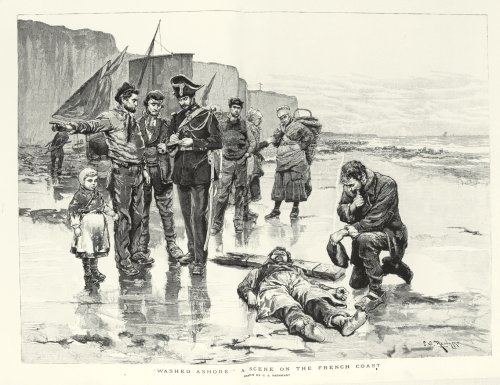
BVG 187, 4/15/1882. No surviving drawings attributed to this period fit this description, although Torn-Up Street with Diggers (F 930 a JH 131) includes in its large cast a female figure on her knees which may be taken from studies that have since disappeared. Later drawings Girl Kneeling by a Cradle (F 1024 JH 336) and Girl Kneeling in Front of a Cradle (F 276 JH 338) fit the description, except that they are of a young girl, not a woman. Two Women, Kneeling (F 1058 JH 348) depicts two women praying and Man Praying (F 1027 JH 354) depicts a single man praying. Potato Grubbers, Four Figures (F 1034 JH 372) and Potato Digging (Five Figurese) (F 9 JH 385), both from summer 1883, depict mixed groups on their knees. Vincent probably did individual studies for each figure. The Sorrow drawings (F 929 JH 129 and F 929a JH 130) show figures not on bended knee but with knees bent in a submissive, fetal-like position, as do Sien with Cigar Sitting on the Floor Near Stove (F 898 JH 141), and Bent Figure of a Woman (F 937 JH 144), as well as later drawings both titled Woman Sitting on a Basket with Head in Hands (F 1069 JH 325; F 1060 JH 326).
Context:
JLB 217, 4/14/1882: "Made another study of the nude today, a kneeling female figure."
Context:
BVG 241, 11/2/1882-11/3/1882: "Two things that in my opinion reinforce one another and remain eternally true are: Do not quench your inspiration and your imagination, do not become the slave of your model; and again: Take the model and study it, otherwise your inspiration will never become plastically concrete."
JLB 280, 11/5/1882: "Two things that remain eternally true and complement each other, in my view are: don't snuff out your inspiration and power of imagination, don't become a slave to the model; and, the other, take a model and study it, for otherwise your inspiration won't take on material form."
Context:
BVG 208, 6/22/1882: "It is astonishing how much patience he has, massaging the patients himself, rubbing them with ointment, and handling them in different ways, infinitely better than a male nurse does, and how well he knows how to banish their scruples and to make them do exactly as he wishes."
JLB 239, 6/22/1882: "It's extraordinary how patient he is when rubbing, massaging and manipulating the sick himself in various ways. He's far stronger than an orderly, and has the knack of allaying their embarrassments and positioning the people exactly as he needs them."
Context:
BVG 208, 6/22/1882: "I believe that the doctor in this ward is a little more abrupt than in the more expensive wards; so much the better."
JLB 239, 6/22/1882: "I believe that here in this class the doctor gives shorter shrift than in the more expensive ones."
Context:
BVG 208, 6/22/1882: "Perhaps they are less afraid to hurt the patients a little here than in the more expensive wards, and, for instance, they often put a catheter into the bladder quickly, without 'ceremony' or fuss."
JLB 239, 6/22/1882: "Perhaps here they're less hesitant about inflicting a little pain on the patients than in the higher wards, and more ready, for example, to stick a catheter in someone's bladder without a lot of 'good manners' or compliments."
Context:
BVG 208, 6/22/1882: "I hope to have learned this much from him, that in the future I shall try to handle my models the way he does his patients, namely by getting a firm hold on them and putting them straightway into the required position."
JLB 239, 6/22/1882: "I hope to have learned something from him, in the sense that I hope to deal with models rather as he deals with patients, namely tackling them firmly, setting them shortly and sharply in the precise position required."
BVG R24, 1/25/1883-1/30/1883: The illustration was The Bashful Model by Sir Luke Fildes. It first appeared in Harper's Weekly on November 29, 1873.

Context:
JLB 304, 1/25/1883: "Fildes has a scene in the courtyard of a prison where policemen are holding onto a thief or murderer so that his photograph can be taken. The chap refuses to submit to this and puts up a struggle. In the other corner of the composition the photographer and onlookers."
Context:
BVG 272, 3/4/1883: "That crayon knows what I want, it listens with intelligence and obeys; the conté pencil is indifferent and unwilling."
JLB 324, 3/4/1883: "That natural chalk understands what one wants, listens with intelligence and obeys, while conté is indifferent and doesn't cooperate."
Context:
BVG 272, 3/4/1883: "I could almost say, That crayon knows what I want, it listens with intelligence and obeys; the conté pencil is indifferent and unwilling."
JLB 324, 3/4/1883: "I would almost say that natural chalk understands what one wants, listens with intelligence and obeys, while conté is indifferent and doesn't cooperate."
Context:
BVG 152, 10/12/1881-10/15/1881: " The artist always comes up against resistance from nature in the beginning, but if he really takes her seriously he will not be put off by that opposition, on the contrary, it is all the more incentive to win her over -- at heart, nature and the honest draughtsman are as one."
JLB 175, 10/12/1881and 10/15/1881: " Nature always begins by resisting the draughtsman, but he who truly takes it seriously doesn't let himself be deterred by that resistance, on the contrary, it's one more stimulus to go on fighting, and at bottom nature and an honest draughtsman see eye to eye."
Context:
BVG 152, 10/12/1881-10/15/1881: "The struggle with nature is sometimes a bit like what Shakespeare calls "the taming of the shrew" (which means wearing down the opposition, bon gré et mal gré [willy-nilly])."
JLB 175, 10/12/1881-10/15/188: "The struggle with nature sometimes resembles what Shakespeare calls 'Taming the shrew' (i.e. to conquer the opposition through perseverance, willy-nilly)."
Context:
BVG 268, 2/20/1883-2/24/1883: "If one had to deal with people only inside the studio!" But personally I cannot get on well with people outside of it, and cannot get them to do anything."
JLB 318, 2/21/1883: "If only one could always deal with people in the studio! But outside it I, for one, can't get them to do much and can't get on well with them."
Context:
JLB 175, 10/12/1881-10/15/1881: "Nature always begins by resisting the draughtsman, but he who truly takes it seriously doesn't let himself be deterred by that resistance, on the contrary, it's one more stimulus to go on fighting, and at bottom nature and an honest draughtsman see eye to eye. Nature is most certainly 'intangible,' though, yet one must seize it, and with a firm hand."
Context:
BVG 177, 2/25/1882: "When I think of Etten it gives me the shudders, as if I were in church."
JLB 206, 2/25/1882: "When I think of Etten, a kind of shiver runs down my body as though I were in a church."
Context:
JLB 93, 10/7/1876-10/8/1876: "Now then, Theo, get well soon and read this letter sometime when Ma is sitting with you, because I'd very much like to be with you both in thought."
Context:
JLB 163, 2/16/1881: "The blue smock of Brabant, for example, the grey linen suit that the miners wear and their leather hat, also a straw hat and clogs, a fisherman's costume of brown fustian and a sou'wester. And most definitely the clothing made of that kind of black or brown velvet that's very picturesque and characteristic -- furthermore, a red doublet or vest. Likewise a couple of women's costumes, such as that of Kempen and the area of Antwerp with the Brabantian cap and that of Blankenberge, for example, or Scheveningen or Katwijk."
For example: Woman at the Window, Knitting, F 910a JH 90, mid-January, 1882, watercolor, 13 x 10.2 in., 33 x 26 cm., Location unknown. Sien's mother may have posed for this and other works.
Context:
JLB 200, 1/14/1882: "This is a little sketch of one of the small watercolours, it's a corner of my studio with a girl grinding coffee."
Context:
JLB 201, 1/21/1882: "I also have to pay and feed my model every day &c. &c."
Context:
JLB 196, 1/3/1882: "I've bought furniture in true 'village constable style,' as you call it, but I think that mine resembles it much more than yours, although it was you who coined the phrase. (I have real kitchen chairs, for example, and a really sturdy kitchen table.)"
Context:
JLB 207, 3/3/1882: "Tomorrow two children are coming to visit whom I must amuse and draw at the same time. I want some life in my studio."
Context:
JLB 207, 3/3/1882: "Sometimes it grieves me to think that I might have to let the model wait, because they need it so much."
Context:
JLB 206, 2/25/1882: "The better I get to know the models, the better I can draw them, of course."
Context:
JLB 207, 3/3/1882: "Or rather it's more than one model, because I've already had 3 people from the same family, a woman of about 45 who's just like a figure by E. Frère, and her daughter, 30 or so, and a younger child of 10 or 12."
Context:
JLB 207, 3/3/1882: "It's a new model I have, although I'd drawn her before superficially. Or rather it's more than one model, because I've already had 3 people from the same family, a woman of about 45 who's just like a figure by E. Frère, and her daughter, 30 or so, and a younger child of 10 or 12."
Context:
BVG 178, 3/3/1882: " They are poor people and, I must say, splendidly willing."
JLB 207, 3/3/1882: " They're poor people and, I must say, invaluably willing."
Context:
JLB 224, 5/7/1882: "This winter I met a pregnant woman, abandoned by the man whose child she was carrying."
Context:
JLB 224, 5/7/1882: "[I] have until now been able, thank God, to preserve her and her child from hunger and cold by sharing my own bread with her."
Context:
JLB 224, 5/7/1882: "For my part, I can marry only once, and when would be a better time to do it than with her, because only by doing so can I continue to help her, and otherwise hardship will make her take the same road that ends in the abyss."