
Notes
Chapters
- A Fanatic Heart
- 27. Against the Grain
- 28. The Zemganno Brothers
- 29. Catch and Release
- 30. A Mercenary Frenzy
- 31. Le Paradou
- 32. The Sunflower and the Oleander
- 33. The Poet's Garden
- 34. Imaginary Savage
- 35. La Lutte
- 36. The Stranger
- 37. Two Roads
- 38. The Real South
- 39. Starry Night
- 40. The Isolated One
- 41. A Degenerate Child
- 42. The Garden and the Wheatfield
- 43. Illusions Fade, the Sublime Remains
- Ici Repose
The Early Years
The Dutch Years
The French Years
Chapters
Although the records show that the wind gusted up to force ten on the Beaufort Scale of Wind Force (55-63 mph) during the storm on August 10-24, we have chosen the lower figure because the Beaufort speeds are calculated at 10 meters (about 30 feet) above ground level. For the same reason, we have assumed a higher wind speed on the crest of the dune where Vincent was positioned. (See Ch. 18, n. 26.)
Van der Mast and Dumas, eds., p. 61: The fishing village of Scheveningen had only recently (in the 1870s) become a mecca of bourgeois leisure. The text is meant to convey the resentment of the year-around local inhabitants at the invasion of the much wealthier summer people, who annually paraded their very modern forms of frolic and decadence before a still largely impoverished citizenry. According to Van der Mast and Dumas: "The local population which was very religious did not entirely approve of all of this, but on the other hand, they profited from the newly created jobs" (ibid., p. 63). It is interesting that, despite his claims to being a peintre de peuple, Vincent never mentions the crowded, squalid conditions in which the fishermen and their families often lived (whole blocks sharing a single communal toilet), separated from the grand new hotels and fashionable bains by only a narrow isthmus of sand. Always preferring imagery to reality, Vincent rarely saw beyond the picturesqueness and "nobility" of poverty. (See, for example, the drawings he made of a fish-drying barn in Scheveningen [Fish-Drying Barn, Seen From a Heigh (F 938 JH 152), Fish-Drying Barn (F 940 JH 154), and Fish-Drying Barn (F 945 JH 160]), and the watercolor, View of Scheveningen [F 1041 JH 167], painted the same summer.)
Van der Mast and Dumas, eds., p. 60: Because Scheveningen did not have a harbor, the fishing boats were designed with flat bottoms so that they could be "stranded" on the beach above the high water line. It is possible that the image depicts an effort to launch the boat before the storm comes ashore. Vincent depicted such a scene in another (lost) painting and letter sketch titled Beach and Boats (F 228 JH 227): "The subject of the sketch I made of it is a pink weighing anchor. The horses stand ready to be hitched to the pink before pulling it into the sea." (JLB 260, 9/3/1882.) However, the sea in the latter image is calm. Also, the women in View of the Sea at Scheveningen (F 4 JH 187) appear to be rushing to the scene. If the boat were being launched, they would likely be already congregated, as they are in Beach and Boats (F 228 JH 227).
Context:
JLB 254, 8/5/1882-8/6/1882: "Another thing I've bought for myself is a tough, warm pair of trousers, and, since I bought a pair of sturdy shoes just before you came, I'm now fully prepared to face the elements."
Context:
JLB 251, 7/26/1882: "I'm so used to my working clothes, in which I can sit or lie in the sand or grass as I please (for in the dunes, for example, I hardly ever use a chair, except perhaps an old fish basket)."
Context:
JLB 369, 7/29/1883-7/30/1883: "Today I bought a field easel and painting canvas. The first is nice, because one doesn't get as dirty as when one works on one's knees outdoors."
Context:
JLB 251, 7/26/1882: "I'm so used to my working clothes, in which I can sit or lie in the sand or grass as I please (for in the dunes, for example, I hardly ever use a chair, except perhaps an old fish basket), that my outfit is rather too Robinson Crusoe-like for me to accompany you much on your rounds."
Context:
JLB 251, 7/26/1882: "I'm so used to my working clothes, in which I can sit or lie in the sand or grass as I please."
Context:
JLB 254, 8/5/1882-8/6/1882: "I bought a pair of sturdy shoes just before you came, I'm now fully prepared to face the elements."
Context:
JLB 228, 5/16/1882: "Wearing a linen smock and smoking my pipe and looking at the deep blue sky ... or at the moss or the grass."
Context:
BVG 220, 7/26/1882: " I am so used to my working clothes, in which I can lie or sit on the sand or the grass, whichever is necessary (for in the dunes I never use a chair, only an old fish basket sometimes); so my dress is a little too Robinson Crusoe-like for paying calls with you."
JLB 251, 7/26/1882: "I'm so used to my working clothes, in which I can sit or lie in the sand or grass as I please (for in the dunes, for example, I hardly ever use a chair, except perhaps an old fish basket), that my outfit is rather too Robinson Crusoe-like for me to accompany you much on your rounds."
BVG 214, 7/7/1882: Vincent had taken the tram only the month before for a sketching trip to Scheveningen. (See Ch. 18, n. 17.) The steam tram, which left (conveniently for Vincent) from the Rijnspoor station, was inaugurated on July 1, 1879 (Van der Mast and Dumas, eds., p. 41 and Wilkie, p. 107).
Context:
JLB 245, 7/6/1882-7/7/1882: "Now tomorrow I'd like to take a trip to Scheveningen by tram and do some drawing on the beach."
Context:
JLB 255, 8/10/1882-8/11/1882: "Then I kept my letter back and marched off to the beach this morning, and have just got back with a fairly large painted study of sand, sea and sky, and a few fishing-boats and men on the beach."
Context:
JLB 253, 8/5/1882: "And a supply of paint -- big tubes (which work out much cheaper than small ones), but you will understand that I've limited myself to simple colours in both watercolour and oil: ochre (red, yellow, brown), cobalt and Prussian blue, Naples yellow, terra sienna, black and white, supplemented with some carmine, sepia, vermilion, ultramarine, gamboge in smaller tubes."
Context:
JLB 253, 8/5/1882: "The moist colour box fits into the painting box -- so that if need be I can carry everything required both for watercolour and for painting in one object" (emphasis in original).
Context:
JLB 253, 8/5/1882: "I had postponed [buying] it until later, and until now worked with loose pieces on saucers, but they're awkward to carry, especially if you have other items as well."
BVG 223, 8/5/1882 or 8/6/1882: Vincent reports that he received his new perspective frame, his third, immediately after Theo left in early August. This was the frame he specifically designed for "uneven ground like the dunes" (JLB 254, 8/5/1882-8/6/1882). (For description, see Ch. 16, n. 362.) Given his enthusiasm for this new frame ("It's in fact especially good for painting"), he undoubtedly took it to the beach at least on the first day of painting in the storm, August 21 (ibid.; emphasis in original).
Context:
JLB 254, 8/5/1882-8/6/1882: "This is why I'm having a new and, I hope, better perspective frame made, which will stand firmly on two legs in uneven ground like the dunes."
Context:
JLB 255, 8/10/1882-8/11/1882: "I don't work in the lid [of the painting box], but instead pin the painting paper for the study to a frame with canvas stretched across it, which is easy to carry."
Context:
JLB 255, 8/10/1882-8/11/1882: "I don't work in the lid [of the painting box], but instead pin the painting paper for the study to a frame with canvas stretched across it, which is easy to carry."
Context:
JLB 234, 6/1/1882-6/2/1882: "Sien and I camped in the dunes for it for days on end from morning till evening like true bohemians. We took bread and a small bag of coffee."
On the first of those days, according to Van Tilborgh and Vellekoop, "the wind was blowing at force 8 but there was no rain" (ibid., p. 36). The reference is to the Beaufort Scale of Wind Force, developed in 1805. "Force 8" refers to wind speed of 39-46 mph (34-40 knots), described as "gale" conditions with the following characteristics: "Breaks twigs off trees; generally impedes progress" (ibid.). On August 22, the second day Vincent went to Scheveningen to paint in the storm, the winds gusted at "force 9-10" (ibid.). On the Beaufort Scale (from 1 to 12), force 9 refers to winds of 47-54 mph (41-47 knots), described as "Severe Gale" conditions: "Slight structural damage occurs (chimney pots and slates removed)." "Force 10" refers to winds of 55-63 mph (48-55 knots), described as "storm" conditions: "Seldom experienced inland, trees uprooted; considerable structural damage occurs." On the Beaufort Scale, force 11 is "violent storm" and force 12 is "Hurricane" (ibid.). Our descriptions are based on the Beaufort land-based specifications, not the sea-based specifications. The wind speeds and designations are the same for both.
Context:
JLB 259, 8/26/1882: "All this week we've had gales, storms and rain here, and I've been to Scheveningen many times to see it."
Context:
JLB 255, 8/10/1882-8/11/1882: "I don't work in the lid, but instead pin the painting paper for the study to a frame with canvas stretched across it, which is easy to carry."
Context:
JLB 259, 8/26/1882: "I tried to get it down anyway by immediately painting it again in a small inn behind the dunes, after first scraping it all off, and then going out to take another look from there."
Context:
JLB 255, 8/10/1882-8/11/1882: "These studies are of medium size, though slightly larger than the lid of an ordinary painting box, because I don't work in the lid, but instead pin the painting paper for the study to a frame with canvas stretched across it, which is easy to carry."
Context:
JLB 259, 8/26/1882: "The wind was so strong that I could barely stay on my feet and barely see through the clouds of sand."
Context:
JLB 259, 8/26/1882: "The sea was the colour of dirty dishwater."
Context:
BVG 225, 8/14/1882: "Then I have painted a huge mass of dune ground -- thickly painted and sticky."
JLB 257, 8/14/1882: "I've also painted a big piece of dune ground -- impasted -- and densely painted."
Context:
BVG 223, 8/5/1882 or 8/6/1882: "With long and continuous practice it enables one to draw quick as lightning, -- and once the drawing is established to paint quick as lightning also."
JLB 254, 8/5/1882-8/6/1882: "With CONSIDERABLE practice and with lengthy practice, it enables one to draw at lightning speed and, once the lines are fixed, to paint at lightning speed" (emphasis in original).
BVG 226, 8/19/1882: Vincent reports doing two paintings, one on each of two consecutive days of storm activity, August 21 and 22 (See Ch. 18, n. 26). The painting executed on the first day was only "already a lot of sand," he reports (JLB 259, 8/26/1882). But the second one was "when there really was a storm and the sea came very close to the dunes, I had to scrape everything off twice because of the thick layer of sand completely covering it" (ibid.). Over the years, scholarly opinion has mostly equivocated over whether the surviving painting from this two-day expedition (View of the Sea at Scheveningen F 4 JH 187) is the first or the second one Vincent describes. (See Van Tilborgh and Vellekoop, p. 39, n. 5.)
Vincent's descriptions only compound the problem. He writes, for instance, that, on the second day, "the sea came very close to the dunes" whereas a good deal of beach is still visible in View of the Sea at Scheveningen (JLB 259, 8/26/1882). However, he also writes about the second day (apparently): "At that spot there was a fishing-boat, the last in the row, and several dark figures" -- exactly the image in View of the Sea at Scheveningen (ibid.). (See Van Tilborgh and Vellekoop, p. 39, n. 7.) Vincent says the sea was not as rough on the second day as the first so that there "was less the effect of furrows of ploughed land" (ibid.).
However, this does not mean either that his observation was correct (by his own admission, his visibility was limited on the second day because "the collision between these bodies of water produced a sort of foam like drifting sand that shrouded the foreground of the sea in a haze"), or that he did not paint (or repaint) the sea on the second day to conform to the more interesting "effect" he had seen the previous day (ibid.). Because of this continuing uncertainty, we have conflated the two paintings and Vincent's description of their creation in our account. In any event, we question Van Tilborgh and Vellekoop's inference that the figures on the beach in View of the Sea at Scheveningen were there merely "to admire the stormy sea" (ibid., p. 38). All of the five figures on the left are clearly fishermen's women (indicated by their white caps) who played an integral role in the outfitting of their men's boats (with special responsibility for the nets), and no doubt took an economic as well as an emotional interest in the securing of both in a storm. The cart on the right side of View of the Sea at Scheveningen, drawn by one black horse and one white one, may be a net cart (see photograph in Van Eekelen, ed., p. 76).
Context:
JLB 259, 8/26/1882: "There's already a lot of sand in the one, but with the second, when there really was a storm and the sea came very close to the dunes, I had to scrape everything off twice because of the thick layer of sand completely covering it. The wind was so strong that I could barely stay on my feet and barely see through the clouds of sand. I tried to get it down anyway by immediately painting it again in a small inn behind the dunes, after first scraping it all off, and then going out to take another look from there."
Context:
BVG 226, 8/19/1882: "One of them is slightly sprinkled with sand -- but the second, made during a real storm, during which the sea came quite close to the dunes, was so covered with a thick layer of sand that I was obliged to scrape it off twice."
JLB 259, 8/26/1882: "There's already a lot of sand in the one, but with the second, when there really was a storm and the sea came very close to the dunes, I had to scrape everything off twice because of the thick layer of sand completely covering it."
Context:
JLB 259, 8/26/1882: "I tried to get it down anyway by immediately painting it again in a small inn behind the dunes, after first scraping it all off, and then going out to take another look from there."
Context:
BVG 226, 8/19/1882: "However, I tried to get it fixed by going to a little inn behind the dunes, and there scraped it off and immediately painted it in again, returning to the beach now and then for a fresh impression."
JLB 259, 8/26/1882: "I tried to get it down anyway by immediately painting it again in a small inn behind the dunes, after first scraping it all off, and then going out to take another look from there."
Context:
BVG 225, 8/14/1882: "But this much I want to tell you -- while painting, I feel a power of colour in me that I did not possess before, things of broadness and strength."
JLB 257, 8/14/1882: "I just wanted to tell you -- I feel that things with colour are becoming apparent in my painting that I didn't use to have, things to do with breadth and strengths."
We believe that after this initial period of ambivalence and face-saving, Vincent became genuinely enamored with oil painting. Thus, his early expressions of enthusiasm sound tepid ("It is my decided aim to learn from this painting of landscape a few things about technique which I feel I need for the figure" [JLB 254, 8/5/1882-8/6/1882]) compared to his later ones ("I have a feeling for nature and the heart of a painter" [JLB 255, 8/10/1882-8/11/1882]). The extent to which he exaggerates his passion (at first) to Theo is evident from a letter to Van Rappard on August 13: "For I don't find it [painting] in the least alien, and I'm very interested in it" (JLB 256, 8/13/1882). In fact, in this same letter, he draws the line directly between Theo's request and his new work: "As for me, as the result of a visit by my brother, who saw my watercolours, I too am busily painting" (ibid.). This is a far cry from his claim to Theo at the same time that painting was always part of his plan: "I'm very glad that I have the necessary equipment, because in the past I often had to restrain myself" (JLB 255, 8/10/1882-8/11/1882).
Context:
BVG 228, 9/3/1882: "You can see that I am plunging full speed ahead into painting, I am plunging into colour."
JLB 260, 9/3/1882: "As you see, I'm immersing myself in painting with all my strength."
Context:
BVG 227, 8/20/1882: "For two weeks I have painted from early in the morning until late at night, so to speak."
JLB 258, 8/20/1882: "I've now painted for a fortnight from early morning to late in the evening, so to speak …"
Context:
BVG 227, 8/20/1882: "If I have now painted so many studies in a short time, it is because I work hard, literally working all day, scarcely taking time even to eat or drink."
JLB 258, 8/20/1882: "If I've now painted quite a number of studies in a short time it's also because I keep on working on them, and literally work all day, barely taking the time even to eat or drink."
Context:
BVG 227, 8/20/1882: "… it is because of such adventures, which often present themselves in different forms, that I think it is not superfluous to wear an ordinary workman's suit, which is less easily spoiled."
JLB 258, 8/20/1882: "… it's because of similar adventures, which happen very often in different ways, that it seems sensible to me to wear ordinary working clothes that aren't easily ruined."
Context:
JLB 258, 8/20/1882: "How beautiful it is outdoors when everything is wet with rain -- before -- during -- after the rain. I really ought not to miss a single shower."
Context:
JLB 258, 8/20/1882: "After I'd been sitting in front of that piece of ground for a while drawing, there came a thunderstorm with torrential rain that lasted a good hour. I had become so gripped, however, that I stayed at my post and sheltered as best I could behind a thick tree. When it had finally passed and the crows took to the air again, I wasn't sorry I had waited, because of the wonderfully deep tone the ground of the wood had taken on after the rain. Because I had started before the storm on my knees with a low horizon, I now had to kneel down in the mud …"
BVG 227, 8/20/1882: Girl in White in the Woods, F 8 JH 182, August, 1882, oil on canvas, 15.4 by 23.2 in., 39 by 59 cm, Otterlo, Kröller-Müller Museum. Vincent describes the creation of this painting, which Hulsker refers to as "undoubtedly the best of the series" that Vincent painted in August and September (Hulsker, Vincent and Theo, p. 146).
Context:
JLB 258, 8/20/1882: "The other study from the woods is of big green beech trunks on a ground with dead leaves, and the small figure of a girl in white. The great difficulty there was to keep it clear and bring in space between the tree-trunks, which stand at different distances -- and the place and relative thickness of the trunks altered by the perspective. To ensure, in short, that one can breathe and wander about in it -- and smell the woods."
Context:
BVG 227, 8/20/1882: "There was the great difficulty of keeping it clear, and of getting space between the trunks standing at different distances -- and the place and relative bulk of those trunks change with the perspective -- to make it so that one can breathe and walk around in it, and to make you smell the fragrance of the wood."
JLB 258, 8/20/1882: "The great difficulty there was to keep it clear and bring in space between the tree-trunks, which stand at different distances -- and the place and relative thickness of the trunks altered by the perspective. To ensure, in short, that one can breathe and wander about in it -- and smell the woods."
Context:
JLB 259, 8/26/1882: "Please accept my sincere thanks for your letter and the enclosure. As soon as I received your letter I bought seven guilders' worth of paint in one go in order to have a supply in reserve and fill up the gaps."
Context:
BVG 228, 9/3/1882: "One doesn't paint well by using a lot of paint, but in order to do a ground effectively or to get a sky bright, one must sometimes not spare the tube. Sometimes the subject calls for less paint, sometimes the material, the nature of the subjects themselves demands impasto."
JLB 260, 9/3/1882: "Good painting doesn't consist in using a great deal of paint, but to give a ground true strength, to make a sky bright, sometimes one mustn't worry about a tube more or less. Sometimes the subject requires that one paints thinly, sometimes the material, the nature of the things, makes it self-evident that they must be impasted."
Context:
JLB 260, 9/3/1882: "I squeezed roots and trunks into it from the tube, and modelled them a little with the brush."
Context:
JLB 260, 9/3/1882: "I was struck by how firmly the slender trunks stood in the ground -- I began them using a brush, but because of the ground, which was already impasted, one brushstroke simply disappeared."
Context:
BVG 225, 8/14/1882: "And as for these two, the small marine and the potato field, I am sure no one could tell that they are my first painted studies. To tell you the truth, it surprises me a little. I had expected the first things to be a failure, though I supposed they would improve later on; but though I say so myself, they are not bad at all, and I repeat, it surprises me a little."
JLB 257, 8/14/1882: "In the case of these two, and of the small seascape and the potato field, I know for certain that people wouldn't say, all things considered, that these were my first painted studies. To tell you the truth, it surprises me a little. I thought that the first things would look like nothing at all, although they would improve later, I thought, though I say so myself, that they do look like something, and that rather amazes me."
Context:
JLB 260, 9/3/1882: " I don't know myself how I paint. I sit with a white board before the spot that strikes me -- I look at what's before my eyes." (Emphasis in original.)
Context:
JLB 258, 8/20/1882: "One of the things I like about painting is that for the same effort as for a drawing one takes home something that conveys the impression much better and is much more pleasing to look at. And at the same time more accurate. In a word, it's more rewarding than drawing."
Context:
BVG 226, 8/19/1882: "There is something infinite in painting -- I cannot explain it to you so well -- but it is so delightful just for expressing one's feelings."
JLB 259, 8/26/1882: "There's something infinite about painting -- I can't quite explain -- but especially for expressing a mood, it's a joy."
Context:
BVG 226, 8/19/1882: "There are hidden harmonies or contrasts in colours which involuntarily combine to work together and which could not possibly be used in another way."
JLB 259, 8/26/1882: "In the colours there are hidden harmonies or contrasts which contribute of their own accord, and which if left unused are of no benefit."
Context:
BVG 224, 8/10/1882-8/12/1882: "And at the same time one can express tender things with it too, let a soft grey or green speak amid all the ruggedness."
JLB 255, 8/10/1882-8/11/1882: "And at the same time one can say delicate things with it too -- let a soft grey or green speak in the midst of roughness."
BVG 227, 8/20/1882. (See Ch. 18, n. 56)
Context:
BVG 227, 8/20/1882: "In a word it is more gratifying than drawing."
JLB 258, 8/20/1882: "In a word, it's more rewarding than drawing."
Context:
BVG 226, 8/19/1882: "There is something infinite in painting -- I cannot explain it to you so well -- but it is so delightful just for expressing one's feelings."
JLB 259, 8/26/1882: "There's something infinite about painting -- I can't quite explain -- but especially for expressing a mood, it's a joy."
Context:
BVG R11, 8/13/1882: "Painting is so sympathetic to me that it will be very difficult for me not to go on painting forever."
JLB 256, 8/13/1882: "I find painting so appealing that I'll have to make a great effort not to paint all the time" (emphasis in original).
Context:
BVG 224, 8/10/1882-8/12/1882: "Of course the studies must get even better. I know they have many faults, but I believe that in these first ones you will already see something of the open air, which proves that I love nature and that I have a painter's heart."
JLB 255, 8/10/1882-8/11/1882: "It goes without saying that the studies must become more beautiful -- and that certainly they have their shortcomings too -- but I believe that even in these first ones you'll already see that there's something of the open air in them, something that proves I have a feeling for nature and the heart of a painter."
Context:
BVG 228, 9/3/1882: "I know for certain that I have a feeling for colour and shall acquire more and more, that painting is in the very marrow of my bones."
JLB 260, 9/3/1882: "I know for sure that I have a feeling for colour that will develop more and more, that painting is in my very marrow."
Vincent never explicitly renounces oil painting. In letter JLB 262, 9/11/1882, responding to Theo's news about a bad debt that has put him in financial jeopardy, Vincent says only that he plans "to vary the work a little, and try to make both ends meet." He indicates that he plans to "buy a new supply" of paint and jokes, "there's so much paint around that it has even got onto this letter" (ibid.). He closes by writing that autumn is "the finest season to work in," although this could refer to either watercolor or oil painting. The next letter (JLB 264, 9/17/1882) is preoccupied with watercolors and "sketches in watercolours." Vincent is still vowing to "vary" his work, but all painting with oils appears to have stopped by this time, and no surviving works in oil are attributed to the period between September 1882 and August 1883.
Context:
BVG 228, 9/3/1882: "But now that I sense I have gained the open sea, painting must go full speed ahead as fast as we are able."
JLB 260, 9/3/1882: "But now, I feel I'm on the high seas -- painting must proceed with all the strength that we can muster."
Context:
BVG 224, 8/10/1882-8/12/1882: "Now that I am making some progress, I will try and strike while the iron is hot -- that means I shall go on painting."
JLB 255, 8/10/1882-8/11/1882: "Now that it's going well, I'll try to strike while the iron's hot and carry on painting for a little."
Working with typical Van Gogh indirection, Vincent clearly hopes to steer Theo into authorizing a higher level of subsidy because of the higher expenditures on paint supplies -- but he wants the raise to be (or, at least, appear to be) Theo's idea, not his own. The best evidence for this reading is that even as Vincent vows to cut back on his consumption of art supplies because they are so expensive, he continues to consume them in prodigious quantities and talks in rapturous terms about the images that "demand" being rendered in color (e.g., "the effect of the yellow leaves" [JLB 258, 8/20/1882]). This letter, JLB 258, 8/20/1882, is another tour-de-force of surreptitious persuasion (like, most recently, JLB 222, 5/1/1882, the letter that preceded Vincent's revelation of the affair with Sien), in which Vincent uses the appearance of a quandary to solicit the desired "voluntary" response.
In JLB 258, 8/20/1882, he states the quandary this way: "And this is why I'm in doubt as to whether it's possible that, despite the higher costs, painting as absolutely the main pursuit might not work out cheaper." But this comes at the end of a letter filled with reasons why he should continue the oil studies (e.g., they "have a much more agreeable look than either the black-and-white drawings or the watercolours that you saw recently"). But Vincent also tries to avoid directly assuring Theo that the images actually are saleable. In other words, he tries to have it both ways -- suggesting that the painted studies are a promising route to salability (and therefore worth the additional expenditure) but also avoiding being held to the standard of salability, at least in the short term. It is crucial to this stratagem that Theo has not seen any of the oil studies in question; he has only Vincent's descriptions of them to go by, and Vincent takes great care with those descriptions to touch all the important talismans of salability: color, tone, subject, a feeling for nature ("through honest study of nature"), etc., aiming for Theo to put the pieces together to reach the desired conclusion. (Vincent's control over Theo's impression of his work will become important when Theo asks Vincent to send him some examples of that work.)
After making all these carefully crafted arguments, Vincent closes by dramatically placing the decision in Theo's hands: "I would rather that you make this decision" -- an act of deference that is wildly uncharacteristic for Vincent, and therefore of doubtful sincerity (ibid.). The irony, of course, is that this is exactly the exaggeratedly circumspect approach that Vincent's father and brother took with him, although they did not raise it to such an art as Vincent does. At the most fundamental level, Vincent's claim that he quit oil painting because of the expense defies the logic of his entire life: he never let cost, either financial or emotional, impede his obsessions. Even Hulsker admits, "it is difficult to believe that [the expense] was his only reason for giving up painting" (Hulsker, Vincent and Theo, p. 146).
Context:
JLB 258, 8/20/1882: "Although I enjoy it tremendously, and probably won't paint as much as my ambition and pleasure demand for the time being, because of the heavy costs …"
Context:
BVG 219, 7/23/1882: "Then I believe they will soon stop their gossip. The only thing they can do is exclude me from some circles where they consider me an outcast."
JLB 250, 7/23/1882: "... then there will very soon be a stop to the gossip, and then only in certain circles will I be seen as a social pariah and be cast out."
Context:
BVG R16, 10/31/1882: "Although the number does not matter so much, I just mention it to show you that I am trying to push on energetically, and yet I am looked down upon, and considered a nonentity, by fellows who are certainly working less hard than I am -- which by the way leaves me pretty cold -- and nobody here pays the slightest attention to my work."
JLB 276, 10/29/1882: "Although the number isn't that important, I mention it to show that I try to put some effort into it, and yet I'm looked down upon as nothing by people who certainly work less than I do, which also leaves me fairly cold, and no one here takes the slightest notice of my work."
Context:
JLB 368, 7/27/1883: "If one follows one's conscience -- for me conscience is the very highest form of reason -- the reason within the reason -- one is tempted to think one has acted wrongly or foolishly, one gets particularly upset if more superficial people are amused by thinking they're so much wiser and are so much better at getting where they want."
Context:
JLB 343, 5/20/1883: "I saw Arnold in town with someone else, perhaps Tripp -- they were walking with Mauve. But saw them in the far distance. Because Mauve was in the middle I thought of Christ between two thieves, or else the group, in dark silhouette against a sunlit wall, looked like someone being taken in by two gendarmes."
Vincent's memory has confused, conflated, or perhaps consciously altered some key details. Dorus's first visit after Vincent "left home in search of peace" was his visit to the hospital in June 1882, not the September visit. At the time of the earlier visit, Vincent had not yet told his father about Sien. Without that knowledge, the rest of the conversation, as Vincent relates it, makes no sense. Vincent's dating of "about a year ago" is of no help in confirming this reading because the mid-June hospital visit and the late-September surprise visit lie roughly equidistant from the mid-August date of this letter the following year. However, to read this passage as constituting a revelation that Vincent told his father about Sien during his visit to the hospital in June would impute to Vincent an extraordinarily thorough and effective charade in his dealings with his brother, who continued to believe that Vincent had not revealed the affair to their father for months after the June encounter in the hospital.
Context:
JLB 375, 8/18/1883: "I stay away of my own accord from those who I believe would be ashamed of me."
Context:
JLB 250, 7/23/1882: "That you've left me free as regards my private life and affairs, and won't coerce or help to coerce me, and then there will very soon be a stop to the gossip, and then only in certain circles will I be seen as a social pariah and be cast out. Which leaves me pretty indifferent, and to which I'm already accustomed."
Context:
JLB 267, 9/19/1882: "Contact with artists has, so to speak, completely ceased for me, without my being able to explain exactly how or why."
Context:
BVG 249, 12/1/1882: "But others think it both wrong and foolish of you to have anything to do with me, and they think my own actions even more foolish; and many who at first were full of good will changed their opinion, and their courage and enthusiasm were as short-lived as a straw-fire."
JLB 289, 12/1/1882: "Yet others think it both wrong of you and foolish that you took an interest in me, and they believe even more strongly that what I do is absurd, and many who were full of enthusiasm at first end up thinking that too, and are only briefly brave and fiery, like a straw fire" (emphasis in original).
Context:
BVG 249, 12/1/1882: "But others think it both wrong and foolish of you to have anything to do with me, and they think my own actions even more foolish; and many who at first were full of good will changed their opinion, and their courage and enthusiasm were as short-lived as a straw-fire."
JLB 289, 12/1/1882: "Yet others think it both wrong of you and foolish that you took an interest in me, and they believe even more strongly that what I do is absurd, and many who were full of enthusiasm at first end up thinking that too, and are only briefly brave and fiery, like a straw fire" (emphasis in original).
Context:
JLB 251, 7/26/1882: "… for various reasons I believe it's better for both of us if I don't go with you to the Plaats, say, or to Mauve, for example. ... my outfit is rather too Robinson Crusoe-like for me to accompany you much on your rounds."
Context:
JLB 244, 7/6/1882: "I don't enjoy company, and dealing with people, talking to them, is often painful and difficult for me."
Context:
JLB 244, 7/6/1882: "Simply from nervousness -- I who am terribly sensitive, both physically and morally, only really acquired it in the years when I was deeply miserable."
Context:
BVG R13, 9/18/1882-9/19/1882: "All kinds of eccentric and bad things are thought and said about me, which makes me feel somewhat forlorn now and then, but on the other hand it concentrates my attention on the things that never change -- that is to say, the eternal beauty of nature."
JLB 267, 9/19/1882: " I'm made out to be everything peculiar and bad. This means that I sometimes have a certain sense of being abandoned, but on the other hand it concentrates my attention on the things that aren't changeable, namely the eternal beauty of nature."
Context:
JLB 307, 2/4/1883: "Envy drives many to malign others, systematically. And what is the result? -- instead of one large entity, a body of painters where unity is strength, everyone withdraws into his shell and works by himself. Those who are now cock of the walk create a kind of desert around them just because of their envy, and that's very unfortunate for themselves, it seems to me."
Context:
BVG 249, 12/1/1882: "But others think it both wrong and foolish of you to have anything to do with me, and they think my own actions even more foolish; and many who at first were full of good will changed their opinion, and their courage and enthusiasm were as short-lived as a straw-fire."
JLB 289, 12/1/1882: "Yet others think it both wrong of you and foolish that you took an interest in me, and they believe even more strongly that what I do is absurd, and many who were full of enthusiasm at first end up thinking that too, and are only briefly brave and fiery, like a straw fire" (emphasis in original).
Context:
JLB 269, 9/25/1882: "I would rather [Mauve] had spoken to me about the use of body-colour instead of saying: 'Above all, you mustn't use body-colour,' while he himself and all the others, so to speak, nearly always use it, and to the best effect."
Context:
BVG 234, 9/25/1882: " I often feel the longing and need to ask someone's advice on different questions, but I do not give in to it after what happened with Mauve, and I do not talk to painters about my work."
JLB 269, 9/25/1882: " I often feel a desire and need to seek advice from someone on various questions, but after what happened with Mauve I don't give in to that, and I don't discuss my work with painters."
Context:
BVG 208, 6/22/1882: " It stabs me to the heart and depresses me whenever I think of it, though I try to throw the whole thought overboard like useless ballast."
JLB 239, 6/22/1882: " It gives me a stab of pain and an anxious feeling each time I think of it, even though I try to chuck the whole thought of it overboard as useless ballast."
Context:
JLB 267, 9/19/1882: "Now it's high time that I sent Karl Robert [Mathieu Meusnier (Georges Karl Robert); French writer], Le fusain, back to you. I've read it through more than once and tried, and yet I make no progress with charcoal, and I prefer to work with a carpenter's pencil. I would like to see someone make a charcoal drawing -- with me it so quickly becomes flat, and the cause is something that I believe would go if I saw it being done. If you come sometime, I have a few things to ask you about it."
Context:
BVG 190, 4/15/1882-4/27/1882: "I wish they would just take me as I am."
JLB 220, 4/23/1882: "I wish they'd simply accept me as I am."
Context:
JLB 259, 8/26/1882: "Pascal Rougon, ... is proof that, however corrupt a lineage may be, it's always possible to overcome fate through willpower and principles. In his profession he found a strength that was greater than that of the nature he inherited from his family, and instead of giving in to his natural tendencies he followed a straight, clear path, and didn't slip into the murky waters in which all the other Rougons drowned. He and Mme François in Le ventre de Paris are the most sympathetic figures to me."
Context:
JLB 249, 7/21/1882: "What am I in the eyes of most people? A nonentity or an oddity or a disagreeable person -- someone who has and will have no position in society, in short a little lower than the lowest."
Context:
JLB 267, 9/19/1882: "I often think of the old story of Robinson Crusoe, who didn't lose heart because of his solitariness but organized things so that he created work for himself and had a very active and very stimulating life through his own searching and toiling."
Context:
BVG R13, 9/18/1882-9/19/1882: "Often I think of the old story of Robinson Crusoe, who did not lose courage in his isolation, but managed to create a round of activities for himself so that through his own seeking and toiling his life became very active and animated."
JLB 267, 9/19/1882: "I often think of the old story of Robinson Crusoe, who didn't lose heart because of his solitariness but organized things so that he created work for himself and had a very active and very stimulating life through his own searching and toiling."
Context:
JLB 220, 4/23/1882: "Then my ugly face and my weather-stained jacket are perfectly in keeping with my surroundings, and I'm myself and work with pleasure."
Context:
JLB 231, 5/27/1882: "I must tell you that these days I'm already out of doors by 4 o'clock in the morning, because during the day it's too difficult to be on the street on account of the passers-by and the urchins, and because that's the best time to see the broad outlines while things still have tone."
Context:
BVG 230, 9/11/1882: "Yesterday, for instance, I heard someone behind me say, That's a queer sort of painter -- he draws the horse's ass instead of drawing it from the front."
JLB 262, 9/11/1882: "Yesterday I heard someone behind me say: well, what kind of a painter is that? -- he's drawing the horse's backside instead of doing him from the front."
Context:
BVG 230, 9/11/1882: "… it may serve as an example of The Hague public's politeness towards painters that suddenly a fellow from behind me, or probably from a window, spat his quid of tobacco onto my paper."
JLB 262, 9/11/1882: "The politeness of the populace of The Hague towards painters is, however, demonstrated by the fact that a fellow behind me, or probably at a window, suddenly spat a wad of tobacco onto my paper …"
Context:
JLB 269, 9/25/1882: "You can't imagine how wearying and irritating it is that people always gather round so close. It makes me so nervous sometimes that I have to give up."
Context:
JLB 269, 9/25/1882: "Just yesterday morning, although it was very early and I hoped to be spared, a study of the chestnut trees on Bezuidenhout (which are so splendid now) was a failure because of it."
BVG 202, 5/27/1882. (See Ch. 18, n. 95.) At this stage in his life, Vincent was clearly an early riser. He recounts stopping at the shop of a "water and coals woman" in Scheveningen "at five in the morning when the street-sweepers came to drink their coffee" (JLB 234, 6/1/1882-6/2/1882). And that would have been after a long trip from the Schenkweg, starting even earlier.
Context:
JLB 231, 5/27/1882: "I must tell you that these days I'm already out of doors by 4 o'clock in the morning, because during the day it's too difficult to be on the street on account of the passers-by and the urchins, and because that's the best time to see the broad outlines while things still have tone."
Context:
JLB 234, 6/1/1882-6/2/1882: "I've already been to that shop at 5 in the morning when the street-sweepers came to drink their coffee."
Context:
BVG 201, 6/2/1882-6/3/1882: "For it is a great sorrow to think, This is worse than having no home at all, no father, no mother, no relations -- and I have often thought so, as I do now."
JLB 234, 6/1/1882-6/2/1882: "For it's a great sorrow to think that it's even worse: as if I had no home, no father, no mother, no family, and I've often thought that -- do so now as well."
Context:
JLB 253, 8/5/1882: "Give Pa and Ma my warmest regards, thank them for what they gave you for me, and tell them I'll write soon -- but as agreed not about special matters."
Context:
JLB 375, 8/18/1883: "Well, thinking thus that they were more or less ashamed of me, which tallied with what you told me, I wasn't a busy correspondent and nor was Pa, and neither his letters nor mine were particularly confiding. This, between you and me, is only to explain, not to draw further conclusions."
Context:
BVG 226, 8/19/1882: "Well, I dare not allow myself any illusions, and I am afraid that Father and Mother may never really appreciate my art."
JLB 259, 8/26/1882: "In short, I dare not cherish any illusions and do fear that Pa and Ma will never take any real pleasure in it."
Not surprisingly, many of Vincent's direst insecurities can be detected in this passage. He has attributed to his parents the criticisms not just of people like Mauve and Tersteeg, but those of his harshest critic, himself. His worst fears are cruelly realized around the turn of the year (1882–83) when he gives his father a copy of his first lithograph (of the orphan man) (JLB 306, 2/3/1883). Dorus responds with criticisms. Vincent then re-draws the image to satisfy his father's critique ("now that I know how you would like it to be, I'll try and make it for you") and sends the drawing to his father for his birthday (ibid.). Dorus rejects that one as well ("Pa didn't write that he didn't like it, but that was what came across anyway") (ibid.). "Yet I fear I haven't succeeded," Vincent wrote, heartbroken. "One doesn't always manage to please people when one does one's best" (ibid.).
Context:
BVG 226, 8/19/1882: "In the future, whenever they saw me toiling and pegging away at my work -- scraping it out and changing it -- now severely comparing it to nature then changing it a little so they can no longer exactly recognize the spot or the figure -- it would always be a disappointment to them."
JLB 259, 8/26/1882: "Also, whenever in the future, even more than now, they should see me slogging and toiling away at my work -- scratching out and altering -- now making a close comparison with nature, and then introducing a change so that they can no longer exactly recognize the spot or the figure, that will always be a disappointment to them."
Context:
JLB 269, 9/25/1882: "Now I must tell you that I had a very unexpected and very pleasing visit from Pa, who came to my house and to the studio, which I believe is infinitely better than his only hearing about me through reports from others."
As for what Vincent told his father, we believe it closely tracked what he told Van Rappard under very similar circumstances when he visited the studio in May 1882 and found Vincent at work with his "model," Sien. In a letter immediately after the visit, Vincent marginalizes his relationship with her in the most patronizing terms, describes his "assistance" to her in strictly proper, Victorian phrases, and caustically dismisses any suggestion of emotional impropriety: "I hear gossip about how I'm always together with her, but why should I let that bother me? -- I've never had such a good assistant as this ugly??? wasted woman" (JLB 232, 5/28/1882).
Almost a year later, in another effort to "explain" Sien to Van Rappard, Vincent summarizes what he said the previous spring: "Do you recall that when you visited me last summer we met a woman and I told you that she was a model I'd found, and also told you how I discovered that she was pregnant and tried all the harder to help her because of that?" (JLB 307, 2/4/1883). In this letter, and the next one, Vincent fleshes out in much greater detail a version of his relationship with Sien that focuses on the Victorian myth of rescue and excludes any suggestion of emotional attachment (JLB 309, 2/8/1883).
We believe that this is the version of the story that Vincent probably gave his father when he visited unexpectedly in September 1882. "Soon after [I discovered that Sien was pregnant] I fell ill myself. She was then in the hospital in Leiden, and in hospital I got a letter from her saying how anxious she was. Before then -- during the winter when she suffered terribly -- I did what I could, and now I was deeply divided within myself as to what to do. Could, should I help? … And what should I do? I had much to think about at that moment. She'd had a very difficult birth, the poor creature of a mother. Aren't there moments in life when remaining inactive or saying, 'What's it to do with me?' is criminal?" (JLB 307, 2/4/1883.) "I am dealing with a woman who had one foot in the grave when I met her, and was shocked and disorientated in her mind and nervous system. Her only chance of surviving, according to the professor in Leiden, was to lead a well-ordered, domestic life. And even then it will take years before she's completely normal." (JLB 309, 2/8/1883; emphasis in original.) Van Rappard, apparently, went to his grave professing to believe this story; Dorus knew his son better than that (Van Crimpen, p. 79).
In addition to the obvious confusing or fudging of the chronology (Dorus did not know about Sien until long after their first reunion in The Hague in June), this passage should be read in the context of what Vincent was simultaneously withholding from Van Rappard at the time. Yes, Dorus knew Vincent's censored version of the Sien story -- the same version he told Van Rappard (see Ch. 18, n. 112) -- but neither one knew the true story. The gift of the coat constituted yet another vain hope for the best from Vincent's parents; they preferred clinging to Vincent's strained fiction rather than giving in to their worst fears about his fate.
Context:
JLB 271, 10/8/1882: "Imagine, this week to my great surprise I received a package from home -- with a winter coat, warm trousers, and a warm lady's coat. I was very touched."
Context:
JLB 375, 8/18/1883: "'And you understand that I won't make it difficult for you, and as long as I haven't yet got my affairs in order and am not back on my feet, wouldn't you think it better if I didn't visit you?' If to that Pa had said something like 'No, that's going too far,' I would have been friendlier since, but Pa's reply was in between yes and no; it was, Oh, do what you think best."
Context:
JLB 269, 9/25/1882: "Now I must tell you that I had a very unexpected and very pleasing visit from Pa, who came to my house and to the studio, which I believe is infinitely better than his only hearing about me through reports from others."
Context:
BVG 312, 8/17/1883: "So, presuming they were more or less ashamed of me, which fits in with what you said, I was not very keen on correspondence -- neither was Father, and neither his letters nor mine have been a very intimate."
JLB 375, 8/18/1883: "Well, thinking thus that they were more or less ashamed of me, which tallied with what you told me, I wasn't a busy correspondent and nor was Pa, and neither his letters nor mine were particularly confiding."
BVG 234, 9/25/1882. (See Ch. 18, n. 112.) When Theo writes Vincent about his acquaintance in Paris who is living in sin with a woman, Vincent launches his long response with this coy remark: "Such people exist there and here" (JLB 274, 10/22/1882).
Another strategy, of course, was to talk about his own art: "I have toiled and laboured, so that at the moment I'm dead tired, having done 7 painted studies. There's also one with a figure -- a mother with a child in the shadow of a big tree, in tone against a dune on which the summer sun is shining. An almost Italian effect." (JLB 257, 8/14/1882.) Even the reference to "Italian effect" may be code for the more sexually liberated Italian peasants often depicted in popular art. That Vincent was ever mindful of the restrictions on his letters to Theo is revealed when, in January 1883, the ban is lifted (see Chapter 19): "I conceded to you [i.e., during Theo's visit in August 1882] that the circumstances were such that there was good reason not to speak of that for the time being. And now you know that I haven't spoken further of that." (JLB 301, 1/13/1883.)
Context:
JLB 292, 12/10/1882: "I thought I saw something -- deeper, more infinite, more eternal than an ocean -- in the expression in the eyes of a baby -- when it wakes in the morning and crows -- or laughs because it sees the sun shine into its cradle."
Our best reading is this: In regard to the acquaintance in Paris, a desperate situation arose and, in an effort to be kind, the man moved the woman into his home -- a situation analogous to Vincent's. But Theo apparently used the example to make the point that the man did what he did for the wrong reason -- i.e., to reclaim his youth, or hang onto it. Thus, he did the right thing for the wrong reason: implying that Vincent, too, is doing the right thing for the wrong reason -- an emotionally tone-deaf argument that would be typical of Theo. In his murky reply, Vincent says that he is not concerned about someone's reasons for doing the right thing, i.e., about some overarching philosophy. He maintains that the important thing is the deed, not the idea. He also argues that a man who does the right thing for the wrong reason is better than the great majority of people who advocate the right thing but never actually follow through by doing the right thing. This could be a veiled criticism of Theo, who may have packed off a lower-class mistress to the coast of Brittany in 1877. (See Chapter 9, and Ch. 11, n. 223.) Vincent, of course, casts himself as the man trying to do the right thing -- one small act at a time.
Context:
JLB 274, 10/22/1882: "Don't think that I look with contempt on people such as you describe because their life isn't founded on serious and well-considered principles. My view on this is as follows: the result must be an action, not an abstract idea. I think principles are good and worth the effort only when they develop into deeds, and I think it's good to reflect and to try to be conscientious, because that makes a person's will to work more resolute and turns the various actions into a whole. I think that people such as you describe would get more steadiness if they went about what they do more rationally, but otherwise I much prefer them to people who make a great show of their principles without making the slightest effort to put them into practice or even giving that a thought. For the latter have no use for the finest of principles, and the former are precisely the people who, if they ever get round to living with willpower and reflection, will do something great. For the great doesn't happen through impulse alone, and is a succession of little things that are brought together." (Emphasis in original.)
Like so much of Vincent's posturing toward his brother, this proposal reflects the contrary pull of guilt ("I wish you did not have to support me") and resentment ("Why don't you send me more?" and "Why do you make me ask for more?"). These conflicting imperatives can be seen also in Vincent's contradictory behavior after being informed of Theo's financial crisis (JLB 262, 9/11/1882). In the very same letter, he writes: "But remember that something extra will of course help me make extra progress -- more successfully than otherwise" (ibid.; emphasis added). And although he vows to "vary the work a little" (i.e., do more drawings rather than paintings to reduce his expenses), he simultaneously asserts his eagerness to do more painting: "I thank you for sending while you yourself are so hard pressed. I need it twice as badly, because the autumn goes so quickly and it's the finest season to work in." (ibid.)
In his next letter, he reports to Theo that he has fulfilled his promise to draw more, paint less (" I'm a little concerned about paint and a few other things, but ... there is and will continue to be an endless amount of things to draw" [JLB 264, 9/17/1882]), but in a letter to Van Rappard the next day, he reports enthusiastically on a shopping trip to buy more prints (JLB 267, 9/19/1882). Almost on the same day, he reports dolefully to Theo: "As I write to you, I'm already down to my last guilder. I hope to hear from you soon but, bearing in mind what you last wrote to me I think it very possible that you may not be able to spare the usual precisely on the twentieth." (JLB 266, 9/18/1882.) Nonetheless, he adds in apparent desperation: "I want to ask you to send whatever you can spare, be it more or less, even if it's only a small part" (ibid.). But the reason he gives for his desperation must have struck Theo as, at best, insensitive in a time of financial crisis: "A model is coming on Friday afternoon, a man from the almshouse, and I wouldn't like to send him away unpaid" (ibid.). Only a few days later, he admits to Van Rappard: "As you know, I have a particular liking for woodcuts. I usually buy them very cheaply, and yet by my standards I spend quite a lot on them and have never regretted that." (JLB 268, 9/23/1882; emphasis added.)
Needless to say, Theo hears nothing about the continuing purchases of prints at this time. Vincent offers only two additional expressions of concern about his brother's financial plight: a chipper remark ("Well, I sincerely hope your pockets aren't too empty" [JLB 271, 10/8/1882]); and a grave one ("don't need to tell you that I sincerely hope you'll receive the you know what" [JLB 272, 10/15/1882]) -- a contrast in mood that perfectly reflects his conflicting feelings. Within weeks of embarking on his new initiative, he was forced to ask plaintively for "a little extra this month."
When Theo responded with details of his own financial woes (a friend had defaulted on a loan), Vincent felt a fresh surge of guilt (JLB 262, 9/11/1882). The specter of a financial "calamity" befalling his brother on his account triggered pangs of self-reproach. "I'm so concerned that you yourself might perhaps be in serious difficulties," he wrote (JLB 264, 9/17/1882). For the first of many times, he pledged all his work to Theo (JLB 265, 9/17/1882-9/18/1882) and promised to do less painting, which was expensive, and more drawing, which was not (JLB 264, 9/17/1882). Vincent had stated the same intention in the previous letter: "But I'll vary the work a little and manage to get by" (JLB 262, 9/11/1882). This promise turned out to be hollow because as soon as he started drawing instead of painting, he returned to hiring models. Only a week after repeating this vow, he writes: "A model is coming on Friday afternoon, a man from the almshouse, and I wouldn't like to send him away unpaid" (JLB 266, 9/18/1882). A few weeks later, he acknowledged that turning from painting to drawing had not really saved money: "I'm varying it now by working a good deal with models, though that also mounts up" (JLB 272, 10/15/1882). This is the clearest indication that Vincent's primary reason for retreating from oil painting was not to reduce expenses.
Context:
BVG 228, 9/3/1882: "If I am going to paint on panel or canvas then the expenses will go up again, everything is so expensive, paint is expensive, too, and is so quickly used up."
JLB 260, 9/3/1882: "If I work on panel or canvas, the costs go up again -- everything is so expensive -- paint is expensive too, and is used up so quickly."
Context:
BVG 234, 9/25/1882: "This is partly because so many things that I start turn out wrong, and then one has to begin anew, and all the trouble has been in vain -- except that after all, this is the way to make progress, and one must persevere."
JLB 269, 9/25/1882: "But that's also partly because many of the things that I begin don't come off, and then one has to start again and the effort comes to nothing, except that this is the way to make progress, and that one must persevere."
Context:
JLB 266, 9/18/1882: "As regards sending you a painted study, I have nothing against that -- but before I do, we must agree on a couple of things."
Context:
JLB 266, 9/18/1882: " Studies done out of doors are different from paintings intended to go out into the world. In my view the latter stem from the studies, but may, and indeed must, differ from them markedly. For in the painting the artist presents a more personal idea, and in a study his aim is simply to analyze a piece of nature. Either to give his thought or conception precision, or to arrive at a thought. Thus studies belong more in the studio than in the trade, and shouldn't be looked at from the same viewpoint as paintings." (Emphasis in original.)
Context:
BVG 233, 9/19/1882: "I consider making studies like sowing, and making pictures like reaping."
JLB 266, 9/18/1882: "I regard making studies as Sowing, and making paintings as reaping" (emphasis in original).
Context:
JLB 269, 9/25/1882: "The only explanation I can offer about this is that the study was done as a study of the foreground, namely the tree roots."
Context:
JLB 269, 9/25/1882: "But, as I said in my last letter, I would of course rather you could see them all together sometime, and it goes without saying that you mustn't judge the future by this one, since I haven't been working with the brush long enough for me not to change a great deal. … Make no mistake, old chap, I send you this because, since you said nothing about it, I didn't know what to do. Of course I intend something very different from this, and I'm sending it in the same way that I make a scratch sometimes, to give you an idea of what I'm working on. … Another thing, you understand that I could do some things differently, for example some branches &c., if I painted them again …"
Context:
BVG R11, 8/13/1882: "Speaking frankly, I do not think people would conclude from my first painted studies that they really are my first."
JLB 256, 8/13/1882: "Actually, I don't believe that anyone seeing my first painted studies would say that they were my first."
Context:
BVG 234, 9/25/1882: "… and of course you can't judge the future from the one, as I have been handling the brush for too short a time not to expect great changes. … I would rather have sent you something else, … Like myself, you will find much to criticize in the background. … If it is a disappointment to you, you must remember that it is such a short time since I began painting."
JLB 269, 9/25/1882: "... you mustn't judge the future by this one ... I haven't been working with the brush long enough for me. I wanted to send you a different one ... Like me, you will no doubt have reservations about the background ... If you're disappointed, remember that I started only a short time ago."
BVG 234, 9/25/1882. (See Ch. 18, n. 129.) We have altered the translation.
Context:
BVG 234, 9/25/1882: "But as I told you in my last letter, of course I would much rather that you saw them all together; and of course you can't judge the future from the one, as I have been handling the brush for too short a time not to expect great changes."
JLB 269, 9/25/1882: "But, as I said in my last letter, I would of course rather you could see them all together sometime, and it goes without saying that you mustn't judge the future by this one, since I haven't been working with the brush long enough for me not to change a great deal."
Context:
JLB 269, 9/25/1882: "… if it's the case that, on seeing it and knowing that I have many others as well as this one, you don't regret enabling me to make it, then I'll be content and shall carry on in good heart."
Context:
JLB 280, 11/5/1882: "I felt more and more a kind of emptiness which I can't fill with the things being made today."
Context:
BVG 262, 1/25/1883-1/29/1883: "It seems to me that something of the fine spirit of that time which ought to have been preserved is disappearing -- in art especially. But also in life itself. Perhaps I express myself too vaguely, but I cannot say it differently -- I don't know exactly what it is, but it is not just the Black-and-White which changed its course and deviated from its healthy, noble beginning ... Rather, there is in general a kind of skepticism and indifference and coolness, notwithstanding all the activity."
JLB 305, 1/27/1883: "It seems to me that something from the past that was good and should have been kept is going, in art particularly, but also in life itself. Perhaps I'm expressing things too vaguely, but I can't put it another way -- I don't know myself what it is exactly, but it wasn't only the Black-and-White that changed direction and strayed from the healthy, noble beginnings. Rather, in general a kind of scepticism and indifference and coldness prevails, despite all the activity."
Context:
JLB 377, 8/20/1883: "For my part, I wrote to you before that it seemed to me that since Millet a sharp falling off was evident, as if the peak had already been reached and decline had set in."
Context:
JLB 304, 1/25/1883: "Don't you find something very dull about these times?"
Context:
JLB 304, 1/25/1883: "A certain lack of passion and warmth and open-heartedness. The 'dealers' and their cronies may claim that 'it's in the nature of things that the desired change will come' (isn't this explanation very satisfactory?), but for my part I don't see that 'in the nature of things' so clearly."
Context:
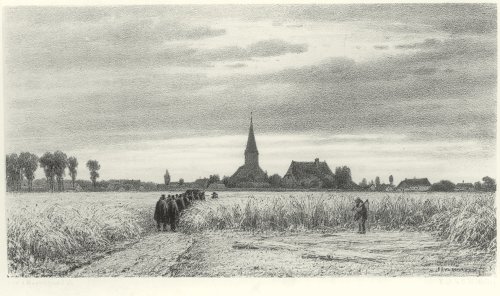
JLB 259, 8/26/1882: "Then you write about the stretch of heath and the pine wood close by. I can tell you, I feel an everlasting homesickness for heath and pine trees ... those simple things that have something of the grandeur of the sea. I have always had a wish to go and live somewhere quite in the country, if I had an opportunity and circumstances would permit."
Context:
JLB 256, 8/13/1882: "Since then have come sugar-beet factories, railways, heath reclamations, &c., which are much less picturesque."
Context:
BVG R11, 8/13/1882: "It can't be helped -- but what is sure to remain is something of the stern poetry of the real heath."
JLB 256, 8/13/1882: "Well, what will remain in me is something of the austere poetry of the true heathland."
Context:
BVG 205, 6/3/1882: " My life, and perhaps after all yours, too, is not as sunny now as it was then; but I would not go back, because through that very trouble and adversity I have seen some good arise, namely the ability to express that feeling."
JLB 235, 6/3/1882: " My life, and yours too perhaps, after all, is no longer as sunny as it was then, but I still wouldn't want to go back, because it's precisely through some trouble and adversity that I see something good emerging, namely the expression of those feelings."
Context:
JLB 276, 10/29/1882: "Don't you find Andersen's fairy tales very beautiful? -- he must be another of those illustrators."
Vincent's reaction to the book was clearly colored by his failure to identify with the main character: "Octave Mouret -- actually the main character -- couldn't he be regarded as typical of the kind of people you wrote about recently, if you remember? He's far better than most people, in many respects, but you won't find him satisfactory any more than I do, and I sense an emptiness in him. Could he have done differently? Perhaps he couldn't, but you and I can and must in my view. After all, we have our roots in a family life of a different kind from Mouret's." (ibid.) Far from the romantic hero of the other books Vincent was reading at the time, Octave Mouret was a very modern anti-hero -- a fact that frustrated Vincent: "Anyway, I don't know what to think of him. He seems to me to be a product of the time, actually more passive than active -- despite his activity." (ibid.) This attitude will change a few years later in Nuenen (see Chapter 21).
Context:
JLB 286, 11/24/1882: "I've finished the book by Zola, Pot-bouille [Pot Luck]."
Context:
JLB 265, 9/17/1882-9/18/1882: "In the last few days I've been reading Les deux frères by Erckmann-Chatrian, which is quite beautiful."
Context:
JLB 516, 7/15/1885: "The French Revolution -- that is the centre -- the constitution of 1789 the modern gospel, no less sublime than that of Year 1."
Context:
JLB 274, 10/22/1882: "… things were a little warmer then, and more good-humoured and livelier than now."
Context:
JLB 286, 11/24/1882: "But after Zola's book I read Quatre vingt treize [1893] by V. Hugo at long last. That's entirely different territory. It's painted, I mean written, like [Alexandre-Gabriel] Decamps or Jules Dupré."
Context:
BVG 247, 11/24/1882: "I would strongly advise you to read it if you haven't already, for the sentiment in which this book is written becomes more and more rare, and among the new things, I really have not found anything nobler."
JLB 286, 11/24/1882: "I strongly recommend that you read it sometime if you haven't read it, for the sentiment in which this book is written is becoming ever more uncommon, and amid the new I see nothing more noble" (emphasis in original).
Context:
JLB 288, 11/26/1882-11/27/1882: "It [Murger's Les buveurs d'eau] breathes that age of la bohème (though the reality of that period is papered over in the book) and that's why it interests me, but in my view it lacks originality and honesty of sentiment."
Context:
JLB 274, 10/22/1882: "Did I write to you before that I read Daudet's Les rois en exil? I thought it rather beautiful."
See Ch. 18, n. 151 and n. 150.
Context: JLB 267, 9/19/1882: "I once read in Eliot 'though it be dead, yet let me think it lives ...'"
Context:
JLB 263, 9/12/1882-9/17/1882: "Some time ago there was also an exhibition of French art from private collections -- Daubigny, Corot, Jules Dupré, Jules Breton, Courbet, Diaz, Jacque, T. Rousseau -- which at once stimulated me and yet made me feel a little melancholy, when I thought of how the faithful veterans have vanished one by one. Corot is no more. T. Rousseau, Millet, Daubigny -- they're resting from their work. Jules Breton, Jules Dupré, Jacque, E. Frère, they're still with us, but how long will they still be going around in their smocks? They're all already old and have one foot in the grave. And their successors -- are they worthy of those first modern masters?" (Emphasis in original.)
Context:
JLB 279, 11/1/1882: "And believe me, those who saw the leading lights of today both as people and as artists 10 years ago -- when they were all much poorer -- they've earned a huge amount in those 10 years -- miss those days of 10 years ago."
Context:
BVG 315, 8/20/1883 or 8/21/1883: "I think now there is a spirit of capriciousness and satiety; people are generally more lukewarm."
JLB 377, 8/20/1883: "Now I believe there's a spirit of caprice and satiety. People are generally more lukewarm."
Context:
BVG 251, 12/3/1882-12/5/1882: "Do I want them back or do I want people to imitate them? No, but I want the honesty, the naïveté, the truth, to remain."
JLB 291, 12/4/1882-12/9/1882: "Do I want them back, or do I want them to be imitated? No, but I do want the honesty, the naivety, the faithfulness to remain."
Most of the artists Vincent names were from the Alsace-Lorraine area (Vautier and Van Muyden) and reached a modest prominence between 1850 and 1870, largely due to the promotion of Goupil, which is probably how Vincent encountered them. Mostly genre painters, they have little in common with Vincent's art or obsessions at this time except for the emphasis on figures. There is no suggestion that they shared any special tie other than their common area of origin. Otherwise, their "joining together" appears to be largely a function of Vincent's projection. (See also JLB 265, n. 15.)
Context:
JLB 274, 10/22/1882: "How far we have strayed in our age from la bohème of Gavarni's day! It seems to me that things were a little warmer then, and more good-humoured and livelier than now. But I don't know, and there's also much that's good in the present, or would be more than is actually the case if there were rather more joining together."
Context:
JLB 297, 12/31/1882 and 1/2/1883: "I imagined that the painters here would form a sort of circle or society in which warmth and open-heartedness and a certain unity would prevail."
Context:
BVG 241, 11/2/1882 or 11/3/1882: "In that high range there is an equality of genius, but higher than the top of the mountain one cannot climb. … Now in the realm of art the summit has been reached."
JLB 280, 11/5/1882: "If one reaches that high zone, one is amid an equality of geniuses, but one can't climb higher than the top of the mountain. … Now, though, the top has been reached in art."
Context:
BVG 201, 6/2/1882-6/3/1882: "For it is a great sorrow to think, This is worse than having no home at all, no father, no mother, no relations -- and I have often thought so, as I do now."
JLB 234, 6/1/1882-6/2/1882: "For it's a great sorrow to think that it's even worse: as if I had no home, no father, no mother, no family, and I've often thought that -- do so now as well."
Context:
JLB 307, 2/4/1883: "I do assure you that The Graphics I now have are amazingly interesting. More than 10 years ago I used to go every week to the display case of the printer of The Graphic and London News in London to see the weekly publications."
Context:
JLB 356, 6/22/1883: "I did that with the English manner particularly. I didn't find it at all beautiful immediately and first thought, exactly like most people here, that the English were in fact completely wrong."
Context:
BVG 017, 6/16/1874: "There are beautiful things in the Royal Academy this year. [James] Tissot has three pictures there."
JLB 23, 6/16/1874: "There are beautiful things at the Royal Academy this year; among others Tissot has 3 paintings."
Context:
JLB 267, 9/19/1882: "For me the English draughtsmen are what Dickens is in the sphere of literature. It's one and the same sentiment, noble and healthy …"
Context:
BVG R12, 9/12/1882-9/14/1882: "And especially as I myself am working at trying to do things that interest me more and more -- scenes in the street, the third-class waiting room, on the beach, in a hospital -- my respect for those great black-and-white artists of the people, as for instance [Charles Paul] Renouard or Lançon or Doré or [Edward] Morin or Gavarni or [George Louis Palmella Busson] du Maurier or Ch. Keene or Howard Pyle or [Arthur] Hopkins or Herkomer Frank Hol, and countless others, is forever increasing."
JLB 263, 9/12/1882-9/17/1882: "And especially while I myself toil away to make something of the things that interest me more and more on the street, in the 3rd-class waiting room, on the beach, in a hospital, my respect grows for the great portrayers of the people such as, for example, Renouard or Lançon or Doré or Morin or Gavarni or Du Maurier or C. Keene or Howard Pyle or Hopkins or Herkomer and Frank Holl and countless others."
Context:
BVG 237, 10/22/1882: "That is also why I always feel attracted to the figures of both the English draughtsmen and of the English writers, whose Monday-morning-like soberness and studied restraint and prose and analysis is something solid and substantial to which one can hang on in days when one feels weak."
JLB 274, 10/22/1882: "And similarly the figures of either the English draughtsmen or the English writers, on account of their Monday morning-like sobriety and deliberate austerity and prose and analysis, continue to attract me as something solid and firm which gives one something to hold onto on days when one is feeling weak."
Context:
BVG 246, 11/22/1882: "But I think there is something rough and audacious in these prints that I wanted there, and this partially reconciles me to losing things which were in the drawing."
JLB 285, 11/22/1882: "Yet what I think of these impressions is that there's something rough and unabashed in them that I indeed wanted them to have, which partly reconciles me to the loss of things that were in the drawing."
Context:
BVG R20, 2/4/1883: "I doubt whether, if the 'London Sketches' -- for instance, Herkomer's 'Low Lodginghouse St. Giles' or Fildes's 'Casual Ward' -- were to be painted, they would be quite as full of feeling and character as they are now in that unpolished Black-and-White."
JLB 307, 2/4/1883: "I wonder whether the London sketches -- such as Low lodging house St Giles's by Herkomer , Casual ward by Fildes -- wouldn't be a little less compelling and full of character if painted than they are in the rough Black-and-White."

Context:
BVG R20, 2/4/1883: "I doubt whether, if the 'London Sketches' -- for instance, Herkomer's 'Low Lodginghouse St. Giles' or Fildes's 'Casual Ward' -- were to be painted, they would be quite as full of feeling and character as they are now in that unpolished Black-and-White."
JLB 307, 2/4/1883: "I wonder whether the London sketches -- such as Low lodging house St Giles's by Herkomer, Casual ward by Fildes -- wouldn't be a little less compelling and full of character if painted than they are in the rough Black-and-White."
Context:
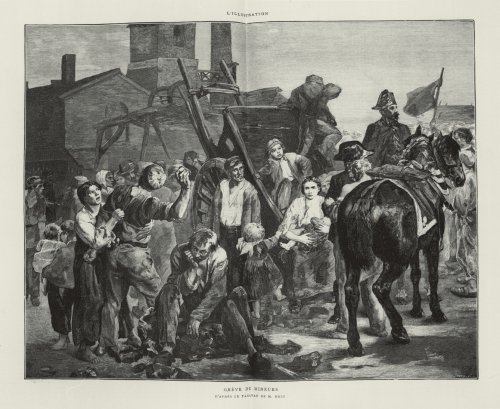
JLB 272, 10/15/1882: "'There are paintings in which there is nothing and yet everything is there'" (emphasis in original).
Context:
JLB 232, 5/28/1882: "It's a pity that the artists here know so little about the English. Mauve, for example, was enthusiastic when he saw that landscape by Millais [John Everett Millais, 1829-1896; English artist], Chill October, but they don't believe in English art, and judge it too superficially in my view. Mauve always says, 'That is literary art,' but doesn't realize that the English writers like Dickens and Eliot and Currer Bell [Charlotte Brontë], and among the French Balzac, are so astonishingly 'plastic,' if I may put it like that, that it's as powerful as, say, a drawing by Herkomer or Fildes or Israëls."

Context:
JLB 278, 11/1/1882: "And as for the painters, I believe they haven't yet made every effort to take the matter to heart. The definition that many a painter here in Holland gives in reply to the question 'What is a wood engraving?' is: 'it's those things lying in the Zuid-Hollandsch Koffiehuis [South Holland Café].' So they rank them among the drinks. And the makers of them among the drunks, perhaps." (Emphasis in original.)
BVG 169, 1/5/1882-1/8/1882. Vincent wrote this less than two weeks after arriving in The Hague. The actual title of the famous Fildes image Vincent describes is Houseless and Hungry. The later painting based on this Graphic illustration was titled Applicants for Admission to a Casual Ward (1874).

Context:
JLB 199, 1/8/1882 or 1/9/1882: "And I've also acquired another ornament for my studio, I got a great bargain on some splendid woodcuts from The Graphic, some of them prints not of the clichés but of the blocks themselves. Just what I've been wanting for years. The drawings by Herkomer, Frank Holl, [Frederick] Walker, and others. ... Some of them are superb, including the Houseless and Homeless by Fildes (poor people waiting outside a night shelter) and two large Herkomers and many small ones, and the Irish Emigrants by Frank Holl and the 'Old Gate' by Walker. And especially a Girls' School by Frank Holl and also that large Herkomer, the invalids."
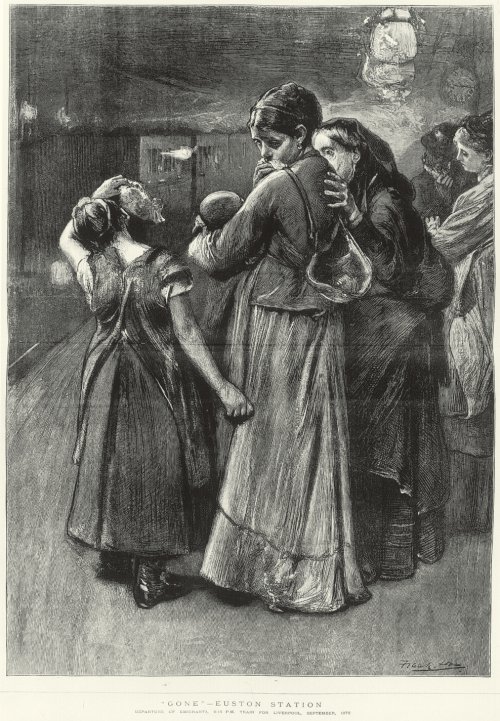
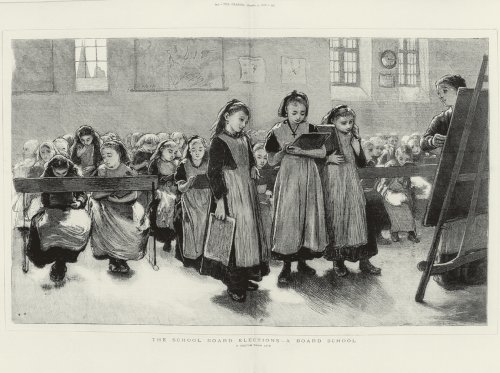
(For a thorough discussion, see Pickvance, p. 32. However, we find Pickvance overeager in his effort to find dots to connect between Vincent's time in London and his later obsession with English illustrators.) Vincent never mentions buying any works by English illustrators that year, despite frequent references to purchasing prints by other artists, almost exclusively French and Dutch. It is not until he arrives in The Hague that he mentions buying his first work by one of the English illustrators (JLB 197, 1/5/1882). In announcing the purchases, he writes Theo that they are "just what I've been wanting for years" (JLB 199, 1/8/1882 or 1/9/1882). It seems hard to imagine that, if he was indeed looking, he could not have found similar prints in Brussels, or on one of several visits to The Hague in 1881. This suggests that Vincent means to say that he didn't realize he had been looking for them until he found them -- in other words, the text's argument: that they struck him in a new way.
Context:
BVG 140, January 1881: "They vaguely resemble certain drawings by [Auguste André] Lançon, or certain English wood engravings, but as yet they are more clumsy and awkward."
JLB 162, January 1881: "They vaguely resemble certain drawings by [Auguste André] Lançon or certain English wood engravings, but even clumsier, more awkward."
Eventually, at least according to Vincent's report to Van Rappard, he did do two more portraits in the family, although not willingly: "I had to go to some trouble to get The Graphic. For example, I had to do two portraits (two of each!) of the father and mother of the Jew I bought them from." (JLB 302, 1/18/1883.) We suspect that these additional portraits may be apocryphal. Vincent had lied to Van Rappard before about commissions in the ongoing effort to impress him. The slight against Blok's family may be Vincent's effort to get credit for the commission while acknowledging to the aristocrat Van Rappard that patrons like the Bloks were beneath his (and, more to the point, Van Rappard's) artistic dignity. This may seem at odds with Vincent's rhetoric about solidarity with the people, but Van Rappard was real, not rhetorical, as was Vincent's craving for his comradeship.
Context:
JLB 263, 9/12/1882-9/17/1882: "I may be able to add some more later, since the Jew told me he still had more of that jumble of magazines at home (from which I took these and my own) which he hadn't brought along because they were too tattered."
Context:
JLB 199, 1/8/1882 or 1/9/1882: "I bought them from Blok, the Jewish bookseller, and chose the best from an enormous pile of Graphics and London News for five guilders."
Context:
BVG R13, 9/18/1882-9/19/1882: "They have quite another way of feeling, conceiving, expressing themselves, to which one must get used to begin with -- but I assure you it is worth the trouble to study them, for they are great artists, these Englishmen."
JLB 267, 9/19/1882: "It's a different way of feeling, conceiving, expressing, which one has to get used to first. Studying them more than repays the effort, for they are great artists, the English."
Context:
BVG R13, 9/18/1882-9/19/1882: " They have quite another way of feeling, conceiving, expressing themselves, to which one must get used to begin with -- but I assure you it is worth the trouble to study them, for they are great artists, these Englishmen."
JLB 267, 9/19/1882: " It's a different way of feeling, conceiving, expressing, which one has to get used to first. Studying them more than repays the effort, for they are great artists, the English."
Context:
JLB 302, 1/18/1883: "I recently bought 21 volumes of The Graphic, namely 1870-1880. What do you say about that? I'll receive them this week, I hope. I got them very cheaply, you understand, otherwise I couldn't have managed it. But I heard that they were for sale and got someone else interested who also appreciates them."
Context:
JLB 303, 1/20/1883: "I'm missing part of volume 70, but apart from that 70-80 complete. Altogether 21 volumes."
Context:
BVG 237, 10/22/1882: "That is also why I always feel attracted to the figures of both the English draughtsmen and of the English writers, whose Monday-morning-like soberness and studied restraint and prose and analysis is something solid and substantial to which one can hang on in days when one feels weak."
JLB 274, 10/22/1882: "And similarly the figures of either the English draughtsmen or the English writers, on account of their Monday morning-like sobriety and deliberate austerity and prose and analysis, continue to attract me as something solid and firm which gives one something to hold onto on days when one is feeling weak."
In addition, Van Rappard apparently asked Vincent about some artists who were not represented in Vincent's collection, suggesting either that Vincent was not as enthusiastic about their work as Van Rappard, or not as knowledgeable. Among these were Achille Jacquet and James Abbot McNeil Whistler (JLB 267, 9/19/1882). The fact that Van Rappard sent Vincent an Art Journal article on wood engravings by Von Herkomer in October 1882 suggests that Van Rappard was following at least some magazines more closely than Vincent (JLB 278, 11/1/1882). Van Rappard may also have kept more closely abreast of Von Herkomer than Vincent through his contacts with German artists and magazines. He had traveled in Germany for several months in the summer of 1876 (Brouwer, Siesling, and Vis, p. 11). According to Edwards: "From 1879, Herkomer also exhibited in Germany where his work was consistently praised" (Edwards, p. 133).
Context:
BVG 187, 4/15/1882: "I have just received a letter from Rappard; I have been 'en froid' with him for some time, but now we are interested in each other's work again."
JLB 217, 4/14/1882: "I've just received a letter from Rappard; was at odds with him for a while, but now we're both interested in each other's work again."
Context:
JLB 217, 4/14/1882: "I've just received a letter from Rappard; was at odds with him for a while, but now we're both interested in each other's work again. In all likelihood he'll come to see me soon."
BVG 220, 7/26/1882: This report is sometimes used to support the more general proposition that Vincent's enthusiasm for engravings preceded Van Rappard's. Clearly this refers only to the English illustrators. Like Vincent -- like many of his generation (both artists and non-artists) -- Van Rappard had been collecting prints for some time. (See Ch. 18, n. 191.)
Context:
JLB 251, 7/26/1882: "I take enormous pleasure in the fact that that chap [Van Rappard] is so fascinated by his English woodcuts. I got him going in the beginning, but now he needs no further encouragement; now he's almost as enthusiastic as I am."
Context:
JLB 275, 10/24/1882-10/27/1882: "I just received your letter and it's precisely as I intended. Now I have a rough idea about this and that, and when an opportunity arises I can try to find something to add."
Context:
JLB 275, 10/24/1882-10/27/1882: "If the boat race by a draughtsman you don't know is one with, in the foreground, a part of a boat in which there are a lady in black, a lady in white and a dog, then it's by none other than Paul Renouard" (emphasis in original).
Context:
JLB 275, 10/24/1882-10/27/1882: "I would have to see the monogram FD or whatever it is to see whether I could decipher it from the way it was done. It wouldn't surprise me if it was F. [Frank] Dadd. Next, I can't decipher the monogram under the Arrival of the coach."
Context:
JLB 268, 9/23/1882: "This is because I'm in negotiations with someone who's selling a number of magazines that come from a subscription library. I've decided to take them in any case, but I already have one or two from the current year, so I'll probably get some duplicates again. ... But if I know you don't have them, then of course they're yours."
Context:
JLB 232, 5/28/1882: "I've never seen all of yours together, only the small Dürers and Holbeins and the Du Mauriers and a few others. If you come across anything interesting in that line, let me know."
Context:
JLB 235, 6/3/1882: "He is someone who understands what I want and appreciates how difficult it is."
Context:
JLB 235, 6/3/1882: "Rappard was pleased with a similar drawing which C.M. has, and moreover with all the others C.M. has. Especially with the largest of the almshouse. And he is someone who understands what I want and appreciates how difficult it is."
Context:
BVG 208, 6/22/1882: It does me so much good when people find some sympathy for my work. For it is so discouraging and dispiriting, and acts like a damper, when one never hears, This or that is right ... It is so cheering to realize that others feel something of what one has tried to express.
JLB 239, 6/22/1882: "What I want most is for people to enjoy my work; that gives me such pleasure. For it's so disheartening and stifling and crushing if you don't even occasionally hear: this or that is right … It's so exhilarating when you see that someone really does feel something of what you've tried to express."
Context:
JLB 277, 10/29/1882: "This week I received a letter from Rappard, who's also surprised by the behaviour of many painters here."
Context:
BVG R16, 10/31/1882: "I think that these gentlemen are up to their usual tricks again."
JLB 276, 10/29/1882: "I think this is another of the usual tricks of those gentlemen."
Context:
JLB 236, 6/6/1882: "... we poor devils who sit there drawing, whether out of doors, on the street, or in the studio, sometimes in the early morning, sometimes deep at night, sometimes in the heat of the sun, sometimes in the snow, we're the people without sensitivity, with no understanding of practical matters, without 'manners' above all. Fine by me!"
Context:
JLB 284, 11/18/1882: "It's campaign time, at least a time in which there's a campaign to be waged."
Context:
BVG R17, 11/1/1882: " I believe it would be a good thing for us to focus our attention on the men and works of former days, say some twenty or thirty years ago, as otherwise it will be justly said of us afterward, 'Rappard and Vincent may also be reckoned among the decadent fellows.'"
JLB 279, 11/1/1882: " I believe we'll do well to keep our attention fixed on the work and on the men of the past, namely 20, 30 years ago, if we don't want it to be rightly said of us later: and Van Rappard and Vincent, too, can be counted among the decadent fellows" (emphasis in original).
Context:
BVG R17, 11/1/1882: "You know yourself, and you yourself suffer under it, that they look upon you and me as unpleasant, quarrelsome nonentities, and that above all they consider us ponderous and boring in our work and in our persons."
JLB 279, 11/1/1882: "You know it yourself and experience it yourself: you and I are regarded by them as awkward customers and nonentities, and above all we're thought to be heavy going and tedious in our work and in our persons."
Context:
BVG R17, 11/1/1882: "We must not have any illusions about ourselves, but be prepared to be misunderstood, despised and slandered, and yet -- even if things become worse than they are now -- we shall have to keep up our courage and enthusiasm."
JLB 279, 11/1/1882: "We must have no illusions, but prepare ourselves for being misunderstood, despised and vilified, and under all that, even when it gets much worse than it is now, we'll have to hold on to courage and fervour."
Brouwer, Siesling, and Vis, pp. 19-20.
Context:
JLB 279, 11/1/1882: "For ourselves, we must remain strict and put our shoulders to the wheel, but there's absolutely no reason to let oneself be discouraged or upset by what's said about our work by those who think they know a better direction than we who make."
Context:
BVG R16, 10/31/1882: "In the same way I think one feels weaker as an artist (and rightly too) the more one associates with artists."
JLB 276, 10/29/1882: "Similarly, I think one feels weaker, and rightly so, as an artist the more one mixes with artists."
Context:
JLB 276, 10/29/1882: "I believe Thomas
Another argument Vincent made openly was the difficulty of working in the worsening weather. After his painting expedition in the storm on August 21-22, Vincent "caught a cold again" which forced him to "stay at home for a few days" (JLB 259, 8/26/1882). As early as mid-September, he was citing the weather as a reason to withdraw from painting: "We're having very beautiful bad weather at present -- rain, wind, thunderstorms -- but with splendid effects, that's why I find it beautiful, but it does feel raw, by the way. The time that one can sit outside is already getting decidedly shorter." (JLB 265, 9/17/1882-9/18/1882.) By early October, he reported, "Going out of doors to work is all over now" (JLB 272, 10/15/1882). He gave this rationale an added dimension by arguing that the bad weather not only made it more difficult to work outside, it also deprived him of interesting subject matter: "it's just that here one sees very little left of the new green leaves, although some time ago I noticed it too. But here they've been withered by the frequent gales." (JLB 264, 9/17/1882.)
It is interesting that Vincent never contemplated painting still-lifes or portraits at this time, even though he would soon launch into a long series of drawn portrait heads. (In July 1883, he articulated his disdain for still-lifes in general in a letter to Van Rappard: "Tell me, is it true that there's no distinction between, say, a red ochre dish with a cod on it and, say, the figure of a digger or a sower?" [JLB 359, 7/3/1883].) Also, the weather was playing into his disinclination to paint in another way: the coming of winter, with its black branches and white snow, was nature's annual change of medium.
Among the rationales for quitting painting that Vincent did not articulate to Theo was his disappointment in his work. Speaking of a study painted in early September, Vincent wrote, obviously dejected by the results: "It doesn't surprise me, though, that I can't do this straightaway, and that so far when I try I've often failed" (JLB 261, 9/9/1882). About another study, he lamented that he could not ask Mauve for pointers -- an indication of his disappointment in it (JLB 265, 9/17/1882-9/18/1882). About the same time, he admitted to Van Rappard: "As to watercolours, I have several that I've started, but they haven't yet worked out as I wished" (JLB 268, 9/23/1882).
Sometimes it is hard to tell if Vincent's expressions of frustration and dismay about his work relate to watercolor alone (which he always found agonizingly difficult), or to both watercolor and oil painting. At times, he seems to combine the two in his thinking (and despairing) about "painting." Some of his comments suggest that he quickly tried to turn his early enthusiasm for oil painting back toward figures, and, because of the expense of oils, attempted "preparatory" sketches in watercolor, only to run up against the same difficulties that figures always posed for him, in addition to the usual frustrations with watercolor. Because of such failures, it seems, he felt both the need and the inclination to return to basics: i.e., drawing figures. That is the implication of passages like these from September: "They require a general knowledge of the figure that I'm trying to gain by drawing large figure studies" (JLB 261, 9/9/1882). "I really believe that one must learn to draw in such a way that it's as easy as writing something down, and that one must master proportion" (JLB 265, 9/17/1882-9/18/1882).
Another objection to oil-painting was that it could not provide the all-important personal interaction that Vincent found with his studio models. "But the less I get on with people the more I learn to trust nature and to concentrate on it" (JLB 251, 7/26/1882). Partly because he was forced to work very early in the morning and avoid well-traveled routes, Vincent's landscapes are notably devoid of people, and one can assume that his experience of painting them was similarly solitary. Vincent's description of a marine study in September is notably desolate: "nothing but a bit of sand, sea, sky, grey and lonely -- sometime I feel a need for that silence -- where there's nothing but the grey sea -- with an occasional seabird. But otherwise, no other voice than the murmur of the waves." (JLB 264, 9/17/1882.) He sought permission to paint in an area near the train station that was "not [open to the] public" (JLB 266, 9/18/1882).
Finally, Vincent's efforts in oil painting were undoubtedly paralyzed by Theo's demand to see one of his studies -- a reckoning that he was not nearly prepared for, either artistically or emotionally. And Theo's flattering, anticipatory comments to their parents about his oil studies no doubt made Vincent's performance anxiety even worse. After hearing that Theo told his parents about his new oil initiative, Vincent wrote in what can only be described as a panic: "Now they may be waiting expectantly for 'painting in oils.' Now it will come at last, and oh how disappointed they'll be should they see it, I fear, seeing nothing but globs of paint in it. Besides, they regard drawing as a 'preparatory study,' a term I've detested for years and believe is as incorrect as possible. As you well know. And if they see me doing that just as much as in the past, they'll think I'm still engaged in preparatory study." (JLB 259, 8/26/1882.)
Overlaid on this anxiety, of course, was the larger apprehension about their reaction to Sien, as Vincent betrayed in the very same letter. In response to Theo's comment (probably responding to Vincent's resurgent nostalgia) that their parents are "people who are very rare in this day and age," and therefore Vincent should appreciate them more, Vincent wrote: "For my part I do indeed appreciate them, only I fear that what you have now reassured them about for the time being would come back, especially if they saw me again" (ibid.). This panic attack gives the lie to months of noisy defiance and vows of indifference as to what his parents thought of him or his art.
Context:
JLB 257, 8/14/1882: "I received a letter from Van Rappard yesterday. He has been to Drenthe, and judging by two sketches he sent me he hasn't been idle. He seems to be working very hard, and well too, both on figures and landscape."
Context:
JLB 250, 7/23/1882: "She posed for my very best drawing, Sorrow, at least I think it's the best thing I've done."
Context:
BVG 226, 8/19/1882: "While writing this I have done another study, of a boy -- grey, charcoal, oil, and very little colour, just for the tone."
JLB 259, 8/26/1882: "While writing this I've done another study of a boy, grisaille: charcoal, oil and very little colour, just for the tone."
Context:
BVG 231, 9/17/1882: "You can see from the enclosed sketch what I want to make -- groups of people who are in action some way or another. ... As to composition, all possible scenes with figures -- either a market or the arrival of a boat, a group of people in line at the soup kitchen, in the waiting room of the station, the hospital, the pawnshop ... groups talking in the street or walking around -- are based on that same principle of the flock of sheep, from which the word moutonner is surely derived, and it all depends on the same problems of light and brown and perspective."
JLB 264, 9/17/1882: "You'll see from the accompanying scratch what I'm searching for. Groups of people doing something or other. ... As to composition, all possible scenes with figures, be it a market or the arrival of a boat, or a crowd of people at the soup kitchen -- in the waiting room, the hospital, the pawnshop, the groups on the street, talking or strolling, are based on that same principle of the flock of sheep from which the word moutonner certainly derives -- and everything comes down to the same questions of light and shade and perspective."
(1) Lining up outside homeless shelters (as in Samuel Luke Fildes's famous painting [see Ch. 18, n. 167]);
(2) Rallying behind Revolutionary banners: Boyd Houghton, The Commune or Death -- Women of Montmartre [Graphic, June 10, 1871]; Godefroy Durand, A Parisian Street During the Reign of Terror [Graphic on April 25, 1874];
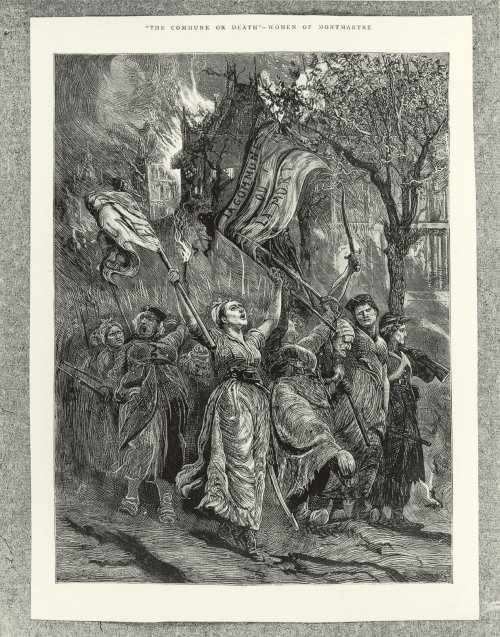

(3) Gathering around disaster sites: Alfred Edward Emslie, A Colliery Explosion: Volunteers to the Rescue [Illustrated London News, February 25, 1882]; Daniel Urrabieta Vierge, La Catastrophe de la Houillère de Framières (Disaster at the Framieres Coal-mine) [L'Illustration, May 3, 1879]; Jacques Victor Eugène Froment after Alfred Philippe Roll, Grève de Mineurs (Miner's Strike) [L'Illustration, October 19, 1881] [JLB 272, 10/15/1882]; and Charles Joseph Staniland, The Two Widows, [Graphic on July 31, 1880];

(4) Working together in fields: William Bazett Murray, Market Gardening -- A Winter's Journey to Covent Garden [Graphic, February 12, 1876]; Percy Macquoid, The Mackerel Fishery -- Sketches in a Devonshire Village [Graphic, May 9, 1874]; William Small, An English Ploughing Match [Graphic, March 13, 1875];
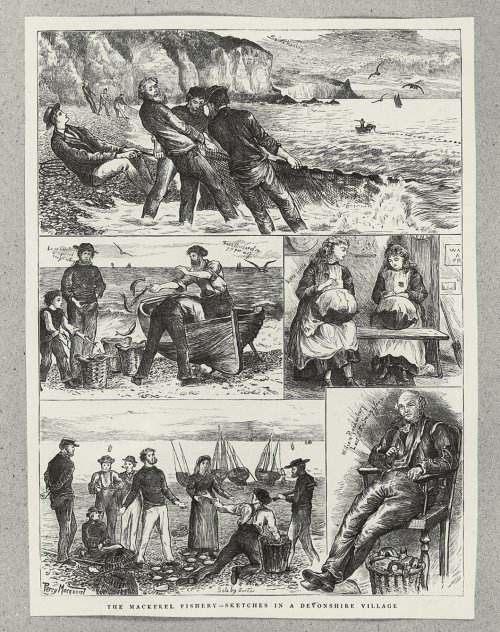
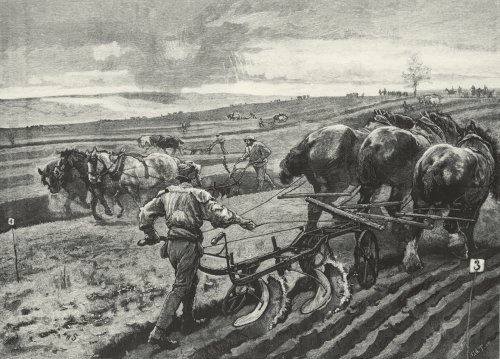
(5) In marketplaces: Boyd Houghton, Shaker Evans [Graphic, August 26, 1871]; James Dromgole Linton, London Sketches -- Curds and Whey in St. James's [Graphic, June 14, 1873]; Charles Green, A Sunday Afternoon in a Gin Palace [Graphic, February 8, 1879]; Small, A Festive Dinner at the Seaman's Hospital [Graphic, February 13, 1875]; the same artist's Sunday Afternoon in St. Giles -- Tea at the Working men's Christian Institute [Graphic, January 13, 1872];

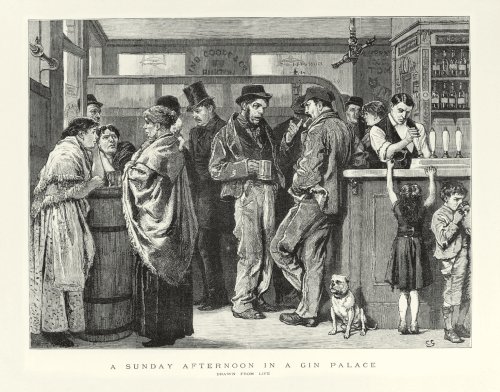
(6) Working in mines: M. W. Ridley, Pitmen Hewing the Coal [Graphic, January 28, 1871]; The Night Shift, [Graphic, February 4, 1871]; Félix Elie Régamey, The Diamond Diggings, South Africa, (a double-page) [Illustrated London News, August 31, 1872] [JLB 359, 7/3/1883; JLB 360, 7/7/1883.
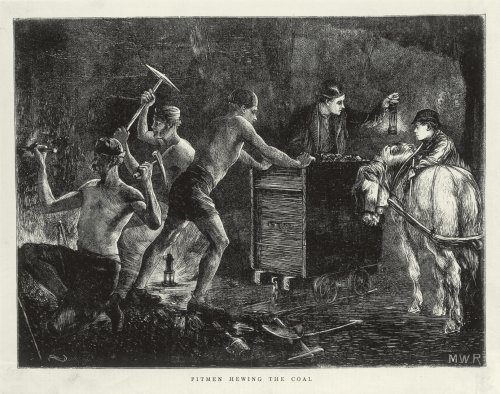
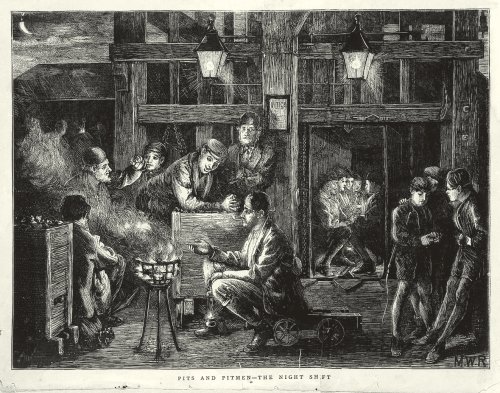
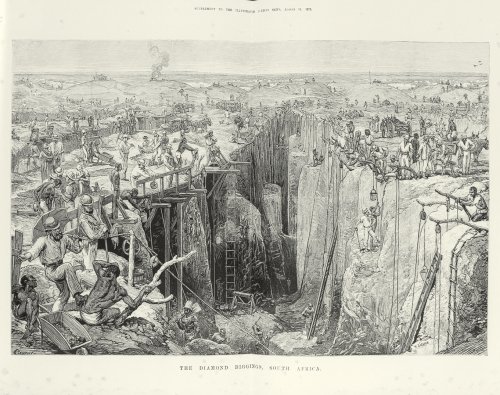
Factories and factory workers make a relatively late appearance in Vincent's print collection. By this time, he probably had William Bazett Murray's L'Industrie du Jute -- Le Tissage des Nattes en Angleterre (Illustrated London News, May 28, 1881); and Frank Holl's Shoemaking at the Philanthropic Society's Farm School at Redhill (Graphic, May 18, 1872), but other, similar images, such as Emslie's At Work in a Woolen Factory (Illustrated London News, August 25, 1883) and Charles Paul Renouard's La Crise Industrielle.

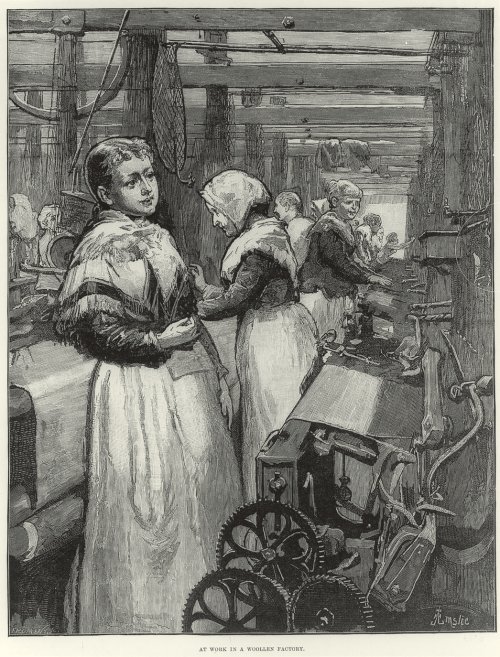
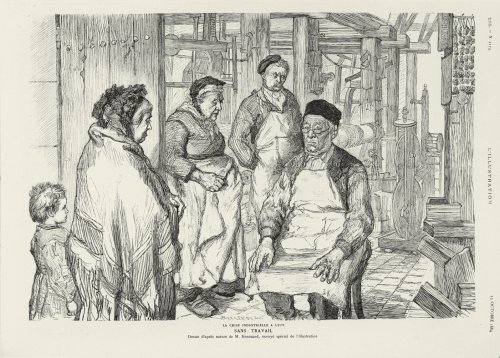
Context:
BVG 231, 9/17/1882: "For the group of figures in the enclosed sketch varies infinitely and requires innumerable separate studies and sketches of each figure, which one must catch quickly in the street."
JLB 264, 9/17/1882: "Because the group of folk in the accompanying scratch has endless variations and requires countless separate studies and scratches of individual figures which one must catch on the street as if on the wing."
Context:
JLB 259, 8/26/1882: "I've painted some figure studies -- I'm sending you two scratches."
By early September, Vincent seems to have launched a low-level campaign to convince Theo that he should retreat from both painting and color. The campaign features the book on the illustrator Gavarni (JLB 260, 9/3/1882) and passages like this, comparing the "tempered light" of color paintings with the dramatic light of black-and-white drawings: "Sometimes there's a gentle melancholy in the falling leaves, in the tempered light, in the haziness of things, in the elegance of the slender trunks. Then, I like the more robust, rougher side just as much -- the strong light effects, for example on a digger sweating in the midday sun." (JLB 261, 9/9/1882.) In the same letter, Vincent includes a catalogue of illustrators and draftsmen (Lançon, Renouard, [James] Mahoney) clearly designed to deflect Theo's pressure for color and landscape. He also argues that painting will improve his drawing -- shifting his ultimate ambition back to its roots. Another indication of his resurgent obsession with drawing is his extensive report on an exhibition of drawings at Gothic Hall in mid-September (JLB 265, 9/17/1882-9/18/1882). In a letter to Van Rappard almost on the same day, he is more direct in his re-embrace of drawing ("It's so silly that this lack of appreciation of drawing is so widespread these days"), and his repudiation of painting (at least watercolor): "I would rather be a waiter in a hotel, for example, than the sort of watercolour manufacturer some Italians are" (JLB 267, 9/19/1882).
BVG 241, 11/2/1882-11/3/1882. Vincent reports that "a study that's of some use requires at least half an hour, say" (JLB 280, 11/5/1882). He also reports working from sunrise to sundown. Undoubtedly, the number varied from day to day. At the end of October, he reports to Theo that he has counted "the studies from the model done since about the time of your visit [in August]," and found "about one hundred." (JLB 277, 10/29/1882.) This would suggest a much slower rate than a dozen a day. However, the count refers only to the drawings Vincent is prepared to show Theo on his next visit (ibid.). If one accepts Vincent's most conservative estimate of the percentage of his studies that were failures (ninety-percent) (See Ch. 18, n. 285), and assumes he is not including these in his "hundred," then the rate of a dozen a day is supportable.
Context:
JLB 280, 11/5/1882: "I try to work quickly, because otherwise it just doesn't pan out, but a study that's of some use requires at least half an hour, say, so one always comes back to actual posing."
Yet, in typical fashion, he begins laying the groundwork for a retreat from painting almost as soon as he begins painting. In mid-August, he offers an elaborate explanation for why he may not be able to satisfy Theo's expectations of progress in painting: "I know so many sad stories of people who threw themselves into it unprepared -- they concentrated on method and woke up disillusioned, without having made any progress, and got deep into debt because of the expensive things they botched. From the start I felt a fear and horror of that -- I regarded and still regard drawing as the only way of avoiding the same fate. And drawing has become dear to my heart, rather than being a burden." (JLB 259, 8/26/1882.)
Torn between managing Theo's expectations and reassuring him, Vincent follows this cautionary note with yet another expression of enthusiasm: "Now, though, almost unexpectedly, painting has given me lots of room, enables me to tackle effects that used to be out of reach, especially those I find, after all, most appealing, and it gives me so much more insight into many issues and new means of expressing effects, so that all this makes me deeply happy" (ibid.). Even as late as October 1, after the failure of his watercolor crowd scenes and his return to full-time drawing, he is still maintaining what has, by now, become an elaborate fiction. After listing a number of possible subjects, he insists, "And that's where painting or watercolouring comes in. Well, I'm toiling away at it." (JLB 270, 10/1/1882.)
According to the best available dating of the surviving works, Vincent is thought to have done only two watercolors after the end of September, Woman Miners (F 994 JH 253) and Woman with Shawl, Umbrella and Basket (F 934 JH 255). Three other watercolors -- Miners in the Snow: Winter (F 1202 JH 229), Orchard in Bloosom with Two Figures: Spring (F 1245 JH 230), and Potato Market (F 1091 JH 252) -- may have been done in early October. However, these works, like almost all of Vincent's watercolors, use primarily opaque watercolor, not transparent watercolor, and therefore can hardly be taken as indications of a continuing commitment to master the medium. More likely, Vincent did them primarily to ward off Theo's pressure to make saleable, colorful images, even as he vigorously pursued his black-and-white ambitions. Vincent enclosed several of these images in letters to Theo. A similar motivation may lie behind Vincent's repeated assurances to Theo of continued work in watercolor, as when he writes in late October: "Still -- you remember that not long ago I wrote (when I sent you a small scratch of a potato market): 'I must have another go at tackling that bustle on the street.' The result is now some 12 watercolours that I'm working on at the moment." (JLB 277, 10/29/1882.)
Context:
JLB 318, 2/20/1883 or 2/21/1883: "As you know, I already had something in front of the windows, namely canvas stretched on laths."
Context: JLB 23, 6/16/1874: "There are beautiful things at the Royal Academy this year; among others Tissot has 3 paintings."
BVG 235, 10/1/1882. The reference is to Church Pew with Worshippers (F 967 JH 225). It is our inference that, while at the church, Vincent recruited models.
Context:
JLB 270, 10/1/1882: "I'm also working on [a watercolor] of a church pew that I saw in a small church in the Geest district where the almsmen go (they're known here very expressively as ORPHAN men and orphan women)" (emphasis in original).
Context:
JLB 272, 10/15/1882: "This week I've drawn some large heads and some figures of children as well as orphan men."
Context:
JLB 270, 10/1/1882: "He has an interesting bald head -- big ears (NB. Deaf) and white sideboards" (emphasis in original).
The uniform can be seen in Old Man in a Tail-coat (F 960 JH 241), Old Man in a Tail-coat (F 977 JH 243), and Orphan Man, Standing (F None JH 271) (coat only). According to Soth, "the Home required them to wear" a top hat "and either a long overcoat with wide lapels and a double row of buttons or a similar, shorter jacket with tails" (Soth, p. 67). This is probably the uniform Vincent refers to when he writes Theo: "I believe you might perhaps enjoy this collection of orphan men in their Sunday and working clothes" (JLB 270, 10/1/1882).
Van Heuten, quoting Visser, p. 131: Visser reports that the "metal cross" that Zuyderland is wearing in drawings like Orphan Man Holding Top Hat in His Hand (F 973 JH 236), Orphan Man with Top Hat and Umbrella Looking at his Watch (F 978 JH 238), Old Man in a Tail-coat (F 977 JH 243) and Old Man Drinking Coffee (F 1682 JH 263) was awarded to the veterans of the War of Belgian Independence in 1830–31.
Context:
JLB 270, 10/1/1882: "I worked with him until it got dark."
Context:
JLB 272, 10/15/1882: "I like to give them half a guilder for an afternoon or morning, because that's just what I need."
Orphan Man, Wearing a Blouse, Sitting with Pipe, F 1046 JH 282, December 1882, pencil, 18.5 by 10.2 in., 47 by 26 cm., Private collection.
Orphan Man with Cap, Eating, F 956a JH 210, 1882, pencil, 20 by 10.8 in., 51 by 27.5 cm., Location unknown.
Old Man Reading, F 966 JH 280, September-December 1882, pencil, washed, 19.3 by 11.2 in., 49 by 28.5 cm., Amsterdam, Van Gogh Museum.
Man and Woman Seen from the Back, F 991 JH 233, September-December 1882, pencil, 19.7 by 12.2 in., 50 by 31 cm., Amsterdam, Van Gogh Museum.
Digger, F 908 JH 258, November, 1882, pencil, ink, 18.7 by 11.6 in., 47.5 by 29.5 cm., Amsterdam, Van Gogh Museum: This identification is not recognized by Hulsker, but we believe Zuyderland's distinctive muttonchops can be just made out. And Vincent himself reports doing "a drawing of a digger -- I took as my model the orphan man you're familiar with -- a bald head bent forward over the black earth -- it seemed to me to have a certain significance, making one think of 'in the sweat of thy face shalt thou eat bread,' for instance" (JLB 333, 3/29/1883 and 4/1/1883). The model in Digger is not bareheaded, however.
Prayer Before the Meal, F 1002 JH 281, c. 12-18 December 1882, pencil, black chalk, ink, heightened with white, 23.6 by 19.7 in., 60 by 50 cm., Private collection. Vincent describes this drawing as "a man saying his prayers before his midday meal, which is on the table" (JLB 294, 12/13/1882-12/18/1882). Referring to it as the "benedicité," he considers it "the best" of the drawings mentioned in the letter (ibid.).
The Sower, The, F 852 JH 275, early December 1882, pencil, brush, China ink, 24 by 15.7 in., 61 by 40 cm., Amsterdam, P. and N. de Boer Foundation. Probably also Two Sowers (F 853 JH 274), Sower (F 1000 JH 276), and Sower (F 999 JH 277).
Context:
JLB 215, 4/6/1882: "A little drawing like the enclosed is simple enough in line, but it's difficult enough to capture those simple, characteristic lines when one is sitting in front of the model. Those lines are now so simple that one can outline them with the pen, but I repeat, the problem is finding those broad outlines, so that one can say what's essential with a couple of strokes or scratches. Choosing the lines in such a way that it's obvious, as it were, that they must run thus, that's something that isn't obvious, however." (Emphasis in original.)
Context:
JLB 207, 3/3/1882: " … for a drawing with 3 seamstresses, for example, one must draw at least 90 seamstresses. That's how it works." (Emphasis in original.)
Context:
JLB 280, 11/5/1882: "I try to work quickly, because otherwise it just doesn't pan out, but a study that's of some use requires at least half an hour, say, so one always comes back to actual posing. ... I've occasionally had a boy or a man stand still for a moment, as they say, on the beach. The outcome was always a great desire on my part for a longer pose, and standing still for a moment isn't enough for me, neither for a person nor for a horse." (Emphasis in original.)
Context:
JLB 250, 7/23/1882: "She posed for my very best drawing, Sorrow [F 1655 JH 259], at least I think it's the best thing I've done."
Context:
BVG R14, 9/22/1882 or 9/23/1882: "I am very busy working on drawings of an orphan-man, as these poor old fellows from the workhouse are popularly called here."
JLB 268, 9/23/1882: "I'm very busy with drawings of an orphan man, as the almsmen are usually called here" (emphasis in original).
Context:
JLB 278, 11/1/1882: "In a letter from Van Rappard I received an extract from a lecture by Herkomer on the subject of the wood engravings of recent times. I can't tell you about the whole thing in detail, you may have read the article yourself (which was in an English art magazine, perhaps the Art Journal)" (emphasis in original).
Context:
JLB 278, 11/1/1882: " Herkomer relates how he himself worked on them with great ambition and enthusiasm, and he particularly recalls the splendid prints in the first volumes" (emphasis in original).
Context:
BVG 240, 11/1/1882: "But then those energetic words of Herkomer's, urging the public not to flag and saying that it is more necessary than ever to keep the hand to the plough, comforted me so, and I thought I would give you a short summary of what he said."
JLB 278, 11/1/1882: "... but then Herkomer's forceful words calling on people not to weaken and saying that it's more necessary than ever to keep the hand to the plough did me so much good and I thought I'd briefly tell you the substance of what he said."
Context:
JLB 278, 11/1/1882: "I [meaning Herkomer] see a decadence if I think back to when The Graphic began."
Context:
JLB 278, 11/1/1882: "Then [Herkomer] talks about the present day, and that brings him to the real subject of his lecture. He says: the wood engravers are cleverer than ever, but nonetheless I [meaning Herkomer] see a decadence if I think back to when The Graphic began. And -- he goes on -- in my view the reason lies in two things against which I protest. One has to do with the publishers, the other with the artists. ... Both have their faults, which will ruin things if one doesn't combat them."
Whether in lockstep with Von Herkomer or having formed his own opinion, Vincent echoes his hero's disdainful attitude toward Impressionism a few weeks later in commenting on the painter in Zola's Le ventre de Paris, Claude Lantier. "One would like to see Zola doing a kind of painter different from Lantier for once, who it seems to me is drawn from life by Zola after someone or other, and certainly not the worst, from the movement that was known as Impressionists, I believe. And they aren't the ones who make up the core of the body of artists." (JLB 288, 11/26/1882-11/27/1882; emphasis in original.)
Context:
BVG 240, 11/1/1882: "The whole thing is thoroughly sound, strong, honest."
JLB 278, 11/1/1882: "The whole thing is thoroughly sound, firm, honest."
Context:
BVG 240, 11/1/1882: "To me it is an inspiration, and it does my heart good to hear someone talk this way."JLB 278, 11/1/1882: quot; It gives me encouragement, and it truly does me good to hear someone talk like that for once."
Context:
JLB 280, 11/5/1882: "I repeat: by this shall ye know them, by their work, and it won't be the most eloquent who say the truest things. See Millet himself, see Von Herkomer, they're certainly not orators, and speak almost reluctantly."
Context:
BVG R25, 2/9/1883: "A collection of sheets like these becomes, in my opinion, a kind of Bible to an artist, in which he reads from time to time to get in a devotional mood."
JLB 311, 2/10/1883: "In my view prints like these together form a kind of Bible for an artist, in which he reads now and again to get into a mood."
Context:
JLB 280, 11/5/1882: "That -- namely, talking -- isn't what one needs to do -- one must work, though with sorrow in the heart. Those who later cry out the loudest about decadence will themselves belong to it the most."
Context:
JLB 312, 2/11/1883: "In 50 years from now people won't, I think, wish they were back in this period. For if it's followed by a 'periwig age,' people will be too drowsy to think about it at all." (Emphasis in original.)
Context:
BVG 319, 9/4/1883: "The thought crossed my mind, how at moments when today's deteriorating society is society seen against the light of a renewal, it stands out as a large, gloomy silhouette."
JLB 381, 7/5/1883: "It made me think for a moment of society today, how as it founders it now often appears like a large, sombre silhouette viewed against the light of reform."
Context:
JLB 293, 12/11/1882: "I begin to see ever more clearly that the illustrated magazines go along with the superficial stream, and I believe that they aren't concerned with being as good as their duty dictates."
Context:
JLB 312, 2/11/1883: "I don't think it absurd to consider it possible that there may again be a kind of periwig age in the future, for after all what's known as the periwig age in Dutch history had its origins in the abandonment of principles and the replacement of the original by the conventional."
Context:
BVG 252, 12/11/1882: "But how hard-hearted they are, how mistaken they are, if they think they can make everybody believe that material grandeur outweighs moral grandeur, and that any good can be accomplished without the latter."
JLB 293, 12/11/1882: "How hard-hearted they are, how mistaken, though, if they think they can fool everyone into believing that material greatness is of equal weight as moral greatness, and that without the latter anything good can be done."
Context:
BVG 252, 12/11/1882: "But how hard-hearted they are, how mistaken they are, if they think they can make everybody believe that material grandeur outweighs moral grandeur, and that any good can be accomplished without the latter."
JLB 293, 12/11/1882: "How hard-hearted they are, how mistaken, though, if they think they can fool everyone into believing that material greatness is of equal weight as moral greatness, and that without the latter anything good can be done."
Context:
JLB 300, 1/10/1883: "That kind of thing makes me so enthusiastic and thus cheers me up, because I imagine models from here as they'd appear if they were drawn in that way, and then naturally I say to myself, onward! and keep on working until we've got the hang of the Black-and-White" (emphasis in original).
BVG 238, 10/10/1882: How many of these potential models showed up and stayed is unclear, since this is a prospective statement. But if Vincent followed through on his plan to "give them half a guilder for an afternoon or morning," then he probably had some takers (JLB 272, 10/15/1882). A few surviving drawings from the period show men, apparently not Zuyderland, carrying carpenter's tools (Carpenter [F 1043 JH 206), Carpenter, Seen from the Back, [F 1042 JH 207), and A Carpenter with Apron [F 1044 JH 208]). In addition, there are some drawings of younger men that do not show specific attributes (Boy with Cap and Clogs [F 1681 JH 202], Boy with Spade [F 986 JH 231], Young Man with a Broom [F 979a JH 257], Digger [F 1656 JH 262], Workman Sitting on a Basket, Cutting Bread [F 1663 JH 272], Young Man, Sitting with a Cup in his Hand, Half-Length [F 964b JH 345]).
Context:
JLB 272, 10/15/1882: "The boss of the yard has promised to send me the labourers who come to ask for work, as regularly happens now and then in the slack time."
We suspect these horse drawings were the thematic predecessor to Worn Out (F 997 JH 267), the drawing of an old man despairing with his head in his hands that Vincent did in November 1882. Vincent had expressed more than once how much the sight of these old work horses moved him. He found their resignation in the face of endless toil and certain death a perfect metaphor for the human condition. This was probably the deeper meaning, the "sentiment," that he hoped to capture in this unlikely series of horse drawings. Clearly, that ambition was beyond his limited technical abilities at the time, as the surviving image from the series (Old Nag [F 1032 JH 368]) shows. However, it was exactly the same deeper significance that he took up again in Worn Out (F 997 JH 267), only using a different, less metaphorical image.
Context:
JLB 280, 11/5/1882: "One can't do everything at once, but it will be absolutely necessary for me to do a number of horse studies."
Context:
BVG 235, 10/1/1882: "What you would notice at once, as I do, is that I need a lot of figure studies; therefore I am working with all my strength and have a model almost every day."
JLB 270, 10/1/1882: "Like me, you would also see immediately that I need a mass of figure studies. I'm putting all my efforts into that, and working almost every day with a model." (Emphasis in original.)
Context:
BVG 241, 11/2/1882-11/3/1882: "… the more one makes the more one wants to make."JLB 280, 11/5/1882: "… the more one makes, the more one realizes one needs."
However, to the extent that the sources for any artist's imagery can be identified or ranked, we believe there are two sources in this case, one of which has been generally overlooked and the other patently obvious. The overlooked one is the influence of Van Rappard, who, in August, returned from Drenthe with portrait heads of peasants (see Bouwer, cat. # 78 and 79, p. 77), then went on to draw the blank-eyed patients at the institute for the blind in Utrecht, likewise inspired by Von Herkomer. (See Bouwer, cat. # 83, 84, p. 79.) Van Rappard sent Vincent the article by Von Herkomer in late October (or a summary thereof), three months after it appeared in The Art Journal, and Vincent clearly had not seen it. This clearly indicates that Van Rappard's interest in Von Herkomer in particular, and even the English illustrators in general, whether or not it led Vincent's enthusiasm, certainly did not follow it. The other source is the obvious one: Von Herkomer's contributions to The Graphic's "Heads of the People" series. Not only did Vincent have these images in his collection (JLB 235, 6/3/1882) and expressed deep admiration for Von Herkomer's work, he also complimented Van Rappard's imitation of them (JLB 345, 5/21/1883). In December, he wrote Theo: " I will do my best for HEADS OF THE PEOPLE" (JLB 293, 12/11/1882; emphasis in original); and in January, he wrote Van Rappard: "What I've been toiling at in particular lately is heads -- Heads of the people" (JLB 302, 1/18/1883; emphasis in original). As Soth points out, Vincent even uses the English phrase "Heads of the People" when writing about his portrait heads (Soth, p. 67).
Context:
JLB 235, 6/3/1882: " Heads of the people by Herkomer, supplemented with drawings by others and by portraits."
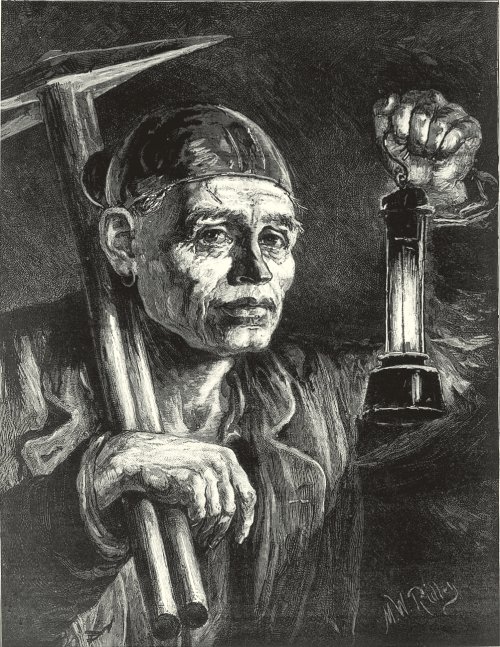
Context:
JLB 272, 10/15/1882: "This week I've drawn some large heads and some figures of children as well as orphan men."
Context:
JLB 301, 1/13/1883: "Tomorrow I'll be getting a sou'wester for the heads. Heads of fishermen, old and young, that's what I've been thinking about for a long time and I had already done one, but then later I couldn't get hold of a sou'wester again. Now I'm going to have one of my own, an old one that many gales and seas have swept over." (Emphasis in original.)
Context:
BVG 257, 1/3/1883: "There is something of life itself in the real studies, and the person who makes them will not think of himself, but of nature, and so prefer the study to what he may perhaps make of it later -- unless something quite different should finally result from the many studies, namely the type distilled from many individuals."
JLB 298, 1/3/1883: "True studies have something of life itself, and the person who makes them will respect not himself but nature in them, and hence prefer the study to what he may make of it later. Unless something entirely different arises from it as the final outcome of many studies, namely the type distilled from many individuals." (Emphasis in original.)
Context:
JLB 280, 11/5/1882: "Do you know who I drew this morning? Blok the Jewish bookseller, not David but the short one who's on the Binnenhof."
Peasant Sitting by the Fireplace ("Worn Out") (F 863 JH 34), on which Vincent wrote the title "Worn out." Van Heugten proposes the existence of at least two versions of this image because of, inter alia, differences between this one and the color sketch that Vincent drew in JLB 172 (September 1881) (Peasant Sitting by the Fireplace ("Worn Out") [F 150 JH 35]) (Van Heugten, p. 160). At this time, Vincent recalled that "once," a man named Cornelis "Schuitemaker" had posed for the drawing (JLB 286, 11/24/1882). Stokvis identifies this "old workman" as a Protestant resident of the town of 't Heike (Sint Willebrord), near Etten (Stokvis, p. 23). Van Heugten identifies the same sitter in a number of drawings from 1881 (Van Heugten, p. 33).
Context:
BVG 242, 11/5/1882: "By the way, it took a long time before I could admire Thomas Faed's work, but now I do not hesitate about it any more; for instance, "Sunday in the Backwoods of Canada, Home and the Homeless," "Worn Out, " "The Poor Man's Friend" -- in short, you know the series published by [Henry] Graves."
JLB 292, 12/10/1882: "By the way, it took a long time before I found Thomas Faed's work beautiful, but these days I don't hesitate about it any more, for instance, the Sunday in the backwoods of Canada -- Home and the homeless -- Worn out -- The poor, the poor man's friend, anyway, you know the series of aquatints published by Graves."
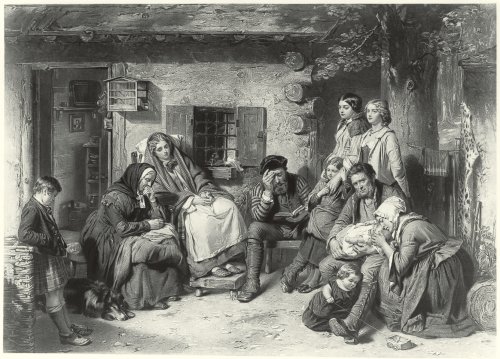
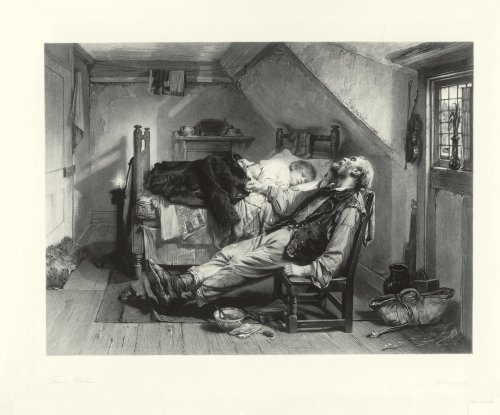
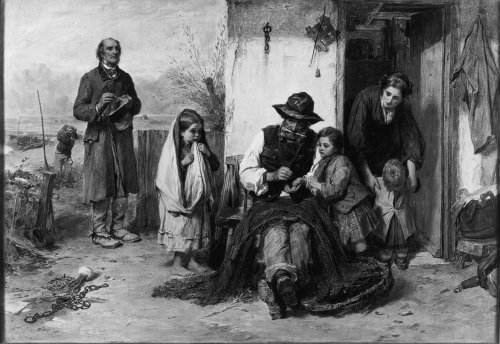
There are some minor differences between Worn Out (F 997 JH 267) and its predecessor, Peasant Sitting by the Fireplace ("Worn Out" ) (F 863 JH 34). The figure has been rotated ninety degrees counterclockwise in relation to the back wall. The half-clenched hands have been moved from the sides of the head to front, which means that the face (which was completely hidden in the earlier side view of Peasant Sitting by the Fireplace ("Worn Out") [F 863 JH 34]) continues to be hidden from view. This may be because Vincent preferred this kind of broken, submissive posture as a general rule (see Chapter 15), or for the more practical reason that the position relieved him of the need to render the face. Or both.
Context:
BVG 248, 11/26/1882-11/27/1882: "In this print I have tried to express ... what seems to me one of the strongest proofs of the existence of "quelque chose là-haut" [something on high] in which Millet believed, namely, the existence of God and eternity -- certainly in the infinitely touching expression of such a little old man, of which he himself is perhaps unconscious, when he is sitting quietly in his corner by the fire."
JLB 288, 11/26/1882-11/27/1882: " I was trying to say this in this print -- but I can't say it as beautifully, as strikingly as reality, of which this is only a dim reflection seen in a dark mirror -- that it seems to me that one of the strongest pieces of evidence for the existence of 'something on high' in which Millet believed, namely in the existence of a God and an eternity, is the unutterably moving quality that there can be in the expression of an old man like that, without his being aware of it perhaps, as he sits so quietly in the corner of his hearth."
Context:
BVG 248, 11/26/1882-11/27/1882: "In this print I have tried to express ... what seems to me one of the strongest proofs of the existence of "quelque chose là-haut" [something on high] in which Millet believed, namely, the existence of God and eternity -- certainly in the infinitely touching expression of such a little old man, of which he himself is perhaps unconscious, when he is sitting quietly in his corner by the fire. At the same time there is something noble, something great that cannot be destined for the worms."
JLB 288, 11/26/1882-11/27/1882: "I was trying to say this in this print -- but I can't say it as beautifully, as strikingly as reality, of which this is only a dim reflection seen in a dark mirror -- that it seems to me that one of the strongest pieces of evidence for the existence of 'something on high' in which Millet believed, namely in the existence of a God and an eternity, is the unutterably moving quality that there can be in the expression of an old man like that, without his being aware of it perhaps, as he sits so quietly in the corner of his hearth. At the same time something precious, something noble, that can't be meant for the worms."
Von Herkomer, p. 168. (See Ch. 18, n. 345.)
Context:
JLB 279, 11/1/1882: " Pleasing, Saleable are horrible words to me. And I've never met a dealer who wasn't steeped in that, and it's a plague." (Emphasis in original.)
Context:
JLB 289, 12/1/1882: "This matter, which not long ago was no more than a few words from you, namely 'I've spoken to Buhot, who knows of a certain way of lithographing, of which more later, you ought to try something on paper that he'll send you,' has in a short time taken on the proportions of a more important matter for me from this initially rather insignificant start."
Context:
JLB 221, 4/26/1882: "I was turned down by various lithographers in Brussels: there wasn't any work, there was nothing doing, that's what they said."
Obviously recognizing the extent to which the Swallow's failure undermined his argument for rallying Dutch artists to the cause of the English illustrators, Vincent took up the issue again only a few weeks later, this time in a more conciliatory, guiltier tone: "There's a popular magazine here called De Zwaluw which is published by Elsevier Rotterdam supported by the Society for General Welfare. I've sometimes wondered in recent days whether they could use a digger like that, for example. 1 print a month. But it would cost me a trip to Rotterdam, and I'm so afraid of coming back with the message: Things are too slack, we're not taking anything &c. Moreover, I would prefer not to do this, since I would much rather work longer until a substantial series is possible." (JLB 285, 11/22/1882.)
Context:
BVG 241, 11/2/1882 or 11/3/1882: " If this is so, be so kind then as to give me all information you can pick up about the way in which one has to work on this paper, and try to get me some of it, so that I can give it a trial."
JLB 280, 11/5/1882: " If this is the case, be so good as to give me all the information you can find about how one should work on this paper, and do your best to send me some of it on which I can do some trials."
Context:
JLB 281, 11/7/1882: "While waiting for further information about the process, I've made a lithograph with the help of Smulders's printer, and I have the pleasure of sending you the very first impression herewith. I drew this lithograph on a piece of prepared paper, probably the same type that Buhot [a paper dealer in Paris] told you about. ... I wrote to you how I came to make this one, didn't I? -- it was after I told Smulders what you had written about that paper, and he said that he had some left."
Context:
JLB 281, 11/7/1882: "He seemed rather surprised that I came back with the drawing a few hours after I had bought some from him."
Context:
JLB 281, 11/7/1882: "He seemed rather surprised that I came back with the drawing a few hours after I had bought some from him."
Context:
JLB 281, 11/7/1882: "As you see, I've scrawled this print as simply as possible -- I'll be content if there's anything in it that brings to mind the old lithographs from the time when there was more zest in this branch of art than now."
Context:
JLB 281, 11/7/1882: "I would dearly like to make more. For example, a series of some thirty figures."
Context:
BVG 243, 11/6/1882-11/8/1882: "But this is what I should like: if we could show, without a third party's intermediary, a series of about thirty pages, not too elaborate, but vigorously done, which we had got printed at our own expense."
JLB 281, 11/7/1882: "But I think it would be bold if, without involving anyone else, we could show a series of some thirty prints -- not laboured but vigorous -- that we'd had printed at our own expense" (emphasis in original).
Context:
JLB 283, 11/16/1882 or 11/17/1882: "I'm going to go and talk to Smulders tomorrow to get the stones from him. I must tell you that I would find it extremely pleasing if I could get around to making a large series sometime."
Context:
JLB 292, 12/10/1882: "Thus in addition I've again made a few drawings for them, a woman with a sack of coal on her head with a yard in the background, a silhouette of roofs and chimneys, and a woman at the wash-tub."
Context:
BVG 241, 11/2/1882 or 11/3/1882: "When I get the paper I shall anyhow have one of the figures to try out, but it must become a group of women, a small caravan."
JLB 280, 11/5/1882: "If I get the paper, I already have one of the figures, for example, to do as a trial. But it must become a little troop of women, a small caravan."
Context:
BVG 243, 11/6/1882-11/8/1882: "This would give us more prestige in the eyes of the people whom we shall need later, namely the editors of the magazines."
JLB 281, 11/7/1882: "... this would make us more credible to the people we'll have to approach later on, namely the managers of the magazines."
Context:
JLB 292, 12/10/1882: "From time to time I have a great longing to be in London again. I'd so very much like to know more about printing and drawing on wood."
Context:
BVG 240, 11/1/1882: "The only excuse that can be accepted is 'a shortage of good draughtsmen.'"
JLB 278, 11/1/1882: "The only excuse you may accept is 'dearth of good draughtsmen.'"
Context:
BVG 288, 6/3/1883: "Now, I don't think it's every day that the managers of magazines find somebody who considers making illustrations his specialty."
JLB 348, 6/3/1883: "Now I believe that it isn't every day that the managers of illustrated magazines find someone who regards those magazines as his special goal."
The vagueness of these comments, combined with the revelation of the full plan only days later, is a typical pattern for Vincent. He follows the same defensive playbook with Theo: laying the conceptual groundwork for his ideas before exposing them specifically, no doubt in the hope of neutralizing concerns in advance and setting the stage for a positive response. Given his attitude toward Van Rappard and his resurgent need for affirmation, it is not hard to imagine that the entire lithography book project was specifically designed to wrap Van Rappard more tightly into his life. In the same letter, he floats (vaguely again) the need for them to see each other's work and share opinions more often -- basically, a plea for another visit by Van Rappard to The Hague combined with a request for an invitation to visit Van Rappard in Utrecht.
Context:
JLB 276, 10/29/1882: "Just as I said above that I long to see your work, so in turn I very often long for you to see mine again. Precisely because you would be of value to me, I believe, and you would see the whole that the individual drawings are gradually beginning to form, and we could talk about them and discuss whether something could be got out of them."
This muddled rationale strikes us as not entirely credible. Vincent may have seen refusing Van Rappard's offer as an opportunity to demonstrate that Vincent's family was as supportive of his artistic ambitions as Van Rappard's was of his, or that Vincent was already earning money from his work (and therefore did not need his friend's money to put his plan into effect). Elsewhere, Vincent seems to represent to Van Rappard that he has had more success in finding work with magazines than is, in fact, the case: "This new process enables me to work for a lithographic printer far away without having to send stones" (JLB 287, 11/24/1882). Vincent also heavily implies to Van Rappard that the lost 50 francs was, in fact, payment from a patron, not Theo, for lithographic work (JLB 284, 11/18/1882).
It is also possible that Van Rappard never offered to fund the project; that Vincent invented the story to encourage Theo's participation (for the same reason he misled Theo about Van Rappard's approval of Sien). Van Rappard apparently did offer to lend Vincent 50 francs when Vincent reported the lost payment, but there is no indication that this was intended specifically as support for the lithographic project (ibid.). Vincent may have intended the reference to Van Rappard's offer of support as a threat, just as he threatened to borrow money from Tersteeg when he first arrived in The Hague. In both cases, Vincent may have been banking on Theo's fear that his borrowing money would embarrass the family, and that to avoid embarrassment, Theo would lend him the money he needed.
In a letter to Theo in early December, Vincent appears to exaggerate and mischaracterize Van Rappard's involvement in the project in multiple ways. "I've long been in touch with Rappard on the question of prints for the people, since both he and I attach importance to it, so that he himself, as I wrote to you, said to me of his own accord, I want to give you a helping hand" (JLB 289, 12/1/1882). In fact, as far as his surviving letters to Van Rappard show, Vincent has not yet discussed the plan for an "association" with Van Rappard (he does not do so until March 1883), which is clearly what Vincent means to imply, although he (apparently with some care) does not directly say it (JLB 332, 3/21/1883). (They have only discussed Vincent's "keenness" for lithography [JLB 284, 11/18/1882].) The only "helping hand" Van Rappard has offered is the replacement of the lost 50 francs, which appears to have been just general assistance. Vincent goes on to imply that the amount of money Van Rappard is prepared to lend to support the project is significant (by suggesting that he would take his friend's money only if he could get none from elsewhere); and that Van Rappard's only problem with the plan is the one about technique. There is no support for the former; and the latter, although perhaps true in itself, Vincent uses in such a way as to make it appear that it is the only point of disagreement between him and Van Rappard on the many points in the combination plan, which is untrue.
It is relevant to this issue that in March of the following year (1883) Vincent writes: "I know that you don't look on the Black-and-White in the way that most of the Dutch do, and while I don't know for sure whether you have plans to make use of this means yourself to express what you feel, I do believe that at any rate you have no prejudice about it." (JLB 307, 2/4/1883; emphasis added). In a later letter, Vincent answers some very basic questions about the lithographic process from Van Rappard (JLB 325, 3/5/1883). Clearly, Vincent's friend had only just begun to explore the process himself, suggesting he was never the partner in the lithographic project that Vincent clearly implied to Theo in October and November of 1882.
Context:
JLB 289, 12/1/1882: "Rappard doesn't, however, view the matter in the way that I would like him to: the thing is, he doesn't agree with me on questions of technique."
Context:
BVG 249, 12/1/1882: "This combination must try to operate as practically and well as possible, and should not disperse before the work is finished."
JLB 289, 12/1/1882: "This association not to be dissolved before the venture is completed, and endeavouring to carry it out as practically and as well as possible."
Context:
JLB 278, 11/1/1882: "If the painters were to close ranks to ensure that their work (which, after all, is made for the people, in my view -- at least I believe that is the highest, noblest vocation for any artist) could also come into the hands of the people and was put within everyone's reach, that would be something that would produce the same results as were produced in the first years of The Graphic."
Context:
JLB 289, 12/1/1882: "Now such an undertaking like making and printing a series of 30 with Working types, say -- sower, digger, woodcutter, ploughman, washerwoman, plus on occasion a cradle or orphan man, in short, the whole vast field lies open, there's an abundance of fine material -- an enterprise like that -- may one undertake it or may one not? It goes even deeper: is it a duty and just, or is it wrong? That is the question."
Context:
JLB 289, 12/1/1882: "It has always been said: in Holland we can't make magazines for the people. I've never been entirely able to believe this. I see now: it CAN be done."
Context:
BVG 249, 12/1/1882: "It ought to be a combination which acts, not deliberates, acts quickly and resolutely and without loss of time."
JLB 289, 12/1/1882: "It ought to be a combination which acts, not deliberates, acts quickly and resolutely and without loss of time."
Context:
BVG 250, 12/2/1882 or 12/3/1882: "I again witnessed the transferring to the stone and the printing and I must tell you that I think great things can be done with this process."
JLB 290, 12/3/1882: "Again I watched the transfer to stone and the printing carefully, and I must say that I believe a great deal can be done with this process."
Context:
BVG 249, 12/1/1882: "If I were a man of means, I shouldn't hesitate to decide, I should say, 'En avant et plus vite que ça.' [Quick march, and hurry up.]"
JLB 289, 12/1/1882: "If I were a man of means, I wouldn't hesitate to decide, I would say, Onward, and be quick about it."
Context:
JLB 289, 12/1/1882: "Given that it's useful and needful for Dutch drawings to be made, printed and circulated, intended for workers' dwellings, farmhouses, in a word, for every working man, several parties undertake to do their utmost, to exert their best efforts for this goal."
Context:
JLB 289, 12/1/1882: "The price of the prints is not to exceed 10 or at the most 15 cents. Publication shall begin when a series of 30 has been made and printed, and the costs involved (for stones, printing wages, paper) have been paid. These thirty prints will appear simultaneously, although available separately, together forming a set in linen cover with a short text, not to go with the prints -- which speak for themselves -- but to explain pithily how and for what purpose they were made &c."
Context:
JLB 289, 12/1/1882: "… the price of the sheets should not exceed 10, or at the most, 15 cents."
Context:
JLB 289, 12/1/1882: "The amount raised by sales will be used first to reimburse those who advanced money, second to give everyone who has supplied a drawing an amount to be determined later that is the same for each draughtsman. When these payments have been made, what remains will be used for new publications to carry on the work."
Context:
JLB 289, 12/1/1882: "And for my part I would wish everyone in the association to be completely equal -- with no regulations or president or this or that -- just a memorandum laying down the venture which, after it had been finally drawn up and signed by the entrepreneurs."
Context:
JLB 289, 12/1/1882: "Those who begin this venture regard it as a duty. Self-interest not being their aim, neither those who advance money nor draughtsmen nor those who participate in other ways may claim back what they have contributed in the event that the venture would founder before it was half way -- so the burden must be shared so that each gets the part that he can bear and so that the venture can be accomplished." (Emphasis in original.)
Context:
JLB 289, 12/1/1882: "In the latter case [success beyond all expectation] the surplus will be used to carry on the work."
In Theo's response to the book project, Vincent also seems to hear a deeper criticism that may have been just suggested (the brothers spoke in indirections) or may have lodged entirely in Vincent's guilty, defensive imagination: "In the illustrated magazines they undergo something like the small tower in the distance that looks very small and insignificant, and when one gets up close proves to be an imposing mass (I mean, only a small part of their work is made public)" (ibid.). Vincent appears to be rebutting an accusation that he doesn't have much to show for his two years as an artist. In responding to Vincent's prints, Theo may have implied that the paintings and watercolors that Vincent has abandoned were more substantial ("significant") than the drawings and lithographs. Such an implication would no doubt have inflamed Vincent. That appears to be the charge Vincent is responding to in this passage from the same letter: "Anyway, some paintings in their huge frames look very substantial, and later one is surprised when they actually leave behind such an empty and dissatisfied feeling. On the other hand, one overlooks many an unpretentious woodcut or lithograph or etching now and then, but comes back to it and becomes more and more attached to it with time, and senses something great in it." (ibid.)
Theo did give the project an initial nod of approval: "I'm really delighted that you took some pleasure in the first one I sent. Herewith you're receiving the very first impression of Sorrow." (JLB 283, 11/16/1882 or 11/17/1882; emphasis in original.) The first lithograph Vincent sent was Orphan Man (F 1658 JH 256), based on a drawing of the orphan man, Zuyderland (Old Man with a Stick [F 962 JH 212]). Multiple sources are increasingly vague on the issue of order of these prints. Vincent sent a second set of prints to Theo on November 11 (JLB 283, 11/16/1882 or 11/17/1882), and a third on November 22 with the obviously unanswered question: "I'd very much like to know as soon as possible what impression they make on you. I still plan to retouch them on the stone, and would like to have your opinion for that." (JLB 285, 11/22/1882.) A letter arrived from Theo sometime before November 24, but Vincent makes no mention of any comment -- which he would certainly have done if Theo had written something positive (JLB 286, 11/24/1882). On December 1, he asks again for a letter -- primarily because the next installment of money is due, but a good sign that Theo has not written any comment yet (JLB 289, 12/1/1882).
The money arrives within the next few days, along with a roll of transfer paper, and it is probably in the accompanying letter that Theo offers his only concrete criticism of the prints: that they are too big -- but still no discernible reaction to Vincent's on-again, off-again proposal for publishing them: "What I wrote to you in my last letter about a plan for making prints for the people is something to which I hope you'll give some thought one day" (ibid.). A few days after that, Vincent almost angrily reminds his brother of his failure to respond: "You've received my letter in which I wrote …" (JLB 291, 12/4/1882-12/9/1882). The ominous silence forces Vincent into another round of argument and exhortation: "And that it's thus something that one can begin and pursue with serenity, something whose good outcome one also needn't doubt or despair of -- provided one doesn't weaken or lose heart" (ibid.). He even stoops to suggesting that both Van Rappard and Van Rappard's father support the project -- almost certainly a figment of his wishful imagination (JLB 291, 12/4/1882-12/9/1882).
There appears to be no reaction to the project at all until January of the following year (the brothers did not see each other at Christmas) when, referring to a pleasant New Year's letter from Theo, Vincent writes: "You speak too highly of me in your letter, but the fact that you think highly of me is an added reason for me to try not to be entirely unworthy of it" (JLB 298, 1/3/1883). However, Vincent goes on to make clear that they have had virtually no interaction in the meantime regarding Vincent's art or his ambitious project: "you've seen so little of my work recently, ... And as for my saying I believed I had made some progress through those experiments, it may be that I can't see my own work properly." (ibid.) Later in the same letter, he appears to have seriously scaled back his ambitions, pushed the lithography project into the indefinite future, and returned to drawing (using lithographic crayon) in yet another round of preparation: "I'm more eager to put together a serious work for reproduction than to have the satisfaction of seeing one drawing printed some day" (ibid.).
About some enclosed drawings, he writes in a quiet voice that contrasts dramatically with the ringing revolutionary rhetoric of only a month before: "This is only a beginning -- later you'll get fine things from me, old chap! For the time being, let me know whether you think some of the objections to using pencil alone could be removed somewhat by using crayon as well. Don't you also agree that by making these drawings I may also indirectly learn things about lithography proper?" (ibid.) The incredible tentativeness of this last sentence suggests just how unresponsive Theo has been.
It is hard to imagine that Theo was not distressed by Vincent's apparently cavalier attitude toward the considerable expenses incurred by the lithographic project, even assuming that he believed Vincent's story about one of Theo's 50-franc payments being lost in the mail (See Ch. 18, n. 397). After explaining that if the project failed, he could still use the drawings to secure a paying job or sell illustrations to a magazine, Vincent then adds as a casual afterthought: "But nothing is lost if they're not immediately accepted," and proceeds to make the argument that all the expensive effort will be a learning experience -- an argument Theo already rejected during his visit the previous August (JLB 281, 11/7/1882).
A few weeks later, there is another exchange that must have soured Theo on Vincent's latest dream of moving to the front of the line. Apparently in response to a question from Theo about possible illustration work in Holland, Vincent rejects out of hand the idea of selling one of his illustrations to The Swallow, the Dutch equivalent of The Graphic. Vincent first offers the lame excuse, "But it would cost me a trip to Rotterdam [where The Swallow was published]," then gives a further explanation that must have horrified Theo with its seeming disinterest in selling his work (or reluctance to risk failure): "Moreover, I would prefer not to do this, since I would much rather work longer until a substantial series is possible." (JLB 285, 11/22/1882.) Perhaps realizing the impact this comment might have, Vincent quickly adds a vague and unconvincing reaffirmation of his determination to support himself: "Yet I do consider it, because I'm sometimes desperate to earn a little extra" (ibid.). Unable to leave well enough alone, Vincent returns to the subject of The Swallow in a subsequent letter in a discussion that must have further discouraged Theo. In analyzing why the magazine was not successful, Vincent takes the publisher, Elsevier, to task for "self-interest" (i.e., trying to turn a profit) (JLB 289, 12/1/1882).
In addition to repeatedly lowering the very expectations that he was responsible for building up, he employed the usual array of devices to distance himself from potential blame (JLB 289, 12/1/1882). He strongly suggested that the project was, in fact, Theo's idea ("This matter, which not long ago was no more than a few words from you"), and therefore any blame for its failure would be, at least, shared (ibid.). Vincent also deployed his rhetorical skills: everything from double negatives that effectively immunized themselves from criticism: "I see that with persistence and perseverance [the book project] could become something which I believe could be absolutely not superfluous but decidedly good and useful" (how could Theo argue that Vincent's efforts were "superfluous"?), to elaborate praeteritio (paraleipsis). "Before I go any further, though, this -- I personally don't want to have any more to do with the business of prints for the people beyond the making of them, in the event that some such venture is started. It must be a matter of charity, not of bookshops. And as it will be necessary to have some contact with the bookshops, if only as regards printing and so on, I mention it to you now, not to ask you, 'do you think it will succeed?' from the bookshop's point of view, but just with the question How to do it? from the point of view that it would be out of love for the cause." (JLB 289, 12/1/1882; emphasis in original.)
Like Marc Anthony claiming that he had come to bury Caesar not to praise him, Vincent ostentatiously left the business end of the proposed enterprise to others and protested that he would be satisfied with the simple task of making the prints. But, of course, he did no such thing, providing not only a detailed blueprint for the enterprise, but ongoing advocacy and direction. Sometimes the contradiction was glaringly obvious. In early December, Vincent wrote defensively, "Since I wrote that to you, I've naturally thought not so much 'Who will do this or that?' as 'What shall I do for it?' on the grounds that I'm not responsible for the one [commercial aspects of the project], but I am for the latter [artistic aspects]" (JLB 291, 12/4/1882-12/9/1882). Then, in the very next sentence, he offered an earful of business advice: "But I can tell you this, ... there would be absolutely no need to resort to aping other popular publications, that on the contrary, the existence of similar magazines like British Workman, for instance, is a guide as to How to do it and How not to do it" (ibid.). Another example is this modest disavowal, which is either disingenuous or delusional, or some combination of the two: "Now it isn't at all my idea that what we might have printed should be exploited by me or you. I had and have not the slightest thought of that." (JLB 282, 11/14/1882.) (The reference to "exploited by me or you" is especially telling.) On other occasions, he made a show of putting control of the project in Theo's hands ("Is this worthwhile, do you think? I would dearly like to make more" or "But you see more clearly in business matters than I") -- but he neither expected nor awaited an answer before proceeding. (JLB 281, 11/7/1882.)
Vincent never shared the details of the expenses with Theo at the time, but his finances were in trouble even before he began "experimenting" with lithography. One week into November, he had apparently already spent the 50-franc payment Theo sent on October 30 and eagerly awaited the November 10 payment. "If at all possible, send no later than the tenth," he forewarned Theo, "for I've had extra expenses here for one thing and another" (JLB 281, 11/7/1882). He subsequently made several vague, despairing references to the cost of his experiments. When he reported on November 14 that the payment for November 10 was lost in the mail, he laments, "I have been literally without money for 5 or 6 days now, and so my work is stuck too, at least I can't work as I would like to" (JLB 282, 11/14/1882). Losing momentum on the lithography project continued to be his primary (expressed) concern: "I fear the 50 francs are down the drain, just when they're almost indispensable -- first, for making progress with the experiments in lithography" (JLB 283, 11/16/1882 or 11/17/1882). A week later, he underscored the point: "When your last letter arrived I had to pay so much immediately, because I had waited for it for so long, that little was left. All the same, I again did these two lithographic trials, even though there were costs involved, because I think work offers the most hope, especially in difficult times, and intend to fight to pull through." (JLB 285, 11/22/1882.) When he told Van Rappard about the lost money (without telling him it was from Theo, leaving the implication that it was payment for his lithographs), he similarly complained: "So now it's hard that I can't get on as well as would have been the case if the money hadn't been lost" (JLB 284, 11/18/1882).
Even though Theo replaced the money immediately (JLB 283, 11/16/1882 or 11/17/1882), Vincent reported being completely penniless again by the end of the month -- "I have nothing left" (JLB 289, 12/1/1882) -- and, as always, experienced terrible guilt over his humiliating dependence: "For many a painter this is something intolerable, or almost intolerable, at least. One wants to be an honest man, and one is, one works just as hard as a porter, and yet one falls short, one has to give the work up, one sees no chance of carrying it out without spending more on it than one will get back for it. One has a feeling of guilt, of falling short, of not keeping promises, one isn't honest as one would be if the work was paid for at its natural, fair price." (JLB 288, 11/26/1882-11/27/1882.) Despite such pangs of guilt, Vincent resisted the pressure to get a job with increasing steadfastness -- even though he had adamantly argued for the lithography project on the basis that it will help him secure a job. "Not doing anything else and devoting all one's time to the work, that's still preferable in my view" (JLB 290, 12/3/1882).
The possibility that Vincent deceived Theo about the loss of the 50 francs should at least be considered. Given Vincent's other deceptions of Theo, and the enormous demands on Vincent's limited funds from both the lithography project and (unmentioned in the letters) a large family ("one thing and another"), it is certainly not impossible (JLB 394, 10/12/1883). Starting in mid-November, phrases like "would that be dishonest, otherwise of course I wouldn't do it" (JLB 282, 11/14/1882), "One wants to be an honest man," (JLB 288, 11/26/1882-11/27/1882) and "one isn't honest" (ibid.) introduce a new vocabulary to Vincent's self-reproach and suggest a specific contrition. This, however, would have been crossing a line, which would account for this extraordinary outburst of guilt in JLB 288, 11/26/1882-11/27/1882. (It should be noted, however, that in addition to painful honesty, there is not a little purblind self-pity in this "confession," and Vincent accepted no specific blame -- he presented his predicament as the inevitable fate of an artist ["For many a painter ..."], not the foreseeable consequence of the choices he had made.)
In March of the following year (1883), in response to a question from Van Rappard, Vincent showed a shockingly laissez-faire regard for the mounting costs of the lithography project: "So for the present I know next to nothing about the actual prices" (JLB 325, 3/5/1883). He offered a cloud of excuses for his ignorance ("The prices I paid provisionally don't count since we had come to an arrangement, because the printer himself didn't know at that point -- and there were failures &c."); he promised belatedly to "get a quotation from Smulders"; and he went on at length about why Smulders has been too busy to give him information (ibid.). The combination of disregard and evasion on financial matters would, no doubt, have horrified Theo. We suspect that Vincent has, in fact, been running up his bill at Smulders ("there were failures") and doesn't really want to do the final figuring because that would require him to pay it. A passage in a letter in late November (to Van Rappard, of course) suggests the debt began mounting up early: "[The printer has] been good enough not to press me about the costs of the stones" (JLB 287, 11/24/1882).
So volatile was Vincent's confidence that he even went back and forth on the fundamental issue of whether or not there actually was a project, much less a commercially viable one. His desperate uncertainty is exposed early by the disappearance of the 50-franc payment from Theo that was due on November 10 (assuming that the payment was, indeed, lost, as Vincent reported to Theo on November 14 [See Ch. 18, n. 397]) (JLB 282, 11/14/1882). When the payment is only four days late, Vincent is overcome by a terror of anxiety that Theo has withheld the money because he disapproves of Vincent's idea for publishing his lithographs. In some of the most agitated prose of their entire correspondence, he frantically retreats from his original enthusiasm: "But on the other hand I'm always nervous when there's something like this, and can't help worrying, and am then afraid that perhaps I wrote or did something of which you disapprove. So last night I was fretting that perhaps you didn't approve of my having my lithograph printed, possibly drawing the conclusion from what I wrote that I intended to publish something, for instance." (JLB 282, 11/14/1882.)
The issue of "publication" becomes the idée fixe of Vincent's anxiety. In his previous letter, he wrote: "But I think it would be bold if, without involving anyone else, we could show a series of some thirty prints -- not laboured but vigorous -- that we'd had printed at our own expense, this would make us more credible to the people we'll have to approach later on, namely the managers of the magazines" (JLB 281, 11/7/1882; emphasis in original). Sitting in his apartment, penniless, imagining the possible offenses he might have given, Vincent focuses on this overreaching as the likeliest cause of Theo's presumed anger (JLB 282, 11/14/1882).
The result is an explosion of apology and back-pedaling "clarification." "Publications, are things I'd most certainly consult you about before undertaking them, and I have no thought of that for the present, and occupy myself, as you know incidentally, with my drawings and the artistic side of my work only. ... At one point Van Rappard experimented in the same way with etchings for instance, which he also had to have printed, but the printing an artist does isn't publishing something, and has nothing directly to do with trade, being strictly private. This seems to me as clear as daylight but, as I say, last night I was fretting that perhaps you might have seen it as a step of a very different nature, for I found it strange not to have a letter yet. ... Now it isn't at all my idea that what we might have printed should be exploited by me or you. I had and have not the slightest thought of that, ... be assured that there is nothing and for the present won't be anything more than the experiments that all those who etch or lithograph or reproduce their drawings in one way or another must carry out to learn about the processes and the strengths of black-and-white. ... a thing, would be purely artistic in character and has not the slightest relation to commercial publications. ... [That] would never have occurred to me." (JLB 282, 11/14/1882; emphasis added.) It is a sign of Vincent's resilience, or dissociation, or both, that less than a month after this abject, groveling retreat, he will rise like a phoenix from the ashes and present a grandly ambitious publication plan, backed by pages of details and argumentation (JLB 288, 11/26/1882-11/27/1882).
Context:
JLB 289, 12/1/1882: "So when it comes down to daring and self-sacrifice and venturing on something that doesn't have to be done for gain but because it's useful and good."
Context:
JLB 276, 10/29/1882: "That sort of thing leaves me absolutely cold."
Context:
JLB 283, 11/16/1882 or 11/17/1882: "Smulders's workmen from the other warehouse in the Laan saw the stone of the orphan man and asked the printer if they could have an impression to hang up. No result of my work would be more agreeable to me than that ordinary working men should hang such prints in their room or workplace."
Context:
BVG 245, 11/16/1882: "Of course a drawing must have artistic value, but in my opinion this doesn't prevent the man in the street from finding something in it."
JLB 283, 11/16/1882 or 11/17/1882: "Of course a drawing must have artistic value, but in my view this shouldn't rule out the possibility that ordinary passers-by may see something in it."
Context:
BVG 249, 12/1/1882: "As it is useful and necessary that Dutch drawings be made, printed and distributed which are destined for workmen's houses and for farms, in a word, for every working man, a number of persons should unite in order to use their full strength toward this end."
JLB 289, 12/1/1882: "Given that it's useful and needful for Dutch drawings to be made, printed and circulated, intended for workers' dwellings, farmhouses, in a word, for every working man, several parties undertake to do their utmost, to exert their best efforts for this goal."
Context:
JLB 293, 12/11/1882: "Renewing themselves -- [the magazines] never give it a thought. Suppose that The Graphic, L'Illustration, Vie Moderne published an issue containing feeble, insipid things. Nonetheless, umpteen cartloads and shiploads would be sold, the managers rub their hands and say, 'It sells just as well like this, no questions asked, they swallow it anyway.'"
Context:
JLB 287, 11/24/1882: "Still, one has to be careful once something has been put on, and can't control everything."
Context:
JLB 290, 12/3/1882: "This time the autographic ink ran badly and that had to be corrected later, but there were still black passages everywhere."
Context:
JLB 307, 2/4/1883: "When it was being transferred to the stone, the upper half came out all blotted and I could only partly correct it with the scraper."
Context:
JLB 297, 12/31/1882 and 1/2/1883: "When I made the lithographs, I was struck by the fact that the lithographic crayon was very pleasant to work with, and I thought of making drawings with it. It has one drawback, though, which you'll understand -- it's greasy, so one can't rub it out in the normal way. Working with it on paper, one mostly has to do without the only thing that one can use to erase on the stone itself, namely the scraper, which can't be used with enough force on the paper because it goes through it."
Context:
BVG 246, 11/22/1882: "The drawing was not done with lithographic crayon only, but was touched up with autographic ink."
JLB 285, 11/22/1882: "The drawing was done not only with lithographic crayon; the strengths were reinforced with autographic ink as well."
Context:
BVG R29, 2/27/1883: "What can you see from it? -- (1) what kind of paper it is; (2) on which side you must draw; (3) what kinds of things one can do on it -- but the autographic ink is treacherous."
JLB 321, 2/23/1883-2/26/1883: "What can you see from this? First what kind of paper it is, second on which side you should draw, third that you can use all kinds of things on it -- but the autographic ink isn't to be trusted ..."
Context:
JLB 321, 2/23/1883-2/26/1883: "What can you see from this? First what kind of paper it is, second on which side you should draw, third that you can use all kinds of things on it -- but the autographic ink isn't to be trusted, sometimes it works very well in transferring, sometimes it runs (for the drawing is wetted when it's laid face down on the grained stone and then pulled through the press until it's transferred)."
Context:
BVG R29, 2/27/1883: "So it may happen that the ink starts running, and in that case you get nothing but a black blot instead of your drawing."
JLB 321, 2/23/1883-2/26/1883: "So the ink can sometimes start to run again, and in that case you get a black cake instead of your drawing" (emphasis in original).
BVG R29, 2/27/1883. Vincent tells Van Rappard: "Now I'm trying to find a way of combining the new process (transferring a drawing on paper) with the old (working directly on the stone itself)" (JLB 287, 11/24/1882). This may also be Vincent trying to stay connected with Van Rappard who apparently did not show much interest in the new transfer method Vincent was using. (See Ch. 18, n. 379.) Middag gives several examples of modifications Vincent made on the stone: Digger (F 1656 JH 262) spade, for instance, was added on the stone, and Van Gogh also scraped off some ink which had run on the stone of 'A workman's meal-break' [Workman Sitting on a Basket, Cutting Bread (F 1663 JH 272)] (Middag, p. 5).
Context:
JLB 321, 2/23/1883-2/26/1883: "Still, it can be done -- and, above all, you can retouch in ink on the stone itself."
Context:
JLB 325, 3/5/1883: "Needless to say, you can in fact use various things as a scraper. The shape doesn't matter much -- I did it with my pocket-knife as well."
BVG R18, 11/26/1882. In late November, Vincent sent early impressions of three images to Van Rappard, adding: "I'll retouch two of them, namely the digger [Digger (F 1656 JH 262)] and the coffee drinker [Orphan Man with Top Hat, Drinking Coffee (F 1657 JH 266)]" (JLB 287, 11/24/1882). Middag notes: "[Vincent] made additions and changes to the printed impressions themselves, treating them as if they were drawings" and gives as an example, the figure in the Digger (F 1656 JH 262) that Vincent transformed into a peat-cutter in one impression and a peasant digging in a field in another by the addition of details on the print (Middag, p. 3). Middag adds drolly that such changes "fall into the category of 'how not to do it' in the eyes of orthodox graphic artists and print collectors."
Context:
JLB 287, 11/24/1882: "First I wanted to tell you that I'm now on my fourth stone, and am sending you herewith impressions of the three you don't have; I'll retouch two of them, namely the digger and the coffee drinker."
Context:
JLB 285, 11/22/1882: "In the drawing of the Coffee drinker [Orphan Man with Top Hat, Drinking Coffee (F 1657 JH 266)] the black was much more broken by the direction of the hatching. It has now become dull, unfortunately, but this can probably be corrected."
Context:
BVG 246, 11/22/1882: "The drawings were better. I had worked hard on them, especially on the digger; now several things have been lost in transferring them to the stone and in the printing."
JLB 285, 11/22/1882: "The drawings were better, I put a lot of work into the Digger especially; now various things have been lost through the transfer and printing."
BVG R18, 11/26/1882. Referring to the lithograph, Orphan Man with Top Hat, Drinking Coffee (F 1657 JH 266), Vincent writes that it "worked much better as a drawing" (probably Old Man Drinking Coffee [F 1682 JH 263]) (JLB 287, 11/24/1882).
Context:
JLB 287, 11/24/1882: "The latter worked much better as a drawing. In the lithograph I used autographic ink that hasn't transferred well, and much of the briskness that was in the drawing has been lost."
BVG R18, 11/26/1882: Vincent writes this referring to the lithograph, Orphan Man with Top Hat, Drinking Coffee (F 1657 JH 266). We assume that "briskness" and "life" both refer to the same quality (JLB 287, 11/24/1882).
Context:
BVG R18, 11/26/1882: "I have used autographic ink, which did not transfer very well, and the 'quickness' of the drawing has to a great extent gone out of it. There was also more animation in the black parts, as the hatching expressed the direction and form of the folds much more strongly."
JLB 287, 11/24/1882: "In the lithograph I used autographic ink that hasn't transferred well, and much of the briskness that was in the drawing has been lost. There was also more life in the black, because the hatching conveyed the direction and form of the folds much better."
Context:
BVG R18, 11/26/1882: "Well, the same is true of the 'Digger,' but this sheet has in general acquired a certain vigour and ruggedness which corresponds with the character of the figure, though I should have liked a greater diversity of tone."
JLB 287, 11/24/1882: "Now the same is true of the digger, but in this print there is in general a certain strength and roughness that corresponds with the character of the figure, though I would have liked to have more variety of tone."
Context:
BVG 248, 11/26/1882-11/27/1882: "Enclosed you will find the first print, not counting one spoiled proof."
JLB 288, 11/26/1882-11/27/1882: "Herewith the first impression, not counting one that went wrong."
Context:
BVG 250, 12/2/1882 or 12/3/1882: "Frankly, it was a misprint, but I sent it to you because a few parts were exactly the way I intended the whole to be."
JLB 290, 12/3/1882: "Actually it went wrong -- but I sent it anyway because there are some bits in it that have turned out as I had intended the whole thing to be."
Context:
JLB 288, 11/26/1882-11/27/1882: "I myself am very far from satisfied with this but, well, getting better must come through doing it and through trying" (emphasis in original).
Context:
BVG R20, 2/4/1883: "As for my lithographs -- the one of the fellow sitting on a basket cutting his bread [Workman Sitting on a Basket, Cutting Bread (F 1663 JH 272)] is a failure. When I transferred it to the stone the upper half got all blurred."
JLB 307, 2/4/1883: "As to the lithographs, the one of the chap sitting on a basket slicing his bread [Workman Sitting on a Basket, Cutting Bread (F 1663 JH 272)] is a failure. When it was being transferred to the stone, the upper half came out all blotted."
BVG R20, 2/4/1883: This also refers to Workman Sitting on a Basket, Cutting Bread (F 1663 JH 272), and it is a harsh judgment that Vincent partially retracts.
Context:
BVG R20, 2/4/1883: "And though at first I thought it a sorry abortion, I have become somewhat reconciled to it since then, and if I were to start over again, I should do it in the same vigorous way -- with a background."
JLB 307, 2/4/1883: "And while I myself found this sheet very ugly in the first days, I've since become more reconciled to it, and if I began again I'd continue in the same, more vigorous way -- with a background behind."
Context:
JLB 290, 12/3/1882: "Hands and head are poor, yet in the other old man they're the best part. ... Actually it went wrong -- but I sent it anyway because there are some bits in it that have turned out as I had intended the whole thing to be."
Context:
JLB 288, 11/26/1882-11/27/1882: "Understand, however, that the dissatisfaction about poor work, the failure of things, the technical difficulties can make one terribly melancholy."
Context:
JLB 293, 12/11/1882: "And still the publishers and dealers, not listening to a prophecy like H.H.'s, will go on assuring us in words like those in the enclosed folder that all is well and that we're making very good progress."
Context:
JLB 293, 12/11/1882: "HH speaks of a: 'DEARTH OF GOOD DRAUGHTSMEN.' And in general his words are the diametrical opposite of those of the publishers in this Xmas issue." (Emphasis in original.)
Context:
BVG 252, 12/11/1882: "Checking our books, we find that besides our professional artists, we have no less than 2730 friends scattered all over the world, sending us sketches or elaborate drawings" (emphasis in original).
JLB 293, 12/11/1882: "On referring to our books we find that besides our professional artists we have no less than Two thousand seven hundred and thirty friends scattered over the world, sending us sketches or elaborate drawings" (emphasis in original).
Context:
JLB 293, 12/11/1882: "Herewith a folder from the 1883 Xmas No. of The Graphic."
Context:
JLB 293, 12/11/1882: "The Graphic began on the narrow way and has now moved to the broad one. I saw the latest issue this morning. There was almost nothing good in it. I took an old, torn, dirty issue of 1873 from a pile of scrap paper at a Jewish bookseller's this morning and am keeping almost everything in it." (Emphasis in original.)
Context:
BVG 252, 12/11/1882: "But it makes me sad, it takes away my pleasure, it upsets me, and personally I am absolutely at a loss about what to do. What sometimes makes me sad is this: formerly, when I started, I used to think, If only I make so or so much progress, I shall get a job somewhere, and I shall be on a straight road and find my way through life."
JLB 293, 12/11/1882: " It's just that it makes me sad, it takes away my pleasure, it upsets me, and I no longer know what I, for my part, should or should not do. What sometimes saddens me is this -- in the past, when I began, I thought when I've got this or that far I'll get a position here or there, and I'll be on a straight path and set for life."
Context:
JLB 283, 11/16/1882 or 11/17/1882: "It's bitterly cold here. Snow and frost, but very beautiful for all that."
Context:
JLB 272, 10/15/1882: "I sometimes have a day or half a day when I'm indescribably faint and weak, much more so than in the past."
Context:
BVG 238, 10/10/1882: "I feel quite normal now, except when I am very tired; then I sometimes have a day or half a day when I feel indescribably weak and faint, much more so now than before."
JLB 272, 10/15/1882: "I feel normal again now, except when I'm very tired, then I sometimes have a day or half a day when I'm indescribably faint and weak, much more so than in the past."
Context:
BVG 238, 10/10/1882: "I feel quite normal now, except when I am very tired; then I sometimes have a day or half a day when I feel indescribably weak and faint, much more so now than before."
JLB 272, 10/15/1882: "I feel normal again now, except when I'm very tired, then I sometimes have a day or half a day when I'm indescribably faint and weak, much more so than in the past."
Context:
BVG 233, 9/19/1882: "It is only at times when I am overtired that I feel thoroughly miserable, but for the rest I believe I shall regain my health."
JLB 266, 9/18/1882: "It's only at times when I'm overtired that I feel thoroughly wretched, yet as to my health, I believe I'll recover."
Context:
JLB 259, 8/26/1882: "But another souvenir is that I've caught a cold again, with the results you know about, which now force me to stay at home for a few days."
Context:
JLB 261, 9/9/1882: "If I can't sleep at night, which often happens, I always rummage among the woodcuts with new enjoyment."
Context:
JLB 296, 12/27/1882: "The past few days I've had a constant, troublesome toothache that sometimes affects my right eye and ear, and may perhaps involve the nerves too."
Context:
JLB 310, 2/8/1883: "I've rested my eyes a little since I last wrote to you and felt better for it, although they still sting."
Context:
BVG R21, 2/7/1883: "The same thing happened to my eyes, so that even simply looking at things bothered me."
JLB 309, 2/8/1883: "In my eyes, too, so that even looking was an effort."
In early November 1882, Vincent makes a comment that certainly can be read as an indirect admission of excessive drinking: "The definition that many a painter here in Holland gives in reply to the question 'What is a wood engraving?' is: 'it's those things lying in the Zuid-Hollandsch Koffiehuis.' So they rank them among the drinks. And the makers of them among the drunks, perhaps." (JLB 278, 11/1/1882; emphasis in original.) Finally, Wagener reports that on his visits to Etten (presumably in 1881), Vincent "used to frequent an old pub" where he would exchange drawings for shots of liquor, a story that strikes us as partly, if not wholly, apocryphal -- except that Vincent no doubt did visit pubs in Etten, as he did everywhere he lived (Wagener, p. 203).
BVG 268a, 2/12/1883. This is clearly one of the aspects of his appearance that he is referring to when he suggests that somebody who saw him on the street might think he was a drunkard (JLB 308, 2/5/1883). (See Ch. 18, n. 446.)
Context:
JLB 313, 2/12/1883: "Up to today my eyes were closed by fluid each night or morning when I awoke, but last night nothing in either for the first time. There's nothing to be seen other than that the white was a little cloudy and red, and what they call blue bags under the eyes."
Context:
BVG 264, 2/5/1883: "Right now my eyes and my face look as if I had been on a spree, which, of course, has not been the case -- on the contrary -- but who knows, maybe someone I meet on the street who hasn't seen me for a while will remark that I am obviously on the road to dissipation."
JLB 308, 2/5/1883: "In my eyes and my face I now look as if I've been having a high old time -- which of course is not the case -- on the contrary, but who knows if some time from now I don't even notice that someone I meet has remarked that I'm evidently going downhill?" (emphasis in original).
Context:
BVG 237, 10/22/1882: "How far we have strayed nowadays from la bohème of Gavarni's time! It seems to me that there was definitely something warmer and more light-hearted and alive about those days than there is today."
JLB 274, 10/22/1882: "How far we have strayed in our age from la bohème of Gavarni's day! It seems to me that things were a little warmer then, and more good-humoured and livelier than now."
Context:
BVG 237, 10/22/1882: "It may be even more difficult over there than it is here to preserve some freshness in one's daily life, because to do so there means swimming even more against the tide."
JLB 274, 10/22/1882: "It's perhaps even more difficult there than here for a person to keep some freshness in domestic life, because that's almost more of an uphill struggle there."
Context:
BVG 237, 10/22/1882: "Even though one loses out here and there, and even though one sometimes feels a kind of exhaustion; one must rally and take courage again, even though things should turn out differently from what one originally intended."
JLB 274, 10/22/1882: "... even if one loses here and there, and even if one sometimes feels a sort of decline, the point is nevertheless to revive and have courage, even though things don't turn out as one first thought."
Context:
BVG 218, 7/21/1882: "I hope that by keeping hard at it I shall draw the little cradle another hundred times, besides what I did today."
JLB 249, 7/21/1882: "I'll draw the cradle, I hope, a hundred times apart from the one today."
Context:
JLB 298, 1/3/1883: "Through working hard, old chap, I hope to make something good one day. I haven't got it yet, but I'm hunting it and fighting for it, I want something serious, something fresh -- something with soul in it! Onward, onward."
Context:
BVG 263, 2/3/1883: "Life is then the colour of dishwater; it becomes something like an ash heap."
JLB 306, 2/3/1883: "Then life has the colour of dirty water, it's like a rubbish dump."
Context:
BVG 252, 12/11/1882: "But my heart gets heavy at times when I think of the way things are going, it's not so much fun any more."
JLB 293, 12/11/1882: "But my heart becomes heavy at times when I think of what's going on -- my pleasure vanishes."
Context:
JLB 308, 2/5/1883: "Now, since about the middle of December I've been slogging away without stopping, mainly on those heads."
Context:
BVG 264, 2/5/1883: "But one feels so miserable at such a time; I have a large pile of studies, but they don't interest me then, and I find them all bad."
JLB 308, 2/5/1883: "But at a time like this one feels so ill -- I have a big pile of studies, but they give me no pleasure and I think them all bad."
Context:
BVG 240, 11/1/1882: "I had collected and mounted my hundred studies, and when I had finished the job, a rather melancholy feeling of 'what's the use?' came over me."
JLB 278, 11/1/1882: "I had gathered together and mounted my 100 or so studies and when I had finished the job a slightly melancholy sense of 'what's the good?' came over me ..."
Baby (F 912 JH 318) is a crayon drawing of the baby Willem; Baby (F 911r JH 319) is a letter sketch of that drawing (JLB 299, 1/5/1883 or 1/6/1883); Woman with Baby on her Lap, Half-Length (F 1066 JH 322) is a drawing of mother and child, undoubtedly Sien and Willem. Uniquely in the surviving drawings from this period, the mother figure in Woman with Baby on her Lap, Half-Length is caped and hooded, as if Vincent were attempting to evoke the dress of a previous era, or religious representations of the Virgin Mary, or both. The baby, however, wears his own clothes.
BVG 253, 12/12/1882-12/18/1882: There are three surviving drawings of Zuyderland with a book: two sitting (Woman Mending Nets in the Dunes [F 7 JH 178] and Old Man Reading [F 966 JH 280]) and one standing (Man, Standing, Reading a Book [F 1683 JH 279]). The catalogue raisonné demurs on whether the book in his hands is a Bible, but Vincent is quite explicit.
Context:
JLB 294, 12/13/1882-12/18/1882: "I now have two more drawings -- one is a man reading the Bible."
Context:
JLB 294, 12/13/1882-12/18/1882: "The grace is the best, I believe, but they complement each other."
Context:
BVG 253, 12/12/1882-12/18/1882: " My intention in these two, and in the first little old man, is one and the same, namely to express the peculiar sentiment of Christmas and New Years Eve."
JLB 294, 12/13/1882-12/18/1882: " My intention with these two and with the first old man is one and the same, namely to express the special mood of Christmas and New Year."
Context:
JLB 295, 12/22/1882: "This chap has the sort of old, lively face that one would wish for beside a cosy Christmas fire."
Context:
JLB 309, 2/8/1883: "I find much that is true in The haunted man by Dickens. Do you know it?"
Context:
BVG 248, 11/26/1882-11/27/1882: "And then storms arise, things one had not foreseen, one doesn't know what to do, and one has a feeling that one may strike a rock at any moment."
JLB 288, 11/26/1882-11/27/1882: "And then come storms, things one hadn't foreseen; one doesn't know what to do, and one has a feeling that one may hit a rock at any moment."
Context:
BVG 248, 11/26/1882-11/27/1882: "One is afraid of making friends, one is afraid of moving, like one of the old lepers, one would like to call from afar to the people: Don't come too near me, for intercourse with me brings you sorrow and loss."
JLB 288, 11/26/1882-11/27/1882: "One is afraid to make friends, one is afraid to stir, one would like to call out to people from a distance like one of the old lepers: Don't come too close, for contact with me will bring you sorrow and harm."
Context:
BVG 248, 11/26/1882-11/27/1882: "One is afraid of making friends, one is afraid of moving, like one of the old lepers, one would like to call from afar to the people: Don't come too near me, for intercourse with me brings you sorrow and loss."
JLB 288, 11/26/1882-11/27/1882: "One is afraid to make friends, one is afraid to stir, one would like to call out to people from a distance like one of the old lepers: Don't come too close, for contact with me will bring you sorrow and harm."
Context:
JLB 296, 12/27/1882: "I'm sorry that I haven't managed to make a saleable drawing this year -- I really don't know why it is that I haven't managed this."
Context:
BVG 262, 1/25/1883-1/29/1883: "Generally speaking (apart from the difference between the two persons in question), to you and me there appeared on the cold cruel pavement a sad pitiful woman's figure, and neither you nor I passed it by -- we both stopped and followed the human impulse of our hearts."
JLB 305, 1/27/1883: "In broad outline (leaving aside the difference between the two people in question), on a cold, merciless pavement a sombre, sorrowful figure of a woman appeared before you and before me, and neither you nor I passed her by, but both of us stopped and followed the promptings of our human heart."
Context:
JLB 301, 1/13/1883: "Now there isn't one in your case and so, above all when the crisis comes -- not now but later -- trust me then and talk to me. See, for that's where there are rocks where many a love has foundered alas and could have been saved." (Emphasis in original.)
Context:
JLB 310, 2/8/1883: "What a riddle life is, and love is a riddle within a riddle."
Context:
BVG 266, 2/11/1883: "I tell you this because you spoke of disenchantment; no, no, it is true there is a withering and budding in love as in nature, but nothing dies entirely."
JLB 312, 2/11/1883: "I write this in relation to disenchantment -- no, no, there's a wilting and a budding again in love as in the whole of nature, but not a dying for ever."
Context:
BVG 266, 2/11/1883: "It is true there is an ebb and flow, but the sea remains the sea."
JLB 312, 2/11/1883: "There's ebb and flow, but the sea remains the sea."
Context:
BVG 266, 2/11/1883: "And in love, either for a woman or for art, there are times of exhaustion and impotence, but there is no permanent disenchantment."
JLB 312, 2/11/1883: "And in love, whether for a woman or for art, for instance, there are times of exhaustion and powerlessness, but not a lasting disenchantment."
BVG R21, 2/7/1883: This is written to Van Rappard. Vincent was not yet this direct with Theo (See Ch. 18, n. 476).
Context:
BVG R21, 2/7/1883: "Although in consequence of having taken the woman and her two children into my house I have had some unpleasant experiences -- some of them very nasty indeed -- still the encounter has given me a certain calm and serenity."
JLB 309, 2/8/1883: "Although as a result of taking in the woman and her two children I experienced some unpleasantness, rather nasty in fact, I still found a certain calm and serenity through this meeting."
Context:
JLB 307, 2/4/1883: "And we're still there. But now the baby from the cradle in the hospital doesn't sleep as much as in those first few days."
Context:
JLB 301, 1/13/1883: "And the poor little girl -- you can see from the drawing that the deep misery of the past hasn't been wiped away yet, and I often worry about that, but still, she's already very different from last year -- then it was very, very bad, and now there's already something truly childlike in her."
Context:
JLB 301, 1/13/1883: "But once again -- I consider it likely that a crisis will come sooner or later, consisting of a kind of mutual disappointment -- if there was a child, it would be like a lightning conductor for the two of you."
Context:
BVG R21, 2/7/1883: " Il y a une creature, insupportable, bête, méchante, c'est la jeune fille; il y a une créature sublime et dévouée c'est cette fille devenue mère (A young girl is an unbearable, stupid, vicious creature: a sublime and devoted creature is that same girl as a mother)."
JLB 309, 2/8/1883: "There is an insupportable, silly and ill-natured creature -- that is the young girl; there is a sublime and devoted creature -- that is that girl when she has become a mother."
BVG R21, 2/7/1883. (See Ch. 18, n. 481.)
Context:
BVG R21, 2/7/1883: "As for the woman herself, do you remember what Gavarni said? -- 'Il y a une creature, insupportable, bête, méchante, c'est la jeune fille; il y a une créature sublime et dévouée c'est cette fille devenue mère' [A young girl is an unbearable, stupid, vicious creature: a sublime and devoted creature is that same girl as a mother]."
JLB 309, 2/8/1883: "And as for the woman herself, do you remember what Gavarni said? 'There is an insupportable, silly and ill-natured creature -- that is the young girl; there is a sublime and devoted creature -- that is that girl when she has become a mother.'"
Context:
BVG 259, 1/11/1883: "I am working very hard at present, and I must not stop, but really the models eat me out of house and home."
JLB 300, 1/10/1883: "I'm working very hard at present and I mustn't stop, but the models are literally eating me out of house and home."
Context:
JLB 301, 1/13/1883: "The woman is stronger and sturdier, has lost a great, a very great deal of that harried look. The little child is as charming, healthy and cheerful a little fellow as you can imagine. He crows like a cockerel -- has nothing but the breast yet is fat and plump."
(See Ch. 18, n. 486.) We think laziness may be the implication of this rose-colored observation in early January, before the truth comes out: "The woman [Sien] is stronger and sturdier, has lost a great, a very great deal of that harried look" (JLB 301, 1/13/1883; emphasis added). Months later, Vincent appears to refer to this laziness again, relating it to her "weakness" and the "exhaustion" of breast-feeding, but no longer hiding or really excusing it: "On top of that she's weak, and nursing the child has exhausted her, which in my view is a reason for forgiving her great lack of activity" (JLB 379, 8/23/1883-8/29/1883; emphasis added). Sien's unwillingness to jump to Vincent's commands must have come as something of a shock to Vincent if he believed what he read in Michelet's L'amour: "What pleases [wives] most is that act of yours which puts everything in the hands of the mistress of the house, permits her to arrange, take care of, and keep things in that order and cleanliness that woman so loves" (Michelet, p. 100).
Context:
JLB 327, 3/11/1883: "But often I have to work in quite a hurry. I daren't ask too much of my models. If I paid them more elaborately I could ask for more elaborate poses, that's to say longer and more." (Emphasis in original.)
Context:
JLB 327, 3/11/1883: "I daren't ask too much of my models. If I paid them more elaborately I could ask for more elaborate poses, that's to say longer and more." (Emphasis in original.)
Context:
BVG 259, 1/11/1883: "Such a feeling is not 'passion,' for a deep, fathomless pity is at the root of it."
JLB 300, 1/10/1883: "Such a thing isn't 'passion,' because an unfathomably deep compassion is involved."
Although ostensibly directed at Theo's situation, the relentless parallelism of the preceding discussion (i.e., "I have a fallen woman; you have a fallen woman") clearly suggests that Vincent is speaking from knowledge acquired in his own situation, not merely commenting on Theo's. The last-minute mention of a lack of "passion" (not, apparently, in Theo's account) is almost surely Vincent's confessional projection. Vincent confirms this reading in September when he finally accedes to Theo's demand that he separate from Sien: "I'll certainly not take her into my house again [emphasis added], but I didn't want to lose touch with her, because I love her and the children too much. That is also possible, precisely because it was and still is something different from a passion." (JLB 381, 7/5/1883; emphasis in original.)
Context:
BVG 259, 1/11/1883: "Such a feeling is not 'passion,' for a deep, fathomless pity is at the root of it."
JLB 300, 1/10/1883: "Such a thing isn't 'passion,' because an unfathomably deep compassion is involved."
Context:
BVG 264, 2/5/1883: "Perhaps I express myself too vaguely, but women do not always understand delicacy, any more than they do humour; and though one must certainly act with delicacy, it often gives rise to misunderstandings (though, in my opinion, one isn't responsible for them) which, in short, make life more difficult."
JLB 308, 2/5/1883: "This may be putting it too vaguely, but women by no means always understand delicacy, any more than humour, and while one certainly ought to act with delicacy, this sometimes leads to misunderstandings (although in my view one can't be held responsible for that) which make life more difficult."
Context:
JLB 308, 2/5/1883: "This may be putting it too vaguely, but women by no means always understand delicacy, any more than humour, and while one certainly ought to act with delicacy, this sometimes leads to misunderstandings (although in my view one can't be held responsible for that) which make life more difficult."
Context:
JLB 316, 2/15/1883: "Namely that she has known not only misery and straitened circumstances, but also other things, so I believe that she'll appreciate you fully, also as regards civilization and broader views, much more so than a woman who has been hurt by misery from an early age and knows no better than to think that normal."
Context:
JLB 312, 2/11/1883: "I sometimes regret that the woman I'm with can understand as little of books as of art."
Context:
BVG 266, 2/11/1883: " If I did not look for art in reality, I should probably find her stupid; as it is I only wish it were otherwise, but after all I am contented with things as they are."
JLB 312, 2/11/1883: " If I didn't seek art in the real, I'd probably find her stupid or something. Now I wish it were otherwise, but I'm still content with the way it is."
Context:
JLB 309, 2/8/1883: "My words about disappointment in the past are based on something that I don't speak of -- at any rate not now. However -- it's only fair I should tell you this much -- suppose someone experiences a disappointment through wounded love ... And if this sympathy or love or tie, arising from chance as it were, were nonetheless strong and remained so? If 'love' is dead, couldn't 'charity' then be alive and well?"
Context:
BVG R21, 2/7/1883: "Suppose a man experiences a disappointment through a cruel injury to his love, a disappointment so deep that he is calmly desperate and desolate -- such a condition is possible, for there is something like the white heat of steel or iron" (emphasis in original).
JLB 309, 2/8/1883: "... suppose someone experiences a disappointment through wounded love so deep that he's calmly desperate and desolate -- such a condition is possible and is something like white-hot steel or iron" (emphasis in original).
Context:
JLB 309, 2/8/1883: "If 'love' is dead, couldn't 'charity' then be alive and well?"
Context:
BVG 266, 2/11/1883: "How I should love to talk with you -- for I am not discouraged about the work, nor listless nor disheartened, but I am at a standstill, and that is, perhaps, because I ought to have some intercourse with someone who is sympathetic to me and whom I could talk to about it; right now there is not a soul here whom I can confide in."
JLB 312, 2/11/1883: "How I'd like to talk to you -- for I'm not despondent about the work, not apathetic or powerless, but I am rather stuck and that may be because I need to have some friction with people one can discuss it with; and with whom could I discuss it here in the present circumstances? At the moment there isn't a single person in whom I can confide ... "
Context:
JLB 305, 1/27/1883: "He's getting better and we're again dealing in woodcuts together."
Even for the accommodating Van Rappard, arguments like this must have sounded exaggerated and off-putting: "ask yourself whether it isn't equally permissible to send a drawing like this one, just as it is, done from the model, without later retouchings, into the world (though I admit there are drawing mistakes in it), equally permissible as my going onto the street in my working clothes if that suits me, and not being obliged to stand before the mirror before I leave the house to see if everything in my toilet is in order. Suppose you conceded that these things are of a fairly similar nature and would yourself do neither the one nor the other, the question still remains whether in the midst of a campaign it isn't much more advisable to march quickly than to make one's toilet." (ibid.)
Even by Vincent's hyperbolic standards, this analogy -- a faulty drawing is like a person leaving the house without giving excess attention to his appearance -- is nonsense on several levels: (1) a person in the street does not put himself out as being an artistic expression; (2) a person in the street can rearrange himself at will, and arrange himself differently for different occasions, while a work of art is a permanent thing; (3) the point of artistic expression is for the artist to give shape and meaning, through thought and creativity, to everyday experience (or, in Vincent's analogy, everyday clothing). If the artist doesn't bring that to his art, then what's the difference between art and life? There's no question that Vincent was at least as interested in justifying himself with this faulty analogy as he was in justifying his art. His poor dressing habits must have been a source of renewed apprehensiveness in his effort to win the respect of the properly bourgeois Van Rappard.
Context:
BVG R19, 11/16/1882: "I have little time to write, but all the same I want to tell you that I think your remarks on the faulty drawing in the lithograph in question are correct in principle -- and that I now notice it myself."
JLB 284, 11/18/1882: "I have little time for writing, but nevertheless want to say first that I believe your comments about drawing mistakes in that lithograph are correct, and now I noticed them too."
Context:
JLB 290, 12/3/1882: "Yesterday I received a letter, not from Rappard but from his father, telling me that R[appard] is ill."
Context:
JLB 346, 5/25/1889: "I wish you had read Les misérables, then I would be better able to discuss it with you, for you might perhaps be struck by the same things that keep coming into my mind. That wouldn't surprise me. I knew that book long ago, but many things from it keep coming to mind now that I've read it again."
Context:
JLB 336, 4/11/1883: "Don't you find this nicely put? -- it's from Les misérables: If Caesar had given me, Glory and war, And if I was forced to forgo, My mother's love, To great Caesar would I say, Take back your sceptre and your chariot, I love my mother more, hey!"
Context:
JLB 335, 4/3/1883: "Naturally you could do an experiment with just printer's ink and turpentine to make it simpler. I don't mean autographic ink this time, but ordinary printer's ink. You may already have it, but otherwise you can get it at any book printer's. In my experience this printer's ink takes remarkably well to the rough grain of a certain paper which they call torchon here (but it's absolutely not Whatman torchon), and which Smulders has recently had delivered in two formats. The large one at 3.75 guilders a quire."
In addition, Vincent goes to elaborate effort to indicate to Van Rappard that no one looks at his work as sensitively as Vincent does: "As for your Tile painters -- I was interested to hear that you're working on it again -- I'm especially interested in what it's like and what it will become. I take an interest in everything to do with this painting or with your other paintings, and see something of them and hear about them with sympathy." (JLB 332, 3/21/1883.) Vincent transcribes for his friend a long passage from Dickens's Little Dorrit which pointedly includes the line: "I may have held its various threads with a more continuous attention than any one else can have given to them ..." (JLB 345, 5/21/1883; emphasis in original). Vincent also compliments Van Rappard by denigrating others, as when he says cattily of Herman Van der Weele, an acquaintance in The Hague: "between you and me, [he] badly needs to see some foreign compositions in my view, and is I think somewhat weighed down by Dutch prejudices" (ibid.).
Context:
BVG R25, 2/9/1883: "There are so few who have a feeling for them; and it is certainly true that since you have an eye and a heart for them, I have become so attached to your friendship that it would be hard for me to do without it."
JLB 311, 2/10/1883: "There are few who are in sympathy with them, and the fact is that I've come to value your friendship precisely because you have an eye and a heart for them, and would find it difficult to do without it."
To Theo, Vincent sounds quite confident of a visit: "[Van Rappard will] come one day when he's better" (JLB 308, 2/5/1883). "He's coming to visit me soon, he's promised" (JLB 323, 3/3/1883). And his tone to Van Rappard changes from plaintive request to wishful certainty: "If you come here sometime I'll show you on what that's done, and I think this will rather surprise you" (JLB 311, 2/10/1883; emphasis in original). By March, after Van Rappard's preliminary recovery, Vincent becomes quite brazen in his request for an invitation to Utrecht (which, apparently, has not yet been issued): "Do you know what I sometimes long for so much? -- it's to see your studio. And not just that, but also the area where you normally stroll and potter about in search of subjects. I'm sure there are beautiful courtyards and alleys in Utrecht too." (JLB 325, 3/5/1883.) The reciprocal visits do not take place until May 1883.
Context:
JLB 263, 9/12/1882-9/17/1882: "Write to me if you would, Rappard, in earnest whether -- supposing I were to go for 2 months, say, to the mining region in the Borinage -- you would like to go with me."
Context:
JLB 312, 2/11/1883: " I regard love -- as I do friendship -- not only as a feeling but chiefly as an action -- and particularly when it involves working and is an effort, it has another side of fatigue and powerlessness" (emphasis in original).
Context:
BVG R32/R43, 3/21/1883: "I consider this latter exigency -- whether it is to be or not to be -- so important that very little else can be counted important except in connection with achieving spiritual unity, and however important some other things may be considered by themselves, no substitute can ever make up for the lack of this unity; and the lack of it means the lack of sure ground to stand on."
JLB 332, 3/21/1883: "I regard this last point -- the existence or non-existence of these things -- as being of such great weight that little else qualifies as possibly being important, other than in connection with this spiritual unity, and whatever other matters, important in themselves, there may be apart from that, no surrogate can make up for the lack of that unity, and the lack of that is a lack of firm ground under one's feet."
Context:
BVG 262, 1/25/1883-1/29/1883: "The truth is that whenever different people love the same thing and work at it together, their union makes strength; combined, they can do more than if their separate energies were each striving in a different direction."
JLB 305, 1/27/1883: "The pity of it is partly that when several people care for the same cause and work on it together, unity is strength, and united they can do more than their separate energies can, each striving in a different direction."
Context:
BVG 262, 1/25/1883-1/29/1883: "By working together one becomes stronger and a whole is formed, though the personality of each need not be blotted out by working together."
JLB 305, 1/27/1883: "People strengthen each other when they work together, and an entity is formed without personality having to be blotted out by the collaboration."
Context:
BVG 347, 12/18/1883: " Feeling, thinking and believing the same to such an extent … two poor brother artists -- bound up in one and the same feeling, for one and the same nature and art -- will it ever come to that?" (emphasis in original).
JLB 414, 12/16/1883: "FEELING so MUCH THE SAME, THINKING AND BELIEVING SO MUCH THE SAME … two poor brothers, artists -- bound up in the same feeling for the same nature and art -- will it ever come to that?" (emphasis in original).
Context:
BVG 275, 3/21/1883: " Two good people -- man and woman combined -- with the same intentions and object in life, actuated by the same serious purpose, what couldn't they accomplish!"
JLB 331, 3/21/1883: " Two good people -- man and woman united -- wanting and intending the same, steeped in the same earnestness, what couldn't they achieve!" (emphasis in original).
Context:
BVG 292, 6/10/1883: "One cannot always live away from one's native land, and one's native land is not nature alone -- there must also be human hearts who search for and feel the same things. And only then is the native land perfect, only then does one feel at home."
JLB 352, 6/11/1883: "One can't always live outside the fatherland, and the fatherland isn't just nature; to that must be added human hearts that seek and feel the same. It's only then that the fatherland is complete and one feels at home."
Context:
BVG 275, 3/21/1883: "Two good people -- man and woman combined -- with the same intentions and object in life, actuated by the same serious purpose, what couldn't they accomplish!"
JLB 331, 3/21/1883: " Two good people -- man and woman united -- wanting and intending the same, steeped in the same earnestness, what couldn't they achieve!" (emphasis in original).
Context:
BVG 271, 3/3/1883: "He has painted much more than I, and has drawn longer, but we are both on just about the same level."
JLB 323, 3/3/1883: "He has painted far more than I and drawn for longer, but there's still a similarity in the level we're at."
Context:
BVG 275, 3/21/1883: " Competition, when it proceeds from jealousy, is quite a different thing from trying one's best to make the work as good as possible, out of mutual respect."
JLB 331, 3/21/1883: " Rivalry stemming from envy is completely different from trying to do one's best to make the work as good as possible precisely out of respect for each other" (emphasis in original).
Context:
BVG 275, 3/21/1883: "I do not see any good in jealousy, but I would despise a friendship which did not call for some exertion on both sides to maintain the same level."
JLB 331, 3/21/1883: "Extremes meet -- I don't see the slightest value at all in envy, but I would despise a friendship that didn't entail making an effort to keep up with one another."
Context:
BVG 271, 3/3/1883: "There is another thing spurring me on, namely that Rappard is also working at top speed, more than he used to, and I want to keep up with him, because then we'll get on better together, and can profit more from each other's experience."
JLB 323, 3/3/1883: "There's also another stimulus, namely that Rappard is making an effort too, more than in the past, and I want to keep up with him so that we can get on better and probably be of more help to each other."
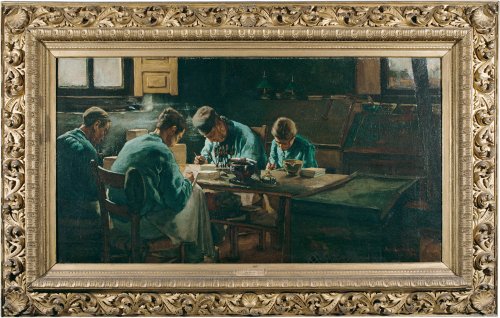
Context:
JLB 331, 3/21/1883: "Rappard wants to send a large painting to the Amsterdam exhibition. It shows 4 tile painters around a table."
Context:
JLB 332, 3/21/1883: "I myself am decidedly not at all fond of exhibitions."
Context:
JLB 332, 3/21/1883: "I used to be fonder of them in the past than I am now -- I don't know why this is -- in the past I viewed exhibitions from a different angle -- perhaps in the past I had ample occasion to see behind the scenes of certain affairs connected to exhibitions &c. -- and perhaps it isn't just nonchalance on my part that I believe that many are mistaken regarding the results of an exhibition."
In fact, the entire letter clearly is intended to persuade Van Rappard to reverse his decision to exhibit. "I myself am decidedly not at all fond of exhibitions. I used to be fonder of them in the past than I am now -- I don't know why this is -- in the past I viewed exhibitions from a different angle -- perhaps in the past I had ample occasion to see behind the scenes of certain affairs connected to exhibitions &c. -- and perhaps it isn't just nonchalance on my part that I believe that many are mistaken regarding the results of an exhibition. I don't want to discuss it further now, other than to say that I myself would have more faith in a coming together of painters through mutual sympathy and similarity of purpose and warm friendship and loyalty than in a coming together of their works by means of exhibitions. This is why, when I see paintings hung together in the same room, I don't yet venture to conclude that a spirit of unity and a respect for each other and a certain healthy collaboration exists among those who made the aforementioned paintings &c. I regard this last point -- the existence or non-existence of these things -- as being of such great weight that little else qualifies as possibly being important, other than in connection with this spiritual unity, and whatever other matters, important in themselves, there may be apart from that, no surrogate can make up for the lack of that unity, and the lack of that is a lack of firm ground under one's feet. I don't have the least desire for exhibitions &c. to stop, but I do desire a reform or rather renewal and strengthening of the associations and the collaboration between painters, which would certainly have the kind of influence that would make even exhibitions beneficial." (ibid.)
As so often in his arguments to Theo, after vehemently making his case, Vincent tries to retreat to a posture of above-the-fray neutrality: "whether or not [your paintings] go to an exhibition matters as little to me as what kind of frame you have them in" (ibid.). Presumably, this is the posture that Vincent assumed two months later when he visited Van Rappard's studio and Van Rappard visited his.
Context:
JLB 332, 3/21/1883: "These thoughts naturally bring me to the field of exhibitions. You work for exhibitions -- fine -- I myself am decidedly not at all fond of exhibitions."
Context:
BVG R32, 3/21/1883: "I don't want to expatiate on this theme at present, I only want to say this, Speaking for myself, I expect more good from a uniting of painters actuated by mutual sympathy and singleness of purpose and warm friendship and loyalty than from a uniting of their works by means of exhibitions."
JLB 332, 3/21/1883: " I don't want to discuss it further now, other than to say that I myself would have more faith in a coming together of painters through mutual sympathy and similarity of purpose and warm friendship and loyalty than in a coming together of their works by means of exhibitions."
Context:
JLB 335, 4/3/1883: "I received the package of woodcuts on 30 March. Because there was no letter with them, I waited a few days to see if you would write. Now, though, I'm writing a few words to say many thanks for this consignment."
It is curious, however, that Enthoven's name is mentioned nowhere in any of the hundreds of pages of letters Vincent wrote while living in The Hague, nor in Theo's letters, nor in Theo's address book. If the wealthy Enthoven had indeed been a "friend," it is almost certain that Vincent would have eagerly advertised such an advantageous relationship to his brother and parents. It may be significant that Enthoven lived in the fashionable Voorburg neighborhood where Vincent's landlord, Pieter de Zwart and his son Michiel, who managed his father's rental affairs, also lived (JLB 318, 2/20/1883 or 2/21/1883). Vincent records several trips to Voorburg, including a visit to De Zwart at his home there as part of Vincent's campaign to secure improvements to his studio (JLB 318, 2/20/1883 or 2/21/1883; JLB 381, 7/5/1883). Vincent also made several trips to sketch in an almshouse in Voorburg (JLB 352, 6/11/1883). Despite Vincent's "attacks" on him, De Zwart appears to have remained friendly with his troublesome tenant right up until Vincent's departure for Drenthe in September 1883. Only the month before, Vincent was considering renting a house from De Zwart -- in Voorburg (JLB 378, 8/21/1883). And only a week or two before leaving The Hague, Vincent contemplated taking a "room or rather an annexe" on the grounds of De Zwart's own house in Voorburg (JLB 382, 7/6/1883). (It should be noted that neither De Zwart père nor fils is ever mentioned by name in Vincent's letters.)
Since Enthoven was a prominent landowner, it is quite possible that he met or knew of Vincent through one of the De Zwarts. Further, it is not just possible, but likely, that when Vincent did not have rent money, he tried to placate his landlord with offers of drawings as either payment on account or collateral on debt. Thus, Enthoven may have come into possession of some of Vincent's Hague-period work through the De Zwarts. The later work he could have collected subsequently.
We find some of the Enthoven account less persuasive. The claim that he gave Vincent "clothes and underclothes" sounds like a borrowing from the colorful Borinage stories of sartorial self-abuse. The image of Vincent on a bicycle seems like it should have found its way into his letters or friends' accounts. (The bicycle was still a modern device, and Vincent both hated modernity and loved to walk.) The story about a cache of drawings and letters from Vincent to Enthoven being burned as trash is of a piece with many such apocryphal stories that floated around the communities where Vincent lived in the first quarter of the twentieth century when his celebrity was widely disseminated and stories of fortunes inadvertently lost -- or still to be found -- infested the Van Gogh literature.
In his competition with Van Rappard, Vincent used Van der Weele as both foil and object lesson, praising his use of models (JLB 332, 3/21/1883), his "manliness", and his "seriousness" (in contrast to the dilettante Van Rappard) (JLB 327, 3/11/1883). By "serious," of course, Vincent meant strict adherence to Von Herkomer's (and Vincent's) nostalgic prescriptions: "If I have something against a new movement, it isn't at all that of Israëls, Mauve and Maris. No, that's simply the best in my view, but something has since arisen from it which, while resembling it, is in fact directly opposed to those masters -- and that's what I'm against. Van der Weele, for instance, is more serious and sticks to a straight line." (JLB 341, 4/9/1883.) (This comment was aimed at the arguments with Van Rappard about "decorative" works.) Vincent also advertised Van der Weele's contacts with prominent Hague artists like Israëls: "I asked Van der Weele -- Tell me, do we take models often ENOUGH??? Van der W. replied: When Israëls was at my studio lately and saw my big painting of the sand-carts, he said: 'Now above all take plenty of models.'" (JLB 332, 3/21/1883; emphasis in original.) In March, Vincent started a collection of prints for Van der Weele, diverting duplicates from the back-sliding Van Rappard (JLB 321, 2/23/1883-2/26/1883). In an act of open reproval, he wrote Van Rappard asking him to return some of the prints Vincent had sent him in order to help establish Van der Weele's collection: "With him in mind, I'd also like to ask you for other prints that you may have available in duplicate" (ibid.).
Vincent clearly intended to position Van der Weele both as a jealousy object for Van Rappard and as an object lesson in how a true friend should behave. That is the subtext of passages like this: "As I wrote, Van der Weele came by this week -- I was just working with a model -- and we held a viewing from The Graphic on a wheelbarrow that I had drawn with the model" (JLB 332, 3/21/1883). How successful Vincent was in planting this seed is debatable. A month later, he wrote Theo: "Van der Weele came by, we held a viewing of woodcuts, ... He's also going to start collecting them, and is to take steps to get some from the estate of Stam the wood engraver that he collected." (JLB 331, 3/21/1883.) In his letters to Van Rappard, Vincent pointedly called Van der Weele "someone who'll become enthusiastic" for his collection (JLB 321, 2/23/1883-2/26/1883), and labeled him one of the "rising men" in the Hague art world -- a self-justifying fiction (JLB 329, 3/16/1883).
In support of this baseless claim, Vincent proposed an elaborate scheme for putting Van Rappard and Van der Weele together, using some duplicate engravings that Van Rappard might otherwise give to Vincent. "And I wish you knew [Van der Weele] personally; now the woodcuts may provide an opportunity for getting acquainted, it seems to me. Either through you bringing him those prints sooner or later ... or through them becoming his with me as intermediary, I may name you as the donor and tell him that you've seen something of his work and would like to make his acquaintance, or something like that" (ibid.). One purpose of this scheme surely was to underscore what an important person Van der Weele was and, especially, would become. Vincent made that explicit: "In short, I just mean that if you're put in touch with him one way or another I believe you'll find in him someone with whom you'll want to keep in touch and probably become real friends" (ibid.; emphasis in original).
There are hints of this diplomatic skill in Vincent's earlier recorded contacts with Van der Weele. For example, Vincent reports in March that, when Van der Weele visited his studio in November, he had shown no interest in Vincent's drawings of diggers (JLB 331, 3/21/1883). Yet Vincent's report of the earlier visit is entirely positive (JLB 285, 11/22/1882). This suggests Van der Weele's skill at keeping his comments constructive rather than critical. During the November visit, he encouraged Vincent to do more complicated compositions -- a comment that Vincent understandably took as a sign of confidence in his ability (JLB 287, 11/24/1882). The mere fact that Vincent and Van der Weele could remain in relatively close proximity and on good terms for ten months, through multiple visits to each other's studio, is the most eloquent possible testimony to Van der Weele's diplomatic acuity.
Context:
JLB 354, 6/15/1883: "Van der Weele's judgment was rather sympathetic, but he said of the Sand quarry that there were too many figures in it. The composition wasn't simple. He said, look, draw that one little fellow with his wheelbarrow on a dyke in the evening set against the light sky, how beautiful that would be, for instance, and now it lacked cohesion."
Context:
BVG 275, 3/21/1883: "Now, in looking over my studies, when we came to the diggers, he spoke quite differently of them than he did last winter; at least, he wasn't so quick to say, 'This or that isn't right.'"
JLB 331, 3/21/1883: "When we came to those diggers while looking through my studies, the way he spoke about them was very different from what it was this winter -- at least he didn't say so readily 'this or that is different.'"
We believe there is no doubt that the following encounter in late March had a direct impact on Vincent's decision to undertake more complicated compositions, in particular the series of drawings of peat diggers (Peat Diggers in the Dunes [F 1031 JH 363] and Peat Diggers in the Dunes [F 1030 JH 364]) and sand diggers (Sand Diggers in Dekkersduin Near The Hague [F 1029 JH 366] and Sand Diggers in Dekkersduin Near The Hague [F 1028 JH 367]) that he undertook in May and June of 1883. "Van der W. also came by one time this winter -- it's months ago now -- I was working on studies of Diggers at the time -- one of which I tried to lithograph. He saw them but they didn't seem to interest him, far from it. Now he has evidently had diggers pose recently for the painting he's working on, or observed them at work somewhere -- anyway, he has taken a close look at diggers in nature." (JLB 331, 3/21/1883; emphasis added.)
Context:
JLB 285, 11/22/1882: "He wanted me to compose something from my numerous studies of orphan men, but I don't feel ready yet."
Context:
JLB 369, 7/29/1883-7/30/1883: "Well, his father is a chemist and deals in paints; he's a stockist for Paillard, and supplies Mauve among others."
Context:
JLB 369, 7/29/1883-7/30/1883: "I've never had anything for teaching the son, but the father has often expressed his readiness to help. I took him up on this and said the following to him. That I had no doubt that there must be a fair number of tubes in his stock that were no longer in demand."
This story is hard to square with the universal rejection that Vincent suffered elsewhere in The Hague because of his odd looks and rebarbative manner. There are several possibilities. One is that Vincent fabricated the story -- either wholly or in part. Another is that the Furnée brothers were exceptionally warm-hearted and open-minded. The more ominous (and likely) reading is that the boys were, in fact, mocking Vincent; but he mistook their attentions (or is misrepresenting them to Theo) as affectionate. For the clothes-conscious Dutch, the gift of the "faded and patched" jacket could easily have been intended as ridicule of Vincent's tendency to dress poorly. In fact, one of the Furnée brothers' few (distinctly un-fond) memories of Vincent was that he wore "a brown 'peat-carrier's suit' with a cap to match" -- not a positive image in light of another of their recollections, that his studio was "very disorderly and untidy" (Bonger-Van Gogh, p. 137). Nor is it likely that Theo received the news of this "gift" in the positive spirit in which Vincent related it. Undoubtedly, it would have raised all the ancient family concerns about Vincent's strange habits and the potential for public embarrassment.
It probably sheds significant light on Vincent's relationship with the Furnée brothers that he had similar relationships with teenage boys in Nuenen and again in Auvers. In the latter case, at least, it is well known that the Secrétan brothers played tricks on him and mocked him mercilessly. (See Chapter 37.) In any event, the relationship with Furnée was brief. Vincent apparently began giving him lessons in early May 1883 (JLB 343, 5/20/1883). They may have continued until Vincent left for Drenthe in September, although Vincent is not specific on the frequency of their lessons and even suggests that they may have trailed off before his departure because of objections from Furnée's father: "[Furnée] has to take an examination in October, however, and his father doesn't want him to spend so much time on it. But in my view he can easily combine his profession of surveyor with drawing." (ibid.) Apparently, teacher and student parted on amicable terms. According to Vincent, Furnée came to say goodbye to him at the train station when he left on September 11 (JLB 385, 9/11/1883-9/12/1883), and there is no doubt that Furnée wrote Vincent a letter the following January announcing his departure for the East Indies (JLB 421, 1/6/1884-1/18/1884). Vincent responded warmly: "Well, my dear friend, I will always think back with great pleasure on many a walk that we took together last summer" (ibid.).
Context:
BVG 251, 12/3/1882-12/5/1882: "I do not mean to say that there are none, but you feel what I mean, and know as well as I how many painters are inveterate liars."
JLB 291, 12/4/1882-12/9/1882: "I'm not saying that there are none, but you yourself feel what I mean, and know as well as I how a host of people who paint are enormous liars."
Context:
BVG 285, 5/20/1883: "The things he made before I knew him were horrible daubs, most of them hideous."
JLB 343, 5/20/1883: "What he did before I knew him were horribly botched paintings, generally atrocious."
Context:
BVG 285, 5/20/1883: "The things he made before I knew him were horrible daubs, most of them hideous."
JLB 343, 5/20/1883: "What he did before I knew him were horribly botched paintings, generally atrocious."
Context:
JLB 351, 6/7/1883: "From the window I sketched an old gardener by a crooked apple tree, and the workshop of the home's carpenter, where I drank tea with two orphan men. I can go into the men's ward as a visitor. It was very real, inexpressibly real."
Context:
BVG 266, 2/11/1883: "Just because I should like to find and keep up a real friendship, it is difficult for me to conform to a conventional friendship."
JLB 312, 2/11/1883: "It's hard for me to be content with conventional friendship, precisely because I seek and persevere in sincere friendship."
Context:
BVG 266, 2/11/1883: "Just because I should like to find and keep up a real friendship, it is difficult for me to conform to a conventional friendship. ... Where it is conventional, bitterness is almost unavoidable, just because one does not feel free, and even though one doesn't express one's real feelings, they are sufficiently apparent to leave a continuing disagreeable impression on both sides and to make it hopeless for one to profit from the other's society."
JLB 312, 2/11/1883: " It's hard for me to be content with conventional friendship, precisely because I seek and persevere in sincere friendship. ... Where there is convention it's almost inevitable that bitterness arises, precisely because one doesn't feel free, and even if one doesn't express one's true feelings they're still enough to leave a lasting, unpleasant impression on both sides and to remove any hope that one might be able to be of help to each other."
Context:
BVG 248, 11/26/1882-11/27/1882: "That there is a great chance of going under in the struggle, that a painter is something like a 'lost sentinel,' these and other things need no saying."
JLB 288, 11/26/1882-11/27/1882: "That one runs a high risk of going under oneself, that being a painter is like being a forward sentry, this and other things -- that goes without saying" (emphasis in original).
Context:
BVG R20, 2/4/1883: "At least a poor struggler of a sick painter like myself knows a few things that a tiny baby like that doesn't know."
JLB 307, 2/4/1883: "At any rate, a sick painter like me struggling to get by knows things about it a child like that doesn't know."
Context:
JLB 304, 1/25/1883: "But actually isn't it ridiculous that here in an artistic city like The Hague someone like me should be the highest bidder at a public book auction? One would expect other bidders to come forward, but no. I myself didn't think I would get them." (Emphasis in original.)
Context:
JLB 309, 2/8/1883: "You'll see, though, that these too are rather tattered at the folds."
Context:
BVG R24, 1/25/1883-1/30/1883: "Oh, Rappard -- in many respect it's like this -- much that has great value nowadays is ignored and looked down upon as worthless rubbish, garbage, wastepaper."
JLB 304, 1/25/1883: "Oh Rappard -- it's the same as with other things -- much that is of great value is paid no attention nowadays, and looked down upon as ballast, rubbish or scrap paper."
Context:
JLB 327, 3/11/1883: "Yet we all face this -- but precisely because anyone who paints or draws is faced with this, and is nearly overwhelmed by it if alone, why don't more painters join hands to work together like soldiers forming ranks? And, above all, why are those branches of art that are the least expensive so despised?"
According to JLB: "Victor Hugo wrote in William Shakespeare: 'He was exiled. He died in exile. Then the orator Lycurgus declared: We must put up a bronze statue to Aeschylus. Athens, which had driven out the man, put up the statue' (Il fut exile. Il mourut en exil. Alors l'orateur Lycurgue s'écria: Il faut élever à Eschyle une statue de bronze. Athènes, qui avait chasse l'homme, éleva la statue)." (JLB 358, n. 3.) Vincent says of Thomas Carlyle (1795-1881; English writer and philosopher), "Many regard Carlyle as a monster" (JLB 325, 3/5/1883).
Finally, he invokes the outcast Dutch painter Matthijs Maris (JLB 318, 2/20/1883 or 2/21/1883), who, like Vincent, "met with fierce opposition" (JLB 476, 12/16/1884). He connects Maris, who led a long, unhappy life, to Quasimodo: "Just last week I read Notre-Dame by Hugo, ... Do you know who I recognized in it, or at least was so convinced I recognized that I don't doubt that Victor Hugo intended some such thing? I recognized Thijs Maris in Quasimodo." (JLB 318, 2/20/1883 or 2/21/1883.) What they have in common -- and, of course, what they have in common with Vincent -- is a passionate and emotionally costly battle in defense of a repudiated art. In Quasimodo's case, it is Gothic architecture as symbolized by the medieval cathedral of Notre Dame. (Hugo's book is, in fact, a ringing denunciation of Paris's "démolisseurs" [demolishers] who were systematically destroying the city's medieval architectural heritage.) Vincent connects this theme of Hugo's book with the work of Belgian history painters like Henri Leys, Victor Lagye, Charles Henri Pille, and Vriendt (either Albert or Juliaan; Vincent does not specify which) (ibid.).
In Maris's case, Vincent is less specific. Although he may be referring to some of the Romantic, evocative medieval images that Maris painted around Lausanne in the early 1860s, Vincent does not group him with other painters and the "persecution" Vincent decries appears to be based more on Maris's non-conforming personal behavior than the nostalgia of his imagery -- a social ostracism that, of course, always sealed Vincent to Maris in a unique way, even before Vincent became an artist. It is interesting that Vincent appears to talk of Maris as if he were dead, even though he lived another thirty-five years -- twenty-seven more than Vincent. "Anyway, Thijs Maris still exists but not in his full prime and vigour -- not unhurt and disenchanted to the extent that there can be disenchantment with him" (ibid.; emphasis in original). Vincent also raises the issue of suicide in an odd way -- a way that suggests that Maris may have attempted suicide and that the attempt was, in fact, one of the reasons for his ostracism. "One of the enormities committed by the painters here is, I believe, that even now they still laugh at Thijs Maris. I think there's something as dismal as suicide in that. Why suicide? Because Thijs Maris is such an embodiment of something high and noble that in my view a painter can't mock that without lowering himself. Those who don't understand Maris, so much the worse for them, those who do understand him grieve for him, and grieve that such a person has snapped." (ibid.; emphasis in original.)
Context:
JLB 291, 12/4/1882-12/9/1882: " Do you realize that it's so very, very necessary that honest people should remain in art? I'm not saying that there are none, but you yourself feel what I mean, and know as well as I how a host of people who paint are enormous liars. Honesty is the best policy applies here too, as does the fable of the hare and the tortoise, and the ugly duckling by Andersen." (Emphasis in original.)
Context:
JLB 288, 11/26/1882-11/27/1882: "Or is it rather that, given that many have fallen asleep and don't wish to be woken up, one must try to confine oneself to things that one can finish alone, which one faces alone and has sole responsibility for? So that those who sleep can go on sleeping and rest."
Context:
JLB 292, 12/10/1882: "In some situations it's better to be the vanquished than the victor, for example, better Prometheus than Jupiter. Anyway, it's an old saying, 'what will be will be.'"
Context:
JLB 318, 2/20/1883 or 2/21/1883: "Most people who read N. Dame probably have an impression of Quasimodo as a sort of clown. But you wouldn't think Quasimodo ridiculous any more than I would …"
Context:
JLB 334, 4/2/1883: "Thank you for your good wishes on my birthday. As it happened, I had a very pleasant day, because just then I had an excellent model for a digger."
Context:
JLB 333, 3/29/1883 and 4/1/1883: "I'm reading Les misérables by V. Hugo. A book of which I have old memories, but at the same time I felt a need to read it again. ... A book like that warms one up, just like paintings by Dupré and old Millets -- or several Decamps' -- it's written with what's called verve." (Emphasis in original.)
Context:
JLB 310, 2/8/1883: "Sometimes I can't understand all the same that I'm only 30 and feel so much older."
Context:
JLB 364, 7/22/1883: "I can't help it if it has no cause, but I've suddenly fallen ill; ... I'm going for a walk to see if it clears up."
Context:
JLB 312, 2/11/1883: "Lately I've walked a good deal in the Geest district and in the streets and alleys where I often walked with the woman last year in the beginning."
Context:
JLB 272, 10/15/1882: "But I no longer let it disturb me, for it annoys me too much and is too inconvenient, since there's too much to do. It often helps, for example, if I take a brisk walk to Scheveningen, or something like that."
Context:
BVG 242, 11/5/1882: "How much good walking out to the desolate seashore and gazing out at the grey-green sea with the long white crests on its waves can do for a man who is downcast and dejected!"
JLB 292, 12/10/1882: "How much good it does a person if one is in a gloomy mood to walk on the empty beach and look into the grey-green sea with the long white lines of the waves."
Context:
JLB 235, 6/3/1882: "But there are also people who, just as it is sometimes pleasant and invigorating for a healthy constitution to go for a walk when a strong wind is blowing, so there are also art lovers, I say, who aren't afraid of the harsh."
Context:
JLB 337, 4/21/1883: "I passed by Israëls's house lately -- I've never been inside it -- the front door stood open because the hall was being scrubbed -- I saw things hanging in the hall and do you know what they were?"
Context:
JLB 326, 3/6/1883: "Have I already written to you about those two large etchings by Israëls, a man lighting his pipe and an interior of a labourer's dwelling? How beautiful they are. I think it mightily good of Israëls that he carries on etching, the more so since all the others, so to speak, have given it up, despite the enthusiasm with which the etching club was started at the time. At any rate, most haven't made any progress in etching, and when they make one now it's no better or more complete than what they made years ago. Yet old Israëls is still young enough to make progress despite his grey hairs, and huge progress at that -- and I think that is true youth and evergreen energy." (Emphasis in original.)
Context:
JLB 337, 4/21/1883: "I passed by Israëls's house lately -- I've never been inside it -- the front door stood open because the hall was being scrubbed -- I saw things hanging in the hall and do you know what they were?"
Context:
BVG 280, 4/21/1883-4/22/1883: "Recently I passed Israëls's house -- I have never been inside -- the front door was open, as the servant was scrubbing the hall."
JLB 337, 4/21/1883: "I passed by Israëls's house lately -- I've never been inside it -- the front door stood open because the hall was being scrubbed ..."
Context:
JLB 259, 8/26/1882: "I always have in mind the idea of moving to the country if an opportunity arises, if circumstances suggest it."
Context:
JLB 339, 5/2/1883 or 5/3/1883: "It's now almost a year since I had the unpleasantness with him (i.e. with H.G.T. [Tersteeg]). I shan't cross his path again, I believe he realizes that too, ... It seems to me, should H.G.T. say anything to you about me, that you should cut him off more or less in this manner: Has V. obstructed you since then or bothered you? -- given that he hasn't, you shouldn't make things difficult for him. It's rather disagreeable to me that I always have to avoid the house of G.&C. out of discretion, on account of that difficulty with H.G.T." (Emphasis added.)
Context:
JLB 339, 5/2/1883 or 5/3/1883: "It goes without saying that as long as [Tersteeg] holds that opinion of me I won't set foot inside the premises on the Plaats. Not, however, that I'm afraid of meeting H. G. T[ersteeg], not because I want to hide from him or anything like that, but because I don't want to give him offence. If someone wants to have nothing to do with me, well I'll help and try to avoid the few places where we might unintentionally bump into each other."
Context:
JLB 336, 4/11/1883: "In the window at G&C. I saw a small seascape which you no doubt know, and which I've been going to have a look at almost every evening ..."
Context:
JLB 336, 4/11/1883: "... but as regards Dupré and similar art -- of which one sees so much more in Paris than here -- you may be rather spoiled -- and not know what an almightily beautiful impression it makes here, where one sees so precious little of it."
Context:
BVG R20, 2/4/1883: "I have lost some friends through it, all the same, but on the other hand I have more light and shade in my own house, although at times, when my worries become too great, I feel as if I were on a ship during a hurricane."
JLB 307, 2/4/1883: "Nonetheless, I've lost some friends because of it, but I've gained more light and shade in my own house and more of a Home, even though sometimes when cares weigh heavily on me it's as if I were on a ship in a storm" (emphasis in original).
Context:
BVG 263, 2/3/1883: "Life is then the colour of dishwater; it becomes something like an ash heap."
JLB 306, 2/3/1883: "Then life has the colour of dirty water, it's like a rubbish dump."
Context:
BVG R21, 2/7/1883: "The daily work is something that does not change, and it is less dangerous to be absorbed in it than to stare into the unfathomable."
JLB 309, 2/8/1883: "The daily work is a thing that doesn't change, and becoming absorbed in that isn't as dangerous as looking into the unfathomable."
Context:
BVG 265, 2/8/1883: "But, at the same time, a phase of life is past. This makes one melancholy, thinking some things will never come back."
JLB 310, 2/8/1883: "Yet at the same time a period of life is over, which makes one sad that this or that will never come back."
Context:
BVG 265, 2/8/1883: "But one doesn't expect out of life what one has already learned that it cannot give, but rather one begins to see more and more clearly that life is only a kind of sowing time, and the harvest is not here."
JLB 310, 2/8/1883: "But one doesn't expect from life what one already knows from experience that it cannot give. Rather, one begins to see much more clearly that life is only a time of fertilization and that the harvest is not here." (Emphasis in original.)
Les extrêmes se touchent (extremes meet) is a French expression that echoes Pascal's philosophical defense of Christianity in Pensees: "The visible extent of the world visibly exceeds us; but as we exceed little things, we think ourselves more capable of knowing them. And yet we need no less capacity for attaining the Nothing and the All. Infinite capacity is required for both, and it seems to me that whoever shall have understood the ultimate principles of being might also attain to the knowledge of the Infinite. The one depends on the other, and one leads to the other. These extremes meet and reunite by force of distance and find each other in God, and in God alone." (Pascal, p. 19; emphasis added.)
Context:
JLB 323, 3/3/1883: "There's also another stimulus, namely that Van Rappard is making an effort too, more than in the past, and I want to keep up with him so that we can get on better and probably be of more help to each other. ... I concede to him as to painting, but I don't want to lag behind him in drawing. What I would like to see happen is that he and I go on in the same direction, namely the figures from the people, scenes in a soup kitchen, Hospital &c." (Emphasis added.)
Context:
JLB 331, 3/21/1883: "Rappard wants to send a large painting to the Amsterdam exhibition. It shows 4 tile painters around a table. I've heard good things about it indirectly." (Emphasis added.)
Context:
JLB 275, 10/24/1882-10/27/1882: "Do you remember the soup kitchens [établissements de bouillon] in Brussels? I remembered that lately, and this is the drawing I'm working on at the moment."

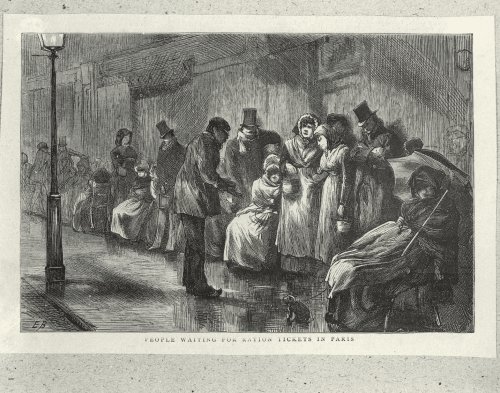
Context:
JLB 263, 9/12/1882-9/17/1882: "I've recently found some things by Lançon -- a soup distribution, a gathering of rag-pickers, gang of snow-shovellers -- which made me get up at night to take another look at them, that's how strong an impression they made on me."
In the end, of course, De Zwart provides nothing but some old shutters and boards (if Vincent's story is to be believed), leaving Vincent to pay the bulk of the costs. Once the changes are made, Vincent returns again and again to praise their transformative effect. "Imagine the difference from the effect of harsh light that the three windows would give at present without blinds and you'll well understand how one can work infinitely better now" (JLB 319, 2/23/1883). "I now have the light in the studio pretty well under control ... and adjust my light accordingly" (ibid.). He sends Theo elaborate explanations of how they work, complete with numbered drawings and excited testimonials: "one can now obtain nice effects and vary them greatly. ... But the studio is 10 times better." (ibid.) "I saw how the studio is now infinitely more suitable for colour" (JLB 324, 3/4/1883). "I believe you'll see in [a sketch] what I gain by the change in the light in the studio" (JLB 331, 3/21/1883). Eventually, of course, the other shoe drops: "It's going to cost me more now than I had thought, though, because so many changes had to be made to the old blinds. So I wanted to ask you, since I've promised to pay something on 1 March, send a day earlier rather than a day later, if you can. I wager you can understand that the studio is utterly transformed as a result -- Oh, I find it such a delight." (JLB 319, 2/23/1883.) "Ut mine Festungstid" (1862; "During the Time of My Incarceration") is an autobiographical account of Reuter's years in prison, and part of the series Olle Kamellen. In JLB 318 (2/20/1883 or 2/21/1883), Vincent refers to the book as 'Uit mijn gevangenistijd.' According to JLB: "Van Gogh would have read a Dutch translation which appeared under the general title Gedroogde kruiden. In this Ut mine Festungstid became Herinneringen uit mijne gevangenissen (printed in 1867, 1868, 1879 and 1883)." (JLB 306, n. 6.)
Context:
BVG 271, 3/3/1883: "In the background I put a white screen, and on that I drew the hatch, according to its real position and measurements; I closed the farthest window entirely, and the middle window at the bottom, so that the light falls from P, exactly as in the place itself."
JLB 323, 3/3/1883: "I put a white screen in the background and on it I drew the hatch in the proportions and dimensions it has in reality, with the furthest window covered and the lower part of the middle window covered. So that the light falls from P. Just as in the place itself." (Emphasis in original.)
BVG 268, 2/20/1883-2/24/1883: Vincent does not directly make this connection. He mentions his intention to use the canvas for other things (not paintings). Subsequently, he mentions putting "a white screen" at one end of the studio and "drew" on it the hatch and "painted" the lower portion with a gray wainscoting (JLB 318, 2/20/1883 or 2/21/1883). The latter especially suggests that the discarded canvas was the material for the screen. The possibility cannot be dismissed that Vincent is underplaying the extent of his exertions (and expenses). At least one of the surviving soup kitchen drawings (Soup Distribution in a Public Soup Kitchen [F 1020a JH 330]) shows a figure in the opening, passing out soup. Given his passion for verisimilitude, and his acquaintance with a local carpenter, it is not at all unlikely that Vincent had a substantial screen wall built with an actual opening, not a drawn one.
Context:
JLB 318, 2/20/1883 or 2/21/1883: "As you know, I already had something in front of the windows, namely canvas stretched on laths. They're no longer needed now, but will be highly desirable as backgrounds, with darker or lighter material stretched over them."
Context:
JLB 323, 3/3/1883: "In the case overleaf the wall is white with panelling painted grey, the floor darker."
Context:
JLB 323, 3/3/1883: "One can re-create the locality much more accurately by paying attention to things like that."
The identification of the models in Vincent's soup kitchen drawings is a subject of surprising deference in the literature. Van Heugten's discussion is the most complete and the most cautious (Van Heugten, pp. 214-215). Sien, her mother, her daughter, her young sister, and her baby, are (to our eyes) clearly visible in one or more of the scenes. Vincent also mentions "a lad from the neighbourhood" (JLB 323, 3/3/1883). For those seeking a mystery, there is always the barely visible figure shown in the darkness on the other side of the serving window in Soup Distribution in a Public Soup Kitchen (F 1020a JH 330). This would have been a figment of Vincent's imagination if, as he claimed, the wall was merely a screen with a window painted on it. If it was not, then there is a possibility that the orphan man Zuyderland posed for it. Vincent was still working with him at this time, and he appears to be shown in the revamped studio in a letter sketch (People in the Studio [F 1060 JH 327]) from two days before the big event (JLB 322, 3/2/1883).
Context:
BVG 271, 3/3/1883: "I have a few of these things already, and also many real clothes."
JLB 323, 3/3/1883: "I already have several things for it, and also have various REAL clothes" (emphasis in original).
Context:
BVG 271, 3/3/1883: "Yesterday, for instance, I bought a very picturesque patched smock of coarse linen."
JLB 323, 3/3/1883: "Yesterday, for example, bought a remarkably picturesque patched smock of coarse linen."
Context:
BVG 271, 3/3/1883: "At all events, one thing I can promise you now, tomorrow I'll have the house full of people, that is, the woman's mother, and her younger sister, and a boy from the neighbourhood, and all these persons, together with my own people, will pose for the drawing of which this is the first rough sketch."
JLB 323, 3/3/1883: " Tomorrow I'll have a house full of people, namely the woman's mother and the woman's youngest sister and a lad from the neighbourhood, and these people will pose with the rest of my household for the drawing for which this is the first scratch."
Context:
JLB 323, 3/3/1883: "Tomorrow I'll have a house full of people …"
Context:
JLB 324, 3/4/1883: " Darkness has just fallen and wanted to send you today's drawing for the fun of it because I wrote to you about it. This morning I began a watercolour of a boy and a girl at a similar soup distribution with another female figure in the corner."
Context:
JLB 322, 3/2/1883: "I can position them like this in the studio, and then get the glancing lights, say, on the figures from above."
Context:
BVG 275, 3/21/1883: "From this conception results first, the difficulty of rendering what one has before one's eyes, and second, something else which is rather difficult -- that is, the problem of posing a figure and letting the light fall so that it renders the character most completely and strongly."
JLB 331, 3/21/1883: "And in the first place this approach entails the difficulties of depicting what one has before one's eyes, but in addition something else that requires a lot of hard work, namely the question of how to position a figure and to have the light fall such that the character comes out at its best and most perfect."
Context:
JLB 325, 3/5/1883: "And I must tell you that this experiment pleased me very much indeed."
Context:
JLB 323, 3/3/1883: "But the road would have fewer obstacles if you could send me something extra soon. Otherwise I foresee that I'll come up against various things, whether drawing materials or taking a model or making some more changes."
Context:
JLB 323, 3/3/1883: "The changes to the studio present me with more indirect costs than direct ones. For I won't consider it finished before I have various things that I need to make it practical."
Context:
JLB 332, 3/21/1883: "I asked Van der Weele -- Tell me, do we take models often ENOUGH??? Van der W. replied: When Israëls was at my studio lately and saw my big painting of the sand-carts, he said: 'Now above all take plenty of models.'" (Emphasis in original.)
Context:
JLB 332, 3/21/1883: "I just carry on drawing."
Context:
BVG 272, 3/4/1883: "As a painter I not only feel perfectly at home and contented with them, but I find in them a quality that sometimes reminds me of gypsies, at least of something as picturesque."
JLB 324, 3/4/1883: "As a painter I feel completely at home with them and not just content, yet I find a character in them that sometimes makes me think of gypsies -- at any rate something as picturesque."
Context:
JLB 332, 3/21/1883: "The draughtsmen's models come to wish them a merry Xmas and no doubt receive a tip."
Context:
JLB 324, 3/4/1883: "And you'll get completely different compositions of soup distributions, of which this is now the first."
Context:
BVG R32, 3/21/1883: "It would be wonderful if the artists combined, and there was some place where the models could meet every day, as in the old days of the Graphic."
JLB 332, 3/21/1883: "It would be wonderful if people joined forces and there was a place where models would rendezvous each day, as at The Graphic in the past."
Context:
JLB 334, 4/2/1883: "My ideal is to work with ever more models, a whole flock of poor folk for whom the studio could be a kind of harbour of refuge on cold days, or when they're out of work or in need. Where they know that there are fire, food, drink and a few quarters to be earned. At present that's only on a very small scale ..."