
Notes
Chapters
- A Fanatic Heart
- 27. Against the Grain
- 28. The Zemganno Brothers
- 29. Catch and Release
- 30. A Mercenary Frenzy
- 31. Le Paradou
- 32. The Sunflower and the Oleander
- 33. The Poet's Garden
- 34. Imaginary Savage
- 35. La Lutte
- 36. The Stranger
- 37. Two Roads
- 38. The Real South
- 39. Starry Night
- 40. The Isolated One
- 41. A Degenerate Child
- 42. The Garden and the Wheatfield
- 43. Illusions Fade, the Sublime Remains
- Ici Repose
The Early Years
The Dutch Years
The French Years
Chapters
Context:
JLB 534, 10/10/1885: "I was there 3 days; went Tuesday, back Thursday."
Context:
BVG 442, 12/28/1885: "Something about my constitution that has pleased me a great deal is that a doctor in Amsterdam, with whom I once discussed a few things that sometimes made me think that I wasn't long for this world, and whose opinion I didn't ask for directly, wanting simply to gauge the first impression of someone who didn't know me at all and availing myself of a small upset I had at the time to bring the conversation round to my general constitution -- I was absolutely delighted that this doctor took me for an ordinary worker, saying, 'I daresay you're an ironworker by trade.'"
JLB 550, 12/28/1885: "Something regarding my constitution that has pleased me very much is that a doctor in Amsterdam, whom I also once spoke to about a few things that sometimes made me think that I wouldn't last long and whose opinion I didn't ask directly, but just to find out the first impression of one who didn't know me at all -- taking advantage of a minor illness that I had to turn things to my constitution in general during the course of the conversation -- it pleased me very much indeed that this doctor took me for an ordinary workman, said 'you must be an ironworker by trade.'"


Context:
BVG 426, 10/10/1885-10/11/1885: "'The Syndics' is perfect, is the most beautiful Rembrandt; but 'The Jewish Bride' -- not ranked so high, what an intimate, what an infinitely sympathetic picture it is, painted d'une main de feu."
JLB 534, 10/10/1885: "The Syndics is perfect -- the finest Rembrandt -- but that Jewish bride -- not reckoned so much -- what an intimate, what an infinitely sympathetic painting, painted -- with a glowing hand."


Context:
JLB 539, 11/7/1885: "When I read this, I thought of -- Vermeer of Delft. When one sees it from close to, the townscape in The Hague is incredible, and done with completely different colours from what one would suppose a few steps away." (Emphasis in original.)
Context:
JLB 539, 11/7/1885: "When I read this, I thought of -- Vermeer of Delft. When one sees it from close to, the townscape in The Hague is incredible, and done with completely different colours from what one would suppose a few steps away." (Emphasis in original.)
Context:
JLB 115, 5/21/1877-5/22/1877: "Before I went to the Strickers' I walked briefly through the Trippenhuis in order to see several paintings again, I'm sure you know which ones."
Context:
JLB 651, 7/30/1888: "Thus the annoying yellow tonality of certain canvases by Rembrandt is an effect of deterioration through humidity or other causes, instances of which I could point out to you."


Context:
JLB 535, 10/13/1885: "Van Goyen -- that Corot among the Dutchmen -- I stood for a long time in front of that masterly piece in the Dupper Collection, two oaks on a dune in the autumn, in a storm."
Context:
BVG 425, 9/4/1885: " Longing most of all for Rembrandt and Frans Hals, this week I shall go to the museum in Amsterdam for a day with a friend of mine from Eindhoven, some of whose studies I showed you."
JLB 533, 10/4/1885: " Longing most of all for Rembrandt and Frans Hals, one day this week I'm going to the museum in Amsterdam with a friend of mine in Eindhoven whose studies I once showed you."
Context:
JLB 534, 10/10/1885: "I don't know whether you remember that to the left of the Night watch, in other words as a pendant to the Syndics, there's a painting -- it was unknown to me until now -- by Frans Hals and P. Codde, 20 or so officers full length" (emphasis in original).

Context:
JLB 534, 10/10/1885: "I stood there literally rooted to the spot."


Context:
JLB 534, 10/10/1885: "Went to the Fodor too."
Context: JLB 534, 10/10/1885: “Now I have a favour to ask you. That friend of mine in Eindhoven, who went with me to Amsterdam, bought Bürger, Musées de la Hollande, Van der Hoop et Rotterdam at C.M.'s, but C.M. didn't have the first volume, Musées de la Haye et d'Amsterdam. We must have that one though. It's out of print, but you'll be able to dig one up somewhere, and he's even prepared to give 10 francs for it if need be, although preferably cheaper, of course. I'll send you what it costs you straightaway, since it's for him, and he charged me with this on that condition. So will you do your best to get it? If you do find it, read it through again yourself first -- because it's so good.”
Context:
JLB 541, 11/14/1885: "In Amsterdam I lodged in a soup kitchen for 50 cents; I'd do the same there, or better yet reach agreement with some painter or other to be allowed to work in his studio."


Context:
JLB 490, 4/6/1885: "And I think it by no means unlikely that I'll stay here for the rest of my life, too. After all, I desire nothing other than to live deep in the country and to paint peasant life."
Context:
BVG 426, 10/10/1885-10/11/1885: "The result is that I am very glad I went in spite of the cost, and I made up my mind not to go so long without seeing pictures again."
JLB 534, 10/10/1885: "I'm very glad I went, whatever the cost, and that I don't propose going for so long again without seeing paintings" (emphasis in original).
Context:
BVG 425, 9/4/1885: "For the very reason that I hope to go on trying to find buyers for my own work, I think it will be a good thing for me to take a trip now and then."
JLB 533, 10/4/1885: "Precisely because I very much hope to go finding people for my own work, I think it will be good for me to go on a trip every now and then."
Context:
BVG 425, 9/4/1885: "For the very reason that I hope to go on trying to find buyers for my own work, I think it will be a good thing for me to take a trip now and then."
JLB 533, 10/4/1885: "Precisely because I very much hope to go finding people for my own work, I think it will be good for me to go on a trip every now and then."
This colorful bit of encouragement was probably nothing but air. Vincent never says another word about showing in Amsterdam. In regard to the Antwerp trip, the evidence is more indirect. Months after the trip, Vincent reports that he met with a painter named "Linnig" while in Antwerp, apparently based on a referral from Theo: "he has nothing but a few miserable old paintings; paints himself rather like Vertin, but seemed to me to be a discouraged man in so far as he ever had any courage, which I reckon wasn't much. All these gentlemen, though, are complaining bitterly that nothing's moving. Still, that's not news." (JLB 546, 12/6/1885; emphasis in original.) This dispiriting report is the only mention Vincent makes of any sales-related activity during his trip to Antwerp. If he had made any other efforts at the time, he surely would have mentioned them here, given all the promises of self-promotion he had made over the previous two years. The "Linnig" Vincent visited would have been either Jan Theodor Joseph Linnig or his nephew Willem Linnig the Younger. Willem Lenning the Elder died in Antwerp in August 1885, almost certainly before Vincent's visit with Kerssemakers. Vincent's other reference is to Petrus Gerardus Vertin, an undistinguished Dutch scene painter with the eye and obsessions of a miniaturist, which may help explain Vincent's uncharacteristically nasty disparagement: "a few miserable old paintings" (ibid.).
Context:
JLB 531, 9/2/1885: "A girl I'd often painted was having a child and they thought it was mine, although it wasn't me."
Context:
JLB 541, 11/14/1885: "Well then, the peasants and the folk from the village aren't mistaken and promptly say, even contradicting me if I say they're wrong, that is Renier de Greef, that's Toon de Groot and that's Dien van der Beek &c. And sometimes even recognize a figure seen from behind." (Emphasis in original.)
In addition to this testamentary evidence, there are scattered hints in Vincent's letters that he would have taken advantage of any opportunity to do nude drawings, despite the obvious risk of scandal. In October 1884, he considered taking lessons in nude drawing with the sculptor Jean Theodore Stracké in Den Bosch or at the academy in Antwerp (JLB 465, 10/9/1884). As recently as July 1885, he had engaged in an odd digression on the subject of the "simple nude but modern figure," indicating that the subject was still on his mind (JLB 515, 7/14/1885; emphasis in original). As Vincent must have known, this was dangerous territory in a tight-knit, rural, religious community like Nuenen. Van Heugten notes: "If it is true that his models did occasionally pose in the nude, it is easy to see that this innocuous activity might have been seized on by the local gossips" (Van Heugten, p. 27). In his letters to Theo after the scandal breaks, Vincent does not own up to nude drawing. Instead, he casts the campaign against him in purely Millet-like terms, maintaining that he is being hounded by the forces of convention merely for socializing with the poor peasants: "But you see that it isn't easy to paint people at home and draw them as they go about their business" (JLB 531, 9/2/1885).
Context:
BVG 433, 11/10/1885-11/20/1885: "The general nickname I have in this neighborhood is 't schildermenneke [the little painter fellow] and it is not without a certain dose of malice that I go abroad."
JLB 541, 11/14/1885: "The nickname I have around here is generally 'the little painter fellow', and it's not entirely without a measure of malice that I'm going there"
Context:
BVG 425, 9/4/1885: "But of course there will always be God-fearing natives in the village who will persist in suspecting me, for one thing is sure, namely that the priest would only too gladly throw the whole blame of that affair on me."
JLB 533, 10/4/1885: "There'll always be God-fearing natives in the village who'll still believe me capable of it, though, because it's certain that the priest would love to pin the blame for that business on me."
Context:
BVG 423, 9/1/1885-9/15/1885: "But you see they do it only for the sake of earning money, and they do nothing for nothing here."
JLB 531, 9/2/1885: "But you see, they only do it for the sake of earning money and I don't get anything done for nothing around here" (emphasis in original).
Context:
BVG 423, 9/1/1885-9/15/1885: "These last two weeks I have had a lot of trouble with the reverend gentlemen of the clergy, who gave me to understand, albeit with the best intentions and believing like so many others that they were obliged to intervene -- that I ought not to be too familiar with people below me in station. But while they put the matter to me in these terms, they used quite a different tone with the 'people of lower station,' namely, threatening them if they allowed themselves to be painted."
JLB 531, 9/2/1885: "This last fortnight I've had a great deal of trouble with the reverend gentlemen of the priesthood, who gave me to understand -- of course with the best of intentions and, no less than others, believing that it was their duty to interfere -- who gave me to understand that I shouldn't be too familiar with people beneath my station -- who, having spoken to me in those terms, spoke in a very different tone to the 'people of lower station', that's to say with threats that they mustn't allow themselves to be painted."
Context:
JLB 548, 12/17/1885: "... until the end Pa also spoke and acted towards me, yes, like the priest."
Context:
JLB 531, 9/2/1885: "This time I simply went straight to the burgomaster and told him exactly what had happened, and pointed out that this was none of the priests' business and that they should stick to their own province of more abstract things."
Context:
BVG 425, 9/4/1885: "With the peasants to whom the accident happened, where I often used to paint, I have remained on good terms, and I am as welcome in their home as I used to be."
JLB 533, 10/4/1885: "I've remained on good terms with the peasants to whom it happened and where I went to paint a lot, and am just as welcome in their home as before."
Context:
JLB 390, 9/26/1883: "I've sometimes wondered, for instance, whether [Sien's] mother wasn't also being backed in turn by a priest, because too much has been done on their part to influence the woman for me to explain. ... if it's the case that [Sien's] family is helping her, I understand well enough that she's too much in agreement with them, and has been for a long time, so that I may not or cannot have anything more to do with it. Or, I've thought, if there's a priest behind it, she's being helped but only on condition that she has nothing more to do with me, and that's the reason for her silence." (Emphasis in original.)
Context:
JLB 531, 9/2/1885: "The priest went so far as to promise the people money if they didn't allow themselves to be painted -- however, the people replied very pertly that they'd rather earn it from me than go cap in hand to him" (emphasis in original).
At the time of his visit to Nuenen in mid-summer, Willem Wenckebach found Vincent already in a fury at the local peasants: "he talked volubly and interestingly about his aim and his work, his difficulties in working with the peasants, and so forth. It seemed so strange to me that, although he lived amongst them, he flew into a rage and was so provoked at them." (Wenckebach, "Letters to an Artist," in Stein, ed., p. 67.) Later, at a dinner at Kerssemakers's house, the subject came up again: "Vincent suddenly flew into a rage, threw down his fork, cursed the peasants, and left the room!" (ibid.). This suggests that Vincent's animosity toward the peasants was the background against which the scandal played out, not the result of the priest's campaign of vilification, as Vincent wants Theo to believe.
Context:
JLB 519, 7/16/1885: "Keep your spirits up, too, for perhaps we'll get more friends, and then it will liven up, and the squabbling among us might perhaps become a peasant battle against the sort of painters one can still point out in all juries nowadays, who even now would try to stifle the ideas for which Millet was the pioneer if they could."
Context:
BVG 423, 9/1/1885-9/15/1885: "And when they hinder me in my work, I sometimes do not see any other way than an eye for an eye, and a tooth for a tooth."
JLB 531, 9/2/1885: "And when they hinder me in my work, sometimes the only way I know is an eye for an eye, a tooth for a tooth."
Context:
JLB 531, 9/2/1885: "Anyway -- they won't easily win in this case, and this winter I do hope to keep the very same models, who are of the old Brabant stock through and through."
And again a few letters later: "A great lesson that the old Dutch masters teach, it seems to me, is this: to regard drawing and colour as one -- which Bracquemond says too. That now -- many do not do it, they draw with everything except with sound colour." (JLB 535, 10/13/1885; emphasis in original.) As Van Tilborgh and Vellekoop discuss, Vincent appears to make an effort to apply this theory in his still lifes from the fall of 1885 (Van Tilborgh and Vellekoop, p. 164).
He never seems to fully master the application of Bracquemond's principles, however, and, like most such passions, it quickly passes. As soon as he leaves Nuenen, he never mentions Bracquemond or his theories again (at the end of his life, he recalls a Bracquemond etching [JLB 877, 6/3/1890]). Nor does Bracquemond's distinguishing notion of the unity of color and drawing play any discernible role in Vincent's mature works, in which color is rarely used for modeling, at least as Bracquemond defined it. Bracquemond's preferred palette (Nicolas Poussin was a favorite [JLB 531, 9/2/1885]) also bears no relation to Vincent's later work.
Commentators have emphasized the "heft" of Vincent's fruit and legumes in these still lifes, taking their cue from Vincent's colorfully-expressed ambitions for them: "Such that they become lumps that have weight and are solid, which you'd feel if they were thrown at you, for instance" (JLB 533, 10/4/1885). While most, but not all, have more volumetric reality than Vincent's figures, that is damning by faint praise. Otherwise, they are fairly standard beginner-level studies of simple shapes, although they obviously provided Vincent a more forgiving opportunity (than figures) to practice his brushwork. Vincent did not go on to apply their "lessons" about rendering volume in any significant way in his later art. As "studies for colour," another of Vincent's claims for them (JLB 534, 10/10/1885), they mostly rehash the same obsession with mixing complementary colors into various grays that preoccupied him throughout the first half of 1885.
Context:
JLB 526, 8/8/1885-8/15/1885: "I've also read a beautiful book by Bracquemond, the etcher -- Du dessin et de la couleur" (emphasis in original).
Even though they may have darkened with age somewhat, it must be remembered that they could be seen, at the time, only in interior daylight and by gaslight -- not in the intense illumination available today. It is hard to imagine that anyone other than Vincent could have made out the fine shadings of gray that he so lovingly describes. There is at least a hint that Theo expressed some skepticism about Vincent's colorful descriptions after he saw the paintings themselves (Vincent shipped some of them in mid-October [JLB 535, 10/13/1885]). Responding to a comment from Theo about one of them, Vincent writes: "But -- this gives me immense pleasure, that either by direct or by indirect personal feeling you notice a colour combination. Further -- that one of the studies appeared to you to be a variation on the brown-grey theme." (JLB 536, 10/20/1885.) Although Vincent sounds pleased with his brother's comment, he could be simply pretending not to notice the insinuation that the new still lifes were nothing more than a tired rehearsal of the tenebrous color scheme of the three still lifes, all titled Basket of Potatoes [F 100 JH 931, F 116 JH 934, and F 107 JH 933; see JLB 536, notes 2-4]. In fact, Vincent goes on to argue an elaborate but unconvincing distinction among the new works and between them and the previous one: "that's very definitely the case -- only -- all 3 of them are, the ones of the potatoes, with the difference that one is a study in sienna, the other in burnt sienna, the other in -- yellow ochre and red ochre" (ibid.; emphasis in original).
Context:
BVG 428, 10/15/1885-10/31/1885: "The latter -- that is the largest one -- is in my opinion the best -- notwithstanding the dull black background which I purposely left dull because the ochres are also naturally non-transparent colours."
JLB 536, 10/20/1885: "The latter -- that's the large one -- to my mind -- is the best -- despite the matt black background, which I left matt on purpose because the ochres are also naturally non-transparent colours" (emphasis in original).
Context:
JLB 490, 4/6/1885: "Herewith another scratch of a man's head and one of a still life with honesty in the same style as the one you took with you. It's rather larger, though -- and the objects in the foreground are a tobacco pouch and a pipe of Pa's."
Context:
BVG 423, 9/1/1885-9/15/1885: "These last two weeks I have had a lot of trouble with the reverend gentlemen of the clergy, who gave me to understand, albeit with the best intentions and believing like so many others that they were obliged to intervene -- that I ought not to be too familiar with people below me in station."
JLB 531, 9/2/1885: "This last fortnight I've had a great deal of trouble with the reverend gentlemen of the priesthood, who gave me to understand -- of course with the best of intentions and, no less than others, believing that it was their duty to interfere -- who gave me to understand that I shouldn't be too familiar with people beneath my station -- who, having spoken to me in those terms, spoke in a very different tone to the 'people of lower station', that's to say with threats that they mustn't allow themselves to be painted."
Our view falls somewhere closer to the interpretation of H. R. Graetz in The Symbolic Language of Vincent van Gogh (1963): "[Vincent's] keen interest in such nests, with their deep dark holes, is another intimation of his somber mood at the time he chose them as a subject. Indeed, deep in his heart, he always looked for a nest -- a home, and never really found one" (Graetz; quoted in Hulsker, p. 202). (See Van Tilborgh and Vellekoop, p. 200, n. 15.) There is not the slightest empirical or intuitive evidence to support Vincent's suggestion that he undertook these images because they would be saleable (i.e., "some people who know nature well might like them" [JLB 533, 10/4/1885]). As Van Tilborgh and Vellekoop point out, there was hardly any precedent for the motif in Western iconography" (Van Tilborgh and Vellekoop, p. 200).
Context:
JLB 533, 10/4/1885: "That dispute I had with the priest -- I haven't had much more bother with it. There'll always be God-fearing natives in the village who'll still believe me capable of it, though, because it's certain that the priest would love to pin the blame for that business on me. Since I'm not to blame, though, the rumours from that quarter leave me completely cold. As long as they don't get in the way of my painting I don't take any notice of them whatsoever."
A truer indication of the depth and timing of Vincent's ostracism can be gleaned elsewhere. In early September, Vincent wrote Theo, reassuring him that the priest's machinations had not deprived him of the friendship of the De Groots: "I've remained on good terms with the peasants to whom it happened and where I went to paint a lot, and am just as welcome in their home as before" (JLB 533, 10/4/1885). (Even this boast may contain an inadvertent admission of estrangement: i.e., "where I went to paint a lot.") Yet when Gordina's child was born about a month later (October 20), Vincent was not involved in any way and knew nothing about the birth. Although he remained in Nuenen for another month, he later had to inquire of his sister Wil as to whether the child had survived, and does not appear to know its sex (JLB 574, October 1887). Vincent comes close to admitting his alienation from the De Groots on the eve of his departure. Believing that the scandal would blow over, he expected to return to Nuenen. But if he did not, he took vindictive satisfaction in imagining how much his models would miss the extra income he provided: "If I go away for a few months now, that might help, and if it doesn't help, then none of those I paid something for it every week last winter will earn anything from it this winter" (JLB 543, 11/20/1885). The bitter reference to "those I paid something for it every week last winter" could only refer to the De Groots and Rooijses, the sitters for his beloved Potato Eaters.
Context:
BVG 435, 11/18/1885-11/22/1885: "But working steadily with models here is not so much hampered by the priest's opposition, which in itself would have been neutralized by my ignoring it completely, but the worst is that though I have the courage to stand my ground, people hesitate, and are more frightened than I thought they would be."
JLB 543, 11/20/1885: "But in practice, continuing to work with models here didn't so much run up against opposition from the priest, which would have been neutralized by being absolutely ignored on my part right away, had that been all there was to it, but the wretched thing is that, although I have the courage to oppose him, the people hesitate and are more frightened than I'd expected."
Context:
BVG 427, 10/1/1885: "[Hendrik Willem] Mesdag, for instance, who was at first very realistic, as you remember, has become in his later pictures and drawings deeper of tone and often somewhat more mysterious."
JLB 535, 10/13/1885: "A Mesdag, for instance, who was once a terrible realist, as you'll remember -- is becoming more tonal in his later paintings and drawings, and often more mysterious" (emphasis in original).
Context:
JLB 535, 10/13/1885: "Is the Ruisdael in the Van der Hoop, the one with the mill, not outdoors? Is there no sky in it and vast space? And yet -- the whole painting is very much darker than the fellows would do, sky and earth moreover form a single whole, belong together." (Emphasis in original.)
Context:
BVG 426, 10/10/1885-10/11/1885: "Speaking of black -- the more I see of those pictures in a cold, childish colour scheme, the more I am glad that my studies are found too black"
JLB 534, 10/10/1885: "Speaking -- of -- too black -- I'm very glad, all the more so as I see more of the paintings in cold, childish spectrums -- that they think my studies are too black."
Context:
JLB 534, 10/10/1885: "I'm writing at some length."
Context:
BVG 426, 10/10/1885-10/11/1885: "I am writing you rather a long letter -- though perhaps you may not believe what I say about the colours, and though you may find me pessimistic when I say that much of what is called delicate grey is a very ugly grey; though you may find me pessimistic or worse when I also disapprove of the smooth polishing of faces, hands and eyes, because the great masters all worked in quite a different way, perhaps by and by your own study of art, which I am glad you took up again thoroughly, will change you too."
JLB 534, 10/10/1885: "I'm writing at some length -- even if you perhaps don't believe what I say about the colours, and even if you think me pessimistic when I say that much of what they call subtle grey is very ugly grey, even if you think me pessimistic or worse still when I also condemn the smooth finishing of faces, hands, eyes, since all the great masters worked differently -- perhaps, little by little, your own study of art, which you have happily begun again properly, will change you too."
Context:
BVG 426, 10/10/1885-10/11/1885: "Let them jabber about technique as much as they like, in Pharisaical, hollow, hypocritical terms -- the true painters are guided by that conscience which is called sentiment, their soul: their brains aren't subject to the pencil, but the pencil to their brains."
JLB 534, 10/10/1885: "Let people prattle on about technique as they will, with hollow, hypocritical, Pharisee words -- the true painters -- allow themselves to be guided by that conscience that's called sentiment; their soul, their brains aren't led by the brush, but the brush is led by their brains."

Context:
JLB 535, 10/13/1885: "In Amsterdam I saw other present-day paintings, Witkamp and others. Witkamp's certainly the best, reminds me of Jules Breton."
Context:
JLB 534, 10/10/1885: "There's a figure in it, the figure of the standard-bearer in the extreme left corner, right up against the frame. That figure is in grey from top to toe, let's call it pearl grey, -- of a singular neutral tone -- probably obtained with orange and blue mixed so that they neutralize each other -- by varying this basic colour in itself -- by making it a little lighter here, a little darker there, the whole figure is as it were painted with one and the same grey. But the leather shoes are a different material from the leggings, which are different from the folds of the breeches, which are different from the doublet -- expressing different materials, very different in colour one from another, still all one family of grey."


Some of the heroes from that era, in addition to Israëls, make a sudden reappearance (Joahnnes Bosboom, Jules Breton, Paul Gavarni, Charles Rochussen [ibid.], Willem Maris, Anton Mauve, Hendrik Willem Mesdag, Albert Neuhuys), triggering an angry spasm of evangelical self-righteousness directed at Vincent's (and Israëls's) critics: "Let them go on about technique as much as they like in their hollow, hypocritical terms -- true painters are guided by the consciousness known as sentiment. Their souls, their minds are not there for the brush, but the brush is there for their minds." (JLB 534, 10/10/1885; translation Van Tilborgh and Vellekoop, p. 14.)
Context:
JLB 534, 10/10/1885: "I'd rather go very calmly to the old Dutchmen and rather to the paintings by Israëls and those who have a direct affinity with Israëls, which the newer ones do not. They are, rather, diametrically opposed to Israëls." (Emphasis in original.)
Context:
JLB 535, 10/13/1885: "Some 10, 15 years ago people started to talk about 'clarity of light'. It's true that originally this was a good thing; it's a fact that masterly things came about as a result of that system. But where it increasingly degenerates into an overproduction of paintings where all through the painting -- in all 4 corners the same light, the same what I think they call day tone and local colour dominates, is this a good thing??? I think not. Is the Ruisdael in the Van der Hoop, the one with the mill, not outdoors? Is there no sky in it and vast space? And yet -- the whole painting is very much darker than the fellows would do." (Emphasis in original.)
Context:
BVG 427, 10/1/1885: "Those are the things which I believe in, but every day I hate more and more those pictures which are light all over."
JLB 535, 10/13/1885: " I believe in that, but every day I dislike the paintings that are equally light all over more and more" (emphasis in original).
Context:
BVG 426, 10/10/1885-10/11/1885: "But what's the good of thinking about it; it is much better to think of Rembrandt, of Frans Hals, of Israëls, than to think of that fashionable impotency."
JLB 534, 10/10/1885: "But what's the point of thinking about it -- it's better to think about Rembrandt, about Frans Hals, about Israëls, than about that respectable impotence."
Context:
JLB 536, 10/20/1885: "Listen -- Frans Hals's flesh colours are also earthy, that's to say in the sense you know."
Context:
JLB 536, 10/20/1885: "The fragment of Rembrandt's anatomy lesson, yes, I was astounded by it too. Do you remember those flesh colours? It's -- OF THE EARTH, particularly the feet." (Emphasis in original.)
Context:
BVG 428, 10/15/1885-10/31/1885: "Just listen, suppose one wants such a muddy tone or drab colour to become light in the picture, like Delacroix said of Veronese, that he could paint a blonde nude woman with a colour like mud in such a way that she comes out fair and blonde in the picture -- then the question arises -- how is this possible, unless by contrast of great forces in bluish-blacks or violets, or reddish-browns?"
JLB 536, 10/20/1885: "Listen -- suppose one wants to make a muddy tone or snot colour like this look light in the painting, what Delacroix said -- that Veronese could paint a blonde, nude woman with a colour like mud so that she looked white and blonde in the painting" (emphasis in original).
Context:
BVG 429, 10/15/1885-10/31/1885: " Just now my palette is thawing and the frigidness of the first beginning has disappeared."
JLB 537, 10/28/1885: " Presently my palette is thawing, and the bleakness of the earliest beginnings has gone."
Context:
BVG 429, 10/15/1885-10/31/1885: "It is true, I often blunder still when I undertake a thing, but the colours follow of their own accord, and taking one colour as a starting-point, I have clearly before my mind what must follow, and how to get life into it."
JLB 537, 10/28/1885: "I still often run up against a blank wall when undertaking something, but all the same, the colours follow one another as if of their own accord, and taking a colour as the starting-point I see clearly in my mind's eye what derives from it, and how one can get life into it."
Context:
JLB 537, 10/28/1885: "Truly colours that can have quite a lot to say to one another."
Context:
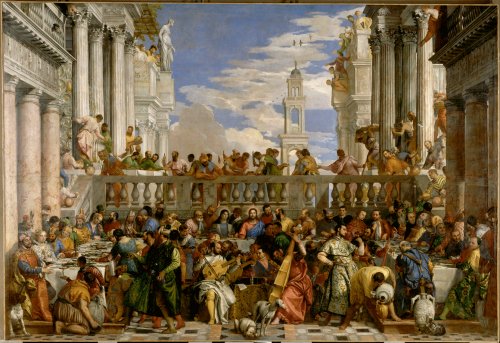
JLB 537, 10/28/1885: "When Veronese had painted the portraits of his beau monde in the The marriage feast at Cana, when he had devoted to it all the richness of his palette in sombre violets, in magnificent golden tones -- then -- there was still a faint azure and a pearly white he thought of -- which doesn't appear in the foreground. He flung it on at the back -- and it was right, changed of its own accord into the surroundings of marble palaces and sky that singularly complete the array of figures. That background is so magnificent in that it came about of its own accord, spontaneously, from a colour calculation. Am I wrong about this? That is truly painting -- and the result is more beautiful than precise imitation of the things themselves." (Emphasis in original.)
Context:
JLB 538, 11/3/1885-11/4/1885: "You'll shortly receive two studies of the autumn leaves, one in yellow (poplars) -- and the other in orange (oaks)."
Context:
JLB 549, 12/19/1885: "It's a real pleasure for me to work with a rather better type of brush, and to have cobalt and carmine,"
Context:
JLB 539, 11/7/1885: "You know the 3 pollard oaks at the end of the garden at home -- I slogged away at them for the 4th time. I'd sat in front of them for three days."
However, we think it is possible that Vincent repainted the background of Still Life with Birds' Nests (F 111 JH 939) after writing this part of the letter and before sending the painting. Not only is Vincent's argument for a black background superfluous (as Van Tilborgh and Vellekoop recognize [p. 201]), but in the very same letter, he seems to back off the argument in light of some paintings he had just seen in Amsterdam: "That, though, a coloured background is attractive in a still life is -- certain. In Amsterdam I saw still lifes by Miss Vos that I thought outstanding -- a good deal better than Blaise Desgoffe -- really Van Beijerenesque." (JLB 536, 10/20/1885; emphasis in original.) "Miss Vos" is probably Maria Vos, a Dutch painter known for her still lifes and watercolors. Blaise Alexandre Desgoffe was a French artist also best known for his still lifes. Abraham Hendrickszn van Beijeren was a leading still-life painter of the Dutch Golden Age, celebrated especially for his sumptuous banquet still lifes.
Context:
BVG 429, 10/15/1885-10/31/1885: "May I not boldly take it to mean that a painter does better to start from the colours on his palette than from the colours in nature?"
JLB 537, 10/28/1885: "May I not simply understand by it that a painter does well if he starts from the colours on his palette instead of starting from the colours in nature?"
Context:
BVG 223, 8/5/1882-8/6/1882: "With long and continuous practice it enables one to draw quick as lightning, -- and once the drawing is established to paint quick as lightning also."
JLB 254, 8/5/1882-8/6/1882: "With CONSIDERABLE practice and with lengthy practice, it enables one to draw at lightning speed and, once the lines are fixed, to paint at lightning speed" (emphasis in original).
Context:
BVG 223, 8/5/1882-8/6/1882: "With long and continuous practice it enables one to draw quick as lightning, -- and once the drawing is established to paint quick as lightning also."
JLB 254, 8/5/1882-8/6/1882: "With CONSIDERABLE practice and with lengthy practice, it enables one to draw at lightning speed and, once the lines are fixed, to paint at lightning speed" (emphasis in original).
Context:
BVG 358, 3/1/1884: "There needs to be more gusto in my life if I am to get more brio into my brush -- exercising patience will not get me a hair's breadth further."
JLB 432, 3/2/1884: "There has to be more zest in my life if I want to get more brio into my brush -- I won't get a hair's breadth further by exercising patience."
Context:
BVG 409, 5/15/1885: "But I shall work on till I am absolute master of my hand, so that I can work even more quickly than now, and, for instance, bring home about thirty studies within a month."
JLB 505, 5/28/1885: "However, I'll keep working until I'm absolutely and utterly sure of my case -- such that I'm working even faster than now and will also be able to bring home 30 or so studies in the space of a month, say."
Context:
JLB 535, 10/13/1885: "Paint in one go, as far as possible in one go."
Context:
JLB 496, 4/28/1885: "But you know I wrote to Mr. Portier -- up till now I've made nothing but studies -- but -- the paintings will come" (emphasis in original.)
Context:
BVG 427, 10/1/1885: " What struck me most on seeing the old Dutch pictures again is that most of them were painted quickly, that these great masters, such as a Frans Hals, a Rembrandt, a Ruysdael and so many others -- dashed off a thing from the first stroke and did not retouch it so very much."
JLB 535, 10/13/1885: " What particularly struck me when I saw the old Dutch paintings again is that they were usually painted quickly. That these great masters like Hals, Rembrandt, Ruisdael -- so many others -- as far as possible just put it straight down -- and didn't come back to it so very much" (emphasis in original).
Context:
JLB 170, 8/5/1881: "Reading books is like looking at paintings: without doubting, without hesitating, with self-assurance, one must find beautiful that which is beautiful."
Context:
JLB 534, 10/10/1885: "You see, in The syndics Rembrandt is true to life, although even there he still goes into the higher -- into the very highest -- infinite. But yet -- Rembrandt could do something else -- when he didn't have to be true in the literal sense, as he did in a portrait -- when he could -- make poetry -- be a poet, that's to say Creator." (Emphasis in original.)
Context:
BVG 427, 10/1/1885: "What joy to see such a Frans Hals, how different it is from those pictures -- there are so many of them -- where everything has been carefully smoothed down in the same way."
JLB 535, 10/13/1885: "What a joy it is to see a Frans Hals like that -- how very different it is from the paintings -- there are so many of them -- where everything has been carefully smoothed out in the same way."
Context:
BVG 427, 10/1/1885: "And heads too -- eyes, nose, mouth done with a single stroke of the brush without any retouching whatever."
JLB 535, 10/13/1885: "And heads, too -- eyes, nose, mouth done with the first brushstrokes, without any sort of retouching."
Context:
BVG 426, 10/10/1885-10/11/1885: "I have packed several still lifes, which you will receive next week, together with two souvenirs from Amsterdam, which I caught on the wing, and also a few drawings."
JLB 534, 10/10/1885: "I've packed up various still lifes which you'll receive next week, with two souvenirs of Amsterdam that I snatched in haste and also a couple of drawings."
Context:
BVG 426, 10/10/1885-10/11/1885: "I have packed several still lifes, which you will receive next week, together with two souvenirsfrom Amsterdam, which I caught on the wing, and also a few drawings."
JLB 534, 10/10/1885: "I've packed up various still lifes which you'll receive next week, with two souvenirs of Amsterdam that I snatched in haste and also a couple of drawings."
Context:
BVG 427, 10/1/1885: "But I sent them to show you that if in an hour's time I want to dash off an impression somewhere, I am learning to do so in the same way as others who analyze their impressions, and who account for what they see. This is a different thing from feeling, i.e. undergoing impressions, there is perhaps a great difference between undergoing impressions and analyzing them, that is to say, taking them to pieces and putting them together again. But it is pleasant work to dash something off in a rush."
JLB 535, 10/13/1885: "I'm sending them all the same to show you that if, in the space of an hour, I want to dash off an impression somewhere, I'm beginning to be able to do this in the same sentiment as others who -- analyze -- their impressions. And give themselves a reason for what they see. This is something other than feeling, that's to say undergoing impressions -- there may perhaps be a great deal between experiencing impressions and -- analyzing them, that's to say taking them apart and putting them together again. But it's enjoyable to put something down in a rush." (Emphasis in original.)
He impatiently asks for the book again in the very next letter: "[I] want to read L'art du XVIIIme siècle as soon as possible -- I particularly want to hear something about Chardin by De Goncourt" (JLB 536, 10/20/1885). And again in early November: "I'm really looking forward to De Goncourt" (JLB 538, 11/3/1885-11/4/1885). Theo finally sent him the book around November 7, 1885 (JLB 539, 11/7/1885). In the meantime, Vincent had apparently read Théophile Thoré's Trésors d'art en Angleterre (Treasures of English Art) (1860) (see JLB 543, 11/20/1885), in which he learned more about Gainsborough. (See Ch. 25, n. 160.) In addition to these possible sources, Vincent had been doing extensive reading in French art of the early nineteenth century for much of 1885 (including Charles Blanc, Armand Silvestre, Alfred Sensier, and Jean-François Gigoux.) Any of these could have led him backwards, and would explain his familiarity, prior to reading the books by Thoré or the De Goncourts, with figures like Maurice Quentin de Latour, the great French pastellist (JLB 539, 11/7/1885).
Context:
JLB 543, 11/20/1885: "I found a passage about Gainsborough that has once more encouraged me to work in one go -- look. It's this brusqueness of touch that gives so much effect. The spontaneity of his impression is there in full, and communicates itself to the viewer. What's more, Gainsborough had a perfect method of ensuring that his compositions formed a whole. He laid down his painting in one go as a rough sketch, and worked it up harmoniously from the top to the bottom, without focusing his attention on small fragments, without getting involved in the details, because he was looking for the general effect and almost always found it, thanks to this broad view of the canvas, which he looked at as one looks at nature, in a single glance." (Emphasis in original.)
Context:
BVG 435, 11/18/1885-11/22/1885: "It is this brusqueness of touch that produces so much effect. The spontaneity of his impression is all there, and communicates itself to the spectator."
JLB 543, 11/20/1885: "It's this brusqueness of touch that gives so much effect. The spontaneity of his impression is there in full, and communicates itself to the viewer."
Context:
BVG 431, 11/8/1885-11/12/1885: "But to work like that one must be something of a magician, to learn which costs a great deal, and the sad sarcastic saying of Michelangelo's: 'Ma manière est destinée a faire de grands sots' [My method is destined to be known as great foolishness] -- is also true of the colourists who dare dash on their colours, this too cannot be imitated by cowards and weaklings."
JLB 539, 11/7/1885: "At the same time, to bring this off one has to be able to do a little magic, which costs one dear to learn, and Michelangelo's gloomy, sarcastic words -- my manner is destined to make great fools -- is also true of those who dare take risks in regard to colour -- there, too, it can't be imitated by the cowards and the dependent" (emphasis in original).
Context:
BVG 431, 11/8/1885-11/12/1885: "But to work like that one must be something of a magician, to learn which costs a great deal, and the sad sarcastic saying of Michelangelo's: 'Ma manière est destinée a faire de grands sots' [My method is destined to be known as great foolishness] -- is also true of the colourists who dare dash on their colours, this too cannot be imitated by cowards and weaklings."
JLB 539, 11/7/1885: "At the same time, to bring this off one has to be able to do a little magic, which costs one dear to learn, and Michelangelo's gloomy, sarcastic words -- my manner is destined to make great fools -- is also true of those who dare take risks in regard to colour -- there, too, it can't be imitated by the cowards and the dependent" (emphasis in original).
Context:
BVG R58, 9/1/1885: "Then I read somewhere else, "Lorsque Delacroix peint -- c'est comme le lion qui dévore le morceau [When Delacroix paints -- it's like a lion devouring a piece (of meat)]."
JLB 526, 8/8/1885-8/15/1885: " 'When Delacroix paints -- it's like the lion devouring his piece of flesh'. And Silvestre's article is particularly full of this latter." (Emphasis in original.)
Context:
JLB 535, 10/13/1885: "That -- dashing off -- with a few brushstrokes, they won't hear of it now -- but how true the results are. And how masterfully well many French painters."
Context:
JLB 535, 10/13/1885: "In the winter I'm going to explore various things regarding manner that I noticed in the old paintings. I saw a great deal that I needed. But this above all things -- what they call -- dashing off -- you see that's what the old Dutch painters did famously." (Emphasis in original.)
Context:
JLB 535, 10/13/1885: "I saw a great deal that I needed. But this above all things -- what they call -- dashing off -- you see that's what the old Dutch painters did famously." (Emphasis in original.)
Context:
JLB 535, 10/13/1885: "In the winter I'm going to explore various things regarding manner that I noticed in the old paintings. I saw a great deal that I needed. But this above all things -- what they call -- dashing off." (Emphasis in original.)
Context:
BVG 429, 10/15/1885-10/31/1885: "This to show you that when I say that I have perhaps not plodded completely in vain, I dare say this, because at present it comes quite easily to me to paint a given subject unhesitatingly, whatever its form or colour may be."
JLB 537, 10/28/1885: "This to show you that when I say that perhaps I haven't swotted entirely for nothing I mean it, because these days it really comes quite readily to me to paint a given object, whatever the shape or colour may be, without hesitation."
Context:
JLB 515, 7/14/1885: "Zola who otherwise, to my mind, often makes colossal mistakes in his judgement of paintings -- says something beautiful about art in general in 'Mes haines'. 'In the painting (the work of art) I look for, I love the man -- the artist.'"
Context:
BVG R57, 8/15/1885-8/31/1885: "I want to paint what I feel and feel what I paint."
JLB 528, 8/18/1885: "I know too well what aim I have in view, I'm too absolutely and utterly convinced that I am, after all, on the right path -- when I want to paint what I feel and feel what I paint -- to worry too much about what people say of me."
Context:
JLB 489, 4/4/1885: "It has become colder again here. As soon as we have a few fine days, I'll make something of the churchyard."
But the real subject is, without question, his recently buried father. Although he never explicitly mentions the pastor or the funeral -- casting everything in terms of the peasants -- he gives the game away inadvertently in his summation: "Victor Hugo, whom they've also just buried, said Religions pass, God remains" (ibid., emphasis added). Another indication of Vincent's recruitment of this image to his Millet fantasy and The Potato Eaters defense is the French name he gives the painting when he sends it to Theo soon after finishing it in June: "Cimitière de Paysans" (The Peasant Cemetery) (ibid.). By choosing this name, Vincent mingles the ashes of his beloved peasants with those of his father in a way that certainly would have been abhorrent to Anna Carbentus, distasteful to Dorus, and perhaps provocative to Theo.
Context:
BVG 411, 6/1/1885-6/15/1885: "I have omitted some details -- I wanted to express how those ruins show that for ages the peasants have been laid to rest in the very fields which they dug up when alive -- I wanted to express what a simple thing death and burial is, just as simple as the falling of an autumn leaf -- just a bit of earth dug up -- a wooden cross."
JLB 507, 6/9/1885: "I've left out some details -- I wanted to say how this ruin shows that for centuries the peasants have been laid to rest there in the very fields that they grubbed up in life -- I wanted to say how perfectly simply death and burial happen, coolly as the falling of an autumn leaf -- no more than a bit of earth turned over -- a little wooden cross. The fields around -- where the grass of the churchyard ends, beyond the little wall, they make a last fine line against the horizon -- like the horizon of a sea."
Context:
BVG 411, 6/1/1885-6/15/1885: "And now those ruins tell me how a faith and a religion mouldered away -- strongly founded though they were -- but how the life and the death of the peasants remain forever the same, budding and withering regularly, like the grass and the flowers growing there in that churchyard."
JLB 507, 6/9/1885: "And now this ruin says to me how a faith and religion mouldered away, although it was solidly founded -- how, though, the life and death of the peasants is and will always be the same, springing up and withering regularly like the grass and the flowers that grow there in that churchyard."

Context:
JLB 507, 6/9/1885: "Today I sent off that little crate, containing 1 other painting, Peasant cemetery, besides what I already told you."
Context:
JLB 538, 11/3/1885-11/4/1885: "I'm enclosing the book by Charles Blanc in the crate with the studies -- also a Bible they gave me for you at home, of which I made a still life"
Context:
JLB 536, 10/20/1885: "Listen -- Frans Hals's flesh colours are also earthy, that's to say in the sense you know. At least often. There's also sometimes -- I almost dare say always -- a relationship of contrast between the tone of the clothes and the tone of the face."
Just as Vincent never fully embraced modernism, he never completely repudiated Christianity. He wrestled with his own faith, or lack thereof, to the end of his life, repeatedly trying to reconstitute the sublime comfort that he had once derived from religion, while still rejecting his parents' judgmental piety. This appears to be roughly the view of Van Tilborgh and Vellekoop, although they parse the symbolism more finely than we would by arguing that the painting does represent a definitive repudiation of at least the Old Testament if not of Vincent's lifelong fascination (and identification) with the figure of Christ (see Van Tilborgh and Vellekoop, pp. 221-222). Other commentators have tried to impose on Vincent's chaotic emotional and psychological life a coherent system of religious beliefs, which we think is both hopeless and misguided (e.g., Greer, pp. 32-35). Vincent never could have separated his bitterness, anger, and guilt toward his father from his feelings about his father's religion -- a necessary predicate to formulating coherent beliefs.

Context:
BVG 429, 10/15/1885-10/31/1885: "In answer to your description of the study by Manet, I send you a still-life of an open -- so a broken white -- Bible bound in leather, against a black background, with a yellow-brown foreground, with a touch of citron yellow. I painted that in one rush, during a single day."
JLB 537, 10/28/1885: "In reply to your description of the study by Manet, I'm sending you a still life of an open, hence an off-white Bible, bound in leather, against a black background with a yellow-brown foreground, with an additional note of lemon yellow. I painted this in one go, in a single day."
Context:
JLB 537, 10/28/1885: "Zola creates, but doesn't hold a mirror up to things, creates them amazingly, but creates, poetizes. That's why it's so good."
Context:
JLB 480, 1/26/1885: "What does not pass in what passes, that exists."
Context:
BVG 429, 10/15/1885-10/31/1885: " Surely that is real painting, and the result is more beautiful than the exact imitation of the things themselves. To think of one thing and to let the surroundings belong to it and proceed from it."
JLB 537, 10/28/1885: " That is truly painting -- and the result is more beautiful than precise imitation of the things themselves. Thinking about one thing and letting the surroundings belong to it, derive from it."
Context:
JLB 537, 10/28/1885: "Romance and romanticism are our era, and one must have imagination, sentiment in painting."
Context:
BVG 434, 11/15/1885-11/20/1885: " As I have been working absolutely alone for years, I imagine that, though I want to and can learn from others, and even adopt some technical things, I shall always see with my own eyes, and render things originally."
JLB 542, 11/17/1885: " Because I've worked entirely alone for years, I imagine that although I will and although I can learn from others and even adopt technical things -- all the same I'll always see through my own eyes and tackle things originally."
Context:
JLB 533, 10/4/1885: "As for Poussin -- he's a painter who thinks and makes one think about everything -- in whose paintings all reality is at the same time symbolic. In the work of Millet, of Lhermitte, all reality is also symbolic at the same time. They're something other than what people call realists."
Context:
BVG 429, 10/15/1885-10/31/1885: "Though I believe that the best pictures are more or less freely painted by heart, still I cannot divorce the principle that one can never study and toil too much from nature."
JLB 537, 10/28/1885: "Although I believe that the finest paintings are made relatively freely from the imagination, I can't break with the idea that one can't study nature, swot even, too much."
Context:
BVG 429, 10/15/1885-10/31/1885: "To study from nature, to wrestle with reality -- I don't want to do away with it, for years and years I myself have been so engaged, almost fruitlessly and with all kinds of sad results. I should not like to have missed that error."
JLB 537, 10/28/1885: "Making studies from nature, wrestling with reality -- I don't want to argue it away. I've tackled it that way myself for years and years, almost fruitlessly and with all sorts of sad results. I wouldn't want to have missed that -- error."
Context:
JLB 537, 10/28/1885: "The greatest, most powerful imaginations have also made things directly from reality that leave one dumbfounded."
"In the beginning," Zola writes in Mes haines, "[Taine] had invented what he called the governing talent; today he has a tendency to do without it. He is carried away, despite himself, by the necessities of his thought, which progresses always through condensing, neglecting the individual more and more, trying to explain the artist solely in terms of external influences. As long as he concedes a bit of humanity to the poet and the painter, a bit of free will and personal flair, he will be unable to reduce him entirely to mathematical rules." (Zola, p. 147.)
This passage surely imprinted itself on Vincent's mind, because it is the prelude to Zola's famous formulation of the modernist credo: "For me, a work is a man; I want to discover a temperament in the work, a particular, unique accent. The more personal it is, the more I am attracted and held. ... I only beg M[onsieur] Taine to accord more importance to personality. As an original artist himself, he must understand that works are tenderly loved offspring for which one sacrifices flesh and blood, and the more they resemble their fathers, feature for feature, the more they move us; they are the cry of a heart and a body, they offer the spectacle of a rare creature nakedly showing all that is human in it. I love these works because I love reality, life. ... Thus it may be well agreed that the artist places himself in front of nature, that he copies and interprets it, that he is more or less realistic according to his vision; in a word, that his mission is to show us objects as he sees them, emphasizing certain details, creating anew. I will express my total thought in saying that a work of art is a corner of creation seen through a temperament." (ibid., pp. 147-150; emphasis added.)
Unwilling to let a good story lie untold, however, Kerssemakers lifted the cloak of charity in a subsequent letter to Albert Plasschaert in 1912: "In my memoirs," he wrote, "I spoke of a strange revenge, which he took on that clergyman in Nuenen. I didn't think that it was suitable for the general public to read. But I will tell you, counting on your discretion. At one time he visited me on his trip from Antwerp and said: 'I have brought something from my trip to please that poor fellow in Nuenen [i.e., the priest].' Of course I was very curious what that could be and then he showed me a few condoms (gants d'amour). 'I will distribute them among the country lads in Nuenen. We'll see what kind of effect it will have.'" (b3038 V/1982, "Kerssemakers, Anton" to "Plasschaert, A.", 8/27/1912.) Kerssemakers adds: "You can tell that the missionary spirit was long gone" (ibid).
Context:
BVG 433, 11/10/1885-11/20/1885: "But then it does not make an absolute impression on people, and by renting another room and taking no notice of it for a few months, the intrigue will lose most of its virulence."
JLB 541, 11/14/1885: "But anyway, it doesn't make an absolute impression on people, and by renting another room and letting things lie for a few months, the intrigue will lose a great deal of its force" (emphasis in original).
Context:
BVG 432, 11/12/1885-11/15/1885: "This month I had to pay my rent, and at the same time I gave notice that I shall leave my studio toward May. Its drawback is, as you know, that I am greatly handicapped by the neighbours, and I notice that people are still afraid of the priest, though perhaps he wouldn't meddle any further."
JLB 540, 11/11/1885: "I had to pay my rent this month, and at the same time gave notice on my studio come May. The drawback to which is that because of the neighbours, as you know, I really lack privacy, and I observe that the people are still afraid of the priest -- although perhaps he wouldn't meddle in things any more.
He then proceeds to an elaborate "diagnosis" of their mother's fatal "illness," which he combines with a broad analysis of her personality -- a strong indication that his prophecies of death spring from a much deeper well. "The change I've observed is that every so often Ma is much more lucid in her thinking, whereas in the last few months she has had long periods when it seemed to be rather clouded -- which is really not to be wondered at. There's been something harried about her for a while -- as a result -- I can well imagine -- of the emptiness and feeling alone. Well -- it struck me -- that she's become very calm and very composed -- and something resolute has taken the place of fretting. There's nothing more to see." (ibid., emphasis in original.)
Vincent's relentlessly poetic imagination appears to be insisting that his mother should die of grief soon after the death of her long-time spouse. It defies his magazine-illustration conventions that his mother has stopped being the grieving ("fretting") widow and has turned "very calm," "composed," and "resolute" -- the latter, perhaps, a reference to her unforgiving attitude toward Vincent. He explains her unsettling clarity by imagining that it masks a resignation in the face of imminent death: "If the lucidity and calm last, for my part I expect a crisis after the trip, in other words before long -- and a death without much struggle. But -- it sometimes happens that the mind becomes rather clouded, then it drags on, and in that case there could still be much suffering and worry to struggle through. Think about this, whether I might be wrong in suggesting these two possibilities, either quickly without suffering, or the other." (ibid.)
In its elaborateness and insistence -- despite the complete lack of foundation or encouragement -- this delusion matches Vincent's other "castles in the air" delusions. And he not only pursues it through several more letters to Theo, but he discusses it with his sister Wil (JLB 540, 11/11/1885), and proposes taking it to his mother's doctor -- although he prepares himself to dismiss the good doctor's opinion: "I'm willing to go to [Arnold Louis Karel Hubert] Van de Loo if need be, only you know that doctors sometimes don't tell you everything, particularly in doubtful cases" (JLB 541, 11/14/1885). He imagines that Van der Loo's silence on the issue means that the case is hopeless: "I mean, he would already have given a warning if a danger that could be averted were threatening. But if he doesn't say anything it's a sign that, if there were something, he can't do anything about it and nothing should be done about it." (ibid.) Slipping into the role of "doctor" himself, Vincent pronounces the grim diagnosis that he suspects Van der Loo is hiding: "I think it will just have to take its course. Now in such cases, you'll agree with me, worrying and being overanxious is intolerable for the patient if she notices it. And with old people there's often no way of predicting it, precisely because in so many cases their hearts aren't normal, because of fatty degeneration, say." (ibid., emphasis in original.)
Vincent then goes into the strangest part of this very strange analysis. He finds the root of his mother's problem in the nature of her psyche: "there's definitely a substratum of deep thoughts in Ma (for her inner life, her life of the mind is fairly complicated and has levels or layers) that she neither wants to nor could express" (ibid.). Thus, her sudden lucidity is even more harmful because "there's much more chance of staying alive if the mind is no longer all too clear, than in periods of lucidity" (ibid.).
The most intriguing aspect of this progression is the insight it may give into Vincent's psyche and his way of dealing with his own problems. It suggests that he felt he had to avoid thinking too clearly about those problems, about his life, lest the clarity kill him. The belief that lucidity brings clearer recognition of problems that can accelerate illness and death would also be an encouragement to substance abuse. Vincent tries to lend his grand theories the imprimatur of real medicine by offering to take his mother for a "really thorough examination" (ibid.). When Van der Loo reports that "there's nothing wrong with her ... she can live for another 10 years or so ... if she dies before that time, then she would have to have contracted some disease or other" (JLB 542, 11/17/1885), Vincent takes the news in stride -- perhaps because, by this time (mid-November), he has accepted the inevitability of leaving Nuenen. In fact, Anna Carbentus van Gogh did not die until 1907, outliving her eldest son by seventeen years. Inevitably, Vincent's effort to rush his mother into her grave has attracted the attention of commentators with a psychological bent. (See Lubin, pp. 80-81, 119-120; and Nagera, pp. 97-98.)
Context:
BVG 432, 11/12/1885-11/15/1885: "I do not think it impossible that to her too death may come unexpectedly and softly, just as it came to Father, and for a similar reason."
JLB 540, 11/11/1885: "I don't consider it impossible -- that death could also come to her unexpectedly and gently, much as with Pa and for similar reason."
Context:
BVG 432, 11/12/1885-11/15/1885: "'Aging' is such a strange thing, and it is absolutely certain that there are many cases of a wife's not outliving her husband by long."
JLB 540, 11/11/1885: "'Getting old' is such a singular thing, and there are certainly a lot of instances where the wife doesn't survive the husband very long."
Context:
JLB 541, 11/14/1885: "... it's to be expected that there would never be an end to it in this studio right next door to the priest and the sacristan. So I'm changing that."
Context:
JLB 541, 11/14/1885: "... by renting another room and letting things lie for a few months, the intrigue will lose a great deal of its force."
Context:
JLB 541, 11/14/1885: "I've also thought of Drenthe, though, but as more difficult to bring about."
Context:
JLB 541, 11/14/1885: "Wouldn't it be best if I could spend the next couple of months, December and January, there?"
Context:
JLB 541, 11/14/1885: "I know the area and the folk too well and love them too much to believe I'm going for good."
Context:
JLB 541, 11/14/1885: "Well roughly, my plan is to go to Antwerp -- I can't possibly calculate the ins and outs beforehand. I've come by the addresses of 6 art dealers, so I'd want to take something with me and further, as to the work, I plan to paint a few views of the city as soon as I get there -- reasonably large -- -- and show them straightaway too."
No, the circumstances point toward other, unrevealed drains on his limited resources. We see two possible explanations for the persistent shortages. The first is the traveling he did that fall: both the reported trip to Amsterdam and the unreported trip to Antwerp. He complains immediately after returning from the second trip (Amsterdam): "As regards the end of this month -- old chap, I'm literally cleaned out -- what's to be done? Couldn't you send an extra twenty francs or something?" (JLB 534, 10/10/1885.) "Be aware that it's awfully tough for me at the end of the month. All the same, I'm glad I went there [to Amsterdam], even if it's at a moment when I can afford the expenditure less than ever." (JLB 535, 10/13/1885.)
The second possible explanation is less flattering. When he was cut off from contact with Gordina, Vincent may have turned more to prostitutes, as he did when he first arrived in Nuenen (see Ch. 22, n. 19). The evidence for this form of expenditure is, of course, circumstantial: his increasing interest in drawing from the nude (see Ch. 25, n. 66) -- one of the factors that drove him to Antwerp ("it's not absolutely impossible I might find an opportunity somewhere to paint from the nude" [JLB 541, 11/14/1885]); his sudden and exaggerated interest in paintings of women (JLB 539, 11/7/1885; (JLB 543, 11/20/1885) and in painting portraits of women ("the bourgeois folk, and certainly no less the tarts, no matter who they are, always value portraits " [JLB 541, 11/14/1885; emphasis in original]) -- an obsession that will explode in Antwerp (see Chapter 25); his new concerns about potency ("the thing that really makes one happy, being young and staying so for a long time" [ibid.]). These two explanations could be related. Vincent's return from Antwerp with a supply of condoms (see Ch. 25, n. 220) may shed indirect light on his activities there.
Context:
JLB 556, 1/29/1886: "If I go to Brabant I'll have the expenses of my journey, I'll also have to pay for my room there (which I gave notice on) and take somewhere else to store my things, which will be not less than 50 francs rent and another 50 francs in advance for a new store and removals. I'd also be obliged to pay for some paint -- and of course I'd begin to paint again there too. Now I thought that because of the force majeure of circumstances I was free to declare myself unable to meet these obligations at present. In other words not to pay my rent there but to say, put my furniture in your attic, keep it as security, I'll pay you when I come to collect it, then at the same time I don't have to rent new storage."
Context:
JLB 559, 2/6/1886: "Further, since you say you'll have to pay rent until the end of June -- well then, perhaps it would be best after all if I were to return to Nuenen, starting in March, only -- if I encountered opposition and scenes like I got before I left, I would be wasting my time there and so, even if it were only just for those few months, I'd make a change anyhow, since I want to have some new things from the country ready to bring to Paris with me."
Context:
BVG 440, 12/15/1885: "As I have received a letter from Mother asking me to write her and informing me that she has asked you to give her my address, will you let them know that I am not going to write, which for that matter I told them quite simply when I went away. You will understand that things like what happened in March are decisive. Then I left the house, from which may be inferred as a matter of course that they got what they wanted; for the rest, I think of them extremely, extremely little, and I do not desire them to think of me, as far as that goes."
JLB 548, 12/17/1885: "As I've received a letter from Ma, who asks me to write and said she'd asked you for my address, will you let them know that I won't write, which for that matter I already made quite plain when I left? You'll understand when something happens as it did in March, it's one of those things that is decisive. I left the house then &c. It follows automatically that, since they got their way, I hardly think about them at all, hardly at all; for that matter don't want them to think about me either."
Context:
JLB 542, 11/17/1885: "He wrote that Tersteeg and Wisselingh had seen them and thought them 'not suitable for them.'"
Context:
JLB 539, 11/7/1885: "Although the man has money, although he really liked it -- I had such a tingle of good spirits when I saw that it worked, that it created a mood as it hung there because of the soft, melancholy peace of that colour combination -- that I COULD not sell. But because it had affected him, I gave it to him, and he accepted it just as I meant it, without many words, that's to say little other than -- 'the thing's damned good.'" (Emphasis in original.)
Context:
BVG 435, 11/18/1885-11/22/1885: "And meanwhile my power has somewhat ripened, so that I feel more independent of the common intrigues, which enables me to pitch certain fellows out."
JLB 543, 11/20/1885: "And in the meantime my powers have matured somewhat, so that I feel more independent of the usual intrigues to chuck someone out."
Context:
BVG 440, 12/15/1885: "And sometimes it is quite refreshing to perceive one has been mistaken, though then one has to begin all over again from the very beginning."
JLB 548, 12/17/1885: "And it's a relief when one realizes that one has been mistaken -- even if one then has to start from the beginning again."
Context:
JLB 539, 11/7/1885: "But one isn't a painter in a year, nor is that necessary. Only there's already a good thing running through it, and hope is alive instead of one feeling powerless in front of a wall."
Context:
JLB 539, 11/7/1885: "Pastel is a process I'd really like to know. I'll do it later, too. If one can paint a head, one must be able to learn it in a few hours."
Context:
JLB 539, 11/7/1885: "At the moment, when I read about that outstanding devil, that famous La Tour -- how real it is, by Jove -- and -- how well (apart from his terrible avarice) that fellow tackled life and -- painting."
Context:
BVG 431, 11/8/1885-11/12/1885: "How great is the similarity between the ideas of Latour, for instance, and Frans Hals, when they express life with pastel which one could almost blow off."
JLB 539, 11/7/1885: "Well, what a similarity there is between the ideas of La Tour &c. and Frans Hals, when they express life in pastel that one could blow away."
Context:
JLB 539, 11/7/1885: "I don't know what I'll do or how things will go for me, but I hope I won't forget these lessons I've been taking recently: in one go, quickly but with absolutely total exertion of everything one may have in the way of spirit and attention."