
Notes
Chapters
- A Fanatic Heart
- 27. Against the Grain
- 28. The Zemganno Brothers
- 29. Catch and Release
- 30. A Mercenary Frenzy
- 31. Le Paradou
- 32. The Sunflower and the Oleander
- 33. The Poet's Garden
- 34. Imaginary Savage
- 35. La Lutte
- 36. The Stranger
- 37. Two Roads
- 38. The Real South
- 39. Starry Night
- 40. The Isolated One
- 41. A Degenerate Child
- 42. The Garden and the Wheatfield
- 43. Illusions Fade, the Sublime Remains
- Ici Repose
The Early Years
The Dutch Years
The French Years
Chapters
What is striking about Vincent's account of the "Amsterdam" whore -- and the reason why suspicions about an earlier connection to Sien Hoornik persist -- is the extraordinary similarity between the two. Describing the Amsterdam prostitute, Vincent writes: "And she was no longer young, perhaps the same age as K.V., and she had a child, yes, life had given her a drubbing and her youth was gone. Gone? -- there is no such thing as an old woman." (JLB 193, 12/23/1881.) Almost everything about this woman -- the age, the child, perhaps even the pockmarks ("life had given her a drubbing") -- even the invocation of Michelet, anticipates Vincent's later descriptions of Sien Hoornik (ibid.). If, in fact, he impregnated her in September, he likely would have sought her out again after the collapse of his romantic suit of Kee Vos (see Zemel, p. 367, n. 22). Finally, there is good reason not to trust Vincent's implied insistence that the timing of their first meeting foreclosed the possibility of his paternity. At the time he tells Theo that he met Sien at the end of January, he is desperately arguing to marry Sien in order to rescue her from the depredations of an uncaring society (specifically, the man who left her pregnant). If, in fact, he was responsible for her pregnancy, his case would have been considerably weakened. (As Zemel points out, other aspects of Vincent's story about Sien's "youthful liaison" gone wrong are contradicted by the known facts [ibid., p. 366].) It must be probative of something that Vincent's denials of paternity were not nearly as convincing to his family at the time as they have been to subsequent commentators like Hulsker. Not only Dorus, but even the sympathetic Theo, continued to suspect that Vincent was, indeed, the father of Sien's child.
Context:
JLB 228, 5/16/1882: "Then, after M. let me down and I was ill for a few days, at the end of January I met Christien."
Context:
BVG 189, 4/15/1882-4/27/1882: " Do you perhaps know something that I do not, or can you give me some information about this matter?"
JLB 219, 4/21/1882: " Do you perhaps know something about this that I don't? Could you perhaps enlighten me on this subject?"
Context:
BVG 197, 5/12/1882 or 5/13/1882: "That is something quite apart -- there is a barrier between artistic and personal matters -- but it is right to settle how we look at those things beforehand."
JLB 226, 5/13/1882: "The other is something entirely separate, there's a boundary between the artistic and the intimate, but it's good to agree frankly on how we see things."
In an effort to display his commanding knowledge on this subject, Vincent lectures Van Rappard at length on "two kinds of mistresses": "Now in my opinion there are two kinds of mistress. One is the kind with whom one can give and take love, one or both of you being aware, meanwhile, that it isn't forever, neither does one surrender to it whole-heartedly and unreservedly. Such mistresses get on one's nerves, they coax, they spoil one, then -- then -- ... they burn up a good many men. The second kind of mistress is of an entirely different disposition. The strait-laced -- Pharisees -- Jesuits!!! They are the kind of women of marble -- sphinx -- cold vipers -- who would like to bind men to themselves, entirely, for ever and ever, without her ever surrendering whole-heartedly, entirely, unreservedly. They suck your blood. Such mistresses freeze men, and petrify them." (ibid.; emphasis in original.) What is striking about this heated disquisition is its removal from the reality of prostitutes and brothels. Even discounting for the elaborate conceit that Vincent is attempting to build, his insights into sex and women seem little more than warmed-over schoolboy bluster.
Vincent had similar exchanges with Theo. This is suggested by this comment in December 1881 after Vincent tells Theo about his encounter with the prostitute in Amsterdam (see Chapter 15): "That woman didn't cheat me -- oh, anyone who thinks all those sisters are swindlers is so wrong and understands so little. That woman was good to me, very good, very decent, very sweet. In what way? That I won't repeat even to my brother Theo, because I strongly suspect my brother Theo of having experienced something of this himself now and then. The better for him." (JLB 193, 12/23/1881.)
Context:
JLB 193, 12/23/1881: "Whenever I walked down the street -- often all alone and at loose ends, half sick and destitute, with no money in my pocket -- I looked at them and envied the people who could go off with her."
Context:
BVG R21, 2/7/1883: "As to her past life, I believe that you condemn 'fallen women' no more than I do."
JLB 309, 2/8/1883: "As to her life, I believe that, like me, you don't condemn fallen women."
Context:
BVG 72, 8/2/1876: "The heart of a carnal man 'sometimes succumbs to a violent desire' is the view of those who preach and work for Him, who has given them some sort of a baptism of the Holy Spirit and of fire."
JLB 87, 8/2/1876: "The heart of a man of flesh and blood 'sometimes faints from earnest longing' upon seeing those who devote themselves to and work for Him who baptized them, as it were, with the Holy Ghost, and with fire, and they -- look, their eyes sometimes grow moist with tears of wistfulness as they think back on their young years and on 'the good things with which He satisfied them.'"
Context:
BVG 72, 8/2/1876: "The heart of a carnal man 'sometimes succumbs to a violent desire' is the view of those who preach and work for Him, who has given them some sort of a baptism of the Holy Spirit and of fire."
JLB 87, 8/2/1876: "The heart of a man of flesh and blood 'sometimes faints from earnest longing' upon seeing those who devote themselves to and work for Him who baptized them, as it were, with the Holy Ghost, and with fire, and they -- look, their eyes sometimes grow moist with tears of wistfulness as they think back on their young years and on 'the good things with which He satisfied them.'"
Context:
JLB 193, 12/23/1881: "It was a sober, simple little room she lived in, with a subdued, grey tone because of the plain wallpaper and yet as warm as a painting by Chardin, a wooden floor with a mat and an old piece of dark-red carpet, an ordinary kitchen stove, a chest of drawers, a large, perfectly simple bed, in short, a real working woman's interior. She had to do the washing the next day. Just right, very good, I would have found her just as charming in a purple jacket and a black skirt as now in a brown or red-grey frock. And she was no longer young, perhaps the same age as K[ee] V[os], and she had a child, yes, life had given her a drubbing and her youth was gone. Gone? -- there is no such thing as an old woman. Ah, and she was strong and healthy -- and yet not rough, not common."
Context:
JLB 193, 12/23/1881: "In the circumstances, however, I struggled much within myself, and in that struggle some things concerning physical powers and health gained the upper hand, things which I believe and know more or less through bitter experience. One doesn't live too long without a woman without going unpunished. And I don't think that what some call God and others the supreme being and others nature is unreasonable and merciless, and, in a word, I came to the conclusion, I must see whether I can't find a woman."
Context:
BVG 164, 12/21/1881: "It was not the first time that I was unable to resist that feeling of affection, that special affection and love for those women who are so damned and condemned and despised by clergymen from the lofty heights of their pulpits."
JLB 193, 12/23/1881: "It's not the first time I couldn't resist that feeling of affection, particularly love and affection for those women whom the clergymen damn so and superciliously despise and condemn from the pulpit."
Context:
JLB 203, 1/26/1882: "… you mustn't be embarrassed about going to a girl now and then, if you know one you can trust and you can feel something for, of which there are many in fact. Because for someone whose life is all hard work and exertion it's necessary, absolutely necessary, to stay normal and to keep one's wits about one."
Context:
JLB 201, 1/21/1882: "I've had a model every day on a regular basis, from morning to evening, and the model is good."
Context:
JLB 212, 3/16/1882-3/20/1882: "I wanted, for instance, so very, very much to have, for example, a nude model for a digger or seamstress. From the front, from the back, from the side. To learn to see and sense the shape through the clothing and get a clear idea of the movement."
Context:
JLB 220, 4/23/1882: "I'll continue to live in a different sphere from most other painters, because my view of things, the subjects I want to depict, inevitably demand it."
Context:
JLB 220, 4/23/1882: "Because -- and you know this -- I do love Mauve, and it's so awful that nothing much will come of all that happiness he held out to me. For I fear that the better I draw the more trouble and opposition I'll encounter."
Context:
JLB 220, 4/23/1882: "I fear that the better I draw the more trouble and opposition I'll encounter. Because I'll have to suffer greatly for various idiosyncrasies that I cannot change. First of all, my appearance and manner of speaking and clothing." (Emphasis in original.)
Context:
JLB 220, 4/23/1882: "Do I lower myself by living with the people I draw, do I lower myself by frequenting the houses of workers and poor people or by receiving them in my studio? It seems to me that my profession involves that."
Context:
JLB 220, 4/23/1882: "Do I lower myself by living with the people I draw ..."
Context:
BVG 190, 4/15/1882-4/27/1882: "Do I lower myself by living with the people I draw? Do I lower myself when I go into the houses of labourers and poor people and when I receive them in my studio?"
JLB 220, 4/23/1882: "Do I lower myself by living with the people I draw, do I lower myself by frequenting the houses of workers and poor people or by receiving them in my studio?"
Context:
BVG 190, 4/15/1882-4/27/1882: "I put the question, where do the draughtsmen who work for the Graphic, Punch, etc., get their models?"
JLB 220, 4/23/1882: "I ask this: where do the draughtsmen for The Graphic, Punch &c. get their models?"
Context:
BVG 190, 4/15/1882-4/27/1882: "First, my appearance and my way of speaking and my clothes; and then, even later on when I earn more, I shall always move in a different sphere from most painters because my conception of things, the subjects I want to make, inexorably demand it."
JLB 220, 4/23/1882: "First of all, my appearance and manner of speaking and clothing, and also because later, when I'm earning more, I'll continue to live in a different sphere from most other painters, because my view of things, the subjects I want to depict, inevitably demand it."
Context:
BVG 195, 5/1/1882: "But I say to myself that it's better to do it in a year than to do it now, because I do not want the beauty to come from the material, but from within myself."
JLB 222, 5/1/1882: "But I imagine it would be better for me to do that in a year and not now, because I want the fine appearance to come from me and not from my material."
Context:
BVG 204, 6/1/1882: "I am longing to know what impression Sien will make on you. There is nothing special about her, she is just an ordinary woman of the people who has something of the sublime for me."
JLB 234, 6/1/1882-6/2/1882: "I'm eager to know what sort of impression Sien will make on you. There's nothing special about her; she's just an ordinary woman of the people who for me has something sublime."
Context:
JLB 222, 5/1/1882: "Last year I wrote you a great many letters telling you what I thought about love. I'm not doing so now, because I'm busy putting those same things into practice. ... Would I have done better to go on thinking of her and to overlook what came my way?"
Context:
JLB 222, 5/1/1882: "I cannot decide whether I'm acting consistently or inconsistently."
Context:
JLB 222, 5/1/1882: "I want to come not only today but also tomorrow and the day after, and I understand what you need, go ahead ..."
Context:
JLB 222, 5/1/1882: "And provided I myself am capable of doing something, I'll make twice as much progress, and perhaps it will prove easier than expected."
Context:
JLB 222, 5/1/1882: "Pa and Ma come to visit me, it would result in a change of feeling on both sides."
Context:
JLB 216, 4/10/1882: "Naturally I don't always draw like this. But I'm extremely fond of those English drawings that are done in this style, so it's no wonder that I tried to do the same for once."
Context:
BVG 186, 4/10/1882: " Mais reste le vide du coeur, Que rien ne remplira. "
JLB 216, 4/10/1882: "But the heart's emptiness remains, that nothing will make full again."
Context:
JLB 216, 4/10/1882: "Naturally I don't always draw like this. But I'm extremely fond of those English drawings that are done in this style, so it's no wonder that I tried to do the same for once, and because it was for you, who understands these things, I didn't hesitate to be somewhat melancholy."
Context:
BVG 186, 4/10/1882: "In my opinion the enclosed is the best figure I have drawn yet, therefore I thought I should send it to you."
JLB 216, 4/10/1882: "The enclosed is, I think, the best figure I've drawn, that's why I thought I'd send it to you."
Context:
JLB 222, 5/1/1882: "I've tried to imbue the landscape with the same sentiment as the figure. Frantically and fervently rooting itself, as it were, in the earth, and yet being half torn up by the storm. I wanted to express something of life's struggle, both in that white, slender female figure and in those gnarled black roots with their knots."
Context:
JLB 224, 5/7/1882: "People suspect me of something ... it's in the air ... I must be hiding something ... Vincent is keeping something back that may not be divulged."
Context:
JLB 224, 5/7/1882: "Well, gentlemen, I'll tell you -- you who set great store by manners and culture, and rightly so, provided it's the real thing -- what is more cultured, more sensitive, more manly: to forsake a woman or to take on a forsaken one? This winter I met a pregnant woman, abandoned by the man whose child she was carrying. A pregnant woman who roamed the streets in winter -- who had to earn her bread, you can imagine how. I took that woman as a model and worked with her the whole winter."
It is interesting to note that the death of the first Hendrik Petrus in 1862, at less than one year of age, was followed a year later by the birth of another Hendrik Petrus -- almost exactly the same circumstances as led to Vincent's naming. Perhaps because of the very early death of Antonius Petrus, Zemel calls Sien "the eldest of ten children" (Zemel, p. 18).
With fingers weary and worn,
With eyelids heavy and red,
A Woman sat in unwomanly rags,
Plying her needle and thread.
Stitch! Stitch! Stitch!
In poverty, hunger and dirt,
And still with a voice of dolorous pitch,
Would that its tone could reach the Rich,
She sang this "Song of the Shirt."
Vincent apparently knew this song.
Context:
JLB 225, 5/10/1882: "I'm amazed at the sight of her getting stronger and more cheerful every day, she's so changed that she seems like a completely different person from the sick, pale woman I met this winter."
Context:
JLB 234, 6/1/1882-6/2/1882: "But she has repeatedly suffered a lot, from smallpox for example, and then from throat disease."
Context:
BVG R8, 5/28/1882: "Oh, there is gossip enough, because I am always in her company, but why should that bother me? -- I never had such a good assistant as this ugly (???),faded woman. In my eyes she is beautiful, and I find in her exactly what I want; her life has been rough, and sorrow and adversity have put their marks upon her -- now I can do something with her."
JLB 232, 5/28/1882: "I hear gossip about how I'm always together with her, but why should I let that bother me? -- I've never had such a good assistant as this ugly??? wasted woman. To me she's beautiful, and I find in her exactly what I need. Life has given her a drubbing, and sorrow and adversity have left their mark on her -- now I can make use of it."
Context:
BVG 201, 6/2/1882: "And she is useful to me just because she is no longer handsome, no longer young, no longer coquettish, no longer foolish."
JLB 234, 6/1/1882-6/2/1882: "And the fact that she's no longer beautiful, no longer young, no longer silly, no longer coquettish -- those are the very things that make it possible for me to do something with her."
Context:
JLB 225, 5/10/1882: "In a short time she became as gentle as a tame dove, certainly not by force on my part but because she saw that I wasn't rough."
Context:
JLB 225, 5/10/1882: "First of all, her speech, which is ugly and which is the result of her illness, then her temper, which stems from a nervous disposition, causing her to have moods that many would find unbearable."
Context:
JLB 225, 5/10/1882: "First of all, her speech, which is ugly and which is the result of her illness, then her temper, which stems from a nervous disposition, causing her to have moods that many would find unbearable."
Context:
JLB 234, 6/1/1882-6/2/1882: "Thanks to plain food, plenty of walking and fresh air and taking baths, she's much stronger and more robust than then."
We have resisted the implication that she was "alcoholic," but we are confident that, given Sien's life, her profession, and her place at the head of a family of men and boys (she had only one surviving sister), that her forthright "Yes" to the doctor's question should be taken at face value, at least. Nor should the absence of any "malice or disapproval" on Vincent's part be given significant weight: he has ample reason to minimize her flaws, as well as his own weakness for alcohol (Hulsker, Vincent and Theo, pp. 138-139). The fact that Sien also smoked cigars -- a habit generally considered male and associated with drink -- also supports the characterization in the text.
Context:
JLB 246, 7/15/1882-7/16/1882: "I've been greatly entertained by what Sien has told me of her conversations with the professor. It really was amusing, and the man seems to go about his work with a good deal of bonhomie. For example, he said: tell me, do you enjoy a glass of bitters and can you smoke cigars? Yes, she replied."
Context:
JLB 234, 6/1/1882-6/2/1882: "But she has repeatedly suffered a lot, from smallpox for example, and then from throat disease."
Context:
BVG 194, 5/4/1882-5/12/1882: "Perhaps I can understand her better than anyone else because she has a few peculiarities which would have been repulsive to many others."
JLB 225, 5/10/1882: "I was perhaps more able than others to understand her, because she has a couple of peculiar habits that many would find repellent."
Context:
BVG 194, 5/4/1882-5/12/1882: "First, her speech, which is very ugly and is a result of her illness; then her temper, caused by a nervous disposition, so that she has fits of anger which would be unbearable to most people."
JLB 225, 5/10/1882: "First of all, her speech, which is ugly and which is the result of her illness, then her temper, which stems from a nervous disposition, causing her to have moods that many would find unbearable."
Context:
BVG R20, 2/4/1883: "Well, my dear friend, that woman had another child, a sickly, neglected chit of a girl."
JLB 307, 2/4/1883: "Now, my dear friend, this woman had another child as well, a sickly, neglected lamb."
Context:
JLB 242, 7/2/1882: "And he says that she had been at death's door more than once, especially during her previous throat illness, in an earlier miscarriage, and then last winter, that she has been profoundly weakened by a life of turmoil and agitation, year after year, that now that she no longer needed to lead that life she'd recover of her own accord, provided there are no complications, with rest, tonics, plenty of fresh air and no heavy labour."
Context:
BVG 260, 1/13/1883: "And when I think it over, would it have been better if the mother had had a miscarriage or if the baby had withered or pined away through lack of milk, if the little girl had become more and more dirty and neglected, and the woman herself had sunk into an almost indescribably miserable condition?"
JLB 301, 1/13/1883: "And when I now reflect, would it have been better if the mother had had a miscarriage, or if the child had withered and wasted away for lack of mother's milk, and if that girl had been left more and more unclean and neglected, and the woman herself in who knows what wretched, near indescribable state"
Context:
BVG 201, 6/2/1882-6/3/1882: "Nobody cared for her or wanted her, she was alone and forsaken like a worthless rag, and I have taken her up and have given her all the love, all the tenderness, all the care that was in me; she has felt this and she has revived, or rather, she is reviving."
JLB 234, 6/1/1882-6/2/1882: "No one cared for her or wanted her, she was alone and abandoned like a discarded rag and I picked her up and gave her all the love, all the tenderness, all the care, that was in me. She felt that and has grown stronger, or rather is in the process of growing stronger."
Context:
JLB 229, 5/18/1882: "Christien had a lot of cramp &c., and so it seemed to me best for her to go to Leiden again to find out exactly what was wrong."
Context:
JLB 417, 12/26/1883: "There was anaemia and perhaps already the first signs of consumption, too."
Context:
BVG 350, 12/25/1883-12/28/1883: "There was anemia, and perhaps the beginning of consumption; well, as long as I was with her, she did not grow worse, but in many respects stronger, so that several ugly symptoms disappeared."
JLB 417, 12/26/1883: "There was anaemia and perhaps already the first signs of consumption, too. Well, as long as I was with her she didn't get any worse, but stronger in many respects, so that various nasty symptoms didn't recur."
Context:
JLB 246, 7/15/1882-7/16/1882: "For example, he said: tell me, do you enjoy a glass of bitters and can you smoke cigars?"

Context:
BVG 201, 6/3/1882: "Her type of profile resembles " L'Ange de la Passion" by Landelle, you know the one I mean, a kneeling figure; the print is published by Goupil."
JLB 234, 6/1/1882-6/2/1882: "Now, her profile is rather like the Angel of the passion by Landelle, you know that I mean a kneeling figure -- the print is published by Goupil."
Context:
BVG 201, 6/3/1882: "You see, if Tersteeg, for instance, could do what he liked, he would separate Sien from me, force her back into her former damned life which she has always hated -- and why?"
JLB 234, 6/1/1882-6/2/1882: "See, if Tersteeg, for example, could do what he wanted, he would take Sien from me and throw her back into that accursed old life that she always loathed."
Context:
BVG 212, 7/6/1882: "I have a feeling of being at home when I'm with her, a sense that she brings my own hearth with her."
JLB 244, 7/6/1882: "I have a sense of being at home when I'm with her, a sense that she brings my 'hearth and home' with her ..." (emphasis in original).
Context:
JLB 234, 6/1/1882-6/2/1882: "What I appreciate in her is that she doesn't play the coquette with me, goes her own way quietly, is thrifty, is very willing to adapt to circumstances as she finds them and to learn, so that she can help me in my work in a thousand ways. And the fact that she's no longer beautiful, no longer young, no longer silly, no longer coquettish -- those are the very things that make it possible for me to do something with her."
Context:
JLB 235, 6/3/1882: "My everyday clothes, however, aren't at all shoddy, because now I have Sien to keep check of them and make minor repairs."
Context:
JLB 234, 6/1/1882-6/2/1882: "Comes every week to scrub the studio to save the money for a cleaner."
Context:
BVG 180, 3/11/1882: "She had brought me a dish of beans and potatoes. There are things that make life worth living after all."
JLB 210, 3/11/1882: "... she had a portion of string beans and potatoes with her. There are indeed things in life that are worth the effort."
Context:
JLB 234, 6/1/1882-6/2/1882: "Do you remember the nursemaid we had years ago in Zundert, Leen Veerman? Sien is a similar type of person, I believe, if my memory is correct."
Context:
JLB 231, 5/27/1882: "… she often manages to calm me down, which I couldn't do myself."
Context:
JLB 193, 12/23/1881: "That woman didn't cheat me -- oh, anyone who thinks all those sisters are swindlers is so wrong and understands so little."
Context:
JLB 228, 5/16/1882: "Christien doesn't know the details -- and doesn't ask, knowing that I deal honestly with her and wanting to be with me come what may."
Context:
BVG 193, 5/14/1882: "I always told her, ' Lass, I fear there will come a time when I shall be left quite without means.'"
JLB 228, 5/16/1882: "I continually said to her ' Lass, I fear a time will come when I'm completely penniless.'"
Context:
JLB 246, 7/15/1882-7/16/1882: "I'm quite used to rolling up my sleeves to do things that the woman is too weak for, such as making the bed or a thousand other chores."
Context:
BVG 217, 7/19/1882: "The poor creature has had a very hard time of it."
JLB 248, 7/19/1882: "The poor creature has suffered appallingly."
Context:
BVG 194, 5/4/1882-5/12/1882: "In a short time she became as meek as a tame dove, certainly not from my coercing her, but because she saw that I was not rough."
JLB 225, 5/10/1882: "In a short time she became as gentle as a tame dove, certainly not by force on my part but because she saw that I wasn't rough" (emphasis in original).
Context:
BVG 201, 6/2/1882: "You know the old fable or parable: There was a poor man in a town who had but one single little ewe lamb which he had bought and fed, and it had been raised in his house -- it ate his bread and drank from his cup and slept in his arms, and it was like a daughter to him."
JLB 234, 6/1/1882-6/2/1882: "You know the old fable or parable. There was a poor man in a city who had absolutely nothing except for one little ewe lamb that he had bought and fed so that it grew up in his house -- it ate from his meat and drank from his cup and slept in his bosom and was like a daughter to him."
Context:
BVG 314, 8/19/1883: "I cannot say exactly what her expression was, but it was something like a sheep that would say, 'If I must be slaughtered, I won't try to defend myself.'"
JLB 376, 8/19/1883: "I can't say exactly what her expression was like, but something like a sheep wanting to say, if I must be slaughtered I won't resist."
Context:
BVG 314, 8/19/1883: "Theo, as a matter of fact she does improve, but one has to show her the same thing over and over again, and she can make one feel discouraged; but when -- which rarely happens -- she tries to say what she means and thinks, it is wonderful how pure she is, notwithstanding her depravity."
JLB 376, 8/19/1883: "Theo, the fact is that she does learn, but one has to point out the same thing to her many times, and she'll sometimes drive a person to despair, yet when she -- but it rarely happens -- comes to say what she wants and intends, it's strange how pure she is despite her corruption."
Context:
BVG 201, 6/2/1882: "But that is just it -- she has a good heart, has endurance, patience and good will, puts herself out to help me."
JLB 234, 6/1/1882-6/2/1882: "But that's just it -- she has lots of heart -- can endure, has patience, good will, takes trouble, and rolls her sleeves up."
Context:
BVG 318, 9/2/1883: "So I said, 'As long as I know that you are trying your best and are not losing hold of everything and that you are good to the children, as you know I have been to them -- if only you act so that the children always find a mother in you, though you are just a poor servant, though you are just a poor whore, with all your damned faults, you will always be good in my eyes.'"
JLB 380, 9/2/1883: "So I say, as long as I know that you're doing your best and not letting everything go and are good to the children, just as you know I too have been good to them -- as long as you behave in a way that the children still find a Mother in you, even if you're only a poor maidservant, even if you're only a poor whore -- in my eyes you are and will remain good, with the whole damned host of faults" (emphasis in original).
Context:
JLB 250, 7/23/1882: "Yet I'm not ashamed to say (though I know very well that the word humanity is out of favour) that for my part I've always felt the need to love one creature or another, and will continue to do so. Preferably an unfortunate or spurned or abandoned creature, I don't know why."
Context:
JLB 247, 7/18/1882: "For my part I feel that one should be kind and gentle to women, children and the weak, and I have a sort of respect and emotion for them."
Context:
BVG 313, 8/18/1883: "So 'Fiat voluntas.' [Thy will be done]"
JLB 374, 8/17/1883: " Thy will be done."
Context:
JLB 248, 7/19/1882: "What I want is to preserve the lives of Sien and her two children. I don't want her to sink back into that terrible state of illness and misery in which I found her and from which she has been rescued for the time being."
Context:
JLB 250, 7/23/1882: "Once I nursed a poor burnt miner for six weeks or 2 months -- I shared my food with an old man a whole winter long -- and I don't know what else, and now Sien."

Context:
JLB 376, 8/19/1883: "And her expression in those rare moments is like that of a Mater Dolorosa by Delacroix or certain heads by Ary Scheffer."

Context:
JLB 376, 8/19/1883: "And her expression in those rare moments is like that of a Mater Dolorosa by Delacroix or certain heads by Ary Scheffer."

Context:
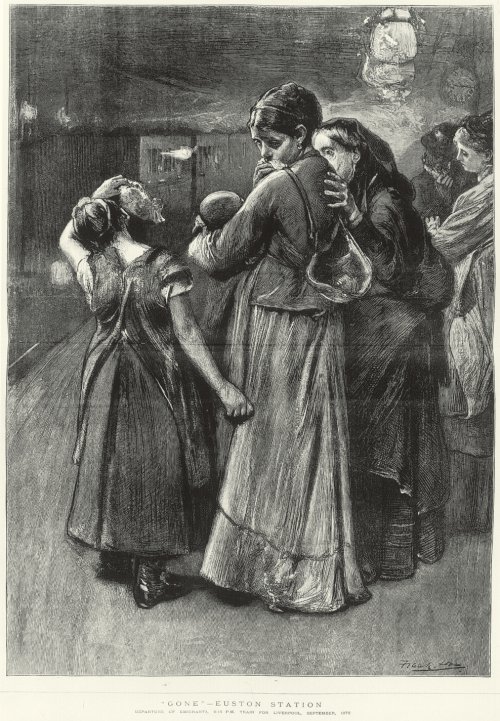
JLB 311, 2/10/1883: "The woman I wrote to you about is, as a type, rather like the central figure in that print, namely the mother with her child on her arm."
Context:
JLB 311, 2/10/1883: "I must say something else to you as regards Irish Emigrants by Holl."
Context:
JLB 309, 2/8/1883: "As to her life, I believe that, like me, you don't condemn fallen women."
Context:
BVG R21, 2/7/1883: "Frank Hol once expressed it this way -- in a drawing which as far as I know has not yet been reproduced -- he called the drawing 'Her Poverty but Not Her Will Consents.'"
JLB 309, 2/8/1883: "Frank Holl expressed that once in a drawing that hasn't been reproduced as far as I know -- he called the drawing: her poverty but not her will consents."

Context:
JLB 304, 1/25/1883: "For example, The foundling by Frank Holl. This shows several policemen in waterproof capes who have taken up a child left as a foundling between the beams and planks of a quay beside the Thames."


Context:
JLB 225, 5/10/1882: "If you know the large drawing from The Graphic by Frank Hall, 'The deserter', I'd say she closely resembles the female figure in it."
Context:
BVG 194, 5/4/1882-5/12/1882: "If you know the large drawing in the Graphic by Frank Holl, 'The Deserter,' I should say she resembles the woman in it."
JLB 225, 5/10/1882: "If you know the large drawing from The Graphic by Frank Hall, 'The deserter,' I'd say she closely resembles the female figure in it."
Context:
BVG 262, 1/25/1883-1/29/1883: "Such an encounter has the quality of an apparition about it, at least when one recalls it; one sees a pale face, a sorrowful look like an Ecce Homo on a dark background -- all the rest disappears. That is the sentiment of an Ecce Homo, and there is the same expression in reality, but in this case it is on a woman's face."
JLB 305, 1/27/1883: "Such an encounter has something of an apparition about it, at least if one thinks back one sees a pale face, a sorrowful look like an Ecce Homo against a dark background; everything else disappears. That is the sentiment of an Ecce Homo and in reality; the same thing is in the expression, but here it's a woman's face."


Context:
JLB 111, 4/15/1877: "Do accept my small contribution, I need so much to commune with you by way of such trifles; when I come back to my room I'm reminded of you again and again by the illustrations on the wall."


Context:
JLB 222, 5/1/1882: "I've tried to imbue the landscape with the same sentiment as the figure. Frantically and fervently rooting itself, as it were, in the earth, and yet being half torn up by the storm."
Context:
JLB 108, 3/16/1877: "The photograph of Mater Dolorosa that you sent is hanging in my room, how beautiful it is. Do you remember it hanging in Pa's study at Zundert?"
Context:
JLB 275, 10/24/1882-10/27/1882: "It was something out of a fairy tale by Andersen, that collection of discarded buckets, baskets, kettles, soldiers' mess-tins, oil-cans, wire, lamp-posts, stovepipes ... I'll no doubt dream of it tonight."
Or course, it may be that this remarkably neat and complete collection of so many favorite images was all in evidence on this single walk. Vincent's portraits of people went through the same "blending" process. In recounting to Theo a "fine fragment" of François Fénelon's Les avontures de Télémaque (The Adventures of Telemachus) (1699), Vincent piles imaginative world on imaginative world. "[S]he makes a big fire, around which all the innocent, peaceful family takes pleasure in singing, the whole evening long, while waiting for sweet sleep. … It's especially nice if one imagines it illustrated by the etchings of [Charles Émile] Jacque." (JLB 126, 8/5/1877.) Consider that this is a description of an idealized pastoral family in ancient time, spoken by a distant mytho-historic literary figure, as written by a Frenchman in the nineteenth century, which Vincent "makes more real" by imagining it through the etchings of a nineteenth-century French engraver. It is hard to imagine a greater remove from reality, and yet it is not clear that Vincent is aware of this remove. Vincent applied the same imaginative process even to qualities of light. For example, he compares the light in "modern houses" to the light in paintings of the Golden Age without any apparent regard to the fact that the one was real and the other depicted: "In those days everyone seems to have had a sort of need for a curious, dimmed light that no longer seems to exist, at least there's a tendency to make it cold, harsh and loveless" (JLB 318, 2/20/1883 or 2/21/1883).
Context:
JLB 98, 11/17/1876-11/18/1876: "As I sit writing to you in my room and it's so very, very quiet and I look around at your portraits and the prints on the wall, Christus Consolator and Good Friday and the Women at the sepulchre and The old Huguenot and The prodigal son by Ary Scheffer and the little boat on a stormy sea and one etching, an autumn landscape, view of the heath, which I got from Harry Gladwell on my birthday."
Context:
JLB 98, 11/17/1876-11/18/1876: "As I sit writing to you in my room and it's so very, very quiet and I look around at your portraits and the prints on the wall, Christus Consolator and Good Friday and the Women at the sepulchre and The old Huguenot and The prodigal son by Ary Scheffer and the little boat on a stormy sea and one etching, an autumn landscape, view of the heath, which I got from Harry Gladwell on my birthday."
Context:
BVG 127, 12/26/1878: "Everything reminded one then of the medieval paintings by, say, Peasant Brueghel, and by so many others who have known how to depict the singular effect of red and green, black and white so strikingly."
JLB 149, 12/26/1878: "Then everything was reminiscent of the medieval paintings by Peasant Bruegel, among others, and by so many others who were so good at expressing the singular effect of red and green, black and white."
Context:
JLB 150, 3/4/1879-3/31/1879: "When the cart with a white horse (l'blanc ch'val) brings an injured man home from the mine, one sees things that remind one of Israëls's shipwreck, and over and over again there is something that moves one."
Context:
BVG 164, 12/21/1881: "She reminded me of some quaint figure by Chardin or Frère or perhaps Jan Steen."
JLB 193, 12/23/1881: "She slightly resembled a nice figure by Chardin or Frere or possibly Jan Steen."
Context:
JLB 272, 10/15/1882: "The other day I saw, and also have in my collection, a large woodcut after a painting by Roll, A miners' strike."
Context:
JLB 148, 11/13/1878-11/15/1878 or 11/16/1878: "And now, as far as the drivers themselves are concerned, with their dirty, dingy clothes, they seemed to be sunk or rooted in poverty almost more deeply than that long row or rather group of poor people drawn by master [Charles] Degroux in his paupers' pew."
Context:
JLB 152, 6/19/1879: "Am currently reading Uncle Tom's cabin a lot -- there's still so much slavery in the world -- and in that astonishingly beautiful book this extremely momentous matter is treated with such wisdom, with a love and a zeal and interest in the genuine welfare of the poor and oppressed, that one can't help coming back to it again and again and finding more in it each time."
Context:
JLB 183, 11/12/1881: "If I saw that she took a man she didn't love because he was rich, I would admit I was wrong and ask forgiveness for my short-sightedness, and I would say, I've taken a painting by Brochart for one by Jules Goupil, a fashion plate for a figure by Boughton, Millais or Tissot.'
Context:
BVG 218, 7/21/1882: "The feeling for things themselves, for reality, is of greater importance than the feeling for painting; anyway it is more productive and more inspiring."
JLB 249, 7/21/1882: " Feeling things themselves, reality, is more important than feeling paintings, at least more productive and life-giving."
Context:
BVG 133, July 1880: "And there is something of M. Maris or of Millet in Bunyan, a reality that, in a manner of speaking, is more real than reality itself, something hitherto unknown that, if only you can read it, will tell you untold things."
JLB 155, 6/22/1880-6/24/1880: "And in Bunyan there's something of M. Maris or of Millet, a reality more real than reality, so to speak, but you have to know how to read him; then there are extraordinary things in him, and he knows how to say inexpressible things."
Context:
BVG 133, July 1880: "And there is something of M. Maris or of Millet in Bunyan, a reality that, in a manner of speaking, is more real than reality itself, something hitherto unknown that, if only you can read it, will tell you untold things."
JLB 155, 6/22/1880-6/24/1880: "And in Bunyan there's something of M. Maris or of Millet, a reality more real than reality, so to speak, but you have to know how to read him; then there are extraordinary things in him, and he knows how to say inexpressible things."
Context:
BVG 218, 7/21/1882: "Because I now have such a broad, such an expansive feeling for art and for life itself, of which art is the essence, it sounds so shrill and false when people like Tersteeg do nothing but harry one."
JLB 249, 7/21/1882: "Because I now have such a broad, such a large sense of art and of life itself, of which art is the essence, it sounds to me so shrill and false when there are people like Tersteeg who are always on the hunt."
Context:
BVG 126, 11/15/1878: "Some of these old white horses resemble a certain old aquatint engraving, which you perhaps know, an engraving that has no great art value, it is true, but which struck me, and made a deep impression upon me. I mean the last from that series of prints called 'The Life of a Horse.'"
JLB 148, 11/13/1878-11/15/1878 or 11/16/1878: "Some of those old white horses resemble a certain old aquatint that you perhaps know, an engraving with no very great artistic value but which nevertheless struck me and made an impression on me. I mean the last of the series of prints titled 'The life of a horse.'"
Context:
BVG 239, 10/29/1882: "I may be mistaken, that you spoke about large drawings, types or heads of people, and I am very curious to see them. If there were more things of his as beautiful as a print I found recently, 'Les 5 ages d'un buveur' [the five ages of a drinker], or like that figure of an old man under a chestnut tree which I mentioned to you before -- yes, then he would perhaps be the greatest of all."
JLB 277, 10/29/1882: "If there were more things by him as beautiful as a print by him I recently found, The 5 ages of a drinker, or as that figure of an old man under a chestnut tree I told you about before, well, then he was perhaps the master of them all."
Context:
JLB 211, 3/11/1882: "… an old man sits in a hut by the fireplace in which a small piece of peat barely glows in the twilight. For it's a dark hut the old man sits in, an old hut with a small window with a little white curtain. His dog, who's grown old with him, sits beside him -- those two old creatures look at each other, they look each other in the eye, the dog and the old man. And meanwhile the man takes his tobacco box out of his trousers pocket and he fills his pipe like that in the twilight."
BVG 181, 3/11/1882: Jozef Israëls. Vincent refers to this painting as "An Old Man," but the painting described is clearly Dialogue Silencieux which was exhibited at the Salon in 1882. Vincent introduces his description this way: "Here's a list of Dutch paintings intended for the Salon" (JLB 211, 3/11/1882). (See Bailey, p. 130, cat. no. 49, ill. p. 35.)
Context:
JLB 211, 3/11/1882: "Israels, 'an old man' (if he weren't a fisherman he'd be Tom Carlyle [1795-1881; Scottish writer] -- the author of the French Revolution and Oliver Cromwell [1599-1658; English soldier and politician] -- for he definitely has that distinctive head of Carlyle), an old man sits in a hut by the fireplace in which a small piece of peat barely glows in the twilight."
Context:
JLB 215, 4/6/1882: "There's a poem by Tom Hood, I believe, in which he tells of a great lady who can't sleep at night because during the day, when she went out to buy a frock, she saw the poor seamstresses pale, consumptive, emaciated, working in an airless room. And now she has twinges of remorse about her wealth and wakes up at night in panic. In short, it's a slender, white female figure, restless in the dark night."

Context:
BVG 299, 7/11/1883: "As you see from the above illustration, the first one is a somewhat mystical scene, probably taken from Revelation, or so one might be inclined to think at first."
JLB 361, 7/11/1883: "As you see from the above illustration, painted with a not unmystical scene, probably taken from Revelation, one would imagine at first sight."
Context:
BVG 241, 11/2/1882 or 11/3/1882: "In reality it is something like 'The Reapers' by Millet, severe, so you understand that one mustn't make a snow effect of it, which would be merely an impression and would only then have its raison d'être if it were done by way of a landscape."
JLB 280, 11/5/1882: " The reality is like Millet's The gleaners -- austere -- so you will understand that one shouldn't turn it into a snow effect, which would only be an impression and have no raison d'être unless the landscape is the whole point."
Context:
BVG 240, 11/1/1882: "What I appreciate in Herkomer, Fildes, Holl and the other founders of the Graphic, the reason why they still mean more to me than Gavarni and Daumier, and will continue to, is that while the latter seem to look on society with malice, the former -- as well as men like Millet, Breton, De Groux, Israëls -- chose subjects which are as true as Gavarni's or Daumier's, but have something noble and a more serious sentiment."
JLB 278, 11/1/1882: "What I value in Herkomer, in Fildes, in Holl and the other founders of The Graphic, why I find and will continue to find them even more sympathetic than Gavarni and Daumier, is that, while the latter seem to view society more with mockery, the former, like such men as Millet, Breton, Degroux and Israels, choose subjects which -- while as true as those of Gav. or Daum. -- have something noble and in which there's a more serious sentiment."
Context:
BVG 237, 10/22/1882: "What impressed me so much at the time was something so stout and manly in Daumier's conception, something that made me think it must be good to think and to feel like that and to overlook or ignore a multitude of things and to concentrate on what makes us sit up and think and what touches us as human beings more directly and personally than meadows or clouds."
JLB 274, 10/22/1882: "But I remember that it struck me so forcefully that there was something so firm and manly in Daumier's approach that I thought: it must be good to feel and think like that and overlook or ignore a mass of things so as to concentrate on something that's thought-provoking and appeals to a human being as a human being more directly than meadows or clouds."
Context:
BVG 257, 1/3/1883: " That's the highest thing in art, and there art sometimes rises above nature -- in Millet's 'Sower,' for instance, there is more soul than in an ordinary sower in the field."
JLB 298, 1/3/1883: " That is the highest art, and in that art is sometimes above nature -- as, for instance, in Millet's sower, in which there is more soul than in an ordinary sower in the field" (emphasis in original).
Context:
BVG 181, 3/11/1882: "I find such a mighty, deep, practical, silent philosophy in this picture -- it seems to say, 'Savoir souffrir sans se plaindre, ça c'est la seule chose practique, c'est là la grande science, la leçon à apprendre, la solution du problème de la vie’ [Knowing how to suffer without complaining, that is the only practical thing, it is the great science, the lesson to learn, the solution of the problem of life.]"
JLB 211, 3/11/1882: “I find such a wonderfully elevated, practical, wordless philosophy in this painting, it seems to be saying, to know how to suffer without complaining, that's the only practical thing, that's the great skill, the lesson to learn, the solution to life's problem."
Context:
BVG 181, 3/11/1882: "… they are standing there, patient, submissive, willing, resigned and quiet. They have still to draw the heavy boat up the last bit of the way -- the job is almost finished. Stop a moment. They are panting, they are covered with sweat, but they do not murmur, they do not protest, they do not complain, not about anything. They got over that long ago, years and years ago. They are resigned to living and working somewhat longer, but if they have to go to the knacker tomorrow, well, so be it, they are ready."
JLB 211, 3/11/1882: "… they stand there, patiently submissive, willing, resigned, still. They'll soon have to drag the heavy boat the last bit of the way, the job's almost done. They stand still for a moment, they pant, they're covered in sweat, but they don't murmur, they don't protest -- they don't complain -- about anything. They're long past that, years ago already. They're resigned to living and working a while longer, but if they have to go to the knacker's yard tomorrow, so be it, they're ready for it."
Context:
BVG 181, 3/11/1882: "Those nags, those poor, ill-treated old nags, black, white and brown; they are standing there, patient, submissive, willing, resigned and quiet."
JLB 211, 3/11/1882: "Those nags, those poor, sorry-looking nags, black, white, brown, they stand there, patiently submissive, willing, resigned, still."
BVG 247, 11/24/1882: Vincent readdresses this favorite subject (Worn Out [F 997 JH 267]) in November 1882.
Context:
JLB 286, 11/24/1882: "Today and yesterday I drew two figures of an old man with his elbows on his knees and his head in his hands."
Context:
BVG 257, 1/3/1883: "That's the highest thing in art, and there art sometimes rises above nature -- in Millet's 'Sower,' for instance, there is more soul than in an ordinary sower in the field."
JLB 298, 1/3/1883: "That is the highest art, and in that art is sometimes above nature -- as, for instance, in Millet's sower, in which there is more soul than in an ordinary sower in the field" (emphasis in original).
Context:
BVG 218, 7/21/1882: "Rembrandt and Ruysdael are sublime, for us as well as for their contemporaries, but there is something in the moderns that seems to us more personal and intimate."
JLB 249, 7/21/1882: "Rembrandt and Ruisdael are sublime, for us as much as for their contemporaries, but there's something in the moderns that strikes us as more personally intimate."
Context:
BVG 237, 10/22/1882: "What impressed me so much at the time was something so stout and manly in Daumier's conception, something that made me think it must be good to think and to feel like that and to overlook or ignore a multitude of things and to concentrate on what makes us sit up and think and what touches us as human beings more directly and personally than meadows or clouds."
JLB 274, 10/22/1882: "But I remember that it struck me so forcefully that there was something so firm and manly in Daumier's approach that I thought: it must be good to feel and think like that and overlook or ignore a mass of things so as to concentrate on something that's thought-provoking and appeals to a human being as a human being more directly than meadows or clouds."
Context:
BVG 251, 12/3/1882-12/5/1882: "Hardly anyone knows that the secret of beautiful work lies mainly in truth and sincere sentiment."
JLB 291, 12/4/1882-12/9/1882: "Almost no one knows that the secret of beautiful work is to a large extent good faith and sincere feeling."
Context:
BVG 218, 7/21/1882: "I want to make drawings that touch some people.".
JLB 249, 7/21/1882: "I want to make drawings that move some people" (emphasis in original).
Context:
BVG 251, 12/3/1882-12/5/1882: "Hardly anyone knows that the secret of beautiful work lies mainly in truth and sincere sentiment."
JLB 291, 12/4/1882-12/9/1882: "Almost no one knows that the secret of beautiful work is to a large extent good faith and sincere feeling."
Context:
BVG 593, 6/2/1889: "Daubigny and Rousseau have done just that, expressing all that it has of intimacy, all that vast peace and majesty, but at the same time adding a feeling so individual, so heart-breaking."
JLB 777, 5/31/1889-6/6/1889: "Daubigny and Rousseau did that, though, with the expression of all the intimacy and all the great peace and majesty that it has, adding to it a feeling so heartbreaking, so personal."
Context:
JLB 777, 5/31/1889-6/6/1889: "Daubigny and Rousseau did that, though, with the expression of all the intimacy and all the great peace and majesty that it has, adding to it a feeling so heartbreaking, so personal."
Context:
BVG R15, 10/29/1882: "Among the Reads I have an 'Autumn Effect' and a 'Moonlight Scene' and a 'Snow Effect,' which are very beautiful."
JLB 273, 10/22/1882: "Among other things by Read I have an autumnal effect and a moonlight and a snow which are very beautiful."
Context:
BVG 236, 10/8/1882: "I also started another one with many more figures, the last summer guests on the beach -- an evening effect."
JLB 271, 10/8/1882: "I've also started another [drawing] with many more figures -- the last visitors to the seaside -- an evening effect."
Context:
BVG R15, 10/29/1882: "Among the Reads I have an 'Autumn Effect' and a 'Moonlight Scene' and a 'Snow Effect,' which are very beautiful."
JLB 273, 10/22/1882: "Among other things by Read I have an autumnal effect and a moonlight and a snow which are very beautiful."
Context:
BVG 299, 7/11/1883: "I want to do a drawing that not quite everybody will understand, the figure simplified to the essentials, with a deliberate disregard of those details that do not belong to the actual character and are merely accidental."
JLB 361, 7/11/1883: "My aim is to do a drawing that not exactly everyone will understand, the figure expressed in its essence in simplified form, with deliberate disregard of those details that aren't part of the true character and are merely accidental" (emphasis in original).
Context:
BVG 299, 7/11/1883: "I want to do a drawing that not quite everybody will understand, the figure simplified to the essentials, with a deliberate disregard of those details that do not belong to the actual character and are merely accidental."
JLB 361, 7/11/1883: "My aim is to do a drawing that not exactly everyone will understand, the figure expressed in its essence in simplified form, with deliberate disregard of those details that aren't part of the true character and are merely accidental" (emphasis in original).
Context:
JLB 276, 10/29/1882: "In the first there's a print -- one of the old Swains -- that is inexpressibly great in character."
It wasn't until Vincent saw a Daumier illustration for a Balzac novel (almost certainly Le Père Goriot, for which Daumier did four wood engravings as part of the monumental publication of the author's entire La Comédie humaine, with illustrations, between 1842 and 1855) that Vincent's opinion of the artist changed. (For more on the Daumier illustrations for Balzac, see Loyrette, Daumier, pp. 188-189.) Also, at a time when Vincent was arguing with his brother over the relative merits of figure drawing, Theo's enthusiasm for Daumier no doubt contributed to Vincent's. Both brothers were responding to the wave of interest in Daumier's work that followed a major, adulatory exhibition at Durand-Ruel in April 1878 (with Victor Hugo as honorary chairman); followed by a considerable rise in the prices paid for his work; followed by the artist's death in February 1879. By the fall of 1882, Vincent was aware that Daumier's caricatures were "only a very small part of his work and ... are definitely not his most typical or main work" (JLB 277, 10/29/1882). In October 1882, he called the recently deceased Frenchman "perhaps the master of them all," (ibid.) and sent Van Rappard three "very beautiful" Daumier illustrations, complaining that "Daumiers are becoming rare" (JLB 267, 9/19/1882) (also, no doubt, a result of recent events).
However, somewhat contrarily, Vincent still professed ignorance about the "other parts" of Daumier's work. In November 1882, he responded to what was clearly a lengthy and enthusiastic description of Daumier's work from Theo: "in you I find someone who understands much about the great men, and I find it delightful to hear things about them now and then that I don't know, like, for example, what you write to me about Daumier. The series of portraits of politicians &c., the painting of the 3rd-class carriage, the Revolution -- I don't know any of them." (JLB 280, 11/5/1882.) Still, Vincent continued to have reservations about Daumier's "good will" as an artist (i.e., his sympathy for his subjects), at one point suspecting that both Daumier and Gavarni "view society more with mockery" (JLB 278, 11/1/1882). By February of the following year (1883), however, all doubts seem to have lifted and Vincent issues his most ringing encomium, calling Daumier "amusing and yet full of emotion and passion. ... I find a passion [in his work] that might be likened to white-hot iron" (JLB 310, 2/8/1883). The influence of Daumier on Vincent's later work will be discussed in subsequent chapters.
Context:
BVG 265, 2/8/1883: " There is pith and a sober depth in him, he is witty and yet full of sentimental passion; sometimes, for instance in "The Drunkards," and possibly also in "The Barricade," which I do not know, I find a passion which can be compared to the white heat of iron."
JLB 310, 2/8/1883: " There's something pithy and 'considered' in him. He's amusing and yet full of emotion and passion. Sometimes, it seems to me I find a passion that might be likened to white-hot iron, in the drunkards, for instance, and probably in the Barricade too (which I don't know)."
Context:
BVG R05, 11/21/1881: "You should know that I am in the habit of observing very accurately the physical exteriors of people in order to get at their real mental make-up."
JLB 188, 11/21/1881: "I should tell you that I'm used to paying very close attention to the outward appearance of people if I want to work out how they actually think."
Context:
JLB 280, 11/5/1882: "[Josef] Blok the Jewish bookseller, not David but the short one who's on the Binnenhof. I wish I had more from that family, for they are a true type."
Context:
BVG 180, 3/11/1882: "The thing to do is to work like a lot of Negroes: I would rather say nothing than express myself feebly."
JLB 210, 3/11/1882: "One must work like a bunch of negroes. I'd rather say nothing than express myself weakly." (Emphasis in original.)
Context:
JLB 653, 7/31/1888: "A negro boy with a red and white cow, a negress in blue, and some green forest. He's someone who works like one possessed, and he does all sorts of things; he's in Brittany now."
Context:
BVG 479, 4/24/1888: "He is a Yankee, and probably paints much better than most Yankees do, but a Yankee all the same."
JLB 601, 4/25/1888: "He's a Yankee who probably does much better than the ordinary run of Yankees. But a Yankee all the same."
Context:
BVG B07, 6/18/1888: "After a few eccentric things, you have succeeded in doing some with Egyptian calm and a great simplicity."
JLB 628, 6/19/1888: "After some eccentric things you have succeeded in making some that have an Egyptian calm and a great simplicity" (emphasis in original).
Context:
JLB 800, 9/5/1889-9/6/1889: "So take things with a certain northern phlegm and take care of yourselves, both of you."
Context:
BVG 295, 6/22/1883: "For the studies which I have already finished, I had a young farm hand, a real type, with something broad and rough and non ébarbé [unpolished] about him."
JLB 356, 6/22/1883: "For the studies I already have I had a young farm labourer, a really typical figure with something broad and rough and unpolished about him" (emphasis in original).
Context:
BVG 295, 6/22/1883: "For the studies which I have already finished, I had a young farm hand, a real type, with something broad and rough and non ébarbé [unpolished] about him."
JLB 356, 6/22/1883: "For the studies I already have I had a young farm labourer, a really typical figure with something broad and rough and unpolished about him" (emphasis in original).
Context:
JLB 160, 11/1/1880: "I had great pleasure lately in reading an extract from the work by Lavater and Gall. Physiognomie et phrénologie. Namely character as it is expressed in facial characteristics and the shape of the skull."
Context:
BVG 299, 7/11/1883: "Speaking of expression in a figure, I am increasingly coming round to the idea that it lies less in the features than in the whole tournure [bearing]."
JLB 361, 7/11/1883: "Speaking of expression in a figure, I'm becoming more and more persuaded that it lies not so much in the features as in the whole manner."
Context:
BVG 276, 3/21/1883-3/28/1883: "Every day here in The Hague I see, so to speak, a world which many people pass by, and which is quite different from what most of the painters make."
JLB 330, 3/18/1883: "Here in The Hague every day, so to speak, I see a world which a great many pass by and which is very different from what most are making."
Context:
BVG 235, 10/1/1882: "It seems to me that it takes on more significance when one views it as: the poor and money."
JLB 270, 10/1/1882: "It becomes more meaningful, I believe, if one thinks of it as THE POOR AND MONEY."
Context:
BVG 276, 3/21/1883-3/28/1883: "Still, the whole of nature is an indescribably beautiful Black and White exhibition during such snow effects."
JLB 330, 3/18/1883: "In short, the whole of nature is an inexpressibly beautiful Black and White exhibition when there are those snow effects."
Context:
BVG 74, 8/26/1876: "He is already tired and asks a woman in black, who is standing on the path and whose name is 'Sorrowful yet always rejoicing.'"
JLB 89, 8/26/1876: "… he is already tired and asks a woman in black standing by the roadside whose name is 'sorrowful, yet always rejoicing …'"
Context:
BVG 155, 11/9/1881-11/10/1881: "Now, I have been complaining a little about Father and Mother, but except that they do not understand the least bit of it and do not understand anything of the 'aimer encore' and could only call it "untimely and indelicate" until I put a stop to that -- after all, they are very good to me and kinder than ever."
JLB 181, 11/8/1881-11/9/1881: "Well, I've grumbled a bit about Pa and Ma, but except that they really don't have the remotest idea of how matters stand, and understand nothing of the 'love on,' and could think of nothing else to say than untimely and indelicate until I stopped them, they are very good to me, and kinder than ever."
Context:
JLB 336, 4/11/1883: "Have got round to reading the last part of Les misérables -- the figure of Fantine -- a prostitute -- made a deep impression on me -- oh, I know as well as anyone that in reality one won't find an exact Fantine -- but all the same this character by Hugo -- like all his characters for that matter -- is true, being the essence of what one sees in reality. It is the type -- of which one encounters only individuals."
Context:
JLB 274, 10/22/1882: "But I remember that it struck me so forcefully that there was something so firm and manly in Daumier's approach that I thought: it must be good to feel and think like that and overlook or ignore a mass of things so as to concentrate on something that's thought-provoking and appeals to a human being as a human being more directly than meadows or clouds."
Context:
BVG 195, 5/1/1882: "Here they all criticize the technique [of my drawings], but they all say the same hackneyed things about the English drawings, for instance. Only Weissenbruch -- when I told him, I see things as pen drawings -- said, 'Then you must draw with the pen.'"
JLB 222, 5/1/1882: "Here everyone criticizes the technique [of my drawings], but I also hear the same platitudes from everyone about English drawings, for example. Weissenbruch alone said, when I told him that I see the things as pen drawings -- then you must draw with the pen." (Emphasis in original.)
Context:
JLB 270, 10/1/1882: "I believe you might perhaps enjoy this collection of orphan men in their Sunday and working clothes. Then I also tackled him sitting with a pipe. He has an interesting bald head -- big ears and white sideboards."
Context:
JLB 351, 6/7/1883: "A small chap with a long, thin neck in a chair on rollers, among others, was priceless."
Context:
BVG 288, 6/3/1883: "Suppose somebody like old Mr. [Adolphe] Goupil should raise monetary objections -- from his point of view as a rich merchant, one could not expect anything else."
JLB 348, 6/3/1883: "Suppose someone like old Mr. Goupil had an objection concerning money -- one expects no less from his standpoint, that of a rich dealer."
Context:
BVG 288, 6/3/1883: "But coming from Father and Mother, who ought to be humble and contented with simple things, I think their speaking that way very wicked, and I feel something like shame at their behaviour."
JLB 348, 6/3/1883: "But with Pa and Ma, who are supposed to be humble and content with simplicity, I think it very nasty of them to speak like that, and I'm ashamed, as it were, that they're like that."
Context:
JLB 349, 6/3/1883: "The poor can be the poor one's friend."
Context:
BVG 290, 6/3/1883: "But here also it sometimes happens that the poor are the poor man's friend, and certainly it is a good thing that women and children learn thrift and that men learn to work hard."
JLB 349, 6/3/1883: "Yet here too it's sometimes so that the poor can be the poor one's friend, and it certainly has a very good side in that both woman and children learn to be thrifty and the man learns to work hard" (emphasis in original).
Context:
JLB 349, 6/3/1883: "Yet because your woman is likely to prove to have an intellectual side and isn't uncultured, I believe that for that reason she deserves to be doubly trusted."
Context:
BVG 301, 7/22/1883: "I do not approve, Theo, of spending more than one receives, but when it is a question of going on strike or working on, I vote for working on to the utmost."
JLB 363, 7/22/1883: "I don't think it right, Theo, to spend more than one receives -- but if it's a question of stopping or carrying on working, I'm for carrying on to the end."
Context:
JLB 286, 11/24/1882: "Octave Mouret -- actually the main character -- couldn't he be regarded as typical of the kind of people you wrote about recently, if you remember? He's far better than most people, in many respects, but you won't find him satisfactory any more than I do, and I sense an emptiness in him."
Context:
BVG 329, 9/27/1883: "Indeed, the woman is quite innocent of my deficit, and so am I, since it was impossible to act differently in The Hague -- but if I had known it, I would have moved here much sooner."
JLB 391, 9/28/1883: "So the woman in particular is as innocent of my deficit as I am myself, in so far as it could be no different in The Hague -- but if I had known I would have moved here much sooner."
Context:
JLB 297, 12/31/1882 and 1/2/1883: "As a painter, one must leave aside other social ambitions ..." (emphasis in original).
Context:
BVG R34, 5/8/1883: " Temporary fits of weakness, nervousness, melancholy are often caused by the exertion of working; but at the same time there is something like a rebound, so that weakness, etc., may be overcome again by exertion."
JLB 341, 4/9/1883: " Momentary weakness, nervousness, melancholy are often caused by the effort of working -- at the same time, though, there's a kind of rebound, and the weakness &c. &c. is cured precisely by making an effort."
Context:
BVG R34, 5/8/1883: "In a certain sense there is something peculiar in the constitution of every painter."
JLB 341, 4/9/1883: "On the contrary indeed, there's something peculiar in the temperament of every painter."
Context:
BVG 290, 6/3/1883: "And in my case, just because it fits in with my profession, many difficulties disappear, though from another side, the financial one, many difficulties do indeed arise, and will remain."
JLB 349, 6/3/1883: "And as for me, precisely because it can fit in with my work, many problems disappear on the one hand, although on the other, namely the financial side, there certainly are many difficulties, and these will remain."
Context:
BVG 313, 8/18/1883: "When I say I am a poor painter and have still years of struggle ahead -- my everyday life I must arrange '
Context:
BVG 190, 4/15/1882-4/27/1882: "Then my ugly face and shabby coat harmonize perfectly with the surroundings and I am myself and work with pleasure."
JLB 220, 4/23/1882: "Then my ugly face and my weather-stained jacket are perfectly in keeping with my surroundings, and I'm myself and work with pleasure."
Context:
JLB 186, 11/18/1881: " You will understand what I tell you, that to work and be an artist one needs love" (emphasis in original).
Context:
JLB 465, 10/9/1884: "I have absolutely no intention of becoming less passionate in ideas or in life than I am."
Context:
BVG 190, 4/15/1882-4/27/1882: "Then my ugly face and shabby coat harmonize perfectly with the surroundings and I am myself and work with pleasure."
JLB 220, 4/23/1882: "Then my ugly face and my weather-stained jacket are perfectly in keeping with my surroundings, and I'm myself and work with pleasure."
Context:
JLB 246, 7/15/1882-7/16/1882: "What a woman wants is to be with one man and to stay with him for good. That's not always possible, but if it is otherwise it goes against nature."
Context:
BVG 215, 7/15/1882-7/16/1882: "A woman changes when she loves and is loved; when nobody cares for her, she loses her spirits and the charm is gone."
JLB 246, 7/15/1882-7/16/1882: "A woman changes when she loves and is loved; if there's no one who cares for them the drive and charm goes."
Context:
JLB 193, 12/23/1881: "Even as a boy I sometimes looked up with endless sympathy and respect into a half-withered female face on which it was written, as it were: life and reality have given me a drubbing."
Context:
JLB 184, 11/12/1881: "Now in my opinion there are two kinds of mistress. One is the kind with whom one can give and take love, one or both of you being aware, meanwhile, that it isn't forever, neither does one surrender to it whole-heartedly and unreservedly."
Context:
JLB 309, 2/8/1883: "My dear friend, at present I recall no less than 4 women here in town (including my own) who have fallen or been deceived and have illegitimate children, and their fate is so sad that it's difficult to imagine" (emphasis in original).
Context:
BVG 279, 4/11/1883: "It is my opinion that no matter how good and noble a woman may be by nature, if she has no means and is not protected by her own family, in the present society she is in great, immediate danger of being drowned in the pool of prostitution."
JLB 336, 4/11/1883: "A woman, however good and noble she may be by nature, in my view stands in great and immediate danger in today's society of sinking into the maelstrom of prostitution if she has no means and isn't protected by her own family."
Context:
JLB 309, 2/8/1883: "My dear friend, at present I recall no less than 4 women here in town (including my own) who have fallen or been deceived and have illegitimate children, and their fate is so sad that it's difficult to imagine. Especially because for 3 of them, at least, the chance of pulling through is almost non-existent -- i.e. it's there in theory but not in practice, in my view." (Emphasis in original.)
Context:
BVG 201, 6/2/1882: "I ask but one single thing [of Pa]: to let me love and care for my poor, weak, ill-used little wife as well as my poverty permits, without their trying to separate, worry or hurt us."
JLB 234, 6/1/1882-6/2/1882: "I ask for nothing [of Pa] ... only one single thing -- that I be allowed to cherish and care for my poor, weak, tormented little wife as well as my poverty permits, without steps being taken to separate or hinder us or cause us sorrow" (emphasis in original).
Context:
BVG 219, 7/23/1882: "Preferably, I don't know why, an unhappy, forsaken or lonely creature."
JLB 250, 7/23/1882: "Preferably an unfortunate or spurned or abandoned creature, I don't know why."
Context:
BVG 288, 6/3/1883: "Thwarting the interests of such a woman, preventing her rescue, is monstrous."
JLB 348, 6/3/1883: "And to stand in the way of such a woman, to obstruct her rescue and salvation, is monstrous."
Context:
BVG 204, 6/3/1882: "There is nothing special about her, she is just an ordinary woman of the people who has something of the sublime for me."
JLB 234, 6/1/1882-6/2/1882: "There's nothing special about her; she's just an ordinary woman of the people who for me has something sublime."
Sien's sister, Maria Wilhelmina, was nine at the time she met Vincent. Sien's daughter, also Maria Wilhelmina, was four at the time. She turned five on May 7, 1872. In Vincent's drawings of Sien with a young female child, it is sometimes difficult to be sure which of the two Maria's posed. The child depicted often looks too small for a nine-year-old and too big for a four- or five-year-old. Identification is further complicated by the fact that Sien was herself probably small and Vincent was never reliably precise about relative sizes of figures. We believe the following drawings probably show Sien with her sister: Backyards (F 939a JH 102), Sien, Sitting on a Basket, with a Girl (F 1072 JH 341), and Woman with a Child on Her Lap (F 1067 JH 356). She is probably shown with her daughter in Sien with Child on her Lap (F 1071 JH 104). In the coming year and a half, Vincent would depict Sien often with the baby born in July, Willem (Sien Nursing Baby, Half-Figure [F 1062 JH 216] through Sien Nursing Baby [F 1064 JH 221], Orphan Man with a Baby in his Arms [F 981 JH 317], and Woman with Baby on her Lap, Half-Length [F 1066 JH 322]).
Woman with a Broom, F 1075 JH 224, late September, 1882, pencil, watercolor, 17.9 x 9 in., 45.5 x 23 cm., Amsterdam, Van Gogh Museum and Woman with a Broom, F 1074 JH 249, 1882, pencil, pen, heightened with watercolor, 19.5 x 10.8 in., 49.5 x 27.5 cm, Amsterdam, Van Gogh Museum.
Context:
JLB 210, 3/11/1882: "Since Theo's visit I've made a drawing of an orphan boy polishing shoes."
Head of a Fisherman with a Fringe of Beard and a Sou'wester (F 1017 JH 302) and Fisherman with Sou'wester, Pipe and Coal-pan (F 1016 JH 304) through Head of a Fisherman with a Sou'wester (F 1014 JH 310). The extent to which Vincent brought his own, powerful stereotyping vision to the reality of these sitters can be seen in the difference between these drawings of the almshouse man as a fisherman and the extraordinary sketch of him as a granite-jawed squire out of Dickens in Orphan Man, Bareheaded, Head (F 955 JH 355).
If Vincent's types had any objective reality, surely the same person could not evoke the essence of so many different types. Partly this can be explained by Vincent's belief in the talismanic power of the "attributes" of type. A good example is the sou'wester hat worn by Dutch fishermen. "Tomorrow I'll be getting a sou'wester for the heads. Heads of fishermen, old and young, that's what I've been thinking about for a long time and I had already done one, but then later I couldn't get hold of a sou'wester again. Now I'm going to have one of my own, an old one that many gales and seas have swept over." (JLB 301, 1/13/1883.) All of this suggests how intense Vincent's powers of visualization were.
Fisherman with Sou'wester, Sitting with Pipe, F 1010 JH 306, February, 1883, pen, pencil, black chalk, washed, 18.1 x 10.2 in., 46 x 26 cm., Otterlo, Kröller-Müller Museum. (The sketchier Fisherman with Sou'wester, Sitting with Pipe [F 1013 JH 305] was obviously done at the same time, but Vincent does not make the same effort to create a specific sense of place.)
The Public Soup Kitchen (F 271 JH 328), Soup Distribution in a Public Soup Kitchen (F 1020a JH 330), The Public Soup Kitchen (F 1020b JH 331) through The Public Soup Kitchen (F 1020 JH 333).
Context:
JLB 319, 2/23/1883: "I saw a little old lady pottering about in a small room and there was a character and something mysterious in the figure that vanished completely when I had that same old lady in the studio."
Context:
JLB 318, 2/20/1883 or 2/21/1883: "In those days everyone seems to have had a sort of need for a curious, dimmed light that no longer seems to exist, at least there's a tendency to make it cold, harsh and loveless."
Vincent's sister Anna also seems to have found special significance in window views. "You write that your room is very beautiful," she wrote Theo from Welwyn, "I believe that ours tops them all. It's so light and cheery and friendly and the window is very pretty, grown with ivy." (b2371 V/1982, "Gogh, Anna van" to "Gogh, Theo van", 11/7/1875.) The next year she rhapsodized about the view out her window in a way that sounds very much like Vincent: "I am sitting here writing in front of my open window and have a magnificent view of the setting sun and large cedar tree, which is from before the poet Young's time" (b2783 V/1982, ''Gogh, Anna van'' to ''Gogh, Theo van'', 10/4/1876). (The reference is probably to the English Augustan poet Edward Young, best known for the long poem Night Thoughts, which was illustrated by William Blake in 1797.)
Vincent's sister Lies also shows a proclivity for gazing longingly out windows: "Last time, you wrote about that beautiful evening in Helvoirt. I thought of it, when I was looking out of the window last night." (b2557 V/1982, "Gogh, Elisabeth van" to "Gogh, Theo van", 9/23/1877.) When she and Wil were together in 1879, Lies wrote, also sounding like Vincent: "Wil and I are sitting in front of the open window, looking towards the beautiful lime-trees with the fresh new green" (b2474 V/1982, "Gogh, Elisabeth van" to "Gogh, Theo van", 5/21/1879). Sister Wil is the only other Van Gogh sibling known to have done a drawing of a view from a window: "Our Wil made such nice drawings on the slate; the view from her little room of the church tower, the church doors and church window, underneath the trees" (b2758 V/1982, "Gogh-Carbentus, Anna C. van" to "Gogh, Theo van", 7/6/1876). And when Wil and her sister Anna united in 1876, they too spent time gazing out the window and thinking nostalgic thoughts: "We see the sun rise from our living room window over the graveyard. How nice it would be to see each other again." (b2740 V/1982, "Gogh, Willemina en Anna van" to "Gogh, Theo van", 1/30/1876.)
Although most of the evidence is indirect, it appears that Theo shared this preoccupation with his siblings. When he went to Paris for the first time in 1878, he wrote his parents a description of the exciting view from his fifth-floor window, as is clear from his father's response: "You did very well to write to us … We can now visualize things, almost at any time of day. While you stick your head out of the window for the first time in the morning and see the industrious tailor work." (b0979 V/1962, "Gogh, Theodorus en Anna C. van" to "Gogh, Theo van", 5/17/1878.) Dorus returned to the subject in a subsequent letter: "I can see you there standing on your chair in the morning to take in the view from your window. You are up high there, on the 5th floor." (b0983 V/1962, "Gogh, Theodorus van" to "Gogh, Theo van", 6/24/1878.) In 1883, a comment from Vincent suggests that Theo had sent vivid, Zola-like descriptions of the view from his Paris apartment: "You've so often shown me a glimpse of Paris through your descriptions" (JLB 330, 3/18/1883). In 1885, Theo wrote his mother in Nuenen about the imminent demolition of an old church tower that was visible from the parsonage window, also sounding like his brother: "What a pity that the tower will be torn down. It will be strange if one cannot see it anymore from the window. Luckily the view on the garden and the fields is beautiful, but it belonged in the beautiful view." (b0901 V/1962, "Gogh, Theo van" to "Gogh-Carbentus, Anna C. van", 5/19/1885.)
Another example that was surely known to Vincent by this time, and perhaps as early as adolescence, was Émile Souvestre's Un philosophe sous les toits; journal d'un homme heureux (An Attic Philosopher [or APeep at the World from a Garret], Being the Journal of a Happy Man) (1853). In a chapter entitled "What we may learn by looking out a window," Souvestre (a favorite of Vincent's as recently as 1874, when Vincent transcribed excerpts from his works into the albums he made for Theo [see Ch. 6, n. 383]), writes: "I open my window, and the prospect of roofs opens out before me in all its splendor" (Souvestre, p. 32). Souvestre calls rooftops "these Alps of civilization" and praises the view from the upper stories of a building: "How many times have my days of leisure passed away in contemplating this wonderful sight; in discovering its darker or brighter episodes; in seeking, in short, in this unknown world for the impressions of travel that wealthy tourists look for lower down!" (ibid.).
In Dordrecht in 1877: "The window of my room looks out over gardens with pine trees and poplars etc. and the back of old houses, including a large one covered with ivy, ... There can be something so serious and rather sombre in that view, and you should see it with the morning sun on it" (JLB 101, 1/21/1877). Later the same year, at his uncle's house in the naval dockyard in Amsterdam: "Am quite often up rather early in the morning, and when the sun rises over the yard and the workers come a while later it's a wonderful sight from the window," (JLB 123, 7/27/1877), and "the view of the yard from the window beside me is indescribably beautiful, with that avenue of poplars whose slender forms and thin branches stand out so delicately against the grey evening sky" (JLB 136, 12/3/1877-12/4/1877). In Etten in 1878, Vincent describes his temporary new home at the parsonage: "[It is] the classroom that looks out on the garden and against which the ivy grows" (JLB 145, 7/22/1878).
Context:
JLB 83, 5/31/1876: "Herewith a little drawing of the view from the school window where the boys stand and watch their parents going back to the station after a visit. Many a boy will never forget the view from that window."
Andersen's great series of stories, What the Moon Saw, with its repeated references to moonlight coming in windows, may be one of the primary sources for Vincent's fascination with windows -- as frames for experiencing the world outside, as peepholes into other lives, and as connections through time and space to distant loved ones:
"Every evening came the moon and whispered in my ear,
Telling of the quiet night and what its eye
Had lit on from its watch-post in the sky.
It who knows centuries -- through ages did it roam,
Casting, high above the Flood and crest of foam,
On the floating ark a soft silver glow,
Just as it now lights my lonely window."
(Hans Christian Andersen, quoted in JLB 121, 7/9/1877.)
Context:
JLB 98, 11/17/1876-11/18/1876: "In the afternoon Mr. [Slade-]Jones and his son and I went and had tea with the sexton, a shoemaker who lives in one of the suburbs. There was a view from the window there that reminded me very much of Holland -- a flat, grass-covered area, which the torrential rains had turned almost into a morass, surrounded by rows of little red houses with their gardens and the lights of the street-lamps that were being lit."
Context:
JLB 333, 3/29/1883 and 4/1/1883: "From the window I looked out on a broad, dark foreground -- dug-over gardens and soil, mostly warm black earth, very deep in tone. Running obliquely across that is the little road of yellowish sand with green edges of grass and the thin, spindly poplars. A background of a grey silhouette of the city with the round roof of the station and towers and chimneys. And, by the way, the backs of houses still everywhere -- but in the evening everything is brought together by the tone. And so, overseeing the whole, simply a foreground of black, dug-over earth, a road crossing that, a grey silhouette of a city with towers behind, just above that and almost on the horizon the red sun. It was just like a page in Hugo -- and something that would certainly have struck you and that you could describe better than I."
Context:
JLB 136, 12/3/1877-12/4/1877: "It's already growing dark, and the view of the yard from the window beside me is indescribably beautiful, with that avenue of poplars whose slender forms and thin branches stand out so delicately against the grey evening sky, and then the old building with the arsenal in the water that is as still as 'the water of the old pool' that is spoken of in the book of Isaiah, the walls of that arsenal are completely green and weathered at the bottom at water level."
Context:
JLB 116, 5/28/1877: "Right now all the people are leaving the dockyard to go home, that's nice to see. One hears them already early in the morning."
Context:
JLB 353, 6/15/1883: "There are heaps of coal and fellows working in them, and people come with small wheelbarrows to buy a sack of coal; trade is very busy some days, and especially in the winter, with the snow it was a charming scene."
Context:
JLB 318, 2/20/1883 or 2/21/1883: "But the latter is an agreeable and easily achieved, pleasing window. But one can't have everything. And it ought really to have a broad window-sill -- where one could sit -- which is entirely lacking in this house."
Context:
JLB 200, 1/14/1882: "This is a sketch of Schenkweg, the view from my window."
Carpenter's Yard and Laundry, F 939 JH 150, May, 1882, pencil, pen, brush, heightened with white, 11.2 x 18.5 in., 28.5 x 47 cm., Otterlo, Kröller-Müller Museum. Vincent made an almost identical copy of the drawing for Theo (Carpenter's Yard and Laundry [F 944 JH 153]).
Context:
BVG 205, 6/3/1882: As you see, there are already several planes in this drawing, and one can look around it and through it, in every nook and cranny.
JLB 235, 6/3/1882: As you see, there are several planes in this drawing, and one can look around in it and peer into all sorts of nooks and crannies.
The most important corpus of such work, of course, is the series of paintings he made from the barred window of his cell at the asylum in St. Remy in 1889-90. Vincent adopted the same perspective again in a drawing of a fish-drying barn in Scheveningen (Fish-Drying Barn, Seen From a Height [F 938 JH 152]). From a position high on an overlooking dune, he peered long and hard at some ramshackle houses and rickety drying sheds surrounded by a ragged barricade of baskets. Vincent did at least two other drawings in the same place, Fish-Drying Barn [F 946a JH 151] and Fish-Drying Barn [F 940 JH 154]. The former is a view from the same height but from a much greater distance; the latter is a ground level view from the opposite side (presumably, the beach side). Vincent was so proud of these two related images (Carpenter's Yard and Laundry [F 939 JH 150] and Fish-Drying Barn, Seen From a Height [F 938 JH 152]) that he sent versions of them to Theo (JLB 235, 6/3/1882). He also made a watercolor of the same scene as Fish-Drying Barn, Seen From a Height [F 938 JH 152] from a lower height on the overlooking dune (Fish-Drying Barn [F 945 JH 160]).
Another surviving drawing attributed to this period in which Vincent draws a scene of Scheveningen houses from atop a dune is View of Scheveningen [F 1041 JH 167]. The connection between Carpenter's Yard and Laundry (F 939 JH 150) and Fish-Drying Barn, Seen From a Height (F 938 JH 152) is not inferred, it is Vincent's own: "Today I made an early start because I wanted to do another one the same [the Carpenter's Yard and Laundry (F 939 JH 150) (JLB 235, 6/3/1882)], and went to the dunes to draw a fish-drying barn, also seen from a height like the carpenter's shed" (JLB 232, 5/28/1882).
Context:
JLB 351, 6/7/1883: "I was there [at the almshouse] today. From the window I sketched an old gardener by a crooked apple tree, and the workshop of the home's carpenter, where I drank tea with two orphan men."
Context:
JLB 261, 9/9/1882: "One ought to be allowed to enter any of the houses and sit down at the windows without further ado."
Context:
JLB 250, 7/23/1882: "You must imagine me sitting at my attic window as early as 4 o'clock, studying the meadows and the carpenter's yard with my perspective frame."
Vincent subsequently read at least one other Cassagne book, Traité d'aquarelle (1875), during his summer in Etten in 1881 (JLB 168, June 1881). Although Vincent seems to have taken this book up to learn more about watercolor than perspective, it is probably where he encountered the reference to cadre rectificateur (correcting frame) or cadre isolateur (isolating frame). The Guide does not mention the device, only the mental "trick" of imagining a grid superimposed on an object. Vincent does not mention any of Cassagne's other books that offer more thorough and technical treatments of the subject, specifically Elements de perspective (prior to 1880) and Traité pratique de perspective (1873). We agree with Van Heugten that these difficult books "were beyond Van Gogh's technical grasp" (Van Heugten, p. 19), although he apparently knew of them (JLB 168, June 1881). (For a complete discussion, see Van Heugten, pp. 18-25.)
We take Vincent's description of his epiphanic first use of the Cassagne Guide in 1880 -- as we take all such reconstructed memories -- with a grain of salt. The story serves to bolster his claim that he was destined to be an artist and, simultaneously, to invoke Theo's role in putting him on this path, at a time when opposition from both Tersteeg and Mauve is casting a long shadow on the entire enterprise. The fact that Vincent did not mention in his letters at the time (1880) the name of the Cassagne book or this supposedly seminal experience supports our inference that, if it happened, it was swept aside by the much stronger enthusiasm for Bargue and the fever to draw figures.
Context:
JLB 158, 9/24/1880: "In the meantime I'm busy reading a book on anatomy and another on perspective, which Mr. Tersteeg also sent me."
Context:
JLB 241, 7/1/1882: "The first person I came across here in Schenkweg was my friend the carpenter, who has helped me on several occasions with one job or another to do with making instruments for perspective."
Context:
BVG 184, April 1882: "What made me stop doubting was reading a clear book on perspective, Cassagne's Guide to the ABC of Drawing; and a week later I drew the interior of a kitchen with stove, chair, table and window -- in their places and on their legs -- whereas before it had seemed to me that getting depth and the right perspective into a drawing was witchcraft or pure chance."
JLB 214, 4/2/1882: "What made me stop doubting is that I read a clearly written book on perspective, Cassagne, Guide de l'Abc du dessin, and a week later drew an interior of a little kitchen, with stove, chair and table and window in their place and on their legs, whereas it used to seem to me downright witchcraft or coincidence that one had depth and proper perspective in a drawing" (emphasis in original).
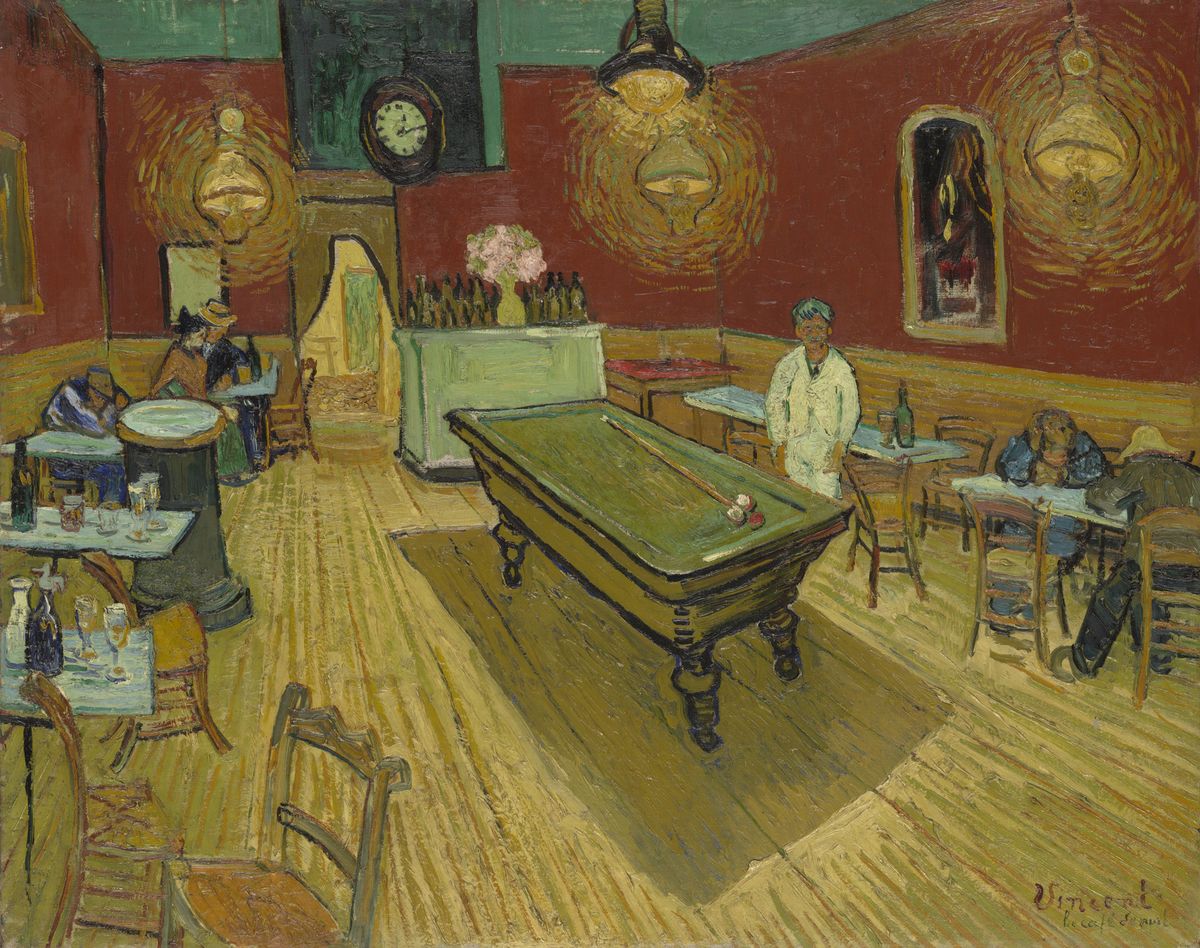
We also agree with Van Heugten that Vincent's understanding of Cassagne did not begin to approach that which has been attributed to him by some modern critics (ibid., n. 14), especially Wylie, who argues that Vincent created a "fusion" of Bargue and Cassagne into a unique system for describing three-dimensional space and that any "awkwardness" was the inevitable product of this fusion: "Van Gogh had discovered a way to use Bargue's descriptive angularity to state the specifically measured angles Cassagne saw as the key to a correct statement of the picture space. ... The reason for the clumsiness of the figure now becomes apparent; the outline is awkward because it has been built up from the descriptive angles of the several planes of the layered cube containing the figure." (Wylie, p. 215.) Again, to quote Van Heugten's admirable summary: "one seriously wonders whether the highly technical explanations, particularly in the Traité [pratique de perspective" by Cassagne], were not beyond Van Gogh's technical grasp. ... He had no real talent for intricate technical structures." (Van Heugten, p. 19.)
Context:
JLB 235, 6/3/1882: "[The frame] makes it possible to compare the proportions of objects close at hand with those on a plane further away, in cases where construction according to the rules of perspective isn't feasible. Which, if you do it by eye, will always come out wrong, unless you're very experienced and skilled." (Emphasis in original.)
Context:
JLB 235, 6/3/1882: "I still believe that the way to get that boldness and daring later is to quietly carry on observing as faithfully as possible now. As you see, there are several planes in this drawing, and one can look around in it and peer into all sorts of nooks and crannies. It lacks that ruggedness as yet, at least doesn't by any means have that quality to the same extent as the above illustrations, but that will come with practice." (Emphasis added.)
Context:
JLB 254, 8/5/1882-8/6/1882: "The perpendicular and horizontal lines of the frame, together with the diagonals and the cross -- or otherwise a grid of squares -- provide a clear guide to some of the principal features, so that one can make a drawing with a firm hand, setting out the broad outlines and proportions."
Context:
JLB 254, 8/5/1882-8/6/1882: "I expect you can imagine how delightful it is to train this view-finder on the sea, on the green fields -- or in the winter on snow-covered land or in the autumn on the fantastic network of thin and thick trunks and branches, or on a stormy sky."
Context:
JLB 254, 8/5/1882-8/6/1882: "I expect you can imagine how delightful it is to train this view-finder on the sea, on the green fields ... or on a stormy sky."
Context:
BVG 223, 8/5/1882 or 8/6/1882: "So on the shore or in the meadow or in the fields one can took through it as through a window, the vertical lines and the perpendicular line of the frame and the diagonal lines and the point of intersection, or else the division in squares, certainly give a few basic markers, with the help of which one can make a firm drawing, from the indication of the main lines and proportions -- at least for those who have some instinct for perspective and some understanding of the reason why and the manner in which perspective gives an apparent change of direction to the lines and a change of size to the lines and to the whole mass" (emphasis in original).
JLB 254, 8/5/1882-8/6/1882: "The result is that on the beach or in a meadow or a field you have a view AS IF THROUGH A WINDOW. The perpendicular and horizontal lines of the frame, together with the diagonals and the cross -- or otherwise a grid of squares -- provide a clear guide to some of the principal features, so that one can make a drawing with a firm hand, setting out the broad outlines and proportions. Assuming, that is, that one has a feeling for perspective and an understanding of why and how perspective appears to change the direction of lines and the size of masses and planes." (Emphasis in original.)
Context:
JLB 371, 8/7/1883: "Letting myself go a little and looking more through my eyelashes instead of looking sharply at the joints and analyzing how things fit together leads me more directly to see things as patches of colour next to each other. ... In those studies, for instance, there's something of that mysteriousness that one gets by looking at nature as if through the eyelashes, so that the forms simplify themselves into patches of colour."
Context:
JLB 219, 4/21/1882: "The lines of the roofs and gutters now shoot away nicely like arrows from a bow."
Context:
BVG 219, 7/23/1882: "Beyond it all lies an infinity of delicate, soft green, miles and miles of flat meadow, and a grey sky, as calm, as peaceful as Corot or Van Goyen."
JLB 250, 7/23/1882: "But behind this an infinity of delicate, gentle green, miles and miles of flat meadow, and a grey sky as still, as peaceful as Corot or Van Goyen."
Context:
JLB 254, 8/5/1882-8/6/1882: "I've just come back from the blacksmith, who has put iron spikes on the legs and iron corners on the frame."
Context:
JLB 253, 8/5/1882: "I'm having a new and, I hope, better perspective frame made, which will stand firmly on two legs in uneven ground like the dunes. Like this, for example."
Context:
BVG 223, 8/5/1882 or 8/6/1882: "The perspective frame is really a fine piece of workmanship; I am sorry you did not see it before you left."
JLB 254, 8/5/1882-8/6/1882: "The frame really has become an excellent piece of equipment -- it's a pity you still haven't seen it."
Context:
BVG 219, 7/23/1882: "Provided I can just keep going, well then, I shall fight my fight quietly in this way and no other -- by calmly looking through my little window at natural things and drawing them faithfully and with love."
JLB 250, 7/23/1882: "Provided I can stay on my feet, well I'll fight my fight quietly in this way and no other, that is by calmly looking through my little window at the things in nature, and drawing them faithfully and lovingly."
Context:
BVG 194, 5/4/1882-5/12/1882: "In a short time she became as meek as a tame dove, certainly not from my coercing her, but because she saw that I was not rough."
JLB 225, 5/10/1882: "In a short time she became as gentle as a tame dove, certainly not by force on my part but because she saw that I wasn't rough" (emphasis in original).
Context:
BVG 193, 5/14/1882: "Christien does not know any details, nor does she ask for them, but she knows I shall be frank with her, and she wants to stay with me quand bien même."
JLB 228, 5/16/1882: "Christien doesn't know the details -- and doesn't ask, knowing that I deal honestly with her and wanting to be with me come what may."
Context:
JLB 224, 5/7/1882: "I made her take baths and as much fortifying remedies as I could afford, she's become much healthier."
BVG 192, 5/3/1882-5/12/1882: In May, Vincent admits only paying Sien's rent, continuing to maintain that Sien lived with her mother, sister, and daughter in a "charity court" (which he later drew [Sien's Mother's House (F 941 JH 146); Sien's Mother's House, Closer View (F 942 JH 147)]). But surely this is a fiction. Vincent's frequent references to their life together prior to his confession to Theo make it clear that she was living primarily with him, not with her mother, who was no doubt taking care of the two young girls, whom Vincent rarely mentions. In June, Dorus visited the Schenkweg apartment while Vincent was in the hospital. He asked the neighbors to let him into Vincent's studio "but they did not have the key" (b2240 V/1982, ''Gogh, Theodorus van'' to ''Gogh, Theo van'', 6/14/1882). This may indicate that Sien was living there.
Context:
JLB 224, 5/7/1882: "I couldn't give her a model's full daily wage, but all the same, I paid her rent and have until now been able, thank God, to preserve her and her child from hunger and cold by sharing my own bread with her."
Context:
JLB 229, 5/18/1882: "The linen for the child is ready too -- the essentials."
Context:
JLB 224, 5/7/1882: "I made her take baths and as much fortifying remedies as I could afford, she's become much healthier."
Context:
JLB 234, 6/1/1882-6/2/1882: "Now, thanks to plain food, plenty of walking and fresh air and taking baths, she's much stronger and more robust than then."
Context:
BVG 192, 5/3/1882-5/12/1882: "I made her take baths and as many restoratives as I could manage, and she has become much healthier. I have been with her to Leiden, where there is a maternity hospital in which she will be confined."
JLB 224, 5/7/1882: "I made her take baths and as much fortifying remedies as I could afford, she's become much healthier. I went with her to Leiden, where there's a maternity hospital she'll go to for her confinement."
Context:
BVG 201, 6/2/1882: "Now, by eating simple food, by walking in the open air a lot, and by taking baths, she has become much healthier and stronger."
JLB 234, 6/1/1882-6/2/1882: "Now, thanks to plain food, plenty of walking and fresh air and taking baths, she's much stronger and more robust than then."
Context:
JLB 242, 7/2/1882: "She'd recover of her own accord, provided there are no complications, with rest, tonics, plenty of fresh air and no heavy labour."
Context:
JLB 234, 6/1/1882-6/2/1882: "I picked her up and gave her all the love, all the tenderness, all the care, that was in me."
Context:
JLB 224, 5/7/1882: "I went with her to Leiden, where there's a maternity hospital she'll go to for her confinement."
Apparently, Vincent did not, however, accompany Sien on a second visit to Leiden in May. "[Sien] had a lot of cramp &c., and so it seemed to me best for her to go to Leiden again to find out exactly what was wrong," he reports in mid-May (ibid.). "She went there and came back again" (ibid., emphasis added). Around the same time, he recounts giving Sien what sounds like a parting message as she leaves for the hospital: "Now the crisis is here and I still can't decide, I don't dare hope yet. I've told Christien: I'll support you until Leiden. When you come back from Leiden, I don't know how you'll find me -- with or without a penny -- but what I have is as much yours and the child's as mine." (JLB 228, 5/16/1882; emphasis added.) At the end of the month, he writes that "she'd [Sien] been to Leiden" (JLB 231, 5/27/1882). Because all of this is said in the middle of an urgent plea for money, however, Vincent may have been trying to minimize his role in funding the Leiden trip. It is at least possible that he took her to Leiden in May and left her there, which would account for JLB 228, 5/16/1882, and that is the trip he refers to in JLB 224, 5/7/1882, which would mean that he might not have been in Leiden in March. The reference to her doctor's prognosis after the March procedure (JLB 229, 5/18/1882) could allude to hearsay from Sien.
Context:
BVG 217, 7/19/1882: " The poor creature has had a very hard time of it."
JLB 248, 7/19/1882: " The poor creature has suffered appallingly."
Context:
JLB 203, 1/26/1882: "What I feared would happen when last I wrote to you has now truly come about, namely that I fell ill and spent three days or so lying in bed with fever and anxiety. Accompanied now and then by headache and toothache."
Context:
JLB 203, 1/26/1882: "This evening I felt completely weak and miserable. But if I do as little as possible for a couple of days then it will be over for a good long time, and if I'm careful I needn't be afraid that it will recur for the time being. ... I have some hope that as soon as I'm completely better things will go well, a little better than now. If I have to rest for a while I'll do it, but it will probably be over soon."
Context:
BVG 173, 1/26/1882: "Well, my youth is gone -- not my love of life or my energy, but I mean the time when one feels so lighthearted and carefree."
JLB 203, 1/26/1882: "In short, my youth is past, not my love of life or my vitality, but I mean the time when one doesn't feel that one lives, and lives without effort."
Context:
JLB 230, 5/23/1882: "I've been rather weak for the last fortnight and haven't felt well."
Context:
BVG 200, 5/23/1882: "During the last fortnight I have been weak, not feeling well at all; I haven't given in to it and have gone on with my work."
JLB 230, 5/23/1882: "I've been rather weak for the last fortnight and haven't felt well. I didn't want to give in to it and carried on regardless."
Context:
BVG 206, 6/8/1882-6/9/1882: " I am in the hospital, where I shall stay only a fortnight, however. For three weeks I have been suffering from insomnia and low fever, and passing water was painful. And now it seems that I really have what they call the 'clap,' but only a mild case."
JLB 237, 6/8/1882: " I'm in hospital, although I'll only be here for about a fortnight. For some 3 weeks I'd been suffering a good deal from sleeplessness and chronic fever, and felt pain on passing water. And now it turns out that I've got a very mild case of what's known as 'a dose of the clap.'"
Context:
JLB 237, 6/8/1882: "There are 10 beds in a ward, and I must say that the treatment is very good in every respect."
Context:
JLB 241, 7/1/1882: "I can't tell you with what pleasure I sit here again in the studio after spending so long in an environment of chamber-pots &c."
Context:
JLB 239, 6/22/1882: "It's extraordinary how patient he is when rubbing, massaging and manipulating the sick himself in various ways. He's far stronger than an orderly." (Emphasis added.)
Context:
BVG 207, 6/10/1882: "And the ward here is no less interesting to me than the third-class waiting room."
JLB 238, 6/9/1882: "And here in the ward it's no less fascinating for me than the 3rd-class waiting room."
Context:
BVG 208, 6/22/1882: "If I could only work here, how I should love to make some studies of the wards."
JLB 239, 6/22/1882: "If only I could settle myself as I need, how I would love to do some studies here in the wards."
Context:
BVG 206, 6/8/1882-6/9/1882: "And now it seems that I really have what they call the 'clap,' but only a mild case."
JLB 237, 6/8/1882: "And now it turns out that I've got a very mild case of what's known as 'a dose of the clap.'"
Context:
JLB 237, 6/8/1882: "So I have to stay quietly in bed, swallow a lot of quinine tablets and from time to time have instillations of pure water or alum water, thus as harmless as could be."
Context:
JLB 237, 6/8/1882: "So I have to stay quietly in bed, swallow a lot of quinine tablets and from time to time have instillations of pure water or alum water, thus as harmless as could be."
Context:
JLB 238, 6/9/1882: "The rest is doing me so much good and making me much calmer and taking away the nervousness I've suffered from so much recently."
Context:
JLB 239, 6/22/1882: "I have a book by Dickens and my perspective books."
Context:
JLB 239, 6/22/1882: "I have a book by Dickens and my perspective books."
Context:
JLB 238, 6/9/1882: "But despite not being allowed to get out of bed, in the evening I can't resist going over to look at it."
Context:
BVG 207, 6/10/1882: "The view from the window of the ward is splendid: yards on the canal, with the barges loaded with potatoes, rear view of houses that are being pulled down by workmen, part of a garden; and on the next, more distant, plane the Quay with its rows of trees and street lamps, a very complicated little almshouse with little gardens connected to it; and finally, all the roofs. The whole is a bird's-eye view which, especially in the evenings and in the mornings, is mysterious because of the light's effect, for instance, like a Ruysdael or Van der Meer."
JLB 238, 6/9/1882: "The view from the window of the ward is splendid to me: wharves, the canal with potato barges, the backs of houses being demolished, with workers, a bit of garden and in the next, more distant plane the quay with the row of trees and lamp-posts, a complicated court with its gardens, and also all the roofs, all seen in a bird's-eye view, but made mysterious in the evening and morning above all by the light effect like, for example, a Ruisdael or Vermeer."
Context:
JLB 170, 8/5/1881: "I did stay in bed the day after you left and have spoken to Dr [Ludovicus Cornelis] Van Genk, a thoroughly practical man, not because I thought this insignificant malaise to be worth the bother, but rather because in general, well or not well, I like to speak to a doctor from time to time to find out if everything is all right."
Context:
BVG 560, 12/4/1888: "You know how I feel about this, how I feel in my element, and that it consoles me up to a certain point for not being a doctor."
JLB 723, 12/1/1888: "You can sense how in my element that makes me feel, and that it consoles me to a certain extent for not being a doctor."
Context:
JLB 241, 7/1/1882: "Then a few days later Iterson came as well, about which I cared much less."
Context:
JLB 241, 7/1/1882: "Johan van Gogh, who I thought was in Helvoirt but turns out to be living in Stationsweg these days."
Context:
BVG 208, 6/22/1882: " She came to visit me regularly until the last day, and brought me some smoked beef and sugar or bread, which I have to do without now, and it makes me feel very faint."
JLB 239, 6/22/1882: "Until the last day she was here she visited me regularly and brought me a little smoked meat or sugar or bread, which is now finished, leaving me feeling very faint."
Context:
JLB 245, 7/6/1882-7/7/1882: "She [Sien] saw Pa when he came because it was the visiting hour and she was sitting downstairs in the corridor waiting, but of course Pa didn't know her."
His other activities while in The Hague, on both days, also suggest this was yet another well-intentioned but misbegotten rescue attempt. "Immediately upon my arrival, I went to the hospital, but could not talk with the director until two o'clock because he was busy doing an operation. I also was not allowed to see the patient before three o'clock. Then I went to Mauve's, but he was away on travel and his wife was out shopping. Then to Tersteeg, who was not at home either until two. When I finally talked to Tersteeg, he did not know anything about Vincent['s illness]. Vincent had severed all connections. [This exchange must have prompted Tersteeg's unexpected visited to Vincent in the hospital reported in JLB 241, 7/1/1882.] ... At two o'clock I talked with the doctor [i.e., the director, Gerrit Pieter van Tienhoven, (JLB 243, 7/4/1882)]. In answer to my questions, he said the patient's illness is katharalen in nature [i.e., can be treated by means of a catheter]." (b2240 V/1982, "Gogh, Theodorus van" to "Gogh, Theo van", 6/14/1882.) The next day, Dorus returned from Leiden and visited Vincent again in the morning.
Because Dorus's narrative skips around in the course of a long letter, it is not always certain which conversations he relates took place on the first visit and which on the second. For narrative convenience, we have conflated these conversations. The offer of returning to Etten almost certainly took place on the first visit. The close encounter in the hospital lobby and Vincent's unease over the possibility of his father meeting Sien could have taken place on either visit, but probably occurred on the second visit.
Context:
BVG 208, 6/22/1882: "This way it was very strange to me, and seemed more or less like a dream, as does this whole business of lying here ill."
JLB 239, 6/22/1882: "Now it was very strange for me, and seemed more or less like a dream -- as does this whole business of lying here being ill."
Context:
JLB 313, 2/12/1883: "1) both have undergone a difficult operation and weren't entirely calm throughout that operation, despite the chloroform; 2) shortly before the operation both had huge shocks to the mind through anxiety and tension and unrest, and their morale suffered almost more than a nervous system can bear."
Context:
JLB 239, 6/22/1882: "I believe that when Sien had to go I became too nervous and then broke down, but there are times when one can't always remain cool-headed. She's lying there so alone, and I would so like to go there because these will be frightening days for her."
Context:
BVG 209, 7/1/1882: "Gradually the bougies they use get bigger, and every time one is introduced, things are stretched a little more; this is not only very painful but also extremely nauseating, as the thing is left inside for some time."
JLB 241, 7/1/1882: "The probes gradually become thicker, and each time a new one goes in everything is stretched a little further, and that's painful, but above all extremely unpleasant, particularly because the thing is left in place for a time."
Context:
JLB 241, 7/1/1882: "The probes gradually become thicker, and each time a new one goes in everything is stretched a little further, and that's painful, but above all extremely unpleasant, particularly because the thing is left in place for a time."
Context:
JLB 241, 7/1/1882: "Blood comes out when it's removed, and then you feel relatively free for a few days, while the pain it causes disappears."
Context:
JLB 241, 7/1/1882: "Yet the sense of getting better makes you forget all the catheters and probes and instillations ... until you see the doctor approaching with them again. And that isn't a very pleasant moment."
Context:
JLB 239, 6/22/1882: "What does what we men have signify compared with the terrible suffering that women must endure in childbirth?"
Context:
JLB 241, 7/1/1882: "... the latest letter from Sien was very melancholy. She hadn't yet given birth but was expecting to at any hour ..."
Context:
BVG 209, 7/1/1882: "Sien's last letter was very melancholy; she has not been delivered yet, but awaited it every hour. Now that the waiting has lasted for days, I am very anxious about it, and it was especially to visit her that I asked the doctor if there were any possibility of his giving me a short leave instead of walks in the garden."
JLB 241, 7/1/1882: "... the latest letter from Sien was very melancholy. She hadn't yet given birth but was expecting to at any hour, and I feel very worried, because this waiting has been going on for days. It was chiefly to be able to visit her that I asked the doctor to change the walks in the garden into a short leave of absence, if it was at all possible."
Context:
JLB 239, 6/22/1882: "They [women] are our masters when it comes to suffering pain, but in other things we are the winners."
Context:
BVG R10, 6/28/1882: "I have not been able to draw until today, and even now it is only a very faint and feeble start."
JLB 240, 6/24/1882: "I'm in a ward with 10 beds, but until today I was unable to draw because I had to lie still, and even now I've made only a very faint and weak beginning."
Context:
JLB 242, 7/2/1882: "Her mother and child and I went there together -- you can imagine how tense we were, not knowing what we'd hear when we enquired after her from the nurse at the hospital, and how delighted we were to be told: gave birth last night ... but you mustn't talk to her too much ... I shan't soon forget that 'you mustn't talk to her too much', because that meant 'you can still talk to her' and might equally well have been 'you will never speak to her again.'"
Context:
JLB 242, 7/2/1882: "Ah, old chap, she had such a look on her face and she was so glad to see us, and because by chance we were there exactly 12 hours after it happened, while visitors are allowed only 1 hour a week."
Context:
JLB 242, 7/2/1882: "Her mother and child and I went there together -- you can imagine how tense we were, not knowing what we'd hear when we enquired after her from the nurse at the hospital, and how delighted we were to be told: gave birth last night ... but you mustn't talk to her too much ... I shan't soon forget that 'you mustn't talk to her too much', because that meant 'you can still talk to her' and might equally well have been 'you will never speak to her again.'"
Context:
JLB 313, 2/12/1883: "2) shortly before the operation both had huge shocks to the mind through anxiety and tension and unrest, and their morale suffered almost more than a nervous system can bear."
Context:
JLB 242, 7/2/1882: "Before that she had endured an enormous amount because the baby was stuck from 9 in the evening until half past one."
Context:
BVG 210, 7/2/1882: "Before that, she had suffered a tremendous amount because the child was stuck fast from 9 in the evening until half-past one."
JLB 242, 7/2/1882: "Before that she had endured an enormous amount because the baby was stuck from 9 in the evening until half past one."
Context:
JLB 242, 7/2/1882: "By all accounts it was a critical situation. There were 5 professors present when it happened, and she was given chloroform."
Context:
JLB 242, 7/2/1882: "But what I can't get over is the child, in particular because although it was delivered with forceps it wasn't the least bit harmed, and lay in its cradle with a sort of air of worldly wisdom."
Context:
JLB 242, 7/2/1882: "There were 5 professors present when it happened, and she was given chloroform."
Context:
JLB 313, 2/12/1883: "Both have undergone a difficult operation and weren't entirely calm throughout that operation, despite the chloroform."
Context:
BVG 268a, 2/12/1883: "I found her looking as though she had withered ... and to make things complete, the baby was sick, too, and looked shrivelled."
JLB 313, 2/12/1883: "I found her looking withered... And in reaction the child ill as well and looking wizened." (Emphasis in original.)
Context:
JLB 313, 2/12/1883: "In the child's case it was jaundice, according to the doctor, but the little eyes were also affected by something else and as if blind, and the woman, who did not have jaundice, looked withered, yellow, grey, I don't know what else" (emphasis in original).
Context:
JLB 313, 2/12/1883: "I understood enough, though, to realize that she was delirious and upset."
Context:
JLB 242, 7/2/1882: "And she's still in considerable pain."
Context:
BVG 268a, 2/12/1883: "When the woman was delivered of the child and the very difficult confinement was over, she was mortally weak."
JLB 313, 2/12/1883: "When the woman had given birth and had survived the extremely difficult delivery, she was terribly weak."
Context:
BVG 284, 5/8/1883 or 5/9/1883: "As the professor who attended her confinement told me, it will take years before the woman has completely recovered her health. That is to say the nervous system remains very sensitive, and she possesses the changeability of women to a high degree."
JLB 342, 5/10/1883: "I was told by the professor who delivered her that the complete cure of my woman would take years. That is, the nervous system remains tremendously sensitive, for example, and she has that changeableness of women very strongly."
Context:
JLB 313, 2/12/1883: "The child continued ailing for a long time."
Context:
BVG 210, 7/2/1882: "I was so happy to see her there, lying close to a window overlooking a garden full of sunshine and greenery, in a sort of drowsy state of exhaustion between sleeping and waking, and then she looked up and saw us all."
JLB 242, 7/2/1882: "Theo, I was so happy when I saw her again, and she was lying right by the window with a view of the garden full of sun and greenery in a sort of exhausted drowse in between sleeping and being awake, and then she looked up and saw us all."
Context:
BVG 210, 7/2/1882: "I was so happy to see her there, lying close to a window overlooking a garden full of sunshine and greenery, in a sort of drowsy state of exhaustion between sleeping and waking, and then she looked up and saw us all."
JLB 242, 7/2/1882: "Theo, I was so happy when I saw her again, and she was lying right by the window with a view of the garden full of sun and greenery in a sort of exhausted drowse in between sleeping and being awake, and then she looked up and saw us all."
Context:
BVG 215, 7/15/1882-7/16/1882: "But there is more spirit and sensitivity in her; one can see that suffering and hard times have refined her."
JLB 246, 7/15/1882-7/16/1882: "Only there's more spirit and sensitivity in her; one can see that suffering and going through hard times have refined her."
Context:
BVG 215, 7/15/1882-7/16/1882: "But there is more spirit and sensitivity in her; one can see that suffering and hard times have refined her."
JLB 246, 7/15/1882-7/16/1882: "Only there's more spirit and sensitivity in her; one can see that suffering and going through hard times have refined her."
Context:
BVG 210, 7/2/1882: "But what I cannot marvel at enough is the child, because although it was delivered by forceps it is not injured in any way and just lay in its cradle with a sort of worldly-wise air."
JLB 242, 7/2/1882: "But what I can't get over is the child, in particular because although it was delivered with forceps it wasn't the least bit harmed, and lay in its cradle with a sort of air of worldly wisdom."
Context:
JLB 242, 7/2/1882: "But what I can't get over is the child, in particular because although it was delivered with forceps it wasn't the least bit harmed, and lay in its cradle with a sort of air of worldly wisdom."
Context:
JLB 313, 2/12/1883: "In the child's case it was jaundice, according to the doctor, but the little eyes were also affected by something else and as if blind, and the woman, who did not have jaundice, looked withered, yellow, grey, I don't know what else."
Context:
JLB 313, 2/12/1883: "When she saw me she sat up and became as cheerful and lively as if nothing had happened."
Context:
JLB 313, 2/12/1883: "Her pleasure in life and thankfulness radiated from her eyes."
Context:
BVG 210, 7/2/1882: "Well, brother, you are to blame for my being so happy today that it made me cry."
JLB 242, 7/2/1882: "Well brother, you have it on your conscience that I'm so happy today that it made me cry."
Context:
BVG 212, 7/6/1882: "But to try to kill that feeling -- that strong wish to have a household of my own -- would be suicide."
JLB 244, 7/6/1882: "But if I were to snuff out this feeling, and the strength to have my own household, that would be suicide" (emphasis in original).
Context:
JLB 222, 5/1/1882: "All the more reason why I'm thinking of moving next door. There's an upstairs flat like this: [sketch]."
Context:
JLB 244, 7/6/1882: "Now the woman has given birth, I've been ill for four weeks -- and still not better -- despite all that the place is clean and cheerful and bright and tidy, and I have a large part of my furniture, bedding and painting materials."
Context:
JLB 245, 7/6/1882-7/7/1882: "Then the little living room with a table, some kitchen chairs, a paraffin stove, a big wicker armchair for the woman in the little corner by the window overlooking the yard and meadows familiar to you from the drawing, and next to it a small iron cradle with a green coverlet."
Context:
BVG 215, 7/15/1882-7/16/1882: "It was indeed a delightful homecoming, and Sien was in high spirits about everything, especially about the cradle, about the easy chair, about everything."
JLB 246, 7/15/1882-7/16/1882: "It really was a lovely homecoming, and Sien was in high spirits over everything, especially over the cradle, over her wicker chair, over everything."
Context:
BVG 213, 7/6/1882: "And upstairs in the large attic, a big bedstead for the two of us and my old one for the child, with all the bedding in good order."
JLB 245, 7/6/1882-7/7/1882: "And upstairs in the large attic a big bedstead for her and me, and my old one for the child with all the bedding in good order."
Context:
JLB 245, 7/6/1882-7/7/1882: "Then the little living room with a table, some kitchen chairs, a paraffin stove, a big wicker armchair for the woman in the little corner by the window overlooking the yard and meadows familiar to you from the drawing, and next to it a small iron cradle with a green coverlet."
Context:
JLB 245, 7/6/1882-7/7/1882: "Now in the small kitchen I have the very basic necessities, but such that if the woman recovers before me she can find all the essentials and cook something in 10 minutes, in short so that she can see that she has been thought about a great deal, and she will enter a house with flowers in the window where she will sit."
Context:
BVG 212, 7/6/1882: " It has cost what it has cost -- indeed, I shall not minimize it -- but then your money has not been thrown away."
JLB 244, 7/6/1882: " It has cost what it cost, to be sure I won't underestimate it, but your money hasn't gone down the drain."
Context:
JLB 246, 7/15/1882-7/16/1882: "I began this letter yesterday evening and I can now tell you that we, namely the woman and the two children and I, spent the night in the big attic."
Context:
JLB 245, 7/6/1882-7/7/1882: "And upstairs in the large attic a big bedstead for her and me, and my old one for the child with all the bedding in good order."
Context:
JLB 245, 7/6/1882-7/7/1882: "The most difficult thing was the bedding -- all made or altered by us -- bought straw, bought eel-grass, ticking &c. and stuffed the beds ourselves in the attic."
Context:
BVG 222, 8/5/1882: "Speaking about the village-policeman-style -- I myself feel less like a policeman than like a kind of Delft bargeman, for instance, and I have no objection to making my studio look like a kind of comfortable barge."
JLB 253, 8/5/1882: "On the subject of the village constable style -- I feel less like a village constable than like a Delft bargee, for example, and I don't at all object to my place being like a cosy tow barge."
Context:
JLB 323, 3/3/1883: "I have a love for the studio such as a bargee would have for his boat."
Context:
JLB 245, 7/6/1882-7/7/1882: "I've hung up other prints there as well, and all very beautiful: Christus Consolator by Scheffer, a photo after [George] Boughton, The sower and The diggers by Millet, The bush by Ruisdael, and splendid, big wood engravings by [Hubert] Herkomer and Frank Hall [sic] and The paupers' pew by [Charles] Degroux."
Context:
JLB 245, 7/6/1882-7/7/1882: "So I've hung the big etching after Rembrandt above it -- those two women beside the cradle, one reading from the Bible by the light of a candle, while the great cast shadows put the whole room in deep chiaroscuro."
Context:
BVG 213, 7/6/1882: "And the result is now, thank God, that this little nest is ready for her after all her pain."
JLB 245, 7/6/1882-7/7/1882: "And now, thank God, the outcome is that the little nest is ready for her after all her pain."
Context:
JLB 244, 7/6/1882: "... now if you come you won't find me dejected or melancholy, but you'll enter a setting with which I believe you'll be satisfied, or at least like. A young studio, a still young, fully functioning household."
Context:
BVG 213, 7/6/1882: "This last piece of furniture is something I cannot look at without emotion -- because a man is gripped by a strong and powerful emotion when he sits down next to the woman he loves with a baby in the cradle beside them."
JLB 245, 7/6/1882-7/7/1882: "I can't look at the last piece of furniture without emotion, for it's a strong and powerful emotion that grips a person when one has sat beside the woman one loves with a child in the cradle near her."
Context:
BVG 213, 7/6/1882: "This last piece of furniture is something I cannot look at without emotion -- because a man is gripped by a strong and powerful emotion when he sits down next to the woman he loves with a baby in the cradle beside them."
JLB 245, 7/6/1882-7/7/1882: " I can't look at the last piece of furniture without emotion, for it's a strong and powerful emotion that grips a person when one has sat beside the woman one loves with a child in the cradle near her."
Context:
BVG 213, 7/6/1882: "This last piece of furniture is something I cannot look at without emotion -- because a man is gripped by a strong and powerful emotion when he sits down next to the woman he loves with a baby in the cradle beside them."
JLB 245, 7/6/1882-7/7/1882: "I can't look at the last piece of furniture without emotion, for it's a strong and powerful emotion that grips a person when one has sat beside the woman one loves with a child in the cradle near her."
Context:
JLB 245, 7/6/1882-7/7/1882: "And even if it was a hospital where she lay and I sat with her, it's always that eternal poetry of Christmas night with the baby in the manger as the old Dutch painters conceived of it, and Millet and Breton -- that light in the darkness -- a brightness in the midst of a dark night."
Context:
BVG 213, 7/6/1882: "And although it was a hospital that she lay and I sat next to her -- it is always that eternal poetry of Christmas night with the infant in the stable, as the old Dutch painters conceived it, and Millet and Breton -- a light in the darkness, a brightness in the middle of a dark night."
JLB 245, 7/6/1882-7/7/1882: "And even if it was a hospital where she lay and I sat with her, it's always that eternal poetry of Christmas night with the baby in the manger as the old Dutch painters conceived of it, and Millet and Breton -- that light in the darkness -- a brightness in the midst of a dark night."
Context:
BVG 213, 7/6/1882: "And although it was a hospital that she lay and I sat next to her -- it is always that eternal poetry of Christmas night with the infant in the stable, as the old Dutch painters conceived it, and Millet and Breton -- a light in the darkness, a brightness in the middle of a dark night."
JLB 245, 7/6/1882-7/7/1882: "And even if it was a hospital where she lay and I sat with her, it's always that eternal poetry of Christmas night with the baby in the manger as the old Dutch painters conceived of it, and Millet and Breton -- that light in the darkness -- a brightness in the midst of a dark night."
Context:
JLB 245, 7/6/1882-7/7/1882: "Do you believe Pa would remain cool and still object -- in front of a cradle?"
Context:
JLB 222, 5/1/1882: "And if I've sent you another couple, since you sent back the old studies as I asked you to do (the Laan van Meerdervoort and Sorrow), it's to give you a sign that I can make more of the same if you'd like. If you say they aren't ready, I'll go on working before sending more, because what I sent isn't something accidental: what I can do, I can do. I must go on working for a time to make even more progress. But I want to say this: if the last batch I sent proves to have anything you could begin showing to people, I could start to send you things as soon as I have something."
Context:
JLB 229, 5/18/1882: "I hadn't expected the gentle tone of your letter of 13 May."
Context:
JLB 228, 5/16/1882: "And first of all thank you sincerely for the 50 francs you enclosed" (emphasis in original).
Context:
BVG 204, 6/1/1882-6/2/1882: "Now I am glad that you have given me your frank opinion of Sien, namely that she tricked me and that I allowed myself be taken in."
JLB 234, 6/1/1882-6/2/1882: "Now, I'm glad you've told me frankly what you think about Sien, namely that she intrigued and that I allowed myself to be fooled by her."
Context:
BVG 204, 6/1/1882-6/2/1882: "Now I am glad that you have given me your frank opinion of Sien, namely that she tricked me and that I allowed myself be taken in."
JLB 234, 6/1/1882-6/2/1882: "Now, I'm glad you've told me frankly what you think about Sien, namely that she intrigued and that I allowed myself to be fooled by her."
Context:
BVG 193, 5/14/1882: "If I reply to your letter: Yes, Theo, you are right, I will give up Christien."
JLB 228, 5/16/1882: "If I reply to your letter: Yes, Theo, you're right, I'll give up Chistien."
Context:
BVG 198, 5/14/1882: "That man's behaviour made him guilty before God, although in the eyes of the world he had kept up his position, 'had paid her off.'"
JLB 227, JLB 227, 5/14/1882 or 5/15/1882: "The behaviour of that person was guilty before God, yet in the eyes of the world he kept his position -- 'he had paid her.'"
Context:
BVG 198, 5/14/1882: "That man's behaviour made him guilty before God, although in the eyes of the world he had kept up his position, 'had paid her off.'"
JLB 227, 5/14/1882 or 5/15/1882: "The behaviour of that person was guilty before God, yet in the eyes of the world he kept his position -- 'he had paid her.'"
Context:
JLB 227, 5/14/1882 or 5/15/1882: Now, you say that you don't see what there is between Christien and me that makes it necessary for me to marry her.
Context:
BVG 198, 5/14/1882: "That is not going to be said about me, and you will realize by now that it isn't 'obstinacy' on my part or 'wantonly having it my own way,' but that I must stand by Sien, that I have pledged her my troth and that I shall keep my pledge."
JLB 227, 5/14/1882 or 5/15/1882: "That shall not be said of me, and you'll see that it isn't 'pigheadedness' or 'recklessly wanting to get my own way' on my part, but because I stand before Christien and I've promised her my loyalty and will remain loyal."
Context:
BVG 198, 5/14/1882: "That is not going to be said about me, and you will realize by now that it isn't "obstinacy" on my part or "wantonly having it my own way," but that I must stand by Sien, that I have pledged her my troth and that I shall keep my pledge."
JLB 227, 5/14/1882 or 5/15/1882: "That shall not be said of me, and you'll see that it isn't 'pigheadedness' or 'recklessly wanting to get my own way' on my part, but because I stand before Christien and I've promised her my loyalty and will remain loyal."
Context:
BVG 199, 5/16/1882: "Only I would not be sincere if I said anything to you other than that it is my decided intention to marry her as soon as possible."
JLB 229, 5/18/1882: "It's just that I wouldn't be honest if I said anything to you other than: it's my firm intention to marry her as soon as possible."
(1) "Please don't abandon me!"
(2) "You don't want to be a slave to convention."
(3) "I am in a particularly vulnerable state right now because of Tersteeg and Mauve."
(4) " Et tu, Theo?"
(5) "Your business is so important that this must seem trivial" (said archly to invite contradiction).
(6) "Don't be too quick to judge -- it could happen to you." (There but for the grace of God ...)
(7) "You wouldn't believe how hard this is for me."
(8) "I'm not demanding anything."
(9) "I hope this won't undermine our relationship."
(10) "Don't be one of those small-minded conventional people that we both disparage."
(11) "I'm doing this for my art."
(12) "This will be a learning experience that builds character."
Context:
BVG 212, 7/6/1882: "At the same time, however, I feel a great calm and brightness and cheerfulness at the thought of her and the straight path lying before me"
JLB 244, 7/6/1882: "At the same time, though, I feel a great calm and clarity and cheerfulness at the thought of her and of the straight path lying before me."
Context:
JLB 247, 7/18/1882: "Because of the love between us, this making do is a joy, so to speak, rather than a burden for her and me."
Context:
BVG 202, 5/27/1882: "She is so willing to help me in everything -- I can't tell you how useful she is to me."
JLB 231, 5/27/1882: "She's so willing to help in everything that I can't tell you how useful she is to me."
Caught up in the heat of his argument, Vincent says things that are either not remotely true or will only be true temporarily. This is perhaps the most startling example and certainly must have caused Theo's eyes to roll. In fact, Vincent did everything within his power to force Kee into a relationship -- and would have done more, no doubt, if her family had let him near her. It should also be noted that Vincent described his feelings for Kee Vos very differently less than two weeks before this. At that time (early May), he clearly implied that his love for her had not been "beaten to death"; that he was still carrying a torch for her: "I was in fact thinking of another woman for whom my heart beats" (JLB 224, 5/7/1882).
Context:
BVG 198, 5/14/1882: "What comes first and foremost with me is this: I will not deceive or forsake a woman."
JLB 227, 5/14/1882 or 5/15/1882: "What comes first with me is this. I DO NOT WANT TO DECEIVE OR ABANDON ANY WOMAN." (Emphasis in original.)
Context:
BVG 198, 5/14/1882: "But when it comes to important, serious maters one must act, not in accordance with l'opinion publique, not according to one's own passions, but following the ABC which is the basis of all morality: 'Love thy neighbour as thyself.' Act in a way you can justify before God. Do the right thing and act loyally."
JLB 227, 5/14/1882 or 5/15/1882: "But in important, serious matters one shouldn't let one's actions be guided by public opinion or by one's own passions. One must stick to the A.B.C. that is the foundation of all morality, 'love thy neighbour as thyself.' Act in a way that you can account for to God. Do right and act loyally."
Context:
BVG 198, 5/14/1882: "We want there to be nothing false in our position and consider marriage the only radical means of stopping the world talking and of seeing to it that we are not … reproached with an illicit relationship."
JLB 227, 5/14/1882 or 5/15/1882: "We don't want to have anything false in our position, and believe that marrying is the only effective way of silencing the world and ensuring that people can't accuse us of living together illicitly."
Context:
BVG 198, 5/14/1882: "We want there to be nothing false in our position and consider marriage the only radical means of stopping the world talking and of seeing to it that we are not ... reproached with an illicit relationship."
JLB 227, 5/14/1882 OR 5/15/1882: "We don't want to have anything false in our position, and believe that marrying is the only effective way of silencing the world and ensuring that people can't accuse us of living together illicitly."
Context:
BVG 213, 7/6/1882: "I believe in a God, and that it is His will that man does not live alone but with a wife and child, if everything is to be normal."
JLB 245, 7/6/1882-7/7/1882: "I believe in a God and that it is his will that man should not live alone but with a woman and with a child, if everything is to be normal."
Context:
JLB 244, 7/6/1882: "For I'm quite sure that neither of us is cut out to be celibate."
Vincent had already told Theo, "if you must [withdraw your support] -- then in God's name 'off with my head.' But preferably not, I need it for drawing." (JLB 227, 5/14/1882 or 5/15/1882; emphasis in original.) Elsewhere, Vincent professes his resignation in melodramatic terms: "If you continue your help it is a solution, a deliverance, so unexpected, so undreamt-of, that I would be utterly overwhelmed by joy. And now, I daren't think about it and resolutely push the thought away, even while I write to you about it with a steady hand, so as not to weaken. What I experienced this winter with Mauve has been a lesson to me, making me prepare myself since then for the worst ... a death sentence from you, that is, the ending of your help." (JLB 228, 5/16/1882.)
"Do I deserve to be left in the lurch, Vincent wrote, because I helped a pregnant woman and don't want to send her back onto the streets? We've promised to be loyal to each other; is that not allowed? Is death the punishment for that???" (BVG 198, 5/14/1882.) "Now I face Christien and reason like this: how would I feel if someone first helped me and then left me in the lurch? Wouldn't I think ... the person who behaves like that would have done better to leave me alone if he couldn't go on to the end as he had begun. In fact he deceived me." (JLB 227, 5/14/1882 OR 5/15/1882.) The obvious parallel to Theo's treatment of Vincent was undoubtedly intentional, and this later use may have been specifically intended to resonate with the earlier application: Theo took on an obligation by supporting Vincent's artistic ambitions just as Vincent took on an obligation by helping Sien to get off the street. To abdicate either one would turn the earlier assistance into a "deception." The harshness of the critique probably accounts for the indirection of the expression.
"If I know in advance that you're definitely going to withdraw your help," Vincent wrote," then I'm powerless; with the best will in the world, my hand is paralyzed -- yes, it will be wretched enough, and then it is truly terrible." (JLB 227, 5/14/1882 OR 5/15/1882.) Vincent goes on at some length in this bleak vision: "If I know in advance that you're definitely going to withdraw your help, then I'm powerless; with the best will in the world, my hand is paralyzed -- yes, it will be wretched enough, and then it is truly terrible. What good would that be to you or anyone else? -- I would despair and Christien and the child would perish. You may think I'm exaggerating if I believe you could do a thing like that, but 'such things happen.' If this awful fate must strike me ..." (JLB 227, 5/14/1882 OR 5/15/1882.) Finally, with far less conviction, he reiterates his brave resignation: "... then let it strike me" (ibid.).
Context:
BVG 199, 5/16/1882: "This time he asked her many questions about whom she was living with, and from what he said about it, I now know for sure what I had guessed -- that she would die if she had to walk the streets again, and when I met her this winter it was only just in time to give her the help she needed."
JLB 229, 5/18/1882: "This time he asked her at length about who she was with, and because of what he said about that I'm now quite certain of what I thought before: that she'd collapse if she had to go back onto the streets, and that it was high time help came last winter when I met her."
Context:
BVG 217, 7/19/1882: "What I want is to save Sien's life and that of her two children."
JLB 248, 7/19/1882: "What I want is to preserve the lives of Sien and her two children."
Context:
BVG 217, 7/19/1882: "I do not want her to fall back into that terrible state of illness and misery in which I found her, and from which she is saved for the present."
JLB 248, 7/19/1882: "I don't want her to sink back into that terrible state of illness and misery in which I found her and from which she has been rescued for the time being."
Context:
JLB 246, 7/15/1882-7/16/1882: "That she must be out of doors often, and do plenty of walking as soon as she's strong enough -- breathe in lots of air and freshness. ... As to food, he told her what she must eat and what isn't good for her. ... She must wash often with cold water and brandy, and regularly take a hot bath every week. ... She must avoid emotions that make her nervous: anxiety, tension, agitation."
Context:
BVG 216, 7/19/1882: "Of course I will, but you must admit that now is a very inopportune moment, as they are in the bustle of moving at home, and as the woman's condition is such that the least emotion might bring about a prolapse of the womb which might be incurable."
JLB 247, 7/18/1882: "... of course -- but now you must admit that this is hardly a suitable moment, just when they're in the middle of moving at home and the woman is in such a state that the least emotion could cause a prolapse of the womb that might never be put right."
Context:
JLB 246, 7/15/1882-7/16/1882: "Her principal remedy, her most important restorative, was having a home; he kept coming back to that."
Context:
BVG 216, 7/19/1882: "To cause her any anxiety, strain or nervousness now would be murder."
JLB 247, 7/18/1882: "Making her feel fearful, anxious and nervous now is murder."
Context:
JLB 228, 5/16/1882: "As for her mother and her child, the latter removes her stain; I have respect for a woman who is a mother and I don't enquire into her past."
Context:
BVG 216, 7/19/1882: "I must tell you that when she is calm, Sien becomes at once a little mother, so quiet, so delicate, so touching, just like an etching or drawing or painting by Feyen-Perrin."
JLB 247, 7/18/1882: "You know, Sien, when she's calm, has become so quiet, so fine, so touching a mother, like an etching or drawing or painting by Feyen-Perrin."
By framing the issue this way, Vincent transforms his determination to marry Sien into a much larger determination about what status he aspires to in life. "This step [marrying Sien] it's proof that I'm taking root close to the ground. I don't think I'd do well to strive for a higher station or to change much in my character." (JLB 226, 5/13/1882.) Theo may have disarmed this argument early when he wrote to Vincent in mid-May: "One would have to be narrow-minded or have a misplaced sense of guilt to put one class absolutely above another" (JLB 227, 5/14/1882 OR 5/15/1882). Commentators have taken this as evidence that Theo did not object to Vincent marrying beneath his class, but it is far from dispositive on the issue of how Theo felt about Vincent marrying a prostitute (e.g., Hulsker, Vincent and Theo, p. 124). Vincent has taken it out of its context in Theo's letter and it could have been followed by paragraphs of exceptions and qualifications -- as Vincent's similarly sweeping declarations often were. In any case, Vincent did not stop making apologies for "lowering" himself by marrying Sien, or claiming that marrying her befitted his type. Ultimately, his arguments constitute a ringing affirmation of the social class structure. Although Vincent is often portrayed as a "modern" (i.e., socialist) thinker, his belief in types overruled any political belief system. "If I don't marry her, it would have been kinder of me not to have taken any interest in her. Yet through this step a gulf opens; I then 'marry beneath my station,' as they say, as decisively as I possibly can, but that is not forbidden and not bad, even if the world calls it wrong." (JLB 228, 5/16/1882.)
Context:
BVG 200, 5/23/1882: " My profession allows me to undertake this marriage -- I could not do it if I had another position."
JLB 230, 5/23/1882: " It's because of my occupation that I dare do this; I couldn't do it if I had a different kind of work."
Then, after giving a detailed reprise of the events in Amsterdam (his most exhaustive account yet; see Ch. 17, n. 529), Vincent writes: "Theo, you say that if I had truly loved K[ee] V[os]. I wouldn't have done that [i.e., taken up with Sien]." (ibid.) Vincent also turns Theo's objection on its ear by arguing that it is Kee's fault that he now can only love Sien ("a love like mine for Sien is the only kind I'm capable of, especially after being disappointed in that first passion" [JLB 234, 6/1/1882-6/2/1882]), and in general, expends much energy and ink portraying himself as a spurned lover, as in this passage: "I was in fact thinking of another woman [Kee Vos] for whom my heart beats -- but she was far away and didn't want to see me, and this one -- there she was, ill, pregnant, hungry -- in the winter" (JLB 224, 5/7/1882). Always sympathetic, Hulsker accepts this and other protestations as offered "in all simplicity" (Hulsker, Vincent and Theo, p. 121). Vincent was many things, but simple was not one of them.
Context:
BVG 204, 6/1/1882-6/2/1882: " Sien and I have been camping in the dunes from morning till night for days on end, like real Bohemians."
JLB 234, 6/1/1882-6/2/1882: "Sien and I camped in the dunes for it for days on end from morning till evening like true bohemians."
In one of the more pathetic passages from the letters arguing for Sien, Vincent reports a conversation that he had with her purporting to show how perfectly suited she is to be a (poor) artist's wife: "I then spoke candidly with her and said: this is what I think about one thing and another, this is how I see your position and mine. I'm poor -- but I'm no seducer. Do you think you could get on with me or not? -- otherwise that's the end of it. Then she said, I want to stay with you, however poor you are. This is how we ended up where we are now." (JLB 227, 5/14/1882 or 5/15/1882.) What is most interesting about this passage is not just the self-reproaching marriage proposal ("Do you think you could get on with me or not?") but the incredible (and uncharacteristic) vagueness of it -- "this is what I think about one thing and another, this is how I see your position and mine" (ibid.). This could suggest either that Vincent is manufacturing the event or that he has no interest in the specifics of the reality of the relationship, only in the image of a family and an artist's wife -- or both.
Context:
BVG 204, 6/1/1882-6/2/1882: "Sien has taken to all the toil and moil of a painter's life and is so willing to pose, I think I shall become a better artist with her than if I had ended up with Kee Vos."
JLB 234, 6/1/1882-6/2/1882: "Sien takes on all the toil and worry of the painter's life and is so willing to pose, I believe I'll be a better artist with her than if I had won Kee Vos."
Context:
JLB 228, 5/16/1882: "I couldn't bear that horrible, cold reception in Amsterdam -- people reveal their true colours when it comes to settling accounts."
Context:
BVG 193, 5/14/1882: "I felt that my love -- so true, so honest and strong -- had literally been killed …"
JLB 228, 5/16/1882: "I felt that my love, which was truly honest, truly unfeigned and strong, had been literally beaten to death …" (emphasis in original).
Context:
BVG 193, 5/14/1882: "When I came back from Amsterdam, I felt that my love -- so true, so honest and strong -- had literally been killed. But after death there is a resurrection. Resurgam."
JLB 228, 5/16/1882: "After I had left Amsterdam I felt that my love, which was truly honest, truly unfeigned and strong, had been literally beaten to death -- yet after death one rises from the dead. Resurgam." (Emphasis in original.)
It is much more like Vincent to have his passions shaped by his identification with a friend than by debates on the pages of literary magazines, no matter how compelling or heated. In his letter to Plasschaert in 1912, J.B. Kam recalled that when he visited the Schenkweg sudio in 1882, Vincent "was reading Zola" (b3025 V/1982, "Kam, J.B." to "Plasschaert, A.", 6/12/1912). But Kam, who made other mistakes in this letter, could have confused his visit in 1882 with his much more extensive contact with Vincent in the summer of 1881, in Etten. In the same letter, Kam reports that Vincent was also studying "a very simple French booklet on perspective" -- probably a reference to Cassagne 's Guide de l'alphabet du dessin. Although Vincent does not specifically report studying the Guide in 1881, he does report studying the same author's Traité d'aquarelle at that time, which suggests that Kam's thirty-year-old memory could have the two encounters confused (JLB 168, June 1881). Given Vincent's combustible reading habits, it has to be significant that it took so long after his first encounter with Zola for his interest to ignite.
Context:
JLB 244, 7/6/1882: "But in the hospital just recently, as it happens, an artist who described that Paris all grey with the hand of a master made a great impression on me. In 'Une page d'amour' [Love Letter] by Emile Zola I found several townscapes painted or drawn in a masterly, masterly fashion."
Context:
JLB 244, 7/6/1882: "But in the hospital just recently, as it happens, an artist who described that Paris all grey with the hand of a master made a great impression on me. In 'Une page d'amour' [Love Letter] by Emile Zola I found several townscapes painted or drawn in a masterly, masterly fashion."
Context:
JLB 245, 7/6/1882-7/7/1882: "That Emile Zola is a superb artist."
Context:
JLB 244, 7/6/1882: "And that small book by him is why I'm very definitely going to read everything by Zola" (emphasis in original).
Context:
BVG 219, 7/23/1882: "P.S. Read as much of Zola as you can; that is good for one, and makes things clear."
JLB 250, 7/23/1882: "P.S. Read lots of Zola, it's healthy stuff and clears the mind."
Context:
JLB 245, 7/6/1882-7/7/1882: "I'm now reading 'Le ventre de Paris,' it's mightily clever."
Context:
JLB 250, 7/23/1882: "You see, Theo, I believe Mme François' act showed true humanity, and in relation to Sien I have done and will continue to do what I believe someone like Mme François would have done for Florent if he hadn't cared more about politics than about her. So there you have it, and that humanity is the salt of life, without that I wouldn't care about life. Enough."
Context:
BVG 219, 7/23/1882: "I just want to ask you what you think of Mme. François, who lifted poor Florent into her cart and took him home when he was lying unconscious in the middle of the road where the greengrocers' carts were passing."
JLB 250, 7/23/1882: "Now I must ask you what you think of Mme François, who picks up poor Florent as he lies unconscious in the middle of the road where the vegetable carts are passing, and lets him ride with her."
Context:
BVG 198, 5/14/1882: "But it goes without saying that there must be no question of putting me under guardianship, I made my feelings concerning that perfectly clear during the Gheel affair: that sort of thing would be quite hors de saison [inopportune]."
JLB 227, 5/14/1882 OR 5/15/1882: "Of course it mustn't be some kind of wardship, I made my feelings about that clear enough at the time of the Geel affair: that sort of thing would be utterly inappropriate."
Context:
JLB 234, 6/1/1882-6/2/1882: "Sadly, yes -- Pa is capable of it -- but I tell you, if he dares to attempt something like that, I will stand up to him to the utmost."
For all his brave talk of indifference, Vincent continued to care deeply about the world's opinion (JLB 227, 5/14/1882 or 5/15/1882). His frantic concern about a financial scandal (having his furniture sold to pay his back rent) stands in stark contrast to his purported lack of concern about a personal scandal involving marrying a prostitute. In his next letter, after Theo sent money on June 1, Vincent explained further about the bind he was in: "There's a mortgage on the house and so the rent is collected by someone else, who evicted the people downstairs last month; he gives short shrift" (JLB 234, 6/1/1882-6/2/1882). This is just the beginning of the problems he will have with his landlord in his new apartment.
Context:
JLB 231, 5/27/1882: "The rent is due on 1 June, and I have nothing, literally nothing. I hope you'll send something."
Context:
BVG 204, 6/1/1882-6/2/1882: "Let me tell you, I know of a case where a noble and very rich family tried to place somebody under guardianship and enlisted the services of lawyers and Jesuits -- and yet failed with the person in question -- although there were two complaints raised against him, in the first place his incompetence in financial affairs and in the second place his being of unsound mind."
JLB 234, 6/1/1882-6/2/1882: "I say to you, I know of a case in which a noble, very rich family wanted to make someone a ward of court, employing lawyers and Jesuits, but still didn't succeed in having that person made a ward of court -- even though he was accused on two counts: first, incompetence in financial matters and second, diminished mental capacity" (emphasis in original).
Context:
JLB 234, 6/1/1882-6/2/1882: "I'm aware that sometimes very ugly things were repeatedly said about me in the family in various ways, although I don't know the exact source."
Context:
BVG 204, 6/1/1882-6/2/1882: "If they do have the will and the temerity, I am not going to say, 'Oh, please don't do that,' but on the contrary will have no hesitation in letting them get on with it so that they incur public disgrace and are saddled with the costs of the case."
JLB 234, 6/1/1882-6/2/1882: "If they do want and dare to, I shan't say, 'Oh, please don't do that', but on the contrary, I'll let them go ahead so that they're shamed in public and have to bear the costs of the matter."
Context:
BVG 204, 6/1/1882-6/2/1882: "If they do have the will and the temerity, I am not going to say, 'Oh, please don't do that,' but on the contrary will have no hesitation in letting them get on with it so that they incur public disgrace and are saddled with the costs of the case."
JLB 234, 6/1/1882-6/2/1882: "If they do want and dare to, I shan't say, 'Oh, please don't do that,' but on the contrary, I'll let them go ahead so that they're shamed in public and have to bear the costs of the matter."
Vincent cited three cases in particular: (1) "I know of a case where even the Jesuits were unable to have someone they wanted out of the way made a ward of court, for the simple reason that the man said, I am not in the slightest the sort of person to whom wardship is at all applicable, and wouldn't give in." (2) "I know of a case in which a noble, very rich family wanted to make someone a ward of court, employing lawyers and Jesuits, but still didn't succeed in having that person made a ward of court -- even though he was accused on two counts: first, incompetence in financial matters and second, diminished mental capacity. He protested, and the judge let the family know unofficially that they'd be well advised to drop the case; the family had to give up even before proceedings really began." (3) "Then, an example of someone who was placed under supervision somewhere against his will so that he couldn't go where he pleased, warns the person supervising him that he has no right to deprive him of his freedom and must let him go ... warns him several times quite coolly and calmly but receives a refusal in reply. Then smashes his guard's brains in with the poker and remains calmly standing beside him and gives himself up. The case was investigated and the result was complete acquittal (because in some extreme cases there's a 'right of self-defence'), and because of the murder the original case was looked at again and it was found that the accused wasn't someone who deserved to be made a ward of court." (JLB 234, 6/1/1882-6/2/1882.)
But the most interesting case Vincent's research turns up is the one he doesn't reveal until almost a year later. Presumably in response to Theo's speculation about a commitment proceeding, Vincent went to see a Dutch painter named Marinus Boks. A year later, he told Van Rappard (not Theo) the story: "One painter here recently ended up in the madhouse -- Boks, a landscape painter. It was very difficult to get help for him before he was in there, although during one illness he did get some help after all, chiefly through Mauve. Now that he's inside, everyone speaks sympathetically of him and calls him very clever. ... The chap himself told me a year ago that he got a medal in England -- which he'd sold for the silver." (JLB 307, 2/4/1883; emphasis in original.) It appears that Vincent visited Boks while the commitment proceedings were underway and that Boks was subsequently committed. Whether Boks's case was one of the three described by Vincent in June 1882 is unknown. If so, then Boks's ultimate failure to defeat the commitment effort must have given Vincent pause.
Context:
JLB 234, 6/1/1882-6/2/1882: "In short, in this day and age it isn't easy to make someone a ward of court if he protests calmly and manfully and forthrightly."
Context:
BVG 204, 6/1/1882-6/2/1882: "There was the case of someone who, placed under supervision somewhere against his will so that he couldn't go where he chose, warned the person under whose supervision he had been placed that he had no right to deprive him of his liberty and that he would have to let him go ... warned him a few times coolly and quite calmly, but was rebuffed. Then bashed his guardian's brains in with a poker and stood there quite calmly and gave himself up."
JLB 234, 6/1/1882-6/2/1882: "Then, an example of someone who was placed under supervision somewhere against his will so that he couldn't go where he pleased, warns the person supervising him that he has no right to deprive him of his freedom and must let him go ... warns him several times quite coolly and calmly but receives a refusal in reply. Then smashes his guard's brains in with the poker and remains calmly standing beside him and gives himself up."
Context:
JLB 234, 6/1/1882-6/2/1882: "What you say about dividing the month into 3 so that I would receive the money on the 1st, 10th and 20th is most welcome. That's much easier for me. I don't need to tell you what a relief your letter was."
Context:
JLB 243, 7/4/1882: "I'm longing ... for what you'll say about the new house. And for what you'll think of Sien when you see her, and of the new little clever-clogs. I do hope you'll feel some sympathy."
Context:
JLB 244, 7/6/1882: "Before going on to various other matters, I must tell you that I was very taken by one passage in your letter describing Paris by night."
Context:
JLB 244, 7/6/1882: "I would much, much rather that you'd been present, so that I could have shown you everything here this afternoon and discussed it with you."
Context:
JLB 245, 7/6/1882-7/7/1882: "You see, brother, I've thought of you so very much recently, first because everything I possess is really yours, including my zest for life and energy ... "
Context:
BVG 216, 7/19/1882: "Sien loves me and I love Sien; we can and will live together on what I should otherwise have lived on alone -- we will save and economize in all respects and as much as possible -- you know well enough I have already told you this."
JLB 247, 7/18/1882: "Sien loves me and I love Sien. We want to and can live together, the two of us, on what I would otherwise have on my own -- we can scrimp and scrape in every way and as much as possible. You know well enough how I've talked about this before."
Context:
JLB 251, 7/26/1882: "It matters greatly to me that you shouldn't get the idea that I'm in a dejected or abnormal mood."
Context:
BVG 218, 7/21/1882: "Art demands dogged work, work in spite of everything and continuous observation. By dogged, I mean in the first place incessant labor, but also not abandoning one's views upon the say-so of this person or that."
JLB 249, 7/21/1882: "Art demands persistent work, work in spite of everything, and unceasing observation. By persistent I mean in the first place continued labour, but also not abandoning your approach because of what someone else says."
Context:
BVG 215, 7/15/1882-7/16/1882: But now I cannot work for a long enough stretch, which worries me a great deal; I am so anxious to set to work, especially in the open air. In the meantime, as things are, I am glad to be able to do at least a little.
JLB 246, 7/15/1882-7/16/1882: "But at present I can't work for long enough at a time on a piece, which is very frustrating because I long so much to work and to go outdoors. Meanwhile I'm glad that at least I can now do a little again."
Context:
JLB 245, 7/6/1882-7/7/1882: "Now tomorrow I'd like to take a trip to Scheveningen by tram and do some drawing on the beach."
Context:
BVG 221, 8/1/1882: "I have attacked that old whopper of a pollard willow, and I think it is the best of the watercolours …"
JLB 252, 7/31/1882: "I've attacked that old giant of a pollard willow, and I believe it has turned out the best of the watercolours."
Context:
JLB 251, 7/26/1882: "I also have a second of the Rijswijk meadows in which the same subject takes on an entirely different aspect through being seen from a different height and viewpoint."
Context:
JLB 251, 7/26/1882: "I've also done a bleaching ground at Scheveningen, on the spot in one go, entirely in wash almost without preparation, on a very coarse piece of torchon. Here are a couple of small sketches of it." (Emphasis in original.)
Context:
BVG 219, 7/23/1882: "They are landscapes with complicated perspective, very difficult to draw, but for that very reason there is a real Dutch character and sentiment in them."
JLB 250, 7/23/1882: "They're landscapes, very difficult in their delineation, with complicated perspective -- but precisely because of that there's a true Dutch character and sentiment to them."
Context:
JLB 251, 7/26/1882: "As you see, I've become very caught up in landscapes."
Three days later, he sounds positively defensive in his insistence that whatever success he is having with watercolors is directly the result of his months of concentrating on drawing: "And look, I think this is why I now work much more fluently in watercolour, because for such a long time I did my best to draw more correctly" (JLB 251, 7/26/1882). (This may be in response to a comment by Theo to the effect of "Finally!" which would undoubtedly have stirred Vincent to defensiveness.) Yet, in the same letter, he reasserts in florid terms his natural affinity to the medium he resisted for so long: "All these things make me fresher and fresher inside -- you'll also see that I'm not afraid of a fresh green or a soft blue ..." (ibid.). Even here, however, one can hear the debate going on in Vincent's head between his old love, black-and-white drawing, and the imperatives of pleasing Theo (i.e., the imperatives of the marketplace). He adds to his celebration of color a postscript that essentially cancels it out: "… and the thousand different greys, for there's hardly any colour that isn't a grey: red-grey, yellow-grey, green-grey, blue-grey. This is what all colour mixing comes down to." (ibid.) This is the muddle of conflicting imperatives from which Vincent's art will struggle to escape for the next several years.
Context:
JLB 246, 7/15/1882-7/16/1882: "The two drawings I've done in the past few days are both watercolours. Because I wanted to make an experiment. It seems to me, though, that I must still keep working mainly at pure drawing, which is the foundation of all the rest. But as you saw in the latest, I'm gradually beginning to use wash."
Context:
BVG 215, 7/15/1882-7/16/1882: "Now, speaking more particularly about art, I sometimes have a great urge to start painting again."
JLB 246, 7/15/1882-7/16/1882: "To continue on the subject of art, I sometimes feel a great desire to get back to painting" (emphasis in original).
Context:
JLB 246, 7/15/1882-7/16/1882: "To continue on the subject of art, I sometimes feel a great desire to get back to painting. The studio is now more spacious, the light better, I have a good cupboard for keeping paint &c. without creating too much mess and dirt. Also, I've already straightaway started working with watercolour again." (Emphasis in original.)
Context:
BVG 215, 7/15/1882-7/16/1882: "The studio is larger now, the light better; I have a good cupboard to keep my paints in, so they will not make too much dirt and mess."
JLB 246, 7/15/1882-7/16/1882: "The studio is now more spacious, the light better, I have a good cupboard for keeping paint &c. without creating too much mess and dirt."
Context:
JLB 251, 7/26/1882: "I'll make sure that several things are ready by the time you come. I think you'll like the Fish-drying barn now that it's with colours."
Context:
BVG 220, 7/26/1882: "About the time of your arrival I will have some things to show you. I think you will like that 'Fish Drying Barn' now that it is done in color."
JLB 251, 7/26/1882: "I'll make sure that several things are ready by the time you come. I think you'll like the Fish-drying barn now that it's with colours."
By the time he emerged from the hospital in July, something of his former bitterness (despite his explicit denials) had reappeared: "I most certainly do appreciate what Pa and Ma did during my illness ... However, that's not why I didn't immediately write to Pa and Ma about Sien or anything else, and only sent a brief word to tell them of my recovery. And here's why. Because something is left of what happened last summer and this winter that marks the line between past and present like an iron barrier. It isn't in the least my intention to go in the same manner as last year to Pa and Ma to ask their advice or opinion, because it became clear to me then that there was a sharp difference in way of thinking and attitude to life. Nonetheless, it is my ardent desire to keep the peace and to convince Pa and Ma that it wouldn't be right if they were to turn against me, in the belief that I was someone who only dreamed and didn't know how to act -- that, I say, they are mistaken in their view that my approach to situations is so impractical as to make it necessary for them to 'guide' me. You see, Theo, believe me, I don't say this out of bitterness, contempt or disdain for Pa and Ma -- or to glorify myself -- but only to help you grasp one fact, namely this. Pa and Ma aren't the sort of people to understand me -- neither my faults nor my better side -- they can't put themselves in my position. Reasoning with them only leads to quarrels." (JLB 244, 7/6/1882; emphasis in original.)
It is indicative of how deeply Vincent was torn between longing for his parents' love and resentment at not receiving it that the next time they sent him a package of gifts ("tobacco and cigars, a cake and underwear"), he was, once again, as elated as a child (JLB 251, 7/26/1882). "In short, a whole package," he wrote Theo (ibid.). "Don't you think that's kind? It's more that I'm pleased by it showing their warm feelings than by anything else." (ibid.)
Context:
JLB 245, 7/6/1882-7/7/1882: "I received a letter from Pa and Ma today and wrote to them as soon as I heard that I needn't go back."
Context:
BVG 212, 7/6/1882: "Then -- but not before -- I shall write Father and Mother that I have something to tell them. I shall beg Father to make another trip here at my expense, and to come and stay with me for a few days."
JLB 244, 7/6/1882: "Then -- but not before -- I want to write to Pa and Ma that I have something to say to them, that I invite Pa to repeat his journey at my expense and to stay with me for a few days."
Context:
JLB 247, 7/18/1882: "He comes in here, takes in the woman breast-feeding the baby with a look that makes her cringe, and without one kind word to her."
Context:
BVG 216, 7/19/1882: "He comes into my house, he looks at the woman -- who has her baby at her breast -- with an expression in his eyes that makes her crumble, and without one kind word to her (a thing one does involuntarily to a young mother, even if one does not know her), says to me, 'Is this your model or is she something else?' Look here, that is neither humane nor delicate."
JLB 247, 7/18/1882: "He comes in here, takes in the woman breast-feeding the baby with a look that makes her cringe, and without one kind word to her (which you would expect for a mother, even if one doesn't know her) he says to me 'Is that your model or is it something else?' You see, that's neither humane nor tactful."
Context:
JLB 247, 7/18/1882: "Is that your model or is it something else?"
Context:
JLB 247, 7/18/1882: "My dear Theo, for the woman's sake, for my own sake, I restrained myself, I didn't get angry. I gave curt and plain answers to his in my view all too indiscreet questions, perhaps too gently, but I preferred to resort to too gently rather than perhaps getting angry."
Context:
BVG 216, 7/19/1882: "Wasn't it just as ridiculous as driving my own four-in-hand all over town?"
JLB 247, 7/18/1882: "Wasn't it as ridiculous as if I were to drive about the city in my own carriage?"
Context:
JLB 247, 7/18/1882: "'Was I not right in the head?'"
Context:
JLB 247, 7/18/1882: "He kept chopping and changing from one subject to another, dragging in my Father and, just imagine, my uncle in Princenhage!!! Would get involved. Would write." (Emphasis in original.)
Context:
BVG 216, 7/19/1882: "Oh! then of course he would not write, but again he talked about my being just as foolish as a man who wanted to drown himself, and his wanting to save me from it."
JLB 247, 7/18/1882: "Oh in that case, of course, he wouldn't write, and then again saying that I was as foolish as someone who wanted to jump into the water and he was trying to hold me back."
Context:
JLB 247, 7/18/1882: "But Sien changed on the spot when she heard Tersteeg speak -- and so did I."
Context:
BVG 216, 7/19/1882: "Then he uttered one other abusive remark -- I should make that woman unhappy, etc."
JLB 247, 7/18/1882: "He had another gibe -- I would make the woman unhappy, &c."
Context:
JLB 247, 7/18/1882: "I'm writing to you about it immediately."
Context:
JLB 247, 7/18/1882: "No one could remain calm in the face of that. So although I didn't get angry, I do severely blame Mr. Tersteeg."
Context:
BVG 216, 7/19/1882: "It is just what I am afraid of, unsympathetic, domineering, indelicate and indiscreet meddling in my most intimate and private affairs."
JLB 247, 7/18/1882: "This is exactly what I fear: an unsympathetic, schoolmasterly, unfeeling and indiscreet meddling in my most intimate and private affairs."
Context:
BVG 216, 7/19/1882: "It is just what I am afraid of, unsympathetic, domineering, indelicate and indiscreet meddling in my most intimate and private affairs."
JLB 247, 7/18/1882: "This is exactly what I fear: an unsympathetic, schoolmasterly, unfeeling and indiscreet meddling in my most intimate and private affairs."
Context:
BVG 216, 7/19/1882: "So though I did not lose my temper, I am very angry with Mr. Tersteeg, and will have nothing to do with him nor speak with him again as long as he is in that policeman-like mood."
JLB 247, 7/18/1882: "So although I didn't get angry, I do severely blame Mr. Tersteeg, and I don't want to have anything to do with him or speak to him as long as he's in this police officer mood."
Context:
JLB 247, 7/18/1882: "I believe he would very cold-bloodedly watch Sien drown or something, and then claim it was beneficial for civilized society."
Context:
JLB 247, 7/18/1882: " Never has a doctor told me I was in any way abnormal in the tone and the sense in which Tersteeg dared to say it to me this morning. That I couldn't think or that I wasn't right in the head. Never in the past, or now, has a doctor said that. I have a nervous constitution, but there's absolutely no harm in that. With Tersteeg these things become serious insults. The same as with Pa when he wanted to send me to Geel, but more so. I may not let that kind of thing go unchallenged." (Emphasis in original.)
Context:
BVG 216, 7/19/1882: "I think he is capable of causing all kinds of miseries through his untimely interference."
JLB 247, 7/18/1882: "I believe he's capable of causing all sorts of misery with his untimely meddling at home ..."
Context:
BVG 216, 7/19/1882: "I am on good terms with Father and Mother now, and who knows but that he will spoil everything again?"
JLB 247, 7/18/1882: "Things are all right with home at the moment, but, you'll see, who knows whether he won't ruin it all again."
Context:
BVG 217, 7/19/1882: "I am ready to propose to you letting the whole question of civil marriage rest for an indefinite time and, for instance, postponing it until I earn 150 francs a month by selling my work, at which time your help will no longer be necessary. With you, but only with you, I will thus agree that for the time being I shall not enter into a civil marriage, not until my drawing has progressed so far that I am independent."
JLB 248, 7/19/1882: "I want to propose that we let the whole subject of civil marriage rest for a while and, for example, postpone speaking about it until such time as I earn around 150 francs a month by selling my work, so that help from you is no longer required. Thus with YOU, but with you alone, I want to agree that for the time being I won't marry her -- in a civil marriage -- until the drawing business is going so well that I'm independent." (Emphasis in original.)
Only a few weeks later, buoyed by a "friendly letter" from his parents and by the increasingly powerful fantasy of his new family and new life, Vincent has changed course completely, vowing to "definitely" tell his parents about the affair "in 3 weeks or so -- when she's in Leiden" (JLB 230, 5/23/1882). He is not without doubts, however. "When, I say, they know about one thing and another, will they still speak kindly then???" (ibid.). Vincent asks Theo not to say anything to their parents before he does. As Vincent gets closer to the time when he said he would tell his parents, the possibility of a refusal becomes more vivid in his imagination: "I know for certain that Pa really does think it important, and although he won't approve of my marrying her he would think it far worse if I lived with her without being married. His advice would be: leave her, and he would give that advice in this form: wait, which would be the end of it and quite inappropriate. Pa's like that ... he procrastinates over matters that are urgent and pressing, and by doing so can make a person furious. So let Pa keep his 'wait' to himself, for if he should say it I couldn't restrain myself." (JLB 234, 6/1/1882-6/2/1882.)
Inflamed by these speculations, Vincent becomes increasingly defiant: "Just imagine, Theo, how very different it could have been in our home. If Pa had been a little less suspicious of me, for example, if he was a little less mistrustful, if, instead of always seeing me as doing everything wrong, he had devoted a little more patience and good will to understanding my true intentions -- which he always completely misinterprets. … For it's a great sorrow to think that it's even worse: as if I had no home, no father, no mother, no family." (JLB 234, 6/1/1882-6/2/1882.) Vincent anticipates his father's objections: "Do you think Pa might perhaps be concerned that I was going to ask him for money because I'm in this situation? Let me just explain how things stand. I most certainly wouldn't do that. Pa has often told me that my upbringing &c. cost more than that of the others. This is why I'll now not ask Pa for anything more, for example in the event of marriage, not so much as a single old cup or saucer." (ibid.)
He tries to shift the blame for his parents' negative reaction in advance to his brother: "Whether Pa and Ma remain calm will depend for 3/4 on what you say to them. If you voice an objection, the fat will be in the fire. If you say something like, stay calm, don't interfere, or if you manage one way or another to calm them, they'll stay calm." (ibid.) After Vincent's return from the hospital, long after he first said he would tell his parents, he is still muttering angrily about the negative response he expects from his parents -- but still defiantly determined to tell them. He makes it clear that he intends to tell them about Sien, not ask them. "It isn't in the least my intention to go in the same manner as last year to Pa and Ma to ask their advice or opinion, because it became clear to me then that there was a sharp difference in way of thinking and attitude to life. Nonetheless, it is my ardent desire to keep the peace and to convince Pa and Ma that it wouldn't be right if they were to turn against me, ... they are mistaken in their view that my approach to situations is so impractical as to make it necessary for them to 'guide' me." (JLB 244, 7/6/1882; emphasis in original.)
By the end of the first week of July, with the extended deadline for telling his parents expiring (i.e., Sien's return from the hospital), Vincent quickly backpedals yet again, arguing that Sien's health demanded waiting another "month or six weeks" -- "she mustn't be subjected to any emotions from without now, or be tense about anything for the time being, most decidedly not" (JLB 245, 7/6/1882-7/7/1882; emphasis in original). When his parents send money in mid-July, Vincent suffers a fit of guilt for continuing to keep them in the dark: "They mustn't do that any more, though. I know they need it themselves, and I say again that we can manage with the money from you, ... So I really would rather not have the money from Pa and Ma." (JLB 246, 7/15/1882-7/16/1882.) And he still holds out a delusional hope that they will accept his new wife and family ("when I speak to them about Sien they won't, I hope, immediately be against it but respond with good will" [ibid.]), and he claims that "relations have long been improving" with his father (JLB 247, 7/18/1882). It was this rare calm spot in his troubled relationship with his parents that Vincent was so eager to preserve and feared terribly would be destroyed by Tersteeg's untimely interference.
Context:
BVG 217, 7/19/1882: "If people should speak to you about the affair, I think you might say that you and I are on sufficiently confidential terms to ensure your getting the necessary information from me, but that you do not think the matter need be discussed for the time being."
JLB 248, 7/19/1882: "If you're asked about the matter, I believe you can say that there's enough trust between you and me for you to get full information from me, but that you don't consider it necessary to discuss the matter for the time being."
Context:
JLB 247, 7/18/1882: "There really is a sympathy between you and me in many things, and it seems to me, Theo, that all your trouble and all my trouble won't be in vain. You have always gone on helping me, and I've always gone on working and now feel new powers developing as I get better. You see, what exists between you and me is, I believe, more serious than that lecture from Tersteeg, and can't be spoiled by his meddling or that of others. Yet for the sake of peace and good order we must calmly put an end to this meddling. Just excuse me for being rather upset. For the woman and me it was the first awful hour since we came out of hospital. If you agree, we'll take no further notice of it, however, and not let ourselves be upset."
Context:
JLB 247, 7/18/1882: "It's 10 to one that that means certain death if one has no money and isn't strong, but we'd prefer that to being parted."
Context:
JLB 249, 7/21/1882: "In short, I want to reach the point where people say of my work, that man feels deeply and that man feels subtly. Despite my so-called coarseness -- you understand -- perhaps precisely because of it."
Context:
JLB 249, 7/21/1882: "I'd like to show what there is in the heart of such an oddity, such a nobody."
There are two other pieces of circumstantial evidence. One is Vincent's report, a year later, that Theo spent "a few days" in Etten on his way to The Hague in August 1882 (JLB 370, 8/3/1883). The other is a letter from Dorus to Theo written on August 2 the following year in which he recalls Theo's visit to Etten in August 1882: "Last year at this time you were with us. Coming Sunday it will be a year ago that I gave my farewell sermon in Etten, and the Saturday thereafter we saw you leave us." (b2244 V/1982, ''Gogh, Theodorus van'' to ''Gogh, Theo van'', 8/2/1883.) It is not clear if Dorus is speaking in terms of days of the month or in terms of the church calendar (i.e., the first Sunday in August). If the former, then Theo was in Etten at least by August 2 in 1882 and left on August 11. If the latter, then Theo was in Etten by August 3 and left on August 12. Although this does not tell us anything definitive about Theo's visit to The Hague, it does indicate that Theo returned to Etten after visiting Vincent; he did not go directly back to Paris. It may also explain why the visit was so brief: Theo wanted to maximize his time in Etten in order to help his parents finalize the move to Nuenen, which occurred, apparently, at almost the same time as his final departure from Etten on August 11 or 12.
Dorus's letter also makes it less likely that the trip to The Hague occurred any earlier than August 4. Assuming that Theo's vacation began on Sunday, July 30, one can construct various scenarios for his visit to The Hague, but all the reasonable permutations would fall within the parameters of an arrival on either August 3 or 4 and a departure on either August 4 or 5, with the preponderance of evidence falling on the later dates.
Context:
BVG 216, 7/19/1882: "At least you know more about the matter than Tersteeg, but you know Sien too little to understand how much we love each other, and how well we get on together. I cannot repeat to you often enough, brother, how my whole future depends on it."
JLB 247, 7/18/1882: "I can't repeat too often, brother, how my whole future depends on this. ... You at least know more about the matter than Tersteeg, but you still know Sien too little to know how much we love each other and how well we get on together."
Context:
JLB 251, 7/26/1882: "Sien and the child are also well; they're getting stronger and I love them dearly."
Context:
BVG 218, 7/21/1882: "I hope that by keeping hard at it I shall draw the little cradle another hundred times, besides what I did today."
JLB 249, 7/21/1882: " I'll draw the cradle, I hope, a hundred times apart from the one today. With persistence." (Emphasis in original.)
Context:
JLB 370, 8/3/1883: "I'm most eager to know if you're planning to do the same as last year, first a few days at home and then straight to here."
Context:
JLB 253, 8/5/1882: "Well, old chap, many thanks for everything, ... Give Pa and Ma my warmest regards, thank them for what they gave you for me."
Context:
JLB 253, 8/5/1882: "As you see, this sample has a grain as coarse as a piece of sailcloth. What you brought is a nicer colour and wonderful, for example, for studies of the sides of ditches and soils. However, I'm glad to have discovered this new batch."
JLB 322, 3/2/1883: "Do you remember bringing me pieces of natural chalk last summer?"
Context:
JLB 253, 8/5/1882: "What we saw together at Scheveningen, sand -- sea -- sky -- is something I certainly hope to express one day."
Context:
BVG 222, 8/5/1882: "What we saw in Scheveningen together -- sand, sea and sky -- is something I certainly hope to express sometime."
JLB 253, 8/5/1882: "What we saw together at Scheveningen, sand -- sea -- sky -- is something I certainly hope to express one day."
Context:
JLB 255, 8/10/1882-8/11/1882: "I do wish that you could be back in the studio for just an hour -- that would be the best way to tell you how it turned out."
Context:
BVG 261, 1/21/1883: "Then you said to me, 'Do not marry her,' and I admitted then that circumstances were such that it was better not to talk about it for the time being."
JLB 301, 1/13/1883: "You said to me then, don't marry her, and I conceded to you that the circumstances were such that there was good reason not to speak of that for the time being."
Context:
JLB 253, 8/5/1882: "It's wonderful to have the prospect of a year of steady work without disasters, and thanks to what you gave me I now also have a new horizon in painting."
Context:
JLB 253, 8/5/1882: "Give Pa and Ma my warmest regards, thank them for what they gave you for me, and tell them I'll write soon -- but as agreed not about special matters" (emphasis added).
In another passage, Zola may be the source of Vincent's new condemnation of art dealing as "speculation," a favorite Zola bête noire (and a curse of the entire fictional Rougon clan): "Making an effort to find art lovers and arouse their love is something else, and of course permissible. But it mustn't become a speculation." (ibid.) When Vincent claims "[I] am really just a friend of nature, of study, of work -- and of people chiefly," he is speaking as a character straight out of Zola, or as the author, in terms that bear no actual relationship to Vincent himself, his past or his present experience (ibid.). This is entirely Vincent as he imagines himself. One could see this sudden resort to Zola's liberal naturalism as yet another of Vincent's many attempts to escape the accountability that his brother is seeking to impose on his artistic project -- an indication of his continuing and understandable insecurity about his art in the face of repeated setbacks.
Context:
BVG 221, 8/1/1882: " To work for the market is in my opinion not exactly the right way, but on the contrary involves deceiving the amateurs."
JLB 252, 7/31/1882: " But working with an eye to saleability isn't exactly the right way in my view, but rather is cheating art lovers."
Context:
BVG 221, 8/1/1882: "But it must not become a speculation, that would perhaps turn out wrong and would certainly cause one to lose time that ought to be spent on the work itself."
JLB 252, 7/31/1882: "But it mustn't become a speculation that might well go wrong and would certainly waste time that ought to be spent on work."
Context:
BVG 221, 8/1/1882: "To work for the market is in my opinion not exactly the right way, but on the contrary involves deceiving the amateurs."
JLB 252, 7/31/1882: "But working with an eye to saleability isn't exactly the right way in my view, but rather is cheating art lovers."
Context:
JLB 254, 8/5/1882-8/6/1882: "It's as a result of your visit that I'm moving on to this, but before you came not a day passed without my thinking about it along these lines. But I would have gone on for longer with just black and white and the outline." (Emphasis added.)
Context:
JLB 253, 8/5/1882: "Still very much under the impression of your visit, and more than a little pleased that I can go on painting with new vigour, I'm writing you a few words."
Context:
JLB 252, 7/31/1882: "And I hope you'll understand that if I go on just drawing, I do that for two reasons. Because at all costs I want to acquire a sure hand when drawing above all else and, second, because painting materials and watercolours entail considerable expense for which there's no return in the early stage -- and these costs are multiplied twice and ten times if you work on the basis of a drawing that isn't yet sufficiently correct."
Context:
JLB 366, 7/24/1883: "When you were here last summer, I had money from you to enable me to make a big effort. From that I had to pay Stam and Leurs [artists' supply stores in The Hague], and I made some extra purchases and paid for them immediately and started work."
BVG 230, 9/11/1882. About a month later, Vincent enclosed in a letter (JLB 262, 9/11/1882) two little watercolors (Four People on a Bench [F None JH 195] and Bench with Four Persons (and Baby) [F 951 JH 197]) for Theo's approval, in fulfillment of their August agreement. One of the works is referenced in the accompanying letter: "As you know, when you were here you said that I should do my best to send you a drawing in the genre known as 'saleable.' ... Now I'd very much like to hear from you whether in your view this little drawing is more or less in the spirit of what we discussed. I'm sending it to you because I wouldn't like you to think that this wasn't on my mind." A week later, Vincent again refers specifically to the agreement: "When you were here we talked about that drawing that I was to send you -- further to which I've already sent you that small bench [one of the watercolors in letter JLB 262, 9/11/1882] ... to show you that I do indeed plan to carry on working in that genre." (JLB 265, 9/17/1882-9/18/1882.) Given the timing of Vincent's first offering about a month after Theo's visit, it is possible that their agreement was explicit as to when Vincent would send Theo a sample, despite Vincent's use of the vague "someday" in BVG 230, 9/11/1882. A reference in an earlier letter also suggests that the agreement was for Vincent to send a sample in a month: "I'll be able to occupy myself exclusively with [painting] for a while. I believe that after a month of regular painting the studio will look completely different. Hoping that this will please you." (JLB 255, 8/10/1882-8/11/1882.)
Context:
JLB 262, 9/11/1882: "Now I'd very much like to hear from you whether in your view this little drawing is more or less in the spirit of what we discussed. I'm sending it to you because I wouldn't like you to think that this wasn't on my mind -- but later I hope to send you something better."
Context:
BVG 221, 8/1/1882: "Of the drawings which I will show you now I think only this: I hope they will prove to you that I am not remaining stationary in my work, but progress in a direction that is reasonable."
JLB 252, 7/31/1882: "As to the drawings I'm going to show you now, I think only this: that they will, I hope, serve as evidence that I'm not stuck on one level but am moving in a direction that is reasonable."
Context:
JLB 261, 9/9/1882: "If I can't sleep at night, which often happens, I always rummage among the woodcuts with new enjoyment."
Context:
BVG R16, 10/31/1882: "I assure you, every time I feel a little out of sorts, I find in my collection of wood engravings a stimulus to set to work with renewed zest."
JLB 276, 10/29/1882: "I assure you that whenever I'm a little downhearted, my collection of woodcuts gives me fresh heart to set to work myself."
Context:
BVG, 522, 8/13/1888: "Why am I so little an artist that I always regret that the statue and the picture are not alive?"
JLB 659, 8/12/1888: "Why am I so little an artist that I always regret that the statue, the painting, aren't alive?"