Notes
Chapters
- A Fanatic Heart
- 27. Against the Grain
- 28. The Zemganno Brothers
- 29. Catch and Release
- 30. A Mercenary Frenzy
- 31. Le Paradou
- 32. The Sunflower and the Oleander
- 33. The Poet's Garden
- 34. Imaginary Savage
- 35. La Lutte
- 36. The Stranger
- 37. Two Roads
- 38. The Real South
- 39. Starry Night
- 40. The Isolated One
- 41. A Degenerate Child
- 42. The Garden and the Wheatfield
- 43. Illusions Fade, the Sublime Remains
- Ici Repose
The Early Years
The Dutch Years
The French Years
Chapters
Context:
BVG 437, 11/28/1885: "As to the overall impression of the harbour, or of one of the docks -- at one moment it is more tangled and fantastic than a thorn hedge, so chaotic that one finds no rest for the eye, grows giddy, and is forced by the 'papillot-ering' [flickering -- Vincent 'Dutchified' the French papillotement] of colours and lines to look first here, then there, unable to distinguish one thing from another -- even after looking at the same point for a long time."
JLB 545, 11/28/1885: "The overall effect of the port or of a dock -- sometimes it's more tangled and fantastic than a thorn-hedge, so tangled that one can find no rest for the eye, so that one gets dizzy, is forced by the flickering of colours and lines to look now here and now there, unable to tell one thing from another even after staring at a single spot for a long while."
Context:
BVG 437, 11/28/1885: "As to the overall impression of the harbour, or of one of the docks -- at one moment it is more tangled and fantastic than a thorn hedge, so chaotic that one finds no rest for the eye, grows giddy, and is forced by the 'papillot-ering' [flickering. Vincent 'Dutchified' the French papillotement] of colours and lines to look first here, then there, unable to distinguish one thing from another -- even after looking at the same point for a long time."
JLB 545, 11/28/1885: "The overall effect of the port or of a dock -- sometimes it's more tangled and fantastic than a thorn-hedge, so tangled that one can find no rest for the eye, so that one gets dizzy, is forced by the flickering of colours and lines to look now here and now there, unable to tell one thing from another even after staring at a single spot for a long while."
Context:
BVG 437, 11/28/1885: "Flemish sailors with excessively ruddy faces and broad shoulders, lusty and tipsy, Antwerpers through and through, are to be seen eating mussels or drinking beer with a great deal of noise and commotion."
JLB 545, 11/28/1885: "There'll be Flemish sailors with exaggeratedly ruddy faces, with broad shoulders, powerful and robust, and Antwerp through and through, standing eating mussels and drinking beer, and making a great deal of noise and commotion about it."
Context:
BVG 437, 11/28/1885: "Through the window of a very elegant English public house one can look out on the filthiest mud and on a ship from which, say, such pleasing wares as hides and buffalo horns are being unloaded by docker types as ugly as sin, or by exotic sailors, while a very fair, very delicate English girl stands at the window looking out at this or at something else."
JLB 545, 11/28/1885: "Through the window of a very elegant English inn one will look out on the filthiest mud and on a ship where such delightful wares as hides and buffalo horns are being unloaded by monstrous docker types or foreign sailors; by the window, looking at this or at something else, stands a very fair, very delicate English girl."
Context:
JLB 545, 11/28/1885: "Through the window of a very elegant English inn one will look out on the filthiest mud and on a ship where such delightful wares as hides and buffalo horns are being unloaded by monstrous docker types or foreign sailors; by the window, looking at this or at something else, stands a very fair, very delicate English girl."
Context:
JLB 545, 11/28/1885: "This street is long, one keeps seeing authentic scenes, and once in a while there's a commotion, louder than usual, when a quarrel breaks out. For instance, you're walking along, looking around, and suddenly a great cheer goes up and all sorts of shouting."
Context:
BVG 437, 11/28/1885: " A sailor is being thrown out of a brothel by the girls in broad daylight and is being pursued by a furious fellow and a string of prostitutes, of whom he seems to be terrified -- anyway, I see him clamber over a pile of sacks and disappear through a window into a warehouse."
JLB 545, 11/28/1885: " In broad daylight a sailor is being thrown out of a brothel by the girls and pursued by a furious fellow and a string of girls."
Context:
JLB 545, 11/28/1885: "It's an incomprehensible confusion."
Context:
JLB 545, 11/28/1885: "There'll be Flemish sailors with exaggeratedly ruddy faces, with broad shoulders, powerful and robust, and Antwerp through and through, standing eating mussels and drinking beer, and making a great deal of noise and commotion about it."
Context:
JLB 545, 11/28/1885: "Through the window of a very elegant English inn one will look out on the filthiest mud and on a ship where such delightful wares as hides and buffalo horns are being unloaded by monstrous docker types or foreign sailors; by the window, looking at this or at something else, stands a very fair, very delicate English girl. The interior with figure wholly in tone, and for light -- the silvery sky above that mud and the buffalo horns, again a series of contrasts that's quite strong. There'll be Flemish sailors with exaggeratedly ruddy faces, with broad shoulders, powerful and robust, and Antwerp through and through, standing eating mussels and drinking beer, and making a great deal of noise and commotion about it."
Context:
BVG 437, 11/28/1885: "All the same I've roamed through quite a number of streets and alleyways without mishap, have even sat down to talk in a very friendly way with various girls, who seemed to take me for a bargee."
JLB 545, 11/28/1885: "All the same, I did roam around a whole lot of streets and alleys without mishap, even sat and talked very genially with various girls, who evidently took me for a bargee."
Context:
BVG 438, 12/6/1885-12/7/1885: "One evening I saw a popular sailors' ball at the docks; it was most interesting and they behaved quite decently."
JLB 546, 12/6/1885: "One evening I saw a popular dance for sailors &c. down by the docks -- it was quite charming and all very respectable" (emphasis in original.)
Context:
JLB 546, 12/6/1885: "It does one good to see people who are really enjoying themselves."
Context:
BVG 438, 12/6/1885-12/7/1885: " I feel a power within me to do something, I see that my work holds its own against other work, and that gives me a great craving for work; lately, when I was in the country, I began to doubt, because I noticed that Portier [Alphonse Portier, 1841-1902; French art dealer] does not seem to care for my things any more."
JLB 546, 12/6/1885: " I feel a power to do something within me. I see that my work holds its own against other work, and that gives me an incredible desire to work; and lately, when I was in the country, I was starting to have doubts precisely because I noticed that Portier seemingly doesn't care for it any more."
Context:
BVG 439, 12/8/1885-12/15/1885: " I am very glad I came here, for in many ways it is useful and necessary for me."
JLB 547, 12/14/1885: " I'm very glad to have come here, because it's useful and necessary for me for many things."
Context:
BVG 434, 11/15/1885-11/20/1885: "Or, what I did not mention in my previous letter among the 'jobs on the side' that would be possible, by giving painting lessons, letting them begin by painting still life, which I think is a different method from that of the drawing masters."
JLB 542, 11/17/1885: "Or -- something I didn't mention in my last letter among the things that I could do 'on the side' -- give lessons in painting, letting them begin by painting still lifes -- which I believe is a different method from that of the drawing masters" (emphasis in original).
Context:
JLB 542, 11/17/1885: "I imagine, though, that in order to get models, as many as I want and good, I won't be done all at once, but will have to find the money for it by making other things. Be it landscapes, be it townscapes, be it portraits, as I said -- or -- even if it were signboards and decoration." (Emphasis in original.)
Context:
BVG 438, 12/6/1885-12/7/1885: "I mean, for instance, for a fishmonger, still life of fishes, for flowers, for vegetables, for restaurants."
JLB 546, 12/6/1885: "I mean, for instance, still lifes of fish for a fishmonger, for flowers, for vegetables, for a restaurant."
Context:
JLB 546, 12/6/1885: "I come briefly to your large decoration and to your menu, and say only this about them. Old chap, do something else, these are dangerous waters, ... The more menus and decorations for festive occasions you make, even if they're pleasing and good, the less you'll be able to remain in agreement with your artistic conscience."
Context:
BVG 438, 12/6/1885-12/7/1885: " One thing is certain, that I want my things to be seen. Later on we may lose courage, but we will try and put it off for a long time."
JLB 546, 12/6/1885: " This much is certain, I want to be seen -- we may have to lose heart later, but we'll manage to put it off for a long while."
Context:
BVG 443, 1/1/1886-1/15/1886: "How the bringing together of contrasts gives me new ideas -- the contrasts between the absolute quiet of the country and the bustle here."
JLB 551, 1/2/1886: "How the bringing together of extremes gives me new ideas -- extremes, the countryside as a whole and the bustle here."
Context:
BVG 443, 1/1/1886-1/15/1886: "How the bringing together of contrasts gives me new ideas -- the contrasts between the absolute quiet of the country and the bustle here. I needed it badly."
JLB 551, 1/2/1886: "How the bringing together of extremes gives me new ideas -- extremes, the countryside as a whole and the bustle here. I really needed it."
Context:
JLB 550, 12/28/1885: "… the lifeline I cling to is my breakfast with the people where I live, and a cup of coffee and bread in the crémerie in the evening. Supplemented, when I have it, by a second cup of coffee and bread in the crémerie for my dinner, and otherwise some rye bread that I have in my case."
Context:
BVG 438, 12/6/1885-12/7/1885: "And one must not look too hungry or shabby either. On the contrary, one must try to make things hum."
JLB 546, 12/6/1885: "And one can't afford to look hungry or wretched. On the contrary, one must see to it that one helps to liven things up."
Context:
JLB 544, 11/26/1885: "I've rented a little room, rue des Images No. 194."
Context:
JLB 556, 1/29/1886: "But if one wants to start on that, one must think about where one rents it, where one has the best chance of getting visitors and making friends and becoming known."
Context:
JLB 545, 11/28/1885: "Well -- I've had no setbacks so far. I'm safe and sound as far as accommodation is concerned, for by forking out a few more francs I've acquired a stove and a lamp."
Context:
JLB 547, 12/14/1885: "I've bought some more paint and two new types of drawing brush which I'm extremely pleased with and with which I can work more accurately."
The association of Antwerp with Japan was not unique to Vincent. At the same time he was in Antwerp (1886), Max Elskamp published a book of sonnets called The Japanese Fan that explored the "Japanese" atmosphere of his native city (Musée des Beaux-Arts de Mons, pp. 24-25). Elskamp went on to become one of Belgium's leading symbolist voices. Although he and Vincent never met, the coincidence of their perceptions in Antwerp indicates that Vincent, too, had the soul of a symbolist before he found the imagery of one.
Context:
JLB 545, 11/28/1885: "My studio's quite tolerable, mainly because I've pinned a set of Japanese prints on the walls that I find very diverting. You know, those little female figures in gardens or on the shore, horsemen, flowers, gnarled thorn branches."
Context:
BVG 437, 11/28/1885: " My little room has turned out better than I expected and certainly doesn't look dreary."
JLB 545, 11/28/1885: " My little room isn't bad at all, and it definitely doesn't look dreary."
Context:
BVG 437, 11/28/1885: "Well, one thing is certain, Antwerp is a splendid and very remarkable place for a painter."
JLB 545, 11/28/1885: "One thing's certain, Antwerp's a very singular and beautiful place for a painter."
Context:
JLB 549, 12/19/1885: "Yesterday, for example, I drew a few studies for a thing in which one sees the cathedral."
Context:
JLB 548, 12/17/1885: "I'd made a painting of Het Steen and took it round the dealers."
Context:
JLB 549, 12/19/1885: "I plan to paint a few views of the city as soon as I get there -- reasonably large -- and show them straightaway too."
Context:
JLB 547, 12/14/1885: "Towards the end of the month, ... I hope to make a view of the Scheldt, which I've also got a canvas for."
Context:
BVG 441, 12/19/1885: "It is just the thing for foreigners who want to have a souvenir of Antwerp, and for that reason I shall make even more city views of that kind."
JLB 549, 12/19/1885: " It's a good thing for when there are foreigners who want to have a souvenir of Antwerp, and for this reason I'll make a few more in the same genre of townscapes."

Context:
BVG 434, 11/15/1885-11/20/1885: "But I am afraid I shall not succeed in getting good models, as many as I like and good ones, but shall have to find the money for it by making other things, either landscapes or city views or portraits, as I said, or even signboards and decorations."
JLB 542, 11/17/1885: "I imagine, though, that in order to get models, as many as I want and good, I won't be done all at once, but will have to find the money for it by making other things. Be it landscapes, be it townscapes, be it portraits, as I said -- or -- even if it were signboards and decoration." (Emphasis in original.)
Context:
BVG 433, 11/10/1885-11/20/1885: "But there will certainly be some people there who take models for the nude, and with whom one might make an arrangement as to the expenses."
JLB 541, 11/14/1885: "All the same, there must be people there who use nude models and with whom one could split the cost."
Context:
JLB 541, 11/14/1885: "I need it for many things."
Context:
JLB 541, 11/14/1885: "In town [Antwerp] the bourgeois folk, and certainly no less the tarts, no matter who they are, always value portraits. And Millet -- discovered that ship's captains actually 'respect someone for it' if he can do that (those portraits are probably intended for their mistresses ashore). This hasn't been exploited yet. Do you remember this in Sensier? I've always remembered how Millet kept himself going in Le Havre this way."
Context:
JLB 541, 11/14/1885: "They wouldn't want me at the academy, nor probably would I -- but -- with a sculptor, say, there must surely be a few living there, one might readily find some sympathy. It goes without saying that people with money can get as many models as they want, but it's a difficult matter without it."
Context:
BVG 438, 12/6/1885-12/7/1885: "There were splendid women's heads, really extraordinarily fine, among the good middle-class folks on the back seats, and on the whole I think what is said about Antwerp true, that the women are handsome."
JLB 546, 12/6/1885: "There were magnificent women's heads, really extraordinarily fine, among the worthy bourgeois folk in the back rows, and on the whole I find what they say about Antwerp true indeed, that the women are good-looking here."
Context:
BVG 438, 12/6/1885-12/7/1885: "There were splendid women's heads, really extraordinarily fine, among the good middle-class folks on the back seats, and on the whole I think what is said about Antwerp true, that the women are handsome."
JLB 546, 12/6/1885: "There were magnificent women's heads, really extraordinarily fine, among the worthy bourgeois folk in the back rows, and on the whole I find what they say about Antwerp true indeed, that the women are good-looking here."
Context:
BVG 437, 11/28/1885: "Here one may see a splendidly healthy-looking girl, who is, or at least seems, wholly honest and unaffectedly cheerful; there a face so slyly vicious, like a hyena's, that it frightens one."
JLB 545, 11/28/1885: "Now one sees a girl who is magnificently healthy and, at least seemingly, very sincere and innocently cheerful, then a countenance so slyly malicious that one is frightened by it as if by a hyena."
Context:
BVG 437, 11/28/1885: "Not to forget faces ravaged by smallpox, the colour of boiled shrimps, with dull, grey little eyes, no eyebrows and sparse, greasy, thinning hair the colour of pure hog bristle, or a bit yellower -- Swedish or Danish types."
JLB 545, 11/28/1885: "Not forgetting the faces ravaged by the pox, the colour of boiled shrimp, with little dull grey eyes and no eyebrows, and sparse, greasy, thin hair, colour of pure pig's bristle or slightly yellower -- Swedish or Danish types."
Context:
BVG 439, 12/8/1885-12/15/1885: "I see the people in the street very well, but I often think the servant girls so much more interesting and beautiful than the ladies, the workmen more interesting than the gentlemen; and in those common girls and fellows I find a power and vitality which, if one wants to express them in their peculiar character, ought to be painted with a firm brush stroke, with a simple technique."
JLB 547, 12/14/1885: "I see the people in the street -- very well -- but I often find the servant girls so much more interesting and beautiful than the ladies -- the labourers more interesting than the gentlemen. And I find a power and vitality in those common girls and fellows which, to express them in their singular character, would have to be done with a firm brushstroke, with a simple technique."
Context:
BVG 439, 12/8/1885-12/15/1885: "I see the people in the street very well, but I often think the servant girls so much more interesting and beautiful than the ladies, the workmen more interesting than the gentlemen; and in those common girls and fellows I find a power and vitality which, if one wants to express them in their peculiar character, ought to be painted with a firm brush stroke, with a simple technique."
JLB 547, 12/14/1885: "And I find a power and vitality in those common girls and fellows which, to express them in their singular character, would have to be done with a firm brushstroke, with a simple technique."
Context:
BVG 438, 12/6/1885-12/7/1885: "I mean, a figure that struck me as a splendid [Jacob] Jordaens or Velásquez, or Goya -- was one in black silk, most likely some barmaid or such, with an ugly and irregular face, but lively and piquant à la Frans Hals.”
JLB 546, 12/6/1885: “I mean, a figure that struck me like an amazingly beautiful Jordaens or Velázquez or -- Goya -- was one in black silk, probably some inn landlady or other, with an ugly and irregular face, but with vivacity and piquancy à la Frans Hals.”
Context:
JLB 545, 11/28/1885: "Not forgetting the faces ravaged by the pox, the colour of boiled shrimp, with little dull grey eyes and no eyebrows, and sparse, greasy, thin hair, colour of pure pig's bristle or slightly yellower -- Swedish or Danish types."
Thereafter, Vincent's preference is evidenced primarily in the images of women on which he fixated. In June 1884, he summarized for Theo a passage from Les artistes de mon temps in which Charles Blancquotes Eugène Delacroix on the subject of Veronese painting "a nice blonde woman" (JLB 449, 6/6/1884). This passage obviously had special meaning for Vincent, as he referred to it again in October 1885: "what Delacroix said -- that Veronese could paint a blonde, nude woman with a colour like mud so that she looked white and blonde in the painting" (JLB 536, 10/20/1885). In the midst of his furious defense of The Potato Eaters (F 82 JH 764, April 1885, oil on canvas, 32.3 x 44.9 in., 82 x 114 cm., Van Gogh Museum, Amsterdam), Vincent curiously exempted one work by Ingres from his counterattack on academic figures. The image was La Source (The Source) -- a painting of a very pretty, very naked, and very blonde young girl (JLB 515, 7/14/1885; see Ch. 24, n. 687).

In Antwerp, Vincent pointed out the "2 blonde women's heads" in Le Christ au Purgatoire by Rubens and called them "prime quality Rubens" (JLB 544, 11/26/1885). Soon afterward he announced a special search "for a blonde model," claiming to have been inspired by Rubens's blondes (JLB 547, 12/14/1885). He disparaged the same artist's famous The Elevation on the Cross and praised its pendant, The Deposition from the Cross, purely on the basis that the former included no women while the latter had "the blonde hair, pale faces and necks of the female figures" (JLB 552, 1/12/1886-1/16/1886). Three years later, in Arles, Vincent singled out and described in longing detail a woman he had seen on the street whom he wanted to paint. She had "a café au lait complexion" and "ash-blonde hair" (JLB 658, 8/9/1888). Curiously, only a few months later, he began a portrait of his mother, working from a black-and-white photograph. "I want an impression of blond colouring," he wrote Theo (JLB 700, 10/9/1888 or 10/10/1888). Nowhere else in the corpus of surviving letters does Vincent display a similar preoccupation with any other hair coloring.


Context:
BVG 438, 12/6/1885-12/7/1885: "I say it again, if only I had my choice of models! The mass of German girls one sees at the café-concerts leave me quite cool, one would say they are all manufactured after one model."
JLB 546, 12/6/1885: "What leaves me quite cold are the mass of German girls, all manufactured from a single model one would say, that one sees at the café concerts."
Context:
BVG 437, 11/28/1885: "Through the window of a very elegant English public house one can look out on the filthiest mud and on a ship from which, say, such pleasing wares as hides and buffalo horns are being unloaded by docker types as ugly as sin, or by exotic sailors, while a very fair, very delicate English girl stands at the window looking out at this or at something else."
JLB 545, 11/28/1885: "Through the window of a very elegant English inn one will look out on the filthiest mud and on a ship where such delightful wares as hides and buffalo horns are being unloaded by monstrous docker types or foreign sailors; by the window, looking at this or at something else, stands a very fair, very delicate English girl."
Context:
BVG 437, 11/28/1885: "In contrast -- there goes a tiny little figure in black, small hands clasped close to her body, scuttling noiselessly past the grey walls. In an encadrement [frame] of jet-black hair, a small oval face. Brown? Orange-yellow? I'm not sure. For a moment she looks up and gives a slanting glance from a pair of jet-black eyes. She is a Chinese girl, quiet as a mouse, stealthy, small, naturally bedbug-like."
JLB 545, 11/28/1885: "Contrast -- there goes a tiny little figure in black, with her small hands pressed against her body, slipping soundlessly along the grey walls. In a frame of jet-black hair, a little oval face, brown? Orange yellow? I don't know. She raises her eyelids momentarily and looks with a slanting glance out of a pair of jet-black eyes. It's a Chinese girl, mysterious, quiet as a mouse, small, like a bedbug by nature."
Context:
BVG 442, 12/28/1885: " There's no denying that they can be damned beautiful, and that it is in keeping with the times that just that kind of painting should be gaining ground."
JLB 550, 12/28/1885: " There's no gainsaying that they can be damned beautiful, and it's in keeping with the spirit of the age that this is the very kind of painting that wins the day."
Context:
BVG 438, 12/6/1885-12/7/1885: "I say it again, if only I had my choice of models!"
JLB 546, 12/6/1885: "Ah! I'll say it again, if I could only get the models I want!
Context:
BVG 437, 11/28/1885: "All the same I've roamed through quite a number of streets and alleyways without mishap, have even sat down to talk in a very friendly way with various girls, who seemed to take me for a bargee."
JLB 545, 11/28/1885: "All the same, I did roam around a whole lot of streets and alleys without mishap, even sat and talked very genially with various girls, who evidently took me for a bargee."
Context:
BVG 443, 1/1/1886-1/15/1886: "I must also try to make acquaintances among the prostitutes, which is not a pleasant task when one has a purse with very little in it."
JLB 551, 1/2/1886: "I must also try to make some acquaintances among the girls, which is no easy task with a purse with little in it, I can assure you; one is by no means doing it for one's pleasure" (emphasis in original).
Context:
BVG 439, 12/8/1885-12/15/1885: "Now she is a washerwoman and knows a lot of women, and could always supply some, she said."
JLB 547, 12/14/1885: "Now she's a washerwoman and knows a lot of women, and would always be able to provide them, she says."
Context:
BVG 445, 1/17/1886-1/20/1886: "One is a question of two portraits of a couple of very beautiful hussies, types with dark eyes, dark hair, two sisters, who I suppose are kept women."
JLB 553, 1/19/1886-1/20/1886: "One is a matter of making two portraits of a couple of very pretty girls -- types with very dark eyes, dark hair -- two sisters who, I imagine, are being kept."
Context:
BVG 437, 11/28/1885: "A sailor is being thrown out of a brothel by the girls in broad daylight and is being pursued by a furious fellow and a string of prostitutes ..."
JLB 545, 11/28/1885: " In broad daylight a sailor is being thrown out of a brothel by the girls and pursued by a furious fellow and a string of girls."
Context:
BVG 438, 12/6/1885-12/7/1885: "But I have been busy going backward and forward, and also tracing those people, and with model-hunting too."
JLB 546, 12/6/1885: "I've been busy going backwards and forwards, though, and still am, tracking down those fellows, and at the same time hunting for models, too."
Context:
BVG 442, 12/28/1885: "The female figures I see among the people here impress me enormously -- far more for the purpose of painting them than having them, though if the truth be told I should like both."
JLB 550, 12/28/1885: "The women's figures I see among the people here make an enormous impression on me -- far more to paint them than to have them, although I'd actually really like both."
Context:
JLB 541, 11/14/1885: "It goes without saying that people with money can get as many models as they want, but it's a difficult matter without it. All the same, there must be people there who use nude models and with whom one could split the cost. I need it for many things."
Context:
BVG 442, 12/28/1885: "There's no denying that they can be damned beautiful, and that it is in keeping with the times that just that kind of painting should be gaining ground."
JLB 550, 12/28/1885: "There's no gainsaying that they can be damned beautiful, and it's in keeping with the spirit of the age that this is the very kind of painting that wins the day."
Context:
JLB 547, 12/14/1885: "As far as the art trade is concerned -- here, as I already wrote, the dealers are complaining -- sheer destitution. And yet -- I believe that so much more might still be done. To mention just one thing -- in the cafés, the restaurants, the cafés chantants -- one sees no paintings, at least as good as none. And how this goes against nature! Why aren't there any still lifes hanging there, ... Why -- if girls are what they want -- no portraits of women?"
Context:
JLB 547, 12/14/1885: "I've noticed the many photographers here, who are much the same as everywhere and apparently have plenty to do."
Inevitably, he framed this competitive threat in the most profound artistic terms, calling photographic portraits "banal" (JLB 626, 6/16/1888-6/20/1888) and "frightful." (JLB 804, 9/19/1889) In a letter from Arles in 1888, he wrote that the aim of his portraits was to create a "looks" -- "but looks different from the work of the pious photographer with his black shadows." (JLB 626, 6/16/1888-6/20/1888) This antipathy may help explain why Vincent so successfully avoided being photographed as an adult.
Vincent's antipathy toward photography, which grew quite bitter by the end of his life, roughly coincides with his interest in making and selling portraits. He seems to have recognized almost immediately that the new medium was competitive. Inevitably, he framed this competitive threat in the most profound artistic terms, calling photographic portraits "banal" (JLB 626, 6/16/1888-6/20/1888) and "frightful" (JLB 804, 9/19/1889). In a letter from Arles in 1888, he wrote that the aim of his portraits was to create a "looks" -- "but looks different from the work of the pious photographer with his black shadows" (JLB 626, 6/16/1888-6/20/1888). This antipathy may help explain why Vincent so successfully avoided being photographed as an adult.
Context:
BVG 439, 12/8/1885-12/15/1885: "And the painted portraits have a life of their own, coming straight from the painter's soul, which the machine cannot reach."
JLB 547, 12/14/1885: "And painted portraits have a life of their own that comes from deep in the soul of the painter and where the machine can't go.
Context:
JLB 545, 11/28/1885: "I don't consider it impossible that I might be able to come by some good models by painting portraits. ... Perhaps the idea of painting portraits and getting the sitters to pay for them by posing is a safer way."
Context:
JLB 550, 12/28/1885: "It seems to be difficult to get a nude model here -- at least the girl I've had wouldn't do it."
Context:
JLB 546, 12/6/1885: "... hunting for models ... is always terribly difficult, but I've done it elsewhere and so I'll manage here too."
Context:
JLB 545, 11/28/1885: "If I could come by good models at virtually no expense I wouldn't be afraid of anything."
Context:
JLB 544, 11/26/1885: "The girl, the woman by the bakery, the lovers and other figures in The walk on the ramparts …"

Context:
JLB 544, 11/26/1885: "I was particularly struck by the Frans Hals, The fisher boy. M.[ Maerten] de Vos, portrait of guild patron. Rembrandt very fine, two small Rembrandts that are perhaps not by R. but by N.[icolaas] Maes?? or someone. Jordaens, As the old sing. Van Goyen. S.[alomon] Ruysdael. And the Quinten Massys. The drawing of St Barbara by Van Eyck. &c."
Context:
JLB 544, 11/26/1885: "The drawing of St Barbara by Van Eyck. &c."


Context:
BVG 442, 12/28/1885: "That is precisely why a whore's head by Rembrandt struck me so forcefully. Because he had caught that mysterious smile in such an infinitely beautiful way, with a sérieux [gravity] of his very own -- the magician of magicians."
JLB 550, 12/28/1885: "That's precisely why I was so enormously struck by a whore's head by Rembrandt, because he had caught that mysterious smile so infinitely well with a gravity that he alone -- the magician of magicians -- can achieve."
Context:
JLB 515, 7/14/1885: "But I'm not biased; ... I like Alfred Stevens, Tissot, to mention something that's entirely unlike peasants -- I like a fine portrait" (emphasis in original).
Context:
JLB 515, 7/14/1885: "I like Alfred Stevens, Tissot, to mention something that's entirely unlike peasants -- I like a fine portrait."
Context:
JLB 551, 1/2/1886: "As to the Tassaert exhibition -- if ever anyone was wronged, it was he."
Context:
JLB 551, 1/2/1886: "Taking the opportunity to mention another [artist] -- I don't wait for exhibitions to form my opinion about painters -- they'll have to recognize Chaplin too" (emphasis in original).
Context:
BVG 443, 1/1/1886-1/15/1886: "As to Tassaert's colour, he is a harmonist, and his work, painted almost in one tone, is beautiful because of the modelling, because of the delicate intuition of the female forms, because of something passionate in the expressions -- and I think he belongs to the race of the Greuzes and Prudhons -- better, more modern, more serious in sentiment than Greuze."
JLB 551, 1/2/1886: "As to Tassaert's colour, he's a harmonist and his work, painted in more or less one tone, is good because of the modelling, because of the fine sense of the female forms that he had, because of something impassioned in the expressions -- and I think he belongs to the family of the Greuzes and Prud'hons -- better, more modern, more sound in his sentiment than Greuze."


Context:
JLB 544, 11/26/1885: "Musée Moderne ... A fine portrait by Ingres, a fine portrait by David, yet more fine things."
Context:
JLB 551, 1/2/1886: "Oh, if only one could get the models that one wanted!!!"

Context:
BVG 443, 1/1/1886-1/15/1886: "I have seen a large bronze group by Lambeau -- two figures -- a man embracing a woman, superb."
JLB 551, 1/2/1886: "I've seen a large bronze group by Lambeaux -- two figures -- a man embracing a woman -- superb, something like Paul Dubois, say, or anyway the first-rate fellows" (emphasis in original).
Context:
BVG 435, 11/18/1885-11/22/1885: " As for Rubens, I am looking forward to him very much, but do you object to my thinking Rubens's conception and sentiment of his religious subjects theatrical, often even badly theatrical in the worst sense of the word?"
JLB 543, 11/20/1885: " As for Rubens, I'm very much looking forward to him, but -- don't you often find that in terms of conception, in terms of the sentiment in his religious subjects, Rubens is theatrical, even badly theatrical?"
Context:
BVG 435, 11/18/1885-11/22/1885: "As for Rubens, I am looking forward to him very much, but do you object to my thinking Rubens's conception and sentiment of his religious subjects theatrical, often even badly theatrical in the worst sense of the word?"
JLB 543, 11/20/1885: "As for Rubens, I'm very much looking forward to him, but -- don't you often find that in terms of conception, in terms of the sentiment in his religious subjects, Rubens is theatrical, even badly theatrical?"
Context:
JLB 543, 11/20/1885: "Rembrandt does it differently, his Christ in the Pilgrims at Emmaus is above all a -- soul in a body that is anyway not the same as a torso by Michelangelo, but yet -- the gesture of persuasion, there's something powerful in it" (emphasis in original).
Context:
BVG 435, 11/18/1885-11/22/1885: "That's how it is in everything religious or philosophical he does, it is flat and hollow; but what he can paint is -- women -- like Boucher and better -- there especially he gives one most to think about and there he is at his deepest."
JLB 543, 11/20/1885: "Thus with everything religious or philosophical he is flat and hollow, but what he can do is -- women -- like Boucher and better -- it's precisely there that he gives one most to think about and is deepest" (emphasis in original).
Context:
JLB 544, 11/26/1885: "I agree with you that the figures in the foreground -- those heads -- in the Christ in Purgatory are very fine, finer than the rest, that's to say the central figure. Those 2 blonde women's heads, above all, are prime quality Rubens." (Emphasis in original.)
In the 1580s, De Mendoza was the ambassador of King Philip II of Spain, first to London and then to Paris. From both positions, he conspired with recusant Catholics in England to assassinate Queen Elizabeth and place on the throne the Catholic Mary Stuart. The Metropolitan Museum of Art (which owns a workshop copy of the Rubens altarpiece), offers this explanation: "The theme of the composition is taken from chapter ten of Teresa's "Foundations," in which she describes the founding of her convent of Valladolid on property given by Bernardino de Mendoza. The donor, who died shortly thereafter, before he was able to make a proper confession, was saved from purgatory because Teresa was able to arrange for a mass at the earliest possible moment. Although the source in the 'Foundations' is specified in the legend of Schelte
Context:
BVG 436, 11/24/1885-11/27/1885: "I agree with you that the figures on the first plane, those heads in 'Le Christ au Purgatoire,' are very beautiful, finer than the rest, and than the principal figure; those two blonde women's heads especially are Rubens at his best."
JLB 544, 11/26/1885: "I agree with you that the figures in the foreground -- those heads -- in the Christ in Purgatory are very fine, finer than the rest, that's to say the central figure. Those 2 blonde women's heads, above all, are prime quality Rubens." (Emphasis in original.)

Context:
JLB 547, 12/14/1885: "I go to the museum quite often and then look at little else but a few heads and hands by him and Jordaens."
Context:
BVG 444, 1/12/1886-1/16/1886: "Last Sunday I saw for the first time the two large pictures by Rubens, and as I had looked at those in the museum repeatedly and at my ease, these two -- 'The Deposition from the Cross' and 'The Elevation of the Cross' -- were the more interesting. 'The Elevation of the Cross' has a peculiarity that struck me at once, and that is -- there is no female figure in it. Unless on the side panels of the triptych."
JLB 552, 1/12/1886-1/16/1886: "Last Sunday I saw the two large paintings by Rubens for the first time, and because I'd looked at the ones in the museum repeatedly and at my leisure, these -- The descent from the Cross and The elevation of the Cross -- were all the more interesting for it."
Context:
JLB 547, 12/14/1885: "I'm utterly carried away, for instance, by his [Rubens's] way of drawing the features in a face with strokes of pure red or, in the hands, modelling the fingers with similar strokes. I go to the museum quite often and then look at little else but a few heads and hands by him and Jordaens. ... those heads are so alive." (Emphasis in original.)
Context:
BVG 439, 12/8/1885-12/15/1885: "I go to the museum fairly often, and then I look at little else but a few heads and hands of his and of Jordaens'. I know he is not as intimate as Hals and Rembrandt, but in themselves those heads are so alive."
JLB 547, 12/14/1885: "I know that he isn't as intimate as Hals and Rembrandt, but those heads are so alive in themselves" (emphasis in original).
Context:
BVG 444, 1/12/1886-1/16/1886: " 'The Elevation of the Cross' has a peculiarity that struck me at once, and that is -- there is no female figure in it."
JLB 552, 1/12/1886-1/16/1886: " There's an oddity in The elevation of the Cross that struck me right away, and that is -- there are no female figures in it."
Context:
BVG 444, 1/12/1886-1/16/1886: "Let me tell you that I love 'The Deposition from the Cross.' But not because of any depth of feeling such as one would find in a Rembrandt or in a picture by Delacroix or in a drawing be Millet."
JLB 552, 1/12/1886-1/16/1886: "Let me tell you that I adore The descent from the Cross. Not, though, because of the depth of emotion that one would find in a Rembrandt or in a painting by Delacroix or in a drawing by Millet."
Context:
BVG 444, 1/12/1886-1/16/1886: "Of the same order, but in my opinion far more beautiful, is the charm of 'The Deposition from the Cross,' where the pale spot is repeated in the blonde hair, the fair face and neck of the female figures, whereas the somber surroundings are enormously rich because of the various low-toned harmonizing masses of red, dark green, black, gray and violet."
JLB 552, 1/12/1886-1/16/1886: "The same thing, but to my mind far more beautiful, is the charm of The descent from the Cross, where the pale spot is repeated by the blonde hair, pale faces and necks of the female figures, while the sombre setting is immensely rich because of those various low masses, brought together by the tone, of red, dark green, black, grey, violet."
Context:
JLB 552, 1/12/1886-1/16/1886: "Nothing moves me less than Rubens when it comes to the expression of human sorrow" (emphasis in original).
Context:
BVG 444, 1/12/1886-1/16/1886: "To explain my meaning more clearly, let me begin by saying that even his most beautiful weeping Magdalenes or Mater Dolorosas always simply remind me of the tears of a beautiful prostitute who has caught a venereal disease or some such small misery of human life. As such they are masterly, but one must not look for more in them."
JLB 552, 1/12/1886-1/16/1886: "Let me start by saying, to make it clearer what I mean -- that even his most beautiful heads of a weeping Magdalen or Mater Dolorosas always just remind me of the tears of a pretty tart who's caught the clap, say, or some such petty vexation of human life -- as such they're masterly, but one needn't look for anything more in them."
Context:
JLB 550, 12/28/1885: "What I have to do, and the only thing that can be sure to help me progress, is work a great deal with models."
Context:
JLB 550, 12/28/1885: "Above all, above all, I still haven't got enough models."
Context:
JLB 548, 12/17/1885: "What the dealers say is that they still think women's heads or figures of women are most likely to sell."
Context:
JLB 361, 7/11/1883: "Thus it shouldn't, for example, be the portrait of Pa but rather the type of a poor village pastor going to visit a sick person. The same with the couple arm in arm by the beech hedge -- the type of a man and woman who have grown old together and in whom love and loyalty have remained, rather than portraits of Pa and Ma, although I hope they'll pose for it. But they must know that it's serious, which they might not see for themselves if the likeness isn't exact." (Emphasis in original.)
Context:
BVG 433, 11/10/1885-11/20/1885: "But I shall do well to keep my eye on portrait painting if I want to earn something. I know it is difficult to satisfy people as to the 'likeness,' and I dare not say beforehand that I feel sure of myself on that point."
JLB 541, 11/14/1885: "I'd do well, I think, to bear portrait painting in mind if I want to earn. I know it's difficult to please people with a 'likeness,' and I dare not say beforehand that I feel sure of my case."
Over time, as the limitations of his natural gifts become more obvious and more frustrating, he developed loftier and more elaborate justifications not just for his "portraits" but for all his infelicitous images: "even though they're unfinished and even if much is completely neglected, than drawings that have a subject, because through them I get a vivid memory of nature itself. ... [I] prefer the study to what he [the artist] may make of it later. Unless something entirely different arises from it as the final outcome of many studies, namely the type distilled from many individuals. That is the highest art, and in that art is sometimes above nature -- -- -- as, for instance, in Millet's sower, in which there is more soul than in an ordinary sower in the field." (JLB 298, 1/3/1883; emphasis in original.)
Context:
BVG R22, 1/15/1883: "What I have been working at especially of late is heads -- heads of the people -- fishermen's heads with sou'westers, among other things."
JLB 302, 1/18/1883: "What I've been toiling at in particular lately is heads -- Heads of the people -- including fishermen's heads with sou'westers."
Context:
BVG 318, 9/2/1883: "And though I do not doubt for a moment that I have the same kind of faults, I hope I shall not change in this respect, that when I see a poor woman with a swollen belly, I shall always try to do what I can to help her."
JLB 380, 9/2/1883: "And I, though I don't doubt for a moment that I have similarly attractive points, will be no different, I hope, from how I was, in that I won't be able to see a woman with a big belly or in a stew without drawing my own conclusions about it and doing what I can if she crosses my path."
Context:
JLB 541, 11/14/1885: "I know it's difficult to please people with a 'likeness', and I dare not say beforehand that I feel sure of my case."
Only a few weeks later, he essentially jettisons that argument and acknowledges the deficits of his portraits when he proposes painting directly on photographs: "one could get very much better colours if one worked with studies painted directly from life from the photographs that people want to see painted" (JLB 549, 12/19/1885). (Note that, in this desperate proposal, the models will still be sitting in his studio; he will use the photographs only to ensure a recognizable likeness.) When, in late December, he finally gets "an attractive model" to sit for him, he explodes in defensive rhetoric: "the expression I was looking for is a little Ecce Homo-like. But precisely as to expression, although I add my own thoughts, I nonetheless endeavour to remain true, see what I wanted to get into it." (JLB 550, 12/28/1885; emphasis in original.)
He dresses his ambivalence in more lofty rhetoric that probably echoes the arguments he used with his models to convince them that his "expressive" portraits were more artistic and more desirable than accurate ones: "The question is simply whether one takes the soul or the clothes as one's starting-point, and whether one allows the form to serve as a clothes-horse for bows and ribbons, or whether one should regard the form as a means of expressing an impression, a sentiment, or whether one models for modelling's sake because it's so infinitely beautiful in itself. Only the first is transitory, and the two latter are both high art." (ibid.)
But apparently neither he nor the models were convinced. In the very next letter, he boasts about the verisimilitude of the two portraits he has just completed (one in profile and one three-quarters, presumably of the same "attractive model"): "I'm still working on my portraits -- and at last I've got two that are definitely 'like'" (JLB 551, 1/2/1886; emphasis added). Probably recognizing how this claim of success undermines his previous rhetoric, he hurriedly adds this confused caveat: "That's [i.e., likeness] not everything, that's not even the most important thing. All the same, it's worth my while to seek it." (ibid.)
Context:
JLB 555, 1/28/1886: "I make the business of putting on the paint too difficult because I haven't yet sufficiently got into the way of it, have to search too long, work it to death. But this is a question of keeping on painting for a while, so that the touch is effective straightaway as one gets it more fixed in one's mind." (Emphasis in original.)
Context:
JLB 546, 12/6/1885: "I have an appointment for tomorrow with a splendid old man -- will he come???"
Context:
BVG 439, 12/8/1885-12/15/1885: "In the woman's portrait I have brought lighter tones into the flesh, white tinted with carmine, vermilion, yellow and a light background of gray-yellow, from which the face is separated only by the black hair. Lilac tones in the dress."
JLB 547, 12/14/1885: "In the woman's portrait I've introduced lighter tones in the flesh, white tinted with carmine, vermilion, yellow, and a light background in greyish yellow, from which the face is separated only by the black hair. Lilac tones in the clothes." (Emphasis in original.)
Context:
BVG 439, 12/8/1885-12/15/1885: "In the woman's portrait I have brought lighter tones into the flesh, white tinted with carmine, vermilion, yellow and a light background of gray-yellow, from which the face is separated only by the black hair."
JLB 547, 12/14/1885: "In the woman's portrait I've introduced lighter tones in the flesh, white tinted with carmine, vermilion, yellow, and a light background in greyish yellow, from which the face is separated only by the black hair."
Context:
BVG 441, 12/19/1885: "And although the quality of the colour is not everything in a picture, it is what gives it life."
JLB 549, 12/19/1885: "And the quality of the colour may not be everything in a painting, but all the same that's what gives it vitality."
Context:
BVG 442, 12/28/1885: "Cobalt -- is a divine colour and there is nothing as fine for putting an atmosphere round things."
JLB 550, 12/28/1885: "Cobalt -- is a divine colour, and there's nothing so fine as that for putting space around things."
Context:
BVG 442, 12/28/1885: "Carmine is the red of wine and is warm and lively like wine."
JLB 550, 12/28/1885: "Carmine is the red of wine, and it's warm, spirited as wine."
Context:
JLB 550, 12/28/1885: "Cadmium likewise."
Context:
BVG 441, 12/19/1885: "It is a real delight to me to work with a better kind of brushes, and to have cobalt and carmine, and the right kind of brilliant yellow and vermilion."
JLB 549, 12/19/1885: "It's a real pleasure for me to work with a rather better type of brush, and to have cobalt and carmine and a good brilliant yellow and vermilion."
Context:
JLB 550, 12/28/1885: "So too is emerald green."
Context:
BVG 439, 12/8/1885-12/15/1885: "I prefer to see a simple brush stroke and a less far-fetched, difficult colour. More simplicity, in short that intelligent simplicity which is not afraid of frank technique."
JLB 547, 12/14/1885: "Only for me, it's by no means always that -- it's too contrived and I'd rather see a simple brushstroke and a less contrived, less difficult colour. More simplicity, in a word that knowledgeable simplicity which isn't afraid of frank technique."
Context:
JLB 547, 12/14/1885: "I'm utterly carried away, for instance, by his way of drawing the features in a face with strokes of pure red or, in the hands, modelling the fingers with similar strokes."
Context:
JLB 551, 1/2/1886: "There's a stained-glass window that I find superb -- very, very remarkable. A shore, a green sea with a castle on the rocks, a sparkling blue sky in the most magnificent tones of blue, greenish, whitish, deeper, higher in tone. A huge three-master, whimsical and fantastic, silhouetted against the sky, breaking everywhere, light in the dark, dark in the light. In the blue a figure of the Blessed Virgin, bright yellow, white, orange. Higher up again, the window is dark green with black, with glowing red."
Vincent's interest in De Braekeleer also anticipates his interest in Adolphe Monticelli soon after he arrived in Paris in 1886. (See Chapter 27.) The bending of Vincent's eye in the direction of vivid, fractured color and a more agitated facture can also be seen in the debut of two other "favorites" during his time in Antwerp: Eugène Isabey and Félix Ziem: "Those two are very much painters and that, after all, is what it comes down to in painting" (JLB 551, 1/2/1886; emphasis in original).
Context:
JLB 547, 12/14/1885: "That's why I saw various fine things, two studies by Henri de Braekeleer, ... I mean the one who's a famous colourist and analyzes rigorously -- Manet-like, at any rate as original as Manet" (emphasis in original).
Context:
JLB 551, 1/2/1886: "We must get to the point where we please the public -- I mean, for example, the girls have to start liking their portraits. I believe that there are some who'd want them."
Context:
JLB 546, 12/6/1885: "I've been busy going backwards and forwards, though, and still am, tracking down those fellows, and at the same time hunting for models, too. That last is always terribly difficult, but I've done it elsewhere and so I'll manage here too."
Context:
JLB 547, 12/14/1885: "In the woman's portrait I've introduced lighter tones in the flesh, white tinted with carmine, vermilion, yellow, and a light background in greyish yellow, from which the face is separated only by the black hair. Lilac tones in the clothes."
Context:
BVG 440, 12/15/1885: "I have half a promise of a model to sit for a portrait, I would do my utmost to get her."
JLB 548, 12/17/1885: "I have a half promise of getting a model for a portrait; I'll try to push that through."
Context:
JLB 550, 12/28/1885: "As soon as I received the money I got an attractive model and painted a life-size head."
Context:
JLB 550, 12/28/1885: "When the model came to me, she'd evidently had a few busy nights -- she said something that was entirely typical -- for my part, champagne doesn't cheer me up, it makes me very sad."
Context:
BVG 442, 12/28/1885: "The moment I received the money I took on a beautiful model and did a life-sized painting of her head."
JLB 550, 12/28/1885: "As soon as I received the money I got an attractive model and painted a life-size head."
Context:
BVG 442, 12/28/1885: "And I really very much hope that I'll get her back, for she has a remarkable head, and she's witty."
JLB 550, 12/28/1885: "And I sincerely hope that it turns out that I do get her back, because she has a remarkable head and is lively."
Context:
JLB 550, 12/28/1885: "I have to practise, though, because it certainly comes down to dexterity -- they don't have much time or patience -- for that matter, the work doesn't have to be any the worse if it's put down virtually in one go, and one has to be able to work even when the model doesn't sit stock still."
Context:
BVG 442, 12/28/1885: "When the model arrived, it was obvious she had had quite a few busy nights -- and she said something that was fairly characteristic: 'Pour moi le champagne ne m'égaye pas, il me rend tout triste [For me, champagne doesn't cheer me up, it makes me very sad].'"
JLB 550, 12/28/1885: "When the model came to me, she'd evidently had a few busy nights -- she said something that was entirely typical -- for my part, champagne doesn't cheer me up, it makes me very sad."
Context:
JLB 550, 12/28/1885: "It seems to be difficult to get a nude model here -- at least the girl I've had wouldn't do it."
Context:
JLB 550, 12/28/1885: "I have to practise, though, because it certainly comes down to dexterity -- they don't have much time or patience -- for that matter, the work doesn't have to be any the worse if it's put down virtually in one go, and one has to be able to work even when the model doesn't sit stock still."
Van Heugten and Vellekoop believe that this quality is evident in the drawing that Vincent did of a "streetwalker" (Portrait of a Woman [F 1357 JH 981]), which, they propose, depicts the same sitter as Portrait of a Woman with Red Ribbon (F 207 JH 979) (Van Heugten and Vellekoop, pp. 59-60). While there are undoubtedly some similarities between the model described in JLB 550 and portrayed in Portrait of a Woman with Red Ribbon on the one hand, and the sitter in Portrait of a Woman on the other, the differences are dramatic. This may indicate that they are not, in fact, the same sitter, or that Vincent had very different aspirations for the oil portraits (i.e., to please the sitter) than for the drawn study (which he did not sign). Discounting the reference to "Ecce Homo," the sitter for the drawing matches much more closely a description Vincent gave of another woman he encountered earlier in December: "There were very good-looking girls there, the best-looking of whom was ugly. I mean, a figure that struck me like an amazingly beautiful Jordaens or Velázquez or -- Goya -- was one in black silk, probably some inn landlady or other, with an ugly and irregular face, but with vivacity and piquancy
Context:
BVG 442, 12/28/1885: "Anyway, here is the colour range: a flesh colour full of tonal values, with more bronze in the neck, jet-black hair -- black which I had to do with carmine and Prussian blue -- off-white for the little jacket, light yellow, much lighter than the white, for the background."
JLB 550, 12/28/1885: "Here, by the way, is the colour spectrum -- a tonal flesh colour, more bronzy in the neck. Jet-black hair -- black that I had to make with carmine and Prussian blue, dingy white for the jacket, light yellow, much lighter than the white, for the background."
Context:
BVG 442, 12/28/1885: "A touch of flame in the jet-black hair and again a flame-coloured bow in the off-white."
JLB 550, 12/28/1885: "A touch of flame red in the jet-black hair and a second flame-red bow in the dingy white."
Context:
BVG 442, 12/28/1885: "Yet the head itself stands out in tone against a background into which I have tried to put a golden glimmer of light. "
JLB 550, 12/28/1885: "Even so, the head itself stands out in tone against a background in which I've tried to get a golden gleam of light."
Context:
BVG 442, 12/28/1885: "Anyway, here is the colour range: a flesh colour full of tonal values, with more bronze in the neck, jet-black hair -- black which I had to do with carmine and Prussian blue -- off-white for the little jacket, light yellow, much lighter than the white, for the background."
JLB 550, 12/28/1885: "Here, by the way, is the colour spectrum -- a tonal flesh colour, more bronzy in the neck. Jet-black hair -- black that I had to make with carmine and Prussian blue, dingy white for the jacket, light yellow, much lighter than the white, for the background."
Context:
JLB 550, 12/28/1885: "Something that pleased me greatly is -- that the girl who posed for me wants a portrait from me for herself, preferably just like the one I did."
Context:
JLB 550, 12/28/1885: "... she's promised to let me paint a study of her in a dancer's costume in her room, as soon as she can."
Context:
JLB 550, 12/28/1885: "... she's promised to let me paint a study of her in a dancer's costume in her room, as soon as she can."
Context:
BVG 442, 12/28/1885: "Manet has done it and Courbet -- well, sacrebleu, I've the same ambition too, the more so as I've felt the infinite beauty of the study of women by the giants of literature -- Zola, Daudet, de Goncourt, Balzac -- in the very marrow of my bones."
JLB 550, 12/28/1885: "Manet did it and Courbet -- well, confound it, I have the same ambition because, moreover, I've felt to the core the infinite beauty of the studies of women by the very great people in literature, Zola, Daudet, De Goncourt, Balzac."
Context:
BVG 442, 12/28/1885: "This is something new for me, and I want to achieve it at all costs. Manet has done it and Courbet -- well, sacrebleu, I've the same ambition too, the more so as I've felt the infinite beauty of the study of women by the giants of literature -- Zola, Daudet, de Goncourt, Balzac -- in the very marrow of my bones."
JLB 550, 12/28/1885: "Now this is something new to me, and I want to get it at any price. Manet did it and Courbet -- well, confound it, I have the same ambition because, moreover, I've felt to the core the infinite beauty of the studies of women by the very great people in literature, Zola, Daudet, De Goncourt, Balzac."
Context:
BVG 440, 12/15/1885: "This is not very encouraging, especially when the weather is chilly and gloomy, and when one has changed one's last 5-franc piece and doesn't know how to get through the next two weeks."
JLB 548, 12/17/1885: "This isn't very cheering, particularly when the weather's cold and bleak, and one has already broken into one's last 5 franc piece and is faced with a fortnight in which one sees no way ahead."
Context:
JLB 549, 12/19/1885: "It occurs to me now that one could get very much better colours if one worked with studies painted directly from life from the photographs that people want to see painted"
Context:
BVG 441, 12/19/1885: "Now it seems to me that one could get a much better colouring if one worked from studies painted directly from life on the photographs which one wants to have painted."
JLB 549, 12/19/1885: "It occurs to me now that one could get very much better colours if one worked with studies painted directly from life from the photographs that people want to see painted."
Context:
BVG 441, 12/19/1885l: "There seems to be a lot of beautiful women in this city, and I feel sure that money is to be earned by painting women's portraits or fantasy heads and figures of women."
JLB 549, 12/19/1885: "There seem to be a lot of beautiful women in this city, and it has to be the case that there's money to be earned with either women's portraits or imaginary women -- heads and figures."
Context:
JLB 549, 12/19/1885: "The prices -- the public -- everything needs renewing. And the future is working cheaply for the bourgeoisie, perhaps. At any rate -- the ordinary art lovers themselves seem to be getting more and more set, becoming hard."
The last part of this sweeping indictment may betray Vincent's real agenda. He wants to use the dealers' negative attitude about the marketplace (i.e., about the salability of Vincent's art) as an excuse to stop visiting dealers ("scratching about") altogether, thus relieving himself of the duty to sell his own work -- a promise he made repeatedly to Theo before coming to Antwerp -- and the unpleasantness of hearing criticisms of his work.
Context:
JLB 544, 11/26/1885: "I'm afraid that the trade is categorically as quiet as the grave."
Context:
BVG 440, 12/15/1885: "If there were more better things on view, more business would be done."
Context:
JLB 549, 12/19/1885: "The prices -- the public -- everything needs renewing."
Context:
BVG 441, 12/19/1885: "Goodbye, but try to write me by return mail, for I am feeling rather faint, as I have somewhat overstrained myself with one thing and another, and I need my strength."
JLB 549, 12/19/1885: "Regards -- but see that you write to me by return, for I have a faint sensation in my body because I've exerted myself rather a lot on this and that, and I need my strength."
Context:
BVG 445, 1/17/1886-1/20/1886: "It is very cold here, and most of the time I feel far from well, but as long as the painting flourishes, it doesn't matter so much."
JLB 553, 1/19/1886-1/20/1886: "It's dreadfully cold here, and I often feel far from well, but anyway, as long as the painting's going, that doesn't really matter."
Context:
JLB 553, 1/19/1886-1/20/1886: "It's dreadfully cold here, and I often feel far from well."
Context:
JLB 550, 12/28/1885: "I notice that my appetite has been kept in check for rather too long and that when I received the money from you I couldn't stomach any food."
Context:
JLB 558, 2/4/1886: "I think that getting the teeth attended to will help in itself because, as my mouth was usually painful, I just swallowed my food as quickly as possible."
Context:
JLB 557, 2/2/1886: "It was the last month that I've had a lot of trouble with it -- I also started to cough all the time, bring up phlegm &c., so that I became worried."
Context:
JLB 552, 1/12/1886-1/16/1886: "At the moment I'm losing weight, and moreover my clothes are getting too bad &c. You know very well yourself that this won't do. All the same, I have a degree of confidence that we can pull through."
The single most persuasive piece of evidence is direct. It was developed by Tralbaut and subsequently verified by Wilkie. In a small sketchbook from Antwerp, Tralbaut recognized a notation Vincent had made ("A Cavenaile, Rue de Hollande, 2 consultations: 8 à 9, 11½ à 3") as a reference to a doctor named Hubertus Amadeus Cavenaille, who established himself in Antwerp in 1883 and was 44 years old in 1885 (Tralbaut, p. 177). Tralbaut interviewed Cavenaille's grandson, also a doctor, who remembered that his grandfather had claimed to have treated the painter and "sometimes discussed [Vincent] in the family" (ibid., p. 178). According to Tralbaut, "Dr. Cavenaille [the grandfather] clearly remembered the 'queer dauber' in disreputable clothes who told him straight off that he had no money" (ibid.). According to the grandson, Dr. Cavenaille also "made no secret of the fact that he had treated Vincent for syphilis, and this explains the nature of the prescriptions" (ibid.). Wilkie followed up with the same witness and secured confirmation of Tralbaut's account: "Did your grandfather tell you what he treated Van Gogh for?" Wilkie asked the grandson, Dr. Amadeus Cavenaille. "Yes," Cavenaille replied. "He said he treated Van Gogh for syphilis. He prescribed a treatment with mercury and sent him to the Stuyvenberg hospital for hip-baths" (Wilkie, pp. 143-144).
If the subject of this reputable and unbroken chain of hearsay had been less inflammatory, it surely would have been accepted into the biographical canon long ago. Resistance from the Van Gogh family, especially Vincent Willem van Gogh, Vincent's nephew and Theo's son, may have been responsible for the quarantining of this and other unflattering aspects of Vincent's biography for so long. Although Vincent Willem did contribute a laudatory preface to the 1969 work by Tralbaut that first broached the subject of Vincent's syphilis, Wilkie reports that, behind the scenes, he was infuriated by the breach (ibid., p. 146). Wilkie himself, by his account, encountered bitter hostility when he attempted to interview Vincent Willem on the subject of Vincent's and Theo's syphilis (ibid., pp. 150-151). This probably had more to do with the implications of the finding for Vincent Willem's father, Theo; the nature of Theo's death (it was later confirmed that he died from the effects of tertiary syphilis); and the unflattering light both threw on the relationship between Vincent Willem's parents. This long and hidden controversy over the revelation of Vincent's (and Theo's) diagnoses of syphilis is relevant to the current discussion in that it illustrates the shame associated with the disease among "decent" people in Vincent's and Theo's class, even a hundred years later; and helps explain the lengths Vincent went to at this time (in Antwerp) to conceal his condition even from his brother.
For that reason, much of the evidence for the diagnosis is circumstantial: (1) While Vincent never explicitly reported syphilis's signature affliction, cankers, he did report the major consequences of oral cankers: mouth pain and difficulty chewing and swallowing. (2) Although he never admitted to mercury treatments, he complained repeatedly about the primary side-effects of mercury treatments administered orally (i.e., salivation and gastrointestinal problems), and later suffered gruesomely from another known side-effect of mercury treatment: tooth loss. (3) The "bain de siège" that he noted in his sketchbook next to Cavenaille's name (see Ch. 26, n. 266) could have referred to the "fumigations" that were commonly used at the time to treat syphilis (see Ch. 26, n. 268). These were conducted while the patient sat covered in blankets. (4) Another of Vincent's jotted notes "alum 20c pinte ou ½ temps à autre" (alum 20c pint or ½ from time to time) could refer to the use of alum as an astringent or styptic -- a (painful) treatment for open sores. (Given Vincent's stomach troubles, it is unlikely that it was prescribed as an emetic, its other common use in medicine at the time.) (5) The "castor oil" Vincent noted could have been prescribed as an ameliorative for his chronic stomach upset -- another side-effect of mercury treatment. (6) According to Wilkie, Dr. Cavenaille's grandson specifically recalled that his grandfather prescribed mercury for Vincent's affliction (ibid., pp. 146-147). (7) After he moved to Arles in 1888, Vincent revealed that he (along with Theo) had received treatments of "iodide of potassium" while living in Paris after leaving Antwerp (JLB 611, 5/20/1888). As discussed in Ch. 26, n. 264, iodide of potassium was commonly used to treat syphilis in its later stages, when mercury was considered less effective. (According to Wilkie's research, it was not used to treat gonorrhea [Wilkie, p. 153].) Setting aside the implications for Theo's health (see Chapter 26), the fact that Vincent received iodide of potassium treatments in Paris strongly suggests that he had been diagnosed and treated for "primary" syphilis by the time he arrived there. (The classic three-stage progression of the disease had not yet been articulated.) (8) The fact that Vincent did not mention the sitz-baths, the castor oil, the alum, the Stuyvenberg hospital, or Dr. Cavenaille in his letters to Theo suggests that the condition for which he was being treated carried a significant burden of shame.
Theo was well aware of his brother's bout of gonorrhea in The Hague so there would have been no reason to hide a recurrence from him. Which is not to say that Vincent was able to completely conceal his afflictions from Theo. The letters from Antwerp are, in our opinion, fraught with hints or "slips" that reveal Vincent's private torment. (1) He complained about the "indifference" and "apathy" of Antwerp dealers, "particularly since this disease is contagious" (JLB 550, 12/28/1885). (2) Speaking unsympathetically of Rubens's "weeping Magdalen or Mater Dolorosas," he wrote that they "remind me of the tears of a pretty tart who's caught the clap" (JLB 552, 1/12/1886-1/16/1886). (3) In discussing the effects of his stomach problems on his teeth, he wrote, "I thought that my teeth were bad for another reason," but he never says what that reason was (JLB 557, 2/2/1886). (4) In "explaining" his sickness, he reminded Theo, "You understand that I'm no better than the next man," and warned that if he neglects himself "just like so many other painters (SO MANY if one looks into it) -- I would drop dead or, worse still, become mad or slow-witted" (ibid.; emphasis in original). This dire prognosis (insanity or death) bears no relationship at all to the symptoms or treatments Vincent has admitted to. It is, however, where syphilis was thought to lead (and, in Theo's case at least, did lead). (5) Similarly, Vincent later described his condition as "a ruin" and reported that his unnamed doctor prescribed a "better way of life" (JLB 562, 2/14/1886). At the time, these terms, especially "hygienic," almost invariably signaled sexual afflictions.
Finally, it is almost statistically certain that Vincent was exposed to syphilis either during his time in Nuenen or in Antwerp. Not only did he see prostitutes regularly in Eindhoven, but he almost certainly visited them on his rare visits to Utrecht, Amsterdam, and Antwerp before he moved to the latter city in late 1885. This was an era in which syphilis was rampant within the prostitute population -- so much so that prostitution and syphilis were widely seen as inseparable problems. (See Corbin; and Harsin, pp. 250-260.) Rates of infection were especially high in port cities like Antwerp and they spiked when major events brought foreigners and provincials (both clients and prostitutes) to town (Corbin, p. 248). Antwerp had hosted a World Exhibition in 1885, just months before Vincent's arrival. For cosmopolitan cities like Paris, the rate of syphilis infection among all adult males was estimated at fifteen percent or more (Micale, p. 202). Given Vincent's obsessive emersion in Antwerp's prostitute population, it is virtually inconceivable that he did not contract the disease there, assuming that he had not already contracted it by the time he arrived.
Quétel, pp. 83-84: In the eighteenth century, "there was virtual unanimity in favour of mercury, which was considered to be the only specific remedy for the pox." The nineteenth century added iodides to the armamentarium, but "the star of the pharmacopeia," according to Crissey and Parish, continued to be mercury (Crissey and Parish, p. 360). The only disagreements among experts related to the dosage: "The question of optimum dose and timing led to an incredible amount of bickering in print. Short and intensive courses of treatment, moderate doses intermittently given, protracted courses with smaller amounts -- each permutation had its stable of champions, and the matter had not been settled to the satisfaction of anyone when the discoveries of [the scientist Paul] Ehrlich finally rendered the whole business irrelevant." (ibid.) In general, mercury was recognized as most effective in the early stages of the disease, while iodides were more effective in the later stages (Crissey and Parish, pp. 363-365). (The three-stage symptomatology -- "primary," "secondary," and "tertiary" -- was not codified until the publication of The Parasyphilitic Diseases by the dermatologist Alfred Fournier in 1894.) Both Vincent and Theo were treated with iodides in Paris between 1886 and 1888 (JLB 611, 5/20/1888), suggesting that both were suffering symptoms of late-stage syphilis at that time (see Chapter 28), and further supporting the conclusion that Vincent was being treated for an earlier stage of the disease in Antwerp (see Ch. 26, n. 199). Theo died of tertiary syphilis in 1890, only six months after Vincent's death. Wilkie offers direct evidence, albeit hearsay, that Vincent's doctor in Antwerp prescribed mercury treatments (Wilkie, pp. 146-147). (See Ch. 26, n. 199.)
According to Crissey and Parish, the method was revived in the 1850s and became "widely used in the last three decades of the century, although it never achieved the popularity of the oral [pill] and inunction [ointment rub] methods" (Crissey and Parish, p. 362). Crissey and Parish quote the instructions from one fumigation manual in 1866, showing that the basic procedure had hardly changed over the centuries: "The best time for taking the bath is just before going to bed. The circular groove, B, is to be filled one third full of boiling water, the alcohol lamp beneath lighted, and at the last moment about a scruple of calomel [mercurous chloride] to be deposited on the plate, A. The patient, stripped of his clothing and enveloped in one or more blankets drawn closely round the neck, sits upon a cane-bottomed chair with the lamp between his legs. In the course of five to ten minutes, profuse perspiration is induced; the calomel is wholly evaporated within fifteen minutes, when the lamp may be blown out, and the patient, after waiting five to ten minutes longer exposed to the moist vapor may retire to bed. I commonly advise, as recommended by Mr. Lee, that the use of a towel after the bath should be avoided, so that the thin layer of mercury deposited upon the surface of the body may remain and be farther absorbed." (ibid.) The special equipment and supplies required by this procedure would have been too expensive for Vincent to purchase, whereas they would have been available at a hospital like Stuyvenberg (see Ch. 26, n. 200).
Context:
JLB 557, 2/2/1886: "It was the last month that I've had a lot of trouble with it -- I also started to cough all the time, bring up phlegm &c., so that I became worried. But we'll put it right. You understand that I'm no better than the next man in so far as if I let things go too much and too far, just like so many other painters (so many if one looks into it) -- I would drop dead or, worse still, become mad or slow-witted."
Context:
BVG 441, 12/19/1885: "Because I need all my good spirits, all my vitality, I must confess I am afraid of feeling physically weak."
JLB 549, 12/19/1885: "Since I need all my high spirits, all my energy -- putting it bluntly, I dread feeling physically weak."
Context:
BVG 448, 2/1/1886-2/15/1886: "During the last month it began to trouble me a great deal; I began to cough continually too, and to expectorate a grayish phlegm, etc., so that I began to get uneasy. But we will try to redress it."
JLB 557, 2/2/1886: "It was the last month that I've had a lot of trouble with it -- I also started to cough all the time, bring up phlegm &c., so that I became worried. But we'll put it right."
Context:
JLB 550, 12/28/1885: "I notice that my appetite has been kept in check for rather too long and that when I received the money from you I couldn't stomach any food -- but I'll see about remedying it."
Context:
JLB 558, 2/4/1886: "As regards this month, I've paid 25 francs in advance for my room, 30 francs in advance for my food, and 50 francs to the dentist; also a visit to the doctor and some drawing materials -- which leaves 6 francs" (emphasis in original).
BVG 448, 2/1/1886-2/15/1886: Vincent seems to fudge the number downward ("no fewer than"), suggesting ten is a low estimate. A few months after the surgery, when Vincent was living with him in Paris, Theo wrote to their mother telling her that Vincent "lost almost all his teeth due to the bad condition of his stomach" (b0942 V/1962, "Gogh, Theo van" to "Gogh-Carbentus, Anna C. van", July 1886; emphasis added). On the scope and cost of Vincent's dental work, see Ch. 26, n. 213.
Context:
JLB 557, 2/2/1886: "I'm seeing about getting my teeth put right again. I have no fewer than 10 teeth that I've either lost or am losing. And that's too many and too disagreeable, and besides it makes me look as though I'm over 40, which puts me at too much of a disadvantage."
Context:
BVG 440, 12/15/1885: "Certainly it is regrettable that such things much happen. But then, you see, there are certain recollections as, for instance, that up to the last Father spoke and behaved toward me, really, in the same way as the Roman Catholic priest."JLB 548, 12/17/1885: "Certainly it's an unfortunate thing that it has to be like this. But then there are those memories like, for instance, that until the end Pa also spoke and acted towards me, yes, like the priest."
Context:
BVG 437, 11/28/1885: "When one has had enough of this hullabaloo -- with the city behind one at the end of the landing stages where the Harwich and Havre steamers lie, there is nothing, absolutely nothing to be seen in front except for an infinite expanse of flat, half-flooded pasture, immensely melancholy and wet, with undulating dry reeds, and mud -- the river with a single small black boat, water in the foreground grey, sky misty and cold, grey -- still as the desert."
JLB 545, 11/28/1885: "Once one's had enough of this racket -- at the end of the berths where the Harwich and Le Havre boats lie -- having the city behind one -- one sees -- in front of one, nothing, absolutely nothing but an infinity of flat, half-flooded pasture, incredibly sad and wet, undulating dry reeds, mud -- the river with a single small black boat, water in the foreground grey, sky misty and cold, grey -- silent as a desert."
Context:
JLB 547, 12/14/1885: "Towards the end of the month, when I've done a few more heads, I hope to make a view of the Scheldt, which I've also got a canvas for. If the weather's bad I can go into an inn at St Anne, which is right opposite the rise where the Church of Our Lady is. Other painters have been there before."
Context:
JLB 548, 12/17/1885: "As I've received a letter from Ma, who asks me to write and said she'd asked you for my address, will you let them know that I won't write, which for that matter I already made quite plain when I left? You'll understand when something happens as it did in March, it's one of those things that is decisive. I left the house then &c. It follows automatically that, since they got their way, I hardly think about them at all, hardly at all; for that matter don't want them to think about me either." (Emphasis in original.)
Context:
JLB 548, 12/17/1885: "I don't have the slightest desire to write to the people at home while they're with my charming sister Anna and other members of my family who are also so charming to me."
Context:
BVG 443, 1/1/1886-1/15/1886: " Always to be in a state of exile, forever having to make great efforts, always half measures ..."
JLB 551, 1/2/1886: " Always to be in a state of exile, always hanging by a thread, always half measures."
Context:
BVG 443, 1/1/1886-1/15/1886: "But never mind -- the family stranger than strangers is one fact -- and being through with Holland is a second fact. It is quite a relief."
JLB 551, 1/2/1886: "But anyway -- the family stranger than strangers -- is one fact -- Holland behind me 2. THAT COMES AS QUITE A RELIEF." (Emphasis in original.)
Context:
JLB 550, 12/28/1885: "I have to practise, though, because it certainly comes down to dexterity -- they don't have much time or patience -- for that matter, the work doesn't have to be any the worse if it's put down virtually in one go, and one has to be able to work even when the model doesn't sit stock still."
Context:
JLB 550, 12/28/1885: "It seems to be difficult to get a nude model here -- at least the girl I've had wouldn't do it. Obviously that -- wouldn't -- is probably relative."
Context:
JLB 551, 1/2/1886: "A few weaknesses could make me fall in a way from which I wouldn't recover for a long time. My situation is perilous on all sides and can only be won by working on determinedly. The paint bill weighs on me like lead and yet I must go forward!!!" (Emphasis in original.)
Context:
BVG 440, 12/15/1885: "Manet and Courbet did not seem serious during their lives, yet how they proved themselves to be real painters!"
JLB 548, 12/17/1885: "Manet and Courbet, who didn't seem to be serious during their lifetimes, how much so they actually were as painters"
Context:
BVG 443, 1/1/1886-1/15/1886: "Ah, if only I could bring home to you how much more satisfaction you yourself might find, how much more you would be a friend to me if, instead of that frigid and unkind slighting and keeping me at a distance"
JLB 551, 1/2/1886: "Oh, if only I could make you understand how much more satisfaction you could have for yourself, how much more of a friend you would be to me -- if, instead of the inflexible and cold neglect, and keeping me at a distance"
Context:
BVG 443, 1/1/1886-1/15/1886: "And yet I tell you that at times Father himself felt vaguely that he had made a mistake and had taken the wrong side."
JLB 551, 1/2/1886: "And yet I tell you that Pa himself sometimes vaguely felt that he had chosen the wrong side" (emphasis in original).
Context:
BVG 443, 1/1/1886-1/15/1886: "I know that your business routine induces you again and again to lapse into the old evil with regard to me."
JLB 551, 1/2/1886: "I know that habit always makes you lapse back into that same mistake in regard to me."
Context:
BVG 440, 12/15/1885: " I am not the least bit, literally not the least bit, better off than I was years ago, that winter in Brussels."
JLB 548, 12/17/1885: " And for myself I'm no better, literally no better off than I was years ago when I spent that winter in Brussels."
Context:
BVG 442, 12/28/1885: "You may well find it difficult to imagine, but it is a fact -- when I receive the money my greatest craving will not be for food, though I shall have been fasting, but even more so for painting -- and I shall immediately go on a hunt for models and continue until all the money has gone."
JLB 550, 12/28/1885: "You might not be able to understand it, but it's true -- when I receive money, my greatest hunger, even if I've fasted, isn't for food, but is even stronger for painting -- and I set out hunting models right away, and I carry on until it's gone."
Context:
BVG 443, 1/1/1886-1/15/1886: "Do you understand or don't you, that I am perfectly right when I point out to you the absolute necessity of having my studio full of very good heads if I want to get orders for portraits here?"
JLB 551, 1/2/1886: "Do you or do you not understand that it makes perfectly good sense when I point out to you that, if I want to find work here making portraits, it's an absolute necessity for me to have my studio full of -- very good heads?" (emphasis in original).
Context:
BVG 442, 12/28/1885: "For much the same reasons that if I paint peasant women I want them to be peasant women -- so I want to get a whore's expression when I paint whores."
JLB 550, 12/28/1885: "For the same motives that when I paint peasant women, I want them to be peasant women -- for the same reason, when they're whores, I want a whore's expression."
Context:
JLB 550, 12/28/1885: "As regards the work I'm doing now -- I feel that I can do something better -- I need more air and space, though. I mean I must be able to expand it a bit. Above all, above all, I still haven't got enough models. I can produce work of a higher quality, but my expenses would be heavier."
BVG 442, 12/28/1885. (See Ch. 26, n. 237.)
Context:
BVG 442, 12/28/1885: "I do need more air and space, in other words I must be able to spread my wings a little."
JLB 550, 12/28/1885: "I need more air and space, though. I mean I must be able to expand it a bit."
Context:
JLB 554, 1/22/1886: "It's by far the best for me to stay there for a long time -- for the models there are good ..."
Context:
JLB 550, 12/28/1885: "You really must still write and tell me whether it seems such an absurd idea to you that one might create a bit more courage if one were to plant a seed for a business. As regards the work I'm doing now -- I feel that I can do something better -- I need more air and space, though. I mean I must be able to expand it a bit. Above all, above all, I still haven't got enough models. I can produce work of a higher quality, but my expenses would be heavier. But isn't it so - shouldn't one search for something high -- for the real, for something distinguished?"
Context:
BVG 442, 12/28/1885: "Still, one should aim at something lofty, genuine, something distinguished, shouldn't one?"
JLB 550, 12/28/1885: "But isn't it so -- shouldn't one search for something high -- for the real, for something distinguished?"
What Vincent seeks is clear enough -- to stay in Antwerp. Where Theo told him to go is less clear. Vincent's reference to a "studio" indicates that his brother may have alluded to Paris, where Vincent could do anything he intended to do at the Antwerp Academy -- and live more cheaply with Theo. By the end of the month, this "invitation" became quite explicit, although Vincent responded differently to it before and after his breakdown in early February (see Ch. 26, n. 432). The later invitation to Paris (and, no doubt, any earlier one) was clearly conditioned on Vincent's going back to Holland first -- a condition that Vincent fought mightily right up to the moment of his unannounced arrival in Paris, but Theo never withdrew (see Ch. 26, n. 242).
Context:
JLB 552, 1/12/1886-1/16/1886: "I've learned something I couldn't do before, so all the opportunities have been renewed and I come up against it, against always being neglected?"
Context:
JLB 552, 1/12/1886-1/16/1886: "I'm not looking for a row and I don't want a row, but I won't allow my career to be blocked."
Context:
BVG 444, 1/12/1886-1/16/1886: "I believe a time will come when, of your own accord, you will come to the conclusion that you have been too weak to persevere in trying to help me regain some credit with people."
JLB 552, 1/12/1886-1/16/1886: "I believe that there will come a time when you yourself will have to acknowledge that you've been too weak in seeing to it that I get back some of my credit with people."
Context:
BVG 442, 12/28/1885: "Well, be that as it may -- I want to get on à tout prix , and -- I want to be myself. I am feeling obstinate, too, and no longer care what people say about me or about my work.”
JLB 550, 12/28/1885: “Anyway, be that as it may -- I want to make progress at all costs, and -- I want to be myself. I’m feeling obstinate, too, and I’ve got over caring what people say about me or my work.”
Context:
BVG 443, 1/1/1886-1/15/1886: "Now, shall we say like impotent dullards and blockheads, 'We cannot do it, we have no money -- there is nothing doing, I tell you No.'"
JLB 551, 1/2/1886: "Shall we now say, like the damned bores and fools: we can't, we haven't any money, there's nothing to be done? I tell you, no." (Emphasis in original).
BVG 443, 1/1/1886-1/15/1886: Vincent hurls this extreme epithet with only the slightest balk of indirection. (See Ch. 26, n. 246.) We have slightly altered the translation.
Context:
BVG 443, 1/1/1886-1/15/1886: "Now, shall we say like impotent dullards and blockheads, "We cannot do it, we have no money -- there is nothing doing"
JLB 551, 1/2/1886: "Shall we now say, like the damned bores and fools: we can't, we haven't any money, there's nothing to be done?"
BVG 443, 1/1/1886-1/15/1886. (See Ch. 26, n. 246.) Essentially, Vincent is saying that he refuses to let Theo say no to his demand for money; that he ought to be prepared to suffer poverty to support Vincent's portrait project. And if he refuses, he is less than a man.
Context:
JLB 551, 1/2/1886: "This is what we'll say -- and say together, if you please. We'll be poor for it personally and suffer want -- as long as we have to -- just as one does in a besieged city that one does NOT mean to surrender, but we'll show that we are someone." (Emphasis in original.)
BVG 442, 12/28/1885. (See Ch. 26, n. 234.)
Context:
BVG 442, 12/28/1885: "I shall immediately go on a hunt for models and continue until all the money has gone"
JLB 550, 12/28/1885: "I set out hunting models right away, and I carry on until it's gone"
Context:
BVG 444, 1/12/1886-1/16/1886: "But you wrote that if I fell ill, we should be worse off."
JLB 552, 1/12/1886-1/16/1886: "But you said that if I became ill we'd be in even more of a state."
A year earlier, when the family wanted Vincent out of the Nuenen parsonage, Theo floated a proposal for Vincent to move to an apartment in Eindhoven. Vincent's reaction was immediate and firm: "taking rooms in Eindhoven would be sheer nonsense -- and I can't even think about it" (JLB 473, 12/6/1884). At this time (early 1886) Theo did not apparently intend for Vincent to move back to Nuenen -- and certainly not to move back in with his family. Besides, their mother was already planning to leave Nuenen and return to the Breda area in the spring of 1886. His urging may have been quite general, in the same spirit as Vincent's musing in mid-December about returning to the country: "This spring I'll have to decide whether or not I'll stay in the Nuenen area" (JLB 548, 12/17/1885). As recently as mid-November 1885, Vincent had toyed with the idea of returning to Drenthe ("I've also thought of Drenthe" [JLB 541, 11/14/1885]), and this may have been in Theo's thinking, also; although Vincent's experience in the far northern province had hardly been encouraging. Only a month later, after Vincent began to press to come to Paris, Theo adjusted course and began urging Vincent to go to Nuenen and help their mother pack for the trip to Breda (JLB 559, 2/6/1886). This sparked another round of argument, as Vincent suspected he was being kept at arm's length by his brother.
Context:
BVG 435, 11/18/1885-11/22/1885: "Now it might help if I go away for a couple of months, and if it doesn't help, then not one of those to whom I gave something for it every week last winter will earn a penny with it this winter."
JLB 543, 11/20/1885: "If I go away for a few months now, that might help, and if it doesn't help, then none of those I paid something for it every week last winter will earn anything from it this winter."
Context:
BVG 444, 1/12/1886-1/16/1886: " I do not think you can reasonably expect me to go back to the country for the sake of perhaps 50 fr. a month less, seeing that the whole series of future years will depend so much on the relations I must establish in town, either here in Antwerp or later on in Paris."
JLB 552, 1/12/1886-1/16/1886: " I don't think that you can reasonably ask me to go back to the country for the sake of perhaps 50 francs a month less, when the whole stretch of years ahead is so closely related to the associations I have to establish in town, either here in Antwerp or later in Paris."
BVG 445, 1/17/1886-1/20/1886. (See Ch. 26, n. 267.)
Context:
JLB 553, 1/19/1886-1/20/1886: "One is a matter of making two portraits of a couple of very pretty girls -- types with very dark eyes, dark hair -- two sisters who, I imagine, are being kept."
Context:
BVG 444, 1/12/1886-1/16/1886: "So let me struggle along my own way, and for Heaven's sake do not lose courage, and do not slacken."
JLB 552, 1/12/1886-1/16/1886: "So just let me scratch around, and for heaven's sake don't lose heart or weaken."
Context:
BVG 444, 1/12/1886-1/16/1886: "So let me struggle along my own way, and for Heaven's sake do not lose courage, and do not slacken"
JLB 552, 1/12/1886-1/16/1886: "So just let me scratch around, and for heaven's sake don't lose heart or weaken"
Context:
JLB 552, 1/12/1886-1/16/1886: "And what can I do in the country, unless I go there with money for models and paint? There's no opportunity in the country, absolutely none, to make money from my work, and that opportunity does exist in town."
Context:
BVG 444, 1/12/1886-1/16/1886: "For the moment this may complicate things somewhat, but after all it is the only way, and going back to the country now would end in stagnation."
JLB 552, 1/12/1886-1/16/1886: "Now for the moment it might make things a bit more difficult but it's the way, all the same, and going back to the country now would end in stagnation."
Context:
BVG 433, 11/10/1885-11/20/1885: " They would not want me at the academy, nor would I want to go there -- but -- perhaps a sculptor, for instance (there surely must be a few living there), might be sympathetic."
JLB 541, 11/14/1885: " They wouldn't want me at the academy, nor probably would I -- but -- with a sculptor, say, there must surely be a few living there, one might readily find some sympathy."
Context:
BVG R58, 9/1/1885: "But does one learn it from the plaster-of-Paris artists or at the drawing academy? I think not! If it were taught in this way, I should be pleased to be an enthusiastic admirer of the academy, but I know only too well that such is not the case."
JLB 526, 8/8/1885-8/15/1885: "But -- does one learn it from the plaster statue copiers and at the art academy? I believe: not. If they taught like that, I'd be happy to enthuse about the academy, but I know only too well that this isn't the case." (Emphasis in original.)
Context:
BVG 418, 7/1/1885: "I believe that no matter how academically correct a figure may be, it is superfluous, though it were by Ingres himself."
JLB 515, 7/14/1885: "I think that no matter how academically correct a figure may be, it's REDUNDANT in this day and age, even if it were by Ingres himself" (emphasis in original).
Context:
BVG 418, 7/1/1885: "I believe that no matter how academically correct a figure may be, it is superfluous, though it were by Ingres himself (with the exception of his Source, because that surely was, is and always shall be, something new), once it lacks that essential modern aspect, the intimate character, the real action."
JLB 515, 7/14/1885: "I think that no matter how academically correct a figure may be, it's REDUNDANT in this day and age, even if it were by Ingres himself (apart from his Source of course, because that indeed was and is and will remain something new) if it lacks that essential modernism -- the intimate character, the actual DOING SOMETHING" (emphasis in original).
Clearly, Vincent did not see his Academy venture as pre-emptive of, or even superseding, the larger portrait-prostitute project. Indeed, quite the other way around. In the same letter in which he announces (falsely [see Ch. 26, n. 315]) that he has enrolled in a painting class at the Academy, he writes about his latest initiative to find prostitutes who will pose for him: "I also have to go to two people with a view to portraits; ... One is a matter of making two portraits of a couple of very pretty girls -- types with very dark eyes, dark hair -- two sisters who, I imagine, are being kept. And the other is a portrait of a married woman. But I tell you, nothing is settled yet and it could fall through. I do know, though, that if need be I'd be prepared to do them for nothing, just so that I can practise." (JLB 553, 1/19/1886-1/20/1886.)
Context:
JLB 552, 1/12/1886-1/16/1886: "Now what else shall I tell you? That I feel increasingly inclined, without rushing, that's to say without rushing nervously -- to do all my figure studies over again from the beginning very calmly and coolly. I'd like to get to the point in knowledge of the nude and the structure of the figure where I can work from memory."
Context:
BVG 444, 1/12/1886-1/16/1886: "It is no fault or crime of mine if I must sometimes tell you we must put more vigor into such and such a thing, and if we haven't got the money ourselves, we must find friends and new relations."
JLB 552, 1/12/1886-1/16/1886: "It's no fault of mine and no crime when I tell you we must put more force into this or that, and if we don't have it ourselves we'll have to find friends and new contacts."
Context:
BVG 446, 1/22/1886: "I do not think I can take a shorter cut to make progress, and whether I go to the country afterward or to a studio in Paris, at all events it is a good thing to see many others paint, and specially to work regularly from the model as much as ever is possible."
JLB 554, 1/22/1886: "I don't think that I can take a shorter route to progress, and whether I go to the country later or come to a studio in Paris, in any event it's good for me to see a lot of painting and above all keep working regularly from models, as much as is in any way possible."
Context:
BVG 449, 2/3/1886: "And one must live in the artists' world, and work at the clubs where one shares the cost of the models."
JLB 558, 2/4/1886: "And one must be in the artists' world and work at clubs where one shares the cost of the models."
Context:
JLB 553, 1/19/1886-1/20/1886: "But, when you think that I'll have to go and work either there or elsewhere at someone's home etc., I'll have to do something about my clothes, because I've been wearing mine for two years and they've suffered, particularly recently. If it were just a 40-franc suit, say, it would be good enough."
Context:
BVG 445, 1/17/1886-1/20/1886: "I feel in high spirits notwithstanding all, just because it refreshes me to be in all kinds of conditions so disparate from those in the country, and it may be that I shall feel at home here after all ..."
JLB 553, 1/19/1886-1/20/1886: "I continue to feel cheerful in spite of everything, precisely because it does me good to be in all sorts of circumstances so unlike the country, and it could well be that I found myself at home here."
Vincent may or may not have followed through on these proposed purchases. Some of the accounts of his brief time at the Academy have him dressed in the blue smock associated with herders -- an item of clothing he surely already owned -- and the fur cap described by Kerssemakers on their trip to Amsterdam in October 1885. (See Pierard's interview with Piet van Havermaert, quoted in Van Gogh, Vincent, Vol. 2, p. 507.) These accounts, on the other hand, all of them taken after Vincent became famous, could be superimposing the legend on the memory. He did, apparently buy fresh supplies in preparation for his first class (even as he assured his brother that the Academy would help him save money): "And if Verlat says that I have to purchase some painting gear or other, I also have to be prepared to do that too" (JLB 553, 1/19/1886-1/20/1886). This expectation is fulfilled soon after he starts classes: "We're getting new models on Monday -- that's when I actually start properly. Now I ought to have had a large canvas by Monday -- I've also been explicitly told that I have to have other brushes &c. besides what I have" (JLB 554, 1/22/1886).
Context:
BVG 443, 1/1/1886-1/15/1886: "And I have got my self-confidence and my serenity back."
JLB 551, 1/2/1886: "And I've recovered my self-confidence and serenity."
Context:
BVG 446, 1/22/1886: " I do not think I can take a shorter cut to make progress, and whether I go to the country afterward or to a studio in Paris, at all events it is a good thing to see many others paint, and specially to work regularly from the model as much as ever is possible."
JLB 554, 1/22/1886: " I don't think that I can take a shorter route to progress, and whether I go to the country later or come to a studio in Paris, in any event it's good for me to see a lot of painting and above all keep working regularly from models, as much as is in any way possible."
Context:
BVG 444, 1/12/1886-1/16/1886: " That is the way to success, but recently it has been too hard for me."
JLB 552, 1/12/1886-1/16/1886: " That's the way to get there, but it's been too tough for me recently."
BVG 442, 12/28/1885. (See Ch. 26, n. 237.)
Context:
JLB 550, 12/28/1885: "As regards the work I'm doing now -- I feel that I can do something better -- I need more air and space, though. I mean I must be able to expand it a bit."
Context;
JLB 554, 1/22/1886: "I say again what I've already said to you before, you've formed a false impression about the expenses of painting and the models, and it's much harder than you evidently realize, particularly when one works alone. But we'll hope that this way there might be some improvement."
Context:
JLB 552, 1/12/1886-1/16/1886: "I hope to arrange it so that I can paint from the model at the academy all day, which would make it easier for me, since the models are so awfully expensive that I can't keep it up."
When the idea of enrolling at the Academy first resurfaces in January 1886, the possibility of working with nudes appears to be the major draw: "With a view to getting models, this month I think I'll go and see [Karel] Verlat, who's the director of the academy here -- and I'll see what the rules are and to what extent one could work from a nude model ... I have an immense desire to improve my knowledge of the nude" (JLB 551, 1/2/1886). In the very next letter, he reinforces this connection: "I'd like to get to the point in knowledge of the nude and the structure of the figure where I can work from memory" (JLB 552, 1/12/1886-1/16/1886). It is not clear whether this is wishful conflation or intentional confusion, or at what point it went from being one to being the other. Vincent reports at least two visits to the Academy (ibid.) prior to his purported conversation with Verlat (JLB 553, 1/19/1886-1/20/1886) -- a conversation in which he had vowed to inquire about the "conditions" for drawing from the nude (JLB 551, 1/2/1886). (It is possible the conversation never happened. [See Ch. 26, n. 321.]) All three reported visits to the Academy took place before he began classes there. It is hard to imagine that neither his foreknowledge nor his research nor these direct encounters revealed to him that nude female models were, in fact, not available at the Academy.
Sheehy, p. 131: "As late as 1886 there were no unclothed, or even semi-draped female models, though they had been introduced by 1892." According to Sheehy, not even male models posed completely nude in class: "The nude model was generally draped from the waist down, and only the top part, the torse, was painted" (ibid.). In one of his later reports on the subject, Vincent summarizes a similar but more nuanced Academy policy on nude female models that suggests ways could be found around the rules: "They hardly ever use nude female models, not at all in class at any rate -- very occasionally individually" (JLB 561, 2/11/1886). This, however, may be the last vestiges of Vincent's pretense to Theo that he has been painting and drawing nudes all along. (See Ch. 26, n. 318.)
Context:
BVG 447, 1/28/1886: "Well, I am still very pleased that I came here, whatever may happen, and whatever the results may be, whether I get along with Verlat or not."
JLB 555, 1/28/1886: "Anyway -- I'm still really pleased that I came here -- however it goes and however it turns out -- whether or not I get along with Verlat."
Context:
BVG 447, 1/28/1886: "I have been tremendously busy this week, for besides the painting class, I go and draw in the evening too, and after that, from half past ten till half past eleven, I work from the model at a club. For I have become a member of not less than two of these clubs, and I now know two fellows who draw well, I think, both Dutchmen."
JLB 555, 1/28/1886: "I've been dreadfully busy this week because, as well as the painting class, I also go drawing in the evenings, and then after that go on and work from a model at a club from half past 9 to half past 11. For I've become a member of no fewer than two of these clubs."
Context:
BVG 445, 1/17/1886-1/20/1886: "And at all events, it is an attempt to come into contact with people. In the painting and drawing class I saw in passing several fellows my age at work."
JLB 553, 1/19/1886-1/20/1886: "And in any event it's an attempt to get to know people.
Context:
BVG 447, 1/28/1886: "The advice Verlat gives me is very severe, and also what Frans Vinck of the drawing class tells me, and they strongly advise me especially to draw for at least a year, if possible to draw nothing but plaster casts and the nude, and that this would be the shortest way, and I shall then go back to my other outdoor work or my portraits quite a different man; and I believe it is true, so I must try to be somewhere where both plaster casts and nude models are within my reach, at least at first."
JLB 555, 1/28/1886: "What Verlat tells me is very severe and so too is what Vinck, who takes the drawing class, tells me -- and they strongly advise me above all to draw, if necessary do nothing else but draw from the antique and nudes for at least a year, and that this would be the shortest way, that then I'll return very differently to my other work outdoors or my portraits" (emphasis in original).
Context:
JLB 555, 1/28/1886: "I'm getting a fresh eye for my own work, can judge better where the weak points are and thus make progress in order to correct them."
Context:
BVG 445, 1/17/1886-1/20/1886: "I, who for years had not seen any good plaster casts of ancient sculptures -- and those they have here are very good -- and who during all those years have always had the living model before me, on looking at them carefully again, I am amazed at the ancients' wonderful knowledge and the correctness of their sentiment."
JLB 553, 1/19/1886-1/20/1886: "I, who haven't seen a good cast of a classical piece for years -- and the ones they have here are very fine -- and who have always had live models in front of me in those years -- I'm astounded by the ancients' immense knowledge and aptness of sentiment now that I really see it again."
Context:
BVG 445, 1/17/1886-1/20/1886: "I feel in high spirits notwithstanding all, just because it refreshes me to be in all kinds of conditions so disparate from those in the country, and it may be that I shall feel at home here after all -- but do your best to write me soon, and it is really necessary that I got those 50 fr. for this month, otherwise I cannot manage, and things are too urgent."
JLB 553, 1/19/1886-1/20/1886: "I continue to feel cheerful in spite of everything, precisely because it does me good to be in all sorts of circumstances so unlike the country, and it could well be that I found myself at home here."
Context:
JLB 555, 1/28/1886: "What I ask you very earnestly for the sake of things working out well, is not to lose your patience, nor above all your optimism, for we'd be cutting our own throats if our courage were to fail us precisely as the moment presents itself when we could acquire a degree of influence if we show that we know what we want, and dare to do something and manage to see it through."
Context:
JLB 555, 1/28/1886: "What Verlat tells me is very severe and so too is what Vinck, who takes the drawing class, tells me -- and they strongly advise me above all to draw, if necessary do nothing else but draw from the antique and nudes for at least a year, and that this would be the shortest way, that then I'll return very differently to my other work outdoors or my portraits" (emphasis in original).
Context:
BVG 447, 1/28/1886: "The advice Verlat gives me is very severe, and also what Vinck of the drawing class tells me, and they strongly advise me especially to draw for at least a year, if possible to draw nothing but plaster casts and the nude, and that this would be the shortest way, and I shall then go back to my other outdoor work or my portraits quite a different man; and I believe it is true, so I must try to be somewhere where both plaster casts and nude models are within my reach, at least at first."
JLB 555, 1/28/1886: "What Verlat tells me is very severe and so too is what Vinck, who takes the drawing class, tells me -- and they strongly advise me above all to draw, if necessary do nothing else but draw from the antique and nudes for at least a year, and that this would be the shortest way, that then I'll return very differently to my other work outdoors or my portraits. And I think it's true -- so I have to see to it that I'm somewhere where I have access to both the antique and nude models at first." (Emphasis in original.)
Context:
BVG 447, 1/28/1886: "But that is a question of time, of exercise, till the touch becomes more immediately correct, the better one has it fixed in one's mind."
JLB 555, 1/28/1886: "But this is a question of keeping on painting for a while, so that the touch is effective straightaway as one gets it more fixed in one's mind."
Context:
BVG 447, 1/28/1886: "Which I certainly shall do systematically, because it is to my advantage to stay here for some time."
Context:
BVG 448, February 1886: "And I repeat, we are on the right track to accomplishing this."
JLB 557, 2/2/1886: "Which, I say, we're on track to establishing really solidly."
But the encounter described by Vincent does not ring true in a variety of ways. In fact, Verlat was extremely interested in landscape and rural subject matter -- in his case, for patriotic reasons -- and dutifully labored to increase enrollment in the Academy's chronically under-subscribed Landscape and Animal Painting class. (See Verlat, Plan général des études à l'Académie Royale d'Anvers, 1879.) If anything, the school suffered from an oversupply of portrait and figure painters, many of whom came to the Antwerp Academy from other countries, just as Vincent did, because models were more available there than in British or French art schools. With its unequivocal affirmation of his own priorities for his art, the encounter Vincent describes sounds suspiciously like his fantasy of an encounter with Verlat that never, in fact, took place. (See Ch. 26, n. 321.)
Context:
BVG 446, 1/22/1886: "The painting class is better and, as I think I wrote you already, there are all kinds of people and of all ages, about five of them even older than I am."
JLB 554, 1/22/1886: "The painting class is better, and as I believe I already told you there are all sorts of people of all ages, at least 5 or so even older than me."
Context:
BVG 447, 1/28/1886: "At all events there are two things to be said for it, in the first place it interests me, after having drawn for years from fully clothed models, to see the nude again, and the works of the ancients, and to verify things."
JLB 555, 1/28/1886: "At any rate it has two things in its favour -- firstly that it interests me greatly, after having drawn clothed models for years, to see the nude and the antique again and to verify things."
Context:
BVG 447, 1/28/1886: "Well, I am still very pleased that I came here, whatever may happen, and whatever the results may be, whether I get along with Verlat or not."
JLB 555, 1/28/1886: "Anyway -- I'm still really pleased that I came here -- however it goes and however it turns out -- whether or not I get along with Verlat."
Context:
JLB 554, 1/22/1886: "I've been painting there for a few days now and it suits me very well."
Any claim that Verlat met Vincent for the first time in the incident described by Hageman (see Ch. 26, n. 324) must confront Vincent's account of his encounter with the director prior to registering for his painting class (JLB 553, 1/19/1886 or 1/20/1886). In addition to announcing, "Wanted to tell you that Verlat has seen my work at last," Vincent summarizes what sounds like a direct conversation: "when he saw the two landscapes and the still life that I brought with me from the country, he said -- 'yes, but that doesn't concern me' -- when I showed him the two portraits, he said – 'that's different, if it's the figure you can come.' So I'm going to begin tomorrow by starting work in the painting class at the academy."
However, in addition to the reasons to suspect the content of the conversation, there is significant circumstantial evidence that the conversation did not take place at all (see Ch. 26, n. 315). First, Vincent did not, in fact, register for the course; second, he originally told Theo that he planned to "go and see Verlat" specifically in order to "I'll see what the rules are and to what extent one could work from a nude model ... I have an immense desire to improve my knowledge of the nude" (JLB 551, 1/2/1886), but he appears surprised when he starts at the Academy and finds that nudes are not available (JLB 560, 2/9/1886); and third, the purported encounter with Verlat comes after at least two failed attempts to see the director the previous week (i.e., mid-January): "At the moment I've left 5 paintings -- 2 portraits, 2 landscapes, 1 still life -- with Verlat's painting class at the academy. I've just been there again, but each time I haven't found him there." (JLB 552, 1/12/1886-1/16/1886.) It would have been perfectly consistent with Vincent's impatient, impetuous, and confrontational nature, and with the urgency he felt in using the Academy as an excuse to stay in Antwerp, that, when he did not succeed in button-holing Verlat after two attempts, he determined to confront the director in the one place he was surely and readily available -- his class (ibid.).
Hageman, "Van Gogh in Antwerp," in Stein, ed., p. 68: Victor Hageman, who was a student at the Academy during Van Gogh's attendance, was interviewed by Louis Piérard for an article, "Van Gogh in Antwerp," that appeared in Les Marges in January 1914, reprinted in Stein, pp. 68-70. Hageman's account, as well as those of other students at the Academy during Vincent's brief stay, generally receive dismissive treatment in the literature, even though some were recorded within three decades of the events. The reason for this resistance is simple: they conflict irreconcilably with Vincent's account to Theo. (See Ch. 26, n. 325.) Vincent's letters do, however, confirm the broad outlines of Hageman's recollection and put Vincent at the scene Hageman describes: "This week I painted a large thing with two nude torsos -- two wrestlers, a pose set by Verlat. And I really like doing that" (JLB 555, 1/28/1886). The painting of the wrestlers has not survived. (For further corroboration, see Ch. 26, n. 351.)
Regarding Hageman's account, Hulsker and others maintain that, even if Verlat did throw Vincent out of the painting class that day, "it is certain that he remained in the class" (Hulsker, Vincent and Theo: A Dual Biography, p. 216). This is surely wrong. The fact that he was not registered in the course (see Ch. 26, n. 315), that he did not enter the concours, that he began a second drawing class immediately after he reported painting the wrestlers in Verlat's class (his only detailed account of any encounter with the teacher), all confirm Hageman's recollection -- if not in detail, then certainly in broad outline. Verlat's stature and duties as the director, as well as his irascibility and decisiveness, also argue against any such quick reconciliation -- even if Vincent had been otherwise a model student. Nor was there time or reason for the wound to heal, with the end of classes literally only days away. The account of Vincent's friend, Archibald Standish Hartrick, whom he met in Paris only a few months later, appears to confirm the finality of Verlat's ban: "[Vincent] stayed for a time in the Academy in Antwerp, where Verlat enraged him by sending him back from 'life' to draw 'antique,' as it is called in schools" (Hartrick, p. 40).
Context:
JLB 553, 1/19/1886-1/20/1886: "I've already drawn there 2 evenings, and I have to say that that I think it's very good to draw plaster casts, particularly for doing peasant figures, for instance, but not, please, as it's usually done! I actually find all the drawings I see there hopelessly bad -- and fundamentally wrong. And I know that mine are totally different -- time will just have to tell who's right. Damn it, not one of them has any feeling for what a classical statue is." (Emphasis in original.)
Context:
JLB 553, 1/19/1886-1/20/1886: "While I've moreover arranged with Vinck (a pupil of Leys's by whom I saw things in the manner of Leys, medieval) to draw some plaster casts in the evening."
Context:
JLB 557, 2/2/1886: "So now I'm drawing during the day, too, and the teacher there -- who presently makes portraits and gets well paid for them -- has repeatedly asked me whether I'd never drawn plaster casts before and whether I'd taught myself to draw."
Hageman, "Van Gogh in Antwerp," in Stein, ed., p. 68: Hageman, who was a student in the drawing class, recalls that Vincent had this effect "on the Academy of Antwerp, overwhelming the director, the drawing master, and the students." (See Ch. 26, n. 324.)
Context:
JLB 557, 2/2/1886: "It was just after I got your letter that Siberdt came to look over the drawings -- (mine was a head of Niobe and a hand that could be by Michelangelo -- I'd done the hand in a couple of hours and he particularly liked that one)."
Context:
BVG 452, 2/1/1886-2/15/1886: "Yet I irritate them even though I don't say anything; and they, me."
JLB 561, 2/11/1886: "All the same, even though I don't say anything, I irritate them -- and they me."
Sheehy, p. 129: The afternoon antiek class began at 1:30 and ended at 4:30 p.m. So the sixteen-hour limit could extend slightly into a second week. However, Sheehy's schedule disagrees with the Academy regulations on file at the Van Gogh Foundation Archives, which give a shorter time for the afternoon classes (see Ch. 26, n. 329).
Context:
BVG 452, 2/1/1886-2/15/1886: "After all I am glad I went to the academy, for the very reason that I have abundant opportunity to observe the results of prendre par le contour."
JLB 561, 2/11/1886: "All the same, I'm glad I went to the academy, if only because I have ample opportunity to observe the results of starting from the outline, because they do that systematically and they pick petty quarrels with me about it."
Context:
BVG 452, 2/1/1886-2/15/1886: " First make a contour, your contour isn't right; I won't correct it if you do your modelling before having seriously fixed your contour."
JLB 561, 2/11/1886: " Make an outline first -- your outline isn't right -- I won't correct that if you model before having conscientiously finished your outline."
Context:
JLB 557, 2/2/1886: Then Siberdt, that's the name of the teacher -- who also takes the life class -- said, as for you, you will draw as you please, since I see that you take drawing seriously; as for the others, in general I don't allow them to make a background because then they skimp on drawing the forms, while on a white background they're really forced to do them -- so it's a straitjacket.
Context:
JLB 555, 1/28/1886: "He showed me the drawing and we talked about it. It was full of life and it was the finest drawing that I've seen by any of the fellows here. Now do you know what they think about it? The teacher, Siberdt, purposely sent for him and said that if he dared to do it again in that manner it would be considered that he was making a fool of the teacher."
BVG 447, 1/28/1886. Vincent claims that when he encouraged another Siberdt student to draw with the same "vigorous modelling," Siberdt scolded the student (JLB 555, 1/28/1886). This is consistent with Vincent's claim elsewhere that he did not directly confront Siberdt on this issue, but that claim is not credible nor is it consistent with other accounts. This anecdote does not have the ring of authenticity. Given the accounts of fellow students, it is hard to imagine that Vincent had any persuasive effect on his classmates. Whether or not the anecdote is true, we suspect that the teacher leveled the charge of "making a fool" directly at Vincent. As to Vincent's provocative behavior in class, Hageman offers another recollection that cuts against Vincent's effort to portray himself as sinned against rather than sinning: "He [Vincent] would sketch everything that was to be found in the classroom: the students, their clothing, or the furniture, but forgetting the plaster cast that the professor had assigned to copy" (Hageman, "Van Gogh in Antwerp," in Stein, ed., pp. 69-70; see Ch. 26, n. 324).
Context:
BVG 447, 1/28/1886: "The teacher Sibert expressly sent for him, and told him that if he dared to do it again in the same way he would be considered to be mocking his teacher."
JLB 555, 1/28/1886: "The teacher, Siberdt, purposely sent for him and said that if he dared to do it again in that manner it would be considered that he was making a fool of the teacher."
Context:
JLB 553, 1/19/1886-1/20/1886: "All the same, it's to be expected that the academic gentlemen will accuse me of heresy, but -- so be it."
Context:
BVG 447, 1/28/1886: "Some of the fellows have seen my drawings, one of them, influenced by the drawing of my peasant figures, has started at once to draw the model in the nude class with a much more vigorous modelling, putting the shadows down firmly."
JLB 555, 1/28/1886: "There are some fellows who've seen my drawings -- after seeing my peasant figures one of them immediately started drawing the model in the life class with more vigorous modelling, putting the shadows in strongly."
Context:
BVG 450, 2/1/1886-2/15/1886: "What's behind it is that the fellows in the class are discussing my work, and that I have said -- not to Sibert, but outside the class to some of the fellows -- that their drawings were absolutely wrong."
JLB 559, 2/6/1886: "The issue behind it is that the fellows in the class are talking about things in my work among themselves, and I've said, not to Siberdt but outside the class to some of the fellows, that their drawings were completely wrong."
Many of the letters from Vincent's time at the Academy are insecurely dated, which makes sequencing them largely deduction and estimating the time between events mere guesswork. Vincent first mentions "drawing in the daytime" (i.e., Siberdt's class) in letter JLB 557, 2/2/1886, recently re-dated by Jansen to "on or about February 2." (There is a mention of Siberdt in an earlier letter dated c. January 28 [JLB 555, 1/28/1886], but the context does not indicate that Vincent was a student in his class at the time.) Exactly when he entered the class would depend on whether he did so in an orderly way or was hastily "sent down" from Verlat's painting class, as some accounts have it. (See Ch. 26, n. 326.) As discussed in Ch. 26, n. 473, we believe the Venus de Milo incident described in Hageman's account happened around February 11 or 12. If JLB 557, 2/2/1886 is accurately re-dated (see Ch. 26, n. 467), then the two events (starting class and the fight with Siberdt) could have been as much as ten days apart (i.e., the end of the following week). Given the provocative and antagonistic behavior attested to by Vincent's classmates, this short interval seems completely likely.
Although he says nothing more about the fight, in the same letter he muses tellingly on the right way and the wrong way for teachers to criticize their students: "if I go to Cormon and run into trouble," he says, ostensibly referring to the possibility of going to Cormon's studio in Paris, " I wouldn't let it worry me. ... I'd far rather have correction -- as long as it doesn't become DELIBERATE provocation; that correction without one giving any cause other than a certain singularity in one's manner of working which is different from the others." (ibid.; emphasis in original.)
Within a few days, this sort of fatalistic brooding over the "quarrel" has taken its toll. By about February 14, 1886, his determinedly optimistic tone has changed dramatically: "I'm not getting on very well with the work," he writes (JLB 562, 2/14/1886). This is followed a few days later by another despairing assessment: "I'd always have trouble with fellows who had been at some academy or other -- that I couldn't draw -- according to them" (JLB 563, 2/16/1886 or 2/17/1886). He also hints, for the first time, at some cloud over his future at the Academy: ("I still don't know how things will turn out for me in the end at the academy here" [ibid.]) All during this slow reveal, Vincent conducts a campaign to cover up the seriousness of the altercation with Siberdt and cast the blame for it on his teacher: "I heard yesterday that Siberdt -- the teacher -- had said somewhere that I had a good understanding of drawing and that he'd been rather too hasty" (JLB 563, 2/16/1886 or 2/17/1886). He also attempts to explain why he has not seen Siberdt since the incident: "Since he doesn't come into the class all that often, I haven't seen him in several days" (ibid.).
In his last letter from Antwerp, he announces a complete reconciliation with his teacher: "since I wrote and told you that the teacher had indirectly let it be known that he hadn't meant to be so harsh I haven't had any more trouble with him, and he even said that the drawing I did today needed virtually no change in proportion and none at all in tone" (JLB 566, 2/24/1886). If nothing else, this confirms the substance of the dispute with Siberdt in a way that corroborates Hegeman's Venus de Milo account (bad proportions and misuse of toning). Whether it can be trusted substantively is another matter. When Vincent first arrived in his class, Siberdt did, apparently, try to placate him (see Ch. 26, n. 355), so he may well have returned to a more conciliatory tone after a cooling-off period. (Piérard gives Siberdt a "disposition less irritable than his director's [i.e., Verlat's]" [Piérard, p. 93].)
More likely, in our opinion, is that Vincent has merely imagined or invented the reconciliation. His assurance that Siberdt found nothing that "needed virtually no change" in his drawing is belied by the results of the concours that he entered for Vinck's antiek class. When the judges saw Vincent's entry, they recommended that he be demoted to the "elementary" level, which included children eight to ten years old (Tralbaut, Vincent van Gogh, p. 198). This does not bespeak the irreproachable competence implied by Vincent's account. Since the latest dating of JLB 559 is February 14 (a Sunday), the incident could not have occurred any later than the end of the previous work week (i.e., February 11 or 12), and may well have occurred earlier in February (see Ch. 26, n. 348).
While it is true that Vincent's subsequent letters suggest that he continued to draw from the antique, it is certainly also true that if he had been kicked out of class prematurely he would not have informed Theo of that fact, but would have continued to pretend that he was enrolled. This is, indeed, what we think happened. (See Ch. 26, n. 351.) As to whether Vincent "hung around" the Academy after he was no longer attending classes, Heugten cites and dismisses the recollection of Richard Baseleer, another of Vincent's classmates (interviewed in 1948 by Tralbaut), that "Van Gogh remained in Antwerp for several months after leaving the Academy" (Hageman, "Van Gogh in Antwerp," in Stein, ed., p. 70, n. 33). But it is quite possible that Baseleer only exaggerated the amount of time between Vincent's last class and his departure for Paris, from several weeks to several months.
Context:
BVG 452, 2/1/1886-2/15/1886: "I must also tell you that, although I keep going there, that nagging of those fellows at the academy is often almost unbearable, for they remain positively spiteful."
JLB 561, 2/11/1886: "I also have to tell you that although I still go there -- it's often insupportable for me, the carping of the fellows at the academy, for it has proved that they're still spiteful."
Context:
JLB 562, 2/14/1886: "And every day I find evidence supporting the proposition that a major reason for many misfortunes among artists lies in the discord between them, in not cooperating, in being nasty, not kind, to one another."
However, as the text points out, there is no surviving evidence, even in Vincent's letters, for a close relationship between the two, while there are indirect indications that the relationship was never more than formal. (See Ch. 26, n. 371.) Vincent apparently knew Livens as part of a group. "Remember me to Allan, Briët, Rink, Durand" he wrote from Paris (JLB 569, September or October 1886), referring to classmates Henry Allan, Arthur Briët, Paul Rink, and Ernest Durand. Of these, interestingly, only Allan hailed from the British Isles (Ireland). Briët came from the Dutch East Indies; Rink, from Holland; and Durand, from Brussels (Tralbaut, "In Vincent van Gogh's voetspoor te Antwerpen," pp. 361-371).
Although the letter has vast implications for Vincent's situation in Paris at the time it was written (see Chapter 27), it contains little hard information about his relationship with Livens in Antwerp in January and February of 1886. The two obviously talked about color and perhaps about the difficulty of selling. However, Vincent knew nothing about Livens's financial status ("not knowing what your circumstances are") and, judging by Vincent's failure to mention his living situation in Paris, Livens knew nothing about Vincent's. (The letter becomes astonishingly confessory toward the end -- "I am not an adventurer by choice but by fate, and feeling nowhere so much myself a stranger as in my family and country" -- but that appears to be a function of Vincent's uncontrollable angst, not of an established intimacy.) Vincent apparently knew Livens as part of a group ("remember me to Allan, Briët, Rink, Durand" he wrote [JLB 569, September or October 1886], referring to Livens's classmates Henry Allan, Arthur Briët, Paul Rink, and Ernest Durand. [See Ch. 26, n. 369.])
Academy records indicate, however, that Vincent and Livens did not share any classes (Tralbaut, "In Vincent van Gogh's voetspoor te Antwerpen," pp. 366-367). This would suggest that they met in one of Vincent's evening drawing clubs. Vincent did at least visit Livens's apartment building in Antwerp, which was on Mutsaertstraat, because he asks Livens to "[k]indly remember me to your landlady Mrs. Roosmalen and say to her that if she will exhibit something of my work I will send her a small picture of mine" (quoted in ibid.). This probably refers to a landlady who occupied a gallery on the street level of Livens's building, which was very close to the Academy (Vincent's landlord was a paint dealer). It does not necessarily mean Vincent visited Livens's lodgings.
Livens's work runs the gamut from greeting-card flowers to candy-colored vignettes to drab city views. Some of his work is vaguely reminiscent of Henri Braekeleer, and it may have been a mutual fondness for the latter's bright dashes of color that brought Vincent and Livens together. Of all Vincent's classmates who were subsequently interviewed, only Victor Hageman recalled a friendship with Livens (see Ch. 26, n. 369). Livens himself never made such a claim and left no known accounts of his time in Antwerp. Vincent never mentioned Livens again after the letter in 1886. We suspect Hageman was basing his account on his knowledge of the Livens letter. Finally, Bonger's misspelling of Livens's (as Levens) name still haunts the Van Gogh literature. Tralbaut first corrected it in 1948, but substituted another incorrect spelling, "Lievens." He corrected his mistake in 1955, but the original error lives on (see, e.g., Hageman, "Van Gogh in Antwerp," in Stein, ed., p. 70).
Context:
JLB 569, September or October 1886: "You will remember that I liked your colour, your ideas on art and litterature and I add, most of all, your personality."
JLB 563, 2/16/1886 or 2/17/1886. (See Ch. 26, n. 375.)
Context:
JLB 563, 2/16/1886 or 2/17/1886: "I heard yesterday that Siberdt -- the teacher -- had said somewhere that I had a good understanding of drawing and that he'd been rather too hasty."
Context:
JLB 561, 2/11/1886: "However, I make a point of avoiding any quarrel, and go my own way."
Context:
BVG 452, 2/1/1886-2/15/1886: " I am sure I shall place last, because all the drawings of the others are exactly alike, and mine is absolutely different."
JLB 561, 2/11/1886: " I know for sure that I'll certainly come last, because all the drawings by the others are the same, and mine is completely different."
Context:
BVG 453, 2/14/1886: "And in the intercourse with women one especially learns so much about art."
JLB 562, 2/14/1886: "And in relationships with women one learns so much specifically about art."
Context:
JLB 535, 10/13/1885: "At the museum -- I thought a lot about Delacroix. Why? Because in front of Hals, in front of Rembrandt, in front of Ruisdael and others, I thought constantly of that saying, When Delacroix paints -- it's like the lion devouring his piece of flesh. How true that is -- and oh, Theo -- when I think about what I'll call the self-styled technical gang, how deathly it is. Rest assured that if I ever have to do with those gentlemen or come across one of them, I'll play the innocent -- but --
Context:
JLB 558, 2/4/1886: "Only it began to worry me that teeth were breaking off one after another. And that I was starting to look worse and worse."
Context:
JLB 558, 2/4/1886: "It really struck me so unexpectedly -- I did feel weak and feverish, but I still kept going."
Context:
BVG 449, 2/3/1886: "But, Theo, this indisposition is a damn bad thing just now; I regret it terribly, but yet I keep courage. It will right itself."
JLB 558, 2/4/1886: "But Theo, it's so rotten about this indisposition -- I'm dreadfully sorry -- but I'm still in good spirits. It will get better."
Context:
BVG 448, 2/1/1886-2/15/1886: "I keep feeling satisfied with having come here, otherwise I should have remained in a fix; and now, though there are still many difficulties, I see some chance of making progress."
JLB 557, 2/2/1886: "I'm still pleased that I came here, otherwise I'd have become stuck, and now, although I see there are still many obstacles, I've nonetheless got light by which to make progress."
Context:
BVG 450, 2/1/1886-2/15/1886: "Now what shall I tell you about my health? I keep thinking there is a chance of avoiding a real illness, but it will take some time to restore my health."
JLB 559, 2/6/1886: "Now what shall I tell you about my health? I still believe that I have a chance of avoiding being really ill; all the same, I'll need time to get better."
Context:
JLB 558, 2/4/1886: "I have a degree of calm and serenity in the face of things."
Context:
JLB 557, 2/2/1886: "Setting up a studio together may perhaps be very good -- but we have to be able to stick it out and -- we really have to know what we're doing and what we want, and once we set it up a degree of self-confidence is needed, left, after all, after whole series of lost illusions" (emphasis in original).
Context:
BVG 448, 2/1/1886-2/15/1886: " I keep feeling satisfied with having come here, otherwise I should have remained in a fix; and now, though there are still many difficulties, I see some chance of making progress."
JLB 557, 2/2/1886: " I'm still pleased that I came here, otherwise I'd have become stuck, and now, although I see there are still many obstacles, I've nonetheless got light by which to make progress."
Context:
BVG 453, 2/14/1886: "In short, there was something of resurrection in the atmosphere."
JLB 562, 2/14/1886: "And in short there was something of a resurrection in the atmosphere."
Context:
JLB 558, 2/4/1886: "It's total debilitation" (emphasis in original).
Context:
JLB 558, 2/4/1886: "It really struck me so unexpectedly."
None of Theo's letters to Vincent survive from this period, except in regurgitated bits in Vincent's letters. However, Theo's friend Andries Bonger clearly hoped to spark a courtship between his sister Jo and Theo even before he introduced the two in August 1885, when Theo visited Amsterdam and met the Bonger family. ("It would please me to introduce my friend to you," Andries wrote Jo on the eve of the visit. After that meeting, both the Van Gogh family and the Bonger family were set on a trajectory of potential engagement, even though Theo did not see Jo again until the following summer. Theo's mother and sister planned a visit to the Bongers in Amsterdam in early January 1886 -- plans about which Vincent was surely aware. The visit was cancelled at the last minute because of Anna van Gogh's infirmity, but the momentum of expectation was such that Jo and her mother visited Theo's mother later that month when she visited Amsterdam (b3552 V/1984, ''Bonger, Jo'' to ''Gogh, Elisabeth van'', 2/21/1886) -- a visit that Theo had suggested (b0905 V/1962, ''Gogh, Theo van'' to ''Gogh-Carbentus, Anna C. van'', 1/12/1886). Theo's match-making sisters Lies and Anna both corresponded with Jo throughout the winter of 1885-86. And the subject of marriage was much on everyone's mind.
In August 1885, Andries Bonger had become secretly engaged to a slender blonde named Anne van der Linden (Theo had met "Annie" on his trip to Amsterdam that summer). In Paris, Andries talked endlessly with his friend Theo about wives and marriage, as he reported to his parents in September: "One important point in our conversation these last weeks has been marriage, with all its benefits and drawbacks" (b1821 V/1970, ''Bonger, Andries'' to ''Bonger, H.C. en H.L.'', 9/7/1885, quoted in Jansen and Robert, p. 14). Andries quotes Theo saying, "'You get married first, then I shall see if it suits you'" (ibid.). Andries adds, "It would be so nice if we were both happily married in Paris" (ibid.). Theo reported his side of these conversations to his sister Lies. "I often hear about her [Annie] through Bonger," he wrote her in December. "I myself would be frightened that she is too out of the ordinary to become a good housewife" (b0904 V/1962, ''Gogh, Theo van'' to ''Gogh, Elisabeth van'', 12/28/1885, quoted in Jansen and Robert, p. 14). As Jansen and Robert acutely point out, Andries's pining "injected a sense of urgency into Theo's own situation" (ibid.). In the same letter to Lies, he complained about the loneliness of his single life in Paris: "The streets are full of people yet one feels lonelier than one would in a village. ... I long to know people who are open about what they are & who make no secret of their virtues and vices. You will find precious few of them here." (ibid.).
Similar plaints surely found their way into Theo's letters to Vincent that winter. Theo later claimed that he carried a flame for Jo Bonger throughout this period. In a letter he wrote to her two years later (July 26, 1887), he described his long preoccupation: "Yet even the first time I saw you, two years ago, when I knew no more about you than I did about your sisters, I instantly felt that our meeting would have far-reaching consequences. There is something in you that I had sought in others, but to no avail. Had we seen more of one another, I would certainly not have waited so long to speak to you, but as that was unfortunately such a rare opportunity, I decided last year to see whether I still felt the same and, if so, to as, whether I might correspond with you. As to my feelings, well, they hadn't changed except that I felt more and more attracted to you." (b4284 V/1984, ''Gogh, Theo van'' to ''Bonger, Jo'', 7/26/1887, quoted in Jansen and Robert, p. 63.)
Even allowing for amorous overstatement, this passage suggests that Theo was entertaining at least a courtship of Bonger during Vincent's time in Antwerp. If so, then he undoubtedly shared his plans with Vincent, as he did with Andries ("I made no secret to André [Andries] of my intentions concerning you," he wrote Jo in 1887 -- a claim that she could have checked with her brother [ibid.]). This deduction also makes sense of a very odd passage in one of Vincent's letters from Antwerp, a passage focused suddenly and inexplicably on the question of finding a wife: "I want to tell you at the start of our conversation about one thing and another that I wish that before too long we could both have acquired a wife, one way or another. Because it's high time, and because we'd be no better off if we were to wait a long while to do it. Anyway -- all that quite coolly. But it's pretty much a prerequisite for living better. And I mention it because we may perhaps have a huge difficulty to overcome in this respect. And on which much depends. And I'm just breaking the ice about it here; we'll always have to come back to it. And in relationships with women one learns so much specifically about art." (JLB 562, 2/14/1886.)
This cryptic passage is surely a response to something Theo has written about marriage (presumably, to Bonger). Vincent agrees that marriage would be a good thing for both of them because it would lead to a more hygienic life (i.e., less masturbation [see Ch. 26, n. 387]); but, he cautions, both of them would have the same enormous difficulty with marriage: that is, they would have to stop sleeping around as much. This is the subject about which Vincent is breaking the ice. Most of this wisdom appears to be offered somewhat archly (for instance, the notion that one of the primary benefits of relationships with women is that one can "learn so much about art" from them). Apparently, the larger "logic" of Vincent's argument had no inhibiting effect on Theo's plans for Jo Bonger, as it appears designed to do (see Chapter 28), even though Theo was supporting yet another mistress in Paris at the time. Note that it is not necessary to the text argument that Theo was thinking and talking (to Andries and Vincent) about Jo Bonger specifically, only that marriage was on his mind. Any talk of marriage would have posed a threat to Vincent's vision of a perfect brotherhood.
Context:
JLB 559, 2/6/1886: "Some years of those 10 years that I appear to have spent in prison will disappear as a result. Because bad teeth, which one so seldom sees any more as it's so easy to get them put right, since bad teeth give a physiognomy a sort of sunken look."
Context:
BVG 448, 2/1/1886-2/15/1886: "That impression I can't help getting of myself when comparing myself to others, namely that I look as if I had been in prison for ten years, is not exaggerated;"
JLB 557, 2/2/1886: "This impression of myself that I can't help getting when I compare me with other people -- that beside them I look as though I've spent 10 years in prison -- is not exaggerated"
Context:
BVG 448, 2/1/1886-2/15/1886: "When I compare myself to the other fellows, there is something stiff and awkward about me, as if I had been in prison for ten years."
JLB 557, 2/2/1886: "When I compare myself with the other fellows, there's something much too stiff about me, as if I'd been in prison for 10 years" (emphasis in original).
Context:
JLB 558, 2/4/1886: "Well I've made it worse by smoking a lot, which I did all the more because then one isn't troubled by one's empty stomach."
Context:
BVG 449, 2/3/1886: "On the contrary, nervous people are more sensitive and refined."
JLB 558, 2/4/1886: "... on the contrary, nervous fellows are more sensitive and more refined."
Context:
JLB 557, 2/2/1886: "And it's important for me to smarten up my appearance a bit."
Context:
BVG 448, 2/1/1886-2/15/1886: "And the cause of this is that for about ten years I have had a difficult and harassed life, much care and sorrow and no friends."
JLB 557, 2/2/1886: "And that's a matter whose cause lies in the fact that for 10 years or so I've had a both difficult and turbulent time, and worry and sorrow and no friends."
Context:
JLB 557, 2/2/1886: "It was the last month that I've had a lot of trouble with it -- I also started to cough all the time, bring up phlegm &c., so that I became worried. But we'll put it right. You understand that I'm no better than the next man in so far as if I let things go too much and too far, just like so many other painters (so many if one looks into it) -- I would drop dead or, worse still, become mad or slow-witted." (Emphasis in original.)
Context:
BVG 453, 2/14/1886: "If one is always in respectable company among rather well-to-do bourgeois, one does not notice this so much perhaps, but if one has dined for years on la vache enragée, as I have, one cannot deny that great misery is a fact that weights the scale."
JLB 562, 2/14/1886: "When one is always in respectable company and among reasonably well-to-do citizens, one may perhaps not notice it so much -- but when, like me, one has been through very hard times, then it's impossible to ignore the fact that great hardship is a factor that weighs in the balance."
JLB 562, 2/14/1886: Vincent couches this stark admission in the third person, but there is no doubt that he is talking about himself. (See Ch. 26, n. 412.)
Context:
BVG 453, 2/14/1886: "One may not be able to cure or to save, but one can sympathize with and pity them."
JLB 562, 2/14/1886: "One may not be able to cure or save, but one can nonetheless sympathize and share in it."
Vincent's newfound fatalism also expressed itself on a larger stage. At the time of Vincent's stay, Antwerp's bars and taverns seethed with labor militancy on the eve of Belgium's first great general strike in 1886. Vincent undoubtedly heard these rumblings, but he listened instead to the apocalyptic predictions of his bourgeois teachers and classmates.
His dread over his own fate merged with these fears of social revolution, producing one of Vincent's rare political pronouncements: "There's so much of interest in the present age when one thinks how very possible it is that we may well yet see the beginning of the end of a society" (JLB 559, 2/6/1886). "Well there's still this -- I believe -- one feels instinctively that a tremendous amount is changing, and everything will change. We're in the last quarter of a century that will end with another colossal revolution." (JLB 560, 2/9/1886.)
But the plight of the working class never really captured Vincent's imagination. This carefully nonjudgmental recognition of the upheaval in the air is quickly swallowed up in the much more pressing issue of "decadence" in art and even larger, vaguer eschatological notions that borrow heavily from the shadow Christianity of Carlyle (Thomas Carlyle, 1795-1881; English writer and philosopher) and Michelet (Jules Michelet, 1798-1874; French writer) (both of whom Vincent mentions at this time [ibid.]). Ultimately, Vincent uses both these wider perspectives (artistic and eschatological) to justify his behavior and console his despondency with the prospect of ultimate vindication somewhere beyond death: "And as for art -- decline, if you will, after the Delacroix, Corots, Millets, Duprés, Troyons, Bretons, Rousseaux, Daubignys -- very well -- but a decline so full of charm -- that there truly is still an immense, immense amount of good things to come, and they're being made every day" (JLB 559, 2/6/1886). "But suppose we both yet see the beginning of it at the end of our lives. We'll certainly not experience the better times of clear air and refreshment of the whole of society after those great storms. All the same, it's something not to be taken in by the falseness of one's time, in so far as one detects in it the unhealthy closeness and mugginess of the hours that precede the thunderstorm." (JLB 560, 2/9/1886; emphasis in original.) This comforting mix of religious faith and belief in eschatological regeneration will become extremely important in Arles, in Vincent's last years, as his hope for his own life's "material happiness" fades even further.
Context:
JLB 560, 2/9/1886: "What touches me is the magnificent serenity of the great thinkers of the present day, like, say, the last walk of the two De Goncourts, which you'll find described. The last days of the ageing Turgenev were like that, too -- he was with Daudet a great deal then. Sensitive, subtle, intelligent as women, sensitive to their own suffering, too, and always still full of life and self-assurance, no indifferent stoicism, no contempt for life -- I say again, those fellows, they die like women die. No idée fixe about God or abstractions -- always on the ground floor of life itself and attached only to that, again, like women who have loved much -- touched and -- as [Armand] Silvestre says of Delacroix -- thus died, almost smiling." (Emphasis in original.)
Context:
BVG 451, 2/1/1886-2/15/1886: "I repeat -- those fellows, they die the way women die. No fixed idea about God, no abstractions, always on the firm ground of life itself, and only attached to that. I repeat -- like women who have loved much, hurt by life."
JLB 560, 2/9/1886: "I say again, those fellows, they die like women die. No idée fixe about God or abstractions -- always on the ground floor of life itself and attached only to that, again, like women who have loved much." (Emphasis in original.)
Context:
JLB 562, 2/14/1886: "But I also see the young girl of barely 20, who could have been healthy and has contracted consumption -- and perhaps will drown herself before she dies of a disease."
The painting is Skull with Burning Cigarette (F 212 JH 999, 1885-86, oil on canvas, 12.8 x 9.4 in., 32.5 x 24 cm., Van Gogh Museum, Amsterdam). (See Ch. 26, n. 418.)
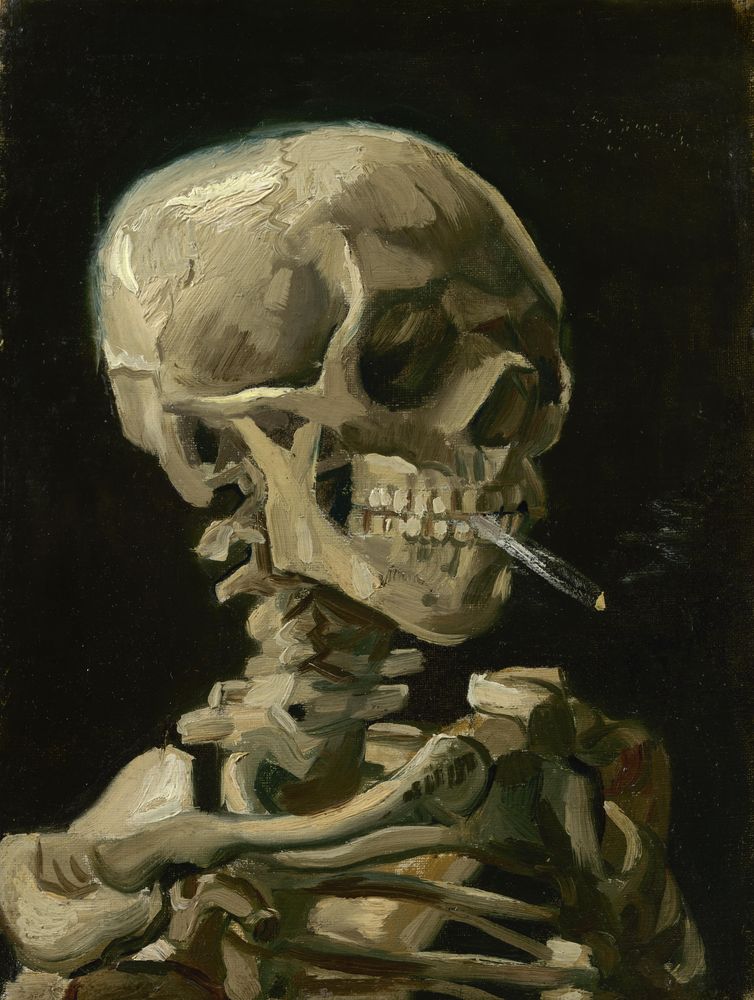
Context:
BVG 451, 2/1/1886-2/15/1886: "Well it may come sooner or later, but for you too there will come a moment when you know for sure that all chance of material happiness is lost, fatally and irrevocably."
JLB 560, 2/9/1886: "Well, whether or not it comes soon -- a moment will come for you, too, when you'll be sure that material well-being has gone by the board, fatally and irrevocably" (emphasis in original).
Context:
JLB 474, 12/10/1884: "Your position doesn't -- does it? -- admit of our associating with each other very intimately and actively and cordially. Your position -- to give just one example -- doesn't, for instance, admit of my living in Paris with you -- either to study or for financial reasons -- however useful and necessary this might increasingly become if things permitted. For -- you, like so many others, have things to say about my person, manners, clothes, words, important enough and evidently without redress -- that have gradually caused personal, brotherly relations to die and weaken over the years. Added to that is my past, and the fact that you feel quite the little gentleman at G&Cie, and I'm insufferable and an awkward customer. Enough -- this is how things are -- aren't they? -- and when it comes to analysis, when it comes to looking manfully at our positions -- you won't contradict me in this respect."
In late 1883, as Vincent's dream of a reunion on the heath faltered and, as in Antwerp, his poor health and out-of-control finances combined to create a mandate for change, the subject of moving to Paris came up. It is not clear who raised it first, but, as in Antwerp, it was probably Theo, trying to deflect Vincent's ardent invitations to Drenthe and save his brother from himself. Vincent, inevitably, uses the invitation as yet another tool to leverage Theo into quitting Goupil and joining him. (See Ch. 20, n. 383.) As part of this same "round," Theo found a job for Vincent at a magazine in Paris, but Vincent refused it and instead descended on his parents in Nuenen. (See Ch. 20, n. 346.)
Context:
JLB 549, 12/19/1885: "But it strikes me right away that -- if you should ever get to the point of working for yourself, independently of the Goupils, either sooner or later -- Antwerp could perhaps be a place where, given the poor displays there are now, by exhibiting properly quite a lot could be done that the other houses don't understand. Furthermore -- It's relatively easy to go back and forth to England from here."
BVG 443, 1/1/1886-1/15/1886: There can be no doubt that Vincent meant this angrily and punitively. (See Ch. 26, n. 332.) Another example comes a few weeks later when Vincent ponders the trip to Paris in what appears at first to be a friendly vein: "I believe that in any event it can do no harm if we see each other again in Paris after a while" (JLB 555, 1/28/1886, emphasis in original). That this statement was made out of fraternal pique, not affection (and thus constitutes a threat), is made clear by the upbraiding that immediately follows it: "As regards your letter, it's still the same and, to my mind, when you judge me you rely too much on generalities and on prejudices that are too superficial and too wrong for me to be able to believe that you'll always stick to them" (ibid.). In the same letter, Vincent tells Theo that teachers Verlat and Vinck have advised him "draw from the antique and nudes for at least a year, ... so I have to see to it that I'm somewhere where I have access to both the antique and nude models" (ibid.). This phrasing pointedly leaves open the possibility of coming to Paris, where both plaster casts and nude models were also available. Vincent wants to keep the threat of coming to Paris alive because he thinks it is the only way to get Theo to come up with the necessary money for Antwerp.
Context:
BVG 443, 1/1/1886-1/15/1886: "I should rather go farther away than go back to Holland before I had worked for a time at some studio. That 'farther' might perhaps be Paris, without any hesitation [i.e., without your permission]."
JLB 551, 1/2/1886: "I might perhaps go further afield rather than go back to Holland before I've worked in a studio for a while. And that further afield -- might possibly be Paris, without hesitation."
Context:
BVG 446, 1/22/1886: "I do not think I can take a shorter cut to make progress, and whether I go to the country afterward or to a studio in Paris, at all events it is a good thing to see many others paint, and specially to work regularly from the model as much as ever is possible."
JLB 554, 1/22/1886: "I don't think that I can take a shorter route to progress, and whether I go to the country later or come to a studio in Paris, in any event it's good for me to see a lot of painting and above all keep working regularly from models, as much as is in any way possible."
Context:
BVG 448, 2/1/1886-2/15/1886: "As to the plan of possibly living together and taking a rather good studio where one can receive people if need be, keep it in mind, and let me keep it in mind too."
JLB 557, 2/2/1886: "As to the plan that we should perhaps live together and take a relatively good studio where we could receive people if need be, keep thinking about it, and let me think about it again too."
Even assuming that the re-dating of JLB 556 (see Ch. 26, n. 467) is correct, we still believe that Theo was the first to mention the possibility of Vincent going to Cormon's atelier. In JLB 555, dated c. January 28, Vincent responds coolly to an invitation that Theo has already proffered: "I believe that in any event it can do no harm if we see each other again in Paris after a while" (emphasis in original). The invitation, apparently, came accompanied with much criticism of Vincent's prospects for success in Antwerp ("As regards your letter, it's still the same and, to my mind, when you judge me you rely too much on generalities and on prejudices that are too superficial and too wrong for me to be able to believe that you'll always stick to them" [ibid.]). But it is also clear that Theo's invitation specifically held out the possibility of Vincent studying at a studio in Paris. "[T]o be admitted anywhere in Paris," Vincent responds, defending his largely fictional involvement at the Antwerp Academy, "one has to have been somewhere else and have lost one's rough edges" (ibid.).
Did Theo mention Cormon by name in his invitation? Whether he did or did not, Vincent rejects coming to Paris any time soon ("Let's stay here for a while first -- and then, all in good time" [ibid.]). If JLB are correct and the next letter is JLB 556, 1/29/1886, then Vincent's first specific mention of Cormon's name sounds more like a response than a new proposal ("Let me draw with Cormon for a year") and in the next letter, he is still surprisingly unenthusiastic, even ambivalent about the prospect (JLB 556, 1/29/1886). "[A]s long as one doesn't have enough money, one must take advantage of the opportunities at the studios, like Verlat, like Cormon," he writes (JLB 558, 2/4/1886). "Because speaking of Cormon -- I imagine he would tell me much the same as Verlat says -- that I have to draw nudes or plaster casts for up to a year" (ibid.). This is hardly the kind of fierce advocacy one would expect if the proposal for Cormon's had been Vincent's own. In fact, no sooner has Vincent acceded to the proposal than he starts exploring alternatives to it: "you can be sure that I'd be very pleased indeed if I could work with Cormon for a year or so, unless there's somewhere better for drawing in L'Ecole des Beaux-Arts or other studios I've heard about here" (JLB 560, 2/9/1886; emphasis added).
Whatever the ordering of letters, we believe Theo was the first to suggest the possibility of going to a studio in Paris and probably mentioned Cormon's as one of several possibilities. It was a way to parry Vincent's repeated demands that he must continue to work from plasters and models -- his primary justification for staying in Antwerp -- and thus to lure Vincent out of his financially draining, personally dangerous, and professionally dead-end stay in that city. As discussed in Ch. 26, n. 602, Theo did not pull the name Cormon out of a hat. Apparently, he and Vincent had discussed it previously, although there is only one mention of his name in the correspondence (in October 1884) prior to this one (JLB 465, 10/9/1884). There is also evidence that Theo made an argument in favor of Cormon ("You talk about the clever fellows at Cormon's studio"), something that Vincent never does (JLB 558, 2/4/1886). Finally, the re-ordering of letters does not alter the primary premise of the text's argument that Vincent's correspondence in late January and early February reflects a profound and quite sudden change of attitude toward Theo and toward the possibility of joining him in Paris as a result of Vincent's self-described "debilitation" at that time (ibid.).
Context:
JLB 557, 2/2/1886: "Thanks for your letter and the enclosure. The fact that you yourself now actually propose the plan of going to Cormon is something that gives me immense pleasure."
BVG 381, 10/1/1884: Vincent first mentions Cormon in his letters in October 1884. In proposing that he go work at the studio of the sculptor Jean Theodore Stracké in "Den Bosch," Vincent notes that "there are people he gives the opportunity to draw the nude or to model in clay" (JLB 465, 10/9/1884). He compares this opportunity to the one that Cormon afforded his former colleague in The Hague, George Hendrik Breitner: "I'll find out more about this, and then it's not impossible that I might go to Stracké in the way that Breitner went to Cormon, say." This makes it clear that, for Vincent, the salient feature of Cormon's studio was the availability of nude models. The connection was no doubt reinforced by the fact that Vincent's and Breitner's principal activity during their acquaintanceship in 1882 (see Chapter 16) was prowling the red-light district in The Hague for "models" (i.e., prostitutes). Thus, by introducing the possibility of working in Cormon's studio in 1886 (see Ch. 26, n. 432), Theo may have provoked Vincent's competitiveness, both artistic and sexual, with his younger countryman Breitner. Indeed, he may have intended to do so.
Context:
JLB 465, 10/9/1884: "I'll find out more about this, and then it's not impossible that I might go to Stracké in the way that Breitner went to Cormon, say. This would be in the area and would also work out the cheapest."
Context:
JLB 555, 1/28/1886: "As regards your letter, it's still the same and, to my mind, when you judge me you rely too much on generalities and on prejudices that are too superficial and too wrong for me to be able to believe that you'll always stick to them."
Context:
JLB 555, 1/28/1886: "Anyway -- I'm still really pleased that I came here -- however it goes and however it turns out -- whether or not I get along with Verlat I find the friction of ideas that I'm looking for here -- I'm getting a fresh eye for my own work, can judge better where the weak points are and thus make progress in order to correct them."
Context:
BVG 447, 1/28/1886: "The advice Verlat gives me is very severe, and also what Vinck of the drawing class tells me, and they strongly advise me especially to draw for at least a year."
JLB 555, 1/28/1886: "What Verlat tells me is very severe and so too is what Vinck, who takes the drawing class, tells me -- and they strongly advise me above all to draw, if necessary do nothing else but draw from the antique and nudes for at least a year" (emphasis in original).
Context:
BVG 447, 1/28/1886: "As for me, if I come to Paris, I shall be perfectly contented with a cheap little room in some remote quarter (Montmartre) or a garret in a hotel, but that is relatively unimportant, and we aren't yet that far."
JLB 555, 1/28/1886: "As to me, though, if I come I'll be perfectly content to take a cheap little room or a garret in a hotel somewhere in an out-of-the-way quarter (Montmartre). But that's pretty much by the way and we're not there yet."
Context:
JLB 552, 1/12/1886-1/16/1886: "You get cross if I make a comment, or rather you take no notice of it, and all the rest that we know, and yet I believe that there will come a time when you yourself will have to acknowledge that you've been too weak in seeing to it that I get back some of my credit with people."
Context:
JLB 555, 1/28/1886: "And as to the money -- if I worked in a studio and so saved a good part of the cost of models, even then 150 francs still wouldn't be much, because painting is very expensive -- but it can be done, provided one economizes even on food."
Context:
BVG 449, 2/3/1886: " If it could be arranged so that we lived in the same city, it would certainly be by far the best, at least for a time."
JLB 558, 2/4/1886: " If we could now find some way of living in the same city it would be far and away the best thing, at least for the time being."
All this elaborately-staged soul-searching (letter JLB 557, 2/2/1886, is the equivalent of four single-spaced typed pages, much of it dedicated to this "question") is reminiscent of a similar simulated quandary in Brussels over where he would go for the summer of 1881, when it was clear he always intended to go home to Etten (see Ch. 14, n. 200); or another in Drenthe in 1883 when he appeared to carefully consider Theo's offer to come to Paris before rejecting it and going to Nuenen. (See Ch. 20, n. 383.) In both those cases, as in this one, the choice was never really in doubt. The elaborate charades of indecision were designed only to mask the raw emotional need that always drove Vincent homeward at times of psychic crisis. Later in letter JLB 557, 2/2/1886, Vincent loses his grip somewhat and betrays his unequivocal determination to come to Paris with vivid, grim descriptions of the state of his health and near-desperate expressions of urgency: "It's not pleasant, but what must be must be, and one must see that one stays alive and see one saves some strength if one wants to make paintings. ... You understand that I'm no better than the next man in so far as if I let things go too much and too far, just like so many other painters (SO MANY if one looks into it) — I would drop dead or, worse still, become mad or slow-witted." (Emphasis in original.)
Then, at the end of the letter, he returns to the pose of a reticent lover, waiting to be won over to the idea of coming to Paris: "As to the plan that we should perhaps live together and take a relatively good studio where we could receive people if need be, keep thinking about it, and let me think about it again too. ... I wish you'd write more, now we're discussing this change." (ibid.) Yet even in these straining efforts at nonchalance, one can hear Vincent's desperation right beneath the surface: "Setting up a studio together may perhaps be very good -- but we have to be able to stick it out and -- we really have to know what we're doing and what we want, and once we set it up a degree of self-confidence is needed, left, after all, after whole series of lost illusions. And one must set up a studio like this -- knowing that it's a battle and that most people are utterly indifferent -- so one has to set it up -- feeling one has a degree of power, and -- SO AS TO BE SOMETHING IN ONE'S TIME, to be active -- to be able to think when one is dying, I am going where the people who dared went. Anyway, we'll see." (ibid.) After this letter, Vincent's pleas to come to Paris immediately meet Theo's resistance, and the pretenses of face-saving fall away.
Context:
BVG 448, 2/1/1886-2/15/1886: "The year of drawing is the critical point; after that we are free to do other things, both portrait and landscape."
JLB 557, 2/2/1886: "The year drawing is the critical point, after that we'll be freer for many things, both for portraits and for paintings."
BVG 454, 2/15/1886-2/17/1886. (See Ch. 26, n. 447.)
Context:
JLB 556, 1/29/1886: "If we're prepared to look at it coolly and sensibly, I don't think this year of drawing is a misfortune. On the contrary, it gives us time to work everything out and consider things at our leisure before we begin."
BVG 451, 2/1/1886-2/15/1886. (See Ch. 26, n. 446.)
Context:
JLB 560, 2/9/1886: "As regards a studio -- if we could find, in one and the same house, a room with an alcove and also a garret or a corner attic -- then you could have that apartment of room and alcove, and we could make it just as comfortable as possible. And during the day the room could serve as studio, and the garret could serve for various more unsightly tools or for dirty work, and I could also sleep there -- and you in the studio alcove."
Context:
JLB 560, 2/9/1886: "As regards a studio -- if we could find, in one and the same house, a room with an alcove and also a garret or a corner attic -- then you could have that apartment of room and alcove, and we could make it just as comfortable as possible."
Context:
BVG 454, 2/15/1886-2/17/1886: "Because of the primary necessity of drawing for a year, for the moment the question of a good studio is quite secondary, and anything will do."
JLB 556, 1/29/1886: "Given the desirability, above all, of drawing for another year -- the question of a good studio is very much a side issue for the time being, and so anything will do" (emphasis in original).
BVG 450, 2/1/1886-2/15/1886. (See Ch. 26, n. 449.)
Context:
JLB 559, 2/6/1886: "It's true, for instance, that wanting to progress too quickly here, I may actually have progressed less, but what would you? My health is also behind it, and if I regain that as I hope to do, then my taking pains will have been less in vain."
Context:
BVG 450, 2/1/1886-2/15/1886: "For the rest, I must say exactly the same about myself as you write about yourself: You will be disappointed in me."
JLB 559, 2/6/1886: "For the rest, I have to tell you the same about me as you write about yourself -- I'll disappoint you" (emphasis in original).
Context:
JLB 562, 2/14/1886: "If you can send me a bit more this month, be it a lot or be it little, but even if it's only five francs, don't neglect to do it, and if you can't, you can't. I'm really looking forward to hearing your decision as to whether for your part you would approve if I were to come to Paris as early as somewhere around 1 April."
Context:
BVG 450, 2/1/1886-2/15/1886: "I am very glad that you are not opposed to my intention of coming to Paris. I think it will help me to make progress, and if I did not go, I am afraid I should get into a mess, and continue to go in the same circle and keep on making the same mistakes. Besides, I do not think it would do you any harm to come home to a studio in the evening."
JLB 559, 2/6/1886: "I'm really glad that you like my plan to come to Paris. I believe it will help me make progress and at the same time that, if I didn't go, I might easily get into a mess, keep moving around in the same circle too much, persist in the same mistakes. Furthermore, as for you, I don't think that coming home to a studio would do you any harm."
Context:
BVG 451, 2/1/1886-2/15/1886: "But perhaps the fault is in ourselves, because we are both too isolated, and because our forces and resources are too much divided and therefore insufficient. So union is strength, that would be much better."
JLB 560, 2/9/1886: "But perhaps it's because of our policy that we're each too much alone and our forces and resources are too divided, and in that form insufficient. So -- unity is strength -- would certainly be much better."
Context:
JLB 562, 2/14/1886: "It's such a brilliant idea, working and thinking in concert."
Context:
BVG 450, 2/1/1886-2/15/1886: "But we must both live somewhat more vigorously, and perhaps joining hands is a step toward this."
JLB 559, 2/6/1886: "But we must both live rather more robustly, and perhaps combining forces is a step towards becoming more robust" (emphasis in original).
Context:
BVG 450, 2/1/1886-2/15/1886: " I do not think you can reasonably expect me to go back to the country for the sake of perhaps 50 fr. a month less, seeing that the whole series of future years will depend so much on the relations I must establish in town, either here in Antwerp or later on in Paris."
JLB 559, 2/6/1886: " I don't think that you can reasonably ask me to go back to the country for the sake of perhaps 50 francs a month less, when the whole stretch of years ahead is so closely related to the associations I have to establish in town, either here in Antwerp or later in Paris."
Context:
BVG 451, 2/1/1886-2/15/1886: "Now I have wanted it to be this way between us for a long time already, and I imagine if you stayed alone, you would get depressed, because times are not cheerful unless one finds satisfaction in one's work."
JLB 560, 2/9/1886: "Well I'd already wanted to have that between us for a long time, and you see, I imagine that if you stayed on your own you'd become depressed because the times aren't encouraging unless one finds satisfaction in one's work" (emphasis in original).
Context:
JLB 556, 1/29/1886: "If we work for another year, if we recover our health -- you as well as me -- we'll be more resilient then than now" (emphasis original).
Context:
JLB 562, 2/14/1886: "And now if we were wiser in this respect, I don't doubt for a moment that we'd be on a better path and happier in a year's time."
BVG 453, 2/14/1886: We have slightly altered the translation; emphasis added. (See Ch. 26, n. 403.)
Context:
BVG 453, 2/14/1886: "Now that we are discussing things, I want to tell you to begin with that I wish both of us might find a wife in some way or other before long, for it is high time, and if we should wait too long, we should not be the better for it."
JLB 562, 2/14/1886: "I want to tell you at the start of our conversation about one thing and another that I wish that before too long we could both have acquired a wife, one way or another. Because it's high time, and because we'd be no better off if we were to wait a long while to do it."
Context:
JLB 557, 2/2/1886: "Do you know what I think? This -- I'd certainly work more in Paris than here -- for instance a drawing in a day or every two days" (emphasis in original).
Context:
JLB 557, 2/2/1886: "This impression of myself that I can't help getting when I compare me with other people -- that beside them I look as though I've spent 10 years in prison -- is not exaggerated -- only, to change it, and it will change, I mustn't stray too far out of the art world again for the present, but will have to carry on for the time being by remaining at a studio or academy."
Context:
BVG 448, 2/1/1886-2/15/1886: "Founding a studio together would perhaps be a good thing, but we must feel sure that we can carry it through -- and we must know our own minds perfectly, and once we begin it, we must have a certain confidence after all, left us after a long series of lost illusions."
JLB 557, 2/2/1886: "Setting up a studio together may perhaps be very good -- but we have to be able to stick it out and -- we really have to know what we're doing and what we want, and once we set it up a degree of self-confidence is needed, left, after all, after whole series of lost illusions" (emphasis in original).
Context:
JLB 559, 2/6/1886: "Further, since you say you'll have to pay rent until the end of June -- well then, perhaps it would be best after all if I were to return to Nuenen, starting in March, only -- if I encountered opposition and scenes like I got before I left, I would be wasting my time there and so, even if it were only just for those few months, I'd make a change anyhow, since I want to have some new things from the country ready to bring to Paris with me."
Vincent makes the same uncharacteristic, back-tracking argument in JLB 556, 1/29/1886: "I hear various people complaining, both painters and -- ordinary people: 'I took a fine room because people were going to come to me, and no one's come to me since, and I don't feel at home there myself.'" Because this argument tracks so closely that in JLB 561, 2/11/1886, among other reasons, we believe the new translation may have erred in re-dating JLB 556 to late January, one day after JLB 555 and prior to the series of closely-spaced letters that begins with JLB 557. JLB make three arguments (in an email to the authors): (1) that JLB 556 contains a reassessment of Vincent's situation in Antwerp and the possibility of coming to Paris that falls more naturally at the end of the painting course at the Antwerp Academy in late January; (2) that the reference to Theo's "proposal" to go to Cormon's contained in JLB 557 ("The fact that you yourself now actually propose the plan of going to Cormon is something that gives me immense pleasure") must post-date Vincent's first mention of the famous atelier in JLB 556 ("Let me draw with Cormon for a year. During that period, you take another really good look at the business, and the opportunities"); and (3) that Vincent's reference to a "résumé" of two letters in JLB 556 must refer to JLB 555 because both these letters discuss Vincent's insistence on drawing for another year.
Although supplemented by the first and last of these arguments, the case for the redating of JLB 556 rests primarily and heavily on an insistence that going to Cormon's atelier must have been Vincent's idea and, therefore, "logic" demands putting his first reference to the atelier (JLB 556, 1/29/1886) ahead of Vincent's acknowledgement of Theo's proposal (JLB 557, 2/2/1886). For the reasons discussed in Ch. 26, n. 620, we believe that it was, in fact, Theo who first proposed the "plan" for Cormon.
We also do not see the close, "résumé" relationship between letters JLB 555 and JLB 556. In fact, quite the opposite. The tone and subject change abruptly between the two letters: JLB 555 is very upbeat and energetic; JLB 556 is very downbeat and apologetic. JLB 555 is obsessed with the possibilities in Antwerp; JLB 556 is determined to put to rest Theo's demand that Vincent go to Brabant. While it is true that both letters mention the need to continue drawing for a year, the imperative is used in completely different ways: in JLB 555, to support staying in Antwerp; in JLB 556, to demand coming directly to Paris.
The plan for Cormon progresses significantly between the two letters -- far more than seems possible in a single day, even in Vincent's volatile imagination -- with apparent input from Theo in the interim as well as a complete change of attitude on Vincent's side. Where JLB 555 is boldly ambitious about the potential in Antwerp, JLB 556 is reticent about the ambition of the Paris project. As for the natural caesura of the end of the painting course in late January, Vincent's participation in this course was brief at best and largely fictitious (see Ch. 26, n. 325, and n. 348). Even if he had been registered in the course, the ebbs and flows and earthquakes of his life never responded to anything as ephemeral and external as school calendars.
Vincent's arguments for avoiding Brabant grow increasingly far-reaching and frantic -- an indication both of his desperation to come to Paris and his dread of returning to the site of his humiliation. His early reaction (if the recent redating of JLB 556, 1/29/1886 is correct [see Ch. 26, n. 467]) is absolute and unequivocal, bordering on outrage: "I've already told you that there's no reason to go and work in the country again for the first year -- that it's infinitely better for the whole future if I draw plaster casts and nudes in town" (ibid.). The argument quickly escalates to the usual excesses of rhetoric: "But what should I do now? Look here, to go back to Brabant is actually a detour, and I'll lose time and money on it. Why can't I go straight from here to Paris whenever you like, and carry on working here until I go? I tell you, I'm in such a bad way that if there's any money, then let me take care of my health and let the rest go, because they can do just as well at home with a labourer, in fact better." (ibid.) He goes so far as to suggest that if he gets sick in the country, it will be Theo's fault (ibid.). As if that were not coercion enough, he informs Theo that he has creditors back in Nuenen with whom he would likely get into a legal dispute -- a source of yet another embarrassment to the family -- and threatens to spend himself into even deeper debt if he returns there (ibid.).
Finally, he uses Theo's own pleas of scarce funds to argue against the side trip to Brabant: "You constantly write and tell me that you haven't any money, very well, so that's so. If making money is not possible when it comes to food -- then it ought not to be possible when it comes to rent or unnecessary travelling expenses." (ibid., emphasis in original.) He vows to stay in Antwerp if Theo will not take him in Paris immediately and defiantly tells Theo that his mind is made up against Nuenen: "Anyway, I've had so much unpleasantness there that I don't have to consider anyone there. It would also be a weakness on your part if you were to alter that." (ibid.) Although his desperate need for money eventually reins in his defiance even at this early stage ("In the end, it doesn't bother me, but I just tell you what's right and I point out to you the urgency of going on with what will enable us to make progress"), it is Vincent's self-described "breakdown" in early February (see Ch. 26, n. 398) that really tempers his arguments (ibid.).
Only days later, he writes with sudden pliability, if not enthusiasm: "As regards going to Nuenen too -- I want to know what you'd think best" (JLB 558, 1/28/1886). He persists in the practical arguments ("But I'm not needed there -- because someone like Rijken, the gardener, for instance, can see to what needs to be packed or sent at least as well as I can" [ibid.]). But not inflexibly so, adding: "If there's any point in it, though, I can be ready by March if need be" (ibid.). Even as he warningly envisions the awkward reunion at the parsonage (" perhaps it would be best after all if I were to return to Nuenen, starting in March, only -- if I encountered opposition and scenes like I got before I left, I would be wasting my time there" [emphasis added]), he appears to defer to Theo's wisdom: "I'm curious as to how those few months in Nuenen will be for me. ... Keep thinking about what we can best do." (JLB 559, 2/6/1886.) But he guides his brother's wisdom by reminding him of the pain their mother would be spared if she did not see Vincent's dreadful condition: "I don't want you to tell Ma that I'm not well -- because she might possibly consider that it wasn't nice that what happened, happened, that's to say that I didn't stay there -- precisely because of these consequences" (JLB 558, 2/4/1886).
As soon as Theo makes clear that he does not want Vincent to come to Paris until summer, Vincent's arguments become much more forceful: "I definitely need to tell you that it would reassure me greatly if you were to approve my coming to Paris much earlier than June or July if need be. The more I think about it, the more desirable this appears to me. (JLB 563, 2/11/1886.) He revives the argument that the recovery of his health would be compromised by staying in Nuenen and his art would be put on hold. In what sounds as much like a threat as a worry, he tells Theo that he would be more likely to abuse his health and overspend his budget in Nuenen: "if things were to be the same for me in Brabant from March to July as they've been for the past few months, and it's likely they'd be no different. ... in Brabant I'd wear myself out again taking models, the same old story would start all over again, and it doesn't seem to me that any good could come of it. That way -- we'd be straying from the path. So please give me permission to come sooner if need be. In fact I'd say right away, if need be." (ibid.) Although he still wants to sound cooperative, he puts more and more conditions on his cooperation: "Know that I don't mind going to Nuenen in the month of March if need be and seeing how things are there, and how the people are, and whether or not I can get models. But if that doesn't work out, which is likely, then after March I could come straight to Paris and start drawing, in the Louvre, for instance." (ibid.)
After appearing to agree on an "interval" of "one month in the country" ("I'm really looking forward to hearing your decision as to whether for your part you would approve if I were to come to Paris as early as somewhere around 1 April" [JLB 562, 2/14/1886]), he then reconsiders and mounts another round of arguments, this time against any detour on his way to Paris, preposterously arguing that his work on drawing plaster casts is so urgent and essential that it must be done for one year (JLB 565, 2/22/1886). Perhaps in response to Theo's continued insistence, Vincent begins discussing a compromise "plan" that involves "coming to Paris should go ahead as soon as possible" and spending a "short while" in Brabant -- although exactly how short is suspiciously unclear (JLB 563, 2/17/1886). This plan may be simply a red herring signaling Vincent's decision to come to Paris without Theo's permission or warning. ("I'm really looking forward to hearing from you," Vincent says in proposing his plan. "But anyway, for my part I've decided -- only it would be pleasant for me if you could see it the same way as I do." [ibid.]) Indeed, there is a thematic thread that connects the resigned language of Vincent's volte-face to the note that he sent Theo on his arrival in Paris: "I've thought about it so much and I think we'll save time this way. ... We'll sort things out, you'll see." (JLB 567, 2/28/1886.)
Context:
BVG 454, 2/15/1886-2/17/1886: "So Brabant is a useless detour, a loss of time, etc."
JLB 556, 1/29/1886: "So Brabant is a detour, waste of time etc."
He even goes so far as to argue that doing landscapes would be a threat to his health: "Moreover, my health -- when I paint outdoors I don't eat -- and I won't overcome it. For I keep relapsing; my constitution is still far from strong." (ibid.) Toward the end of the month, he seems to have a change of heart both on going to Nuenen and on Theo's advice to paint landscapes: "The time when one can work outdoors could be upon us with the slightest change in the weather and so, if I have to and if you're absolutely set on it, at least my being in Brabant wouldn't be entirely fruitless" (JLB 566, 2/24/1886). But these reversals are clearly either tactical or disingenuous, as Vincent arrives in Paris only days later. (See Ch. 26, n. 665.)
Context:
JLB 557, 2/2/1886: "The year of drawing is the critical point; after that we are free to do other things, both portrait and landscape. I think we must put that first."
Context:
BVG 457, 2/19/1886-2/20/1886: "And I should not insist so much if I did not think it necessary to continue drawing from the casts without interruption, especially with regard to June."
JLB 565, 2/22/1886: "And I wouldn't insist on it like this if I didn't think it was necessary, with a view to June, specifically, for me to go on drawing plaster casts at once."
When Theo rejects Vincent's "plan" for coming to Paris "as soon as possible" (see Ch. 26, n. 473), Vincent responds furiously: "your letter disappoints me since you don't accede to my request, because I still continue to believe so strongly that the reasons which I gave you in my last letter for preferring to come even sooner were justified. But since I don't want to argue about that, after all, I just wanted to ask you to reconsider it again." (JLB 565, 2/22/1886.) To underscore just how angry he is, he tells Theo: "I tore up a letter that I wrote to you first" (ibid.). Theo clearly hesitated to give Vincent the bad news. He delayed through several plaintive, impatient letters in which Vincent pleaded emergency conditions: "It's at the moment when my money has entirely gone -- entirely ... For I have absolutely nothing left. Nothing left even at the baker's." (JLB 564, 2/18/1886; emphasis original.) He warns Theo that every day he has to wait for an answer, his health deteriorates: "from the time I send this letter off until I receive your reply, which I hope will cross this, I have nothing and it's fasting time again" (ibid.). At the same time, Vincent reads his brother's silence as signaling a "no": "I do realize that you don't agree with me about coming straight to Paris, otherwise you would already have answered me" (ibid.).
It is typical of Theo that when his refusal finally comes, it comes accompanied by a payment of 50 francs, as if he can buy Vincent's patience with extra money (JLB 565, 2/22/1886). Vincent, also typically, uses the money to buy a ticket to Paris. It is only because he has already made the decision to join his brother, with or without permission, that Vincent takes Theo's "no" with such apparent calmness: "your letter disappoints me since you don't accede to my request, because I still continue to believe so strongly that the reasons which I gave you in my last letter for preferring to come even sooner were justified. But since I don't want to argue about that, after all, I just wanted to ask you to reconsider it again." (ibid.) His final letter from Antwerp, which must have come as he made final preparations for his departure, is a study in disingenuousness, as Vincent writes of an impending trip to Brabant: "I'm writing to you once again, because in any event my time here is almost up and I have to go back [to Brabant] one of these days. The time when one can work outdoors could be upon us with the slightest change in the weather and so, if I have to and if you're absolutely set on it, at least my being in Brabant wouldn't be entirely fruitless. Yet be that as it may, I still continue to urge you rather to go ahead with the Cormon plan and what, for my part, I would so much like to precede it -- a further period continuing to draw plaster casts." (JLB 566, 2/24/1886.)
Context:
JLB 563, 2/16/1886 or 2/17/1886: "If you agree that the plan of coming to Paris should go ahead as soon as possible -- in other words after I've been in Brabant for a short while -- then I'll send you from here the studies and drawings I have here."
Context:
JLB 563, 2/16/1886 or 2/17/1886: "If it were in any way possible, I'd like to have the second half of that work on my teeth done this month. I'd like to pack up my studies and send them to you, and leave on the last day of this month or even a few days earlier."
Vincent was chronically delinquent on his color bills. One of the reasons he cites for not returning to Nuenen at Theo's request is that he would "also be obliged to pay for some paint" (JLB 556, 1/29/1886). In Nuenen, he was forever avoiding (not always successfully) his creditors from The Hague. In Antwerp, his paint supplier was also his landlord, and he admits to leaving town with his rent unpaid. (See Ch. 26, n. 475.)
BVG 455, 2/15/1886-2/17/1886: Vincent did apparently pay a 50-franc advance on dental work that would cost a total of 100 francs: 60 francs for the upper jaw and 40 for the lower. (See Ch. 26, n. 213.) As of mid-February, he had not yet had the lower-jaw work done, but he still owed 10 francs on the upper-jaw work (JLB 563, 2/16/1886 or 2/17/1886). Theo took the hint and, by return mail, sent him an additional 50 francs (JLB 565, 2/22/1886). But Vincent apparently did not use the money on his teeth as Theo intended; instead, he bought a train ticket to Paris and paid to ship some of his paintings. Even then, he reported having "some money left, that goes without saying," after he arrived in Paris (JLB 567, 2/28/1886). This, and Vincent's record of avoiding debt with his feet, suggest that the dentist was never paid.
Context:
JLB 563, 2/16/1886 or 2/17/1886: "I'd also so very much like to get the work on my teeth finished. What should I do? Altogether I've got one franc fifty left -- and as for food, I've still got five francs credit until the end of the month."
Context:
JLB 567, 2/28/1886: "Don't be cross with me that I've come all of a sudden. I've thought about it so much and I think we'll save time this way. Will be at the Louvre from midday, or earlier if you like."