Notes
Chapters
- A Fanatic Heart
- 27. Against the Grain
- 28. The Zemganno Brothers
- 29. Catch and Release
- 30. A Mercenary Frenzy
- 31. Le Paradou
- 32. The Sunflower and the Oleander
- 33. The Poet's Garden
- 34. Imaginary Savage
- 35. La Lutte
- 36. The Stranger
- 37. Two Roads
- 38. The Real South
- 39. Starry Night
- 40. The Isolated One
- 41. A Degenerate Child
- 42. The Garden and the Wheatfield
- 43. Illusions Fade, the Sublime Remains
- Ici Repose
The Early Years
The Dutch Years
The French Years
Chapters

Context:
JLB 560, 2/9/1886: "What I'm not sure about is whether we'll get on personally …"
Context:
BVG 453, 2/14/1886: " And if we were together soon, I should disappoint you in many things, yes, to be sure, but not in everything, and not in my way of looking at things, I suppose."
JLB 562, 2/14/1886: "And were we to be together much more in the near future, I'd disappoint you in things for sure, but not in everything and not in my way of looking at things, I believe."
Context:
BVG 448, 2/1/1886-2/15/1886: "As to the plan of possibly living together and taking a rather good studio where one can receive people if need be, keep it in mind, and let me keep it in mind too."
JLB 557, 2/2/1886: "As to the plan that we should perhaps live together and take a relatively good studio where we could receive people if need be, keep thinking about it, and let me think about it again too."
Context:
JLB 556, 1/29/1886: "Given the desirability, above all, of drawing for another year -- the question of a good studio is very much a side issue for the time being, and so anything will do" (emphasis in original).
Context:
JLB 561, 2/11/1886: "I've given a lot of thought to what you wrote about taking a studio -- but it seems to me that it would be a good thing if we were to look for it together and that before we start living together permanently -- did it for a while -- provisionally -- and I started by renting a garret at the beginning of April, say, until June."
Context:
JLB 556, 1/29/1886: "All the same -- setting up a studio in Paris now, straightaway, might perhaps not be as good as not doing it until after another year of study, both for yourself and for me. Let me draw with Cormon for a year. During that period, you take another really good look at the business, and the opportunities. And then -- I believe -- we can chance it. ... it gives us time to work everything out and consider things at our leisure before we begin." (Emphasis in original.)
The coincidence that the dealer Alphonse Portier lived on the first (i.e., second) floor of the rue Lepic building, suggests only how Vincent and Theo heard about the availability of the apartment, not an underlying rationale for the move (Welsh-Ovcharov, Vincent van Gogh: His Paris Period, 1886-1888, p. 16). Portier was an elderly, small-time "courtier" dealer -- a charming man, perhaps, but hardly a liaison worth developing at such inconvenience and expense. If Portier was, indeed, part of the motivation for the move, then it suggests even more strongly that Vincent was the moving party. It would have been typical of Vincent to undertake the hopeless task of re-igniting Portier's initial faint interest in his Nuenen work by moving into the same building. Of course, because he paid the rent, Theo undoubtedly made the final decision; but after three months in the tiny rue Laval apartment, he must have been desperate to placate his difficult and tenacious brother.
Context:
BVG 454, 2/15/1886-2/17/1886: "But if one wants to start a studio, one must consider well where to rent it, where one has the greatest chance of getting visitors, and making friends, and getting known."
JLB 555, 1/28/1886: "But if one wants to start on that, one must think about where one rents it, where one has the best chance of getting visitors and making friends and becoming known."
Context:
JLB 37, 7/6/1875: "I've rented a small room in Montmartre which you'd like; it's small, but overlooks a little garden full of ivy and Virginia creeper."
Context:
JLB 406, 11/12/1883 or 11/13/1883: "… if one only had company it would be such a wonderful thing to rent a peasant cottage and to arrange everything solidly and less precariously than in an inn."
Context:
JLB 707, 10/17/1888: "I much prefer Guy de Maupassant to [Jean] Richepin, for being more consoling."
Context:
BVG 482, 5/4/1888: "I should be heartily glad, I say, if a kind of Guy de Maupassant in painting came along to paint the beautiful people and things here lightheartedly."
JLB 604, 5/4/1888: "I'd be, I tell you -- mightily pleased if in painting a man like Guy de Maupassant came along and cheerfully painted the beautiful people and things in these parts."
Sund draws a distinction between Vincent's more serious appreciation of the older Naturalists, with their dedication to "truth, life as it is," and his appreciation of Maupassant -- i.e., "the lightest of Naturalist fare" (Sund, p. 140). However, we see the transition of Vincent's taste in literature to lighter fare (culminating in his obsession with Daudet's comic Tartarin series in Arles) as symptomatic of his increasing disconnection from the real world. Just as his art undergoes a passage from the exaggeratedly dark "de terre" world of Millet and the Potato Eaters to the magically bright world of the wheatfield outside his dark asylum cell at St. Remy, so his taste in literature undergoes a similar withdrawal from reality. Welsh-Ovcharov recognizes this "lightening" transition in Vincent's art, especially his palette, but misattributes it, we believe, to a change in Vincent's appreciation of Zola (Welsh-Ovcharov, Vincent van Gogh, p. 41). Welsh-Ovcharov argues that after he arrived in Paris, Vincent turned from a philosophical appreciation of Zola to a descriptive appreciation (ibid.). We would argue that Vincent's first appreciation of Zola (Un page d'amour) was descriptive, not philosophical (JLB 244, 7/6/1882) (see Ch. 17, n. 534 and n. 532), and that his ultimate appreciation was autobiographical, not descriptive (see Ch. 24, n. 212, n. 214, and n. 230).
Context:
BVG W1, 6/21/1887-12/21/1887: "Maupassant's masterpiece is Bel Ami. I hope to be able to get it for you."
JLB 574, October 1887: "Maupassant's masterpiece is Bel-ami; I hope to be able to get it for you."
Context:
BVG W1, 6/21/1887-12/21/1887: "And the diseases from which we civilized people suffer most are melancholy and pessimism."
JLB 574, October 1887: "And the diseases from which we civilized people suffer the most are melancholia and pessimism.
Context:
BVG W1, 6/21/1887-12/21/1887: "So I, for instance, who can count so many years of my life during which I lost any inclination to laugh -- leaving aside whether or not this was my own fault -- I, for one, feel the need for a really good laugh above all else. I've found it in Guy de Maupassant, …"
JLB 574, October 1887: "Like me, for instance, who can count so many years in my life when I completely lost all inclination to laugh, leaving aside whether or not this was my own fault, I for one need above all just to have a good laugh. I found that in Guy de Maupassant…" (Emphasis in original.)
Context:
JLB 569, September or October 1886: "At this present moment I have found four dealers who have exhibited studies of mine. And I have exchanged studies with several artists. Now the prices are 50 francs. Certainly not much but -- as far as I can see one must sell cheap to rise, and even at costing price.
Context:
JLB 569, September or October 1886: "Certainly not much but -- as far as I can see one must sell cheap to rise, and even at costing price. And mind my dear fellow, Paris is Paris, …"
Because Vincent had every reason to exaggerate his success at Cormon's given how he must have bragged about it during his time with Livens in Antwerp, we do not take it as probative, much less dispositive. Van Tilborgh coaxes unconvincing support for his argument from the ambiguous passage in Andries Bonger's letter from April 1886 in which he informs his parents: "Theo's brother is here for good, he's staying for at least three years to work in the painter Cormon's studio" -- a passage that Van Tilborgh acknowledges "has always been read as if this was a future plan" (Van Tilborgh, in Hendriks and Van Tilborgh, eds., p. 41, n. 21). Indeed, Van Tilborgh's extrapolation from this passage inadvertently raises the strongest circumstantial argument against an immediate start at Cormon's in March. "[F]rom this we can infer that there was no longer any doubt about his admission to the studio. The length of his period of study -- at least three years -- was already fixed, and this also tends to confirm that he already had a place. In Antwerp, Vincent had been thinking in terms of staying at Cormon's for just one year [JLB 556, 1/29/1886], and this drastic extension and change to the original plan would seem to reflect consultation and an arrangement with the studio itself." (Van Tilborgh, in Hendriks and Van Tilborgh, eds., p. 41.)
But surely Vincent's "plans" for three years of study at Cormon's -- like his Antwerp plans for one year -- were little more than ambition. After he arrived unannounced in Paris, he must have been desperate to justify his coming with renewed, redoubled pledges of hard work at Cormon's studio. We know from Vincent's Antwerp letters, indeed from the entire corpus of letters, that he was always full of ambitious hopes. That he would, in discussing his plans for Cormon with Theo or Bonger, inflate his enthusiasm and intentions can hardly be surprising. Bonger's report, which came either directly from Vincent or from Vincent via Theo, surely represents yet more of the same -- hardly a "confirmation" of a settled plan, as Van Tilborgh would have it. Furthermore, Van Tilborgh nowhere else addresses the issue of "consultation" with Cormon.
Vincent's admission was by no means inevitable (as Vincent acknowledges), and Theo no doubt had to do some persuading to secure Cormon's permission (JLB 555, 1/28/1886). The text also makes the point that Vincent, for all his professed enthusiasm from Antwerp, admitted to being sharply insecure and apprehensive about joining a prestigious atelier like Cormon's and competing (there was, after all, a concours) with academy-trained artists ("I'd always have trouble with fellows who had been at some academy or other -- that I couldn't draw -- according to them") and undoubtedly wanted to look and feel his best before jumping in (JLB 563, 2/16/1886 or 2/17/1886).
This reticence becomes apparent almost as soon as the plan for Cormon is agreed upon -- a plan that, for Vincent, appears to include an interim transition period between his arrival in Paris and his start at Cormon's. "If I take a garret in Paris," he wrote from Antwerp, "I can finish the most pressing things at once -- those studies of plaster casts that will certainly help me when I go to Cormon's. ... after March I could come straight to Paris and start drawing, in the Louvre, for instance." (JLB 561, 2/11/1886.) The insistence in the literature (by Hulsker and others) that Vincent came to Paris in a fever of enthusiasm for Cormon's studio and therefore could not have put it off, is mistaken.
As discussed in Chapter 26, the plan for Cormon was probably Theo's proposal originally, and Vincent was ambivalent about it from the start. He came to Paris in a fever, all right, but for Theo's companionship, not for Cormon's instruction. Of course, if Van Tilborgh's arguments about the end-date are correct (and we believe they are), then the later Vincent started at Cormon's studio in the spring of 1886, the less time he spent there. The closest thing to a certain start-date is given in Bonger's April letter, which means Vincent probably spent only two months at the atelier, and might have spent less. In his very first account of Vincent, Bernard wrote that "il est resté deux mois" [he remained two months] à l'atelier Cormon" (Bernard, quoted by Van Tilborgh, in Hendriks and Van Tilborgh, eds., p. 40, n. 20). This short stay would explain the slight accounts (or lack thereof) of Vincent's time at Cormon's from his fellow students (he and Hartrick never overlapped) or even Cormon himself. It would also be consistent with Vincent's previous academy-like experiences.
Finally, a later start date would also explain one of the strange contradictions in Bernard's story of meeting Vincent. Bernard left the Cormon studio in early April 1886 (ibid., p. 39), but almost certainly did not meet him until the fall of that year (despite his occasional claim to an earlier encounter). If Vincent did not start until after early April, it would explain the otherwise inexplicable failure of these two artists to connect in March.
Context:
JLB 557, 2/2/1886: "… it's become dreadfully apparent to me that there are other things that I absolutely definitely have to change. When I compare myself with the other fellows, there's something much too stiff about me, as if I'd been in prison for 10 years. ... And it's important for me to smarten up my appearance a bit. Perhaps you'll say that it has nothing to do with art -- and -- perhaps you'll agree with me. I'm seeing about getting my teeth put right again. I have no fewer than 10 teeth that I've either lost or am losing. And that's too many and too disagreeable, and besides it makes me look as though I'm over 40, which puts me at too much of a disadvantage." (Emphasis in original.)
Context:
JLB 566, 2/24/1886: "Of course I wish I'd come here [in Antwerp] with the experience of it that I have now, at the moment I'm leaving. But if that were possible, things would be easier, and one always begins by coming in green." (Emphasis added.)

Fabian de Castro exhibited with the Indépendents and later knew both Picasso and the sculptor Manolo (Manuel Martínez Hugué) (ibid.). Salter adds an additional piece to the puzzle: in 1883, Russell traveled to Grenada, Spain to meet up with the American painter Dodge MacKnight (1860-1950) who was "on a visit to the wretched hovel of a studio belonging to the Spanish painter Fabian" (Salter, p. 51). For unstated reasons, JLB doubt that the "Fabian" Vincent refers to is Fabian de Castro (JLB 598, n. 7). The identification is problematic because the sitter in Russell's portrait looks somewhat older than nineteen; and Fabian de Castro would have been only fourteen or fifteen when MacKnight visited his studio in Grenada in 1883 (MacKnight was twenty-three at the time). This may point only to a mistake in the birthdate listed for De Castro. Fabian's name, like Vincent's, does not appear in Russell's correspondence from the time (Galbally, p. 41) -- another indication that a portrait by Russell did not necessarily betoken a close relationship with the artist. Finally, it seems likeliest that Vincent knew Fabian through their mutual association with Russell, not because Fabian was a fellow student at Cormon's, the common assumption in the literature.
Context:
BVG 539, 9/17/1888: "I am definitely opposed to Cormon, who says that if he did not measure, he would draw like a pig."
JLB 683, 9/18/1888: "I'm quite categorically opposed to Cormon, who says that if he didn't measure he would draw like a pig."
Context:
JLB 569, September or October 1886: "I have been in Cormons studio for three or four months but did not find that so useful as I had expected it to be."
In letters like this one, Theo often plays the enabler to Vincent's excuses. From Paris, he writes as if Vincent's dental procedures will be the answer to a lifetime of social and professional problems: "You would not recognize Vincent, he has changed so much, others notice it even more than I do. He has undergone a major operation on his mouth, for he lost almost all his teeth due to the bad condition of his stomach. The doctor says that he has recovered completely. He is improving a lot in his work, proof that he is becoming successful." (b0942 V/1962, "Gogh, Theo van" to "Gogh-Carbentus, Anna C. van", July 1886.) This upbeat campaign, of course, included relentlessly glowing reports on the quality (and eventual salability) of Vincent's work, his hard work, and his popularity among his fellow painters. (The latter of these was designed to gratify his mother's conviction that Vincent's problems had always stemmed from his failure to mingle with the right people; thus his report in June 1886: "[Vincent] also has acquaintances who give him a collection of flowers every week which may serve him as models" [see Ch. 27, n. 359].)
When Vincent was in Antwerp, Theo wrote his mother, "I received a few letters from Vincent. He works a lot, and seems to specialize in portrait painting; that always brings in a bit more money." (b0905 V/1962, ''Gogh, Theo van'' to ''Gogh-Carbentus, Anna C. van'', 1/12/1886.) It should be noted that Theo's father, Dorus, calculated his letters to Vincent in exactly the same way, as he revealed to Theo in a letter from 1876: "We expect Vincent tomorrow. He will leave Paris tonight at 8 o'clock. What emotions he will have! And how emotional for us as well. I think you will understand. It is bitter sorrow, yet I always kept on writing to him in a cheerful tone." (b0955 V/1962, ''Gogh, Theodorus van'' to ''Gogh, Theo van',' 3/31/1876; emphasis added.) Interestingly, subsequent commentators readily allow that Theo calculated his reports so as to "spare his mother anxiety"), but only on the issue of his personal relationship with Vincent (Welsh-Ovcharov, Vincent van Gogh: His Paris Period, 1886-1888, p. 9). "[W]hen Theo himself wrote to their mother, he avoided complaining about Vincent's unruly behavior" (Rewald, p. 23). In fact, all of Theo's reporting on Vincent's life was shaped first and foremost by the need to reassure his mother (or, earlier, keep family peace) and should be seen in the same sympathetic but skeptical light.
Nevertheless, according to another account, Theo did some business with Thomas. That, and not an interest in Vincent's art, may explain the visit that Thomas paid to the rue Lepic apartment as recalled by Vincent from Arles in 1889 (JLB 753, 3/29/1889). Looking at Vincent's sketch of "a faded woman" with "strange eyes," Thomas commented: "Ah but -- are those the kind of women to make a man horny?'" Pierre Firmin Martin (whom Vincent refers to as "père" (father) Martin (a generic term for an old man, not necessarily intimate), was an even more marginal dealer than Thomas. A former mason, Martin, like Portier, combined home and shop, and even then moved locations frequently. During Vincent's stay in Paris, Martin had a tiny apartment (one room and a kitchen) at 29, rue St. Georges from which he tried to sell, mostly unsuccessfully, a small inventory of paintings (Coquiot, p. 147). Like Thomas, Martin was known for being "unscrupulous" (ibid.). Artists complained that he had their paintings repainted to his own taste by a third party then demanded that artists re-sign the altered works (ibid.).
Probably in Theo's company, Vincent met other dealers while in Paris, dealers like Gabriel Delarebeyrette (referred to by Vincent as "Gabriel de la Roquette" (1862-1891) [JLB 625, 6/15/1888-6/16/1888]), son of Joseph Delarebeyrette, the leading Monticelli dealer, who died in September 1886 (Sheon, p. 56). A joint visit to the gallery is mentioned in JLB 830, 12/22/1889 and Vincent apparently knew members of the dealer's family well enough to write one of them from Arles (JLB 686, 9/23/1888 or 9/24/1888), but he referred to another one as "malicious" (JLB 635, 7/1/1888) and to the son Gabriel as a "scoundrel" (JLB 625, 6/15/1888-6/16/1888).
Similarly, Vincent is known to have patronized paint merchants other than Tanguy (e.g., Arnold & Tripp [JLB 699, 10/8/1888] and Guillaume Charles Tasset [JLB 700, 10/9/1888 or 10/10/1888]) where he may have displayed his works alongside those of other customers. But Thomas and Martin were the only dealers Vincent felt he knew well enough to call upon after leaving Paris. If the vehemence and persistence of his calls are an indication of how well he knew them, then he knew Thomas much better than Martin. Throughout 1888 and into the following year, he cajoled and demanded that his brother extract money from Thomas, through either sales or advances. (JLB 617, 5/29/1888 or 5/30/1888; JLB 625, 6/15/1888-6/16/1888; JLB 697, 10/4/1888 or 10/5/1888; JLB 637, 7/8/1888 or 7/9/1888; JLB 639, 7/13/1888; JLB 640, 7/15/1888; JLB 683, 9/18/1888; JLB 689, 9/26/1888; JLB 699, 10/8/1888; JLB 702, 10/10/1888 or 10/11/1888; JLB 709, 10/21/1888; JLB 718, 11/10/1888; JLB 753, 3/29/1889.)
When these efforts failed, he wrote Thomas directly, leading, inevitably, to a complete break. The relationship with Martin ended abruptly, apparently, in April 1888, only a few months after Vincent's arrival in Arles (JLB 592, 4/3/1888). Although Martin, like Thomas, may have visited the rue Lepic apartment once (JLB 634, 6/28/1888), we dismiss as apocryphal the story that Vincent painted a portrait of Martin's daughter "in the style of Renoir " (Coquiot, p. 147). That leaves only the question of when during his time in Paris Vincent knew and exhibited with these two dealers. The story about Thomas's visit to the brothers' apartment does not give any clue, as it is not clear which of Vincent's paintings, or drawings, elicited the dealer's crude comment. Woman Sitting by a Cradle (F 369 JH 1206), Agostina Segatori Sitting in the Café du Tambourin (F 370 JH 1208), Nude Woman on a Bed (F 330 JH 1214), Portrait of a Woman (F 357 JH 1216), and Italian Woman (Agostina Segatori?) (F 381 JH 1355), or related drawings, are all possibilities, although Vincent's imprecise renderings of faces, and particularly eyes, makes the descriptor "strange" a difficult one to apply. The reference to a "faded woman" surely excludes not only Woman Sitting by a Cradle (F 369 JH 1206) but also Portrait of a Woman with Hat (F 215c) and Portrait of a Woman Seated (215d), which would argue for a dating sometime after the summer of 1886, which is the position of the text.
Moreover, Thomas was not fully converted to the "new" art until 1890, according to Thomson, making it unlikely that he would support Vincent this early in his career, except as a favor to Theo (ibid., p. 76). The dating of Thomas's interest would determine the possible start-date of Martin's involvement, as Vincent later recalled that Thomas was the second venue in Paris (after Tanguy's) where his work was "exhibited" (JLB 726, 12/17/1888 or 12/18/1888). As discussed in Chapter 27, we do not take as probative at all Vincent's claim in his letter to Livens that, as of October 1886, his work was being exhibited by four dealers (JLB 569, September or October 1886). Thus, the extensive effort in the literature to identify those dealers is, we believe, misguided.

The year of the meeting Angrand describes is not clear from his account, but given that he mentions the same painting, Jeune fille aux poules, as being the object of Vincent's exchange proposal, it must have been November 1886. Elsewhere in his account, Angrand appears to point to an 1887 date for the meeting, as he told Coquiot that Vincent "was obliged to leave Paris shortly afterwards" (i.e., after their meeting). This could be merely the compression of memory. Both the letter and the subsequent meeting were probably prompted by Vincent seeing Angrand's six works in the Indépendants exhibition that ran from August 20 to September 21, 1886. (See Welsh-Ovcharov, Vincent van Gogh: His Paris Period, 1886-1888, p. 218.) However, the painting that Vincent had picked out for exchange, Jeune fille aux poules, was hanging at Tanguy's at the time, according to Angrand's account (Coquiot, p. 149).
Context:
JLB 850, 2/1/1890: "In any case, Russell has outbursts, he gets angry, he says something true, and that's what I need sometimes" (emphasis in original).
Context:
JLB 569, September or October 1886: " And so I am struggling for life and progress in art. … It may be my fault however, any how I left there too as I left Antwerp and since I worked alone, and fancy that since I feel my own self more."
Context:
JLB 569, September or October 1886: "Now I would very much like to know what you are doing and whether you ever think of going to Paris. If ever you did come here, write to me before and I will, if you like, share my lodgings and studio with you so long as I have any."
Context:
JLB 569, September or October 1886: " In spring -- say February or even sooner -- I may be going to the south of France, the land of the blue tones and gay colours. And look here, if I knew you had longings for the same we might combine." (Emphasis in original.)
Context:
BVG B5, 5/20/1888: "Something like this is not characteristic at all, for the women of our boulevard -- the little one -- usually sleep alone by night, for they have five or six hauls during the day or in the evening. and très tard there is that honorable carnivore, their maquereau, who comes and takes them home, but he does not sleep with them (or rarely)."
JLB 633, 6/27/1888: "Something like that -- it's not characteristic, because the women of our boulevard -- le petit -- usually sleep alone at night because they screw 5 or 6 times during the day or the evening and -- late at night it's that honourable carnivore, their pimp, who comes to collect them and take them home, yes, but he doesn't sleep with them (only rarely)."
Context:
BVG B5, 5/20/1888: "… and très tard there is that honorable carnivore, their maquereau [pimp], who comes and takes them home, but he does not sleep with them (or rarely)."
JLB 633, 6/27/1888: "… late at night it's that honourable carnivore, their pimp, who comes to collect them and take them home, yes, but he doesn't sleep with them (only rarely)."
Context:
BVG B9, 6/24/1888: "That's all right, the whore is like meat in a butcher's shop. I, though, having become a mere brute, I understand, I feel it, I rediscover a sensation in my own life; I say, That is well spoken -- for the sonorous rhythm of the colorful words evoke for me with great intensity the brutal reality of the slums, but on me, the brute, the reproaches directed against society, such hollow words as 'le bon Dieu' -- the good God -- no longer make any impression. I say, That isn't the real thing -- and I sink back into my brutish state; I forget poetry, which was powerful enough at first to dispel my stupefaction."
JLB 633, 6/27/1888: "Very good, that, the whore is like meat at the butcher's. For myself -- numbed -- I understand, I feel that, I recognize a sensation from my own life, I say: that's well said. Because the sonorous rhythm of the colourful words suggests to me the brutal reality of the dive with great intensity. But the reproofs addressed at the end to 'society,' a word as hollow as 'the good Lord' to me, numbed as I am, no longer have any effect on me. It isn't there, I say, and I sink into my numbness again; I forget the poem, at first strong enough to dispel my lethargy." (Emphasis in original.)
Context:
BVG 439, 12/8/1885-12/15/1885: "Now she is a washerwoman and knows a lot of women, and could always supply some, she said."
JLB 547, 12/14/1885: "Now she's a washerwoman and knows a lot of women, and would always be able to provide them, she says."
Van Heugten entertains the possibility that not all of these images show the same woman, but largely dismisses it (Van Heugten, p. 252). He also points out that Vincent probably depicted the same woman in yet another painting which he later covered over with a self-portrait (Self-Portrait with Pipe and Glass [F 263a JH 1199]) (see Van Heugten, p. 252, n. 9). He then conjectures that only the drawing, Study for 'Reclining Female Nude' (F 1404 JH 1213), was done from the live model: "The drawing is not a preliminary study in the sense of a rapid sketch in which the artist tries to find the right pose. It is too detailed for that. Van Gogh probably made it as an aide-mémoire which he could use to help him finish the painting after the model had left. Working with small dabs of paint was a time-consuming business, and it would have been very expensive to keep the woman posing all that time." (ibid.)
We would agree, with only two caveats: the painting was probably not done at his studio and Vincent was probably paying the "sitter" sexual wages, not modeling wages (either one of which would have been too expensive for dallying). Also, one version of the odalisque (Nude Woman Reclining [F 329 JH 1215]) is done in a much smaller version that Vincent boldly signed (although there are questions about the attribution of this painting [see Van Heugten, p. 249, n. 6].) If it is Vincent's, he might have made it as a gift for the model, although the fact that it survives would suggest that she never took possession of it. If Van Heugten is right about the aide-mémoire, then Vincent must have done another quick drawing, since lost, showing the same woman turned with her back facing him, as there is an elaborate painting showing her from that angle (Nude Woman Reclining, Seen from the Back [F 328 JH 1212]).


Context:
BVG 428, 10/15/1885-10/31/1885: "These things concerning complementary colors, simultaneous contrast, and the neutralizing of complementals, this question is the first and principal one ..."
JLB 536, 10/20/1885: "These things that relate to complementary colours, to simultaneous contrast and to the way complementaries neutralize each other, this question is the first and foremost."
Over many retellings, by Bernard and others, the story was aggrandized into an "historic revolt" (Salter, p. 83) and attracted a number of unlikely, contradictory, and even absurd details: that Cormon was, in fact, a doctrinaire taskmaster (Destremau, quoted in Bernard, p. 128); that Bernard's "protest" spoke for a group of "radicalized" Cormon students (Murray, p. 84); that Bernard won Toulouse-Lautrec over to the insurgents (ibid.); that Toulouse-Lautrec and Bernard were co-leaders of the rebellion (Hartrick, p. 43); that Anquetin led the "hardliners" (Destremau, p. 174) and "carried most of the studio with him" (ibid.); that many students, including Toulouse-Lautrec, were expelled by Cormon (Coquiot, quoted in Hartrick, p. 48); that the atelier was forced to shut down as a result of the "upheaval" (Destremau, p. 174); that Cormon closed the atelier prematurely for the summer (Salter, p. 84); and that Van Gogh was among the rebels (Hartrick, p. 48).
Pursuing the last of these fictions, Hartrick, a fearless storyteller who had no first-hand knowledge of the event, retails an embellishment on Bernard's story that was clearly crafted to foreshadow Vincent's death four years later: "Vincent, full of indignation, took [Cormon's] interference with the free expression of the artist so much to heart that he went round with a pistol to shoot Cormon, but, fortunately, did not find him in" (Hartrick, p. 42). Even in its essence, however, Bernard's story is lame and suspect. The sources cannot even agree on a date for this so-called insurrection. Some put it in spring, right before Bernard left for Brittany in April; some insist on putting it that summer, even though Bernard wasn't in Paris at that time. The only contemporaneous letters of a participant are those of Toulouse-Lautrec and they suggest business as usual at the atelier in both the spring and summer of 1886. "Cormon was satisfied with my work on Sunday," he wrote his mother that spring. "The competition will be judged on Wednesday. ... Nothing new apart from that." (Schimmel, p. 100; letter 125.) And in the next letter: "Anquetin is going to leave for the south, somewhere near Nice. Now that really annoys me and if I felt strong enough I swear I'd follow him. It's dismal here. Cormon is down in the dumps and doesn't have a penny." (ibid., pp. 100-101; letter 126.)
To support the story of the rebellion, Destremau cites several passages from other Toulouse-Lautrec letters that ring with revolutionary fervor ("There is a revolt in the studio!" [ibid., pp. 78-79; letter 93], "There has been a revolution at the studio" [ibid., p. 78; letter 92]); and that paint Cormon as a harsh oppressor ("for two weeks he [Cormon] has been fighting back and he has laid down the law to some of the students" [ibid., pp. 70-71; letter 82]) (Destremeau, p. 179). But these are all from 1883, before Bernard's arrival at the atelier in 1884, and they reflect Toulouse-Lautrec's sense of relieved isolation, at that time, in his enthusiasm for Impressionist ideas ("Viva Manet!" [ibid., p. 73; letter 85]), not Seurat's neo-Impressionist ideas, which were the primary source of debate in 1886 and with which Anquetin experimented that summer (Rewald, p. 30).
Bernard may well have appropriated the story of this earlier unrest at the atelier, undoubtedly heard from Toulouse-Lautrec, as a way of inflating what was probably just a disciplinary incident involving only him, or perhaps an altercation with his father (one of many), into personal myth. As for whether or not he actually painted the drab backdrop in bright colors, we cannot help but notice how Bernard uses this defiant act to connect himself to Van Gogh. Arrogating Vincent's posthumous celebrity to himself was the overriding purpose of Bernard's "recollections," and this incident represents the birth-myth of that narrative. Several weeks after being expelled for painting the backdrop, according to his version of events, Bernard returned to the Cormon studio only to find a new student, Vincent van Gogh, hard at work painting a model. The drape in the studio that Bernard had colored had been replaced by another drab one. But, on his canvas, Vincent had ignored the brown backdrop and painted instead a colorful background of his own invention. Lesson: Vincent had brought to the canvas for the first time the new ideas about color that Bernard had introduced to the Cormon studio. At the dawn of their respective careers, they had mystically shared the same impulse to color, exercised on exactly the same object: the atelier backdrop.
Some commentators have tried to mend Bernard's excesses by arguing that he meant to say that he, too, painted the background on his canvas colorfully, not the actual drapes themselves, citing the impracticability of the latter (Salter, p. 84). Others have stoutly defended Bernard's original version, and even purchased its intended message. ("Thus van Gogh achieved in his sketch what Bernard had attempted to do to the object itself" [Rewald, p. 71, n. 20].) Neither version, however, confronts the transparently self-serving and therefore suspect nature of the entire story. The text cites it not as a true account but only as an indication of the pervasiveness of debate and depth of feeling about color in the Paris art world at the time Vincent entered it in 1886.
Context:
JLB 569, September or October 1886: "I felt sure at the time that you are a thorough colourist and since I saw the impressionists I assure you that neither your colour nor mine as it is developping itself, is exactly the same as their theories but so much dare I say, we have a chance and a good one of finding friends" (emphasis in original).
Context:
JLB 569, September or October 1886: "However I have faith in colour, even what regards the price the public will pay for it in the longer run."



.jpg)

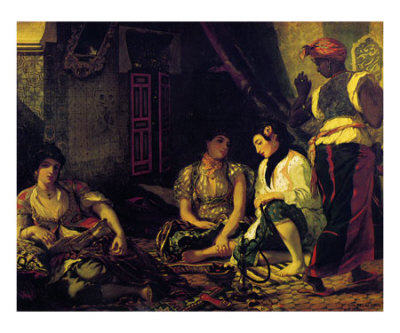
Ziem was a successful commercial artist of sixty-five when Vincent met him on the rue Lepic in 1886. He had traveled extensively over his long career (North Africa, Russia), but his primary destination, and eventually his artistic home, was Venice. His candy-colored, light-filled depictions of that city had become the foundation of his success. As a landscape painter, he had also been an active member of the Barbizon school in the 1850s and probably knew Millet -- one of many facets of his long life that would undoubtedly have been of interest to Vincent. Although primarily a landscape painter, Ziem also applied his virtuoso brush to vibrant, daring still-lifes -- images that bear a striking relationship to those of Manet, on the one hand, and to those of Vincent during his first year in Paris, on the other (e.g., Still Life with Mussels and Shrimps [F 256 JH 1169]). In Still Life with Bloaters (F 283 JH 1120) and Still Life with Bloaters (F 203 JH 1123), Vincent treats the scales of fish with the same iridescent light as Ziem famously applied to the Venetian lagoon. The elder painter must have been "courtly" as he had spent many of his travels accompanied by members of the European aristocracy.
Although Vincent attributes Monticelli's understanding of Delacroix color to Ziem, as well as to Diaz de la Peña (JLB 853, 2/9/1890 or 2/10/1890), it is not clear how well Ziem actually knew either Monticelli or Diaz. Very early in his career, Ziem had briefly shared a drawing class with Monticelli in Marseille. But soon thereafter, he left for Nice and then began decades of travel and never spent more than a part of each year in the rue Lepic apartment. They both visited the Barbizon in the 1850s (along with a cascade of other artists) and both lived primarily in Paris, apparently, between 1863 and 1870, when Monticelli returned to Marseille. There is no record of Ziem meeting or knowing Diaz personally. There are two possibilities: Vincent conflated these three names in his later recollections; or Ziem, who was undoubtedly a charming raconteur, inflated his personal connections with the other two artists in his conversations with Vincent.
Context:
JLB 853, 2/9/1890 or 2/10/1890: "… as far as I know there is no colourist who comes so straight and directly from Delacroix."
Context:
JLB 568, 8/18/1886: "He keeps replying: but I wanted to get this or that colour contrast into it. As if I gave a damn what he wanted to do!" (Emphasis in original.)
Because Vincent eventually painted at least two portraits of Reid (Portrait of Alexander Reid [F 270 JH 1207] and Portrait of the Art Dealer Alexander Reid [F 343 JH 1250]) and later, in Arles, fanatically self-identified with the Marseilles painter (JLB 670, 8/26/1888), some authorities (Jampoller) have assumed that Vincent persuaded both his brother and Reid to the merits of Monticelli. But this is clearly backwards. Reid disliked Vincent (see Chapter 26) and the suggestion that the sober Scotsman followed Vincent's volatile enthusiasm rather that Theo's knowledgeable judgment -- especially on commercial issues -- is untenable. It is far more likely that Vincent's enthusiasm was validated and reinforced by Theo's (and Reid's), not the other way around. And this analysis would not be altered by a finding that Reid, an amateur artist himself, met Vincent first during his brief experience at Cormon's studio or, perhaps, through Russell (Shoen, p. 445). It is possible, as Shoen argues, that Vincent first saw Monticelli's work during his earlier stay in Paris in 1874, 1875-76 (after the artist had left for Marseilles), but that would not alter the text's analysis that Vincent's enthusiasm for it was not ignited until a decade later when a number of vectors (Theo's sponsorship, Vincent's passion for Delacroix and anti-Impressionist contrarianism, the wider controversy over color, the artist's death, etc.) all intersected (ibid., p. 444).
Context:
JLB 600, 4/20/1888: "I'm increasingly doubtful about the truth of the legend of Monticelli's absorbing huge quantities of absinthe. When I think of his work it doesn't seem possible to me that a man who's jittery from drink could have done it."
Context:
JLB 568, 8/18/1886: "I have a pendant for that bouquet that you have with you, and also a branch of white lilies -- white, pink, green -- against black, in the spirit of black Japanese lacquer inlaid with mother-of-pearl that you know -- then a branch of orange tiger lilies on a blue ground."
Virtually every detail of this lavish re-telling can be dismissed or discounted. While there is a possibility (discussed in the next chapter) that Vincent became emotionally involved with the aging but still sensuous Segatori -- a woman fifteen to twenty years his senior but whose Italian warmth and flirtatious charms must have been a welcome contrast to his mother's northern iciness and disapproval, the initial arrangement was not based on amore in either direction. As the text discusses, Segatori was already showing art in her restaurant and Vincent had already proposed earning money by painting "theme" still-lifes for retailers and restauranteurs. The fit of buyer and seller was obvious. Once that fit was established, the next logical step was for the proprietess to pay the painter "in kind": i.e., with food and drink rather than cash. This is not to take sides in the subsequent controversy over ownership of the paintings. It would have been very much like Vincent to hang as many paintings as he could, regardless of the meals he took, subject only to available space and Segatori's tolerance. This would account for Bernard's report that Vincent "invaded the place ... with his passionate intransigence." However, it is surely Bernard's embellishment that Vincent had the power, either amorous or artistic, to "demand" an exhibition, and we know from other, more honest testimony, that far from drawing people to the restaurant with "their attractive and youthful feel," Vincent's work was more likely to frighten them away. (See Ch. 27, n. 391.)
Context:
JLB 626, 6/16/1888-6/20/1888: "Cornflowers with white chrysanthemums and a few marigolds. There you have a motif in blue and orange. Heliotrope and yellow roses, motif in lilac and yellow. Poppies or red geraniums in bold green leaves, motif in red and green. There you have basics that one can subdivide further, can elaborate, but enough to show you without a painting that there are colours that make each other shine." (Emphasis in original.)
Context:
JLB 569, September or October 1886: "Now after these gymnastics I lately did two heads which I dare say are better in light and colour than those I did before."
Context:
JLB 568, 8/18/1886: "I have ... a branch of orange tiger lilies on a blue ground, then a bouquet of dahlias."